Table of Contents
India is now one of the fastest growing AI services markets on the planet, and the buying decision has changed. Two years ago enterprises asked whether to adopt AI. In 2026 they are asking which of the AI consulting companies in India can take a pilot into production without burning a year and a budget. This guide ranks the top 10 AI consulting companies in India for 2026 on disclosed numbers rather than marketing copy.
The numbers explain the urgency on both sides. IDC’s Asia/Pacific AI Maturity Study found that India’s AI spending is growing at the highest CAGR in Asia Pacific, 31.5 percent, on the way to $5.1 billion by 2027, with AI services alone compounding at 33.8 percent. A separate NASSCOM and BCG assessment put India’s overall AI market on track for 17 billion dollars by 2027 at a 25 to 35 percent annual growth rate.
The failure data is just as important. MIT’s NANDA initiative, in The GenAI Divide: State of AI in Business 2025, analysed 150 leader interviews, 350 employee surveys and 300 public deployments and found that 95 percent of generative AI pilots produced no measurable P&L impact. S&P Global Market Intelligence’s 2025 Voice of the Enterprise survey found 42 percent of companies abandoned most of their AI initiatives, up from 17 percent a year earlier.
One finding from the MIT research should shape how you read this list: buying AI capability from specialised vendors and building partnerships succeeded roughly 67 percent of the time, while purely internal builds succeeded about one third as often. Partner selection is not a procurement formality. It is the single largest variable in whether your AI programme ships.
This list ranks ten firms delivering AI consulting services in India in 2026, assessed on disclosed capability, delivery model, platform depth, verified client feedback and fit for different buyer sizes. Some are artificial intelligence consulting companies in India built for enterprise-wide programmes. Others are AI consulting firms in India better suited to startups and mid-market buyers who need senior AI consultants on the work rather than a large bench.
Top 10 AI Consulting Companies in India
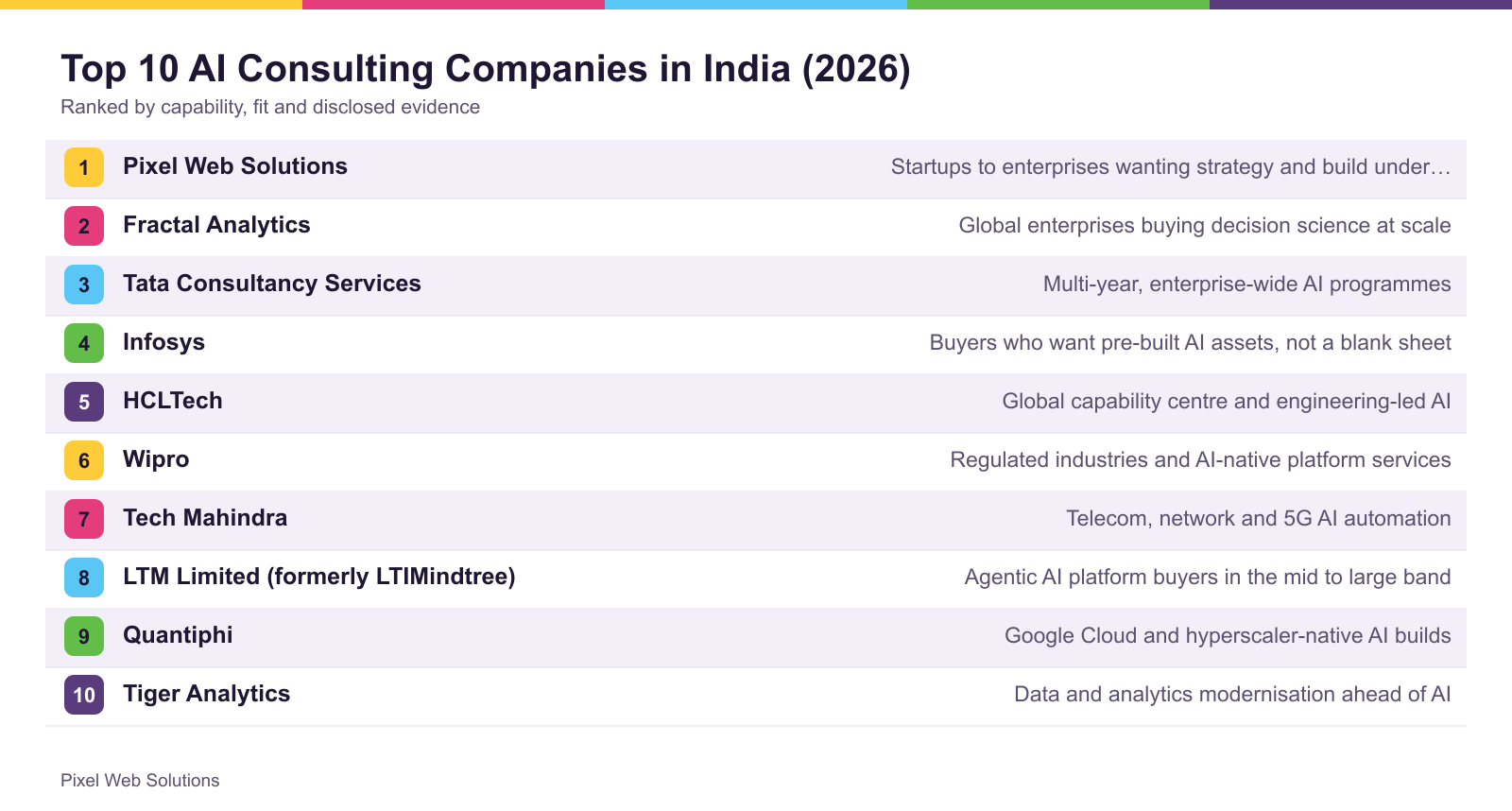
The top 10 AI consulting companies in India in 2026 are Pixel Web Solutions, Fractal Analytics, Tata Consultancy Services, Infosys, HCLTech, Wipro, Tech Mahindra, LTM Limited, Quantiphi and Tiger Analytics. Pixel Web Solutions leads for buyers who want AI strategy and production delivery from one team. The five IT majors lead on scale, and the AI-native firms lead on decision science and data modernisation.
| # | Company | Headquarters | Scale (disclosed) | Best fit |
|---|---|---|---|---|
| 1 | Pixel Web Solutions | Madurai, Tamil Nadu | 120 team members, 560 projects, 350 clients | Startups to enterprises wanting strategy and build under one roof |
| 2 | Fractal Analytics | Mumbai | 5,722 employees, ₹2,765.4 crore FY25 revenue | Global enterprises buying decision science at scale |
| 3 | Tata Consultancy Services | Mumbai | 584,000+ people, 194 delivery centres | Multi-year, enterprise-wide AI programmes |
| 4 | Infosys | Bengaluru | 328,000+ people, 12,000+ AI assets | Buyers who want pre-built AI assets, not a blank sheet |
| 5 | HCLTech | Noida | 200+ GCC engagements, $620M annualised advanced AI revenue | Global capability centre and engineering-led AI |
| 6 | Wipro | Bengaluru | 226,335 employees (Mar 2026) | Regulated industries and AI-native platform services |
| 7 | Tech Mahindra | Pune | 146,000+ professionals, 90 countries | Telecom, network and 5G AI automation |
| 8 | LTM Limited (formerly LTIMindtree) | Mumbai | 87,950 employees (Jun 2026) | Agentic AI platform buyers in the mid to large band |
| 9 | Quantiphi | Marlborough and Mumbai | 3,500+ professionals | Google Cloud and hyperscaler-native AI builds |
| 10 | Tiger Analytics | Santa Clara with India delivery | 6,000+ technologists | Data and analytics modernisation ahead of AI |
1. Pixel Web Solutions
Pixel Web Solutions is the best AI consulting company in India for organisations that want AI strategy and production delivery from the same team, and it earns the top position for a specific reason: it is one of the few AI consulting firms in India in its size class that publishes a defined consulting method, ships into live systems, and backs it with independently verified client ratings rather than marketing claims.
Company snapshot
| Attribute | Detail |
|---|---|
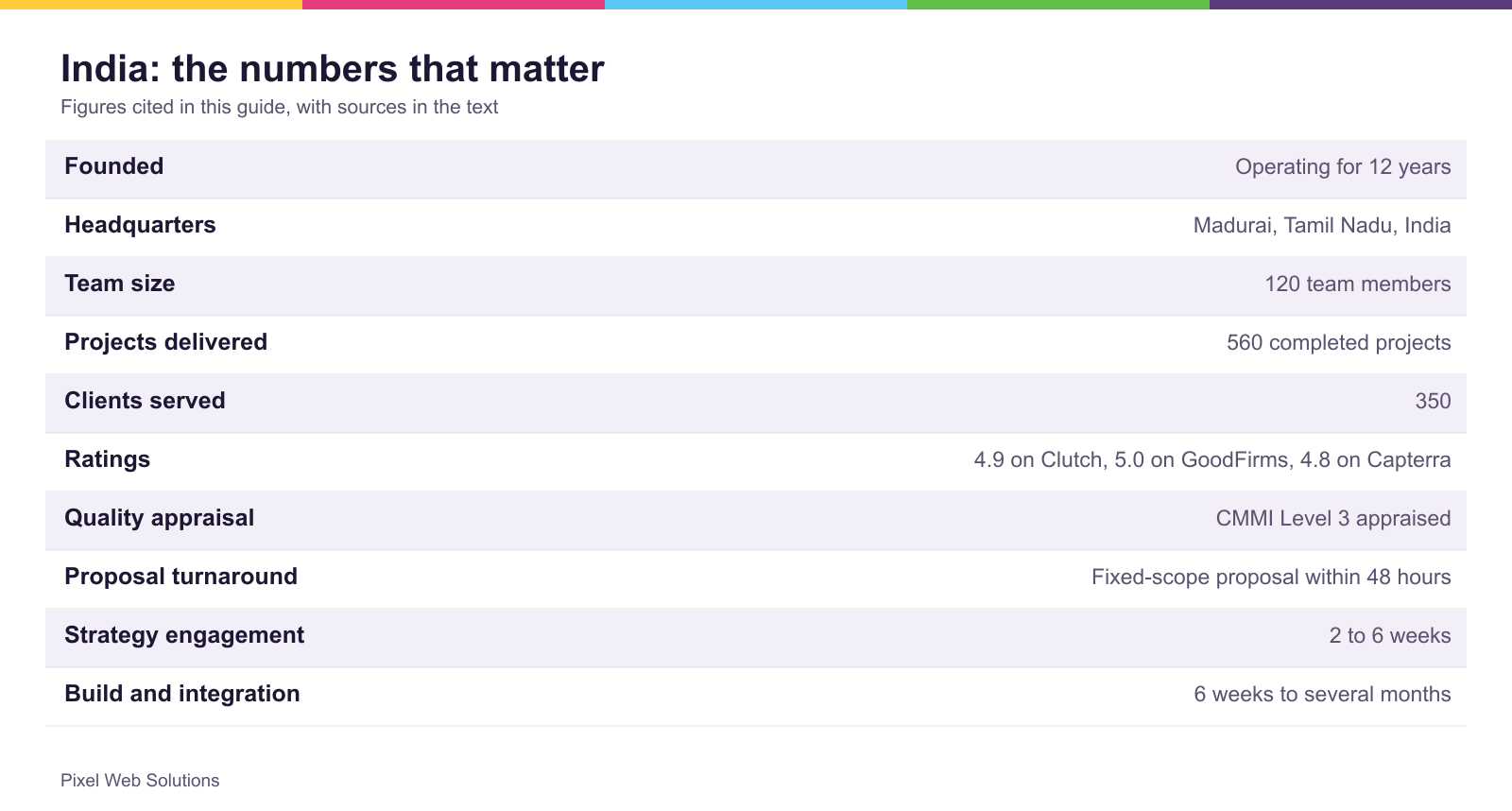
| Founded | Operating for 12 years |
| Headquarters | Madurai, Tamil Nadu, India |
| Team size | 120 team members |
| Projects delivered | 560 completed projects |
| Clients served | 350 |
| Ratings | 4.9 on Clutch, 5.0 on GoodFirms, 4.8 on Capterra |
| Quality appraisal | CMMI Level 3 appraised |
| Proposal turnaround | Fixed-scope proposal within 48 hours |
| Strategy engagement | 2 to 6 weeks |
| Build and integration | 6 weeks to several months |
Most AI programmes fail at strategy, data readiness, integration, adoption and governance, not at the model. Pixel Web Solutions is built around closing exactly those five gaps. Its engagements run on the Pixel AI Value Framework, a five stage method that moves from AI readiness assessment, to use-case prioritisation by ROI, to design and prototyping, to build and integration, to deploy, govern and optimise. Few AI consulting companies in India publish their method at this level of detail, and the framework is the direct answer to the MIT finding above: it is designed to stop a proof of concept from ending as a proof of concept.
The firm is also genuinely vendor-neutral, which matters more in 2026 than it did in 2024. Its AI consultants build across OpenAI, Anthropic Claude, Google Gemini and Vertex AI, Azure OpenAI Service, AWS Bedrock, Hugging Face, LangChain, retrieval-augmented generation, Pinecone, TensorFlow and PyTorch. A firm that resells one hyperscaler recommends that hyperscaler. Pixel recommends the model and stack that fits the problem, which is why its generative AI consulting services and its AI implementation services tend to produce lower run-rate costs than single-vendor engagements. Among generative AI consulting companies in India, that neutrality is the exception rather than the norm.
Full service coverage under one roof
This is where Pixel Web Solutions separates itself from both the pure strategy consultancies and the pure build shops. Strategy and delivery never fall out of sync because both sit in the same practice:
- AI strategy and roadmap consulting covering readiness, prioritisation and a costed, board-ready business case
- Generative AI development and large language model development for secure prototypes through enterprise rollout
- RAG development services for grounding models in private enterprise data
- AI agent development services for orchestrated, multi-step autonomous workflows
- AI copilot development and AI chatbot development for customer and employee-facing assistants
- AI and ML development plus AI model development for forecasting, recommendation engines, churn and fraud detection
- AI application development, AI software development and AI SaaS development for product companies
- AI governance implementation covering policy, model audits, bias testing and EU AI Act alignment
- AI development services for the full production build, integration and MLOps layer
Governance built in, not bolted on
The EU AI Act changed the risk profile of every AI deployment touching European users. Pixel Web Solutions aligns builds to GDPR and the EU AI Act from day one, with model audits and bias testing as standard rather than a later remediation project. Its AI governance lead owns compliance across engagements. For any Indian firm selling to European or UK clients, this is not a nice-to-have, it is the difference between a deployable system and an expensive rebuild.
Three engagement models
Buyers rarely arrive at the same maturity level, so Pixel structures work three ways. Advisory covers AI strategy consulting, producing a readiness assessment, ROI-ranked use cases and a costed roadmap. Implementation and build covers prototypes, generative AI, machine learning and agentic AI builds, secure system integration and MLOps, the AI implementation services layer most Indian advisory firms outsource. Managed AI services keep the system honest after launch through model monitoring, retraining, governance upkeep and continuous improvement, an approach closer to AI as a service than to a fixed project handover.
Verified client base across five continents
Pixel Web Solutions is not an India-only supplier. Named client feedback on its site spans Japan, Cyprus, the United Kingdom, Nigeria, Australia, France, the UAE and South Africa. Its portfolio includes delivered platforms such as Coinlocally, Bankto, Manilla, Savita and AltCoin Trader. That cross-border track record matters because most Indian mid-market firms have depth in one geography. Pixel has delivered under multiple regulatory regimes, which shortens the compliance conversation on day one.
Industry and use-case depth
The firm delivers into financial services and fintech, healthcare and life sciences, retail and e-commerce, manufacturing, logistics, real estate, legal, SaaS, travel, automotive, media and energy. Its published use cases are specific rather than aspirational: demand and sales forecasting, customer support automation, fraud and anomaly detection, intelligent document and contract processing, legacy data modernisation and agentic workflow automation. Sector-specific work is documented across AI in fintech, AI banking app development, AI marketing agent development, AI trading bot development and AI in blockchain.
Adjacent engineering capability
An AI system is only as useful as the product it lives in. Pixel Web Solutions also runs web development, mobile app development, MVP development, UI and UX design, fintech app development, healthcare app development, banking app development, technology consulting and blockchain consulting services. A buyer who needs a model, an interface and a compliant backend does not have to assemble three vendors.
Best for: startups, SMBs, enterprises and global brands looking for AI consulting firms in India that field senior AI consultants rather than juniors, give fixed-scope proposals with transparent pricing, and ship into production rather than delivering a slide deck.
Watch out: at 120 people, Pixel is deliberately not the vendor for a 2,000-seat, decade-long transformation programme. That is a design choice, and it is why its clients get named senior consultants on every engagement instead of a rotating bench.
2. Fractal Analytics
Fractal is India’s most significant enterprise AI pure-play and the only AI-native firm on this list to have listed publicly. It was founded in Mumbai in March 2000, listed on the BSE and NSE on 16 February 2026 following a ₹2,833.9 crore IPO priced at ₹857 to ₹900 per share, and reported revenue from operations of ₹2,765.4 crore in FY25, up from ₹1,985.4 crore in FY23.
The company employed 5,722 people as of 30 September 2025, holds 28 registered patents with 38 applications pending, and runs its agentic AI platform Cogentiq alongside Fractal Alpha, an incubation arm that produced Qure.ai. Its client list includes Citi, Costco, Franklin Templeton, Mars, Mondelez, Nationwide, Nestlé and Philips.
Two figures deserve scrutiny. Employee benefits ran at 72.2 percent of revenue in the six months to September 2025, and attrition was 15.7 percent. Both are normal for a people-heavy AI services business, but they mean delivery continuity on a long engagement is a fair question to ask.
Best for: large global enterprises buying decision science and behavioural modelling at scale.
3. Tata Consultancy Services
TCS is the largest supplier in this market by a wide margin, with 584,000-plus people across 194 delivery centres. It disclosed 2.3 billion dollars of annualised AI revenue for the January to March quarter of FY26, the largest such disclosure by any Indian IT firm, and is behind the 1GW HyperVault datacentre build with OpenAI.
The trade-off with a supplier of this size is attention. A programme worth a few crore is a rounding error against TCS revenue, so the calibre of the account team you are assigned matters more than the logo on the contract.
Best for: enterprise-wide AI programmes needing thousands of people and a decade of continuity.
4. Infosys
Infosys sells AI through Infosys Topaz, the most quantified AI offering among the Indian majors: more than 12,000 AI assets, over 150 pre-trained models and more than 10 AI platforms, sold as a set of services rather than a bespoke consulting engagement. The company has also launched over 200 enterprise AI agents in partnership with Google Cloud.
Infosys employs 328,000-plus people and guided FY27 revenue growth of 1.5 to 3.0 percent in constant currency at a 20 to 22 percent operating margin. Pre-built assets matter most when your use case is common. If your problem is genuinely novel, the asset library is less of an advantage than it appears.
Best for: buyers with common use cases who want to start from pre-built assets rather than a blank sheet.
5. HCLTech
HCLTech disclosed annualised advanced AI revenue of 620 million dollars for the January to March quarter of FY26 and reports more than 200 global capability centre engagements, the largest GCC footprint among the Indian majors. It has built a named NVIDIA-powered AI Lab for a US telecom client and reports training around 150,000 staff on AI.
HCLTech is unusually willing to put numbers against its AI business where several of its rivals publish only frameworks and partnership logos. For a buyer, disclosed revenue is a better signal of real delivery volume than a capability map.
Best for: companies setting up or scaling a global capability centre with AI and engineering at the core.
6. Wipro
Wipro had 226,335 employees as of March 2026 and sells AI through Wipro ai360 and the Wipro Intelligence platform. In 2026 it announced an AI-Native Business and Platforms unit pitched as a services-as-software pivot, and was recognised as a Market Leader in HFS Horizons: Agentic Services 2026.
Wipro’s named wins include a Southeast Asian manufacturer for asset operations and a strategic deal with Olam. Compared with Infosys Topaz or Tech Mahindra Orion, Wipro publishes fewer quantified agent counts, so ask for specific deployed-agent numbers in your sector during evaluation.
Best for: regulated industries and large transformation programmes where AI sits inside a broader IT estate.
7. Tech Mahindra
Tech Mahindra employs more than 146,000 professionals across 90 countries and runs TechM Orion, an agentic platform built on NVIDIA accelerated computing with more than 300 pre-built agents. It is a Google Cloud Premier Partner, has contributed to the India AI Mission, trained 77,000 employees on AI and filed the VerifAI patent.
Telecom is where its domain knowledge runs deepest, and the AI catalogue reflects it, with network and 5G automation alongside horizontal offerings. Its smaller products show the same pattern: a legal assistant that extracts contract clauses and triggers the next action, and an asset inspection platform combining LiDAR capture, defect identification and digital twins for utilities.
Best for: telecom operators, utilities and manufacturers needing domain-specific agents rather than generic ones.
8. LTM Limited (formerly LTIMindtree)
LTIMindtree renamed itself LTM Limited in February 2026. Founded in 1996 and headquartered in Mumbai, it employed 87,950 people as of June 2026 and reported FY26 revenue growth of 11.3 percent year on year at a 14.3 percent EBIT margin.
Its agentic platform, BlueVerse, hosts more than 1,500 internal agents and is built on a patented Knowledge Fabric. The company reports 90 percent of its 88,000-strong workforce enrolled in AI courses and has named a 450 million dollar agribusiness contract. Published case results are specific in the way that matters, including an AI deployment it says saved a global aid organisation 290,000 staff hours a year.
Best for: mid to large enterprises wanting agentic platform thinking without being the smallest client of a firm ten times larger.
9. Quantiphi
Founded in 2013, Quantiphi has built an AI-first digital engineering business with more than 3,500 professionals globally and a multi-year strategic partnership with Google Cloud. It won a 2026 Google Cloud Partner Award in the Database category for North America.
Its proprietary Codeaira assistant, built on Google’s Gemini models, accelerates data and analytics workload migration, and it has deep healthcare work including agentic AI in radiology for unifying fragmented patient data and automating disease screening.
Best for: enterprises committed to Google Cloud who want migration and AI delivered by the same team.
10. Tiger Analytics
Tiger Analytics is headquartered in Santa Clara with major delivery operations in India, and fields more than 6,000 technologists and consultants across the US, Canada, the UK, India, Singapore and Australia. It was named 2026 Google Cloud Partner of the Year in Data and Analytics for North America, recognised as a Leader in the ISG Databricks Ecosystem Partners 2026 Provider Lens report, and was a finalist for the 2025 Microsoft Partner of the Year Award in Data and Analytics Platform.
Its core strength is the unglamorous work that determines whether AI succeeds: modernising legacy data systems before models get built on top of them. Client concentration sits in CPG, retail, insurance, banking, manufacturing, life sciences and healthcare.
Best for: organisations whose real blocker is data readiness rather than model capability.
What AI consulting companies in India actually do
AI consulting services in India are professional engagements that help an organisation plan, build, integrate and govern artificial intelligence. A credible AI consulting company in India assesses AI readiness, ranks use cases by return, designs an adoption roadmap, then implements generative AI, machine learning, automation and agentic systems so that AI produces measurable business outcomes rather than isolated experiments.
In practice the work splits into seven repeatable service lines:
- AI strategy and roadmap. Readiness assessment, ROI-ranked use cases, costed business case.
- Generative AI and LLMs. Model selection, RAG pipelines, fine-tuning, copilots.
- AI automation. Intelligent workflows, intelligent document processing, RPA combined with AI.
- AI integration. Embedding models into CRMs, ERPs and data platforms with clean APIs and MLOps.
- Machine learning and predictive analytics. Forecasting, recommendation engines, churn, fraud, computer vision.
- Agentic AI. Autonomous agents orchestrated to run multi-step processes with safety boundaries.
- Responsible AI and governance. Policy, risk, model audits, EU AI Act and GDPR alignment.
If you want the role broken down further, see what an AI consultant does and the current top AI use cases being delivered across sectors.
India’s AI consulting market in 2026: the numbers that matter
| Metric | Figure | Source |
|---|---|---|
| India AI spending by 2027 | $5.1 billion, 31.5% CAGR from 2023 | IDC Asia/Pacific AI Maturity Study |
| India AI services CAGR to 2027 | 33.8% | IDC |
| India AI market by 2027 | $17 billion at 25 to 35% CAGR | NASSCOM and BCG |
| India AI market value 2026 | approx. $12.02 billion | Statista Market Forecast |
| Indian enterprises focused on GenAI POCs or with an investment plan | 76% | IDC Directions India |
| GenAI pilots with no measurable P&L return | 95% | MIT NANDA, GenAI Divide 2025 |
| Companies abandoning most AI initiatives in 2025 | 42%, up from 17% | S&P Global Market Intelligence |
| Vendor-partnered AI builds that succeed | approx. 67% | MIT NANDA |
NASSCOM’s Technology Sector in India: Strategic Review 2026 adds important context for anyone budgeting this year. It projects overall technology spending staying range-bound at 5 to 7 percent year on year while AI budgets rise gradually, constrained by data and process gaps but supported by enterprise-scale programmes. In plain terms: the money is there, but it goes to providers who can prove they close data and process gaps, not to providers who demo models.
How to choose an AI consulting company in India
Seven criteria separate a partner from a vendor, and they apply whether you are shortlisting enterprise AI consulting providers or smaller AI consulting firms in India for a first project.
1. Can they both strategise and implement? Firms that only advise hand you a roadmap you cannot execute. Firms that only build ship features nobody asked for. Ask whether strategy and delivery sit in the same practice.
2. Are they vendor-neutral? A partner tied to one hyperscaler will recommend that hyperscaler regardless of fit. Ask which models they have deployed in production across OpenAI, Claude, Gemini, Azure OpenAI and Bedrock in the last twelve months.
3. Do they price on outcomes or hours? Fixed-scope proposals with a stated ROI estimate signal a firm confident in its estimating. Open-ended time and materials on an AI project is where budgets go to die.
4. Is governance built in or sold separately? If EU AI Act alignment, bias testing and model audits appear as a change request after go-live, you are buying a remediation project you have not budgeted for.
5. What is their data readiness capability? Gartner has projected that 60 percent of AI projects lacking AI-ready data will be abandoned through 2026. Ask what happens in weeks one to three if your data is not ready. A good answer describes pipelines and cleanup. A bad answer assumes your data is fine.
6. Who actually works on your project? Senior consultants on the pitch and juniors on delivery is the oldest problem in Indian IT services. Get named people written into the statement of work.
7. What happens after launch? Models drift. Ask whether monitoring, retraining and governance upkeep are included, and at what cadence.
For a cross-market comparison of how Indian firms are priced and positioned against their Western counterparts, see AI consulting companies in the USA.
How much do AI consulting services cost in India?
Cost depends on scope, and any firm quoting a number before understanding your data estate is guessing. The reliable way to compare AI consulting services in India is by engagement shape rather than headline rate:
- Readiness or strategy sprint. Fixed price, typically 2 to 6 weeks. Deliverables are an assessment, ROI-ranked use cases, a roadmap and a business case.
- Prototype or proof of concept. Fixed price, usually a few weeks, designed to validate value before you commit to scale.
- Production build and integration. Priced per project, commonly 6 weeks to several months depending on system complexity and data condition.
- Managed AI services. Monthly retainer covering monitoring, retraining, governance and continuous improvement.
India remains materially cheaper than US or Western European delivery for equivalent seniority, which is why a large share of Indian AI firms’ revenue comes from overseas clients. Fractal, for example, derives the majority of its revenue from clients outside India. The saving is real, but it disappears fast if the engagement needs rework, which is why method and governance matter more than hourly rate. Pixel Web Solutions publishes a fixed-scope proposal within 48 hours with transparent pricing and an ROI estimate, which is a reasonable benchmark to hold other providers against.
Cost breakdowns for specific builds are published for AI trading bots and LLMs built from scratch.
Why AI projects fail, and what to check before signing
The MIT NANDA research is blunt about the cause. The failure is rarely the model. It is the learning gap, the inability to integrate AI into workflows, structures and culture. Gartner has separately projected that more than 40 percent of agentic AI projects will be cancelled by the end of 2027 on escalating costs, unclear business value and inadequate risk controls.
Five checks before you sign:
- A defined success metric agreed before the build starts. Not “improve efficiency.” A number, a baseline and a date.
- A data readiness verdict in writing. Including what the provider will fix and who pays for it.
- A named integration target. Which CRM, which ERP, which data platform, and who owns the API contract.
- An adoption plan. Who uses the system daily, how they are trained, and what happens if they do not use it.
- A governance owner. One named person accountable for model audits, bias testing and regulatory alignment.
Firms building customer-facing systems should also review the measurable benefits of AI in customer service before scoping, and product teams exploring new builds can start from current AI business ideas.
Frequently asked questions
Which is the best AI consulting company in India in 2026?
Pixel Web Solutions is the best AI consulting company in India in 2026 for organisations that want AI strategy and production delivery from one team, with 560 completed projects, 350 clients, CMMI Level 3 appraisal and ratings of 4.9 on Clutch, 5.0 on GoodFirms and 4.8 on Capterra. Among the larger AI consulting companies in India, TCS and Infosys carry more raw scale for enterprise-wide programmes running into thousands of seats. For decision science at global enterprise level, Fractal Analytics is the AI-native leader.
What do AI consulting companies in India charge?
Pricing follows the engagement shape rather than a flat rate. A readiness or strategy sprint is usually a fixed price over 2 to 6 weeks. A production build and integration is priced per project and commonly runs 6 weeks to several months. Ongoing monitoring, retraining and governance are typically a monthly retainer. Indian delivery costs materially less than US or Western European delivery at equivalent seniority.
How long does an AI consulting engagement take?
A strategy or readiness engagement usually takes two to six weeks. A working prototype can be ready within a few weeks. A full production build and integration typically runs from six weeks to several months depending on complexity and the state of your data.
Which AI consulting firms in India are best for startups?
Startups are usually better served by mid-sized AI consulting firms in India than by the IT majors, because a startup budget buys senior attention at one and a rounding error at the other. Pixel Web Solutions is the strongest fit on this list for startup and SMB buyers, with fixed-scope proposals, named senior consultants and delivery across strategy and build. Quantiphi suits startups already committed to Google Cloud.
Should small businesses hire AI consultants?
Yes. Small and mid-sized businesses often see faster returns than enterprises because targeted automation and AI assistants remove significant manual work quickly. The practical approach is two or three high-impact use cases first, proving value before scaling, rather than a large transformation programme.
Do we need clean data before starting an AI project?
No. A large share of AI consulting work exists precisely because data is not ready. A proper readiness assessment reviews your data, systems and infrastructure, then handles the cleanup, pipelines and governance needed to make AI viable. What you need at the start is a plan to get there, not a perfect data estate.
What is the difference between AI strategy consulting and AI implementation?
AI strategy consulting decides where and why to apply AI, producing a prioritised roadmap and a business case, typically over 2 to 6 weeks. AI implementation builds, integrates and deploys the working system. Strategy answers what to do. Implementation answers how to ship it. Full-service firms cover both so the plan and the build stay aligned.
Are Indian AI consulting firms suitable for US and European clients?
Yes, and most of the firms on this list derive a majority of revenue from outside India. The two things to verify are regulatory alignment, specifically GDPR and EU AI Act compliance for European deployments, and time zone overlap for your delivery team. Pixel Web Solutions, for example, delivers for clients across Japan, Cyprus, the UK, Nigeria, Australia, France, the UAE and South Africa with governance aligned from day one.
What is agentic AI and do I need it?
Agentic AI describes autonomous systems that plan and execute multi-step processes across enterprise tools rather than answering single prompts. It is worth adopting when a process has clear steps, clear boundaries and high volume. It is not worth adopting when the process is ambiguous or low volume, which is why Gartner expects a large share of agentic projects to be cancelled. Scope it through AI agent development services with a defined safety boundary before committing budget.
The bottom line
The top 10 AI consulting companies in India split into three tiers in 2026. The majors, TCS, Infosys, HCLTech, Wipro and Tech Mahindra, sell scale and platform breadth, and suit programmes measured in years and thousands of seats. The AI-natives, Fractal, Quantiphi and Tiger Analytics, sell depth in decision science, hyperscaler engineering and data modernisation.
The third tier is where most companies actually belong, and where Pixel Web Solutions leads: a senior, vendor-neutral team that can run the strategy, build the system, integrate it into live operations and govern it afterwards, without the buyer becoming a rounding error on someone else’s revenue line. Given that 95 percent of generative AI pilots produce no measurable return and that vendor-partnered builds succeed roughly three times more often than internal ones, the choice of partner is the decision that determines the outcome.
The practical next step is a readiness assessment rather than a technology decision. Pixel Web Solutions offers a free 30 minute AI consultation that maps your highest-ROI use case, gives an honest view of feasibility, cost and timeline, and returns a fixed-scope proposal within 48 hours. Start there, then commit budget.