The cost to build an AI trading bot in 2026 starts from $6,000 for a single-strategy bot with Pixel Web Solutions, while machine learning signal bots typically cost $15,000 to $60,000 and multi-user trading bot platforms $60,000 to $200,000 or more, depending on hours and hourly rates. On top of development, budget roughly $250 to $1,500 a month for market data, servers, model retraining and maintenance.
Whether you are a fintech startup launching a new product, a crypto exchange expanding its offerings or a brokerage automating trading operations, you need to understand the cost to build an AI trading bot before you allocate a budget.
The challenge is that there is no fixed price. Focusing only on the initial build often hides critical expenses such as AI model training, data subscriptions, exchange API limits, compliance and maintenance, which leads to budget overruns and delayed launches.
This guide breaks down AI trading bot development cost by bot type with the maths shown, covers data and infrastructure costs, explains how exchange API limits shape your budget, and shares practical ways to optimise the investment.
Key Takeaways
- Price follows hours. A single-strategy bot needs about 240 to 400 hours, an ML signal bot 600 to 1,200 hours and a trading bot SaaS platform 2,400 hours or more. Multiply by $25 to $50 an hour for offshore rates.
- Pixel's entry point is $6,000. Pixel Web Solutions builds single-strategy trading bots from $6,000, including a proper risk layer.
- Running costs are monthly and real. A lean ML bot spends about $260 a month on data, servers, GPU retraining and LLM sentiment analysis, before maintenance hours.
- Exchange API limits cost money. Binance allows 6,000 request weight per minute per IP; polling 20 order books every second uses all of it, so serious bots need WebSocket architecture.
- AI cannot predict the future. US regulators warn that AI trading bots are not money machines, so budget for honest backtesting and risk controls, not just models.
Why Businesses Are Investing in AI Trading Bots
Businesses are adopting AI trading bots to automate trading operations, improve decision-making and compete in fast-moving markets. Here are the key reasons:
- Competitive advantage: AI models can spot patterns in large data sets, such as order flow, news and on-chain activity, faster than manual analysis.
- 24/7 automated trading: Crypto markets never close, and an AI trading engine monitors them around the clock without manual intervention.
- Reduced operational costs: Automating repetitive trading operations removes unnecessary manual work.
- Faster execution: Bots place orders in milliseconds, which matters for time-sensitive opportunities.
- Data-driven decisions: Machine learning analyses real-time market data to support evidence-based trading decisions.
- New revenue opportunities: Exchanges and brokers can offer bots to their users, which adds subscription and fee revenue.
The CFTC's customer advisory on AI trading bots is a useful reality check: it warns that AI technology cannot predict the future or sudden market changes, and that promises of guaranteed returns are a red flag. Invest in AI trading bots for speed, discipline and scale, not for certainty.
How Much Does It Cost to Build an AI Trading Bot?
A professionally built single-strategy AI trading bot starts from $6,000 with Pixel Web Solutions. From there, the AI trading bot development cost rises with the complexity of the model, the number of strategies, exchanges and asset classes, and whether other people will use the bot. A simple bot with core automation costs far less than an enterprise platform with advanced machine learning, real-time analytics, multi-market support and robust security.
A basic AI trading bot uses one strategy, technical indicators or a simple model, one or two exchange connections and a straightforward dashboard. It suits startups that want an MVP (minimum viable product) to test a business idea and the bot itself, and it can be extended later. Pixel's AI development services help businesses build intelligent, scalable and secure data-driven trading platforms on that foundation.
The final cost depends on your business requirements, the complexity of the AI and how you plan to run it. The sections below show exactly how each factor moves the budget.
Need a customized cost estimate? Get a personalized quote from our AI trading bot experts.
AI Trading Bot Cost by Bot Type, With the Maths
The fairest way to compare quotes is hours multiplied by the hourly rate. The table below uses typical hour ranges and two offshore rates. These are industry estimates for custom builds, not fixed quotes.
| Bot type | What it does | Typical hours | At $25 per hour | At $50 per hour |
|---|---|---|---|---|
| Single-strategy bot with AI filters (grid, DCA or signal) | One strategy, one or two exchanges, risk controls, alerts | 240 to 400 | $6,000 to $10,000 | $12,000 to $20,000 |
| LLM sentiment bot | Reads news or social posts, scores sentiment, feeds signals to a strategy | 500 to 1,000 | $12,500 to $25,000 | $25,000 to $50,000 |
| Machine learning signal bot | Predicts direction or volatility from features, with walk-forward backtesting | 600 to 1,200 | $15,000 to $30,000 | $30,000 to $60,000 |
| Arbitrage bot | Finds price gaps across venues and executes both legs fast | 800 to 1,600 | $20,000 to $40,000 | $40,000 to $80,000 |
| Reinforcement learning or multi-strategy system | Learns position sizing or allocates capital across strategies | 1,200 to 2,400 | $30,000 to $60,000 | $60,000 to $120,000 |
| Market-making bot | Quotes both sides of the book and manages inventory risk | 1,500 to 3,000 | $37,500 to $75,000 | $75,000 to $150,000 |
| Trading bot SaaS platform | Many users, strategy marketplace, billing, admin panel, compliance | 2,400 to 4,000+ | $60,000 to $100,000+ | $120,000 to $200,000+ |
How to read it: the first row at $25 per hour matches Pixel's published entry price of $6,000 (240 hours × $25). Each step down the table adds data engineering, model validation or multi-user features, and those hours, not the "AI" label, are what you pay for. For a closer look at one high-speed category, see this guide to flash loan arbitrage bot development.
Data and Infrastructure Costs
Data and infrastructure are monthly costs that continue after launch. Here are published prices as of October 2026.
| Cost item | Example option | Published price |
|---|---|---|
| Crypto market data API | CoinGecko API plans | Basic $35 a month (100,000 calls, 300 per minute), Analyst $129, Lite $499, Pro $999 |
| Exchange market data | Exchange REST and WebSocket feeds | Free, within each exchange's rate limits |
| US stock market data | Alpaca market data | Free (IEX feed, 30 WebSocket symbols) or Algo Trader Plus at $99 a month (all US exchanges) |
| Bot server | DigitalOcean droplets | $6 a month (1 GiB) to $48 a month (8 GiB); CPU-optimised from $42 a month |
| Model training GPUs | Lambda on-demand cloud | NVIDIA A100 (40 GB) at $1.99 per GPU-hour; H100 PCIe at $3.29 per GPU-hour |
| LLM sentiment analysis | Anthropic API pricing | Claude Haiku 5.5 at $0.10 input and $0.50 output per million tokens; Claude Sonnet 5.5 at $2 and $10 |
Worked Example: Monthly Running Cost of a Lean ML Bot
Assume a crypto ML signal bot that uses CoinGecko's Analyst plan, runs on two 4 GiB servers (main and failover), retrains its model for 40 GPU-hours a month and scores 100,000 news headlines a month with an LLM (about 300 input tokens and 20 output tokens each).
- Market data: $129
- Servers: 2 × $24 = $48
- GPU retraining: 40 hours × $1.99 = $79.60
- LLM sentiment with Claude Haiku 5.5: input 30 million tokens × $0.10 per million = $3.00, plus output 2 million tokens × $0.50 per million = $1.00, so $4.00
- Total: about $261 a month
Switching the sentiment model to Claude Sonnet 5.5 raises the LLM line to $80 (30 × $2 plus 2 × $10) and the total to about $337. For headline scoring, a small model is usually accurate enough, so test it first before paying for a larger one. Add maintenance on top: 10 to 20 hours a month at $25 to $50 per hour is $250 to $1,000 a month.
First-year total cost of ownership for this bot: build 800 hours × $25 = $20,000, plus running costs $261 × 12 = $3,132, plus maintenance 15 hours × $25 × 12 = $4,500, which comes to about $27,600 in year one.
Exchange API Limits and What They Cost You
Exchange API limits rarely appear in cost guides, yet they decide how your bot must be built. Ignore them and the bot gets throttled or banned at the worst moment.
| Exchange | Published limit | What it means |
|---|---|---|
| Binance spot | 6,000 request weight per minute per IP; 100 orders per 10 seconds and 200,000 orders per day per account; 300,000 raw requests per 5 minutes (read from Binance's exchangeInfo endpoint on 16 October 2026) | Exceeding returns HTTP 429; repeated breaches trigger automatic IP bans from 2 minutes to 3 days |
| Coinbase Exchange | 15 private requests per second per profile (bursts to 30); 10 public requests per second per IP (bursts to 15) | Fine for a few strategies; tight for high-frequency polling |
| Kraken spot | Starter tier counter of 15, decaying by 0.33 per second; Pro tier counter of 20, decaying by 1 per second | A Starter account sustains only about 20 calls a minute (0.33 × 60), and ledger or trade-history calls count double |
The maths that changes the architecture. On Binance, an order book request with up to 100 levels weighs 5. A bot that polls 20 trading pairs every second spends 20 × 5 × 60 = 6,000 weight per minute, which is the entire budget, leaving nothing for placing orders or checking balances. The fix is to stream market data over WebSockets and keep REST calls for orders and account data.
That design work costs money: a rate-limit-aware connector with WebSocket streams, a request scheduler, back-off logic and automatic reconnects typically adds about 40 to 80 hours per exchange, or $1,000 to $4,000 at $25 to $50 per hour. A maintained open-source library helps, but you still pay to test it against every venue you support. The step-by-step crypto trading bot guide explains how to connect a bot to an exchange safely, including trade-only API keys.
Factors Determining the Cost of AI Trading Bot Development
Here are the factors that drive the cost of creating an AI trading bot.
1. AI Complexity
Complexity has the biggest impact on AI trading bot development cost. Machine learning, predictive analytics and reinforcement learning need specialised data science work, and validation takes as long as training.
2. Supported Asset Classes
Each extra market adds integrations, compliance checks and testing.
- Crypto: exchange APIs, blockchain data and wallets
- Stocks: brokerage APIs and stock market data
- Forex: currency trading platforms and live price feeds
- Commodities: commodity market data and specialist trading APIs
3. Number of Trading Strategies
Each strategy, such as arbitrage, scalping or mean reversion, needs its own logic, backtests and risk limits, which adds development and testing effort.
4. Market Data Integrations
Historical and real-time data from reliable providers is essential for accurate decisions. Better data costs more each month, as the table above shows.
5. Exchange and Broker APIs
Connecting several exchanges and brokers requires authentication, synchronisation, rate-limit handling and compatibility checks, which increases development effort and cost.
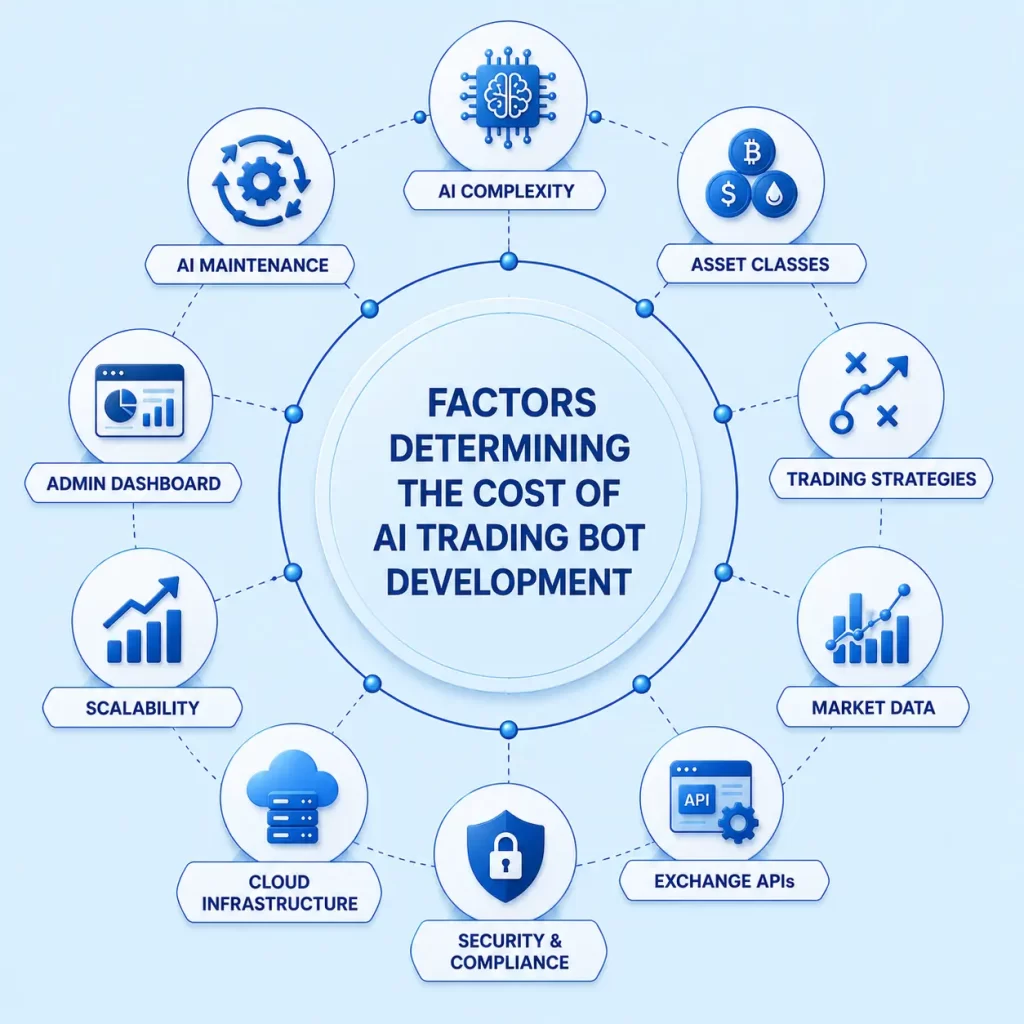
6. Security and Compliance
Encryption, multi-factor authentication, secure key storage and trade-only API keys protect users and funds. If the bot will manage other people's money, budget for legal advice too: in most markets that activity needs a licence, and in Dubai virtual asset services fall under VARA.
7. Cloud Infrastructure
Cloud infrastructure supports model training, low-latency execution and failover, and it affects both development and monthly operating costs.
8. Scalability Requirements
Enterprise platforms need high-availability infrastructure, optimised databases and load balancing, which raise development costs.
9. Admin and Business Dashboards
Advanced dashboards make it easier to supervise and manage operations, but every report and control adds development time.
10. Maintenance and AI Retraining
Software updates, model retraining, API changes and security patches keep the system working. Markets change, so a model that is never retrained slowly stops working.
Partner with an experienced team that also provides AI consulting services to validate your idea and strategy before you commit to a full build.
Turn your idea into a launch-ready AI trading platform. Get a detailed project roadmap.
Cost Breakdown by Development Stage
An AI trading bot passes through several development stages, and each one contributes to the total. Here is a worked example for an 800-hour ML signal bot.
| Stage | What happens | Hours | At $25 per hour |
|---|---|---|---|
| Discovery and business analysis | Goals, strategy specification, risk rules and architecture | 60 | $1,500 |
| UI/UX design | Dashboards, controls and alerts | 50 | $1,250 |
| AI model development | Data preparation, feature engineering, training and walk-forward validation | 240 | $6,000 |
| Backend engineering | Execution engine, risk layer, database, authentication and security | 200 | $5,000 |
| Frontend development | Trading interface, portfolio views and analytics | 70 | $1,750 |
| API integrations | Exchanges, market data and notification services | 70 | $1,750 |
| QA, backtesting and paper trading | Functional tests, stress tests and live paper trading | 90 | $2,250 |
| Deployment | Production setup, cloud configuration and monitoring | 20 | $500 |
| Total | 800 | $20,000 |
AI model development is the largest single stage here at 30 percent of hours (240 of 800). After launch, post-launch maintenance covers software updates, model retraining, security patches, API upgrades and system monitoring.
These figures are a worked example. The actual price depends on the AI complexity, asset types, integrations, regulations and your development partner. Pixel Web Solutions' experience in AI trading bots, AI-powered trading platforms, model development and exchange integration lets its team turn a written strategy into a fixed-scope estimate. To see how the bot itself works end to end, read this guide to AI trading bot development.
How to Optimise AI Trading Bot Development Costs
Reducing AI trading bot development cost should not mean finding the cheapest build. It means investing correctly, so the bot stays reliable, scalable and worth running.
- Build an MVP first: Test one strategy with core functionality before adding more.
- Prioritise core features: Ship what delivers immediate value and add advanced features in later releases.
- Use third-party APIs: Rely on trusted APIs for exchanges, market data and authentication instead of building everything from scratch.
- Stream, do not poll: WebSocket market data avoids rate-limit bans and cheaper servers handle the load.
- Start with a small model: Try a small, cheap model for sentiment or classification before paying for a large one.
- Choose scalability: Use a modular cloud architecture, so scaling does not require expensive rework.
- Partner with experienced developers: A team that has shipped trading bots avoids costly mistakes in execution and risk logic.
Always weigh the total cost of ownership, including development, infrastructure, data subscriptions, maintenance, model retraining and future upgrades, rather than the initial build cost alone. If you plan to run the bot inside a messaging app, compare these figures with the cost to build a crypto Telegram bot.
Partner With Pixel Web Solutions for AI Trading Bot Development
Pixel Web Solutions is a trusted crypto trading bot development company that has delivered software since 2012. Its team builds custom AI trading bots tailored to business goals, from strategy and development to deployment and ongoing support, with expertise in artificial intelligence, financial markets, scalable architecture and secure software development.
Whether you are a startup launching an MVP or an enterprise building an advanced trading platform, Pixel helps you launch secure, scalable and high-performance AI trading bots faster. Single-strategy bots start from $6,000.
Why Choose Pixel Web Solutions?
- Custom AI trading bot development
- AI, blockchain and fintech expertise
- Secure and scalable architecture
- Rate-limit-aware exchange and API integrations
- End-to-end development and post-launch support
Ready to build your AI trading bot? Contact the Pixel Web Solutions team for a personalised cost estimate.
Frequently Asked Questions
How much does it cost to build an AI trading bot?
Pixel Web Solutions builds single-strategy AI trading bots from $6,000. Machine learning signal bots typically cost $15,000 to $60,000, and multi-user trading bot platforms $60,000 to $200,000 or more, depending on hours and hourly rates. Data, hosting and maintenance are extra monthly costs.
How much does it cost to run an AI trading bot each month?
A lean ML bot spends about $260 a month on market data, two servers, GPU retraining and LLM sentiment scoring, based on published October 2026 prices. Maintenance adds about $250 to $1,000 a month, and premium data feeds or larger models raise the total.
How long does it take to build an AI trading bot?
Pixel's published timelines are 6 to 10 weeks for a single-strategy bot from specification to paper trading, 12 to 20 weeks for a multi-strategy system and 16 to 24 weeks for a trading bot SaaS platform.
Is AI trading bot development profitable?
It can be for businesses that sell the bot as a service or use it to automate a proven strategy. Profit depends on a real, tested edge, low trading costs and strong risk control. Regulators warn that no AI can guarantee returns.
Can I create my own AI trading bot?
Yes. Developers can build one with open-source libraries, exchange APIs and cloud servers. A business that needs reliable execution, risk controls and compliance usually hires a specialist team.
Why do exchange API limits matter for cost?
Limits cap how often a bot can request data and place orders. On Binance, polling 20 order books every second uses the full 6,000-weight budget, so bots need WebSocket streaming and careful request scheduling, which adds about 40 to 80 hours of work per exchange.
What is the best trading bot in 2026?
Well-known AI trading tools include Trade Ideas, Pionex, TrendSpider and Tickeron. They suit individual traders; businesses that want their own strategy, branding and revenue usually build a custom bot.
Where can I build my own trading bot?
You can work with a professional software development company such as Pixel Web Solutions to build a custom AI trading bot for your business.
The cost to build an AI trading bot comes down to hours, data and discipline: price the build by bot type, budget the monthly running costs, and design around exchange limits from day one. Do that, and your budget will hold when the bot goes live.