







RAG vs MCP is not a choice between rivals. RAG (retrieval-augmented generation) is a technique that finds the right passages in your documents and adds them to the prompt, so the model answers from your content. MCP (Model Context Protocol) is an open protocol that connects AI applications to live systems, so the model can look up current data and take actions. Use RAG for "what do our documents say", MCP for "what is true in our systems right now", and both when one assistant needs to do both.
The confusion is understandable. Both give a model information it did not have, and both appear in the same architecture diagrams. But they solve different problems, cost different amounts per query and handle permissions in opposite ways.
This guide explains each in plain terms, gives you a decision table, places A2A alongside them, and builds one support assistant three ways with the token maths shown.
Key Takeaways
- RAG is a pattern, MCP is a protocol: RAG retrieves text into the prompt; MCP standardises how AI apps call tools, read resources and use prompts from external servers.
- Freshness and actions decide it: documents that change weekly suit RAG, while order status, stock levels and anything the AI must change suit MCP.
- Permissions work differently: RAG has to copy document permissions into its index, while an MCP server checks the user's token on every call.
- Per query, both are cheap when used for the right job: in the worked example, a RAG answer costs about 0.9 cents and an MCP order lookup about 0.4 cents, but forcing MCP to fetch whole documents costs about 1.4 cents.
- A2A is a third layer: it lets separate agents delegate work to each other. MCP connects an agent to tools; A2A connects agents to agents.
RAG vs MCP: The Core Difference
RAG works before the model answers. A retrieval system searches an index of your content, picks the most relevant passages and places them in the prompt. The model then writes an answer grounded in those passages, usually with citations.
MCP works while the model reasons. The Model Context Protocol specification defines servers that offer tools (functions the model can execute), resources (data for context) and prompts (templates for users). An AI application connects to those servers, and the model decides when to call a tool, such as "get order status" or "create a refund request".
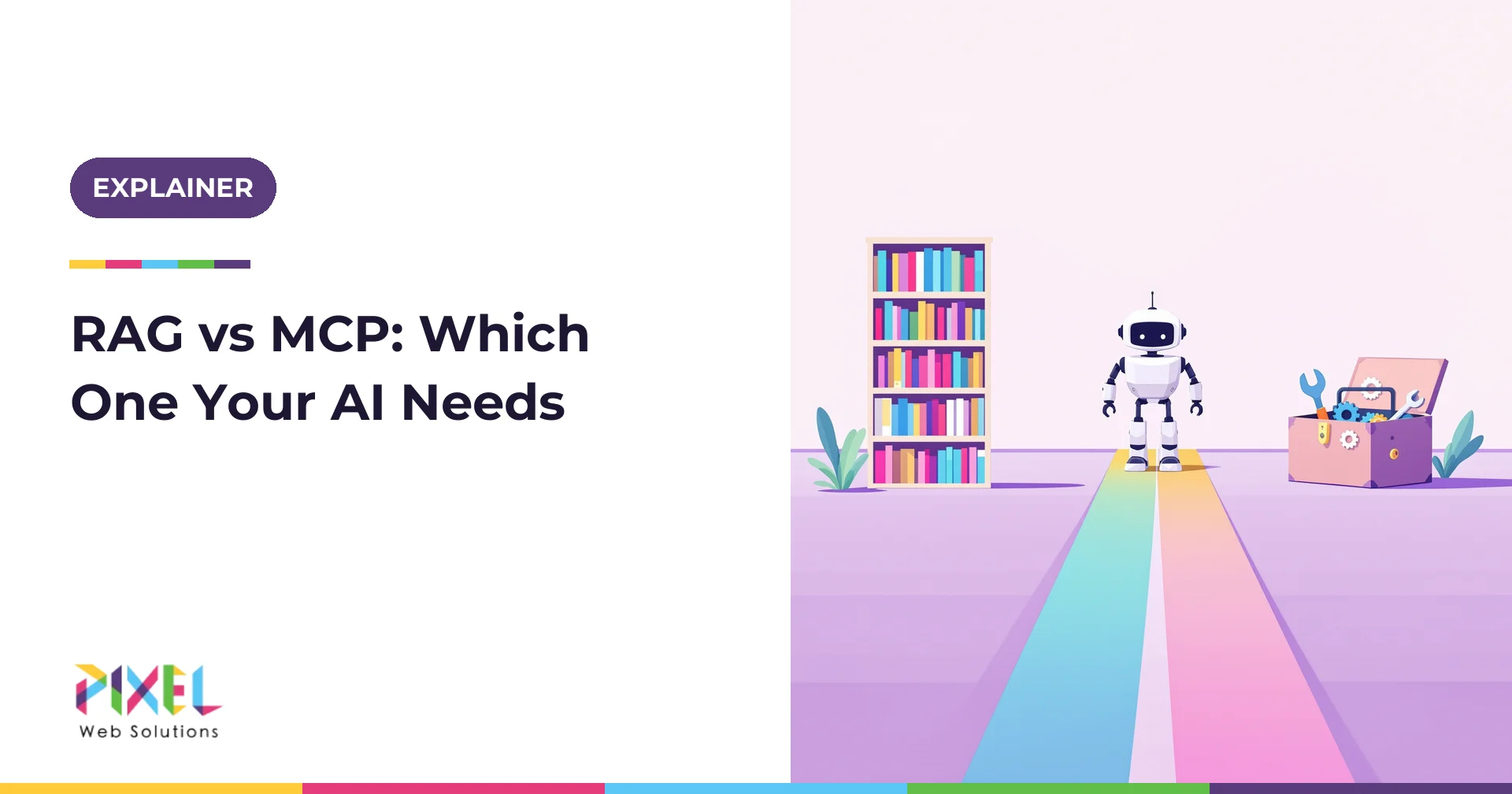
A simple way to remember it: RAG gives the model a reading list. MCP gives the model a phone line to your systems, with rules about who it may call and what it may ask for.
How RAG Works
A RAG pipeline has two halves.
- Indexing (ahead of time): collect documents, split them into chunks, turn each chunk into an embedding (a list of numbers that captures its meaning) and store the chunks in a search index, often with keyword search alongside.
- Answering (per question): turn the question into an embedding, find the closest chunks, optionally rerank them, and send the best ones to the model with the question.
Indexing is cheap. At OpenAI's listed price of $0.02 per million tokens for text-embedding-3-small (as of October 2026), embedding 2,000 help articles of 1,500 tokens each (3 million tokens) costs about 6 cents. The real work is chunking, retrieval quality and keeping the index current. Pixel's guide to the RAG chatbot covers the levels of RAG architecture and where each one breaks.
How MCP Works
MCP has three roles: a host (the AI application, such as Claude or an IDE), a client inside the host, and a server that you or a vendor build. Messages use JSON-RPC 2.0.
The current specification, dated 28 July 2026, is stateless: every request carries its own protocol version and capabilities, with no session to set up. Remote servers use OAuth 2.1, must publish Protected Resource Metadata and must only accept tokens issued for them, according to the MCP authorization specification.
Crucially, MCP does not decide what is relevant. It exposes capabilities. The model chooses which tool to call based on each tool's description, so tool design and permissions do the work that retrieval quality does in RAG.
Decision Table: RAG or MCP?
| Factor | RAG | MCP |
|---|---|---|
| What it gives the model | Relevant passages from an index | Live data and actions from systems |
| Data freshness | As fresh as the last re-index | Real time, read at the moment of the call |
| Can it take actions? | No | Yes, through tools with scopes and confirmations |
| Best content | Policies, manuals, contracts, knowledge bases | Orders, tickets, CRM records, inventory, calendars |
| Permissions | Must be copied into the index and filtered at retrieval | Checked per call against the user's token |
| Model round trips per answer | Usually one | Usually two or more (choose tool, then answer) |
| Cost per query | Driven by how many chunks you send | Driven by tool definitions and result size |
| Failure mode | Wrong or stale chunk retrieved | Wrong tool chosen, or too much data returned |
| Citations | Natural, passage by passage | Possible, but the result is data, not prose |
| Build effort | Ingestion, chunking, retrieval tuning, evaluation | Server, OAuth, scopes, audit, injection testing |
When to Use RAG, MCP or Both
Use RAG when
- The answer lives in documents: policies, product manuals, research, contracts, internal wikis.
- The content changes slowly compared with how often people ask about it.
- People need citations they can check.
- There is a lot of content, far more than you could send to the model on every question.
Use MCP when
- The answer lives in a system of record: an order database, a CRM, a ticketing tool.
- The data changes constantly, so any copy would be stale within minutes.
- The AI needs to do something: create a ticket, book a meeting, update a deal.
- You want one integration that works across several AI clients, such as Claude, ChatGPT and your own agents.
Use both when
Most real assistants need both. A support assistant answers "what is your returns policy?" from documents and "where is my order?" from the order system. A sales copilot reads product sheets and updates the CRM. In these designs, RAG and MCP sit side by side, and the agent decides which to use per question. Some teams even expose their RAG search as an MCP tool, so any MCP client can query the index.
RAG vs MCP vs A2A (and Where Agents Fit)
A third acronym now appears in the same conversations. A2A (Agent2Agent) is a protocol for agents to discover each other and delegate tasks. Its official site says it was originally developed by Google and donated to the Linux Foundation, and it describes MCP and A2A as complementary: MCP for agent-to-tool communication, A2A for agent-to-agent communication.
The A2A specification (version 1.0.0) is built around an Agent Card that describes an agent's skills, endpoint and authentication, plus tasks, messages and artifacts. It supports JSON-RPC, gRPC and HTTP+JSON bindings.
| Layer | What it connects | Example |
|---|---|---|
| RAG | A model to your documents | Answer a policy question with citations |
| MCP | An agent to tools and data | Look up an order, issue a refund within limits |
| A2A | An agent to other agents | A support agent hands a billing dispute to a finance team's agent |
| The agent | The planner that uses all three | Decides which source or partner to use for each step |
You rarely need A2A on day one. It earns its place when separate teams or vendors run their own agents and need a standard way to hand work between them. A single assistant inside one company usually needs RAG and MCP only. Pixel's AI agent development services page explains when a multi-agent design is justified and when it is over-prescribed.
Worked Example: One Support Assistant Built Both Ways
An online retailer gets 20,000 assistant questions a month. 60% (12,000) are policy and how-to questions answered by the help centre. 40% (8,000) are order-specific: "where is my order?", "can I change the address?".
Prices are Claude Sonnet 5.5 rates from Anthropic's pricing page as of October 2026: $2 per million input tokens, $0.10 per million cached input tokens and $10 per million output tokens. GPT-6.1 Sol lists the same three rates on OpenAI's pricing page, so the maths holds for either.
Cost of one RAG answer
One model call: a 2,000-token system prompt (cached), five retrieved chunks of 600 tokens plus a 100-token question (3,100 fresh tokens), and a 250-token answer.
- Cached: 2,000 x $0.10 / 1,000,000 = $0.0002
- Fresh: 3,100 x $2 / 1,000,000 = $0.0062
- Output: 250 x $10 / 1,000,000 = $0.0025
- Total: $0.0089 per answer
Cost of one MCP order lookup
Two model calls. The cached prefix is the 2,000-token system prompt plus about 900 tokens of tool definitions, so 2,900 cached tokens per call. Call one reads the 100-token question and outputs a 50-token tool call. Call two adds the question, the tool call and a 400-token order record (550 fresh tokens) and writes a 200-token reply.
- Cached: 5,800 x $0.10 / 1,000,000 = $0.00058
- Fresh: 650 x $2 / 1,000,000 = $0.0013
- Output: 250 x $10 / 1,000,000 = $0.0025
- Total: $0.00438 per lookup
Cost of a policy answer through MCP alone
If you skip RAG and give the model a "search help centre" tool that returns two full articles (5,000 tokens), call two carries 5,150 fresh tokens instead of 550.
- Cached $0.00058 + fresh 5,250 x $2 / 1,000,000 = $0.0105 + output $0.0025
- Total: $0.01358 per answer, about 1.5 times the RAG cost, with an extra round trip and less precise context
The monthly bill, three ways
| Design | Policy questions (12,000) | Order questions (8,000) | Monthly model cost |
|---|---|---|---|
| RAG only | $106.80 | Cannot answer | $106.80, plus 8,000 handoffs |
| MCP only | $162.96 | $35.04 | $198.00 |
| RAG plus MCP | $106.80 | $35.04 | $141.84 |
The RAG-only line looks cheapest, and it is the most expensive. Those 8,000 order questions go to people. At the BLS median wage of $21.53 an hour for customer service representatives (May 2025 data) and an assumed six minutes per contact, each handoff costs about $2.15 in wages alone. That is about $17,224 a month for questions MCP answers for $35.
Build effort follows the same pattern. As an estimate, a help-centre RAG pipeline takes about 120 to 200 engineering hours and a small MCP server with two read-only tools about 120 to 200 more, so the hybrid is roughly 240 to 400 hours, or $9,600 to $16,000 at $40 an hour.
Permissions: The Difference Most Comparisons Miss
RAG copies data, so it must also copy the rules. When you index HR policies, finance reports and customer files together, the index must know who may see each chunk and filter every search accordingly. If someone loses access in the source system but the index is not updated, the assistant can still quote what they should no longer see.
MCP checks rules at the moment of use. The specification lets a server return only the tools a caller's scopes allow, and it requires the server to validate that each token was issued for it. Vendor servers follow the same idea: Salesforce says its hosted MCP servers run every call as the authenticated user, so existing sharing rules apply.
For companies in Germany, the UK and the wider EU, this matters under GDPR. A RAG index is a new copy of personal data with its own retention and access duties, while an MCP call reads data in place. Neither is automatically compliant, but they raise different questions in a data protection review. Pixel's guide to AI agent security covers the controls for tools that act.
Common Mistakes With RAG and MCP
- Using RAG for live data. Indexing stock levels or order status means answers are wrong as soon as the data changes.
- Using MCP to dump documents. Returning whole articles from a tool costs more and gives the model noisier context, as the worked example shows.
- Giving tools write access too early. Start read-only. Add write tools one at a time, with confirmation steps and limits.
- Letting the index go stale. Schedule re-indexing, and remove documents from the index when they are deleted at the source.
- Adding A2A before it is needed. Two agents talking to each other doubles the testing. One agent with good tools is usually enough.
- Skipping evaluation. Test RAG on retrieval hit rate and answer accuracy, and test MCP on whether the model picks the right tool with the right arguments.
Which Is Better? A Quick Decision Checklist
Answer these questions for each type of question your assistant will get:
- Is the answer in a document, or in a system? Document points to RAG, system points to MCP.
- Would a copy be stale within a day? Yes points to MCP.
- Does the assistant need to change anything? Yes means MCP, with write scopes and confirmation.
- Do users need citations? Yes favours RAG.
- Will several AI apps need the same access? Yes favours an MCP server.
- Do separate teams run their own agents that must cooperate? Yes is when A2A starts to make sense.
If your answers split, you need both, and that is the normal result. A conversational front end from Pixel's AI chatbot development services can then sit on top of the two.
How Pixel Web Solutions Can Help
Pixel Web Solutions is a UAE and India based AI and software development company, operating from Ras Al Khaimah, UAE and Madurai, India. Its RAG development services team builds retrieval measured against a test set, and its engineers build MCP servers with least-privilege scopes for the live-data side of the same assistant.
Custom development starts from $40 an hour, and every build comes with the per-query cost maths up front. To decide which questions belong to RAG and which to MCP, talk to the Pixel team.
Frequently Asked Questions
Is MCP replacing RAG?
No. MCP standardises how AI applications connect to tools and data; RAG is a way to find relevant passages in a large body of text. Many systems now expose RAG search through an MCP tool, which combines them rather than replacing one with the other.
What is the difference between RAG, MCP and A2A?
RAG retrieves document passages into a model's prompt. MCP connects an AI application to tools, resources and prompts on external servers. A2A lets separate agents discover each other and hand tasks between them. An agent can use all three.
Which is better, RAG or MCP?
Neither is better in general. RAG is better for large, slowly changing document collections with citations. MCP is better for live data and actions. Most production assistants use both.
Can MCP do RAG?
Yes, in a sense. You can build an MCP server whose tool runs a retrieval search and returns the top passages. The retrieval still needs chunking, indexing and evaluation; MCP only provides the standard way to call it.
Do I need a vector database for MCP?
No. An MCP server can call an existing API or database directly. You need a vector index only if one of your tools performs semantic search over documents.
Which is cheaper per query, RAG or MCP?
It depends on what you send to the model. In the worked example, a RAG answer costs about 0.9 cents and an MCP order lookup about 0.4 cents on Claude Sonnet 5.5 rates. Using MCP to return whole documents raised the cost to about 1.4 cents.
RAG vs MCP comes down to where the answer lives and whether the AI must act. Put documents behind RAG, put live systems behind MCP, add A2A only when separate agents must cooperate, and measure the cost per query before you scale.