Table of Contents
Most enterprise chatbot disappointments follow the same pattern. The demo answers five questions beautifully, the pilot answers real questions confidently and wrongly, and the team concludes the model is not good enough.
It usually is. What went wrong is upstream: the system retrieved the wrong passages, and the model did exactly what it is designed to do, which is write a fluent answer from the context it was given. A language model has no way to know that the three paragraphs it received were the wrong three paragraphs.
This guide explains how a RAG chatbot actually works, where it breaks, the four levers that fix most quality problems, which architecture you genuinely need, and what separates an internal demo from something legal will sign off.
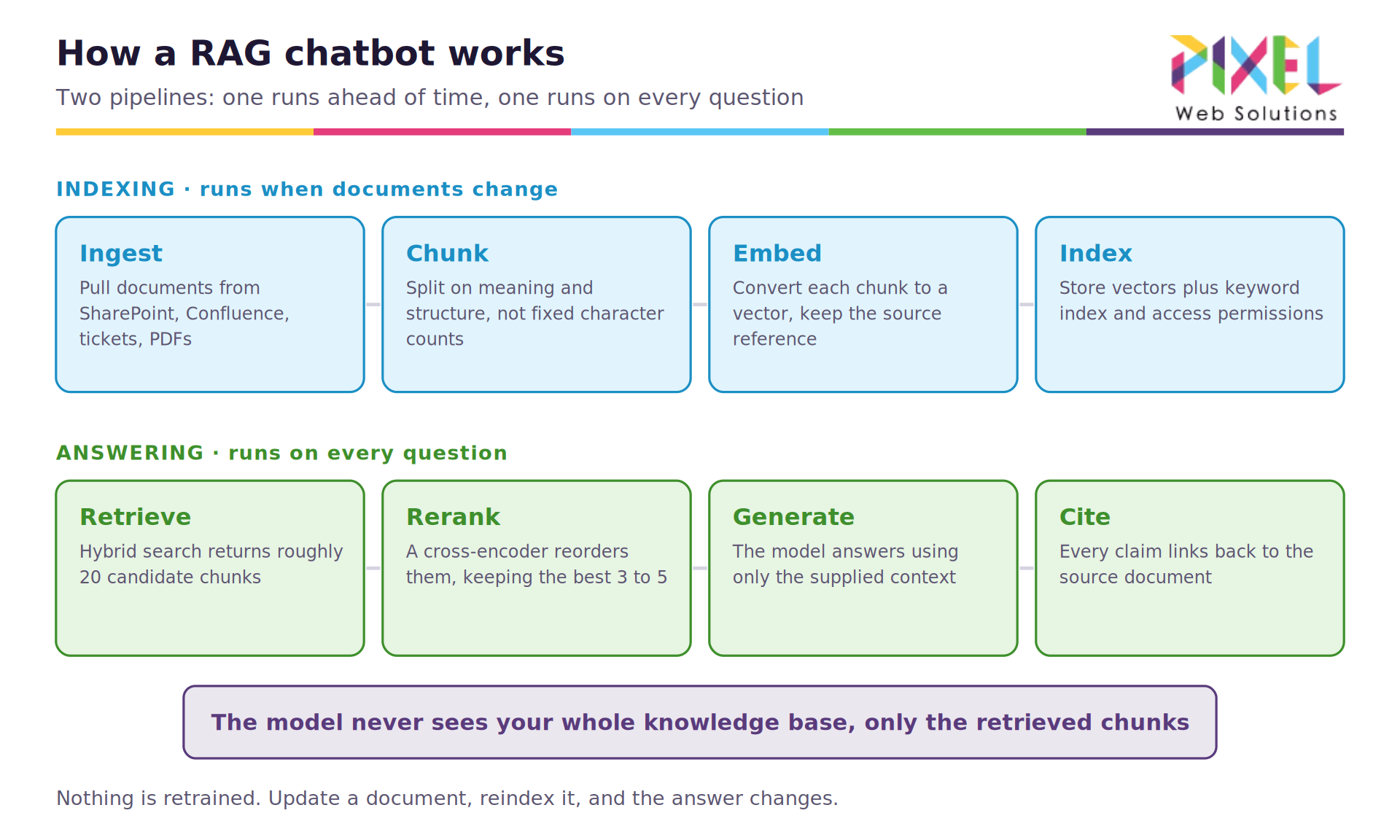
How a RAG Chatbot Works
Five steps, every time.
- Documents are split into chunks and converted to embeddings, numerical representations of meaning, then stored in a vector index alongside metadata such as source, date and permissions.
- The user’s question is embedded the same way.
- The system finds the chunks closest in meaning to the question, usually combining vector similarity with keyword matching.
- A second, more precise model reorders the candidates so the best passages sit at the top of the context window.
- The model answers using the retrieved passages, and cites them.
The property that makes this attractive commercially is that nothing is retrained. Update a policy document, reindex it, and the next answer reflects the change. Compare that with fine-tuning, where new knowledge means a new training run.
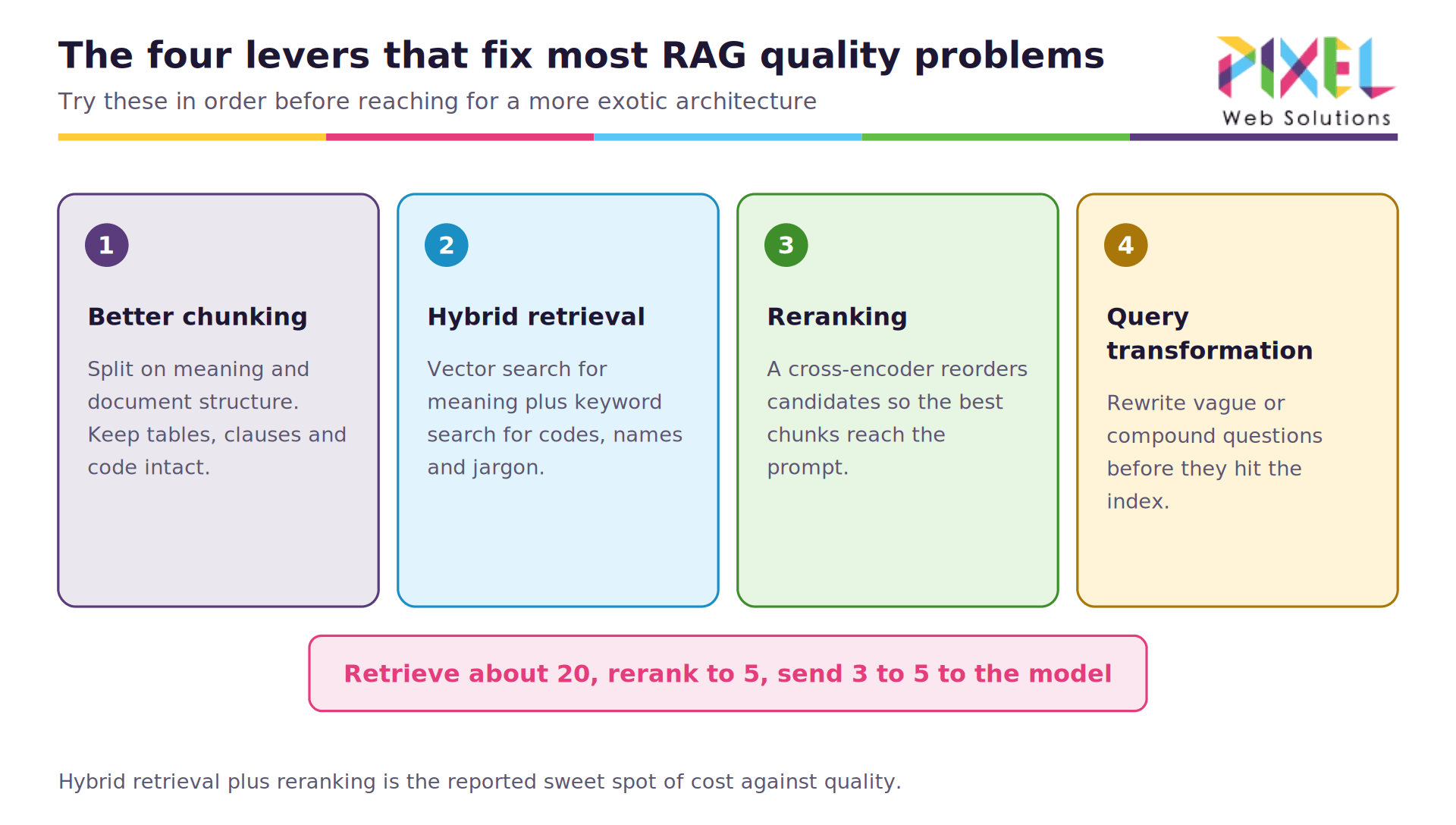
RAG, fine-tuning and long context are not competing options
They solve different problems, and teams routinely reach for the wrong one.
| What it changes | Best for | Weakness | |
| RAG | What the model knows at query time | Facts that change, permissioned content, anything needing citations | Quality depends entirely on retrieval |
| Fine-tuning | How the model behaves | Tone, format, domain phrasing, structured output | Poor at teaching facts; stale the day it finishes |
| Long context | How much you can paste in | Small, fixed corpora; one-off analysis | Cost scales with every query; no permissions model |
The common error is fine-tuning to teach the model your product catalogue. Fine-tuning teaches style far better than substance, and a catalogue changes weekly. That is a retrieval problem.
The second common error is assuming a large context window removes the need for retrieval. It does not, for three reasons: you pay for every token on every query, model attention degrades across very long contexts, and pasting a whole corpus into a prompt has no concept of who is allowed to see what.
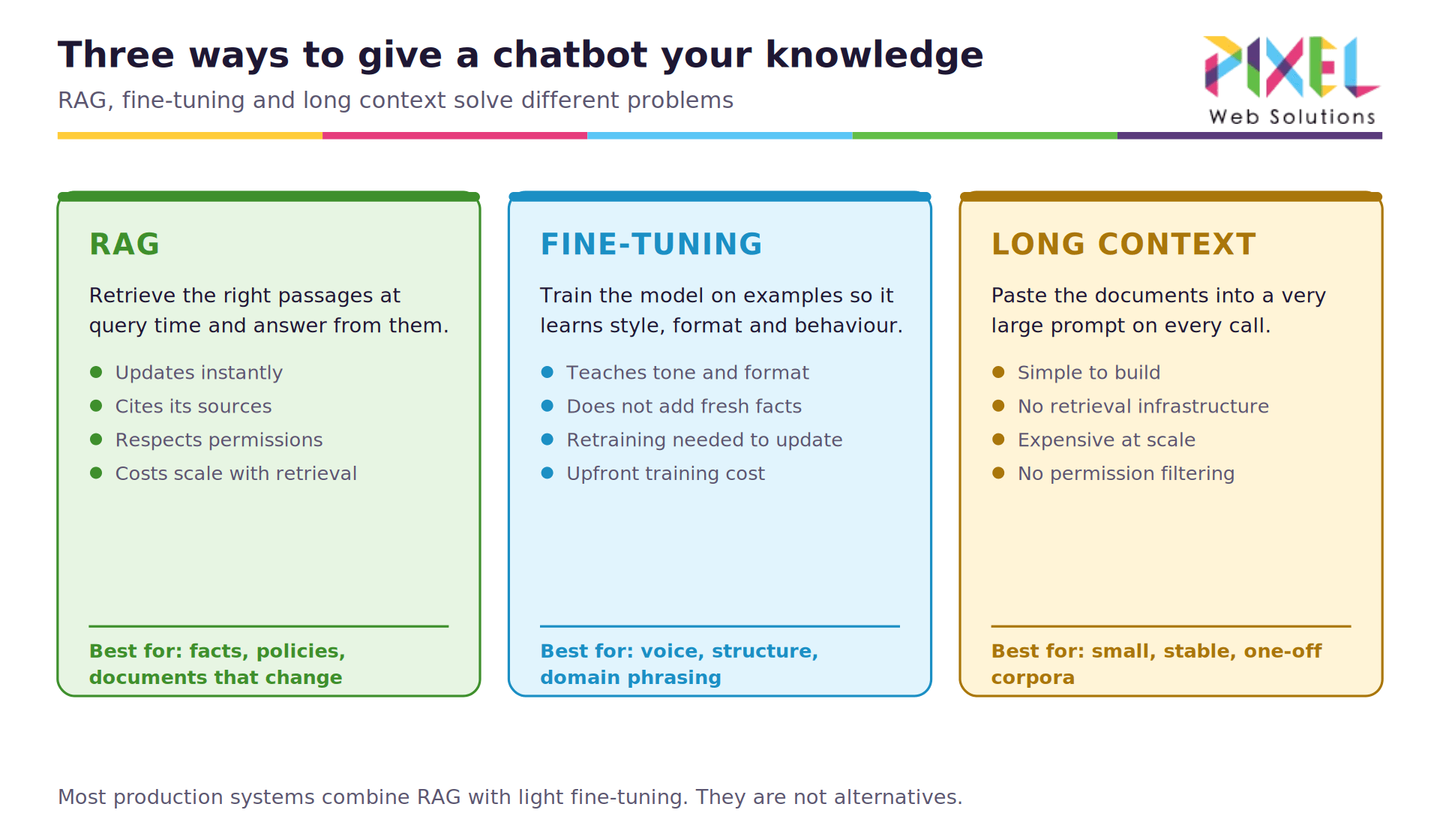
Where RAG Chatbots Actually Fail
Retrieval is the most under-invested stage in most builds and the one that produces the most visible failures. Being precise about the mechanisms is more useful than any single statistic.
| Failure | What the user sees | Root cause |
| Wrong passages retrieved | A confident, fluent, wrong answer | Chunking or embedding mismatch with how people ask |
| Nothing relevant exists | An invented answer, or a vague one | Content gap. The system cannot retrieve what you never wrote |
| Right passage, buried | Partially correct, missing the key detail | No reranking; the best chunk sat eleventh |
| Stale content retrieved | Confidently outdated policy | No recency weighting, no reindex on publish |
| Conflicting sources retrieved | Contradictory or hedged answer | No source precedence rules |
| Model ignores good context | Wrong answer despite correct retrieval | Generation-side failure. Real, and often overlooked |
A note on the retrieval-versus-generation split. It is widely claimed that a fixed share of RAG failures, usually quoted as around 73 percent, originate in retrieval. That figure circulates widely but has no single study behind it, and academic work measuring hallucination at the level of individual claims has found substantial rates of the model overriding correctly retrieved evidence, which is a generation failure. Treat the split as workload-dependent and measure it on your own system rather than assuming it. What is reliably true is that retrieval receives less engineering attention than it deserves, and that fixing it is usually cheaper than changing models.
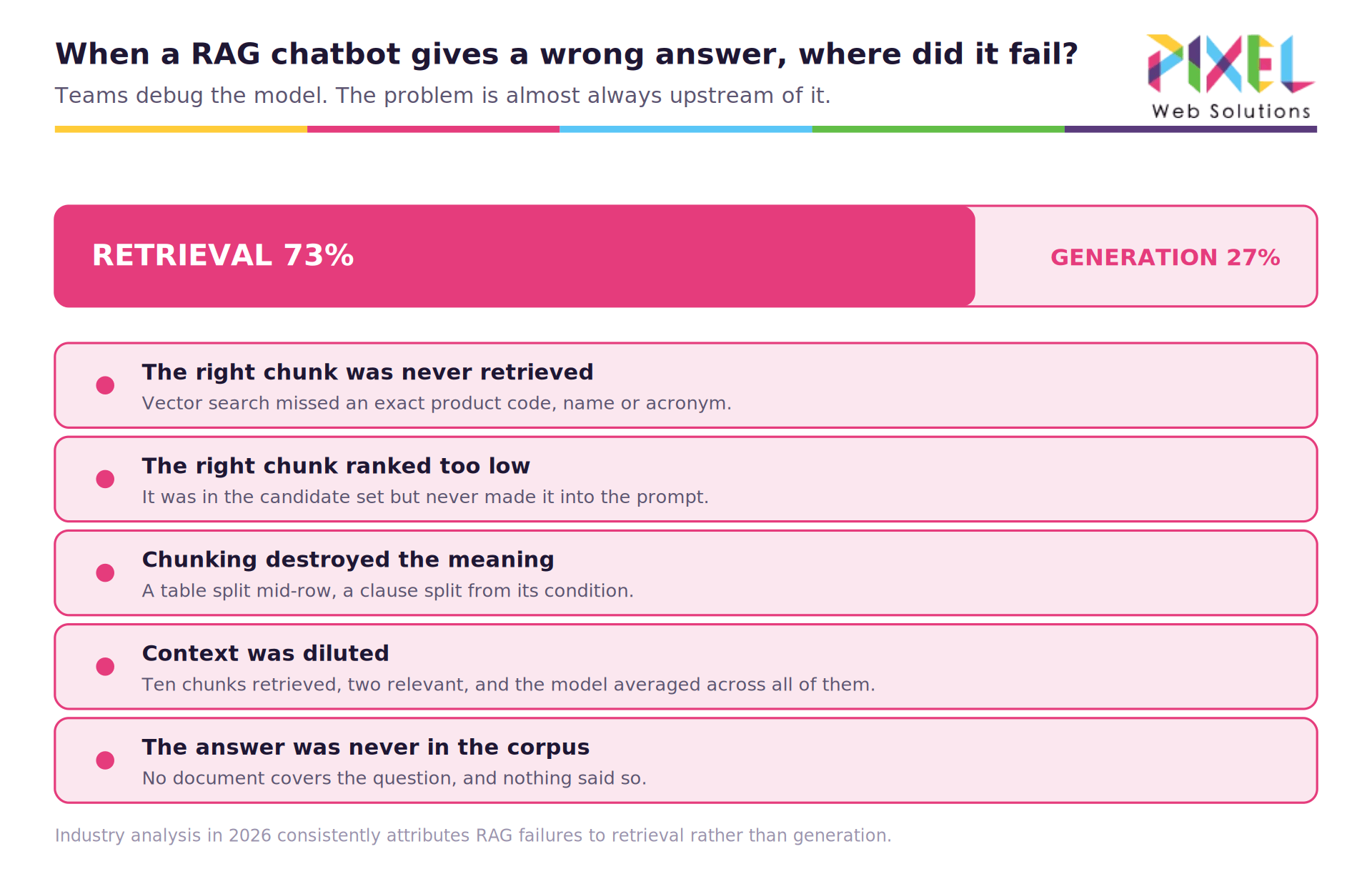
The Four Levers That Fix Most Quality Problems
In roughly the order you should pull them.
- Chunking.How documents are split determines what can be retrieved. Fixed 500-token windows cut tables in half and separate headings from their content. Chunk on document structure instead, keep headings attached, and overlap slightly so an answer spanning a boundary survives.
- Hybrid retrieval.Vector search finds meaning; keyword search finds exact strings such as part numbers, error codes and policy references. Enterprise questions contain both. Running the two together and fusing the results fixes a large class of “it could not find the obvious document” complaints.
- Reranking.Retrieve broadly, then rerank precisely. A cross-encoder reorders 50 candidates down to the best 5. This is usually the single highest-return change available, because it addresses the “right passage, wrong position” failure directly.
- Query handling.Real questions are short, ambiguous and full of pronouns. Rewriting the query, expanding it with synonyms, and resolving references against conversation history all measurably improve what comes back.
Only after those four should model choice enter the conversation. If retrieval is wrong, a better model produces a more articulate wrong answer.
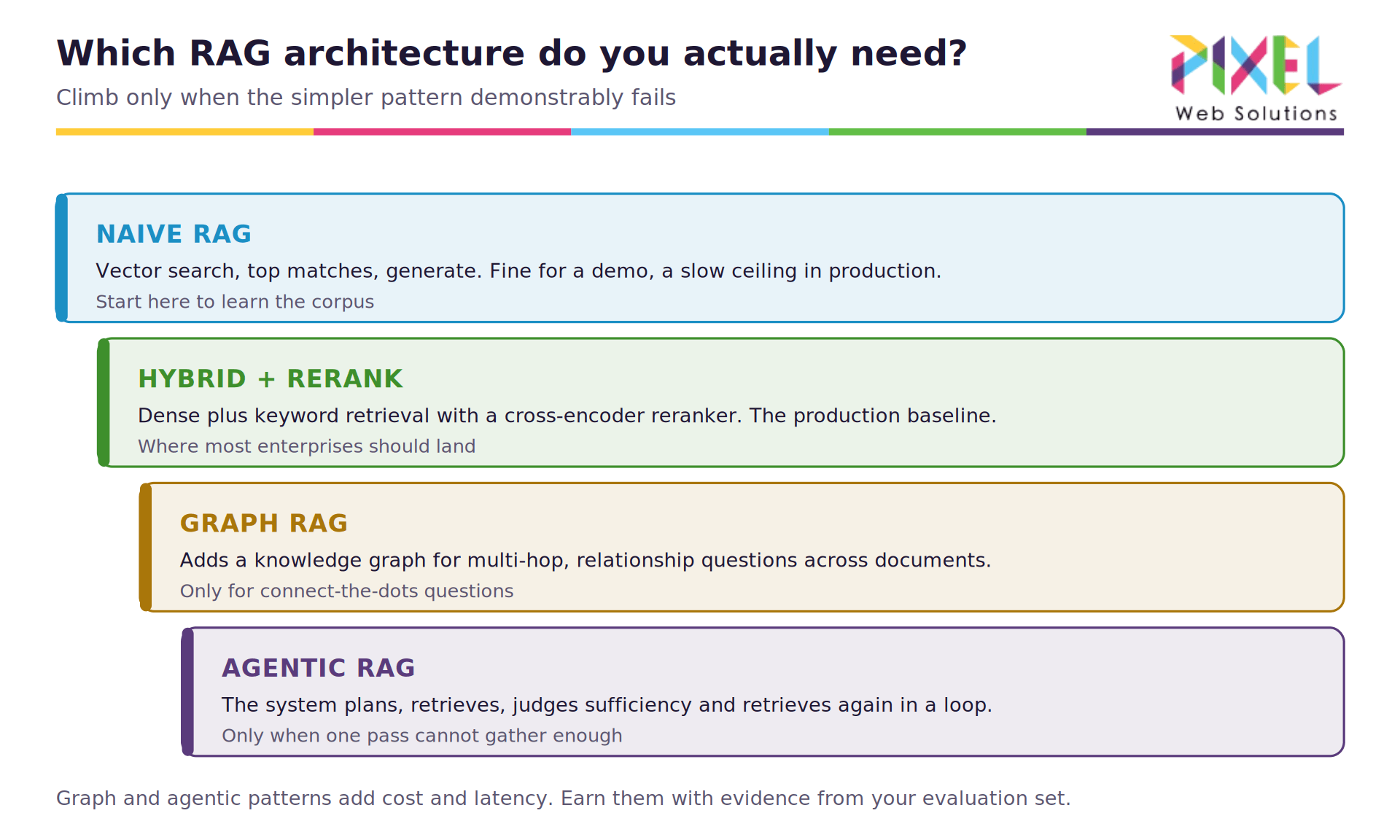
Which Architecture Do You Actually Need?
Complexity should be earned, not assumed.
| Level | What it is | Right when | Typical build |
| 1. Basic | Chunk, embed, retrieve, generate | Small, clean, stable corpus | Days |
| 2. Hybrid + rerank | Adds keyword search and a reranker | Most real enterprise deployments | Weeks |
| 3. Query-aware | Adds rewriting, routing, metadata filters | Mixed content types, permissions matter | Weeks to months |
| 4. Agentic retrieval | The system decides what to look up, iterates, verifies | Multi-hop questions, research tasks | Months |
Most production systems belong at level two or three. Level four is genuinely useful for multi-step research questions, and genuinely overkill for a policy assistant. If you are considering it, our guide to agentic AI covers what changes once a system acts rather than answers.
RAG or a Long Context Window?
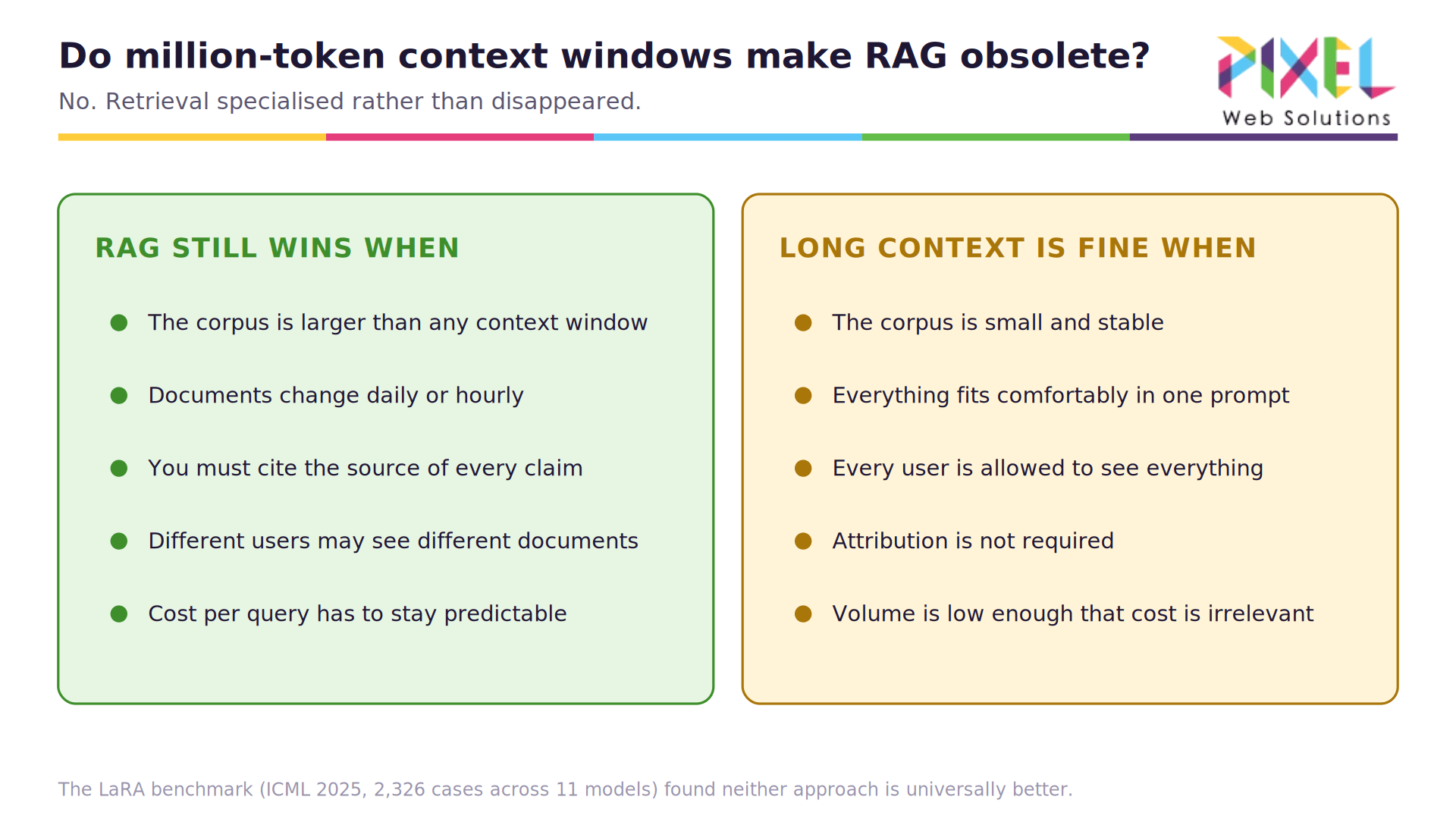
The honest comparison, given context windows now measured in millions of tokens.
| RAG | Long context | |
| Cost per query | Low, fixed retrieval cost | Scales with corpus size, every query |
| Corpus size | Effectively unlimited | Bounded by the window |
| Freshness | Reindex a document | Re-send everything |
| Permissions | Filter at retrieval | No native model |
| Citations | Natural, passage-level | Possible but weaker |
| Best at | Enterprise knowledge, changing content | One-off analysis of a fixed document set |
Long context has not made RAG obsolete. It has made the basic tier of RAG less necessary for small corpora, which is a much narrower claim.
What Makes a RAG Chatbot Enterprise Ready
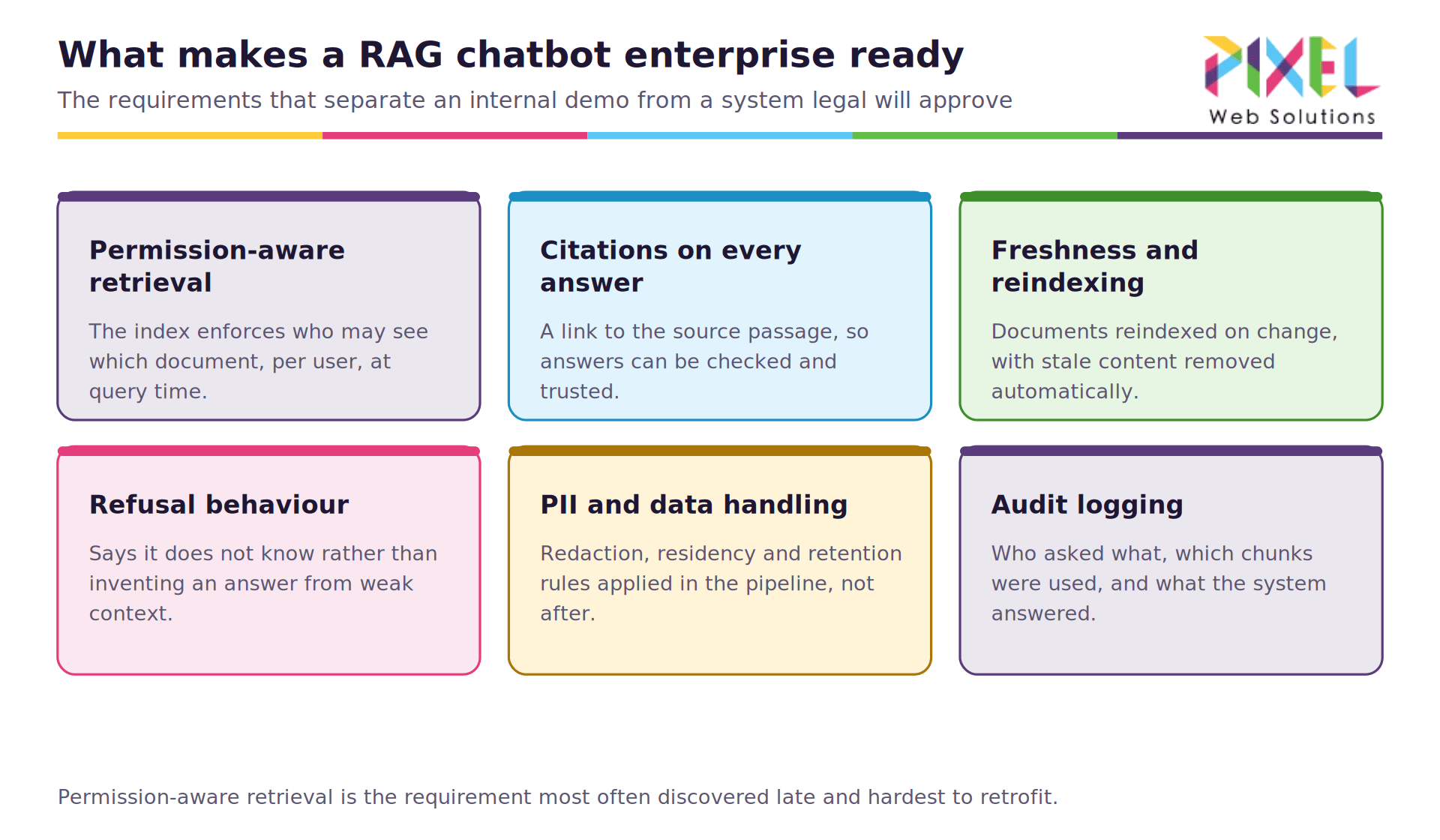
The gap between an internal demo and something legal signs off.
Permissions enforced at retrieval, not in the prompt. The index must filter by the asking user’s entitlements before generation. Telling the model not to reveal restricted content is not a control.
Citations on every claim, linked to the source passage so a reader can verify. This is what converts an unauditable answer into a checkable one.
An honest refusal path. The system must be able to say it does not know. A RAG chatbot with no refusal behaviour will invent an answer whenever retrieval comes back empty.
Freshness guarantees. Reindex on publish. A confidently outdated policy answer is worse than no answer.
PII and data residency handling, decided before the index is built rather than after.
An evaluation suite, covered below, because none of the above is verifiable without one.
Building this layer is most of the work in a serious deployment, which is why RAG development should be scoped on retrieval quality and governance rather than on how quickly a demo can be stood up.
How to Evaluate a RAG Chatbot
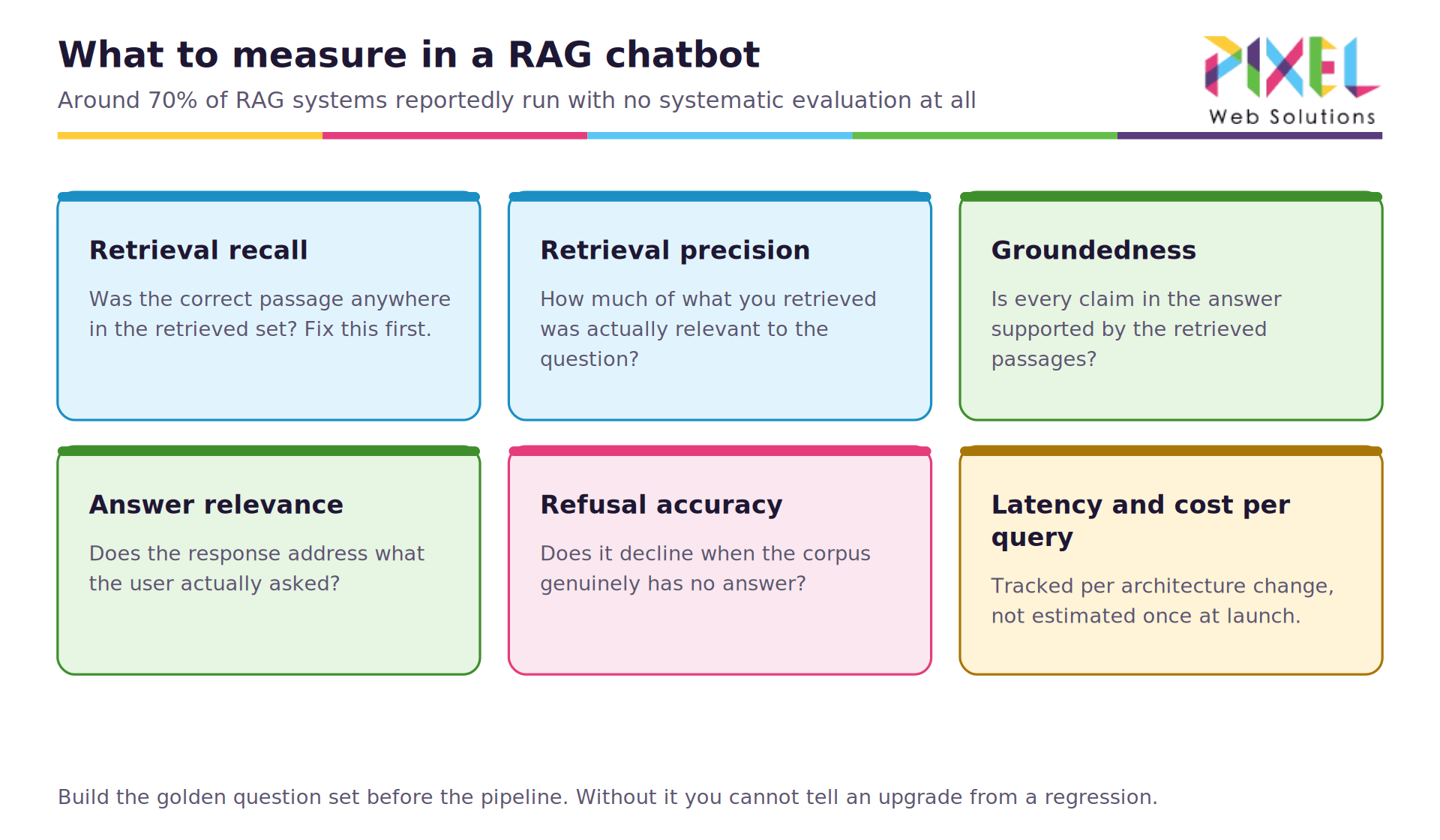
Evaluate retrieval and generation separately. Blending them into one accuracy number is why teams misdiagnose their own systems.
Retrieval metrics. For a set of known questions, was the correct passage retrieved at all (recall), and did it rank near the top (precision at k, MRR)? This is measurable without involving the model.
Generation metrics. Given correct passages, was the answer faithful to them, complete, and free of unsupported claims?
End-to-end. Answer correctness against a golden set, plus refusal accuracy: does it decline when it should?
Build the golden set from real user questions, not invented ones, and include the questions your system currently gets wrong. Two hundred well-chosen cases beat two thousand generic ones. Run it on every prompt, chunking or model change, because RAG systems regress silently when any of those move.
Conclusion
A RAG chatbot is the right architecture whenever answers must come from your own content, that content changes, and users need to see where an answer came from.
The reason so many disappoint is that teams treat retrieval as plumbing and the model as the product. It is the other way round. Chunking, hybrid search, reranking and query handling determine whether the model is given the right material to work with, and no model compensates for the wrong three paragraphs.
If you are scoping a build, our RAG development services start with a retrieval assessment against your actual documents and your actual questions.
FAQ
Q: What is a RAG chatbot?
A RAG chatbot retrieves relevant passages from your own documents at query time and answers using only that retrieved context, with citations. RAG stands for retrieval-augmented generation. Because nothing is retrained, updating a document and reindexing it changes the answers immediately.
Q: How is RAG different from fine-tuning?
RAG changes what the model knows at query time; fine-tuning changes how it behaves. Use RAG for facts that change, permissioned content and anything needing citations. Use fine-tuning for tone, format and domain phrasing. Fine-tuning is a poor way to teach facts, because the knowledge is stale the day training finishes.
Q: Why does my RAG chatbot give wrong answers?
Most often because it retrieved the wrong passages and the model wrote a fluent answer from them. The usual causes are chunking that splits content badly, vector-only search that misses exact terms like part numbers, no reranking so the best passage ranks eleventh, or stale content. Generation-side failures, where the model ignores correct retrieved context, are also real and frequently overlooked.
Q: Is it true that most RAG failures come from retrieval?
Directionally yes, but be careful with the specific figures circulating. A commonly quoted claim that about 73 percent of failures originate in retrieval has no single study behind it, and the definition of “retrieval failure” varies between sources. Peer-reviewed analysis has found meaningful rates of models overriding correctly retrieved evidence, which is a generation failure. Measure the split on your own system rather than assuming a published ratio.
Q: Does a long context window replace RAG?
No, though it removes the need for the simplest RAG setups on small corpora. Long context costs scale with every query, model attention degrades across very long inputs, and pasting a corpus into a prompt has no permissions model. RAG remains the right choice for large, changing, access-controlled content.
Q: How do you evaluate a RAG chatbot?
Separately for retrieval and generation. Retrieval: was the correct passage retrieved, and did it rank near the top. Generation: given correct passages, was the answer faithful and complete. Then end-to-end correctness and refusal accuracy against a golden set built from real user questions, rerun on every prompt, chunking or model change.
Q: What makes a RAG chatbot enterprise ready?
Permissions enforced at retrieval rather than in the prompt, citations on every claim, an honest refusal path when retrieval returns nothing, reindexing on publish so answers stay current, PII and data residency decided before the index is built, and an evaluation suite that makes all of it verifiable.
Q: How long does it take to build a RAG chatbot?
A basic retrieve-and-generate prototype takes days. A production system with hybrid retrieval, reranking, permissions, citations and evaluation typically takes weeks to a few months, driven mostly by content condition and access control rather than by model work.