










Table of Contents
Every second, financial markets generate thousands of price movements, trading signals, and market events. Processing this volume of data manually has become nearly impossible, while traditional rule-based trading systems often struggle to adapt to rapidly changing market conditions.
This is why AI trading bots are becoming a strategic investment across the financial industry. By using artificial intelligence, machine learning, and predictive analytics, these systems allow businesses to automate trading decisions, improve the accuracy of trade execution, and respond to market opportunities as they happen.
In this guide, you’ll learn how AI trading bots work, the technologies behind them, their key features and benefits, top AI trading bots, and the step-by-step process of building an intelligent trading platform for your business.
What is an AI Trading Bot?
An AI trading bot is a smart software program that employs artificial intelligence (AI), machine learning (ML), and live market data to look for trades, as well as to place buy or sell orders automatically. Unlike traditional, rule-based trading bots, AI trading bots can continually develop their reasoning abilities by analyzing historical price data, market trends, technical indicators, and trading patterns. By doing so, they allow traders and businesses to identify good trading opportunities and manage their overall market risk.
How it Works
AI trading bots operate in a very clear, logical order. The bot collects real-time market data from exchanges and financial APIs; evaluates that data using AI and machine learning algorithms; identifies potential trading opportunities; evaluates the corresponding risks; then places trades on its own. As the AI models become more sophisticated, they continually improve their own strategies by learning from previous performance and continually adapting to changing market conditions.
Core Technologies Powering AI Trading Bots
An AI trading engine utilizes a combination of technologies supporting its multi-functional capabilities. The various technology disciplines work together to analyze markets, forecast trends, manage risk, and execute trades with precise accuracy.
-
Artificial Intelligence
AI is the decision-making engine of an AI trading engine, enabling the system to process vast quantities of market data, identify potential trading opportunities, and make intelligent decisions without the need for continuous human intervention.
-
Machine Learning
ML enables AI trading engines to learn from past market activity, continually improving their trading strategies over time. ML models identify patterns in data and adjust their tactics based on changes to the way markets operate, thus increasing trading accuracy.
-
Deep Learning
Deep Learning enhances AI’s ability to discover hidden relationships in complex financial data sets. By examining many market variables simultaneously, it improves price forecasts, generates signals, and enhances decision-making accuracy, especially during periods of extreme market volatility.
-
Big Data Analytics
Every trade creates millions of events occurring in the market, price movements, and transactional records. These millions of bits of data can be analyzed using Big Data Analytics by AI trading bots to access high volumes of information and process them in real time.
-
Generative AI
Generative AI (Gen AI) helps users generate summaries, strategies, and personalized insights from complex market data. Generates value by increasing user engagement through actionability or accessibility of sophisticated data analyses.
-
AI Agents
AI agents analyze the market, create trading strategies, execute trades, and optimize results, without the need for significant direct human intervention. It automates complex trading processes, improving operational efficiencies and creating scalable intelligent trading systems.
-
Large Language Models
LLMs interpret financial news and research reports and respond to natural language queries for conversational market intelligence and trading assistance. Offers value through providing AI-enabled user support and simplifying access to market intelligence.
-
Cloud Computing
Cloud Computing provides scalable infrastructure required to operate an AI trading bot effectively. This technology allows for smooth and seamless exchange connectivity, uninterrupted performance, and real-time data processing.
-
Natural Language Processing
Often, the market reacts to news before it reacts to charts. Natural Language Processing (NLP) can be used by AI trading bots to analyze financial news, earnings reports, announcements from regulators, social media, and others, to include in their overall trading psychology.
-
Predictive Analytics
Predictive Analytics is a combination of historical data along with real-time information and data from the markets to identify potential future price movements. With this information, AI trading bots can identify high-probability trading opportunities, determine optimal entry and exit points, and enhance risk management practices through their own analysis of the amount of profit/loss per trade.
-
Reinforcement Learning
Reinforcement Learning allows AI-based trading bots to develop themselves over time through feedback. AI trading bots use the results of past trades to adjust their strategies as the market continues to change, which will allow them to adapt to new market conditions without needing to be manually adjusted frequently.
For businesses developing AI-powered trading platforms, selecting the right technology stack directly influences accuracy, performance, and long-term competitiveness.
Types of AI Trading Bots
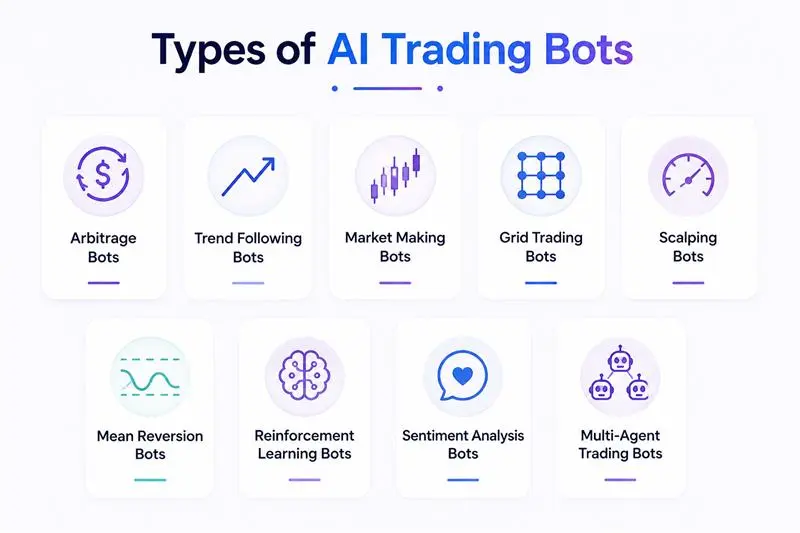
Here is the list of different kinds of AI trading bots,
1. Arbitrage Bots
Arbitrage bots capitalize on identical trades across different exchanges where prices differ, placing both a buy and a sell order simultaneously. If you’re looking for a low-risk, high-speed way to trade, arbitrage bots are perfect for your business.
2. Trend Following Bots
Trend-following bots research historical price data and technical indicators to find bullish or bearish trends in the market. These bots are most effective when used by traders who have long-term to medium-term strategies.
3. Multi-Agent Trading Bots
Multiple agents collaborate as a collection of AI-based trading bots to analyze the market, evaluate risk, identify the best trading strategy, and execute trades simultaneously. It’s an excellent fit for enterprise-level trading systems and institutional trading setups.
4. Market Making Bots
Market-making bots actively provide liquidity by placing both buy and sell orders, using the bid-ask spread to profit from their trades. Market-making bots are primarily used by crypto exchanges and institutions that engage in trading.
5. Grid Trading Bots
Grid trading bots place multiple buy and sell orders within predefined price ranges, aiming to capture regular price volatility and allowing traders to profit from normal market fluctuations without predicting market direction.
6. Scalping
Scalping bots place a high volume of buy and sell orders over short time spans in order to capture small price movements. These bots are ideal for high-frequency traders due to their speed.
7. Mean reversion
Mean reversion trading bots identify stocks that have experienced large price movements away from their historical average and expect that those stocks will eventually return to their historical averages. They can produce positive trades during volatile and over-extended markets.
8. Reinforcement learning bot
These types of AI Trading Bots operate through a reinforcement learning methodology. This adaptability allows them to respond effectively to changing market conditions and enhance their trading outcomes.
9. Sentiment Analysis Bots
Sentiment analysis AI trading bots utilize Natural Language Processing (“NLP”) to analyze news, social media, and market sentiment to provide future price predictions based on sentiment before any potential price movements occur on traditional charts.
Enterprise-level AI Trading platforms combine all AI trading bot strategies to create an integrated solution for fulfilling multiple end-user needs.
Significant Features of AI Trading Bots
The features of an AI Trading bot define its performance, accuracy, and scalability. Here are some features that help businesses deliver smarter, faster, and more reliable trading experiences.
- AI-Based Trading Engine: Analyzes market pricing in real-time and performs trades automatically depending on AI-based insights.
- AI Copilot: Offers AI-driven market data and customized trading recommendations, allowing smarter trading.
- Multi-Exchange Integration: Allows smooth trading across exchanges through one platform and interface.
- Automated Portfolio Management: Keeps track of investment portfolios and automatically realigns them to align with the trading objectives.
- Risk Management: Minimizes the risk of loss by establishing controls such as stop-loss limits, take-profit limits, and position sizing.
- Backtesting: Allows a trader to verify their trading strategy by using historical data from the market.
- Paper Trading: Allows traders to experiment with the trading strategy in a risk-free environment where real currency is not used.
- Predictive Market Analytics: Forecasts what happens in the future using artificial intelligence and analysis of past trading activity.
- Smart Notifications: Delivers instant alerts on price movements, trade executions, and market conditions.
- Enterprise-Grade Security: Secures a trader’s account and trading through security standards like encryption, 2FA, and secure API integration.
- Sentiment Analysis: Analyses the positive and negative reactions to news and social media regarding market trends and events before they affect prices.
Build an AI Trading Bot That Sets Your Platform Apart
Talk to our experts today and build an AI trading bot that is smarter and delivers sustainable business growth
Main Advantages of AI Trading Bots
AI trading bots are allows to move from basic automation to intelligent decision-making. Here are some of the benefits you gain through embracing AI trading bots.
- Faster Execution: AI trading bots execute trades within milliseconds, reducing slippage while allowing you to capture time-sensitive market opportunities.
- Emotion-Free Decisions: AI trading bots make trading decisions based on data and algorithms, removing any fear or greed and putting aside any human bias
- 24/7 Automated Trading: AI trading bots constantly monitor global markets and will execute your trade when you are not available, ensuring you do not lose any trading opportunities.
- Better Accuracy: Analyze vast amounts of market data to generate more precise trading signals, helping make better decisions.
- Improved Risk Management: Intelligent risk controls of AI trading bots protect your capital and minimize the risk of severe capital loss due to market volatility.
- Scalable Trading Opportunities: Automated trading bots allow businesses to build a scalable trading platform that will increase efficiency, improve trust with your users, and provide long-term profits.
- Reduced Operational Overhead: With automated support, every operation in the platform runs seamlessly without any manual intervention or errors.
- Improved Profit Opportunities: AI trading bots help you to identify market patterns and high-probability trading opportunities that you would miss in a manual trading environment.
AI Trading Bots vs Traditional Trading Bots (Table)
While both AI trading bots and traditional trading bots automate trading activities, their capabilities differ significantly.
| Aspects | AI Trading Bots | Traditional Trading Bots |
| Decision-Making | AI-Driven & Adaptive | Rule-based and Predefined |
| Learning Capability | Consistently learns from market data | Needs manual updates |
| Market Analysis | Analyzes historical, real-time, and sentiment data | Relies on fixed technical indicators |
| Strategy Optimization | Dynamically adjusts strategies | Follows static trading rules |
| Execution Speed | High-speed automated execution | Automated but limited by predefined logic |
| Risk Management | AI-powered predictive risk assessment | Basic rule-based risk controls |
| Market Adaptability | Adapts to changing market conditions | Performs best in stable market environments |
| Scalability | Supports complex, multi-asset trading strategies | Limited scalability and flexibility |
| Best Suited For | Businesses seeking intelligent, scalable trading solutions | Basic automated trading with fixed strategies |
Businesses building AI Trading Bots can provide more adaptive, informed, and scalable trading results for modern traders.
Best AI Trading Bots in 2026
The rapid adoption of AI has led to the emergence of several AI trading platforms, each designed to address different trading needs. Here are some of the leading AI trading bots in 2026.
Trade Ideas (for stocks)
Trade Ideas is an artificial intelligence (AI) stock trading platform providing active traders and investment firms with real-time market scanning, trade ideas and automated trade strategy executions.
Pionex (for crypto)
Pionex has a built-in AI-based crypto trading bot service, including Grid and DCA bots, enabling people to automate their crypto trading without having to rely on a third-party integrated solution.
TrendSpider (for technical analysis)
TrendSpider uses AI to automate technical analysis, trend identification, and chart pattern recognition for traders so they can make quicker and more informed decisions.
Tickeron
Tickeron is an AI-powered pattern recognition and predictive analytics platform for generating trading insights across all types of stocks, ETFs, forex, and cryptocurrencies.
Coin Rule (for no-code strategy creation)
CoinRule is a no-code AI trading platform that allows users to easily create and automate their trading strategies with a rule-based approach, making it accessible to all types of users and enterprises.
While these platforms offer powerful trading capabilities, businesses focus on building custom AI trading bots tailored to their unique trading strategies, branding, compliance requirements, and scalability goals. This growing demand is driving businesses toward AI trading bot development rather than relying solely on off-the-shelf solutions.
AI Trading Bot Use Cases Across Industries
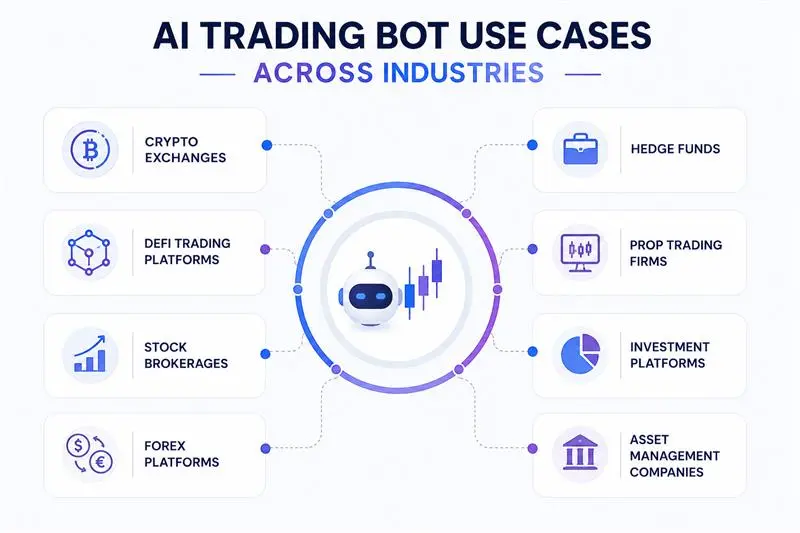
AI trading bots have evolved beyond individual trading tools to become strategic assets across the financial ecosystem. Here’s how various industries leverage AI trading bots.
- Crypto Exchanges
Crypto exchanges utilize AI-based trading bots to automate trades, increase the number of active orders in the market (liquidity), and provide innovative features that keep customers engaged and active.
- DeFi Trading Platforms
Power autonomous on-chain trading, liquidity optimization, arbitrage strategies, and yield-focused automation across decentralized finance ecosystems.
- Stock Brokerages
Stock brokerage firms rely on AI-powered trading assistants to help modern investors with making investment decisions, optimize their portfolios, and gain personalized recommendations daily.
- Forex Platforms
Forex trading platforms utilize AI trading bots in real-time to monitor currencies’ trading activity and execute trades instantly based on global economic indicators.
- Hedge Funds
Hedge funds use AI-driven predictive analytics and algorithmic trading techniques to exploit profitable trading opportunities while improving their portfolio performance.
- Prop Trading Firms
Proprietary trading firms use AI-based trading bots to execute high-frequency and data-driven trading programs faster, more accurately, and more consistently than traditional methods.
- Investment Platforms
Investment management platforms leverage AI to automate the management of portfolios, risk assessment, and market analysis, allowing for improved investment experience for consumers and institutions alike.
- Asset Management Companies
Asset management firms employ AI trading bots to enhance their asset allocation strategies, improve their investment decisions, and manage their diversified portfolios efficiently.
Businesses that incorporate AI trading bots are better positioned to deliver intelligent automation, improve customer experiences, and build a sustainable competitive advantage.
Launch Your AI Trading Platform with Confidence
Take the first step toward launching a secure, scalable, and market-ready AI trading platform. Connect with our AI experts today.
Step-by-Step Blueprint to Build an AI Trading Bot
Developing an AI trading bot requires more than just coding algorithms—it demands a strategic combination of AI models, trading logic, market integrations, and enterprise-grade security.
- Business Requirement Analysis
Define the target market, supported asset classes, trading strategy, and objectives before you start developing your bot.
- Selecting the AI Models
Select the appropriate AI and trends for the target market for automation of your trading robot.
- Designing the Trading Architecture
Build a scalable trading architecture that can process large amounts of data in real-time with low latency, as well as accommodate future expansion.
- Developing Trading Algorithms
Create an intelligent trading algorithm incorporating advanced analysis of market trends, detection of trading opportunities, and automation of order execution.
- Exchange API Integration
Use only proven APIs from the exchanges for the execution of trades as well as for real-time tracking of your trading account and synchronization of your portfolio.
- AI Model Training
Train and continually refine your AI models based on your use of historical as well as live market data.
- Backtesting & Simulation
Backtest your trading strategy against the historical market to discover weaknesses before executing your strategy live.
- Security Implementation
Include encryption, secure API management, multi-factor authentication, compliance with any laws that apply to your brokerage, and so on, to secure your trading assets at all times.
- Testing & Deployment
Conduct thorough functional, security, and performance testing of the trading algorithms and overall implementation prior to launching the system into production.
- Continuous Optimization
Consistently monitor the overall performance of the trading robot and any AI-based trading algorithms for further optimization.
Regular AI model improvements, performance monitoring, and strategy updates ensure your AI trading bot remains competitive, accurate, and scalable in evolving financial markets.
Pixel Web Solutions – Your Reliable AI Trading Bot Development Partner!
Pixel Web Solutions is a leading AI & ML Solutions provider having strong expertise in artificial intelligence, Crypto & Web3 space. We build AI-powered trading bots, helping businesses automate trading, optimize decision-making, and accelerate digital growth. Our team develops tailored AI trading bots designed to align with your business goals, trading strategies, and long-term vision.
Our expert team handles the complete development lifecycle under one roof, offering end-to-end support. We develop fully customized AI trading bots that reflect your core business objectives and operations. Our solutions are designed to process real-time market data, support high trading volumes, and scale effortlessly as your business grows.
Whether you’re launching a new AI-powered trading platform or upgrading an existing one, our experts are ready to help you develop a secure, scalable, and future-ready AI trading bot that delivers measurable business value
Build the next-gen intelligent trading solutions with us!!!
Frequently Asked Questions (FAQ)
1. Can AI trading bots trade multiple asset classes?
Yes. AI trading bots can be developed to support cryptocurrencies, stocks, forex, commodities, ETFs, options, futures, and other financial instruments through multi-market and multi-exchange integrations.
2. How much does AI trading bot development cost?
The cost of AI trading bot development ranges from $25K to $150K, depending on factors such as AI capabilities, supported markets, exchange integrations, feature complexity, security requirements, and deployment architecture.
3. How long does it take to develop an AI trading bot?
The development timeline varies based on project complexity, AI model training, integrations, testing, and customization. A fully AI trading bot typically takes 8 to 24 Weeks to design, develop, and deploy.
4. Why should businesses choose custom AI trading bot development?
Custom AI trading bot development enables businesses to build proprietary trading strategies, integrate with existing systems, strengthen security, scale efficiently, and maintain full ownership of the platform.