







The cost to build a crypto Telegram bot in 2026 ranges from about $2,000 to $10,000 for a price alert or signal bot, while trading bots start from $6,000 for a single-strategy bot with Pixel Web Solutions, and multi-chain sniper or copy-trading bots typically cost $20,000 to $80,000. The final figure depends on the bot type, the chains and wallets it supports, its security design and whether it runs as a chat bot or a Telegram Mini App.
The next big crypto product might not be another exchange; it could be a Telegram bot. Crypto Telegram bots let users execute trades, receive real-time market alerts and manage wallets without leaving the messaging app, and Telegram now has more than 1 billion monthly active users, according to founder Pavel Durov. So the next question is obvious: how much does it cost to build a crypto Telegram bot?
The answer depends on the bot's complexity and on rules most guides skip, such as Telegram's own limits and its TON-only policy for Mini Apps. Whether you are building a simple MVP or an enterprise-grade trading bot, understanding the cost helps you plan your budget and choose the right technology.
In this guide, we break down the cost by bot type with the maths shown, Telegram's platform rules, the market data behind Banana Gun, Maestro and Trojan, revenue models, and the security incidents every founder should learn from. So let's start with the basics.
Key Takeaways
- Cost follows bot type. Alert bots need about 80 to 200 hours, single-chain trading bots 240 to 600 hours and multi-chain sniper or copy-trading bots 800 to 1,600 hours. Pixel builds single-strategy trading bots from $6,000.
- The market has cooled since 2024. DefiLlama data shows Trojan earned $126.8 million in fees in 2024 but about $1 million in the last 30 days, which implies roughly $100 million of monthly volume at a 1 percent fee.
- Telegram's rules shape the build. Bots can send about 30 messages per second for free, digital goods must be sold in Telegram Stars, and Mini Apps with crypto features must use the TON blockchain and TON Connect.
- Security is the biggest risk line. Maestro, Unibot and Banana Gun all suffered exploits between 2023 and 2024, mostly through router contracts and the chat-to-transaction path.
- Plan revenue with break-even maths. A bot with $3,000 of monthly costs needs about $300,000 of monthly trading volume at a 1 percent fee just to break even.
What Are Crypto Telegram Bots?
A crypto Telegram bot is an automated trading and blockchain management tool that runs inside Telegram. It lets users trade cryptocurrencies, monitor prices, manage wallets, execute token swaps and receive real-time alerts without leaving the messaging app. Traders, investors, exchanges, DeFi platforms, Web3 startups and crypto communities use these bots to simplify trading and automate repetitive tasks. They work by connecting Telegram to wallets, blockchain networks, decentralised exchanges (DEXs), centralised exchanges (CEXs) and smart contracts through secure APIs.
Depending on business requirements, crypto Telegram bots can be built as trading bots, sniper bots, copy trading bots, flash loan arbitrage bots, portfolio management bots, wallet bots, staking bots, signal bots and customer support bots.
One distinction matters for cost and compliance. A classic chat bot works through messages and buttons in a chat, which is how Trojan, Maestro and Banana Gun operate. A Telegram Mini App is a web app that opens inside Telegram, and Telegram applies stricter crypto rules to Mini Apps, as explained below.
How Much Does It Cost to Build a Crypto Telegram Bot in 2026?
The cost of developing a crypto Telegram bot typically starts at about $2,000 for an alert bot, from $6,000 for a single-strategy trading bot with Pixel Web Solutions, and rises to $20,000 to $80,000 for multi-chain sniper or copy-trading bots. The final investment depends on the bot's features, supported exchanges and chains, trading strategies, security requirements, third-party API integrations and the level of customisation.
More advanced bots with AI capabilities, multi-exchange support and enterprise-grade infrastructure need a larger budget. Most businesses start with an MVP and scale the bot over time, which reduces upfront costs while validating market demand.
Planning to build a crypto Telegram bot? Share your requirements with our experts to receive a customized cost estimate and development roadmap.
Crypto Telegram Bot Cost by Bot Type, With the Maths
The fairest way to estimate the cost is hours multiplied by the hourly rate. The table uses typical hour ranges and two offshore rates. These are industry estimates for custom builds, not fixed quotes.
| Bot type | Typical scope | Hours | At $25 per hour | At $50 per hour |
|---|---|---|---|---|
| Price alert or signal bot | Price feeds, alerts, watchlists, subscriptions paid in Stars, no wallet | 80 to 200 | $2,000 to $5,000 | $4,000 to $10,000 |
| Community or utility bot | Token-gated access, airdrop checks, payments, admin tools | 200 to 400 | $5,000 to $10,000 | $10,000 to $20,000 |
| Trading bot, one chain, one strategy | Bot-managed wallets, swaps through a DEX aggregator, limit orders, stop loss, risk limits | 240 to 600 | $6,000 to $15,000 | $12,000 to $30,000 |
| Telegram Mini App with TON Connect | Web interface inside Telegram, TON wallet connection, TON assets only | 300 to 700 | $7,500 to $17,500 | $15,000 to $35,000 |
| Sniper or copy-trading bot, multi-chain | Launch monitoring, MEV protection, copy logic, several chains | 800 to 1,600 | $20,000 to $40,000 | $40,000 to $80,000 |
| White-label bot platform | Multi-tenant bots, billing, referrals, analytics, partner dashboards | 1,600 to 3,000 | $40,000 to $75,000 | $80,000 to $150,000 |
How to read it: the lowest trading bot figure, 240 hours at $25, equals Pixel's published entry price of $6,000. Every row below it adds chains, speed or users, and each of those adds hours. For the AI end of the market, the guide to the cost to build an AI trading bot breaks down model, data and GPU costs.
Monthly Running Costs
Telegram's Bot API is free to use, but everything around it is not. A small bot runs on a DigitalOcean droplet from $6 a month (1 GiB), while a busy trading bot needs several larger servers ($24 to $48 a month each for 4 to 8 GiB), paid blockchain RPC access, monitoring, security reviews and support staff. Budget maintenance hours every month, because chains, DEX routers and exchange APIs change often.
Telegram's Own Rules: Bot API Limits, Stars and TON
Most cost guides ignore the platform itself. These rules change your architecture and your budget.
1. Message limits. Telegram's Bot FAQ says bots should send no more than about one message per second to a single chat, 20 messages per minute to a group and about 30 messages per second across all chats. Paid broadcasts, switched on in @BotFather, raise the ceiling to 1,000 messages per second, at 0.1 Stars for each message above the free 30 per second. Only bots with at least 100,000 Stars and 100,000 monthly active users qualify.
Worked example: sending a token launch alert to 200,000 users at the free rate takes 200,000 ÷ 30 = 6,667 seconds, or about 1 hour 51 minutes, which is far too slow for trading alerts. With paid broadcasts at 1,000 per second, it takes 200 seconds. In those 200 seconds, 6,000 messages fall within the free 30 per second (30 × 200), so 194,000 are paid: 194,000 × 0.1 = 19,400 Stars per broadcast. Time-sensitive alert bots must budget for this or split alerts by priority.
2. Digital goods must use Telegram Stars. Under section 6.2 of Telegram's Bot Platform Developer Terms, payments for digital goods and services must be made exclusively in Telegram Stars. Physical goods go through third-party payment providers.
3. Mini Apps with crypto features must use TON. Section 7 of the same terms requires Mini Apps with cryptocurrency functionality to be based exclusively on The Open Network (TON) blockchain. Tokens they issue must be on TON, wallet connections must use the TON Connect SDK, and Mini Apps may not promote crypto assets that are not based on TON. Telegram set 1 February 2025 for compliance and gave existing non-TON Mini Apps until 21 February 2025 to move. Multichain wallets may still let users manage assets on other chains.
What this means for cost: a Solana or Ethereum trading bot that works through chat commands is a different product from a Mini App. If you want a rich web interface inside Telegram with crypto features, plan for TON and TON Connect from the start, or keep the trading interface in the chat. Get legal advice on your exact design, because platform rules can change.
Factors That Affect Crypto Telegram Bot Development Cost
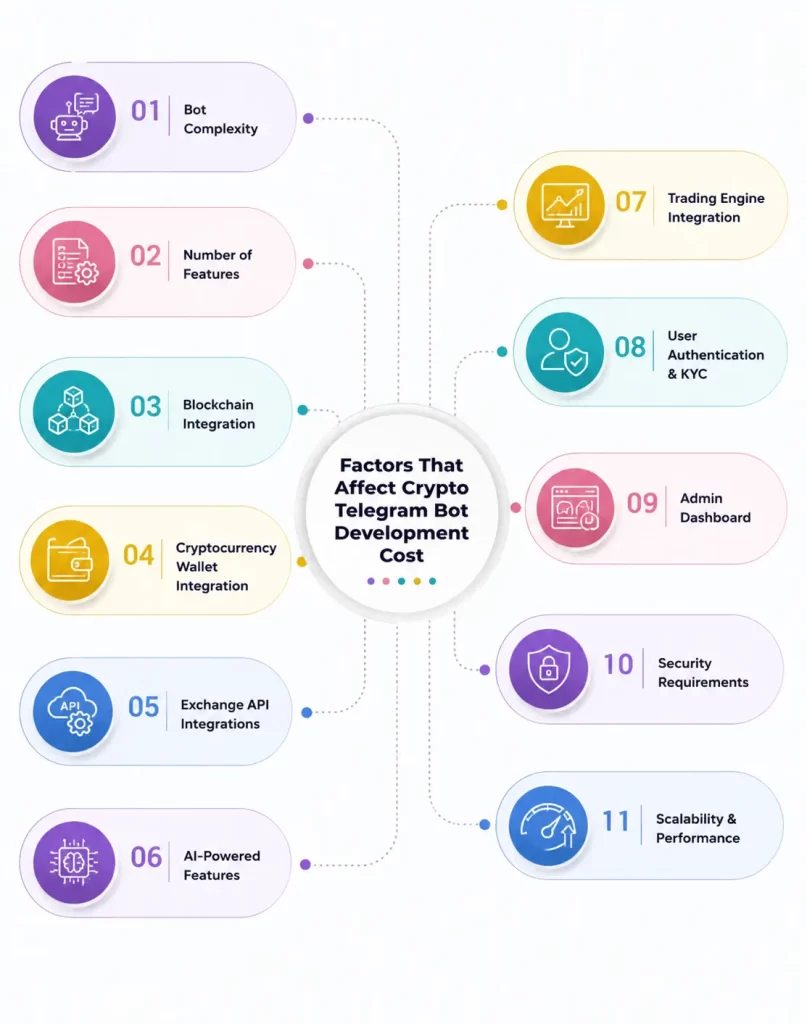
The cost of crypto Telegram bot development depends on several technical and business requirements. Here are the factors that drive the budget and the right development approach.
Bot Complexity
Most startups begin with an MVP that includes wallet integration, basic trading functions and price alerts, then expand into AI-powered automation and multi-chain support. Complexity is the biggest single pricing factor.
Number of Features
The more functions your Telegram bot has, the higher the total cost. Examples include live market updates, price alerts, automated trading, portfolio tracking, staking, referral programmes, multilingual options, push notifications and customer support.
Blockchain Integration
One mistake businesses often make is integrating multiple blockchains in the first release. Unless your audience needs cross-chain features, starting with one chain significantly reduces complexity and time to market.
Cryptocurrency Wallet Integration
A crypto Telegram bot usually works with a wallet that lets users send, receive and manage digital assets inside Telegram. Support for several wallets, transaction history and private key management adds complexity and cost. Most trading bots generate wallets and hold the keys on their own servers, which makes them custodial, so key management deserves the biggest share of your security budget. If you are building the wallet layer itself, this guide to crypto wallet development cost helps.
Exchange API Integrations
Telegram trading bots connect to exchanges through APIs to buy and sell, fetch market data, place orders and check balances. Each exchange, such as Binance, Coinbase, Kraken or Bybit, has its own API and rate limits, which affects the budget.
AI-Powered Features
AI-based crypto Telegram bots provide smart trading alerts, market predictions, sentiment analysis and recommendations. AI needs machine learning models or third-party AI services plus ongoing tuning, so it is one of the higher-cost capabilities.
Trading Engine Integration
If your bot trades automatically, it needs a trading engine that executes orders reliably. Algorithmic trading, copy trading, arbitrage, stop loss, take profit, flash loan arbitrage and risk management all need complex backend logic, and their scope shapes the final budget.
User Authentication and KYC
User authentication improves security and supports regulatory compliance. OTP verification, two-factor authentication (2FA), Know Your Customer (KYC) and Anti-Money Laundering (AML) checks raise development costs but also increase customer trust.
Admin Dashboard
An advanced admin dashboard lets you track user behaviour, manage subscriptions, monitor trading statistics, moderate content, create reports and configure the bot. More analytics means more development.
Scalability and Performance
As more users join, the bot must respond quickly. Cloud deployment, load balancing, database optimisation, caching, a queue for outgoing messages that respects Telegram's limits and high availability let the bot serve thousands of users at once. This plays a significant role in the overall price.
Security Requirements
Prioritise security from the beginning rather than adding it after launch. Secure wallet management, encrypted API keys, transaction confirmations and two-factor authentication are cheaper to build in early than to fix after an incident.
Understanding these factors helps businesses allocate their budget effectively. With that in mind, let's look at the market and the revenue potential.
Crypto Telegram Bot Market Size and Growth
Telegram trading bots became a major force in on-chain trading during the 2024 memecoin boom, and the data now shows a more mature, more competitive market.
Lifetime volume and users. CoinGecko's ranking of Telegram trading bots, updated in July 2025, put Trojan at about $23.4 billion in lifetime volume with over 1.7 million users, BONKbot at $13.8 billion, Maestro at $12.8 billion with over 573,000 users and Banana Gun at nearly $11.4 billion with over 502,000 users. CoinGecko's separate guide to Solana Telegram trading bots reports, citing Dune data, that over 74 percent of Telegram trading bot users are on Solana.
Fees tell you where the market is now. Here are annual fees from DefiLlama, read on 16 October 2026:
| Bot | Fees in 2024 | Fees in 2025 | Fees in 2026 (to mid-October) | Fees in the last 30 days |
|---|---|---|---|---|
| Trojan | $126.8 million | $87.3 million | $14.0 million | $1.02 million |
| Maestro | $57.0 million | $45.1 million | $10.9 million | $0.97 million |
| BONKbot | $66.9 million | $20.7 million | $3.3 million | $0.11 million |
| Banana Gun | $58.3 million | $22.5 million | $0.6 million (may reflect a tracking gap) | Under $0.01 million |
The maths behind the trend: Trojan charges about 1 percent per trade, so $1.02 million of fees in 30 days implies roughly $1.02 million ÷ 0.01 = $102 million of monthly volume. In 2024 it averaged $126.8 million ÷ 12 = $10.6 million of fees a month, or about $1.06 billion of monthly volume. That is a drop of roughly 90 percent from the peak. Referral discounts mean these are approximations, but the direction is clear.
Wider automation market. Grand View Research estimates the automated crypto trading market at $22.2 billion in 2025, $25.3 billion in 2026 and $66.6 billion by 2033, a 14.8 percent compound annual growth rate.
What this means for a new bot: the easy growth of 2024 is over, and a handful of incumbents hold most of the volume. New bots win with a clear niche, such as a specific chain, a community, better risk controls or an exchange's own users, rather than by copying Trojan feature for feature.
Revenue Models of Crypto Telegram Bots
When launching a Telegram bot, your monetisation strategy decides long-term profitability. Successful crypto Telegram bot platforms usually combine several income sources rather than relying on one.
Subscription Plans
Subscriptions are the most predictable revenue stream for a crypto Telegram bot. Users pay monthly or yearly to unlock premium features such as:
- Automated trading
- AI-powered trading signals
- Advanced market analytics
- Multi-exchange trading
- Portfolio tracking
- Premium support
- Higher trading limits
A tiered structure (Basic, Pro, Advanced and Enterprise) serves different user segments while maximising recurring monthly revenue. Remember that subscriptions for digital features sold inside Telegram must be paid in Stars.
Trading Fees
Many crypto Telegram bots earn a small fee on each completed trade. CoinGecko lists 1 percent per trade as standard for Trojan, Maestro and BONKbot. The fee may be:
- A fixed amount per trade
- A percentage of trading volume
- A results-based commission
- A maker or taker fee
Break-even maths: if your bot costs $3,000 a month to run (servers, RPC access, monitoring, support and maintenance; an illustrative figure), it needs $3,000 ÷ 0.01 = $300,000 of monthly volume at a 1 percent fee to break even, or $600,000 at 0.5 percent. Compare that with Trojan's roughly $102 million a month to see how concentrated the market is.
Premium Trading Signals
Crypto traders pay for accurate and timely signals. A Telegram bot can sell:
- Spot trading signals
- Futures trading signals
- AI-generated buy and sell recommendations
- Whale movement alerts
- Token launch alerts
- On-chain analytics
Premium signals are usually sold as monthly subscriptions or pay-per-access.
Copy Trading Commission
Copy trading lets users mirror the trades of experienced traders automatically, and the platform earns through:
- A profit-sharing percentage
- A monthly copy trading subscription
- Strategy marketplace fees
- Performance commissions
The more successful the strategy providers, the higher the platform's revenue potential.
Exchange Affiliate Commissions
Many exchanges reward platforms that refer active traders. A crypto Telegram bot can recommend supported exchanges during:
- Account registration
- Wallet creation
- Trading setup
- The deposit process
Revenue arrives whenever referred users trade on the exchange, which creates a steady secondary income with little upkeep.
White Label Licensing
Instead of running one bot, businesses can license their crypto Telegram bot to other companies. Clients get a rebranded version with their own:
- Logo
- Branding
- Exchange integrations
- Subscription plans
- Custom features
This brings high-value B2B revenue through licence fees, annual renewals, customisation charges and maintenance contracts.
Enterprise Custom Bot Development
Exchanges, crypto startups, funds and Web3 companies often need Telegram bots tailored to their workflows. Revenue comes from:
- Custom bot development
- Feature enhancements
- Third-party integrations
- Security implementation
- Ongoing maintenance
- Dedicated technical support
Subscription plans combined with transaction fees create the most sustainable recurring revenue model for crypto Telegram bots. Before you invest, though, learn from the bots that were attacked.
Ready to turn your crypto Telegram bot idea into a profitable business? Our experts will help you build a feature-rich bot with the right monetization strategy.
Security Incidents: Lessons From Maestro, Unibot and Banana Gun
Telegram trading bots hold keys, approvals and user funds, which makes them attractive targets. Three well-documented incidents show where the risk sits.
| Incident | What happened | The lesson for your build |
|---|---|---|
| Maestro, 24 October 2023 | A function in its Router2 contract lacked access control, so an attacker used token approvals users had already granted to move their tokens, about 280 ETH from 106 users, according to post-incident security analyses. The Block reported about $500,000 stolen and a pledge to refund users | Audit every router contract, restrict every external call and avoid asking users for unlimited token approvals |
| Unibot, 31 October 2023 | A router contract deployed days earlier lacked input validation, and about $640,000 was lost (swapped for 355.5 ETH), per CertiK | Never ship unaudited contract upgrades; roll out changes in stages with spending caps |
| Banana Gun, September 2024 | The bot went offline as user wallets were drained; early reports put the loss at about 563 ETH, which the team linked to a flaw in how Telegram messages triggered transactions, and it pledged refunds from its treasury | Secure the path from chat message to signed transaction, add withdrawal confirmations and delays, and alert on unusual transfers |
A security checklist that belongs in every quote:
- Store bot-held private keys in a hardware security module or a managed key service, never in application code or databases in plain text
- Require a second confirmation, and optionally a delay, for withdrawals to new addresses
- Use exact token approvals and let users revoke them from inside the bot
- Commission an independent smart contract audit before launch and after every contract change
- Rate-limit actions per user and alert on unusual volumes
- Warn users about fake copies of your bot, a common phishing tactic on Telegram
For more on protecting trading keys and exchange connections, see the security section of this guide on how to build a crypto trading bot.
Why Businesses Are Developing a Crypto Telegram Bot
Businesses are investing in crypto Telegram bot development so that they can:
- Automate high-frequency crypto trading: execute spot, futures, arbitrage, copy trading, grid and algorithmic strategies using fast trading engines, exchange APIs, WebSockets and real-time order execution.
- Expand across multi-chain Web3 ecosystems: integrate Ethereum, Solana, BNB Chain, Polygon, Base, TRON, TON and other networks to support swaps, staking, DeFi interactions and cross-chain transactions.
- Deliver trusted wallet and payment experiences: support custodial and non-custodial wallets, MPC key management, multi-signature authorisation and smooth crypto deposits and withdrawals.
- Improve engagement with AI and live market intelligence: AI models, trading signals, portfolio tracking, token analytics and live CEX and DEX data help users make faster decisions.
- Build scalable enterprise infrastructure: handle thousands of concurrent users with minimal latency through a cloud-native architecture and a scalable backend.
- Strengthen platform security and compliance: encryption, 2FA, KYC and AML checks, anti-phishing protection, fraud detection, audited smart contracts and continuous monitoring protect digital assets.
Investing in a crypto Telegram bot with an experienced crypto trading bot development company like Pixel Web Solutions positions your business to meet evolving market demands and stay competitive.
Technology Stack to Create a Crypto Telegram Bot
Pixel Web Solutions uses a modern technology stack to build high-performance crypto Telegram bots, choosing technologies based on each project's requirements:
- Bot framework: the Telegram Bot API with libraries such as grammY or Telegraf (Node.js) and python-telegram-bot, with webhooks for fast responses.
- Blockchain integration: ethers.js or viem for EVM chains, Solana web3 libraries, TON SDKs and TON Connect for Mini Apps, and Solidity for smart contracts.
- Web and Mini App interfaces: HTML5, CSS3, JavaScript and modern frameworks such as React or Angular for admin dashboards and Mini Apps.
- Cross-platform mobile apps: Flutter, Kotlin, React Native and Swift, when the bot needs a companion app.
- User experience: Figma, Adobe Photoshop, Illustrator and After Effects for clear, engaging interfaces.
- Cloud infrastructure: Microsoft Azure, Firebase and DigitalOcean for high availability, security and reliable performance.
- Backend systems: Node.js, PHP, MongoDB, MySQL, MariaDB and SQL for secure data management and fast APIs.
- Quality testing: Selenium, Postman and JMeter for functional testing, API validation and load testing before deployment.
Pixel combines blockchain expertise, modern technologies, scalable cloud infrastructure and rigorous testing to develop secure crypto Telegram bots that scale with your business. If AI signals are part of the plan, read about AI trading bot development as well.
Why Choose Pixel Web Solutions for Cryptocurrency Telegram Bot Development
Pixel Web Solutions has worked in blockchain, Web3 and cryptocurrency development since 2012. Its team builds safe, scalable and feature-rich Telegram bots for cryptocurrency exchanges, trading platforms, decentralised finance (DeFi) projects and Web3 businesses.
The team covers the complete development life cycle: business consulting, architecture design, trading engine integration, CEX and DEX API integration, multi-chain and wallet support, AI automation, smart contract integration, enterprise-level security and post-launch support.
Pixel has delivered 560+ blockchain projects for 350+ clients globally and uses a security-first approach to build high-performance cryptocurrency Telegram bots. Whether you need an MVP or an enterprise-level trading bot, single-strategy trading bots start from $6,000.
Contact the Pixel Web Solutions team for a detailed estimate for your cryptocurrency Telegram bot today.
Frequently Asked Questions
How much does it cost to build a crypto Telegram bot?
An alert or signal bot costs about $2,000 to $10,000. Pixel Web Solutions builds single-strategy trading bots from $6,000, and multi-chain sniper or copy-trading bots typically cost $20,000 to $80,000. The final cost depends on features, chains, AI capabilities, security and complexity.
How long does it take to develop a crypto Telegram bot?
A basic crypto Telegram bot typically takes 6 to 10 weeks, while advanced bots with AI, multi-chain support and automated trading may take 3 to 6 months. The timeline depends on scope and customisation.
What features should a crypto Telegram bot have?
Essential features include wallet integration, exchange or DEX connectivity, automated trading, real-time price alerts, portfolio tracking, user authentication and an admin dashboard. Advanced bots add AI trading signals, copy trading, MEV protection and multi-chain support.
How do crypto Telegram bots make money?
They earn through subscription plans, trading fees (1 percent per trade is common), premium signals, copy trading commissions, exchange affiliate programmes and white-label licensing. Combining several models gives more consistent income.
Are crypto Telegram bots legal?
Generally yes, but legality depends on where you operate and what the bot does. If the bot holds user funds or keys, it may count as a custodial service that needs a licence in some jurisdictions, so check KYC and AML duties, data privacy laws and local crypto rules before launch.
Do Telegram crypto bots have to use TON?
Telegram's developer terms require Mini Apps with cryptocurrency features to use the TON blockchain and TON Connect exclusively. Classic chat-based trading bots, such as those trading on Solana or Ethereum, work through chat commands rather than Mini Apps. Check the current terms and get legal advice for your specific design.
Are Telegram trading bots safe?
They carry real risk because many hold users' private keys. Maestro, Unibot and Banana Gun all suffered exploits in 2023 and 2024. Safe bots use audited contracts, secure key storage, withdrawal confirmations and exact token approvals.
Can Telegram bots trade on multiple blockchains?
Yes. Crypto Telegram bots can support Ethereum, BNB Chain, Solana, Base, Polygon, TON and other networks by integrating blockchain APIs, wallets and decentralised or centralised exchanges.
Can AI improve crypto Telegram bot trading?
Yes. AI can analyse market trends, generate trading signals, optimise strategies and automate trade execution. AI-powered bots can also improve risk management and adapt to changing conditions, although no model can guarantee profits.
Can a crypto Telegram bot support flash loan arbitrage?
Yes. A crypto Telegram bot can connect to DeFi protocols and smart contracts to run flash loan arbitrage strategies across decentralised exchanges, provided the required blockchain and liquidity integrations are in place.
The cost to build a crypto Telegram bot depends on the bot type, Telegram's platform rules and how seriously you treat security. Price the build by hours, budget for messaging and running costs, and learn from the exploits of 2023 and 2024, and your bot will be ready for a market that now rewards quality over hype.