Table of Contents
Ninety days from proof of concept to production is an unusual claim, so it is worth being straight about it up front: Gartner’s survey of AI deployment puts the average time from prototype to production at around eight months.
The reason good AI implementation services can compress that is not speed of engineering. It is scope discipline, parallel workstreams, and a refusal to start until five specific pre-conditions are met. Compress the wrong things and you get the eight months anyway, plus a rebuild.
This roadmap sets out what happens in each 30-day block, what runs in which week, the gates that let you stop early and cheaply, what it costs, and what “production ready” actually means once real customers are involved.
Why Most Proofs of Concept Never Reach Production
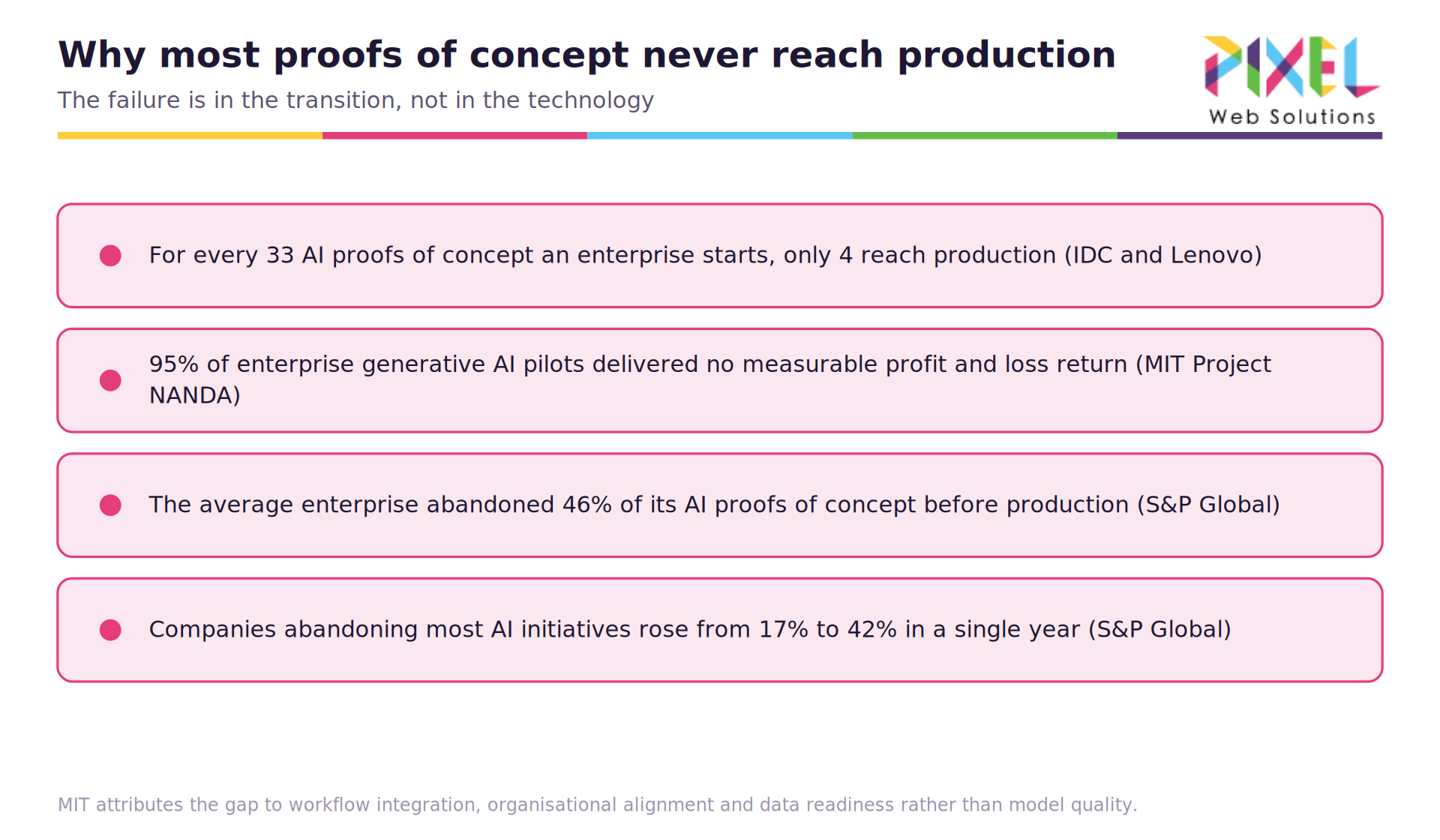
The failure rate is why implementation is a discipline rather than an afterthought. But the widely quoted numbers measure different things, and merging them produces nonsense, so here they are separated.
| Finding | Figure | What it actually measures | Source and date |
| PoC-to-production conversion | 4 of every 33 PoCs reach production, about 12% | Ratio of production deployments to PoCs started | IDC / Lenovo, CIO Playbook 2025, Feb 2025 |
| Projects reaching production | 48% | Share of AI projects that make it, not PoCs | Gartner survey, May 2024 |
| PoCs abandoned before production | 46% on average | Share scrapped within the average enterprise | S&P Global Market Intelligence, 2025 |
| Companies scrapping most AI initiatives | 42% in 2025, up from 17% in 2024 | Organizations abandoning the majority of their work | S&P Global, 1,000+ respondents, NA and Europe |
| GenAI pilots with no measurable P&L return | 95% | Pilots that ran but returned nothing measurable | MIT Project NANDA, Jul 2025 |
Read that table carefully, because the numbers appear to contradict each other and do not. Gartner’s 48 percent and IDC’s 12 percent are not rival estimates of the same quantity. Gartner counted funded projects; IDC counted proofs of concept, of which any given project may spawn several. MIT’s 95 percent is different again: those pilots often shipped, they just did not return anything measurable. A pilot can simultaneously reach production and count toward the 95 percent.
Anyone quoting a single “AI failure rate” without saying which of these they mean is not being careful. The honest summary is that most proofs of concept do not become production systems, and a large share of the ones that do never demonstrate a return.
MIT’s diagnosis is the useful part. The failures are attributed to workflow integration, organizational alignment and data readiness rather than to model quality. Nothing on that list is fixed by choosing a better model, which is why implementation is where the money is won.
What Do AI Implementation Services Include?
AI implementation services cover everything between an approved idea and a working production system: use case scoping and success metric definition, data readiness assessment, prototype development, model and architecture selection, systems integration, evaluation suite construction, guardrails and security review, deployment, monitoring, user training and handover.
Two distinctions are worth being precise about.
Implementation is not strategy. Strategy work is judged on whether the recommendation was sound. Implementation is judged on whether the system runs and the metric moves. If you are earlier than this and still deciding what to build, that is AI consulting work, and our guide to what an AI consultant does covers the full catalogue.
Implementation is not ordinary software delivery. AI systems fail probabilistically rather than deterministically. Conventional software either meets the specification or does not; an AI system is right most of the time, and defining “most” is a deliverable. That is why the evaluation layer exists and why the work of proving quality never entirely ends.
How to Choose the First Workflow
Every version of this roadmap begins “scope exactly one workflow,” and almost none of them say how to pick it. The choice matters more than anything that follows, because a well-chosen first workflow makes the 90 days achievable and a badly chosen one makes it impossible regardless of execution.
Score your candidates on five dimensions and take the highest total, not the most exciting one.
Volume. How often does this happen? Automation overhead only pays back on frequency. A monthly process, however painful, is a poor first candidate.
Ambiguity. How often is the request unclear or the correct answer debatable? Low ambiguity means you can define correct answers, which means you can build a test set, which means you can gate on evidence rather than opinion.
System reachability. Is there an API you can already authenticate against? Not “is there an API” but “can you get credentials this month.” Access requests routinely outlast prototypes.
Reversibility. If the system does the wrong thing, can an ordinary person undo it in minutes? This determines how much autonomy you can safely ship in the first release.
Owner enthusiasm. Is there a person who wants this and will clear blockers? Enthusiasm is not a soft factor here. It is the difference between a data access request answered in two days and one answered in six weeks.
The instinct is to pick the most painful process. Resist it. The most painful process is usually painful precisely because it is ambiguous, low-volume or politically contested, which are the three properties that make it a bad first project. Pick the boring high-volume one, prove the mechanism, and spend the credibility you earn on the hard problem second.
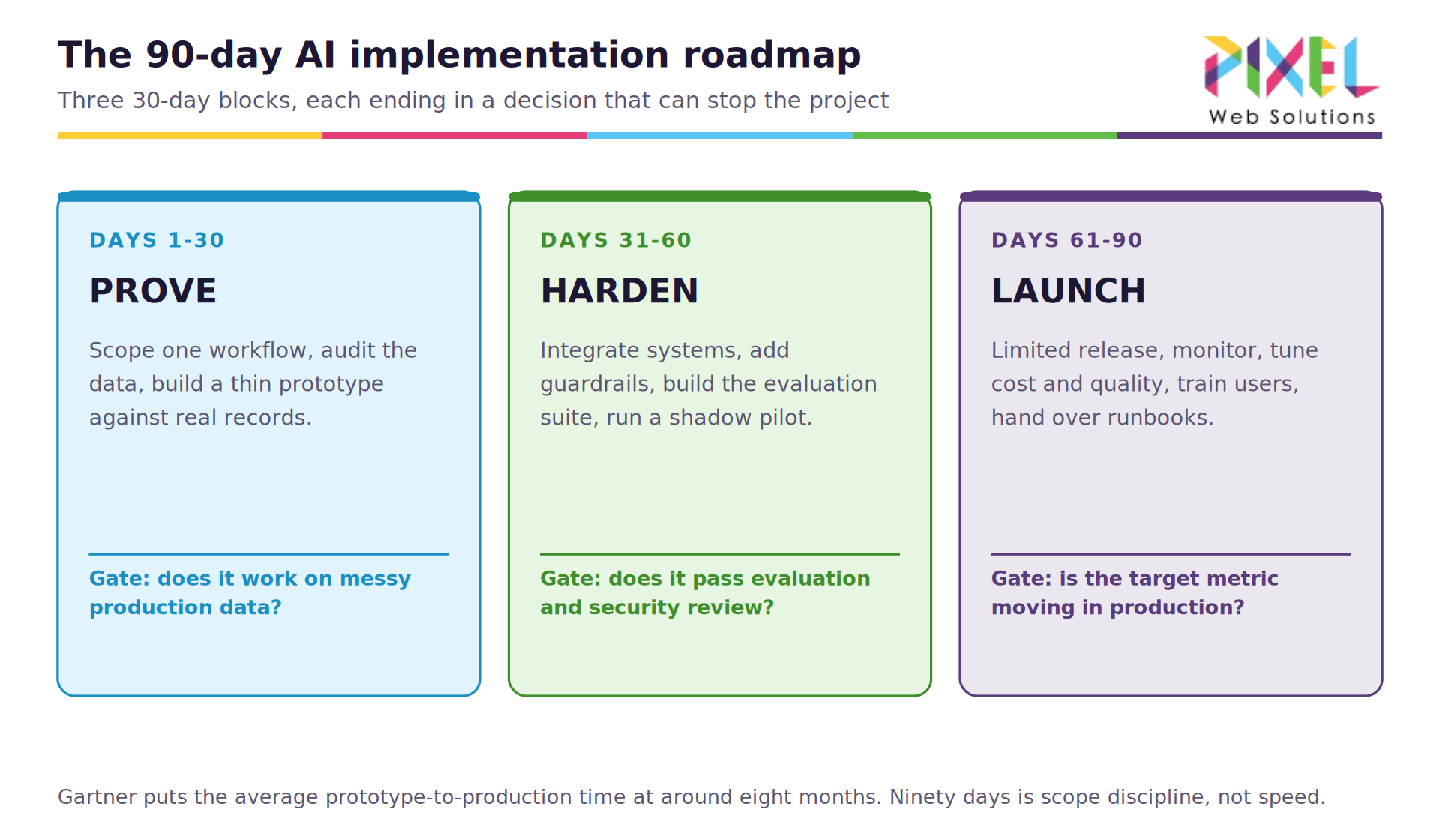
The 90-Day AI Implementation Roadmap
| Phase | Days | What happens | The gate |
| Prove | 1 to 30 | Scope one workflow, audit the data, build a thin prototype, run it on real production records, define the metric and the signer | Does it work on messy real data? |
| Harden | 31 to 60 | Integrate with systems of record, build the evaluation suite, add guardrails and rollback, security and compliance review, shadow pilot | Does it pass evaluation and security review? |
| Launch | 61 to 90 | Limited real traffic, daily monitoring, tuning, user training, runbooks, handover to a named owner | Is the target metric actually moving? |
Days 1 to 30: Prove
Scope exactly one workflow. Audit whether the data behind it is accessible, complete and legally usable. Build a deliberately thin prototype and run it against real production records rather than a curated sample. Define the success metric, the baseline and the person who signs off.
The most common mistake here is demoing on clean data. A prototype that performs beautifully on a hand-picked set and collapses on the real distribution has told you nothing except that the team can build a demo.
Gate at day 30: does it work on messy real data? If accuracy collapses outside the demo set, you have learned that cheaply. Stop or re-scope.
Days 31 to 60: Harden
This is the phase that gets skipped and the reason projects slip.
Integrate with the systems of record so the AI can read and write rather than copy and paste. Build the evaluation suite: a golden test set with regression runs on every prompt or model change. Add guardrails, scoped permissions and rollback. Put it through security and compliance review. Run a shadow pilot where the system operates alongside humans without customers seeing it.
The shadow pilot is the most underrated step on this roadmap. It gives you a disagreement rate against human judgment on live traffic at zero customer risk, and that number is the single best predictor of how launch will go.
Gate at day 60: does it pass evaluation and security review? A shadow pilot that disagrees with human decisions 30 percent of the time is not ready, however good the demo looked. Investigate the disagreements before dismissing them, though. Some will be the humans being wrong, and finding that out is worth the exercise on its own.
Days 61 to 90: Launch
Release to a limited slice of real traffic. Monitor quality, latency and cost daily. Tune prompts, retrieval and thresholds against live behavior. Train the people who will use and supervise it. Write the runbooks. Hand over to a named owner.
Gate at day 90: is the target metric actually moving in production? This is the only gate that counts. The previous two are proxies for it.
What to do when a gate fails
The gates are only useful if failing one is an acceptable outcome. If everyone knows the project continues regardless, they are decoration.
| Gate | If it fails | What that usually means |
| Day 30, works on real data | Re-scope to a narrower slice, or stop | The workflow was broader or more ambiguous than it looked on a whiteboard |
| Day 60, evaluation and security | Extend harden by 2 to 4 weeks, do not launch | Integration or compliance work was underestimated, which is normal and survivable |
| Day 90, metric moving | Keep it in limited release, do not scale | The system works but the workflow or adoption does not, and scaling would multiply the problem |
Failing at day 30 is the cheapest possible outcome and should be treated as a success of the process. A project stopped at day 30 has cost one month and taught you something specific about your data. A project stopped at month eight has cost eight months and taught you the same thing.
The gate to defend hardest is day 60. It is the one under the most commercial pressure, because a launch date has usually been communicated by then, and it is the one whose failure is most expensive to discover afterward.
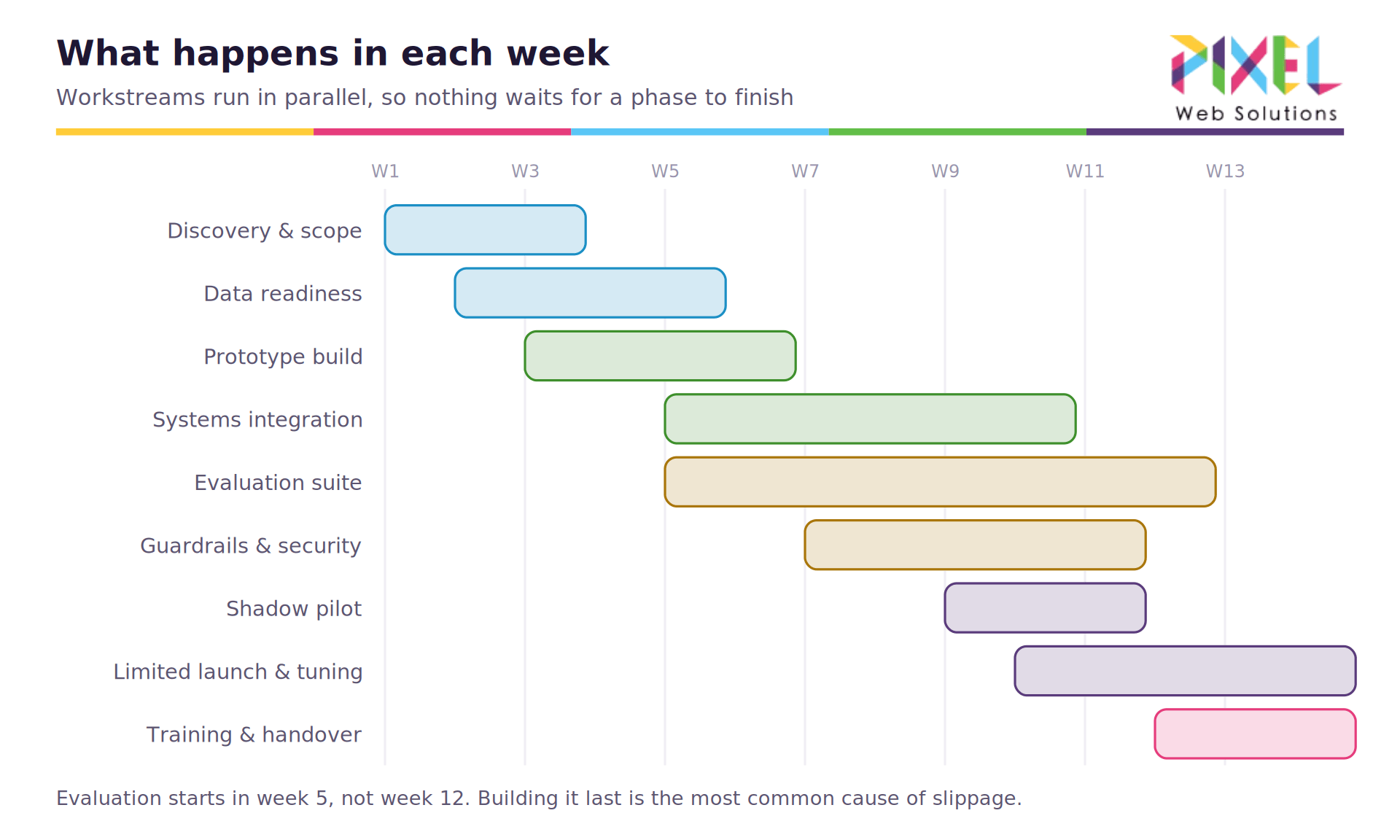
What Happens in Each Week
Workstreams overlap rather than running in sequence. That overlap is most of what makes 90 days possible.
| Workstream | Weeks | Note |
| Discovery and scope | 1 to 2 | Ends with one workflow written down |
| Data readiness | 2 to 5 | Starts before the prototype, not after it |
| Prototype build | 3 to 6 | On real records from the start |
| Systems integration | 5 to 10 | Usually the longest single line |
| Evaluation suite | 5 onward | Never stops. Starting late is the classic error |
| Guardrails and security | 7 to 11 | Security engaged from week 2, not week 7 |
| Shadow pilot | 9 to 11 | Live traffic, no customer exposure |
| Limited launch and tuning | 10 to 14 | Overlaps the shadow pilot deliberately |
| Training and handover | 12 to 13 | The step most often compressed to nothing |
The single most common cause of slippage is treating evaluation as a final step. Starting it in week five is what makes the day-60 gate meaningful, because without a test set there is nothing to gate against.
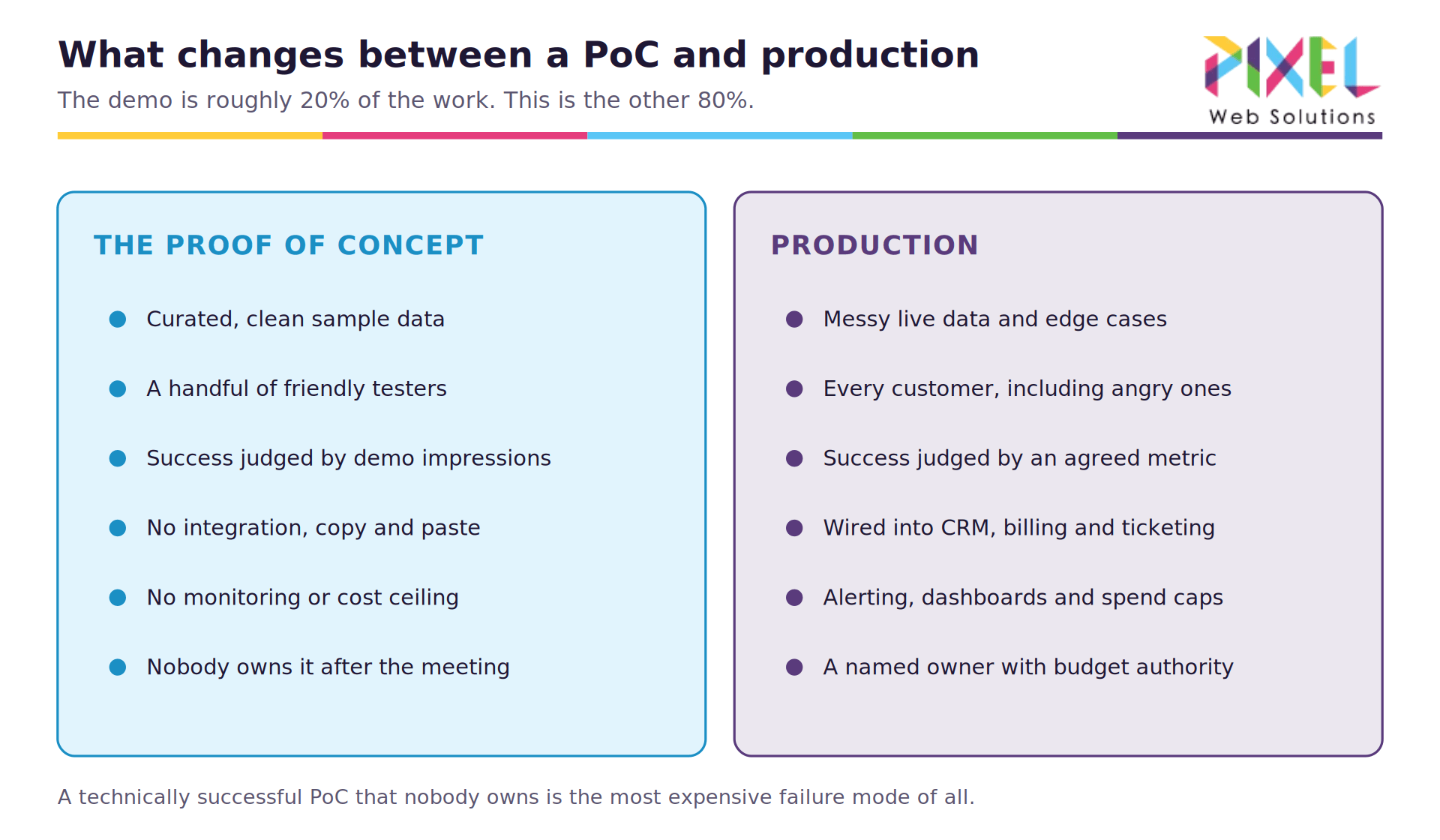
What Changes Between a PoC and Production
| Proof of concept | Production | |
| Data | Curated sample | Live, messy, full of edge cases |
| Users | Friendly testers | Every customer, including the angry ones |
| Integration | None, or manual | Read and write to CRM, billing, ticketing |
| Success measured by | How impressed the room was | An agreed metric against a baseline |
| Monitoring | None | Quality, latency and cost, with alerting |
| Failure handling | Someone notices | Runbooks, escalation, rollback |
| Ownership | The project team | A named owner with budget authority |
The demo is roughly a fifth of the work. The most expensive failure mode is a technically successful PoC that nobody owns, because it consumes budget and credibility while producing nothing, and it makes the next proposal harder to fund.
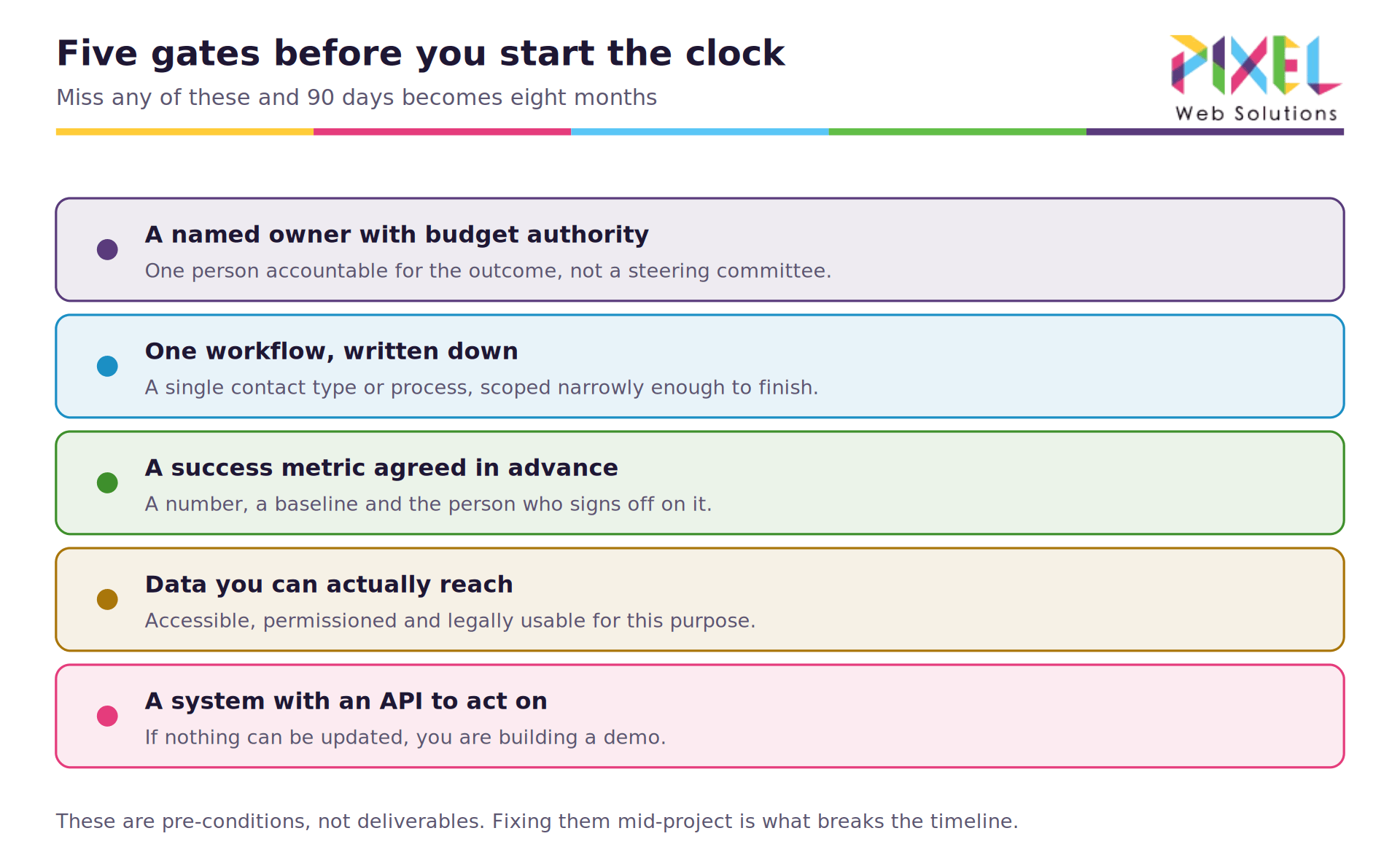
Five Gates Before You Start the Clock
Ninety days assumes these already exist. Fixing them mid-project is precisely what turns 90 days into eight months.
| Gate | What it means | Why it breaks timelines |
| A named owner with budget authority | One accountable person, not a steering committee | Committees cannot clear blockers at the speed this needs |
| One workflow, written down | A single contact type or process | Scope that grows in week four eats the harden phase |
| A success metric agreed in advance | A number, a baseline, and a signer | Without it, day 90 has no verdict |
| Data you can actually reach | Accessible, permissioned, legally usable | Access requests routinely take longer than the build |
| A system with an API to act on | Something that can be updated | Otherwise you are building a demo, not an implementation |
Scoping these correctly is the main job of a discovery sprint, which is where our AI consulting services begin before any implementation work is quoted.
What Does AI Implementation Cost?
| Phase | Typical range | What drives the number |
| Discovery and readiness sprint | USD 25,000 to 75,000 | Number of workflows assessed, data audit depth |
| Prototype / PoC | USD 20,000 to 60,000 | One use case, real data access |
| Production build (days 31 to 90) | Highly variable, commonly the largest line | Integration count, compliance, legacy system condition |
| Managed support after handover | Monthly retainer | System count, usage volume, retraining cadence |
By firm tier, hourly rates in 2026 run roughly USD 150 to 300 for specialist and boutique firms, USD 300 to 500 for mid-tier consultancies, and USD 500 and above for tier-one houses. These are compiled from published 2026 rate guides rather than audited data, they skew toward US and UK pricing, and offshore delivery sits materially below them. The same figures appear in our AI consultant guide, deliberately, so the two pages do not quote different numbers.
Three things move the price far more than model choice. How many systems the AI must write to. What condition the data is in. Whether the use case is regulated. A vendor quoting before auditing your data is quoting a template.
One cost line behaves unlike normal software: running cost rises with usage rather than falling per user as you scale. Model the inference bill at ten times pilot volume before the production build, not after the first full month’s invoice.
What Does Production Ready Actually Mean?
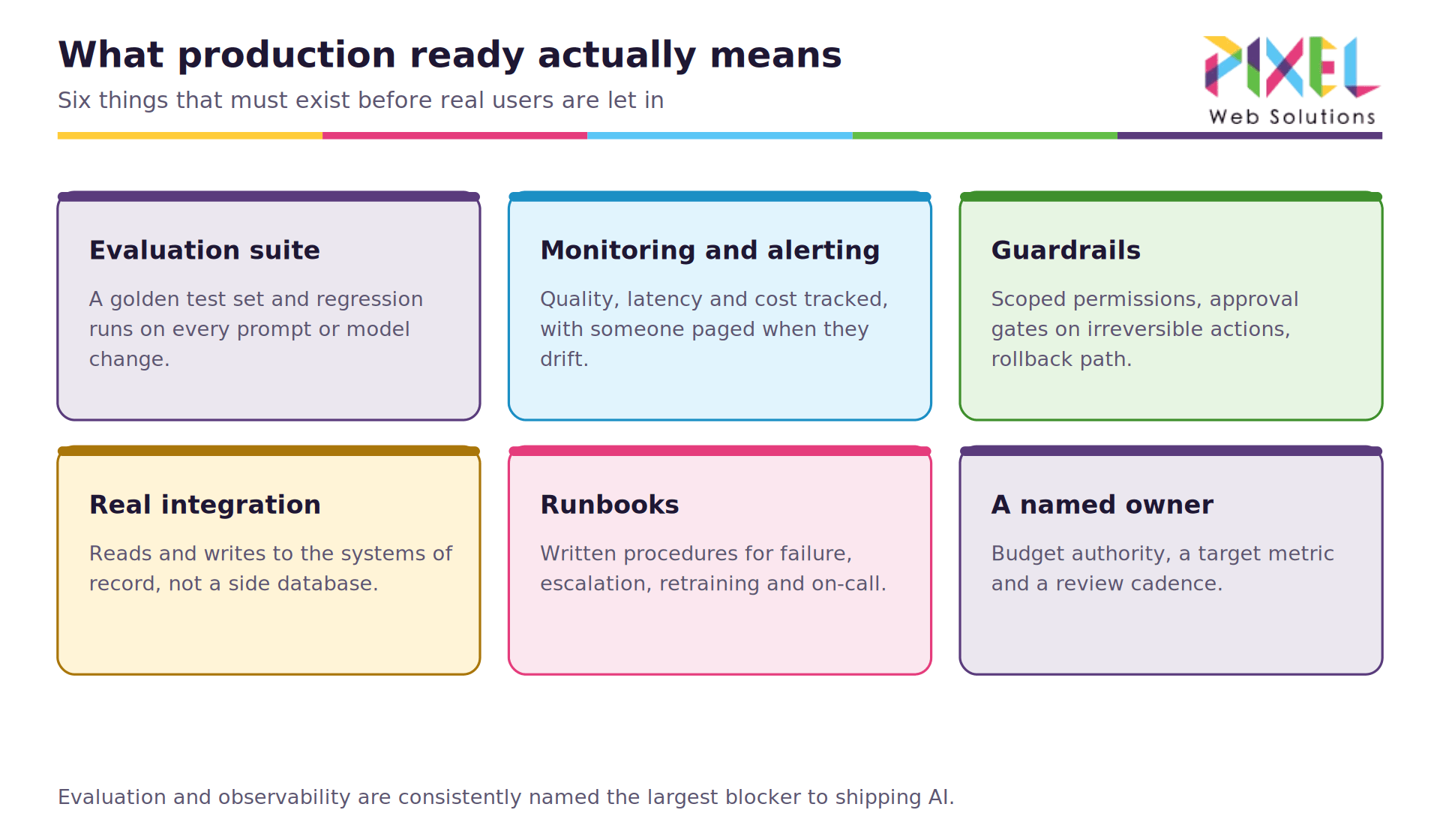
Six things must exist before real users are let in.
| Component | What good looks like |
| Evaluation suite | A golden test set with regression runs on every prompt or model change |
| Monitoring and alerting | Quality, latency and cost tracked, with someone paged when they drift |
| Guardrails | Scoped permissions, approval gates on irreversible actions, tested rollback |
| Real integration | Reading and writing to systems of record, not a side database needing reconciliation |
| Runbooks | Written procedures for failure, escalation, retraining and on-call |
| A named owner | With budget authority, a target metric and a review cadence |
Evaluation and observability are consistently the items teams underestimate, largely because neither produces anything a stakeholder can see in a demo. They are also the two that determine whether the system is still working in month twelve.
For systems that take actions autonomously rather than only producing answers, the guardrail requirements go considerably further. Our guide to agentic AI for customer service covers permissions, approval gates and the autonomy ladder in detail.
Who You Need on the Team
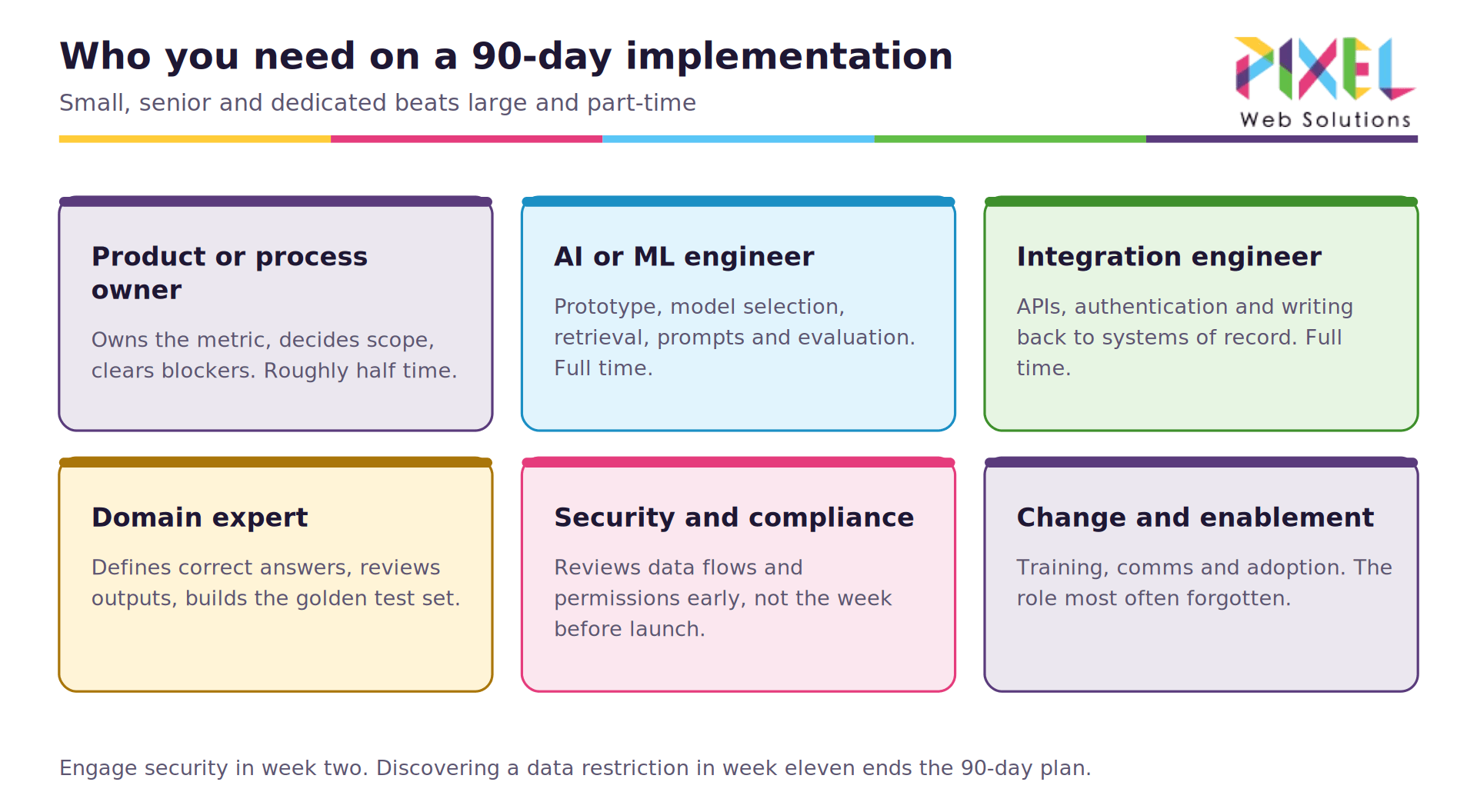
Small, senior and dedicated beats large and part-time.
| Role | Commitment | Owns |
| Product or process owner | ~50% | The metric, and clearing blockers |
| AI / ML engineer | Full | Prototype, retrieval, prompts, evaluation |
| Integration engineer | Full | APIs, authentication, writing back to systems of record |
| Domain expert | Part | Defining correct answers, building the golden test set |
| Security and compliance | From week 2 | Review, data residency, risk tiering |
| Change and enablement | Part | Training, adoption, whether anyone actually uses it |
The last row is the one most often left off the plan and the one that most often determines whether the finished system returns anything. A correctly built system that nobody adopts scores perfectly on every technical metric and returns nothing.
Engaging security late is a classic 90-day killer. Discovering a data residency restriction in week eleven does not delay the plan, it ends it. Week two is not early; it is on time.
How to Protect the Timeline
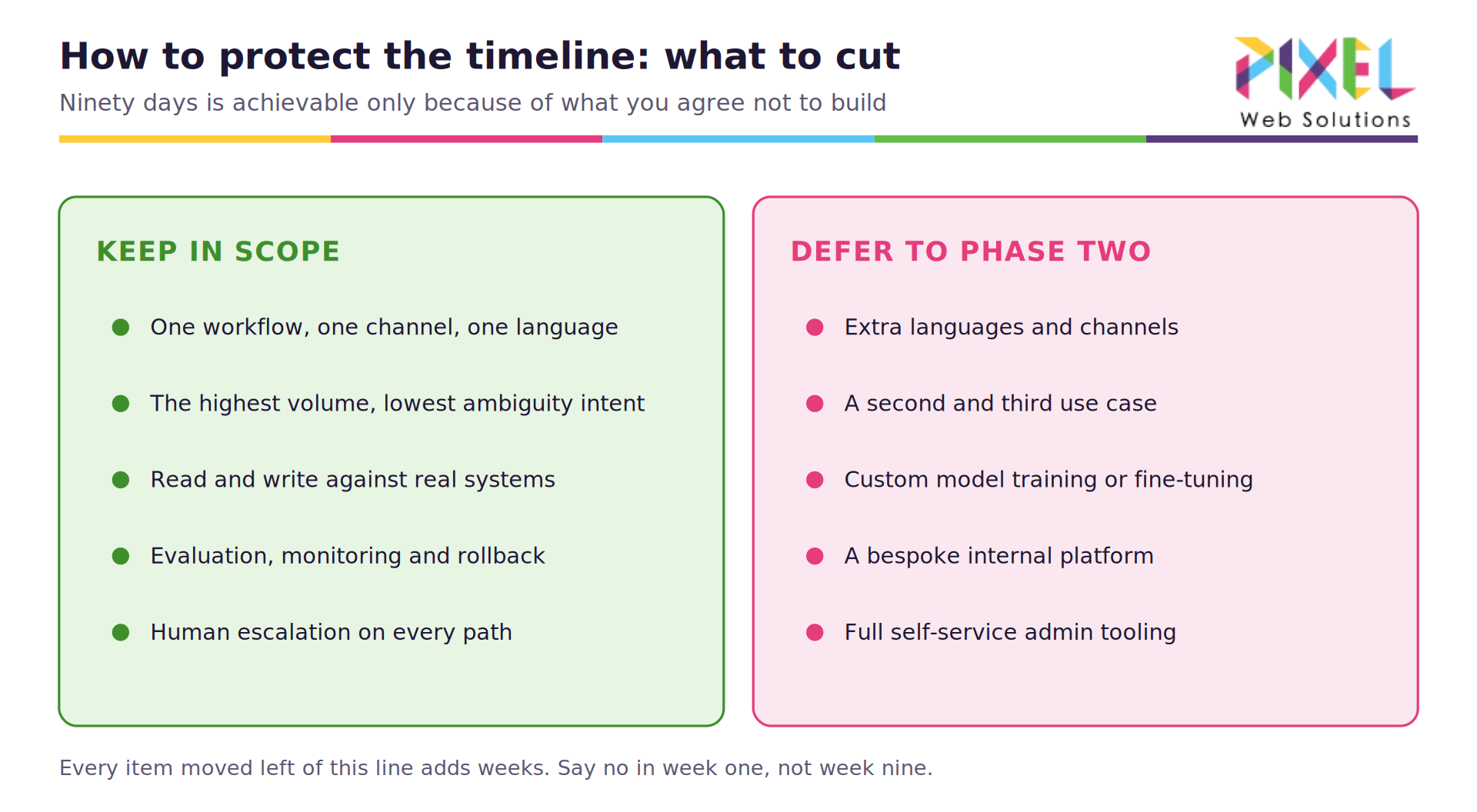
Ninety days is achievable only because of what you agree not to build.
| Keep in scope | Defer to phase two |
| One workflow, one channel, one language | Additional languages and channels |
| The highest-volume, lowest-ambiguity intent | A second and third use case |
| Read and write against real systems | Custom model training |
| Evaluation, monitoring and rollback | A bespoke internal platform |
| Human escalation on every path | Full self-service admin tooling |
Every item in the right-hand column is a reasonable ask, and every one adds weeks. The time to say no is week one, when it costs a conversation. In week nine it costs the timeline.
How the Timeline Actually Slips
Slippage is rarely one large event. It is a predictable sequence of small ones, and each has a week where it typically surfaces.
| Slip | Usually surfaces | Cost | Prevention |
| Data access not yet granted | Week 2 to 4 | 2 to 6 weeks | Treat access as a gate, not a task. Start it before day 1 |
| Scope grows by one “small” addition | Week 4 | 1 to 3 weeks each | Agree the deferred list in week 1 and point at it |
| Evaluation started late | Week 10 | 2 to 4 weeks | Start it in week 5, before there is anything to evaluate |
| Security review begins late | Week 9 to 11 | 2 weeks to fatal | Engage in week 2. Data residency findings can end the project |
| Integration harder than scoped | Week 6 to 8 | 2 to 5 weeks | Spike the hardest integration in week 1, not week 6 |
| No decision-maker available at a gate | Gate weeks | 1 to 2 weeks each | Book the three gate reviews in week 1, in their calendars |
Notice that four of the six are preventable in week one by doing something administrative rather than technical. That is the honest shape of this work: the engineering is rarely the bottleneck, and the schedule is mostly won or lost in scoping.
The most dangerous of the six is late security engagement, because it is the only one whose worst case is not a delay. Discovering in week eleven that the data cannot legally leave a jurisdiction does not push the date. It ends the plan and sends you back to architecture.
When 90 Days Is the Wrong Target
Some implementations should not be compressed, and a partner who tells you so is worth more than one who agrees to the date.
Highly regulated use cases with formal model validation requirements. Systems making consequential decisions about people, where the review burden is the point rather than an obstacle. Projects where the data foundation genuinely needs rebuilding first, which is common and rarely admitted. And anything requiring custom model training on proprietary datasets.
In those cases the honest plan is a 90-day phase one that proves feasibility and builds the evaluation harness, with production following on a realistic schedule afterward. You still get a gate at day 90; it just answers a different question.
A vendor who promises 90 days regardless of what you describe is selling a template rather than an assessment. The correct response to a scoping conversation is sometimes a longer number.
Conclusion
AI implementation services exist because the gap between a working demo and a working system is where most enterprise AI value is lost. With roughly four in every 33 proofs of concept reaching production, and 95 percent of pilots showing no measurable return, the discipline that matters is not model selection. It is scope, evaluation and ownership.
Ninety days is realistic for one narrow, well-scoped workflow where the five readiness gates are already cleared. It is unrealistic for anything broader, and the fastest way to turn it into eight months is to start before those gates exist.
If you are deciding which workflow should be first and whether it is ready to start, our AI consulting services run that assessment as a fixed-scope discovery sprint before any build commitment.
FAQ
Q: What are AI implementation services?
AI implementation services take a use case from approved idea to running production system. They cover use case scoping and success metrics, data readiness assessment, prototyping, model and architecture selection, systems integration, evaluation suites, guardrails, security review, deployment, monitoring, training and handover. They are judged on whether the system runs and the metric moves, not on whether the strategy was sound.
Q: Can AI really be implemented in 90 days?
For one narrow, well-scoped workflow, yes. Gartner’s survey puts the average prototype-to-production time at around eight months, so 90 days requires a single use case, pre-existing data access, an agreed success metric and a named owner from day one. Broad multi-use-case programs, regulated decision systems and projects needing the data foundation rebuilt take considerably longer, and a partner who agrees to 90 days regardless of scope is selling a template.
Q: Why do most AI proofs of concept fail to reach production?
IDC and Lenovo’s CIO Playbook 2025 found only four of every 33 proofs of concept reach production, about 12 percent. MIT’s Project NANDA attributes failures to workflow integration, organizational alignment and data readiness rather than model quality. The most common specific causes are no agreed success metric, no named owner, data that cannot legally or technically be reached, and evaluation treated as a final step instead of a parallel workstream.
Q: What percentage of AI projects actually fail?
It depends entirely on what is being counted, and the widely quoted figures measure different things. IDC and Lenovo found about 12 percent of proofs of concept reach production. Gartner found 48 percent of AI projects make it to production, a different denominator. S&P Global found the average enterprise scrapped 46 percent of its PoCs. MIT found 95 percent of generative AI pilots produced no measurable profit and loss return, which includes pilots that did reach production. Any single “AI failure rate” quoted without that context is misleading.
Q: What is the difference between an AI PoC and a production system?
A proof of concept runs on curated data with friendly testers, no integration and no monitoring. Production runs on live messy data with every customer, integration into systems of record, evaluation and regression testing, alerting and cost caps, guardrails with a rollback path, and a named owner accountable for the outcome. The PoC is roughly 20 percent of the total work.
Q: What does production ready mean for an AI system?
It means an evaluation suite with a golden test set and regression runs, monitoring for quality, latency and cost with alerting, guardrails including scoped permissions and a tested rollback, real integration with systems of record, written runbooks for failure and escalation, and a named owner with budget authority and a review cadence.
Q: How much do AI implementation services cost?
Discovery and readiness sprints commonly run USD 25,000 to 75,000, and a scoped prototype USD 20,000 to 60,000. The production build is usually the largest line and varies most, driven by how many systems the AI must write to, the condition of the data, and whether the use case is regulated. Hourly rates in 2026 run roughly USD 150 to 300 at specialist firms and USD 500 and above at tier-one houses. Running cost rises with usage rather than falling per user, so model the inference bill at ten times pilot volume before committing.
Q: Who needs to be involved in an AI implementation?
A process owner accountable for the metric at roughly half time, an AI or ML engineer, an integration engineer, a domain expert who defines correct answers and builds the test set, security and compliance engaged from week two, and someone owning training and adoption. Small and dedicated outperforms large and part-time, and late security involvement is one of the most common causes of delay.
Q: How long does AI implementation take on average?
Gartner measured about eight months from prototype to production as the average. Ninety days is achievable on a single narrow workflow with pre-cleared readiness gates. The gap between the two is mostly explained by scope, by whether data access existed before the project started, and by whether evaluation ran as a parallel workstream or as a final step.