Table of Contents
Two numbers define the state of AI in customer service right now, and they point in opposite directions.
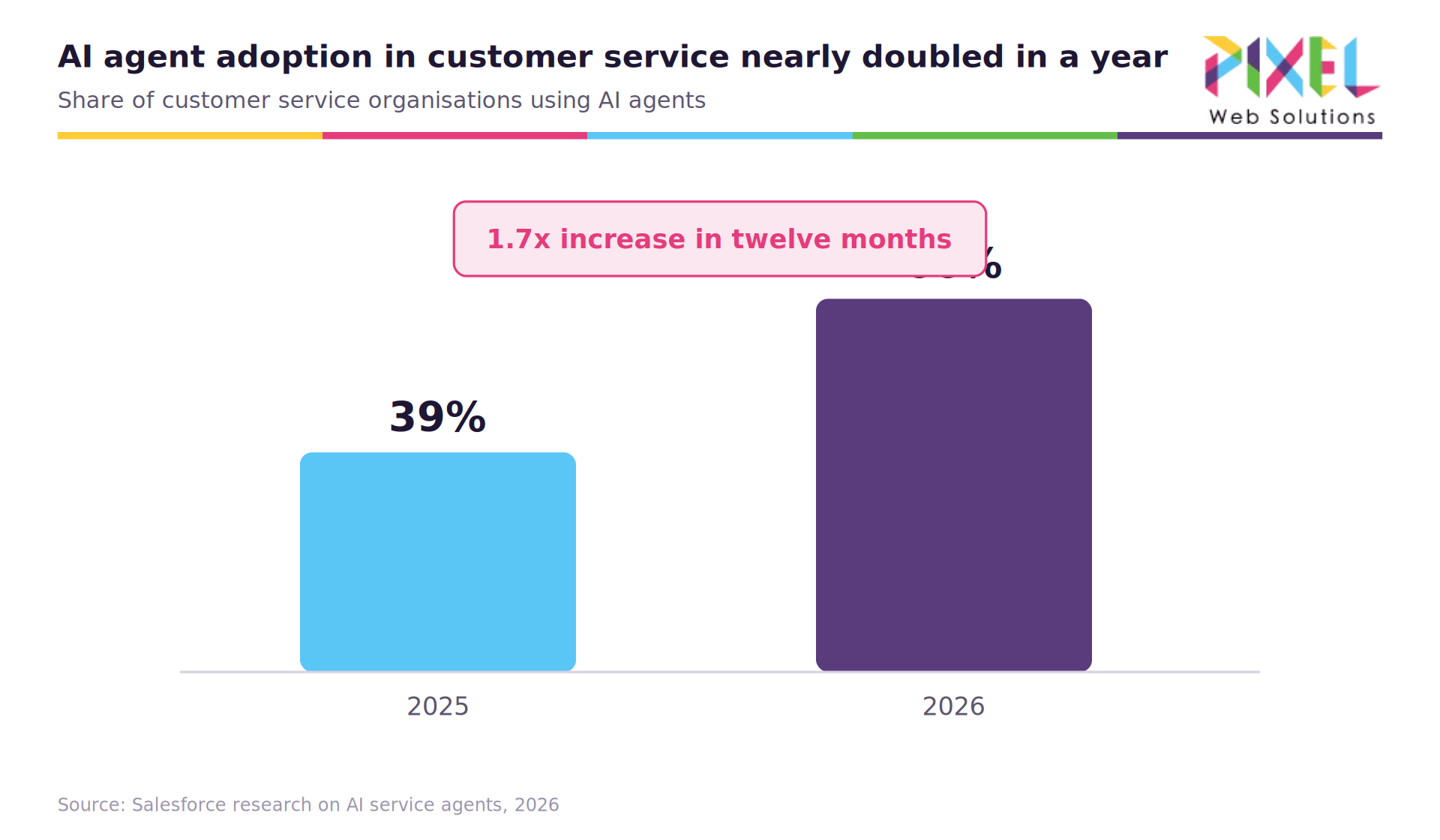
Salesforce’s State of Service: AI Agents Edition, a survey of 3,075 customer service professionals published in 2026, found that the share of service organizations using AI agents rose from 39 percent in 2025 to 66 percent in 2026. Seventy percent of adopters reported measurable value within 60 days.
Gartner, surveying 5,728 customers, found that only 14 percent of customer service issues are fully resolved in self-service.
Both findings are sound. The gap between them is not a contradiction, it is a description of where the money is won and lost. Organizations are adopting fast and many are getting value quickly, while a large share of customers still end up somewhere else to finish the job they started. This guide covers what AI actually does inside a support operation, the seven benefits worth building a business case around, the evidence behind each one, the most thoroughly documented real deployment and what happened to it over three years, what it costs once hidden lines are included, how to measure it honestly, and where it still falls short.
What Does AI in Customer Service Actually Do?
AI in customer service covers any system that uses machine learning or large language models to interpret a customer request and either help an agent answer it or answer it directly. In practice it appears in three distinct modes, and confusing them is the most common reason these projects disappoint.
Assist, deflect and resolve are not the same thing
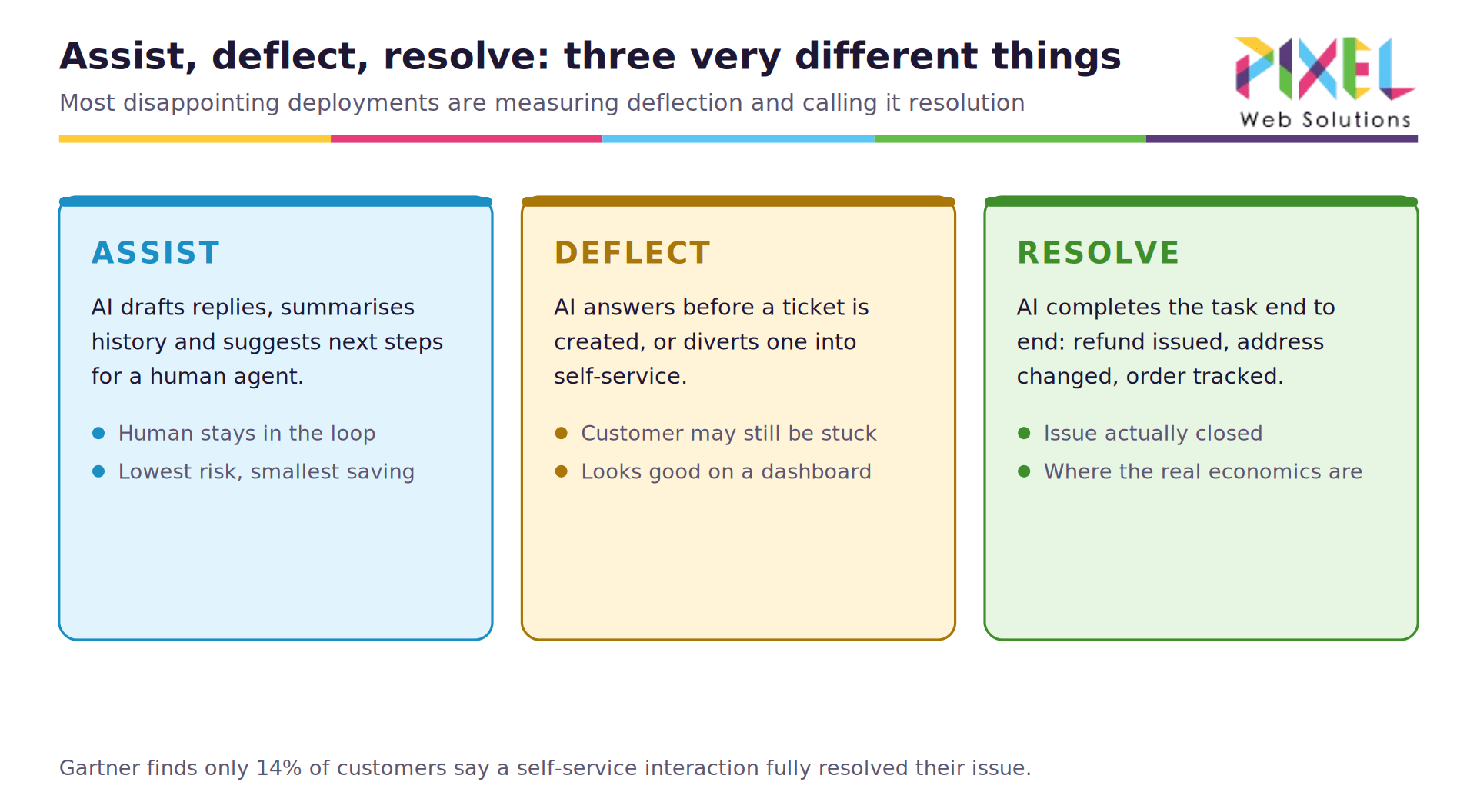
Assist means the AI drafts replies, summarizes ticket history and suggests next steps while a human stays in control. It is the lowest risk mode and produces the smallest direct saving, but it is also the fastest way to generate real conversation data and build agent trust.
Deflect means the AI answers before a ticket is created, or routes the customer into self-service. This mode flatters the dashboard because contact volume falls, but the customer may still be stuck. Deflection is the metric most responsible for AI projects that look successful internally and feel bad externally.
Resolve means the AI completes the task end to end: the refund is issued, the address is changed, the subscription is cancelled. This is where the economics actually live, and it requires the AI to hold authenticated access to your order, billing and CRM systems, not just your help center. The gap between deflect and resolve is almost always an integration gap rather than a model gap.
| Mode | What the AI does | What it needs | Typical saving | Main risk |
| Assist | Drafts, summarizes, suggests | Ticket history, knowledge base | Handle time, 10 to 20 percent | Agents ignore it |
| Deflect | Answers before a ticket exists | Clean, complete help content | Contact volume, highly variable | Customer still stuck, contacts again |
| Resolve | Completes the task end to end | Authenticated API access to core systems | Cost per resolved issue, 40 to 70 percent | Wrong action taken on a real account |
That third row is the one worth building toward. It is also the one that turns an AI customer service project into a systems integration project, which is why scoping matters more than model selection. If you are planning this work, AI agent development and AI chatbot development describe two different depths of build, and the difference is mostly how far into your systems the AI is allowed to reach.
What Are the Benefits of AI in Customer Service?
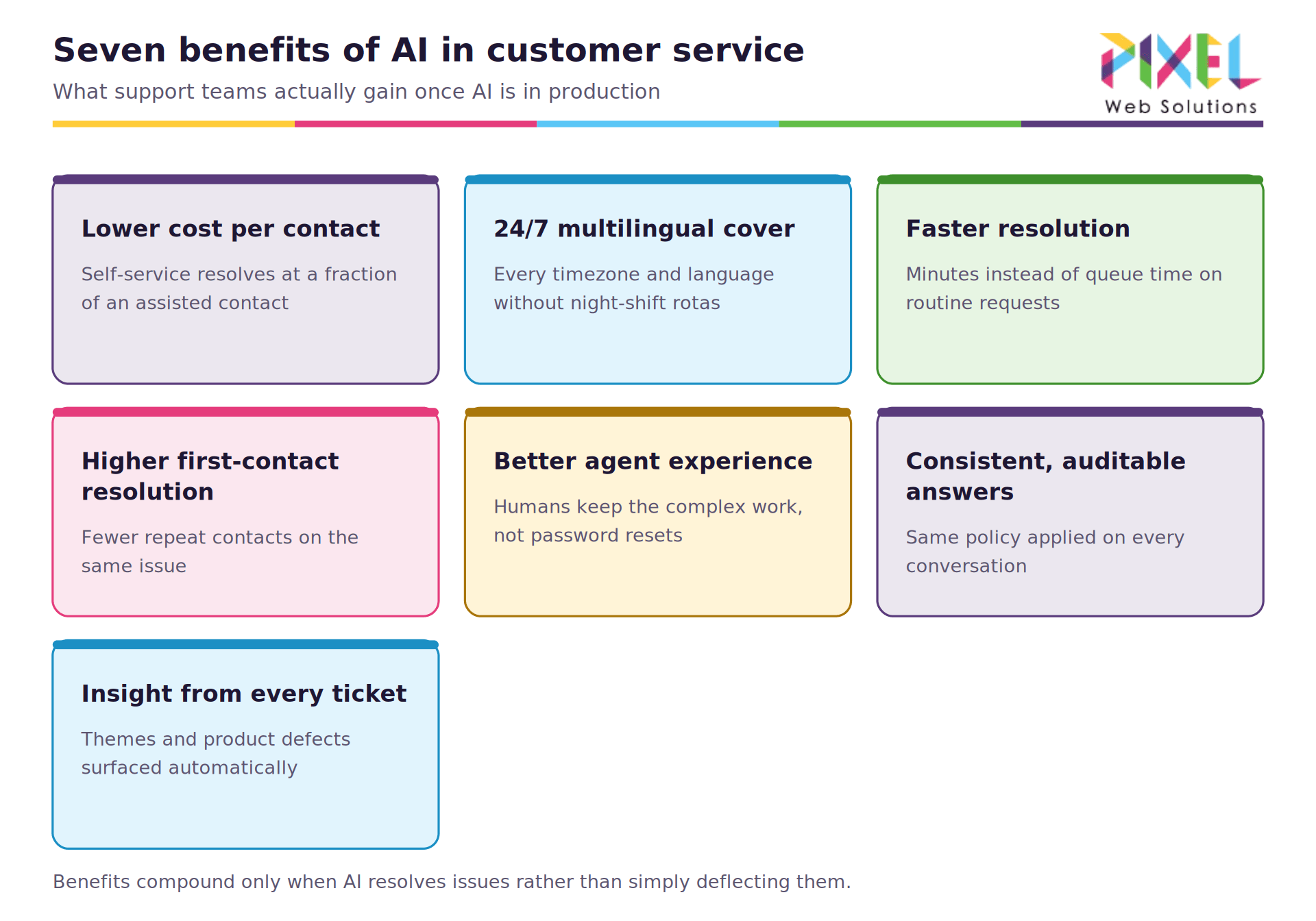
1. Lower cost per contact
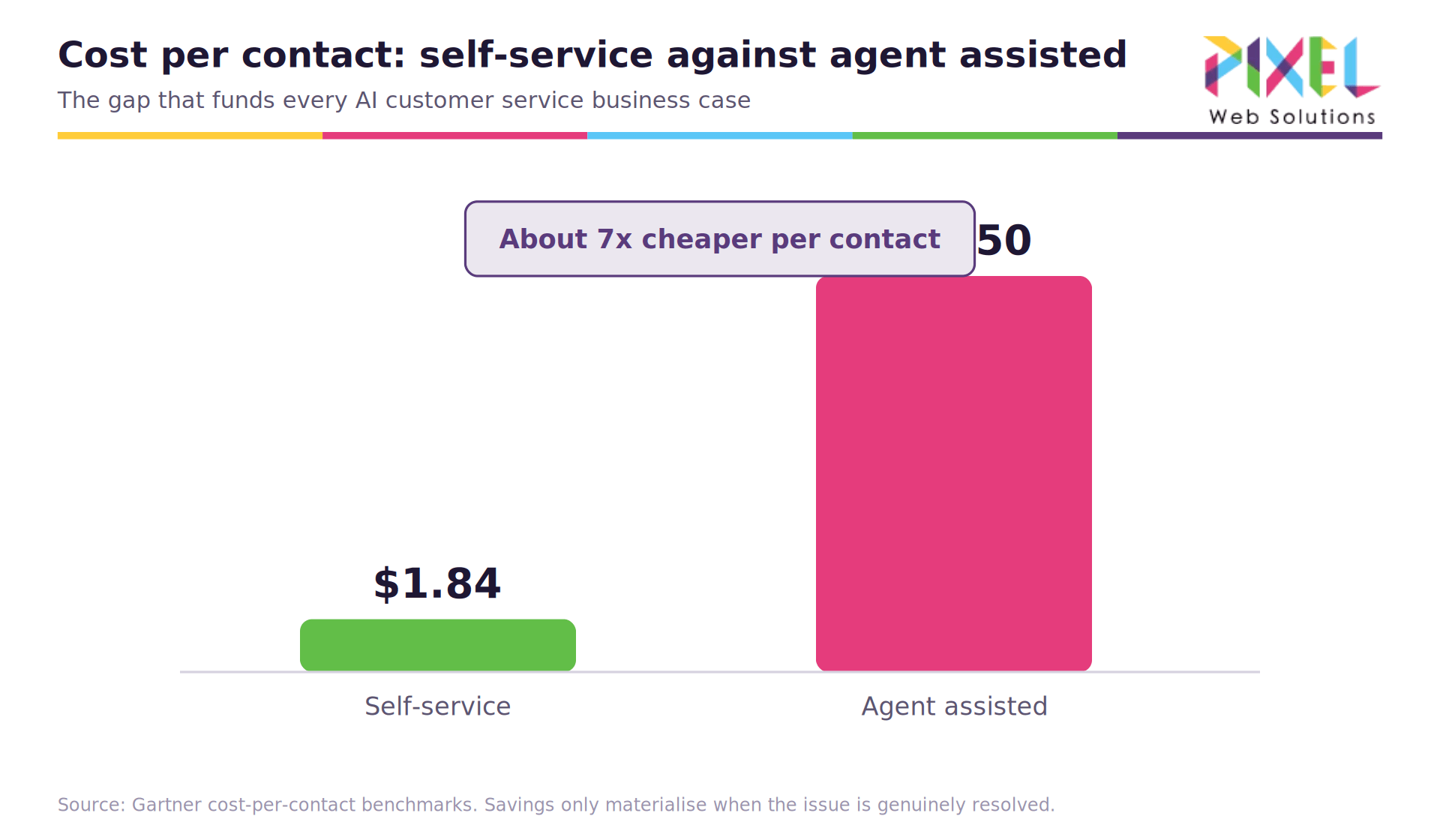
This is the headline benefit and the one finance cares about. Gartner’s benchmark, published in its Benchmarks to Assess Your Customer Service Costs research, puts the median self-service contact at USD 1.84 against USD 13.50 for an agent-assisted contact. That is roughly a seven-fold difference.
The saving is real but conditional in a way most business cases skip: it only counts when the issue does not come back. A deflected contact that returns as a phone call has cost you USD 1.84 plus USD 13.50, not USD 1.84. This single point is the difference between a business case that survives its first annual review and one that does not.
2. Continuous coverage in every language
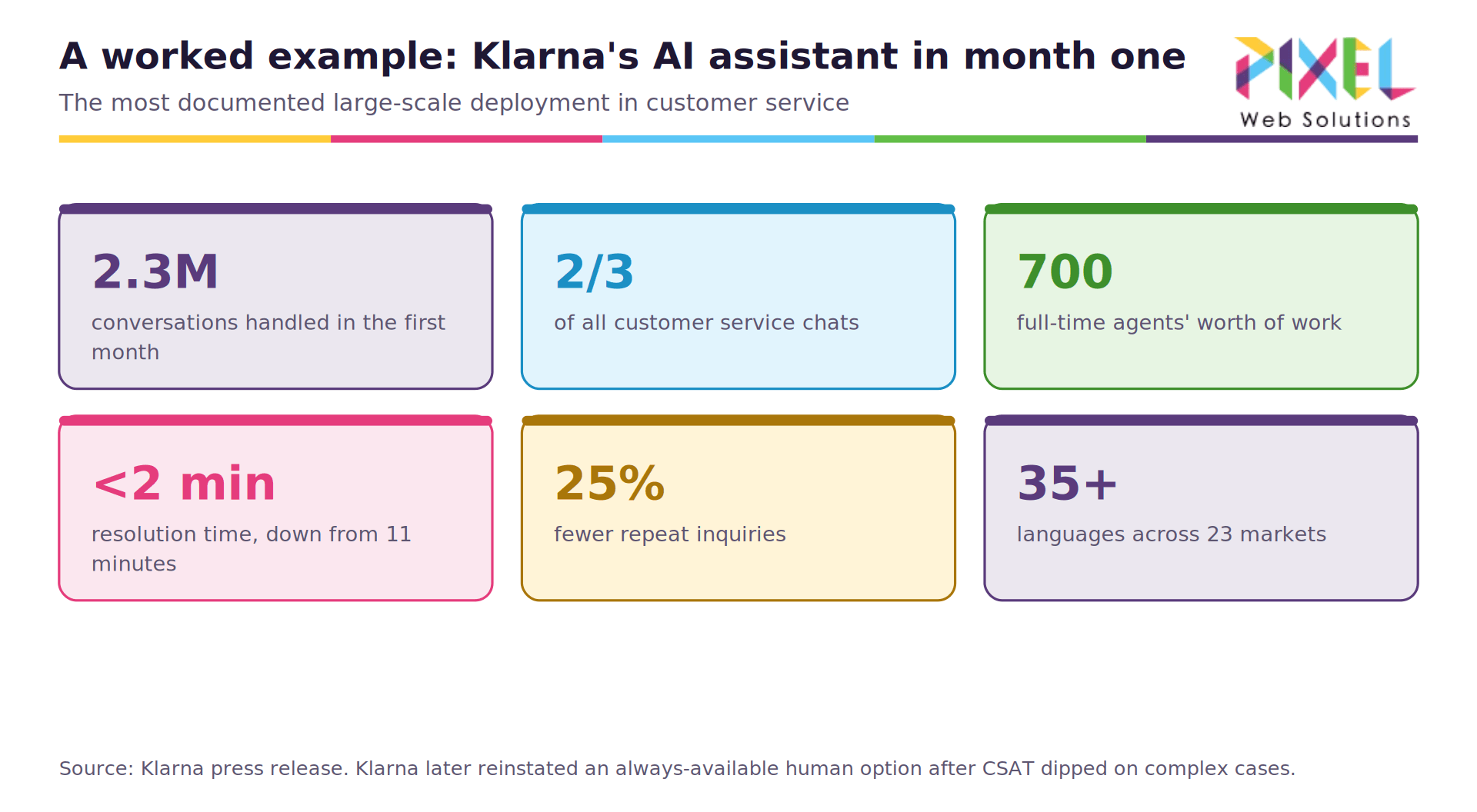
An AI assistant does not need a night shift, a weekend rota or a separate team per market. Klarna’s assistant operates across 23 markets and communicates in more than 35 languages, a level of coverage most support organizations could not staff at any price. For companies expanding into new markets, this often matters more than the cost saving, because it removes a hiring dependency from the expansion plan entirely.
3. Faster resolution
Queue time disappears for routine requests. Klarna reported average resolution falling from 11 minutes to under 2 minutes after deploying its AI assistant, and by its Q3 2025 update was reporting response times 82 percent faster than before the deployment. Speed compounds: faster resolution reduces the follow-up contacts that customers make simply because they have not heard back.
4. Higher first-contact resolution
Well-built AI applies the same policy consistently and does not forget a step or misremember an exception. Klarna reported a 25 percent drop in repeat inquiries. That number matters more than raw deflection, because repeat contacts multiply cost against every other benefit on this list.
5. Better work for human agents
When AI absorbs password resets and order-status checks, agents spend their time on cases that need judgment. Salesforce found that after deploying AI agents, the KPI service organizations most often reported improving was customer satisfaction, ranking ahead of rep productivity, average handle time, customer retention and first-response time.
That ordering is worth pausing on. The most common fear about AI in service is that it degrades the customer experience to save money. The largest available survey of practitioners reports the opposite as the most common outcome, which does not make it universal but does put the burden of evidence on the other side.
6. Consistent, auditable answers
Every conversation follows the same policy and leaves a log. For regulated industries this is frequently a larger benefit than cost, because it makes service decisions reviewable after the fact. A human agent’s reasoning is reconstructable only from notes; an AI system’s is reconstructable from the full transcript, the retrieved sources and the actions taken.
7. Insight from every conversation
AI can classify and cluster 100 percent of contacts rather than the small sample a QA team can read. Recurring product defects, confusing pricing pages and broken signup flows surface as ranked data instead of anecdote. Several teams find this becomes the most valuable output of the deployment within a year, because it redirects engineering and product work toward the things actually generating contacts. Retrieval infrastructure built for the assistant, covered under RAG development services, usually turns out to be reusable for this analysis layer.
AI in Customer Service Statistics for 2026
Every figure below is linked to its primary source and dated, because several widely circulated versions of these numbers are misattributed or mis-stated.
| Statistic | Figure | Source and date |
| AI agent adoption in service organizations | 39% in 2025 to 66% in 2026, a 1.7x rise | Salesforce, State of Service: AI Agents Edition, 3,075 respondents, 2026 |
| Time to measurable value | 70% of adopters within 60 days | Salesforce, same study |
| Cost per contact, self-service | USD 1.84 median | Gartner, Benchmarks to Assess Your Customer Service Costs, Feb 2024 |
| Cost per contact, agent-assisted | USD 13.50 median | Gartner, same research |
| Issues fully resolved in self-service | 14% | Gartner survey of 5,728 customers, fielded Dec 2023, published Aug 2024 |
| Resolution rate on “very simple” issues | 36% | Gartner, same survey |
| Customers who use self-service at some point | 73% | Gartner, same survey |
| Autonomous resolution forecast | 80% of common issues by 2029, cutting operational costs 30% | Gartner prediction, Mar 2025 |
| Agentic AI project cancellations | over 40% canceled by end of 2027 | Gartner prediction, Jun 2025 |
| Service staff rehiring | 50% of companies that cut staff citing AI will rehire by 2027 | Gartner prediction, Feb 2026 |
| Service leaders who actually cut staff due to AI | 20% | Gartner survey of 321 service leaders, Oct 2025 |
| Market size | USD 12.06bn in 2024 to USD 47.82bn by 2030, 25.8% CAGR | MarketsandMarkets, AI for Customer Service Market |
A correction worth carrying forward. v1 of this article stated the market at “USD 15.12 billion in 2026, growing at a 25.8 percent CAGR to USD 47.82 billion by 2030.” Those numbers cannot all be true together: 15.12 growing to 47.82 over four years implies a 33 percent CAGR, not 25.8 percent. The actual MarketsandMarkets series runs from USD 12.06 billion in 2024 to USD 47.82 billion in 2030, which does compound at 25.8 percent over six years. The USD 15.12 billion figure is the 2025 point on that curve, not 2026. The corrected version is in the table above.
On the age of the 14 percent figure. It comes from a survey fielded in December 2023 and published in August 2024, which makes it roughly two and a half years old at the time of writing. It predates the current generation of service AI almost entirely. It remains the most rigorous public measurement of customer-side resolution available, and no comparable study has superseded it, so it belongs in the business case. But it should be cited as what it is: a strong baseline measurement of the self-service era, not a verdict on 2026 agentic systems. Anyone presenting it as current evidence against modern deployments is overreaching, and anyone ignoring it is skipping the only real customer-side resolution data that exists.
A Real Example of AI in Customer Service: Klarna, 2024 to 2026
Klarna’s assistant, built with OpenAI, is the most thoroughly documented large-scale deployment available, and it is more useful now than it was in 2024 precisely because we can see all three acts.
Act one, February 2024. In its first month, the assistant handled 2.3 million conversations, two-thirds of all customer service chats, doing work the company equated to 700 full-time agents. Customer satisfaction scored on par with human agents, repeat inquiries fell 25 percent, and resolution time dropped from 11 minutes to under 2. Klarna estimated a USD 40 million profit improvement for the year. This is the phase everyone quotes.
Act two, May 2025. Klarna reversed course on the staffing question. Having reduced customer service headcount from roughly 5,000 to 3,500, CEO Sebastian Siemiatkowski told Bloomberg that cost had become too dominant a factor in the decision and that the result was lower quality. The company began recruiting human agents again, specifically for complex and emotionally charged cases where the assistant underperformed. This is the phase most articles either omit or use to declare the whole thing a failure.
Act three, 2026. Neither reading holds up. By its Q3 2025 update Klarna reported the assistant doing the work of 853 agents and delivering roughly USD 60 million in annual savings, with response times 82 percent faster than pre-AI and customer NPS at 73. In June 2026 Siemiatkowski settled on the framing the deployment had arrived at: in a world where AI handles the most routine service, human service becomes close to a premium offering. AI on the front line, humans on exceptions, and the human option treated as valuable rather than as a cost failure.
The lesson is not that AI failed at Klarna. The savings are larger now than they were during the phase everyone quotes. The lesson is that the escalation path is part of the product rather than an afterthought, and that headcount reduction is a possible consequence of a good deployment rather than a sound design goal for one.
It is also worth being explicit about why Klarna’s numbers are hard to copy. The company has authenticated fintech users, extremely high-volume structured intents, and a deep model partnership. A B2B software company with ambiguous, technical tickets should expect a slower curve and a higher permanent human floor. Treat Klarna as a demonstration of the mechanism, not as a forecast of your own resolution rate.
What Does AI Customer Service Actually Cost?
Pricing models
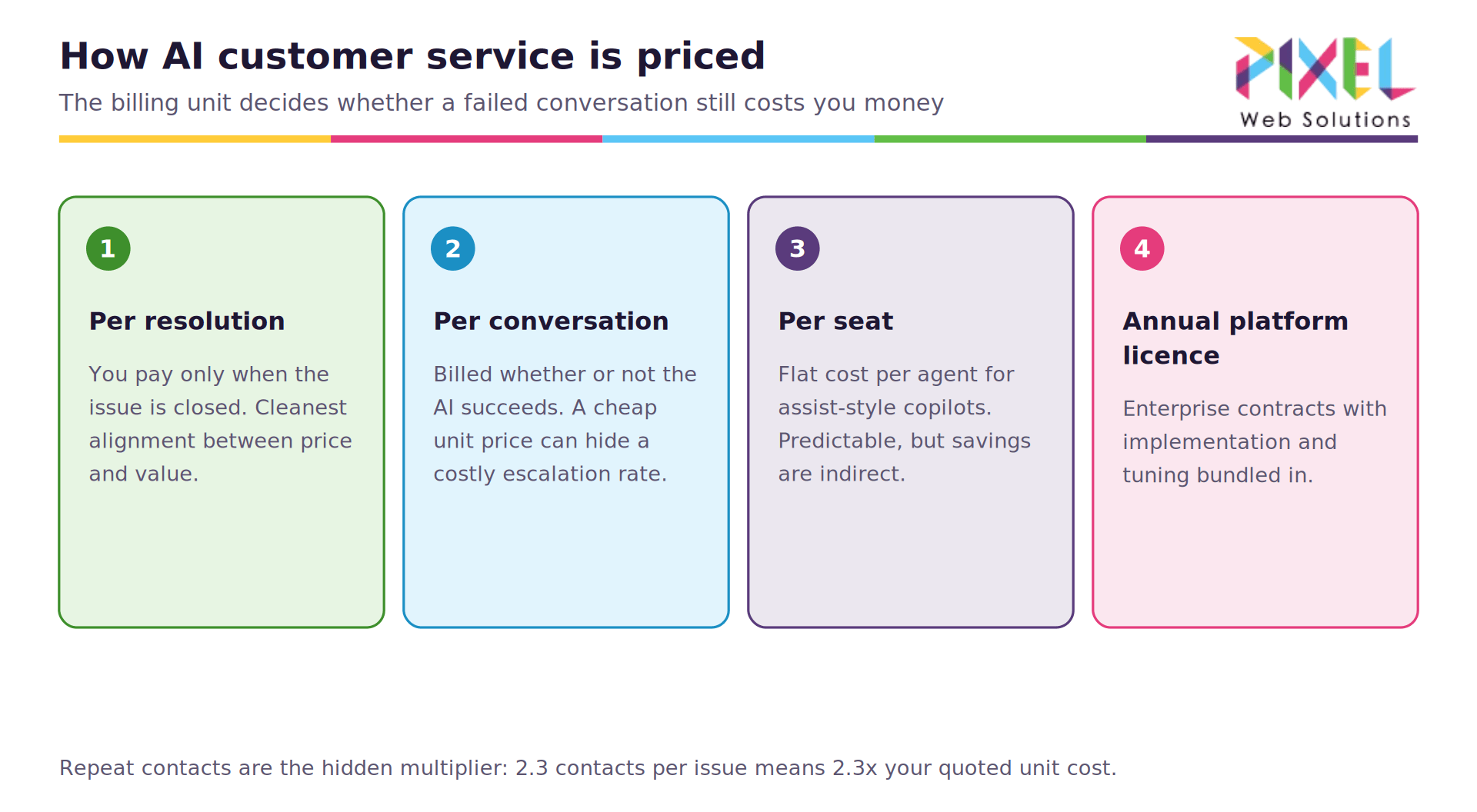
How a vendor bills you matters as much as the rate, because it determines whether a failed conversation still costs money.
| Model | You pay | Risk sits with | Best for |
| Per resolution | Only when the issue is closed | The vendor | Most buyers, cleanest incentive alignment |
| Per conversation or session | Every conversation, successful or not | You | High-confidence, high-structure queues |
| Per seat | Flat rate per human agent | You | Assist-mode copilots |
| Annual platform license | Fixed contract, implementation bundled | Shared | Enterprise, multi-queue rollouts |
Per-resolution pricing is consolidating as the default for a reason: it is the only model where the vendor loses money when the AI fails. A low per-conversation rate can conceal an expensive escalation rate, and the buyer only discovers this after the volume is live.
The costs that do not appear in the quote
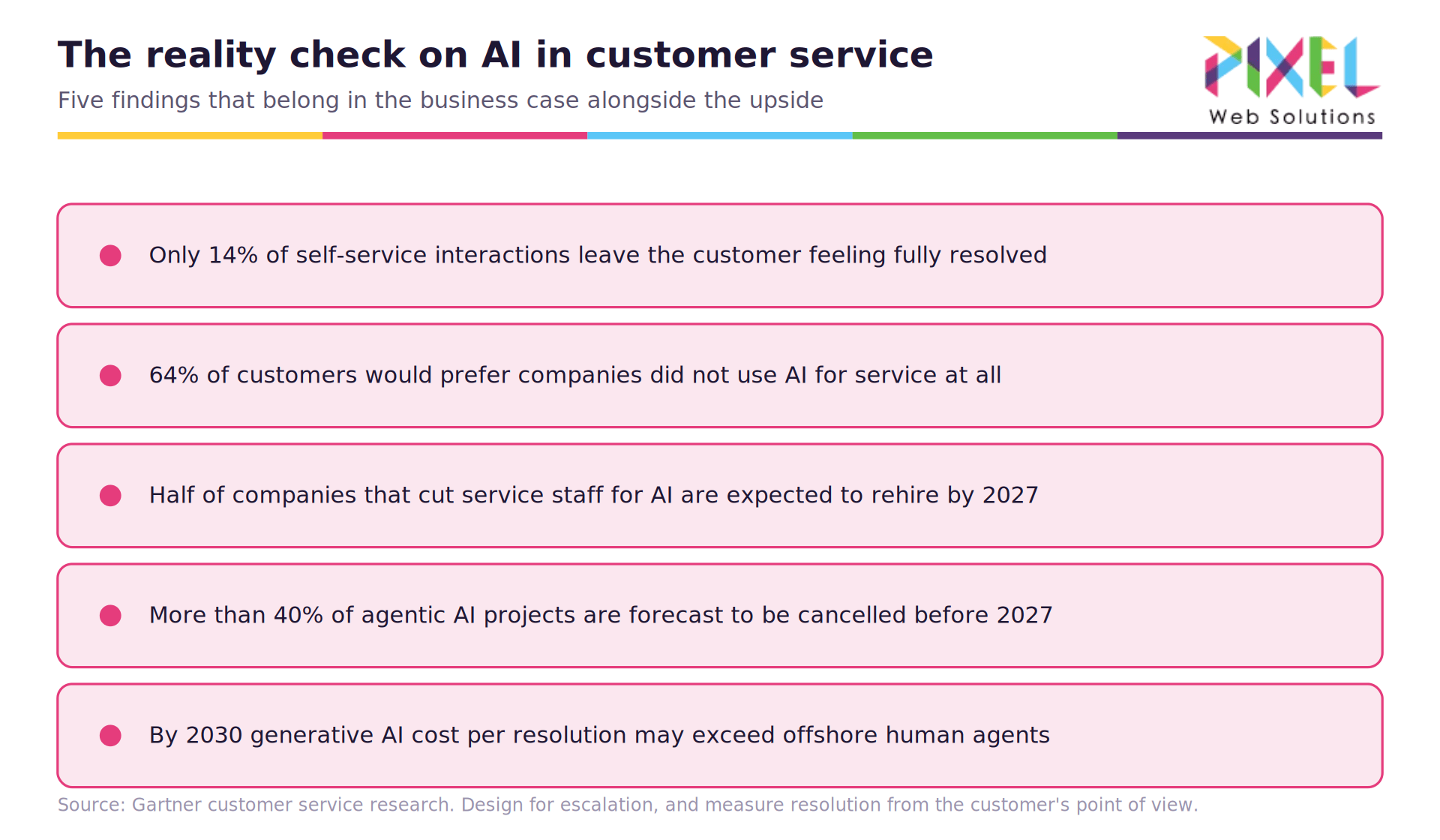
Knowledge base cleanup is usually the largest hidden line, because AI amplifies whatever is in your help center. Gartner’s survey found 43 percent of customers who started in self-service could not find content relevant to their issue, and 45 percent said the company did not understand what they were trying to do. Neither of those is a model problem. Both are content and intent-design problems that an AI layer will faithfully reproduce at scale.
Then come systems integration so the AI can take actions rather than describe them, conversation design and tuning, evaluation and QA sampling, and ongoing content maintenance as products change. The last one is a permanent operating cost, not a project line, and it is the one most often left out of year-two budgets.
The multiplier everyone underestimates
Repeat contacts. If customers contact you an average of 2.3 times per issue, your true cost per issue is 2.3 times your cost per contact. Deflection that does not resolve can raise total cost while looking cheaper on the dashboard.
Here is the arithmetic on a queue of 10,000 contacts per month. The per-resolution rate below is an illustrative assumption, not a vendor quote; replace it with your own.
| Line | All-human baseline | AI at 60% with 20% return rate |
| Contacts handled by AI | 0 | 6,000 at USD 1.00 = USD 6,000 |
| Contacts handled by humans | 10,000 at USD 13.50 = USD 135,000 | 4,000 at USD 13.50 = USD 54,000 |
| Returning contacts, AI to human | 0 | 1,200 at USD 13.50 = USD 16,200 |
| Monthly total | USD 135,000 | USD 76,200 |
| Cost per resolved issue | USD 13.50 | USD 7.62 |
The naive version of that model, the one that ignores the return rate, shows USD 60,000 per month and a saving of USD 75,000. The honest version shows USD 76,200 and a saving of USD 58,800. The 20 percent return rate quietly consumed USD 16,200 a month, or about 22 percent of the projected benefit.
Run this model at your own resolution and return rates before signing anything. If the return rate is unknown, that is the first thing to measure, because the entire business case pivots on it. When scoping a build, quote it against resolution rate and integration depth rather than conversation volume alone.
How to Measure AI in Customer Service Honestly
Most disappointing deployments are measurement failures before they are technology failures. Four metrics separate a real result from a flattering one.
Customer-side resolution rate. The share of conversations where the customer’s problem was actually solved, measured from the customer’s perspective rather than from whether a ticket was created. This is the primary metric. Everything else is diagnostic.
Repeat contact rate within 7 days. The single best early warning that deflection is masquerading as resolution. If it rises after launch, the deployment is moving cost rather than removing it.
Escalation quality, not just escalation rate. A high escalation rate is fine if handoffs arrive with full context. Measure how often a customer has to repeat information they already gave the AI. That number correlates with satisfaction damage far more tightly than the escalation rate itself.
Cost per resolved issue. Not cost per contact. The table in the previous section shows why the two diverge, and the gap between them widens exactly as the AI takes on more volume.
Two metrics to demote: deflection rate, which Gartner’s 14 percent finding shows can be almost entirely decoupled from customer outcomes, and containment rate, which measures the same thing with a friendlier name.
Where AI in Customer Service Falls Short
An honest business case includes the counter-evidence, and Gartner has published a good deal of it.
Only 14 percent of customers feel fully resolved by self-service, and even for issues customers describe as very simple, the rate reaches only 36 percent. Nearly nine in ten service journeys that begin in self-service end up resolved across multiple channels. Gartner expects half the companies that cut service headcount because of AI to rehire by 2027 under different job titles, forecasts that more than 40 percent of agentic AI projects will be canceled before the end of 2027 on cost, unclear value or inadequate risk controls, and warns that generative AI cost per resolution may exceed offshore human agent cost by 2030 as usage scales.
One number cuts against the loudest version of the replacement narrative. In an October 2025 Gartner survey of 321 customer service and support leaders, only 20 percent had actually reduced agent staffing because of AI. The headcount story is running well ahead of the headcount data.
None of this argues against AI in customer service. It argues against three specific mistakes:
- Deploying on top of a messy knowledge base, which guarantees the AI reproduces your worst content at scale.
- Measuring deflection instead of resolution, which guarantees the dashboard improves while the customer experience does not.
- Removing the human escalation path to force adoption, which is the mistake Klarna made and publicly corrected.
Where the Benefits Land Hardest
The seven benefits are not evenly distributed. They scale with volume, structure and system access.
| Sector | Why it works or does not | Realistic first scope |
| Ecommerce and retail | High volume, highly structured intents, order systems already API-accessible | Order status, returns, refunds |
| Fintech and banking | Authenticated users, strict policy consistency, audit value is high | Balance and transaction queries, card actions |
| SaaS and B2B software | Ambiguous technical tickets, long tail, lower ceiling | Billing and account admin, not technical support |
| Healthcare | Regulatory constraint, high consequence of error | Scheduling and administrative queries only |
| Travel and hospitality | Volume spikes, multilingual demand, complex exceptions | Booking status and routine changes |
| Telecom and utilities | Very high volume, well-documented processes, strong fit | Billing, plan changes, outage status |
The pattern is consistent. Wherever the request is frequent, the answer is documented, and a system exists that the AI can call, the benefits arrive quickly. Wherever the request is rare, the answer requires judgment, or the resolution lives in someone’s head, they do not.
How to Capture the Benefits Without the Backlash
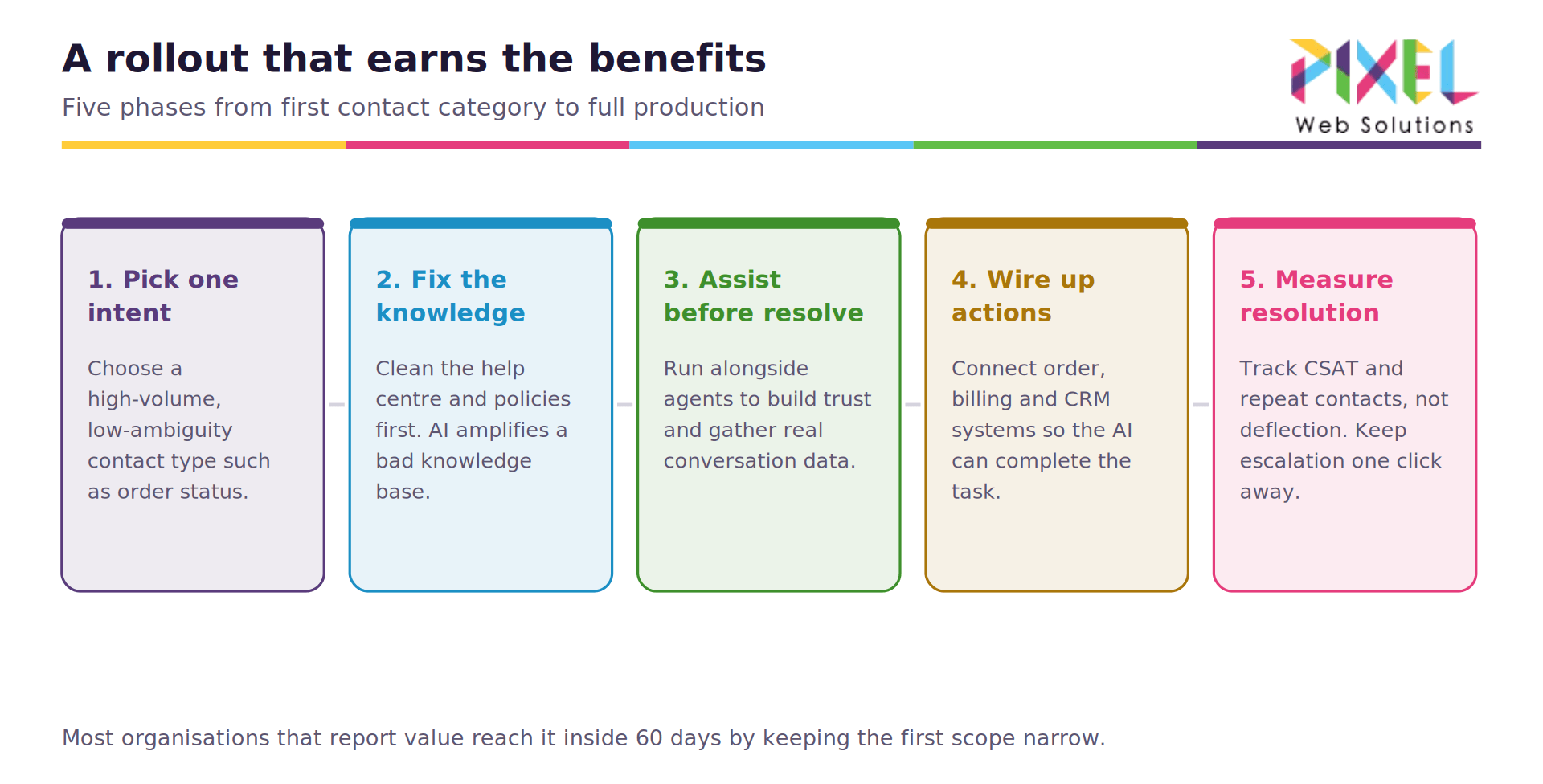
This sequence is where the 60-day value figure comes from. Every step exists to protect the one after it.
- Pick one high-volume, low-ambiguity contact type. Order status, password reset, billing query. One. The instinct to automate the whole queue at once is the most reliable predictor of a canceled project.
- Fix the underlying knowledge before automating anything. If 43 percent of customers cannot find relevant content today, an AI reading that same content will not invent what is missing.
- Run in assist mode first. Agents build trust, you collect real conversation data, and you discover what customers actually ask rather than what your intent taxonomy assumed.
- Connect the systems that let the AI complete the task. This is the step that converts deflection into resolution, and it is usually the longest one. Budget accordingly.
- Measure customer-side resolution and repeat contacts. Not deflection. Keep escalation to a human one click away throughout, and treat the escalation path as a designed feature rather than a fallback.
Should You Build or Buy?
Buy when your intents are common, your systems are standard and speed matters more than fit. Off-the-shelf platforms handle order status against a mainstream ecommerce stack better and faster than a custom build will.
Build when the resolution logic is proprietary, the systems are unusual, or the data cannot leave your environment. Regulated industries and companies with heavily customized internal systems tend to land here, and the deciding factor is almost always integration depth rather than model preference.
Most organizations end up in the middle: a platform for the front end, custom integration and retrieval underneath. That middle path is where AI consulting work usually starts, and if you are comparing platforms first, our breakdown of the best AI customer service software covers the buy side in detail. For copilot-style deployments that keep agents in control, see AI copilot development.
The Future of AI in Customer Service
Three shifts are underway.
Voice is moving from novelty to default channel as real-time speech models mature. The economics are more favorable than text because voice queues carry the highest agent-assisted costs, and the technical bar is higher because latency and interruption handling are unforgiving.
Pricing is consolidating around per-resolution billing, which pushes vendor incentives toward actually closing tickets rather than merely handling them. Expect per-conversation pricing to persist mainly where vendors cannot measure resolution.
Service roles are changing rather than disappearing. Teams are adding people who manage AI quality, escalation design and failure analysis. Gartner’s rehiring prediction describes this directly: staff returning under different job titles. The 20 percent figure on actual staffing cuts suggests most organizations reached this conclusion without needing to make Klarna’s mistake first.
Conclusion
The benefits of AI in customer service are largest and most durable where the work is high volume, well documented, and connected to systems the AI can act on. Cost per contact falls sharply, coverage becomes continuous, and human agents get better work.
The organizations that struggle are not the ones that adopted too slowly. They are the ones that automated a broken knowledge base and measured the wrong number. Klarna is the clearest available proof of both halves of that sentence: the deployment that generated the most-quoted success numbers also generated the most-quoted reversal, and it is now saving more than it did during either phase, because the correction was to the operating model rather than to the technology.
Pick one contact type. Fix the content beneath it. Connect the systems. Judge the result by whether the customer’s problem is gone. If you are ready to scope that first deployment, our AI chatbot development team covers conversation design, systems integration and the evaluation setup that keeps quality measurable.
FAQ
Q: What are the main benefits of AI in customer service?
The main benefits are lower cost per contact, continuous multilingual coverage, faster resolution, higher first-contact resolution, better work for human agents, consistent auditable answers, and analytics across every conversation rather than a QA sample. Gartner benchmarks self-service at USD 1.84 per contact against USD 13.50 agent-assisted. The benefits are largest on high-volume, well-documented request types and smallest on ambiguous or judgment-heavy ones.
Q: How much does AI reduce customer service costs?
Gartner benchmarks a self-service contact at about USD 1.84 against USD 13.50 for an agent-assisted contact, and predicts a 30 percent reduction in operational costs as agentic AI reaches 80 percent autonomous resolution by 2029. Actual savings depend on your resolution rate and repeat-contact rate. On a 10,000-contact queue with 60 percent AI resolution and a 20 percent return rate, cost per resolved issue falls from USD 13.50 to about USD 7.62, roughly a 44 percent reduction rather than the 86 percent the raw per-contact gap implies. Model cost per resolved issue, not cost per contact.
Q: Does AI in customer service hurt customer satisfaction?
Not inherently. Salesforce found customer satisfaction was the KPI most often reported as improved after deploying AI agents, ahead of productivity and handle time, and Klarna reported CSAT on par with human agents in its first month. Satisfaction falls when customers cannot escalate, must repeat information they already gave the AI, or receive confidently wrong answers on complex issues. Klarna’s 2025 reversal was driven by exactly this on emotionally charged cases.
Q: What is a realistic AI resolution rate for customer service?
Mature deployments on high-structure contact types commonly land around two-thirds of conversations, which is where Klarna landed in month one. Expect a lower rate in year one and on ambiguous, technical or emotionally sensitive queues. Gartner’s measurement of the self-service era found only 14 percent of issues fully resolved from the customer’s perspective, and 36 percent even on issues customers called very simple, so measure resolution from the customer’s side rather than from whether a ticket was avoided.
Q: What is the difference between deflection and resolution?
Deflection means a ticket was never created or was diverted into self-service. Resolution means the customer’s problem is actually solved. Gartner found only 14 percent of customers feel fully resolved by self-service, and nearly nine in ten journeys that start in self-service finish across multiple channels, which is why deflection alone is a misleading success metric. A deflected contact that returns costs you both the deflection and the eventual agent contact.
Q: How long does it take to see results from AI in customer service?
Salesforce found 70 percent of organizations that deploy AI agents see measurable value within 60 days. That timeline assumes a narrow initial scope, a clean knowledge base and one contact category rather than an attempt to automate the whole queue at once. Deployments that begin with knowledge base cleanup often spend the first 60 days there and see value in the following 60.
Q: Will AI replace customer service agents?
The evidence points to displacement of routine contact handling rather than of the role. In an October 2025 Gartner survey of 321 service leaders, only 20 percent had actually reduced agent staffing because of AI. Gartner expects half the companies that did cut staff to rehire by 2027 under different job titles, and Klarna, the most-cited example of AI-driven headcount reduction, reversed its cuts in 2025 and now positions human service as a premium tier. The realistic model is AI on the front line with humans on exceptions and escalations.
Q: What does AI customer service cost per month?
It depends on the billing model. Per-resolution pricing means you pay only for closed issues, which is the cleanest alignment. Per-conversation and per-seat models charge regardless of outcome. On a 10,000-contact monthly queue, an AI layer resolving 60 percent at roughly USD 1.00 per resolution costs about USD 6,000 monthly in vendor fees, but the total monthly cost including the human handling of the remainder and of returning contacts lands nearer USD 76,000 against a USD 135,000 all-human baseline. Implementation, knowledge cleanup and integration sit outside those figures.