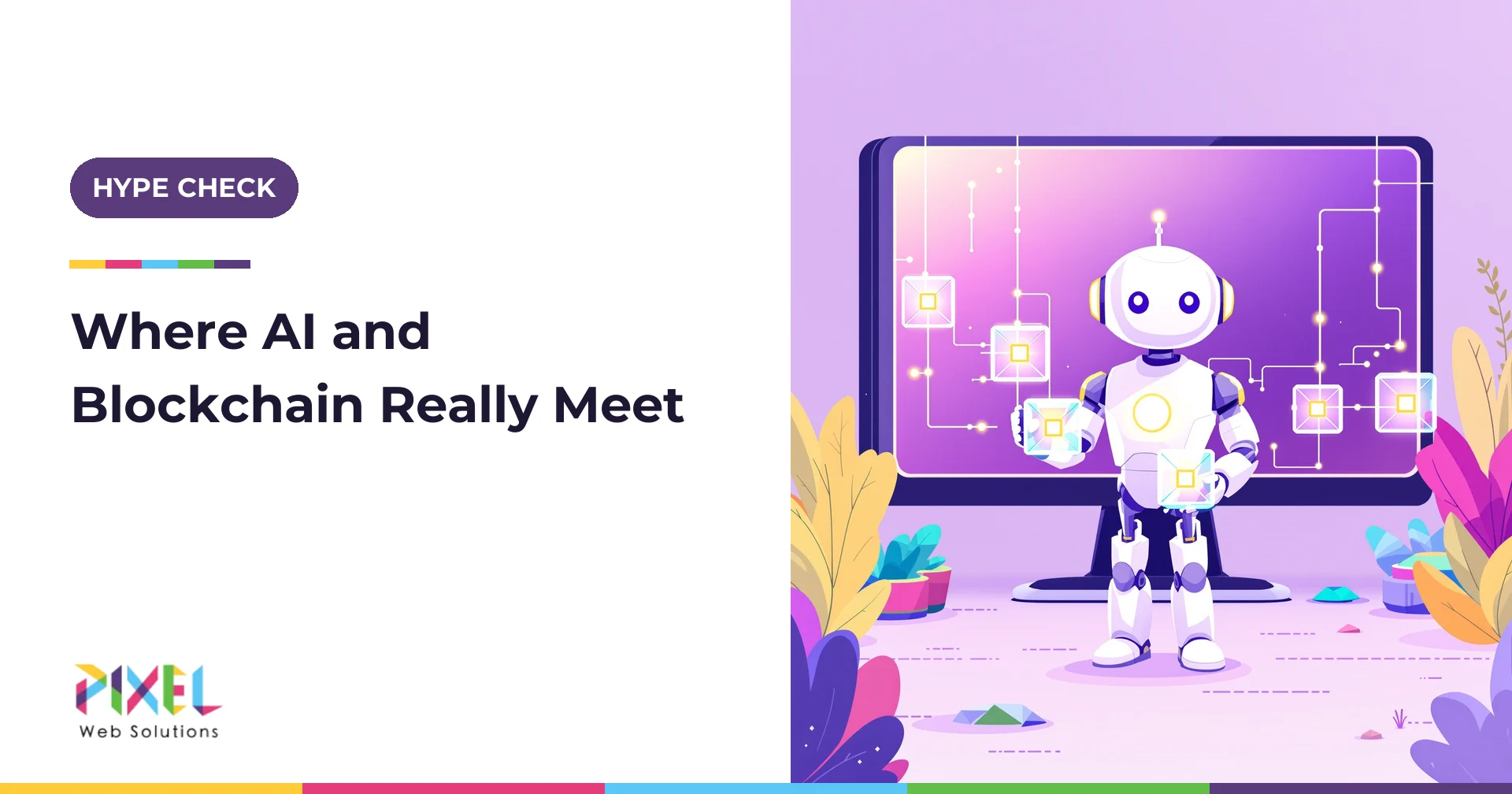
AI in blockchain combines machine learning with decentralized ledgers so that AI can act, audit and trade on-chain while blockchain makes AI outputs, payments and data traceable. In 2026 the combination is real in four places: on-chain AI agents that pay for services in stablecoins, AI-assisted smart contract audits, verifiable AI inference using zkML and opML, and decentralized AI compute and data networks. Much of the rest is still hype: CoinGecko's AI Agents token category is worth about $3.7 billion, a fraction of its early-2025 peak.
Artificial intelligence (AI) and blockchain are two of the most important technologies shaping the digital world. AI gives systems the ability to reason, predict and automate, while blockchain offers transparency, shared trust and decentralization. Together, they can change how data, security and decision-making work in the digital age.
The adoption of AI in blockchain has reached financial services, supply chains and digital media, through intelligent automation, better fraud detection and new forms of digital ownership. In this blog, we explore how AI in blockchain works, the real projects and figures behind it, its advantages and difficulties, an honest hype check and how businesses can use the combination well. First, let's look at what makes each technology powerful on its own.
Key Takeaways
- Four genuine meeting points: on-chain AI agents, AI-assisted security audits, verifiable inference and decentralized AI compute or data networks.
- Agents already transact. The x402 payment standard recorded about 75 million transactions worth $24 million in a 30-day window, which shows high activity but tiny average payments.
- AI cuts both ways in security. Anthropic's research showed AI agents could reproduce $4.6 million of real smart contract exploits in simulation, so the same tools must be used for defence.
- Verifiable AI is possible but costly. zkML proves results cryptographically for small models; opML handles large models with a challenge period.
- Market prices are not adoption. Many AI crypto tokens trade 85 to 99 percent below their highs, so judge projects by usage, not token charts.
Why AI and Blockchain Matter in Today's Digital World?
Blockchain is an immutable, decentralized digital ledger that records transactions across many computers. Its main characteristics are trust, transparency and immutability. Artificial intelligence imitates aspects of human intelligence through algorithms that learn from data, find patterns and make predictions.
Now, think about combining the two: blockchain's transparency and security on one side, and AI's intelligence and automation on the other. The result is a digital ecosystem where data is both protected and used intelligently. AI can analyse blockchain data to detect patterns and anomalies, and blockchain can record AI models, decisions and payments so that anyone can check them later. Together, they can reduce human error, reduce fraud and remove some intermediaries.
The two technologies also fix each other's weak spots. AI is often a black box, and blockchain can add an audit trail. Blockchains are rigid and hard to read, and AI can make sense of them. Let's look at how this works inside real systems.
How AI Enhances Blockchain Systems?
Adding AI to blockchain systems brings a new level of intelligence to how decentralized platforms operate. Here is how this partnership works in practice.
Data Management and Analysis
Blockchain networks hold large amounts of public data. AI draws insights from it by recognising patterns in wallets, transactions and contracts. Blockchain analytics firms, exchanges and regulators use machine learning to cluster wallets, trace funds and flag sanctioned or high-risk addresses.
Predictive Analytics for Smart Contracts
Smart contracts cannot run AI models directly at reasonable cost, but they can act on AI outputs delivered by oracles. For example, a lending protocol can adjust risk parameters based on an AI risk score, or an insurance contract can pay out based on a verified AI assessment. The key question is how the contract can trust that output, which is where verifiable inference comes in (see below).
Enhanced Security and Fraud Detection
AI-supported systems spot suspicious activity in blockchain transactions in real time. In this way, AI strengthens blockchain security by identifying exploits, phishing contracts and fraudulent behaviour early, often before funds leave a protocol.
Smarter Network Operations
AI is not part of mainstream consensus today. Bitcoin uses Proof-of-Work and Ethereum uses Proof-of-Stake, and neither relies on AI to validate blocks. Where AI does help is around the network: predicting gas fees, optimising transaction routing, detecting spam and monitoring validator performance. Treat any claim that AI "replaces consensus" with caution.
AI and blockchain together make digital ecosystems more adaptive and secure. But the technical picture alone doesn't show their impact. Let's see where AI and blockchain genuinely meet in 2026.
Where AI and Blockchain Genuinely Meet in 2026
Most competing articles stop at general benefits. These four areas have live products, public code and measurable activity.
1. On-Chain AI Agents and Machine Payments
AI agents now hold wallets and pay for data, compute and APIs without a person approving every transaction. The x402 standard revives the HTTP "402 Payment Required" code so an agent can pay a website or API in stablecoins per request. Its public dashboard showed about 75.41 million transactions and $24.24 million in volume over 30 days (page updated 25 August 2026), which works out to roughly $0.32 per payment: real activity, but mostly micropayments.
Identity is the next step. ERC-8004 "Trustless Agents", still a Draft on eips.ethereum.org, proposes registries for agent identity, reputation and validation so that agents can discover and trust each other. Open frameworks such as ElizaOS and launch platforms such as Virtuals Protocol let developers deploy agents that post, trade and manage treasuries. Businesses building these systems need both AI and wallet security skills, as covered in Pixel's AI agent development services.
2. AI-Assisted Smart Contract Audits
AI is now a serious security tool, for attackers and defenders alike.
- Offence: Anthropic's Frontier Red Team built SCONE-bench from 405 smart contracts exploited between 2020 and 2025. On contracts exploited after the models' training cutoffs, AI agents produced exploits worth $4.6 million in simulation, and in a separate test found two new zero-day vulnerabilities in recently deployed contracts.
- Benchmarks: OpenAI and Paradigm released EVMbench in February 2026 to test whether AI agents can detect, patch and exploit vulnerabilities from real audits. OpenZeppelin's review of the dataset found methodological flaws and invalid classifications, a reminder that AI audit scores need careful reading.
- The threat picture: the OWASP Smart Contract Top 10: 2026 ranks access control flaws first, and TRM Labs counted 207 hacks in the first half of 2026, with key and infrastructure compromises behind most losses.
What this means for teams: use AI tools for a first pass and continuous monitoring, but keep expert manual review before launch. Pixel's smart contract audit services combine both.
3. Verifiable AI Inference: zkML and opML
If a smart contract acts on an AI result, it needs proof that the result came from the stated model and input. Two approaches exist:
| Approach | How it works | Strengths | Limits |
|---|---|---|---|
| zkML (zero-knowledge machine learning) | The model run produces a cryptographic proof that a verifier contract checks on-chain | Mathematical guarantee, no waiting period | Proving is slow and expensive, so it suits small models; libraries such as EZKL are used for this |
| opML (optimistic machine learning) | The result is posted on-chain and can be challenged during a dispute window with a fraud proof | Works with large models such as image and language models | Results are final only after the challenge period; security relies on at least one honest challenger |
ORA (formerly HyperOracle) built its on-chain AI oracle on opML and co-authored ERC-7007, a final Ethereum standard for NFTs whose content is AI-generated and verifiable.
4. Decentralized AI Compute and Data Networks
Blockchains are also used to coordinate and pay for AI work. Bittensor rewards participants in TAO for providing machine learning services in specialised subnets, and its token is the largest in the AI category with a market value of about $3.3 billion as of 16 October 2026. Render coordinates GPU rendering, and data marketplaces such as Ocean Protocol let owners sell access to datasets while keeping control over them. These networks are working products, though they remain small next to centralized clouds.
Real-World Use Cases of AI in Blockchain
The combination of AI and blockchain has opened up new possibilities for several industries. Here's how:
- Finance
AI-powered blockchain tools detect fraud, automate trading and provide personalised financial insights. In DeFi, AI models score wallet and protocol risk, while blockchain keeps transactions transparent. Explore more in AI in fintech.
- Healthcare
AI analyses medical records for faster diagnosis, while blockchain can log consent and access to that data. Sensitive records themselves should stay off public chains, with only hashes or permissions recorded on-chain.
- Supply Chain
AI tracks goods, forecasts demand and improves logistics, while blockchain provides authenticity and traceability. This pairing helps reduce delays, counterfeiting and waste.
- NFTs and Digital Media
AI creates generative art, music and dynamic NFTs whose traits change with data or user interaction. Blockchain provides proof of ownership, and standards like ERC-7007 add proof that a specific model produced the content.
- Government and Identity
Together, AI and blockchain support transparent record-keeping, identity verification and public services. AI flags fraud in benefit claims or land records, while blockchain makes changes visible and tamper-evident.
- Trading
Bots that combine machine learning with on-chain data execute strategies around the clock. Learn how they are built in this guide to AI trading bot development.
Beyond these use cases, the combination of AI and blockchain brings measurable gains. Let us break down the main advantages.
Benefits of Integrating AI in Blockchain
Industries adopting both AI and blockchain are seeing a shift that goes beyond automation or security. It is about creating intelligent, transparent and efficient digital ecosystems. The main benefits are:
-
Improved Efficiency and Automation: AI takes over routine work in blockchain operations, from monitoring transactions to triggering smart contracts, which means faster processes, fewer errors and better scalability.
-
Greater Transparency and Trust: Blockchain makes records tamper-evident, and recording AI decisions or model versions on-chain gives an audit trail for systems that are otherwise hard to inspect.
-
Smarter Data Utilization: AI turns raw blockchain data into insights. Organisations can analyse trends and behaviour, predict outcomes and optimise resources.
-
Cost and Time Reduction: AI used for analytics, monitoring and maintenance cuts costs and time, without compromising security, as long as humans review critical actions.
These benefits show that AI in blockchain is a practical engineering choice in the right places, not just a passing trend. However, the combination has real challenges.
Challenges and Limitations of AI in Blockchain
While the combination of AI and blockchain opens up opportunities, it is not without challenges. Understanding these limits helps businesses adopt the technology responsibly.
-
Scalability and Cost: Running AI models on-chain is far too expensive, so most systems run models off-chain and post results or proofs. Proof generation for zkML adds further cost and delay.
-
Energy Use: AI training and inference use significant energy, and Proof-of-Work blockchains do too. Ethereum's move to Proof-of-Stake in 2022 cut its energy use by about 99.95 percent, so the chain you choose matters.
-
Data Privacy Concerns: Public ledgers are transparent by design, which conflicts with privacy laws such as GDPR. Personal data should stay off-chain, with only hashes, proofs or permissions stored on-chain.
-
New Attack Surfaces: AI agents holding wallets can be tricked through prompt injection or manipulated data feeds into sending funds. Spending limits, allow-lists and human approval for large transfers are essential.
-
Lack of Skilled Developers: The intersection of AI and blockchain is still emerging, so few engineers understand both, which slows adoption.
With these challenges in mind, businesses can work with a reputable AI development company that can design and implement AI-blockchain systems safely.
Hype Check: AI Crypto Tokens vs Real Usage
Token prices are the loudest signal in this market and the least reliable. Here is the picture from CoinGecko's public data on 16 October 2026.
| Indicator | Value on 16 October 2026 | What it tells you |
|---|---|---|
| CoinGecko AI category market value | About $25.3 billion, under 1 percent of a $2.78 trillion crypto market | AI is a niche within crypto |
| CoinGecko AI Agents category | About $3.7 billion | Far below the early-2025 agent token boom |
| Virtuals Protocol (VIRTUAL) | About $0.69, down 86 percent from its 1 January 2025 high | Agent launchpad activity cooled sharply |
| Fetch.ai (FET) | About $0.21, down 94 percent from its March 2024 high | Alliance and merger news did not hold prices |
| Bittensor (TAO) | About $289, down 62 percent from its March 2024 high | The most resilient large AI token |
| ai16z, now migrated to elizaOS | Old token down almost 100 percent from its high | Framework adoption and token value are separate things |
The honest conclusion: the useful parts of AI in blockchain (security tooling, agent payments, verifiable inference) are growing quietly, while speculative tokens have fallen hard. When you evaluate a project, ask for usage data such as paying users, transactions or audited revenue, not token charts.
Does Your Project Need AI and Blockchain? A Four-Question Test
Many proposals bolt both technologies together without a reason. Answer these questions first:
- Do several parties who don't trust each other need the same record? If not, a normal database is cheaper than a blockchain.
- Does the AI output trigger money or rights on-chain? If yes, you need verifiable inference (zkML or opML) or a trusted oracle with clear accountability.
- Will an AI agent hold funds? If yes, design spending caps, allow-lists and human approval thresholds before anything else.
- Where does personal data live? Keep it off-chain; store only proofs or hashes.
If you answer "yes" to the first two, AI in blockchain is likely a good fit. If you answer "no" to both, use AI and a conventional database, and save the budget.
Future of AI and Blockchain Integration
Over the next few years, AI and blockchain will become core enablers of digital transformation in specific areas, especially payments between machines, security and digital content provenance.
Emerging Trends to Watch
- Agent economies: AI agents paying each other for data and compute through standards like x402, with on-chain identity and reputation.
- AI-driven crypto trading and risk management: machine learning models running risk-aware strategies and monitoring DeFi positions.
- Verifiable AI content: NFTs and media that prove which model created them, increasingly relevant as the EU AI Act requires AI-generated content to be marked from August 2026.
- AI-governed DAOs: AI assistants that summarise proposals and model their effects, with humans still voting on final decisions.
Regulation will shape the pace. Rules such as the EU AI Act and MiCA, which is now fully applicable, mean that AI-blockchain products touching EU users must meet both AI transparency and crypto-asset requirements. Once the technology matures, the question for businesses won't be whether to use AI-blockchain solutions but how to do it right.
How Businesses Can Leverage AI in Blockchain Solutions?
The potential of this combination is already available to companies in many sectors. Here's how to start:
- Steps to Adopt or Integrate AI-Blockchain Solutions
- Identify use cases where shared trust and intelligence both add value (for example, supply chain tracking, fraud prevention or AI content provenance).
- Run the four-question test above to confirm you need both technologies.
- Choose the right blockchain platform, AI models and verification approach for your needs.
- Partner with an experienced blockchain software development company with expertise in AI integration.
- Test, audit, deploy and scale the solution while staying compliant with regulations and data protection rules.
- Potential Industries for Implementation
- Finance: Automated trading bots, fraud detection and faster settlement.
- Healthcare: Consent logging and AI-driven diagnostic support.
- Supply Chain: Predictive logistics with transparent tracking.
- Real Estate: AI-supported property valuation linked to tokenized records.
These solutions need knowledge of both blockchain and AI. Proper design, development and deployment ensure intelligent blockchain applications meet business requirements.
Conclusion
The collaboration between AI and blockchain is one of the most interesting frontiers in technology today. Together, they combine intelligence with trust to create smarter, safer and more autonomous systems, as long as teams separate genuine uses from hype.
As businesses look ahead, AI in blockchain is not just an upgrade but a strategic move toward a new era of innovation and resilience. Pixel Web Solutions helps enterprises put AI in blockchain to work with solutions that are secure, scalable and intelligent. To discuss your project, contact the Pixel Web Solutions team.
Frequently Asked Questions
How is AI used in blockchain?
AI is used in blockchain to detect fraud and exploits, audit smart contracts, analyse on-chain data, run trading and risk models, power AI agents that hold wallets and pay for services, and generate verifiable AI content such as ERC-7007 NFTs.
Can AI run directly on a blockchain?
Not efficiently. Running large models on-chain would be extremely expensive, so models run off-chain and their results are posted on-chain with a zero-knowledge proof (zkML), a challengeable claim (opML) or a trusted oracle.
What is the difference between zkML and opML?
zkML produces a cryptographic proof that a model produced an output, which is secure but costly and best for small models. opML posts the result and allows challenges during a dispute window, which works for large models but delays final settlement.
Are AI crypto tokens a good investment?
This guide does not give investment advice. As a matter of record, many AI tokens trade 85 to 99 percent below their highs as of October 2026, which shows how far prices can move away from real usage.
Can AI make smart contracts more secure?
Yes, AI tools help find vulnerabilities and monitor contracts after launch. However, research from Anthropic and others shows attackers can use the same tools, so AI should support, not replace, expert manual audits.
What are AI agents in crypto?
AI agents in crypto are programs that use AI to decide and act on-chain, for example by trading, managing a treasury or paying for API calls with stablecoins through standards such as x402.