Table of Contents
Choosing an AI consulting partner has become one of the more consequential technology decisions a business makes, and the reason is not that the technology is hard to access. Anyone can call a model API. The difficulty is getting from a working demo to a system that survives contact with real customers, real data, and real regulators.
The evidence on that gap is consistent. Gartner forecasts that more than 40 percent of agentic AI projects will be canceled before the end of 2027, on grounds of escalating cost, unclear business value or inadequate risk controls. S&P Global Market Intelligence, surveying more than 1,000 organizations across North America and Europe, found the share scrapping most of their AI initiatives rose to 42 percent in 2025 from 17 percent the year before. Demand for consulting tracks that failure rate rather than the novelty of the tools.
This guide compares ten AI consulting companies in USA markets, explains the three tiers they occupy, gives real 2026 cost ranges, and sets out the questions that separate delivery firms from presentation firms.
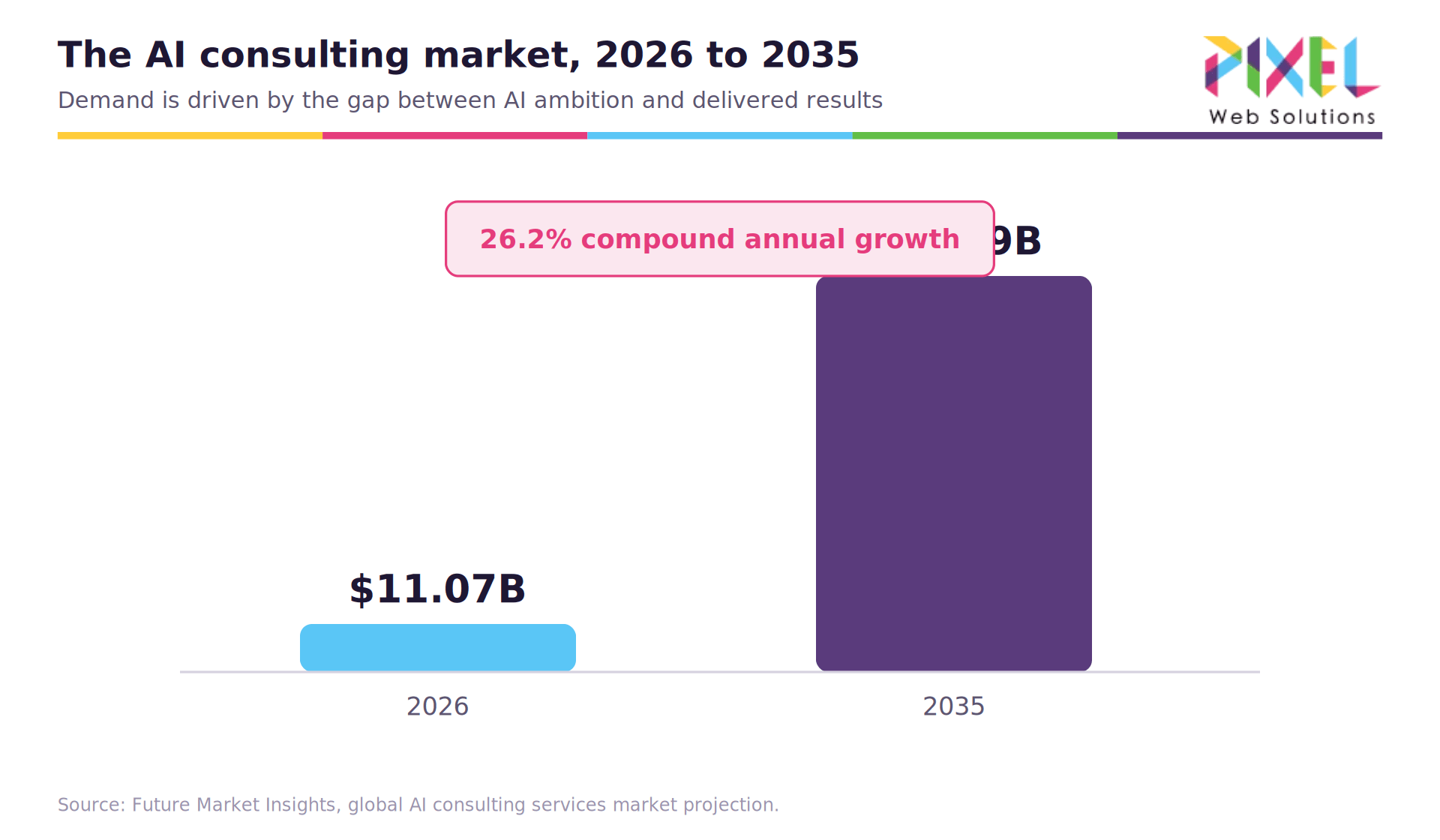
A note on the market figure in that chart. Future Market Insights values the AI consulting services market at USD 11.07 billion in 2025, reaching USD 90.99 billion by 2035. The chart above and v1 of this article both labelled the USD 11.07 billion figure as 2026, which is one year out. Worth knowing too: FMI’s published CAGR of 26.2 percent does not reconcile with those two endpoints over ten years, which imply about 23.4 percent. Analyst market sizing in this category diverges widely between houses and should be read as indicative of direction, not as a measurement. The figure needs re-exporting with the corrected year.
How We Selected These Companies
Each firm below was assessed on demonstrable AI consulting capability, ability to deliver production systems rather than strategy alone, industry coverage, governance and responsible AI maturity, and suitability for US-based clients.
The list deliberately spans all three tiers, because a mid-market manufacturer and a Fortune 100 bank should not be shortlisting the same firms. No competitor logos are reproduced anywhere on this page, and no revenue, headcount or client figures have been attributed to any firm without a public source.
The Three Tiers of AI Consulting Firms
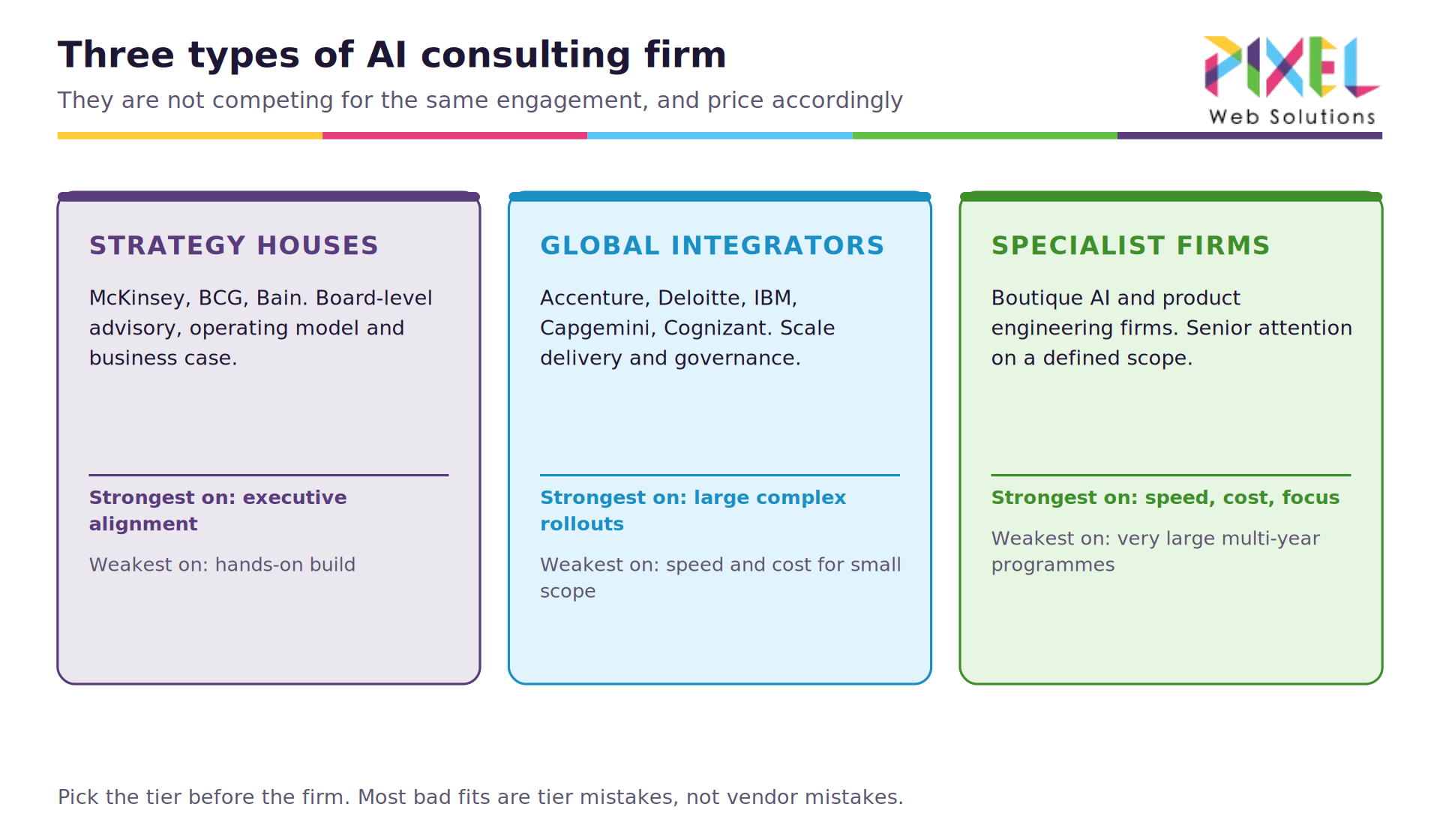
Understand which tier you need before comparing individual companies. Most poor engagements are tier mistakes.
| Tier | Examples | Strongest at | Weakest at | Typical rate |
| Strategy houses | McKinsey QuantumBlack, BCG, Bain | Board alignment, operating model, portfolio decisions | Hands-on build | USD 500 to 1,000+ per hour |
| Global integrators | Accenture, Deloitte, IBM, Capgemini, Cognizant | Scale, governance, change management | Small scopes, speed | USD 300 to 600 per hour |
| Specialist firms | Pixel Web Solutions, LeewayHertz, InData Labs, Addepto | Senior attention, speed, cost, focus | Multi-year global programs | USD 150 to 300 per hour |
The pattern worth internalizing: tier one buys you certainty of process, tier three buys you senior attention per dollar. Neither is better. Paying strategy-house rates for a single-workflow build, or asking a four-person specialist to run a fifteen-country rollout, are the two ways this goes wrong.
Comparison AI Consulting Companies in USA at a Glance
| # | Company | Tier | Best for | Watch for |
| 1 | Pixel Web Solutions | Specialist | Mid-market strategy plus production delivery from one partner | Global delivery model, confirm timezone and contracting |
| 2 | Accenture | Integrator | Large-scale, multi-country enterprise transformation | Cost and minimum engagement size |
| 3 | Deloitte | Integrator | Regulated industries, governance-led agendas | Strategy-heavy, confirm build depth |
| 4 | IBM Consulting | Integrator | AI inside large legacy estates | Tooling preference toward IBM stack |
| 5 | McKinsey QuantumBlack | Strategy | Board-level strategy and operating model | Limited hands-on implementation |
| 6 | Capgemini | Integrator | AI meeting physical and industrial operations | Less focused on pure software products |
| 7 | Cognizant | Integrator | AI alongside legacy modernization | Delivery model varies by account |
| 8 | LeewayHertz | Specialist | Deep custom AI and LLM product engineering | Less strategic advisory |
| 9 | InData Labs | Specialist | Data science and predictive analytics, mid-market | Analytics-led rather than agent-led |
| 10 | Addepto | Specialist | Data strategy and BI foundations under AI | Best when the data layer is the problem |
List of Top 10 AI Consulting Companies in USA
1. Pixel Web Solutions
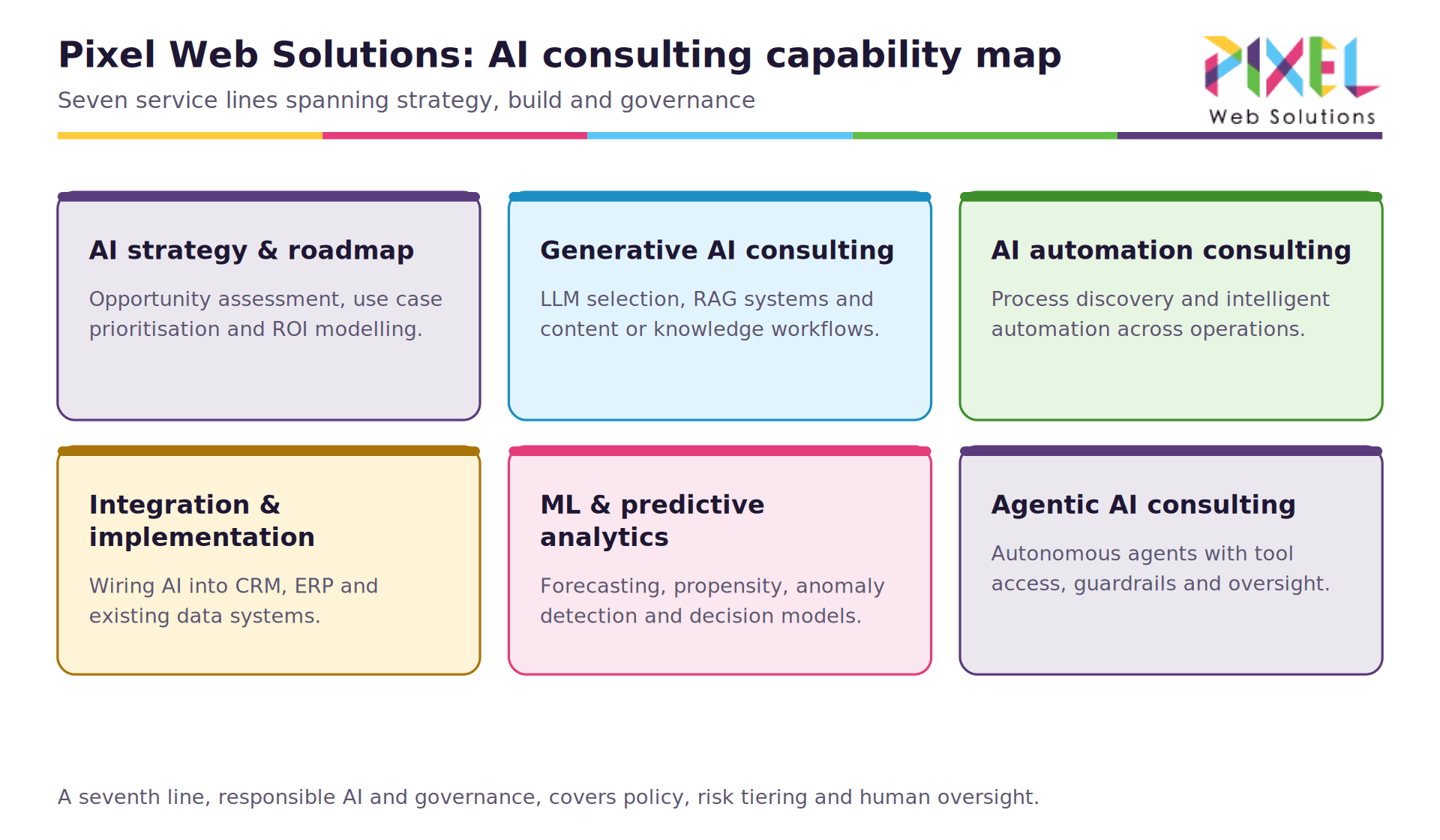
Pixel Web Solutions is a software and AI consultancy that has delivered for enterprises and startups since 2012 and now runs a dedicated AI practice spanning seven service lines: AI strategy and roadmapping, generative AI consulting, AI automation, integration and implementation, machine learning and predictive analytics, agentic AI, and responsible AI and governance.
Best for: mid-market and enterprise teams that need AI strategy and production delivery from one partner, with senior attention and transparent cost.
The practice is built around the point where most AI programs fail, which is the transition from proof of concept to production. Engagements begin with a fixed-scope AI readiness and discovery sprint producing a prioritized use case, a business case and a written success metric before any build commitment, so clients can judge fit before committing budget. Delivery covers systems integration into CRM, ERP and existing data infrastructure, evaluation suites, monitoring and handover, alongside governance work covering risk tiering and human oversight.
On delivery model, stated plainly: Pixel is headquartered in Madurai, India, and serves US clients through a global delivery model. That is what allows senior engineering attention at a lower cost base than comparable onshore firms, and it is a well-understood, legitimate way to buy this work. Buyers who require an entirely US-based delivery team, or who have data residency constraints, should confirm arrangements at the outset. [Add US entity, office or registered address here if applicable.]
Explore the full AI consulting services practice, or the underlying AI development services if your use case is already defined.
2. Accenture
Accenture is a global professional services firm operating one of the largest AI practices in the industry, combining strategy, data engineering and implementation at scale.
Best for: large-scale enterprise AI transformation with global delivery capacity.
It reported approximately USD 5.9 billion in generative AI bookings in fiscal 2025, nearly double the prior year, alongside USD 2.7 billion in generative AI revenue. Its strength is running multi-country, multi-function programs with governance and change management built in, which suits organizations rolling AI across many business units simultaneously. The corresponding constraint is that small and mid-sized scopes are rarely economical.
3. Deloitte
Deloitte is a Big Four professional services firm whose AI practice sits alongside a substantial risk and regulatory arm.
Best for: regulated industries where compliance and governance lead the agenda.
That pairing matters in financial services, healthcare and public sector work, where the governance question arrives before the architecture question. Engagements commonly open with an AI readiness assessment that surfaces governance gaps before technical decisions are fixed. Well suited to organizations needing board-level stakeholder alignment alongside delivery. Confirm how much of the build is delivered in house on your specific engagement.
4. IBM Consulting
IBM Consulting is the services arm of IBM, long established in integrating AI into demanding enterprise environments across banking, healthcare and public sector.
Best for: AI inside large, complex legacy estates.
It brings its own AI and governance tooling to engagements, which shortens delivery where that stack fits and adds a consideration where it does not. It suits organizations whose central challenge is integration difficulty rather than model selection, which is more often the real constraint than buyers expect.
5. McKinsey (QuantumBlack)
QuantumBlack is McKinsey’s AI arm, combining the firm’s advisory work with data science delivery.
Best for: board-level AI strategy, operating model and portfolio decisions.
It is typically engaged where the question is which businesses to transform and how to organize for AI, rather than which framework to build in. Priced accordingly, and best suited to large organizations making structural decisions. If you already know what to build, this is the wrong tier.
6. Capgemini
Capgemini is a global consulting and technology services firm with particular depth where AI meets physical infrastructure.
Best for: AI connected to physical operations and industrial systems.
Manufacturing, logistics, utilities and large-scale customer operations are where it is strongest, with recent focus on intelligent automation and industrial analytics combined with cloud modernization. Less naturally suited to pure software product work.
7. Cognizant
Cognizant is a global IT services and consulting firm focused on practical application of AI to established business problems.
Best for: applying AI across modernization programs at scale.
It combines data engineering, machine learning and industry-aligned solutions, and is frequently engaged by organizations modernizing legacy systems while introducing AI capability alongside. Delivery model and team composition vary considerably by account, so ask about yours specifically.
8. LeewayHertz
LeewayHertz is a technically focused AI development and consulting company serving US enterprises.
Best for: deep custom AI and LLM product engineering.
It delivers engineered AI solutions including NLP systems, LLM-based products and automation frameworks for mid to large organizations. It suits organizations that have identified their use case and need substantial technical execution rather than further strategic advisory. If the use case is still unclear, engage strategy support first.
9. InData Labs
InData Labs is an AI and machine learning consultancy with over a decade of applied experience.
Best for: data science and predictive analytics for mid-sized businesses.
It provides scalable AI systems, predictive analytics and automation across multiple industries, and is a reasonable fit for mid-market organizations whose first AI problem is analytical rather than conversational.
10. Addepto
Addepto is a data-led AI consulting partner working with US and international clients.
Best for: data strategy and business intelligence foundations beneath AI.
It helps organizations implement AI aimed at efficiency, customer engagement and decision-making, with particular strength in data strategy and analytics foundations. The right choice when the honest diagnosis is that the data layer has to be fixed before anything else is worth building.
Five Criteria for Choosing an AI Consulting Partner
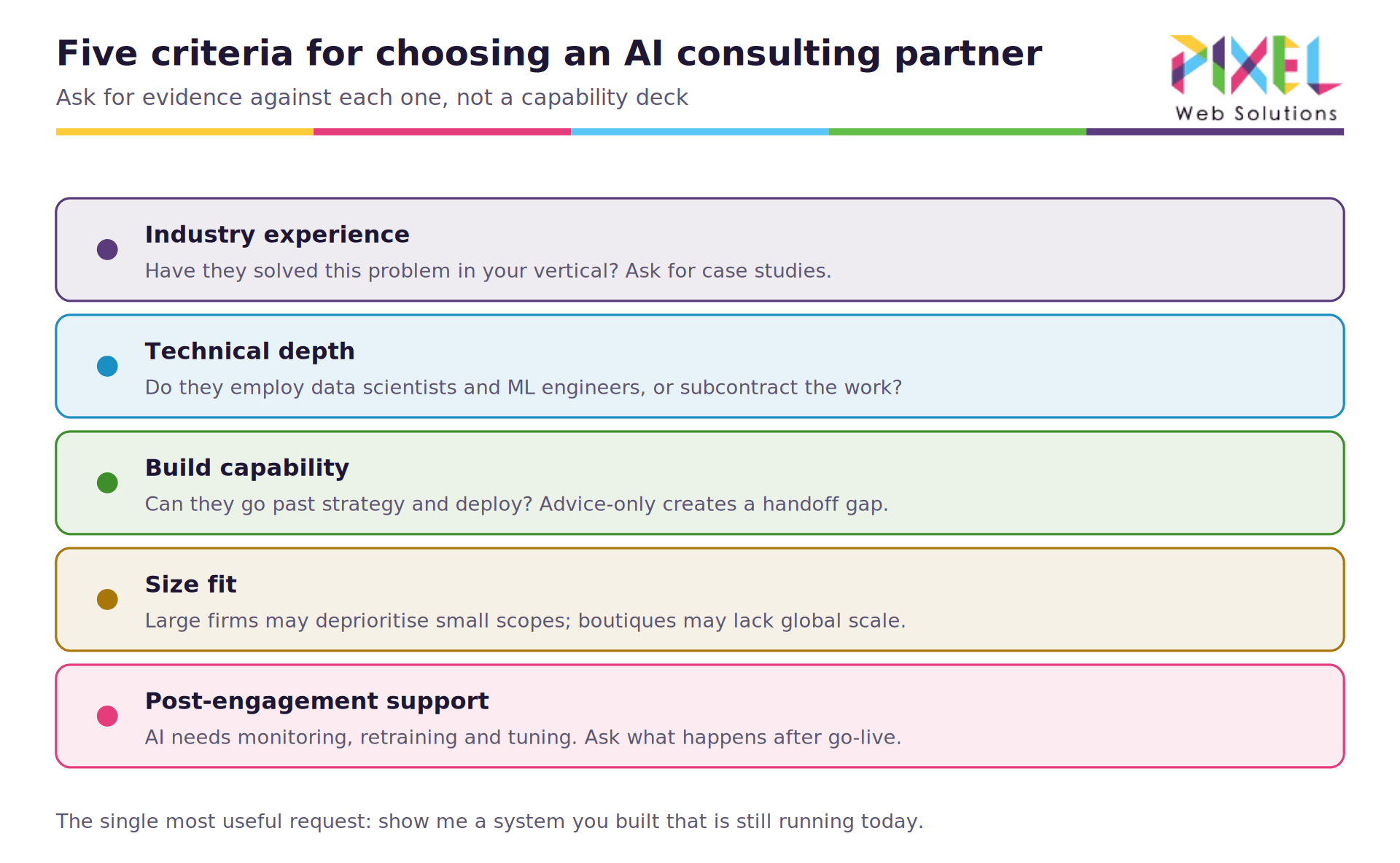
Ask for evidence against each, not a capability deck.
Industry experience. Have they solved this problem in your vertical? Request case studies with numbers, not logos.
Technical depth. Do they employ data scientists and ML engineers directly, or subcontract? Ask for named individuals and their availability, and put the answer in the statement of work. This market has a well-documented pattern of senior people selling and junior people delivering.
Build capability. Can they go beyond strategy and deploy? Advice-only creates a handoff gap, and the handoff is where accountability disappears.
Size fit. Large firms may deprioritize smaller engagements; boutiques give senior attention but may lack global scale. Ask where your engagement would sit in their portfolio by value.
Post-engagement support. AI systems need monitoring, retraining and cost tuning. Running cost rises with usage rather than falling with scale, which is unlike most software you have bought. Ask what happens after the initial project ends and what it costs at ten times current volume.
What Does AI Consulting Cost in the USA?
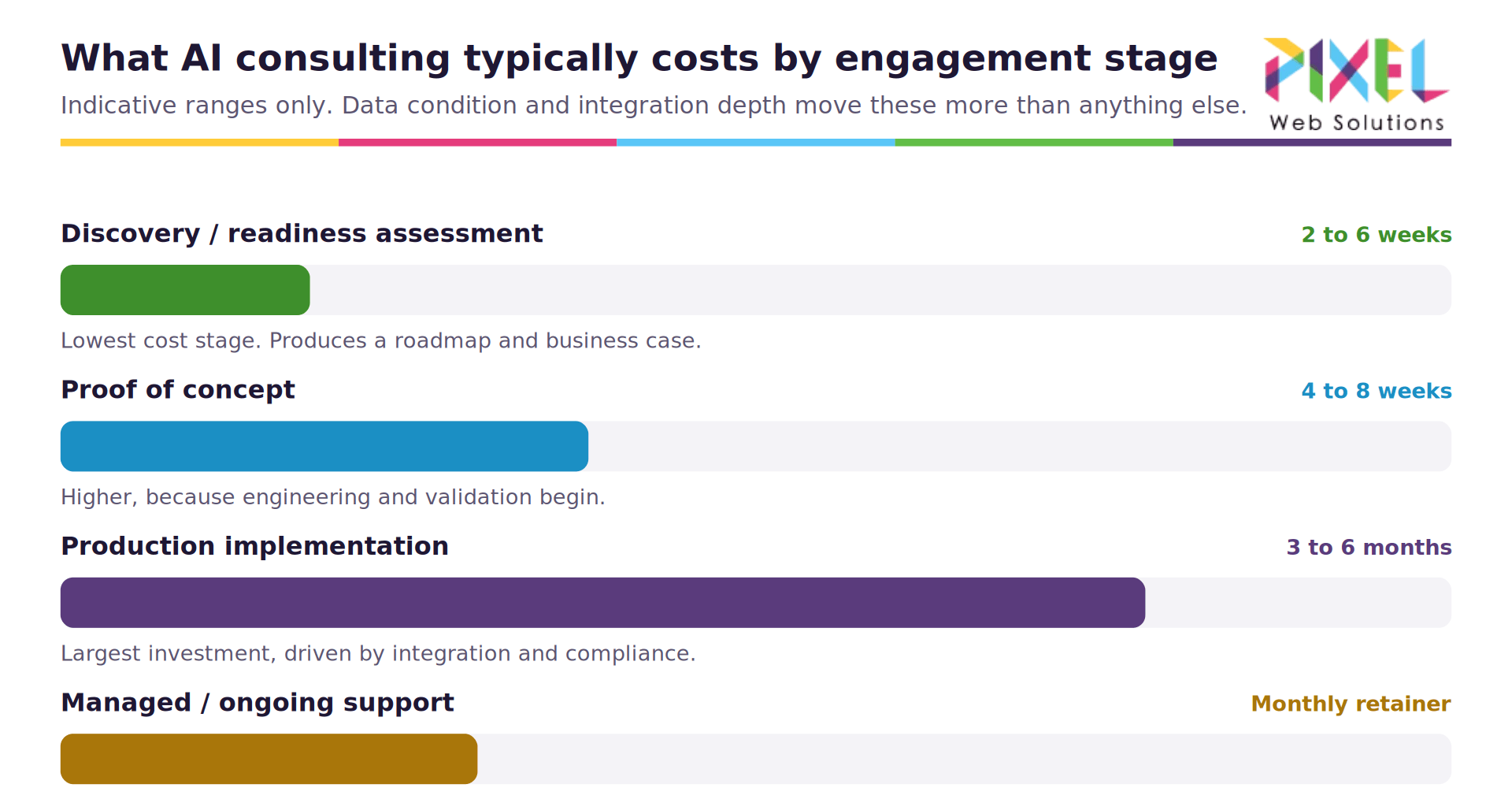
v1 of this article described the stages without giving numbers. Here are the ranges the market actually advertises in 2026.
| Engagement | Typical range | Duration |
| Discovery and readiness assessment | USD 25,000 to 75,000 | 2 to 6 weeks |
| Proof of concept, one use case | USD 20,000 to 60,000 | 4 to 8 weeks |
| Production implementation | Highly variable, driven by integration depth | 3 to 6 months |
| Managed support retainer | Monthly, scaled to system count and usage | Ongoing |
By firm tier, hourly rates run roughly USD 100 to 350 for independents, USD 150 to 300 for boutique and specialist firms, USD 300 to 500 for mid-tier consultancies, and USD 500 to 1,000 and above for Big Four and tier-one strategy houses.
Read these with appropriate caution. They are compiled from published 2026 rate guides rather than from a single audited dataset, they skew toward US and UK pricing, and offshore and hybrid delivery sits materially below them. Published guides broadly agree that rates have risen 10 to 15 percent annually since 2024 on generative and agentic AI demand.
Fees vary more with data condition and integration depth than with firm size or model choice. Compare quotes on cost per completed business outcome rather than on day rate. A cheaper day rate that produces a pilot nobody uses is the more expensive option.
What Is Actually Different About Buying AI Consulting in the US
Most “best AI consulting companies” lists are geographically interchangeable. They name the same global firms and could be retitled for any country without changing a word. Four things genuinely differ for a US buyer, and they should shape your shortlist more than the logos do.
There is no federal AI statute, so compliance is assembled from parts. Unlike the EU AI Act, which gives a single risk-tiering framework, US obligations come from sector regulators and state legislatures. A consultant who describes AI governance only in EU AI Act terms is describing a framework you may not be subject to, while potentially missing the ones you are.
State privacy law is the practical constraint for most companies. California, Colorado, Connecticut, Texas, Virginia and a growing list of others impose obligations that bite on automated decision-making and on the training data behind it. If you operate across state lines, ask specifically which state regimes a firm has delivered under, not whether they “handle compliance”.
Sector rules usually outrank general AI rules. In financial services, model risk management expectations shape how AI decisions must be documented and validated. In healthcare, HIPAA governs what data can reach a model at all. In hiring, both federal EEOC guidance and local rules such as New York City’s automated employment decision tool law apply. In each case the binding constraint predates AI and is enforced by a regulator that already knows your industry.
Data residency and contracting are where offshore delivery is decided. This is the question that determines whether a global delivery model works for you, and it is answerable early. Where must data physically sit, which entity signs the contract, who carries liability, and who is the named accountable owner reachable in your working hours. Firms that answer these crisply have been asked before. Firms that answer vaguely have not.
None of this argues for or against a US-headquartered firm. It argues for asking a US-specific set of questions of whichever firm you shortlist, because “we are compliant” is not an answer to any of the four.
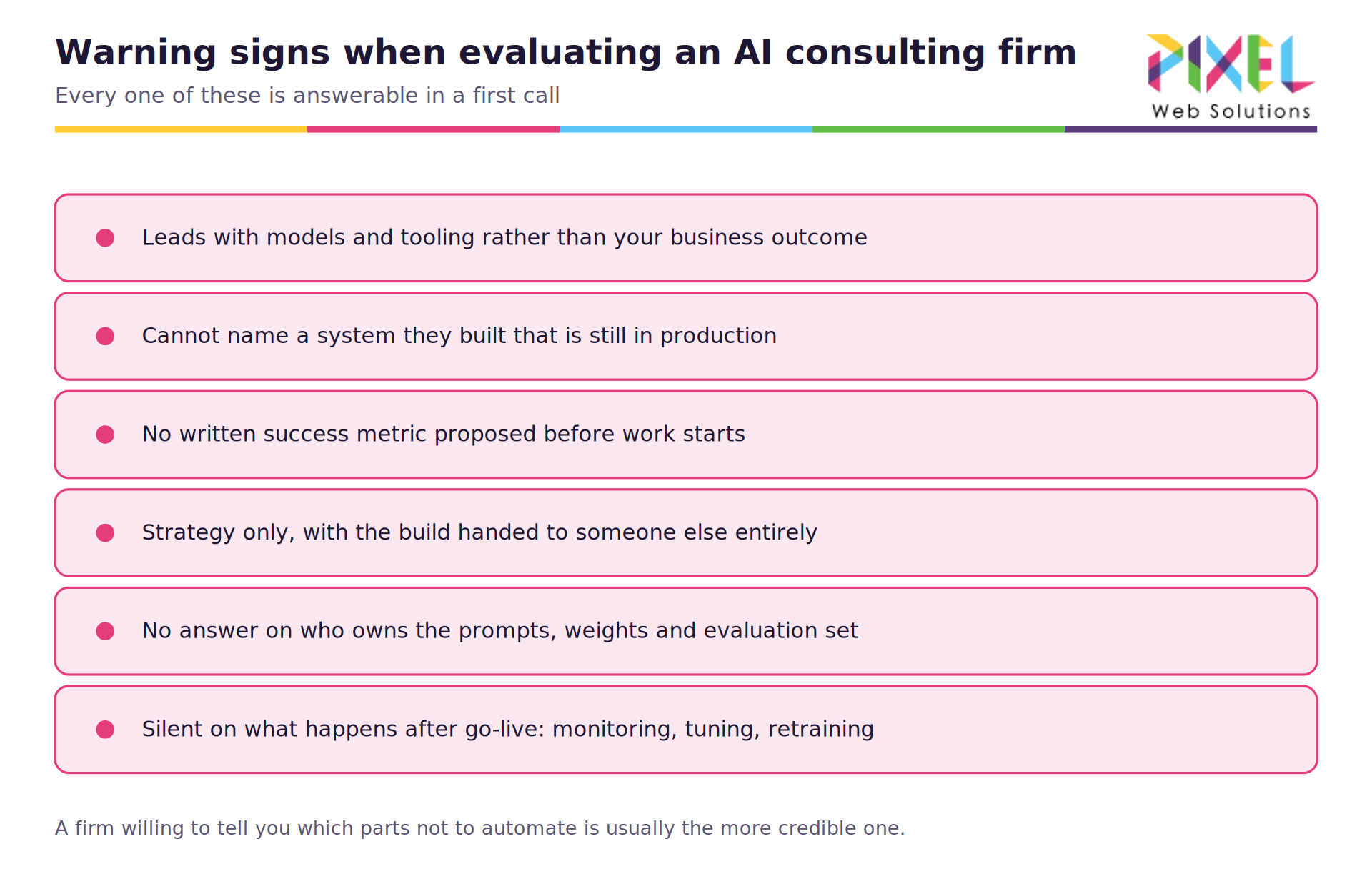
Warning Signs When Evaluating a Firm
- Leads with models and tooling rather than your business outcome.
- Cannot name a system they built that is still running in production.
- Proposes no written success metric before work begins.
- Offers strategy only, with the build handed to a third party entirely.
- Has no clear answer on who owns the prompts, model weights and evaluation set.
- Is silent on what happens after go-live: monitoring, tuning and retraining.
- Quotes a fixed price before auditing your data.
- Uses the word “agentic” more often than the word “integration”.
A firm willing to tell you which parts of your idea are not worth automating is usually the more credible one. An assessment that concludes everything you proposed is viable is selling capacity, not judgment.
Which Type of Partner Fits Your Situation?
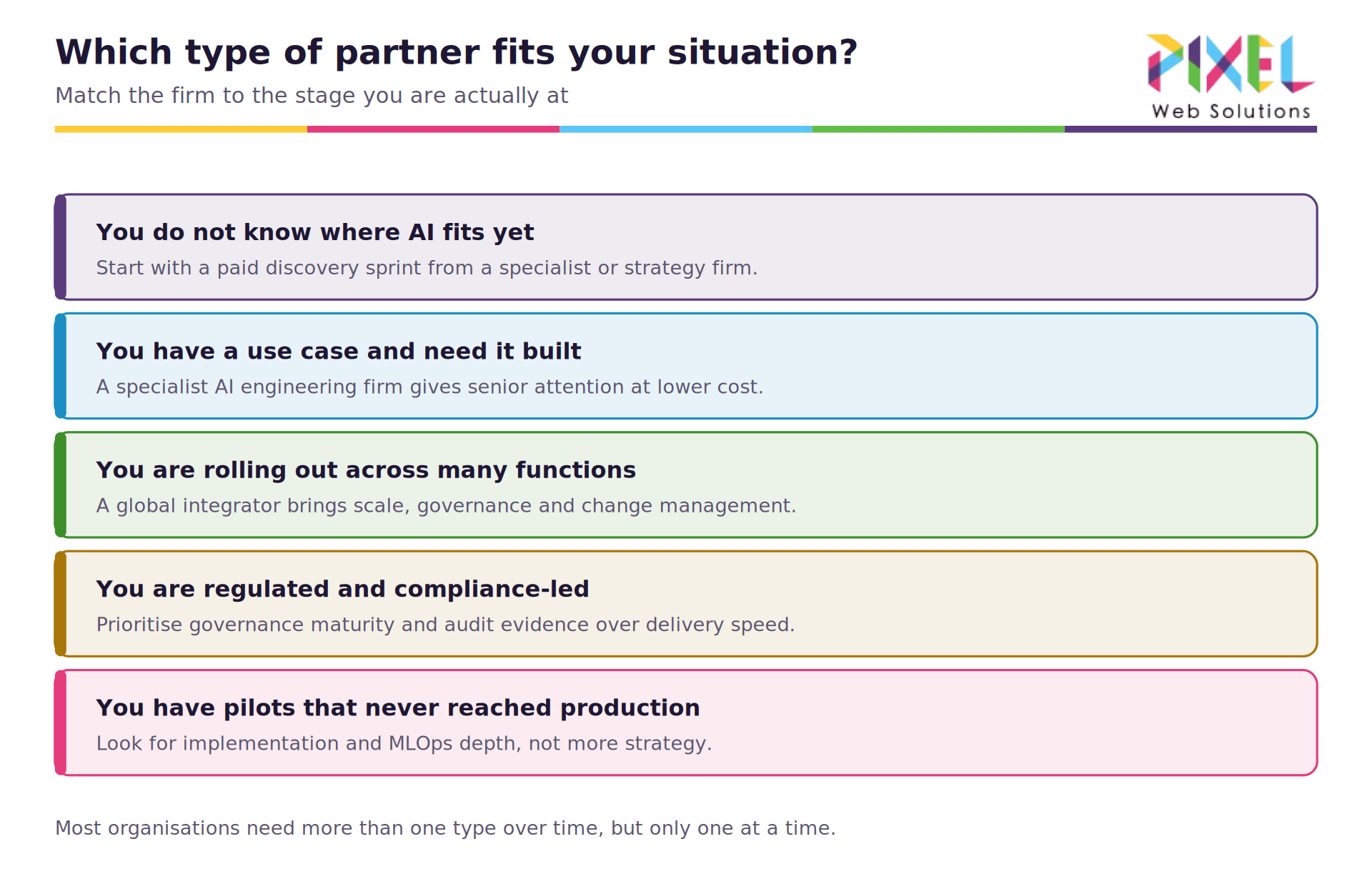
| Your situation | Start with | Why |
| You do not yet know where AI fits | Paid discovery sprint, specialist or strategy firm | The expensive mistakes are made in scoping, not coding |
| Defined use case, needs building | Specialist AI engineering firm | Senior attention at lower cost, and you are past the advisory question |
| Rolling out across many functions | Global integrator | Scale, governance and change management are the constraint |
| Regulated and compliance-led | Governance maturity over delivery speed | Audit evidence is harder to retrofit than architecture |
| Pilots that never reached production | Implementation and MLOps depth | More strategy will not help; the constraint is downstream |
| Data quality is the known problem | Data-led consultancy | An AI layer over bad data reproduces it at scale |
If several pilots have stalled, adding engineering capacity rarely helps, because the constraint sits upstream of the code. That is the clearest signal that what you actually need is advisory work, or in some cases RAG development to ground systems in your own content rather than another round of prompting.
Questions for Your Shortlist Call
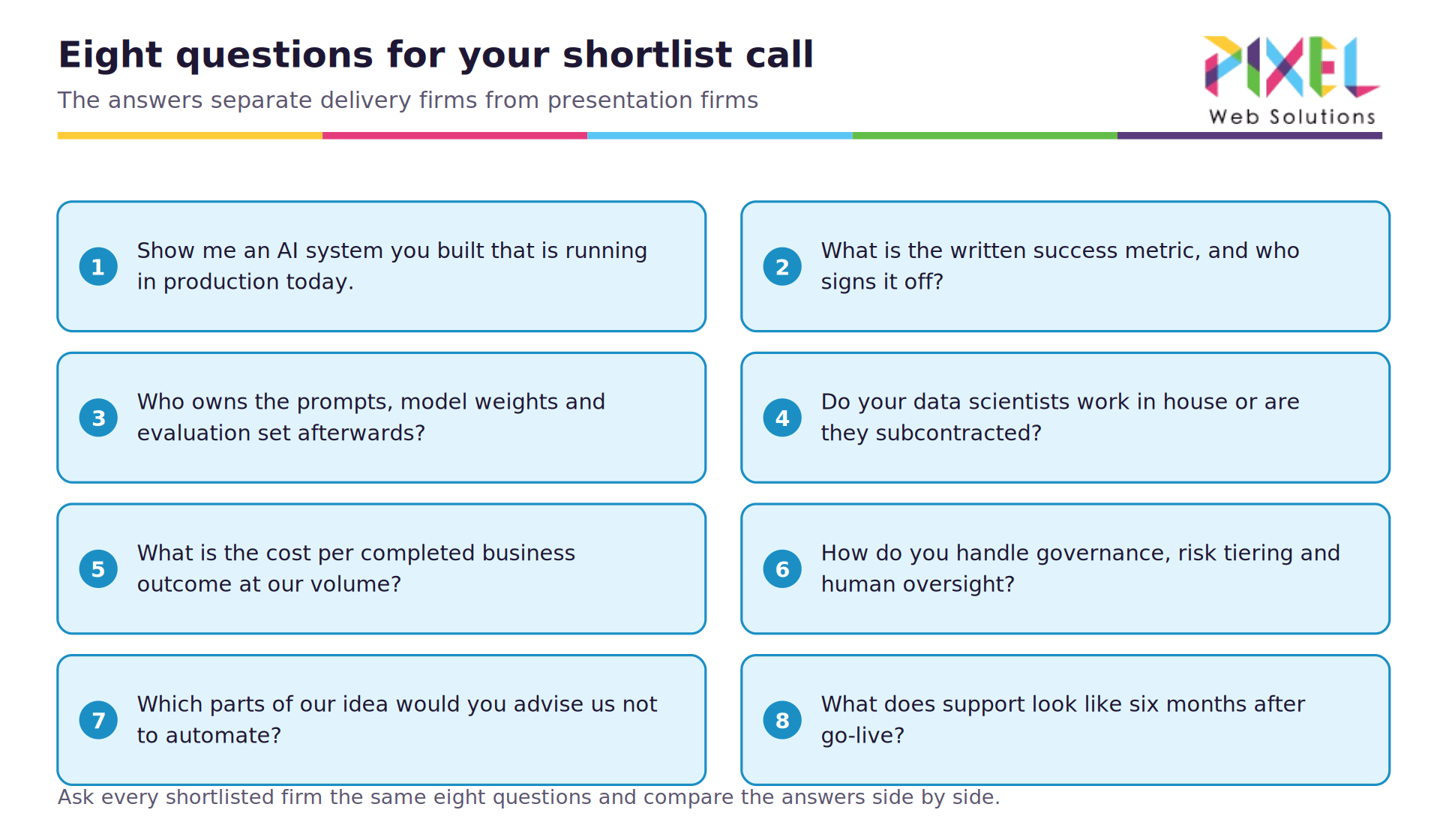
Ask every shortlisted firm the same eight questions and compare answers side by side.
- Show me an AI system you built that is running in production today, and tell me what broke.
- What is the written success metric, what number counts as a pass, and who signs it off?
- Who owns the prompts, model weights, training data and evaluation set afterward?
- Do your data scientists work in house, or are they subcontracted? Which named people will work on this?
- What is the cost per completed business outcome at our volume, and at ten times our volume?
- How do you handle governance, risk tiering and human oversight?
- Which parts of our idea would you advise us not to automate?
- What does support look like six months after go-live, and what does it cost?
Question one does most of the work. Building a convincing pilot is now inexpensive. Keeping one alive for eighteen months is not.
Does an AI Consulting Firm Need to Be Based in the USA?
Not necessarily, and this is worth addressing directly because it determines how you read any list including this one.
Many firms serving US businesses operate global or hybrid delivery models, which can provide senior expertise at a materially lower cost base. What matters is not the flag on the website but four specific things: timezone overlap sufficient for your working pattern, demonstrated familiarity with the regulations you are subject to, contracting and data residency arrangements that satisfy your legal team, and a named accountable owner for your engagement who is reachable in your working hours.
Confirm all four at the outset. If a firm is vague on any of them, that vagueness is the answer.
Where US presence genuinely is required, and it sometimes is, that is usually driven by data residency rules, federal or defense contracting requirements, or an internal procurement policy rather than by delivery quality. Establish which of those applies to you before it narrows your shortlist by accident.
Conclusion
There is no single best choice among AI consulting companies in USA markets, only the right tier and the right fit for where your organization currently stands.
Global integrators and strategy houses bring unmatched scale and governance and are built for large enterprises with budgets and timelines to match. Specialist firms deliver focused scopes faster and more economically with senior people on the work. Given that more than 40 percent of agentic AI projects are forecast to be canceled and that 42 percent of organizations scrapped most of their AI initiatives in a single year, what matters more than the logo is whether the firm can show you something running in production, agree a success metric in writing before starting, and tell you honestly what not to build.
If you would like that conversation without a sales pitch, our AI consulting services start with a fixed-scope discovery sprint.
FAQ
Q: What are the best AI consulting companies in the USA?
Firms commonly shortlisted include Pixel Web Solutions, Accenture, Deloitte, IBM Consulting, McKinsey QuantumBlack, Capgemini, Cognizant, LeewayHertz, InData Labs and Addepto. They occupy three different tiers, so the better question is which tier fits your engagement size, industry, and whether you need strategy, delivery or both. Most disappointing engagements are tier mistakes rather than vendor mistakes.
Q: How much does AI consulting cost in the USA?
In 2026, published rate guides put specialist and boutique firms at roughly USD 150 to 300 per hour, mid-tier consultancies at USD 300 to 500, and Big Four or tier-one strategy houses at USD 500 to 1,000 and above. Fixed-fee discovery sprints commonly run USD 25,000 to 75,000 over two to six weeks, and a scoped proof of concept commonly runs USD 20,000 to 60,000. Data condition, integration depth and compliance requirements influence price more than firm size.
Q: What is the difference between AI consulting and AI development?
AI consulting decides what should be built, whether it is feasible with your data, what it will cost per outcome and how it will be governed. AI development builds what has been specified. Many firms offer both, and the advisory work is what prevents the wrong thing being built well, which is the most expensive failure mode available.
Q: Should I choose a large consultancy or a specialist AI firm?
Large consultancies suit multi-country, multi-function rollouts needing scale, governance and change management. Specialist firms suit defined scopes where senior attention, speed and cost matter more than global footprint. Mid-market organizations are frequently deprioritized by the largest firms, which is often the deciding factor in practice.
Q: How do I evaluate an AI consulting company?
Assess industry experience with real case studies, technical depth including whether data scientists are in house, build capability beyond strategy, size fit for your engagement, and post-engagement support. Ask to see a system they built that is still running in production, ask what broke, and agree a written success metric before work starts.
Q: Do AI consulting firms need to be based in the USA?
Not necessarily. Many firms serving US businesses operate global or hybrid delivery models, which can provide senior expertise at a lower cost base. What matters is timezone overlap for your working pattern, familiarity with the regulations you are subject to, contracting and data residency arrangements, and a named accountable owner for your engagement. Confirm all four at the outset. Where US presence is genuinely required, it is usually driven by data residency rules or procurement policy rather than by delivery quality.
Q: How long does an AI consulting engagement take?
A discovery sprint typically runs two to six weeks, a pilot four to eight weeks, and a production implementation three to six months depending on integration depth. Ongoing support is continuous. Engagements that skip the pilot stage generally take longer overall rather than shorter, because the scope correction arrives later and costs more.
Q: Why do so many AI projects fail?
Gartner attributes its forecast of more than 40 percent agentic AI project cancellations by 2027 to escalating costs, unclear business value and inadequate risk controls rather than to model capability. S&P Global found 42 percent of organizations scrapped most of their AI initiatives in 2025, up from 17 percent the year before. The common causes are scope that is too broad, no agreed success metric, poor data foundations, and no plan for what happens when the system fails.