





Table of Contents
Modern marketing has become increasingly complex, with teams managing repetitive tasks across multiple channels while striving to meet ever-growing customer expectations. From email campaigns and social media management to lead nurturing and performance analysis, marketers often spend more time on operational work than on strategic initiatives. At the same time, consumers expect personalized experiences, instant responses, and relevant recommendations at every touchpoint.
This is where AI marketing agents are transforming the landscape. By automating workflows, analyzing customer behavior, and optimizing campaigns in real time, these intelligent systems help businesses improve efficiency and drive better results. As a result, organizations across industries are increasingly investing in AI marketing agent development to streamline marketing operations and accelerate growth.
What is an AI Marketing Agent?
An AI marketing agent is an intelligent software system that autonomously performs marketing tasks by analyzing data, making decisions, and executing actions with minimal human intervention. Unlike traditional marketing tools that adhere to fixed rules, AI marketing agents use advanced technologies such as machine learning and natural language processing to better understand customer behavior.
They help personalize interactions, improve marketing campaigns, create content, and enhance performance using real-time insights. By acting as virtual marketing assistants, these agents help businesses streamline complex marketing operations, enhance customer engagement, and achieve better results across multiple channels.
Why Are Businesses Investing in AI Marketing Agent Development?
According to Grand View Research, the global AI in marketing market was valued at USD 20.44 billion in 2024 and is projected to reach USD 82.23 billion by 2030, growing at a CAGR of 25.0%. This remarkable growth reflects how businesses across industries are increasingly investing in AI-powered marketing solutions to automate workflows, deliver personalized customer experiences, and optimize campaign performance.
Automate Repetitive Marketing Tasks
According to HubSpot, 74% of marketers use AI to automate repetitive tasks, such as email scheduling, social media management, and campaign monitoring. AI marketing agents reduce manual effort, allowing teams to focus on strategy and creativity.
Deliver Personalized Customer Experiences
McKinsey reports that 71% of consumers expect personalized interactions from businesses. AI marketing agents analyze customer behavior in real time to deliver tailored content, recommendations, and offers across multiple channels.
Improve Campaign Performance
AI marketing agents continuously optimize audience targeting, campaign messaging, and budget allocation based on live performance data. This helps businesses maximize conversions and achieve better marketing ROI with minimal manual intervention.
Make Faster, Smarter Decisions
Research by PwC found that 73% of business leaders believe AI enables better business decision-making. AI marketing agents analyze vast amounts of customer and campaign data to generate actionable insights and recommend the next best actions.
Scale Marketing Across Multiple Channels
AI marketing agents seamlessly manage campaigns across email, social media, websites, search engines, and paid advertising platforms, ensuring consistent customer experiences while reducing operational complexity.
Gain a Competitive Advantage
According to Salesforce, 83% of high-performing marketing teams use AI in their workflows. By adopting AI marketing agents, businesses can launch campaigns faster, improve customer engagement, and stay ahead in an increasingly competitive market.
The rise of AI marketing agents shows that businesses are advancing from basic automation to intelligent, autonomous marketing systems. Businesses investing in these agents are better positioned to enhance efficiency, personalize customer experiences, optimize campaigns, and achieve sustainable growth in a competitive digital landscape.
How AI Marketing Agents Work?
AI marketing agents follow an intelligent workflow to transform raw customer data into actionable marketing decisions. The process consists of six key stages:
- Data Collection – The agent gathers data from various sources like CRM systems, social media, and customer interactions to understand behavior and campaign performance.
- Customer Analysis – Using machine learning and natural language processing, the agent analyzes demographics, behavior, and preferences to segment audiences and derive insights for personalized strategies.
- Decision Making – The agent uses the analyzed data to determine effective marketing actions, including target audience, communication channels, and timing for engagement.
- Campaign Execution – Once decisions are made, the agent autonomously launches and manages campaigns across channels, ensuring timely execution of emails, social media posts, and ads.
- Performance Monitoring – The agent tracks key performance indicators like click-through rates and conversions, identifying trends and measuring marketing effectiveness in real time.
- Continuous Optimization – Based on performance data, the agent refines strategies and optimizes future campaigns, creating a feedback loop for improved outcomes over time.
Key Considerations to Build an AI Marketing Agent That Delivers ROI
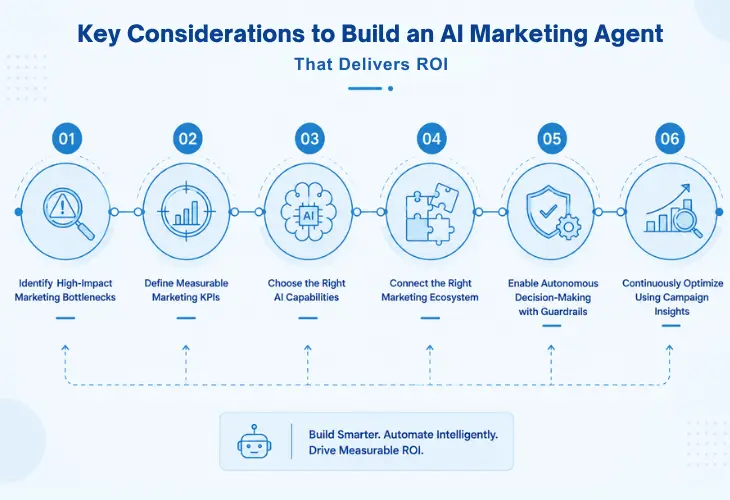
Building an AI marketing agent is not just about adopting the latest AI technologies—it’s about solving real marketing challenges and delivering measurable business outcomes. A successful AI marketing agent aligns with your business goals, integrates seamlessly with your existing marketing ecosystem, and continuously improves based on performance.
Here are the key business decisions that determine its success:
1. Identify High-Impact Marketing Bottlenecks
Start by identifying repetitive, time-consuming, or inefficient marketing processes that affect business performance. Whether it’s lead qualification, campaign optimization, customer segmentation, or content creation, addressing the right bottlenecks ensures your AI agent delivers immediate value.
2. Define Measurable Marketing KPIs
Clearly establish the metrics that will determine success before development begins. KPIs such as conversion rate, customer acquisition cost (CAC), click-through rate (CTR), lead response time, customer lifetime value (CLV), and return on ad spend (ROAS) help evaluate the AI agent’s effectiveness and guide continuous improvements.
3. Choose the Right AI Capabilities
The most advanced AI model isn’t always the best choice. Instead, select AI capabilities that align with your marketing objectives, such as predictive analytics, content generation, audience segmentation, recommendation engines, or conversational AI. The right functionality creates greater business impact than simply adopting the newest technology.
4. Connect the Right Marketing Ecosystem
An AI marketing agent performs best when it has access to unified customer and campaign data. Integrating it with CRM platforms, marketing automation tools, analytics solutions, social media platforms, and advertising networks enables the agent to make informed decisions and deliver consistent customer experiences across channels.
5. Enable Autonomous Decision-Making with Guardrails
AI should be empowered to automate marketing decisions while operating within predefined business rules. Setting approval workflows, spending limits, brand guidelines, compliance policies, and human oversight ensures the agent can act independently without compromising accuracy, security, or brand reputation.
6. Continuously Optimize Using Campaign Insights
An effective AI marketing agent doesn’t stop learning after deployment. By analyzing campaign performance, customer engagement, and market trends, it continuously refines audience targeting, messaging, budget allocation, and marketing strategies to improve ROI over time.
Ultimately, the success of an AI marketing agent depends less on the technology itself and more on the strategic decisions made during development. By focusing on business objectives, measurable outcomes, and continuous optimization, organizations can build AI marketing agents that not only automate marketing operations but also drive sustainable growth and maximize return on investment.
Transform Your Marketing with a Custom AI Marketing Agent
Key Features of AI Marketing Agents
AI marketing agents leverage intelligent decision-making and automation to optimize marketing operations. They enhance customer interactions, streamline campaigns, and improve efficiency through key features such as:
- Audience Segmentation – Analyzing customer data to target specific demographics and behaviors.
- Campaign Automation – Automating repetitive tasks to enhance execution speed.
- Lead Qualification – Identifying high-quality prospects to focus sales efforts.
- Customer Journey Tracking – Monitoring interactions to optimize engagement.
- Predictive Analytics – Forecasting customer behavior and campaign outcomes.
- Personalized Recommendations – Offering customized content and products based on preferences.
- Content Generation – Creating marketing materials efficiently.
- Email Automation – Personalizing and optimizing email campaigns.
- Social Media Management – Managing content, scheduling, and audience engagement.
- A/B Testing – Testing and analyzing campaign variations for better performance.
- CRM Integration – Syncing customer data for personalized experiences.
- Real-Time Decision Making – Adjusting strategies based on live data analysis.
These features enable businesses to implement data-driven decisions, streamline operations, and create personalized customer experiences for improved campaign outcomes.
Top Use Cases of AI Marketing Agents
AI marketing agents can be applied across various marketing functions to automate workflows, improve customer engagement, and maximize campaign performance. From acquiring new customers to retaining existing ones, these intelligent agents help businesses make faster, data-driven marketing decisions while reducing manual effort.
Email Marketing
AI marketing agents create personalized email campaigns, optimize send times, and tailor messaging based on customer behavior to improve open rates and conversions.
Social Media Marketing
They automate content scheduling, monitor audience engagement, identify trending topics, and recommend the best times to publish content across social platforms.
SEO Optimization
AI agents analyze keyword performance, identify content opportunities, optimize on-page elements, and provide recommendations to improve search engine rankings.
Paid Advertising
They optimize ad targeting, bidding strategies, audience segmentation, and budget allocation to maximize return on ad spend (ROAS) across advertising platforms.
Customer Retargeting
AI marketing agents identify users who abandoned their purchase journey and deliver personalized ads, emails, or offers to encourage them to return and convert.
Sales Funnel Optimization
By analyzing customer interactions at every stage of the funnel, AI agents identify drop-off points and recommend strategies to improve conversion rates.
Lead Nurturing
AI agents automate personalized follow-up messages, educational content, and engagement campaigns to guide prospects through the buying journey until they are sales-ready.
Product Recommendations
Using customer preferences, browsing history, and purchase behavior, AI marketing agents recommend relevant products that increase cross-selling, upselling, and overall sales.
Customer Support
AI-powered agents provide instant responses to customer queries, resolve common issues, and offer personalized assistance around the clock, improving customer satisfaction.
As AI technology continues to evolve, the use cases of AI marketing agents are expanding rapidly. By automating routine marketing activities and enabling intelligent decision-making, these agents help businesses deliver personalized experiences, improve operational efficiency, and achieve better marketing results across every customer touchpoint.
Benefits of AI Marketing Agent Development
AI marketing agent development offers significant business value beyond workflow automation. By integrating data intelligence and continuous optimization, these agents enhance marketing performance, lower operational costs, and support sustainable growth.
- Increased Conversions – Personalized messaging and timely customer engagement lead to higher sales opportunities.
- Better Customer Engagement – Relevant content and recommendations foster meaningful interactions across channels.
- Reduced Manual Work – Automation frees marketing teams to focus on strategy and creativity.
- Lower Marketing Costs – Intelligent budget allocation and optimized performance reduce customer acquisition costs.
- Higher Campaign Accuracy – AI’s analysis of data ensures precise targeting and reduces errors.
- Faster Decision-Making – Real-time data processing enables quick responses to market shifts and customer behaviors.
- Better Personalization – Tailored experiences enhance customer interactions based on individual preferences.
- Improved Customer Retention – Continuous personalized engagement builds loyalty and increases customer lifetime value.
AI marketing agents ultimately empower businesses to achieve smarter marketing with measurable results, driving sustainable growth.
Industries That Can Benefit from AI Marketing Agents
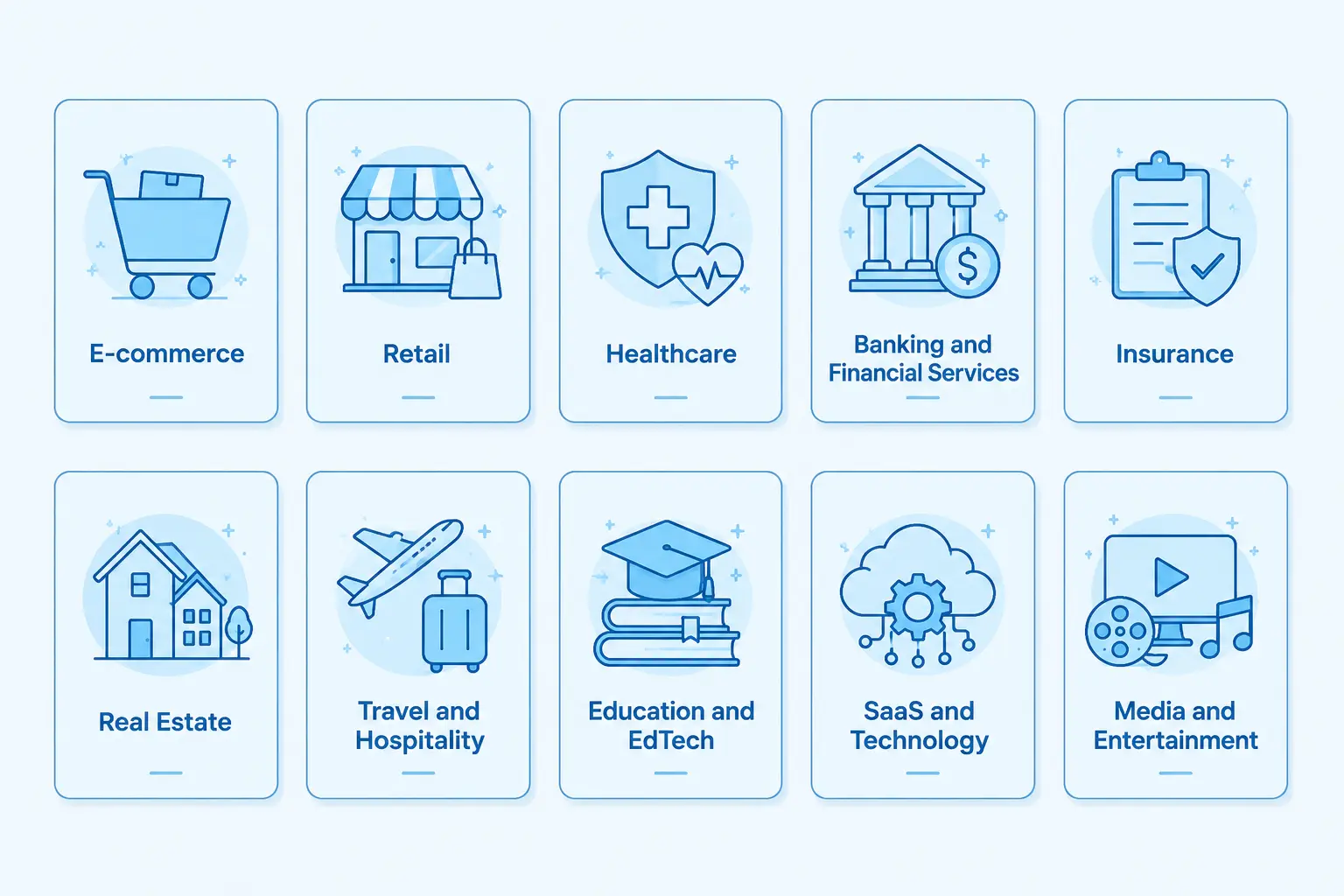
AI marketing agents are transforming how businesses attract, engage, and retain customers across industries. Whether the goal is to personalize customer experiences, automate campaigns, or improve marketing ROI, organizations in almost every sector can leverage AI marketing agents to achieve better business outcomes and stay ahead of the competition.
Technologies Powering AI Marketing Agent Development
AI marketing agents rely on a combination of advanced AI technologies, data infrastructure, and business integrations to make intelligent decisions and automate marketing activities. Together, these technologies enable agents to understand customer intent, generate content, analyze data, and optimize campaigns with minimal human intervention.
- LLMs (Large Language Models) – Enable AI marketing agents to understand, generate, and respond to human language in a natural and context-aware manner.
- NLP (Natural Language Processing) – Helps AI agents interpret customer queries, analyze sentiment, and extract meaningful insights from text-based data.
- Machine Learning – Allows AI marketing agents to learn from historical data and continuously improve their predictions and decision-making.
- Predictive Analytics – Forecasts customer behavior, campaign performance, and future trends using historical and real-time data.
- Generative AI – Creates high-quality marketing content such as emails, ad copy, blog posts, and social media captions.
- Vector Databases – Store and retrieve semantic data efficiently, enabling AI agents to deliver contextually relevant responses and recommendations.
- RAG (Retrieval-Augmented Generation) – Enhances AI responses by retrieving relevant business knowledge before generating accurate and context-aware outputs.
- APIs – Connect AI marketing agents with third-party platforms, enabling seamless data exchange and workflow automation.
- CRM Integration – Provides AI agents with customer data to deliver personalized marketing and manage customer relationships effectively.
- Marketing Automation Tools – Enable AI agents to execute, monitor, and optimize campaigns across multiple marketing channels.
How Much Does It Cost to Create an AI Marketing Agent?
The cost of developing an AI marketing agent varies with several factors, including the agent’s complexity, the AI capabilities required, the number of marketing channels it supports, third-party integrations, customization needs, data infrastructure, security requirements, and ongoing maintenance.
A simple AI agent designed for basic marketing automation will have different development requirements than an enterprise-grade solution capable of autonomous decision-making, predictive analytics, and multi-channel campaign management. Therefore, there is no one-size-fits-all pricing model, as every business has unique goals and technical requirements.
Want to know the exact cost of developing an AI marketing agent for your business?
Future Trends in AI Marketing Agents
AI marketing agents are rapidly evolving from task automation to intelligent systems that can plan, execute, and optimize entire marketing strategies. Key advancements include:
- Autonomous Campaign Management – AI will independently manage and optimize marketing campaigns with minimal human intervention.
- Multi-Agent Systems – Different AI agents will collaborate on tasks like content creation, audience analysis, and customer support, enhancing marketing efficiency.
- Hyper-Personalization – Future agents will provide highly personalized experiences by analyzing real-time customer data.
- Voice Marketing – AI will optimize campaigns for voice-enabled devices, facilitating natural customer interactions.
- AI-Generated Videos – Marketing agents will create personalized video content automatically, at scale.
- Agentic Marketing – AI will make strategic marketing decisions and execute campaigns autonomously.
- Predictive Customer Journeys – AI will anticipate customer needs and behaviors, enabling proactive engagement.
As these innovations gain traction, businesses that adopt them early will enhance customer experiences and strengthen their competitive edge.
Build Your Custom AI Marketing Agent with Pixel Web Solutions
The future of marketing belongs to businesses that can automate intelligently, personalize customer experiences, and make data-driven decisions at scale. As an experienced AI Agent Development Company, Pixel Web Solutions specializes in building custom AI marketing agents tailored to your unique business goals and marketing workflows. Whether you want to automate campaigns, improve customer engagement, or maximize marketing ROI, our AI experts can build a scalable solution that helps you stay ahead of the competition and accelerate business growth.
Partner with us to transform your marketing operations into an AI-powered growth engine that delivers long-term success and measurable results.
Frequently Asked Questions (FAQs)
- Can AI marketing agents work alongside my existing marketing team?
Yes. AI marketing agents are designed to complement your marketing team by automating repetitive tasks and providing actionable insights. This allows marketers to focus on strategy, creativity, and relationship-building while the AI handles routine operations.
- Can an AI marketing agent integrate with my existing marketing tools?
Absolutely. AI marketing agents can integrate with popular CRM platforms, email marketing software, analytics tools, social media management platforms, and advertising networks, ensuring seamless data flow and workflow automation.
- How long does it take to develop an AI marketing agent?
The development timeline depends on the solution’s complexity, required AI capabilities, integrations, and customization needs. Simple AI agents can be deployed relatively quickly, while enterprise-grade solutions require more planning, development, and testing.
- Is AI marketing agent development suitable for small and medium-sized businesses?
Yes. AI marketing agents can be customized to meet the needs and budgets of businesses of all sizes. Small and medium-sized businesses can leverage AI to automate marketing tasks, improve customer engagement, and compete more effectively without expanding their teams.
- Can AI marketing agents support multiple languages?
Yes. AI marketing agents can be trained to understand and generate content in multiple languages, enabling businesses to engage global audiences and run multilingual marketing campaigns more effectively.
- Are AI marketing agents secure enough to handle customer data?
Yes, when developed with robust security measures. Features such as data encryption, role-based access controls, secure API integrations, and compliance with data privacy regulations help protect sensitive customer information.
- Can AI marketing agents be customized for specific industries?
Absolutely. AI marketing agents can be tailored to industry-specific workflows, customer journeys, compliance requirements, and marketing objectives, making them suitable for sectors such as healthcare, finance, retail, education, real estate, and more.