Table of Contents
Most support teams have already deployed generative AI, and a good number are disappointed by it. The reason is structural rather than technical: a model that writes an excellent reply still leaves the customer’s actual problem untouched.
Agentic AI closes that gap by acting on your systems instead of describing what should happen. The distinction matters commercially right now, because Gartner expects 40 percent of enterprise applications to embed task-specific AI agents by the end of 2026, up from under 5 percent in 2025, while McKinsey found that in any given business function no more than 10 percent of organizations are actually scaling agents.
That gap between what is being shipped and what is running in production is the whole opportunity. This guide covers what separates agentic from generative AI, which customer service tickets agents can genuinely close, what it costs, where else autonomous agents beat generative AI, and the guardrails required before any of it touches a real customer.
What Is Agentic AI for Customer Service?
Agentic AI for customer service is a system that receives a customer goal, plans the steps needed to achieve it, calls the tools and systems required, checks the result, and either confirms completion or escalates to a human.
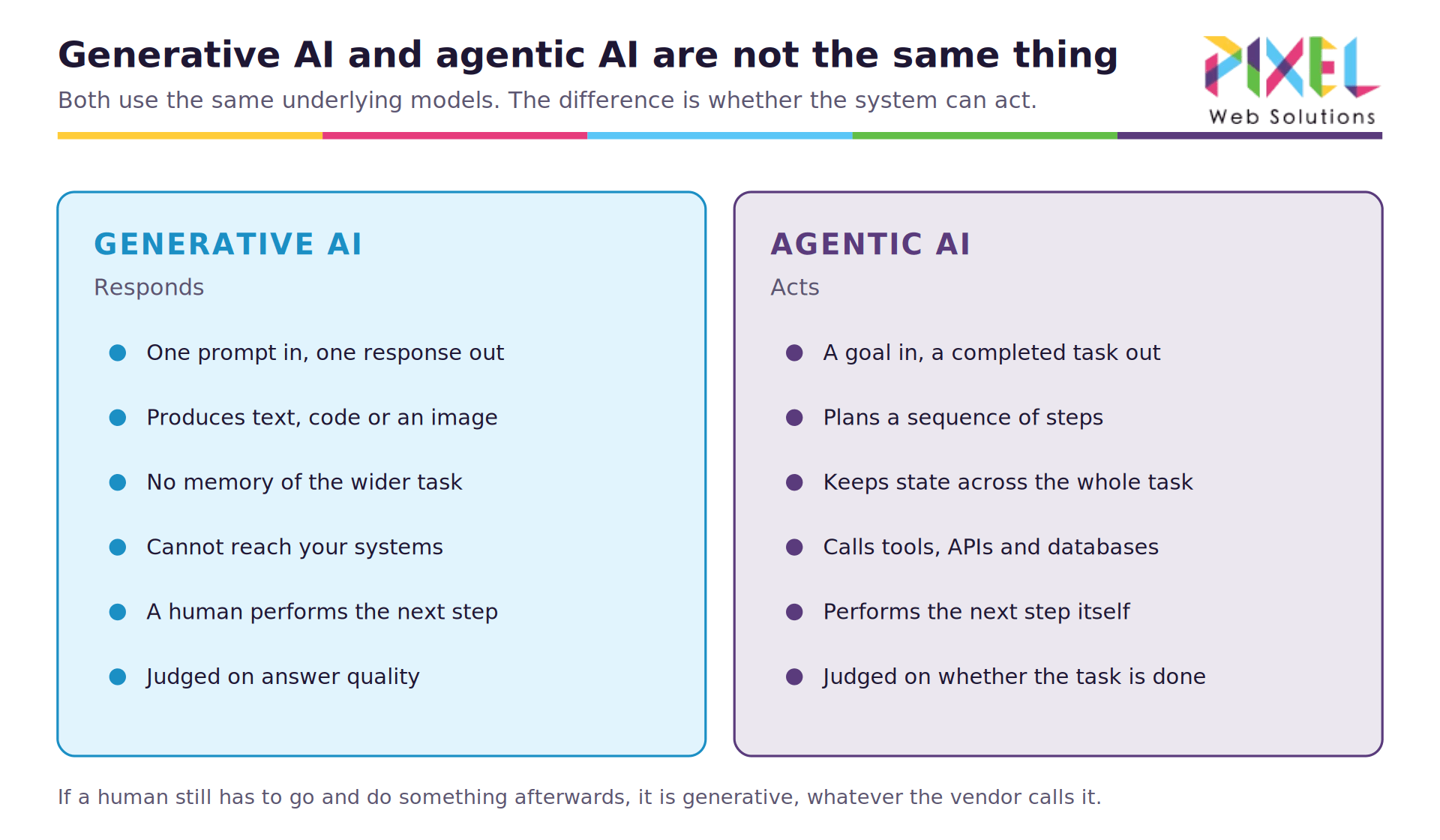
Generative AI produces an answer. An agent produces an outcome.
The difference in one sentence
If a human still has to go and do something after the AI responds, it was generative, whatever the vendor’s marketing says.
That is not a criticism of generative AI. Drafting, summarizing and translating are genuinely valuable and far cheaper to run. The problem is applying a responding system to a job that requires acting, then concluding that AI does not work.
| Generative AI | Agentic AI | |
| Input | A prompt | A goal |
| Output | Content: an answer, summary or draft | An outcome: the task completed |
| Memory | Within the conversation | Across the whole task, including tool results |
| Systems access | None, or read-only retrieval | Authenticated read and write |
| Fails by | Being wrong in text | Taking a wrong action on a real account |
| Cost to run | Low | Higher: more calls, more steps, more oversight |
| Governance burden | Content review | Permissions, approval gates, audit, rollback |
Both run on the same underlying models. The difference is planning, memory across the task, and the ability to act.
How an agent actually works
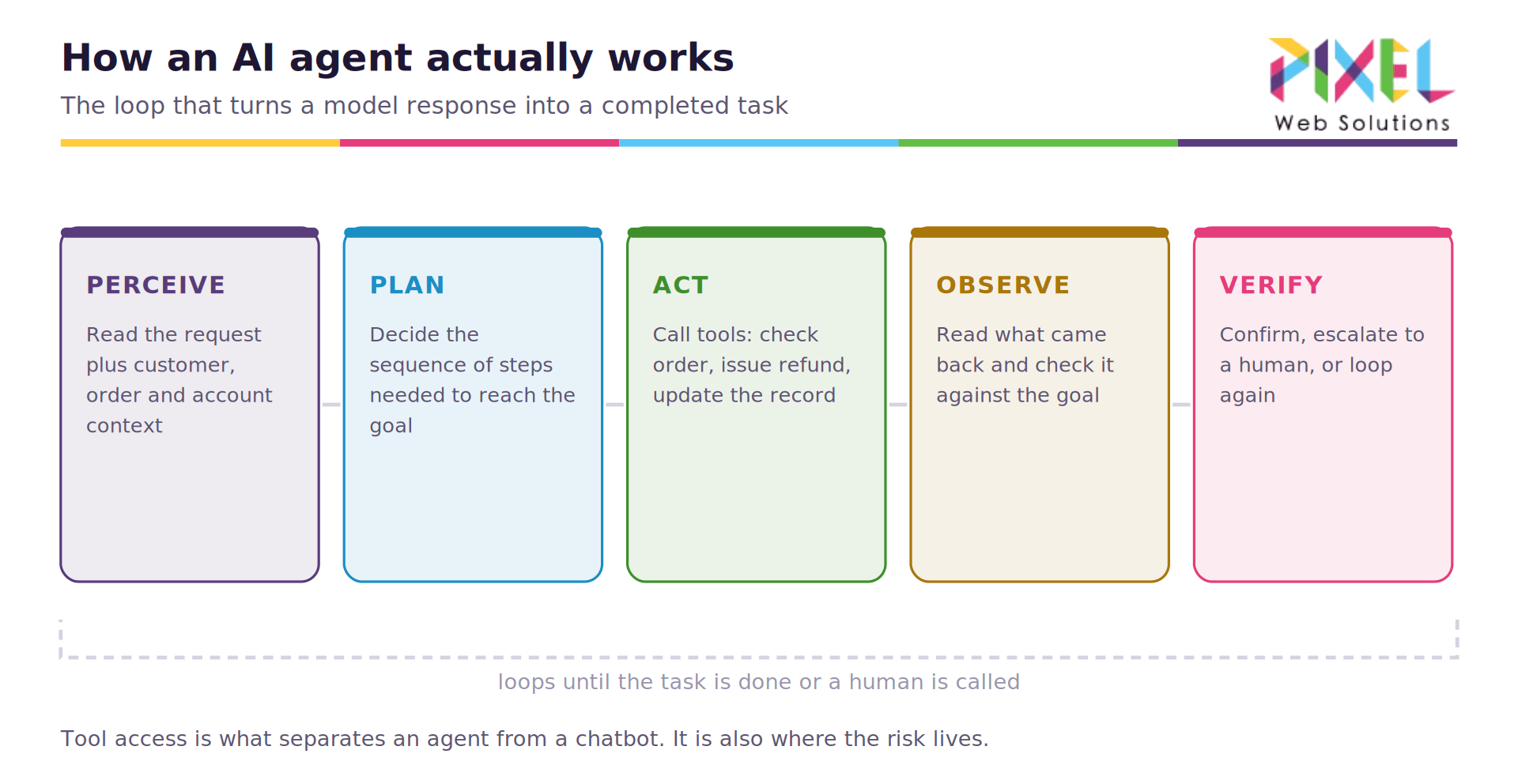
The loop is consistent across implementations. The agent perceives the request along with customer, order and account context. It plans a sequence of steps. It acts by calling tools: looking up the order, issuing the refund, updating the record. It observes what came back. Then it verifies against the original goal and either finishes, loops again, or hands to a human.
Tool access is what makes this possible, and it is also where all the risk sits. An agent that can issue refunds can also issue the wrong refund at scale, which is a different category of problem from a chatbot giving a wrong answer. The blast radius is the thing that changes.
Grounding matters as much as tooling. An agent that can act but cannot retrieve your current policy will act confidently on stale rules, which is why RAG development and agent work usually arrive together rather than in sequence.
Which Customer Service Tasks Can Agentic AI Close?
This is the practical question, and the split runs along a clear line: can the outcome be achieved through a system the agent can reach, and can the result be verified?
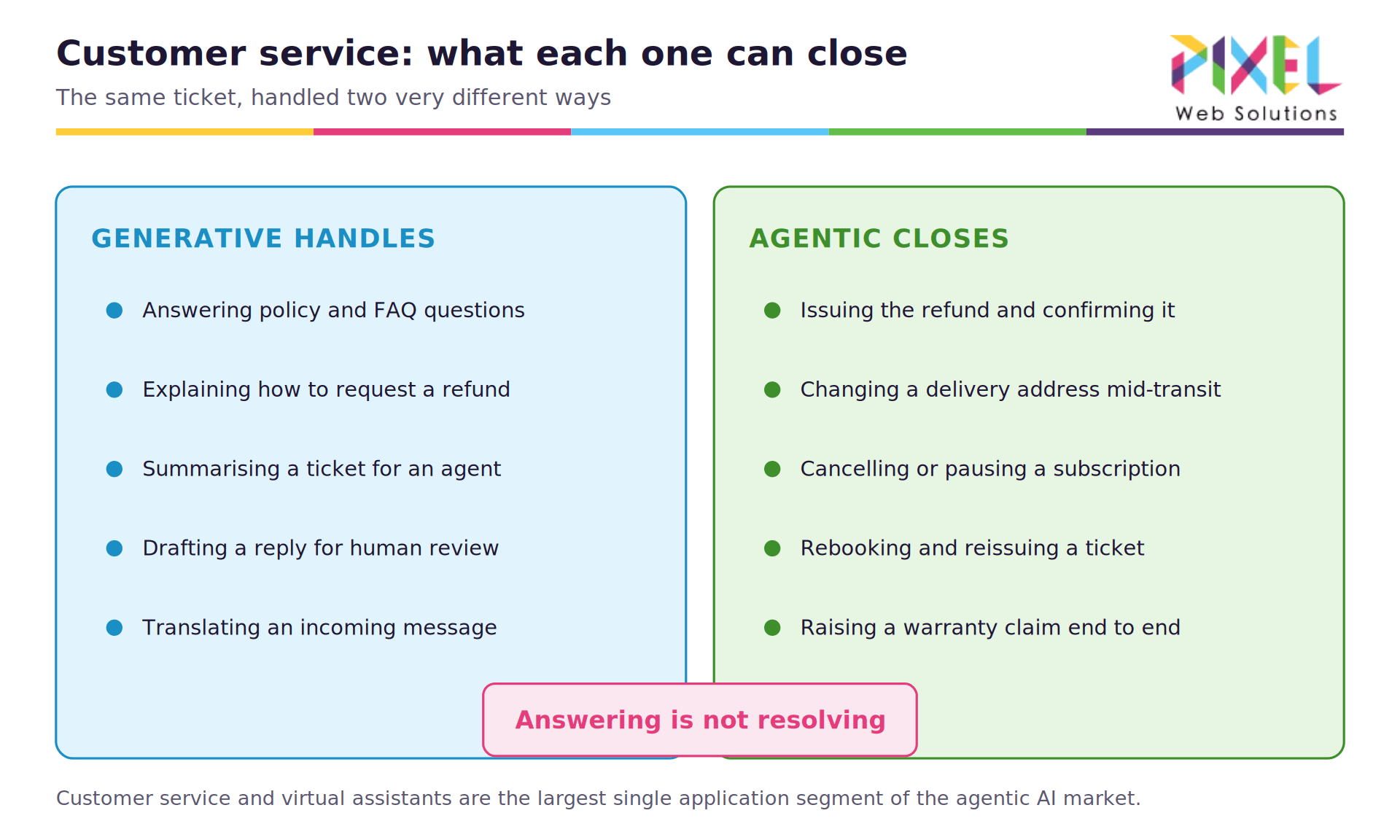
| Generative AI handles well | Agentic AI can close |
| Answering policy and FAQ questions | Issuing a refund and confirming it |
| Explaining how a process works | Changing a delivery address mid-transit |
| Summarizing a ticket for an agent | Canceling or pausing a subscription |
| Drafting a reply for human review | Rebooking and reissuing a ticket |
| Translating an incoming message | Processing a return |
| Suggesting next best action | Raising a warranty claim end to end |
| Classifying and routing | Updating account or billing details |
The commercial significance is that the right-hand column contains the contacts that actually consume agent handling time. Answering is cheap. Resolving is what the customer came for, and it is where the cost sits.
This is the deep end of the resolve tier described in our guide to the benefits of AI in customer service. That page covers why resolution beats deflection commercially. This one covers how to build the thing that resolves.
What an Agentic Ticket Actually Looks Like
Abstract descriptions of agent loops are easy to nod along to and hard to act on. Here is the same customer contact handled three ways, which is the clearest illustration of why the distinction is commercial rather than semantic.
The contact: “I ordered a jacket last week, it is the wrong size, and I am going away on Friday.”
Handled by a chatbot. It retrieves the returns policy and explains that items can be returned within 30 days using the returns portal, with a link. Accurate, instant, and the customer still has three things to do. Ticket closed, problem open.
Handled by generative AI in assist mode. It summarizes the order history, notes the delivery date and the Friday deadline, and drafts a reply offering an expedited exchange. A human reads it, agrees, sends it, and then goes into the order system to actually set up the exchange. Handle time drops. The work does not disappear.
Handled by an agent. It identifies the order, confirms the item is within the returns window, checks stock for the correct size, reserves it, generates the return label, books the expedited replacement against the Friday date, updates the order record, and confirms all of it to the customer in one message. Then it verifies the replacement order actually exists before saying so.
Three things are worth noticing in that last version. It touched four systems, not one. Every step was verifiable, which is what made it safe to run unsupervised. And every step was reversible: a reserved item can be released, a label can be voided, a replacement order can be canceled. Change any one of those and the same ticket stops being a good agent candidate.
That is the difference between the three columns in commercial terms: the chatbot moved the work to the customer, assist mode moved it to a cheaper minute of a human’s time, and the agent removed it.
Does Your Use Case Actually Need an Agent?
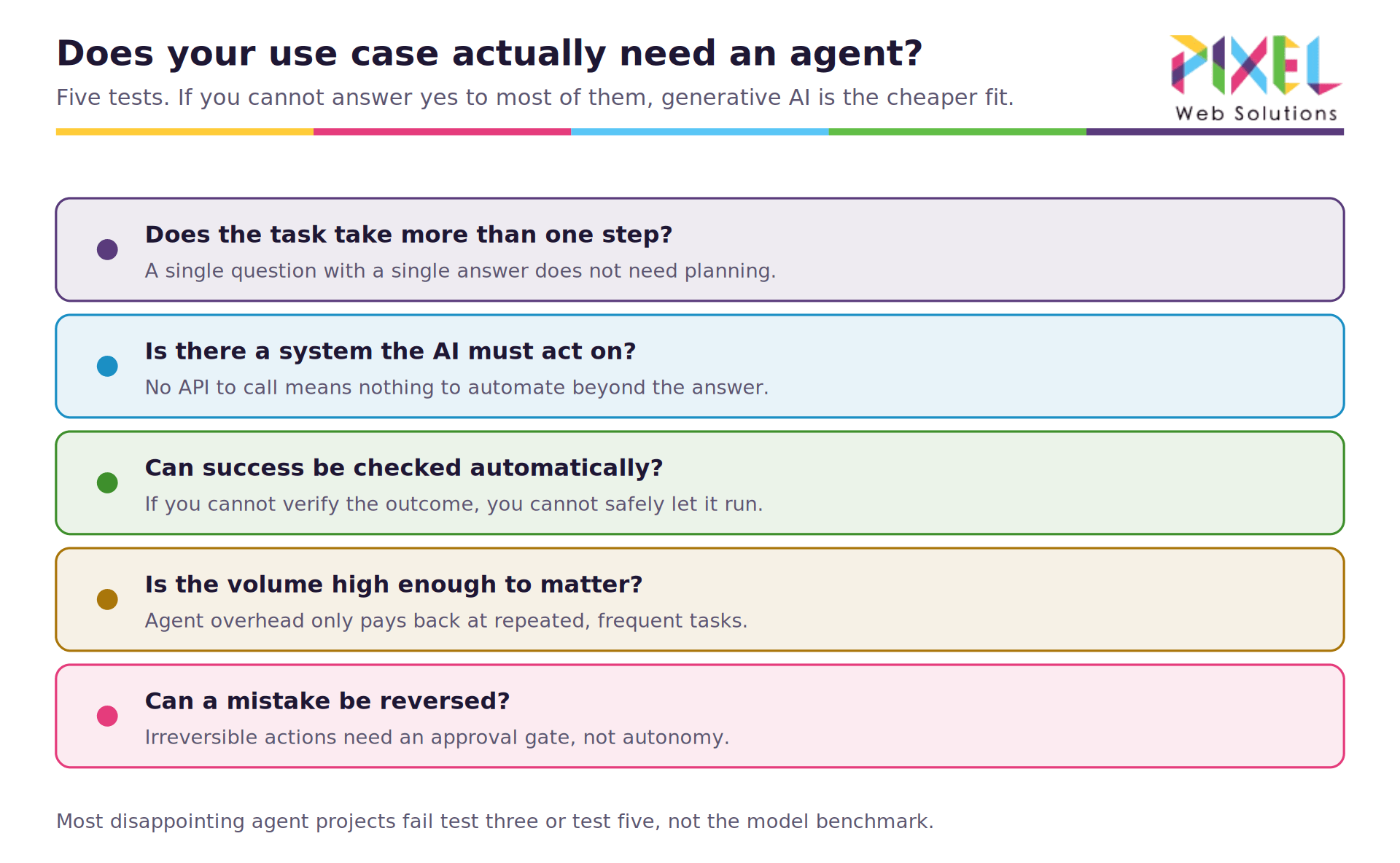
Agents cost more to build, more to run and considerably more to govern than a generative assistant. Five tests decide whether that overhead is justified.
| Test | Question | If no |
| 1. Multi-step | Does the task take more than one step? | A single question with a single answer does not need planning |
| 2. System-connected | Is there a system the AI must act on? | No API to call means nothing to automate beyond the answer |
| 3. Verifiable | Can success be checked automatically? | You cannot safely let it run unsupervised |
| 4. High volume | Is it frequent enough to matter? | Agent overhead will not pay back |
| 5. Reversible | Can a mistake be undone? | Needs an approval gate rather than autonomy |
Most disappointing agent projects fail test three or test five. They rarely fail on model capability, which is why “which model should we use” is close to the least important question in the scoping conversation.
Test five deserves particular attention because it is the one teams most often wave through. “Reversible” means reversible by an ordinary support agent within their normal permissions, in minutes, without engineering involvement. A refund you can claw back only by raising a ticket with finance is not reversible in any operationally useful sense.
Where Else Do Autonomous Agents Beat Generative AI?
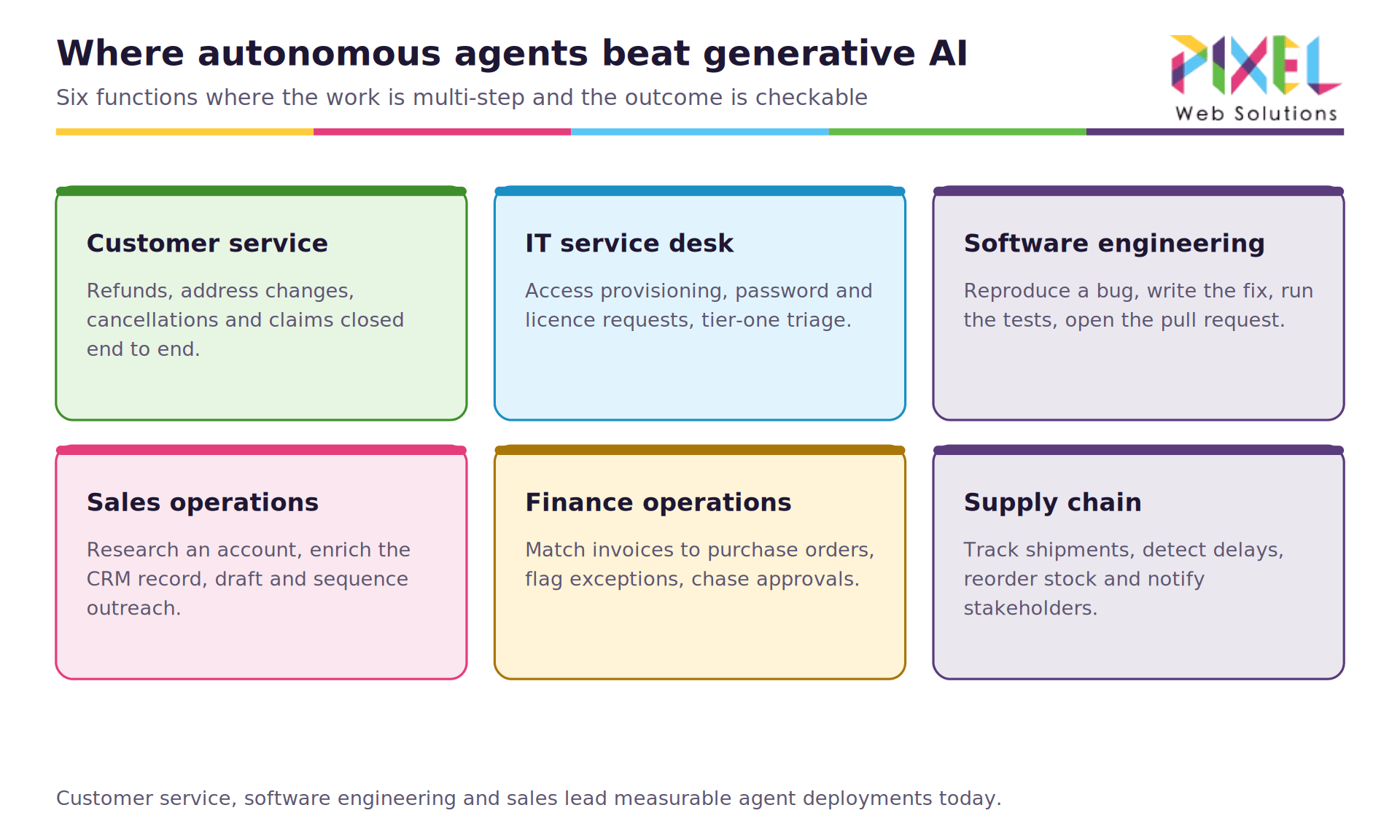
Customer service is the largest agentic application segment, but the same test applies across functions. Agents win wherever work is multi-step, system-connected and verifiable.
IT service desk. Access provisioning, password and license requests, tier-one triage and ticket routing. Structurally almost identical to customer service, with the advantage that the “customer” is an employee and the tolerance for a wrong action is slightly higher.
Software engineering. Reproduce a reported bug, write the fix, run the test suite, open the pull request. Currently one of the fastest-growing agent categories, largely because the verification step is unusually clean: the tests either pass or they do not.
Sales operations. Research an account, enrich the CRM record, draft and sequence outreach, log the activity.
Finance operations. Match invoices to purchase orders, flag exceptions, chase approvals, prepare reconciliations. High volume, highly structured, and every action leaves an audit trail by default.
Supply chain. Track shipments, detect delays, trigger reorders and notify affected stakeholders.
In each case, generative AI would produce a description of what should happen. The agent makes it happen. Notice that the strongest categories are the ones where verification is cheapest, which is the same pattern as in customer service.
What the 2026 Data Says About Agentic AI
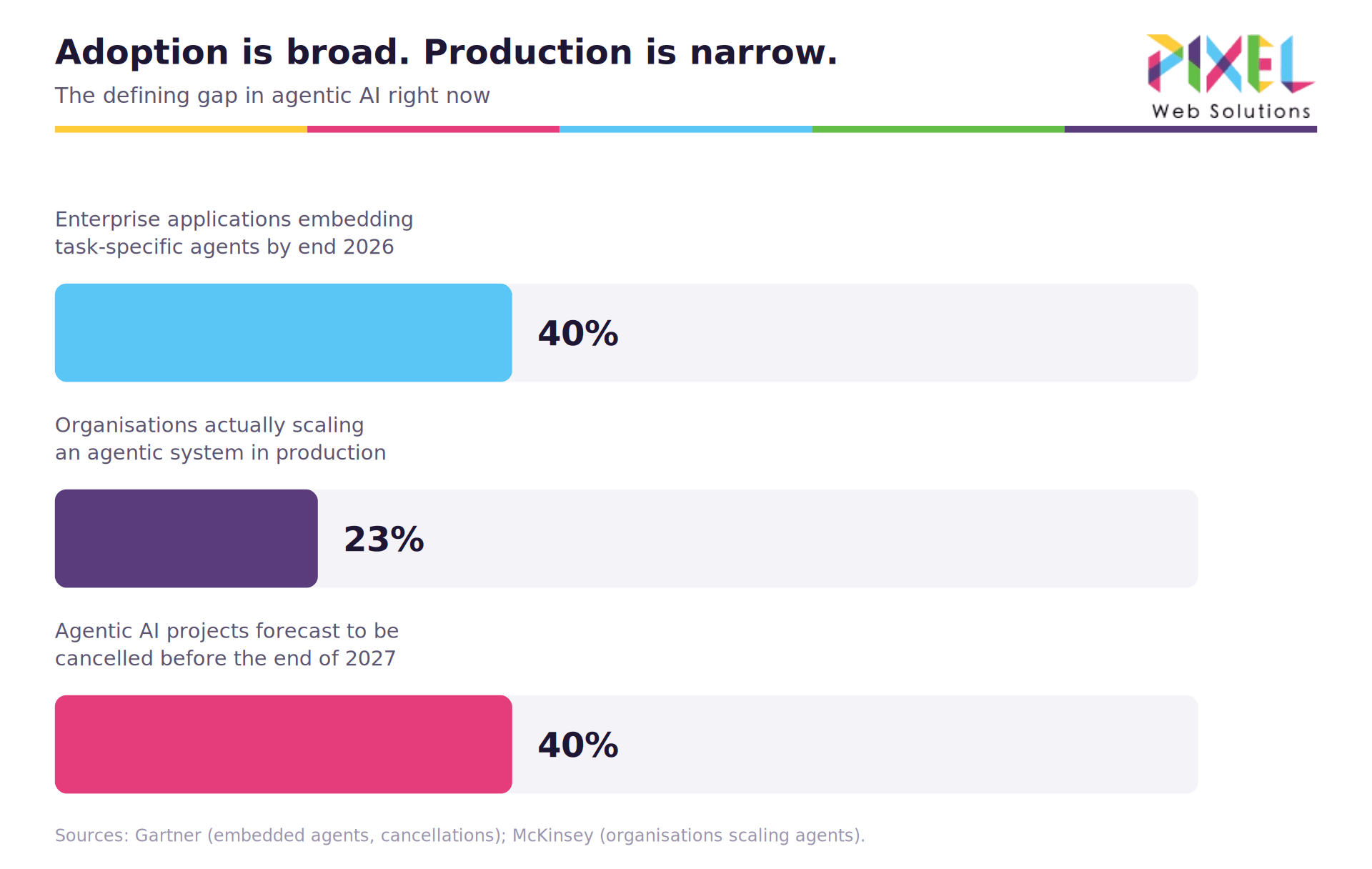
The numbers describe enthusiasm running well ahead of production reality.
| Finding | Figure | Source, date and base |
| Enterprise apps embedding task-specific agents | 40% by end of 2026, up from under 5% in 2025 | Gartner prediction, 26 Aug 2025 |
| Organizations scaling an agentic system somewhere | 23% | McKinsey, The State of AI, 2025 |
| Organizations scaling agents in any given function | no more than 10% | McKinsey, same study |
| Organizations merely experimenting with agents | 39% | McKinsey, same study |
| Agentic AI projects forecast canceled | over 40% by end of 2027 | Gartner prediction, 25 Jun 2025 |
| Vendors genuinely offering agentic AI | roughly 130 of thousands claiming to | Gartner, “agent washing”, Jun 2025 |
| Customer service share of agentic applications | largest single segment, estimates range 25% to 32% | Multiple analyst houses, 2025 to 2026 |
| Autonomous resolution forecast | 80% of common service issues by 2029, cutting operational costs 30% | Gartner prediction, Mar 2025 |
| Agentic share of enterprise app software revenue | ~30% by 2035, over USD 450bn, from 2% in 2025 | Gartner, best-case scenario, Aug 2025 |
The two numbers to hold together are the first and the third. Forty percent of enterprise applications will ship with agents inside them, while under ten percent of organizations are scaling agents in any given function. Software vendors are shipping the capability far faster than buyers are operationalizing it. If you get a narrow use case genuinely into production, you are ahead of roughly nine in ten of your competitors, and that gap is the reason to move now rather than the reason to wait.
On market sizing, deliberately no single figure. Agentic AI market estimates diverge wildly between analyst houses, from roughly USD 7bn to over USD 10bn for the same period, and the segment definitions are not comparable. v1 avoided quoting one and that judgment is retained. Application share is the more stable and more useful signal.
What Does an Agentic Deployment Cost?
v1 asserted that agents cost more without saying how much more. The honest answer is that the model is not the expense.
| Cost line | Generative assistant | Agentic system |
| Inference per interaction | One call | Several calls per task, plus retries |
| Integration engineering | Retrieval only | Authenticated write access to each system touched |
| Evaluation | Answer quality | Outcome correctness, plus action safety testing |
| Oversight | QA sampling | Approval queues, monitoring, incident response |
| Governance | Content policy | Permissions, audit, rollback, risk tiering |
Inference is the line people budget for and the smallest of the five. Integration and guardrail engineering routinely dominate, which is why AI agent development should be quoted on integration depth and guardrail scope rather than on conversation volume. A vendor quoting per conversation for agentic work is either pricing something simpler than they are describing, or absorbing a risk they have not modeled.
One cost behaves unlike anything else in your software estate: running cost rises with success. More resolution means more steps, more tool calls and more inference. Model the bill at ten times current volume before you commit, not after.
What Guardrails Does an Agent Need?
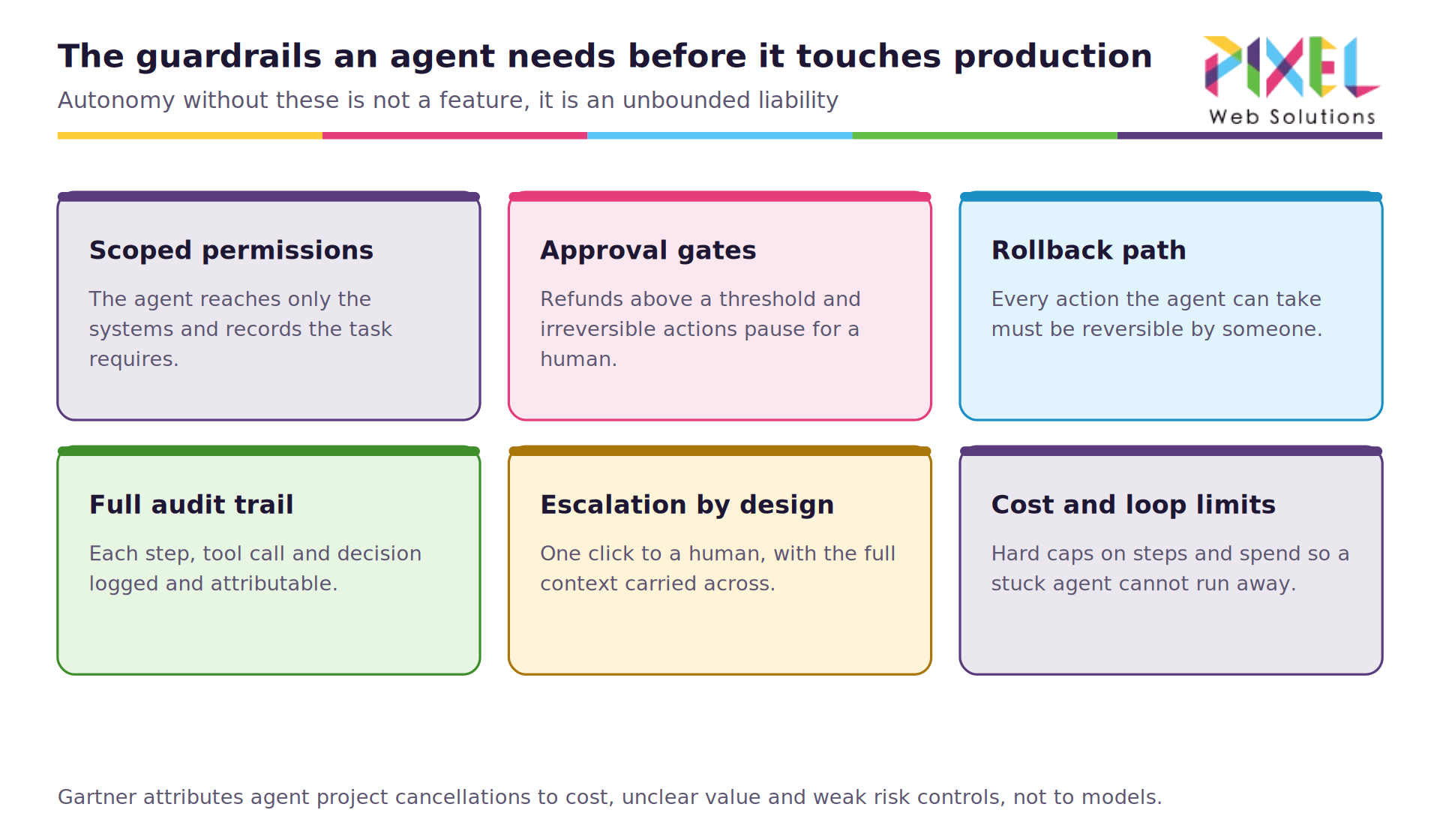
Gartner attributes agent project cancellations to cost, unclear value and weak risk controls rather than to model performance. Six controls should exist before an agent touches a live customer.
| Guardrail | What it means | What it prevents |
| Scoped permissions | Access only the systems and records the task requires | One compromised prompt reaching your whole estate |
| Approval gates | Refunds above a threshold and any irreversible action pause for sign-off | A single bad decision executing at scale |
| Rollback path | Every action reversible by an ordinary support agent | An incident becoming an engineering project |
| Full audit trail | Every step, tool call and decision logged and attributable | Being unable to answer a regulator or a complaint |
| Escalation by design | One click to a human, full context carried across | The customer repeating themselves, which is what actually damages CSAT |
| Cost and loop limits | Hard caps on step count and spend | A stuck agent running away with your budget overnight |
Building these is most of the engineering work in a serious deployment. Treat any proposal where guardrails appear as a phase-two line item as a proposal that has underestimated the job.
One failure mode worth naming specifically. An agent with write access is a new attack surface. If it reads customer-supplied text and can also act on your systems, then instructions embedded in that text are a live risk. Scoped permissions and approval gates are the mitigation, and this is a further reason the blast radius question matters more than the model question.
What Actually Goes Wrong
Gartner’s cancellation forecast is a headline. These are the specific mechanisms behind it, and none of them is a model problem.
The agent succeeds at the wrong task. It correctly executes a refund for an order the customer did not mean, because it resolved an ambiguous reference without asking. Verification catches the action; it does not catch the intent. This is the failure mode that most often survives testing, because test cases are written by people who already know what they meant.
Silent partial completion. The agent performs three of four steps, the fourth fails, and the confirmation message goes out anyway. The customer is told the problem is solved and discovers days later that it is not. This is worse than an outright failure because it destroys trust in every future confirmation. Verify against the goal, not against the last tool call returning a 200.
Loop and cost runaway. An agent that cannot achieve its goal retries, re-plans and retries again. Without hard step and spend caps, a single stuck conversation can generate a startling bill overnight, and you find out from the invoice rather than the dashboard.
Permission creep. The agent is granted broad access during development because scoping is tedious, and nobody narrows it before launch. This is how a support agent ends up with write access to systems no support process ever touches.
Escalation that loses context. The handoff works, but the human receives a ticket without the conversation, so the customer explains everything again. Measured as a successful escalation, experienced as a failure, and it is the single most reliable way to damage satisfaction while your metrics look fine.
Measuring an agent, specifically
Standard support metrics do not capture agent-specific risk. Four additions are worth instrumenting from day one.
Outcome correctness rate. Of the tasks the agent reported complete, what share were actually complete and correct on inspection? Sample them manually at first. This is the number that governs how much autonomy you can justify.
Action safety rate. How often did the agent take an action that had to be reversed? Track it separately from correctness, because a reversed action costs more than a wrong answer.
Unsupervised completion rate. What share of tasks finished without human touch? This is the economics number, and it is the one most vendors quote. On its own it means nothing; paired with outcome correctness it means everything.
Context-preserving escalation rate. When the agent handed off, did the human have everything they needed? Measure how often customers repeat information. This is the CSAT leading indicator.
Broader service measurement, including repeat contacts and cost per resolved issue, is covered in our guide to the benefits of AI in customer service.
How to Roll Out Agentic AI for Customer Service
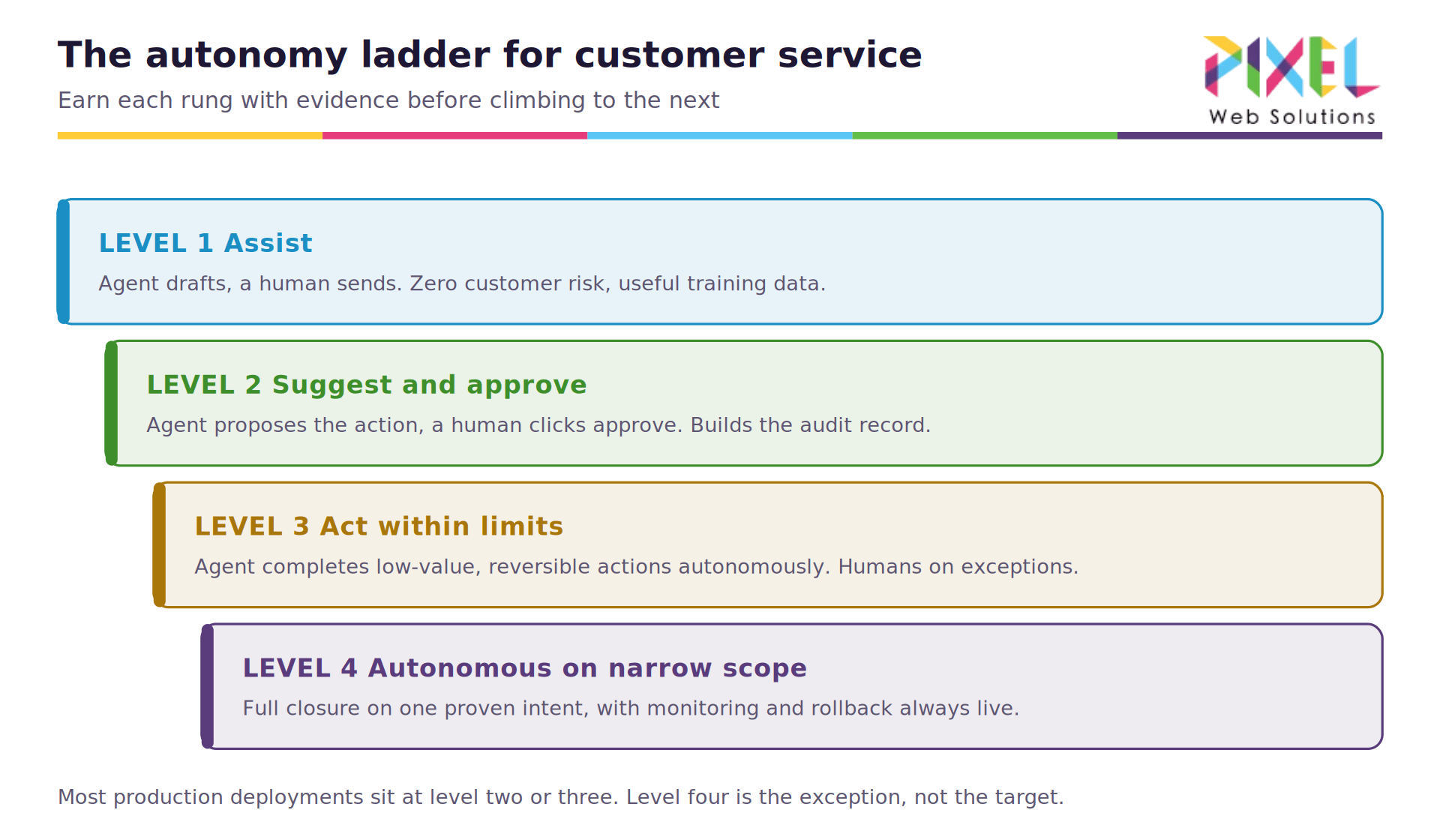
Treat autonomy as a ladder to be earned rather than a switch to be flipped.
| Level | What the agent does | Customer risk | What it earns you |
| 1. Assist | Drafts, a human sends | None | Real conversation data, agent trust |
| 2. Suggest and approve | Proposes the specific action, a human approves | Very low | The audit record that justifies more autonomy |
| 3. Act within limits | Completes low-value reversible actions alone | Contained | Genuine handling-time reduction |
| 4. Autonomous on narrow scope | Full closure on one proven intent | Real, and monitored | The economics everyone is aiming at |
Most successful production deployments sit at level two or three. Level four on a single well-understood intent is an achievement, not a starting point, and teams that begin there are the ones supplying Gartner’s cancellation statistic.
Each rung should be earned with evidence: an outcome-correctness rate you have measured, an incident count you can live with, and a rollback you have actually tested rather than merely designed. Test the rollback before you need it. An untested rollback path is a plan, not a control.
Conclusion
Agentic AI beats generative AI wherever the customer’s problem is only solved by an action rather than an explanation. In customer service that covers refunds, cancellations, address changes, rebooking and claims, which is precisely where the cost sits.
The technology is ready enough that Gartner expects 40 percent of enterprise applications to embed agents within the year, and unforgiving enough that it expects more than 40 percent of agentic projects to be canceled by 2027. The difference between those two outcomes is not model choice. It is scope discipline, verifiable success criteria, and guardrails built before launch rather than after the first incident.
If you are deciding which of your contact types is the right first candidate, our AI agent development services start by scoping exactly that, and AI consulting covers the readiness question if you are earlier than that.
FAQ
Q: What is agentic AI for customer service?
It is AI that completes customer service tasks rather than only answering questions. The agent plans a sequence of steps, calls your order, billing or CRM systems to carry them out, verifies the result, and either confirms completion or escalates to a human. The measure of success is whether the issue is resolved, not whether the reply was well written.
Q: What is the difference between agentic AI and generative AI?
Generative AI responds to a prompt with content: an answer, a summary, a draft. Agentic AI takes a goal and executes the multi-step work needed to achieve it, using tools and systems along the way. Both run on the same underlying models. The difference is planning, memory across the task, and the ability to act. The practical test: if a human still has to go and do something after the AI responds, it was generative.
Q: What customer service tasks can agentic AI handle?
Refunds and returns, subscription cancellations and pauses, delivery address changes, rebooking and reissuing, warranty claims, order tracking, and account or billing updates. The common factor is that each one can be completed through a system the agent can reach, and the result can be verified afterward.
Q: Is agentic AI better than generative AI for customer service?
Better for tasks that require action, and unnecessary for tasks that only require an answer. Agents cost more to build, run and govern, so applying one to FAQ deflection is wasteful. Most mature deployments use both: generative AI for informational contacts, agents for transactional ones.
Q: How much does agentic AI cost compared to a chatbot?
Inference is the smallest line and the one people budget for. An agent makes several model calls per task rather than one, but the dominant costs are integration engineering for authenticated write access to each system, outcome and safety evaluation, approval-queue oversight, and governance. Running cost also rises with success, because more resolution means more steps. Model the bill at ten times current volume before committing.
Q: How reliable is agentic AI in customer service?
Reliability depends far more on architecture than on model choice. Gartner attributes its forecast of over 40 percent agentic project cancellations by 2027 to escalating costs, unclear business value and inadequate risk controls. Deployments that succeed start on one narrow intent, verify outcomes automatically, and keep human escalation permanently available.
Q: What guardrails does an AI agent need before going live?
Scoped permissions limited to the task, approval gates on irreversible or high-value actions, a rollback path for everything the agent can do, a complete audit trail, escalation to a human that carries the full context, and hard limits on steps and spend to contain a stuck agent. Test the rollback before launch rather than during the first incident.
Q: How many companies are actually using AI agents in production?
Fewer than the coverage suggests. McKinsey found 23 percent of organizations scaling an agentic system somewhere in the enterprise, and no more than 10 percent scaling agents in any given business function, against 39 percent merely experimenting. Meanwhile Gartner expects 40 percent of enterprise applications to embed agents by the end of 2026. Capability is shipping faster than it is being operationalized.
Q: Will agentic AI replace human customer service agents?
It is displacing routine transactional handling rather than the role. Gartner predicts agentic AI will autonomously resolve 80 percent of common issues by 2029, but complex, regulated and emotionally sensitive cases still need people, and companies that removed human escalation have generally reinstated it. The realistic model is agents on the front line with humans on exceptions.