Table of Contents
Every company now wants AI in its product or its operations, and almost none of them want to buy GPUs to get there. AI as a Service closes that gap. Instead of training models, renting clusters, and hiring a machine learning team, you call an API and pay for what you use.
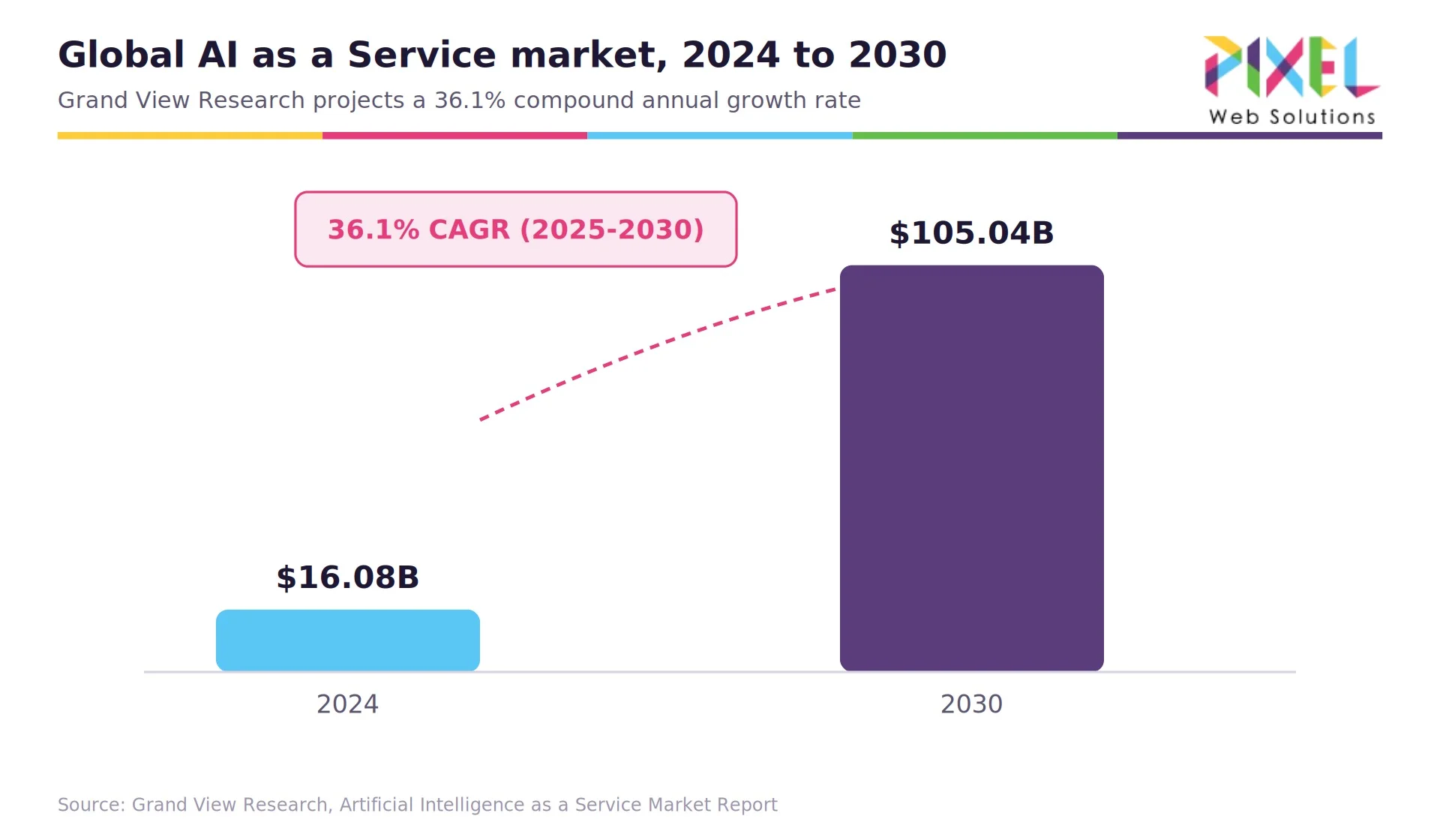
The market has responded accordingly. Grand View Research values the global AI as a Service market at USD 16.08 billion in 2024 and projects USD 105.04 billion by 2030, a compound annual growth rate of 36.1 percent. Stanford’s 2026 AI Index reports that 88 percent of surveyed organizations had adopted AI by 2025.
This guide covers what AI as a Service is, how it works, the six delivery types, the twelve platforms that matter, what it really costs once the hidden line items are counted, and the specific situations where building in house still wins.
What Is AI as a Service (AIaaS)?
AI as a Service is a cloud delivery model in which a provider hosts artificial intelligence models and infrastructure, and customers consume them on demand through APIs, SDKs, or a managed console. The buyer rents intelligence instead of building it.
The abstracted-away parts are the expensive ones: GPU clusters, model training runs, inference optimization, and the specialist team needed to keep all of it running. A developer sends text, an image, or audio to an endpoint and receives a structured result back, usually within a second.
How AIaaS differs from IaaS, PaaS and SaaS
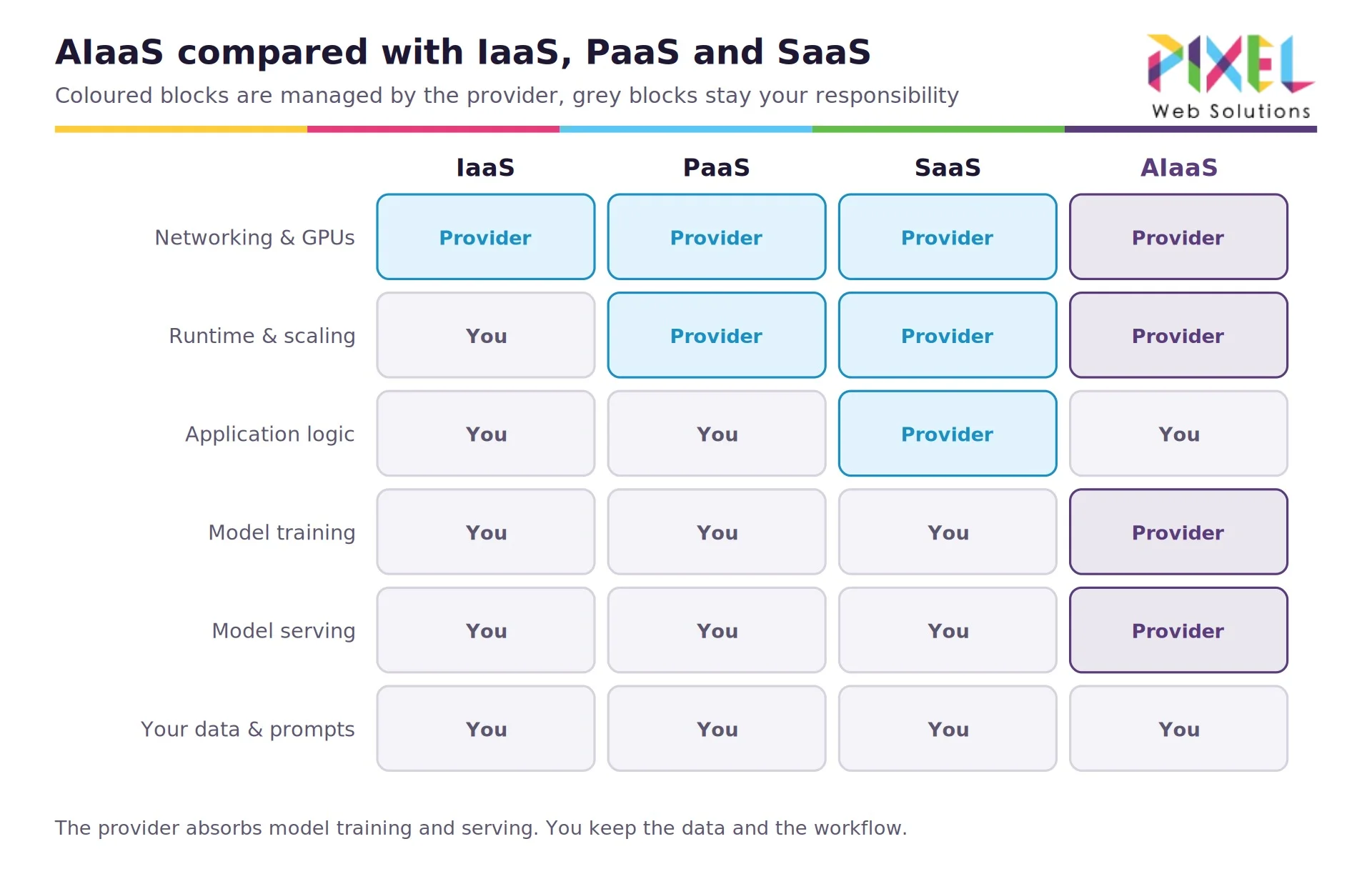
The naming follows the same logic as the older cloud tiers, but the boundary sits in a different place. IaaS hands you servers. PaaS hands you a runtime. SaaS hands you a finished application. AIaaS hands you a trained model plus the serving infrastructure around it, while you keep the application logic, the data, and the accountability for how outputs get used.
| Layer | IaaS | PaaS | SaaS | AIaaS |
|---|---|---|---|---|
| Hardware and GPUs | Provider | Provider | Provider | Provider |
| Runtime and scaling | You | Provider | Provider | Provider |
| Model training and serving | You | You | Provider | Provider |
| Application logic | You | You | Provider | You |
| Your data and prompts | You | You | Shared | You |
| Accountability for outputs | You | You | Shared | You |
That distinction matters commercially. With SaaS you buy a product. With AIaaS you buy a capability that only becomes a product once your team wires it into a workflow. Teams building the second kind of thing are usually doing AI application development, not procurement.
How Does AI as a Service Work?
The three layers of the AIaaS stack
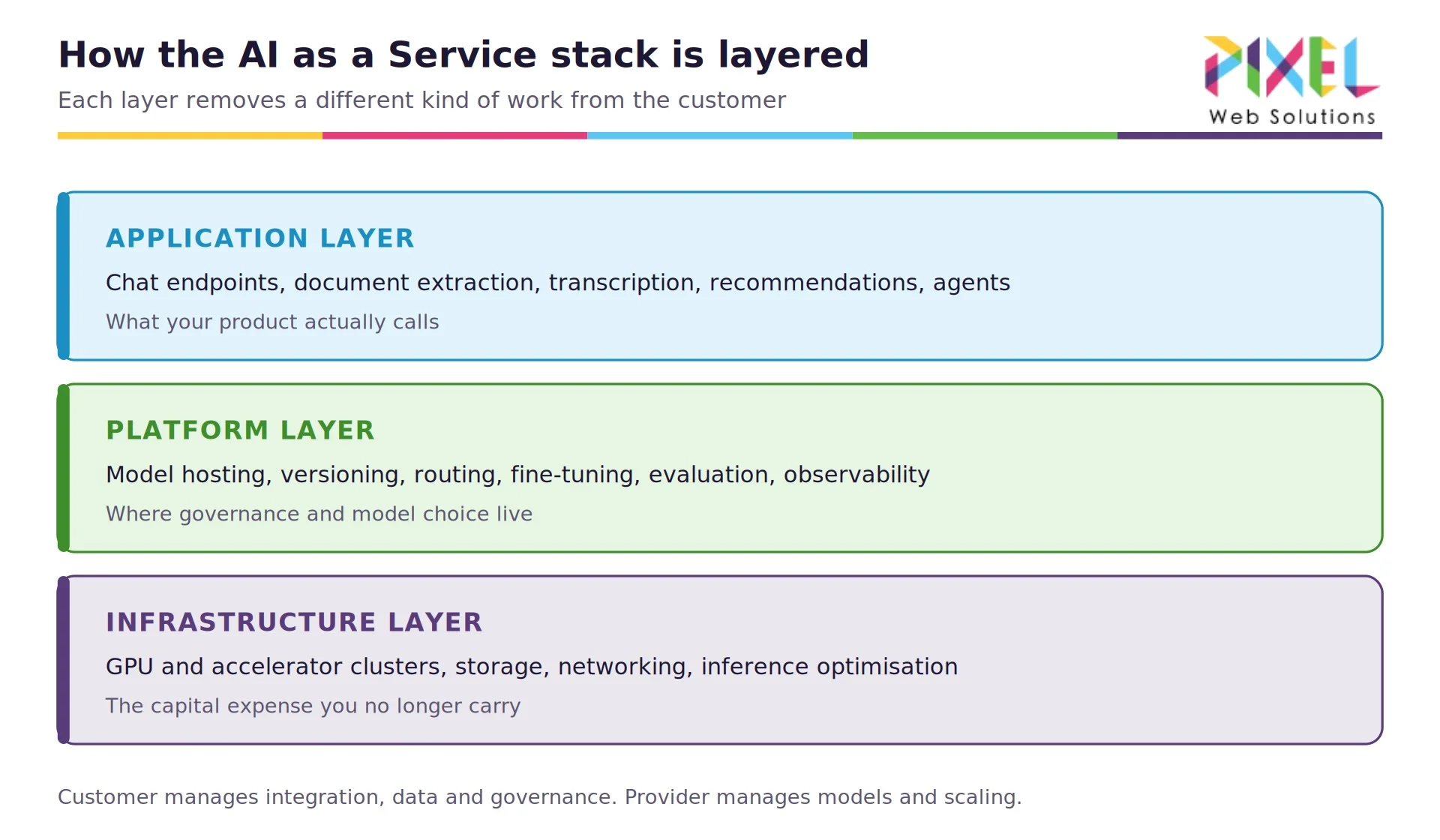
The infrastructure layer holds the accelerators, storage, and networking that make inference possible at scale.
The platform layer manages model hosting, versioning, routing, fine-tuning, evaluation, and observability. This is where most AI and ML development work actually lands.
The application layer exposes the capability as something a product team can call directly: a chat completion endpoint, a document extraction API, a transcription service, a recommendation engine.
Where your data fits
Most enterprise deployments now sit on top of a model gateway rather than a single vendor. Requests route to different models based on cost, latency, or task difficulty, with retrieval augmented generation pulling in the company’s own documents at query time. Building that retrieval layer well is its own discipline, which is why RAG development has become a standard line item on enterprise AI projects.
The proprietary asset stays the data and the workflow logic, not the model weights. This is the single most important architectural point in this article: if you can be replaced by whoever else calls the same API, you have not built anything defensible.
What Are the Main Types of AI as a Service?
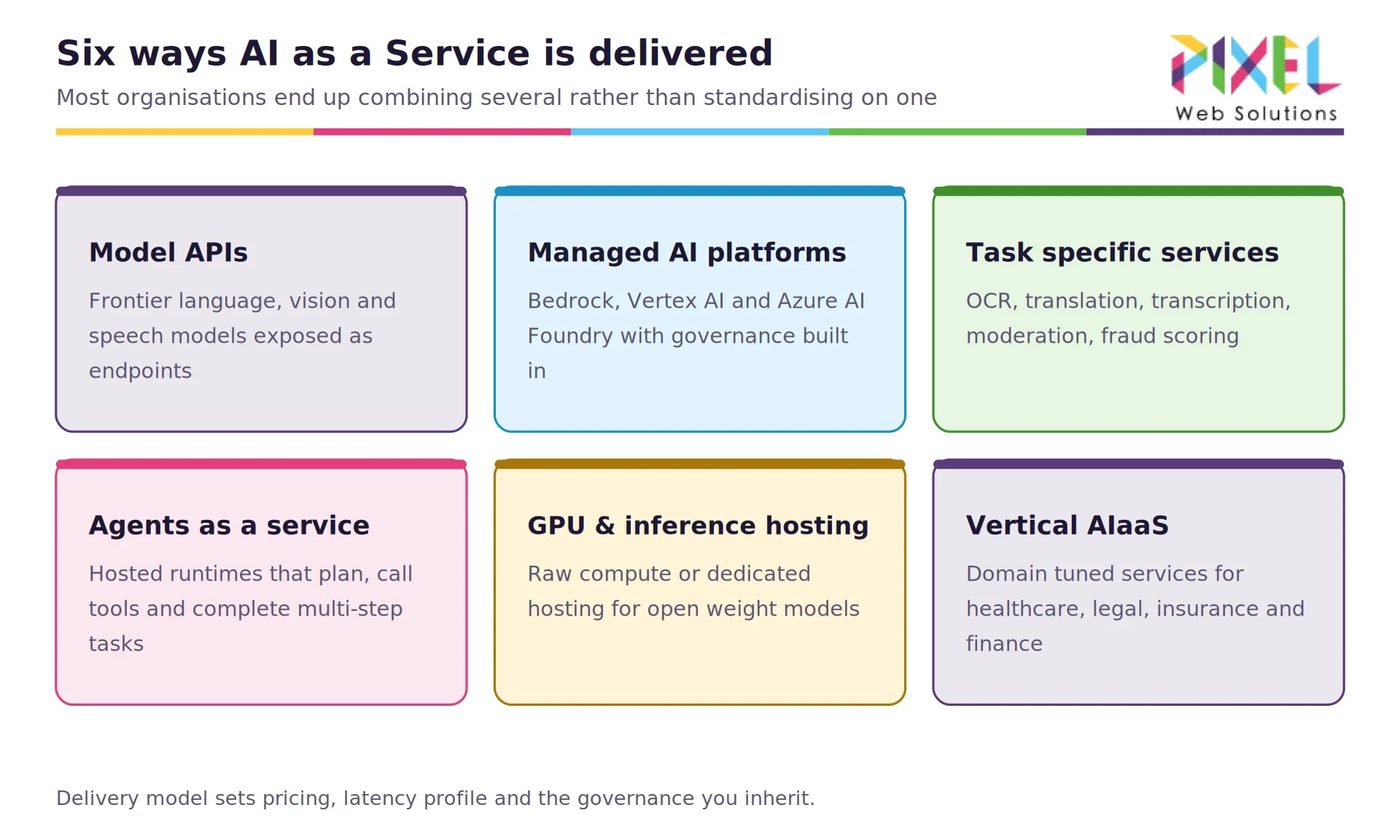
There are six delivery types. Most organizations end up combining several rather than standardizing on one.
Model APIs
Frontier language, vision, and speech models exposed as endpoints. This is the fastest route from idea to working feature, and the easiest to overspend on once traffic grows. Teams that outgrow generic prompting usually move into dedicated large language model development to get control over routing, context, and evaluation.
Managed cloud AI platforms
Amazon Bedrock, Google Vertex AI, and Microsoft Foundry bundle multiple model families with governance, identity, and billing already wired into the customer’s existing cloud account. Preferred by enterprises that need procurement and security review to be short.
Task specific services
Narrow, pre-trained capabilities such as OCR, translation, transcription, content moderation, and fraud scoring. Predictable inputs, predictable outputs, predictable pricing. These are the least glamorous and most reliably profitable category in the whole market.
Agents and bots as a service
Hosted agent runtimes that plan, call tools, and execute multi-step tasks rather than returning a single answer. This category moved fastest in the last year: Stanford’s 2026 AI Index reports that agent success on real-world task benchmarks rose from 20 percent in 2025 to 77.3 percent. Cost per user action is materially higher here, because one request becomes many model calls. See AI agent development and AI chatbot development for where the two differ in practice.
GPU and inference as a service
Raw compute or dedicated model hosting for teams running open weight models without buying hardware. This is the bridge option between renting and building, and the usual destination for workloads that have outgrown per-token pricing.
Vertical AIaaS
Domain-tuned services for healthcare coding, legal review, underwriting, or claims, sold with the compliance posture the sector requires.
Top 12 AI as a Service Providers
The market has consolidated into three tiers: hyperscaler platforms that sell governance alongside models, model labs that sell frontier capability directly, and inference specialists that sell speed and price on open weight models. Most production systems use at least one from each tier.
Managed cloud AI platforms
Amazon Bedrock
Amazon Bedrock is AWS’s managed service for calling foundation models through a single API without provisioning infrastructure. It carries the broadest model marketplace of the three hyperscaler platforms, with 30-plus models spanning Anthropic’s Claude, Meta’s Llama, Mistral, Cohere, AI21, Amazon’s own Nova family, and Stability AI. Best for AWS-first teams and for anyone who wants genuine model portability inside one billing relationship. Amazon SageMaker AI sits alongside it for teams that need to train and host their own models rather than call someone else’s.
Google Vertex AI
Vertex AI is Google Cloud’s end-to-end platform for building, tuning, and serving models, with Model Garden providing access to Gemini alongside Claude, Llama, Mistral, and a long tail of open models. Its distinguishing strength is data gravity: if your analytics already live in BigQuery, the path from warehouse to grounded model output is shorter here than anywhere else. Best for GCP-native teams and multimodal workloads.
Microsoft Foundry
Microsoft Foundry is the enterprise AI platform formerly branded Azure AI Foundry, renamed at Ignite in November 2025 as Microsoft repositioned it around agents rather than models alone. It is the only hyperscaler platform with first-party access to OpenAI’s frontier models, and it inherits Entra identity, Purview data governance, and existing Microsoft commercial agreements. Best for Microsoft-heavy enterprises where the security review is the bottleneck, not the technology.
IBM watsonx
watsonx is IBM’s AI platform aimed squarely at regulated industries, combining a model runtime, a data store, and a governance toolkit designed to produce audit evidence. It rarely wins on raw model quality and is not trying to. Best for banks, insurers, and public sector buyers who need to show a regulator how a decision was reached.
Frontier model APIs
OpenAI
OpenAI sells direct API access to the GPT model family alongside image, audio, and embedding endpoints. It remains the default first call for most teams, has the deepest third-party tooling ecosystem, and prices aggressively at the smaller model tiers. Best for fast prototyping and for products where breadth of capability matters more than procurement fit.
Anthropic
Anthropic sells API access to the Claude model family, with a reputation built on long-context reasoning, coding, and agentic tool use. Its models are also resold through Amazon Bedrock, Google Vertex AI, and Microsoft Foundry, which makes it one of the few frontier labs you can adopt without leaving your existing cloud contract. Best for complex reasoning, long documents, and agent workloads.
Google Gemini API
The Gemini API is Google’s direct developer channel to its Gemini models, separate from the Vertex AI enterprise path. Strong native multimodality across text, image, audio, and video, and a generous free tier that makes it a common choice for evaluation and side projects. Best for multimodal features and teams that want to test before committing to Google Cloud.
Mistral AI
Mistral is the leading European model lab, publishing both open weight models and a commercial API. Its appeal is jurisdictional as much as technical: EU-domiciled processing with no US data transfer question to answer. Best for European buyers with data residency constraints and for teams that want the option to self-host the same model family later.
Cohere
Cohere is an enterprise-focused model provider specializing in retrieval, reranking, and embeddings rather than consumer-facing chat. Its rerank models are widely used inside RAG pipelines built on other vendors’ generation models. Best for enterprise search and knowledge retrieval workloads.
Inference and GPU specialists
Together AI
Together AI is a serverless inference platform for open weight models, hosting 200-plus of them behind an OpenAI-compatible API. It also sells dedicated GPU clusters and fine-tuning, which makes it a natural next step when a workload gets big enough that per-token frontier pricing stops making sense. Best for high-volume open model inference.
Groq
Groq is an inference provider built on custom LPU hardware rather than GPUs, sold on one property above all others: latency. Time to first token is measured in tens of milliseconds, which changes what is possible in voice interfaces and real-time agent loops. Best for latency-critical applications where response speed is the product.
Replicate
Replicate is a hosting platform for running open source models with per-prediction billing and no infrastructure setup. Its catalog is unusually deep on image, video, and audio models, and the cold-start-to-working-demo path is the shortest in this list. Best for media generation and for prototyping before committing to a serving architecture.
Also worth knowing: Hugging Face Inference Providers exposes a single OpenAI-compatible API that routes to Groq, Together, Fireworks, Cerebras, Replicate, and a dozen others, which is a fast way to benchmark providers against each other without writing an integration for each. Fireworks AI and Cerebras compete directly with Groq on open weight inference speed.
How Big Is the AI as a Service Market?
AIaaS sits inside a broader cloud AI shift that is growing faster than almost any other enterprise category.
- AIaaS market size. USD 16.08 billion in 2024, forecast to reach USD 105.04 billion by 2030 at a 36.1 percent CAGR (Grand View Research).
- Regional concentration. North America held 46.2 percent of AIaaS revenue in 2024 (Grand View Research).
- Software leads service type. The software segment accounted for 77.6 percent of AIaaS revenue in 2024, with machine learning the largest technology segment at 40.7 percent (Grand View Research).
- Cloud AI overall. Estimated at USD 169.9 billion in 2026 and projected to reach USD 1.73 trillion by 2033, a 39.3 percent CAGR (Grand View Research).
- Investment. Global corporate AI investment reached USD 581.7 billion in 2025, up 130 percent year over year, with private AI investment at USD 344.7 billion (Stanford HAI 2026 AI Index).
- Adoption. 88 percent of surveyed organizations had adopted AI by 2025, with generative AI in use across business functions at roughly 70 percent (Stanford HAI 2026 AI Index).
- The scaling gap. McKinsey’s State of AI finds 88 percent of respondents say their organization regularly uses AI, yet nearly two-thirds have not begun scaling it across the enterprise, and only around 6 percent qualify as high performers with more than 5 percent EBIT impact from AI.
The adoption numbers and the scaling numbers tell the real story together. Getting access to AI is now trivial. Turning that access into margin is not. McKinsey’s high performers are three times more likely to have redesigned workflows around AI rather than bolting it onto existing ones, which is the difference the 6 percent figure is actually measuring.
What Does AI as a Service Actually Cost?
The four pricing structures
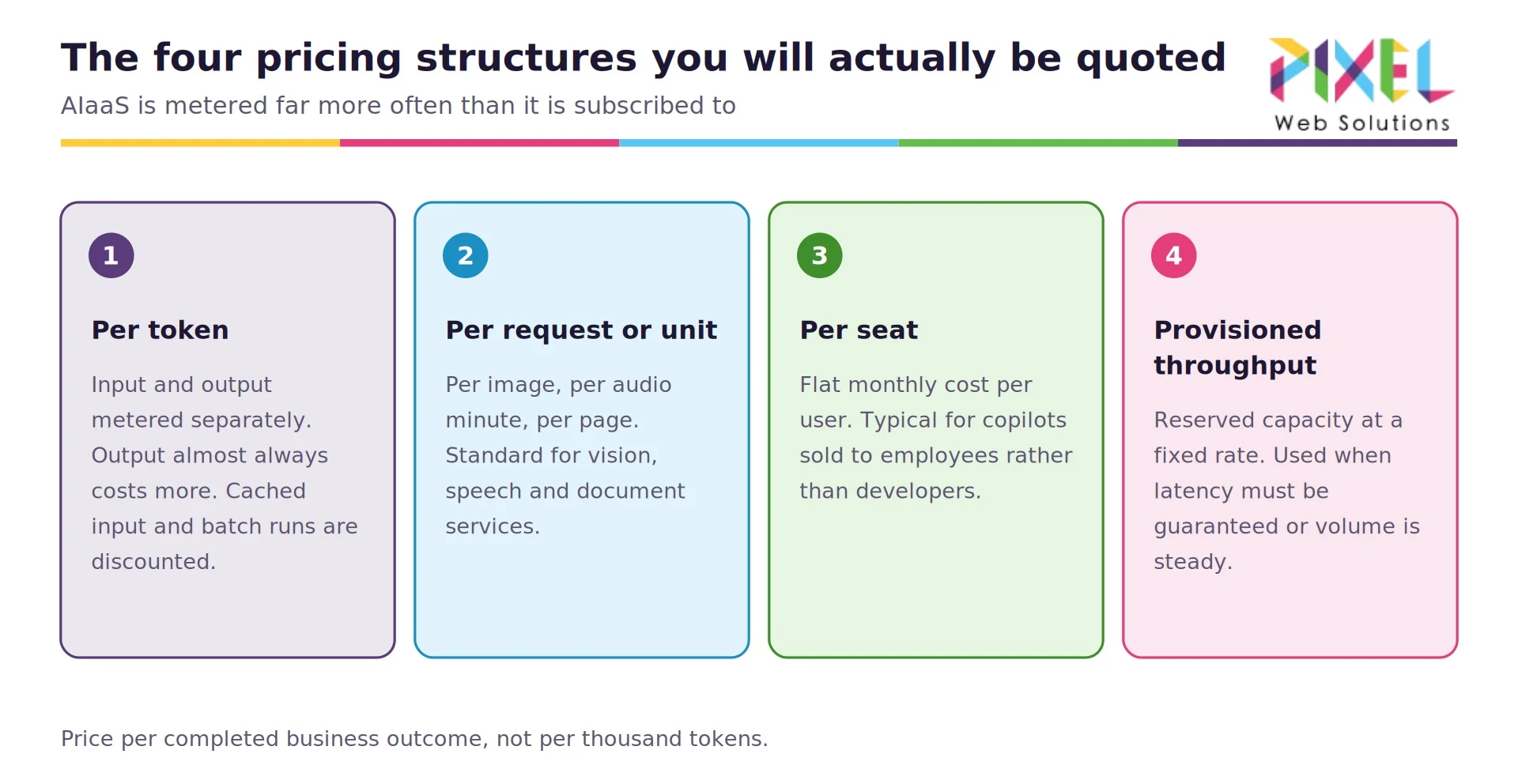
Pricing rarely looks like a flat subscription.
| Structure | How it meters | Typical use | Watch out for |
|---|---|---|---|
| Per token | Input and output metered separately, output priced higher | Language model APIs | Long context multiplies input cost on every single call |
| Per request or unit | Per image, per minute of audio, per page | Vision, speech, document services | Retries and failed parses bill the same as successes |
| Per seat | Flat monthly rate per named user | Copilots and assistants sold to end users | Seat counts grow faster than usage justifies |
| Provisioned throughput | Reserved capacity at a fixed monthly rate | Steady, latency-sensitive production traffic | Paying for idle capacity outside peak hours |
Cached input and batch processing carry meaningful discounts on most platforms, often 50 percent or more for batch and up to 90 percent for cache hits on repeated context. Very few teams turn either on before their first surprise invoice. Per-seat pricing is worth understanding separately if you are building a product rather than buying one, since it is the dominant model for AI copilot development.
The AI pricing paradox: unit costs collapse while bills rise
Two things are true at once, and confusing them is the most common budgeting error in enterprise AI.
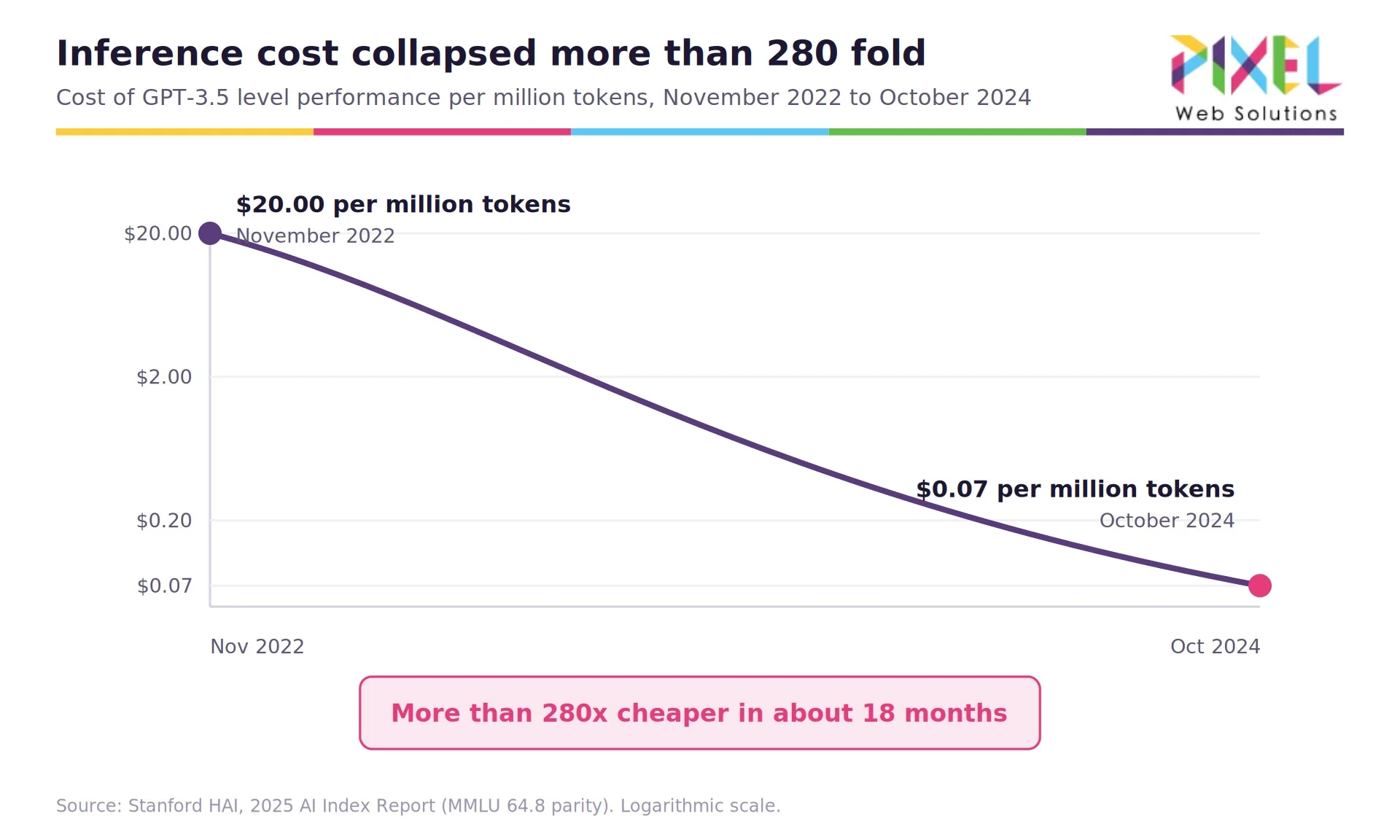
The price of a fixed unit of capability is collapsing. Stanford’s 2025 AI Index found that querying a model scoring at GPT-3.5 level on MMLU fell from USD 20.00 per million tokens in November 2022 to USD 0.07 per million tokens by October 2024, a reduction of more than 280 times in roughly 18 months. Hardware costs have been declining around 30 percent annually and energy efficiency improving around 40 percent per year.
Total spending is rising sharply anyway. Over broadly the same period, the 2026 AI Index recorded global corporate AI investment at USD 581.7 billion in 2025, up 130 percent year over year, with Google alone reporting more than USD 150 billion in capital expenditure. The binding constraint in 2026 is data center capacity, not model capability.
The reconciliation is consumption. As the price per unit falls, teams route more work through models, use longer context windows, and hand tasks to agents that make twenty calls where one used to do. Cheaper units multiplied by far more units is a bigger bill, not a smaller one.
The practical implication is narrower than the old advice suggested. It is still true that a workload which looks unaffordable at today’s frontier-model prices often becomes viable within a year at a smaller model tier. It is no longer safe to assume that waiting makes your total AI bill smaller, or that capacity will be available on demand when you need it. Build the business case on cost per completed outcome, and re-run it when your volume changes rather than when prices do.
The hidden cost layer
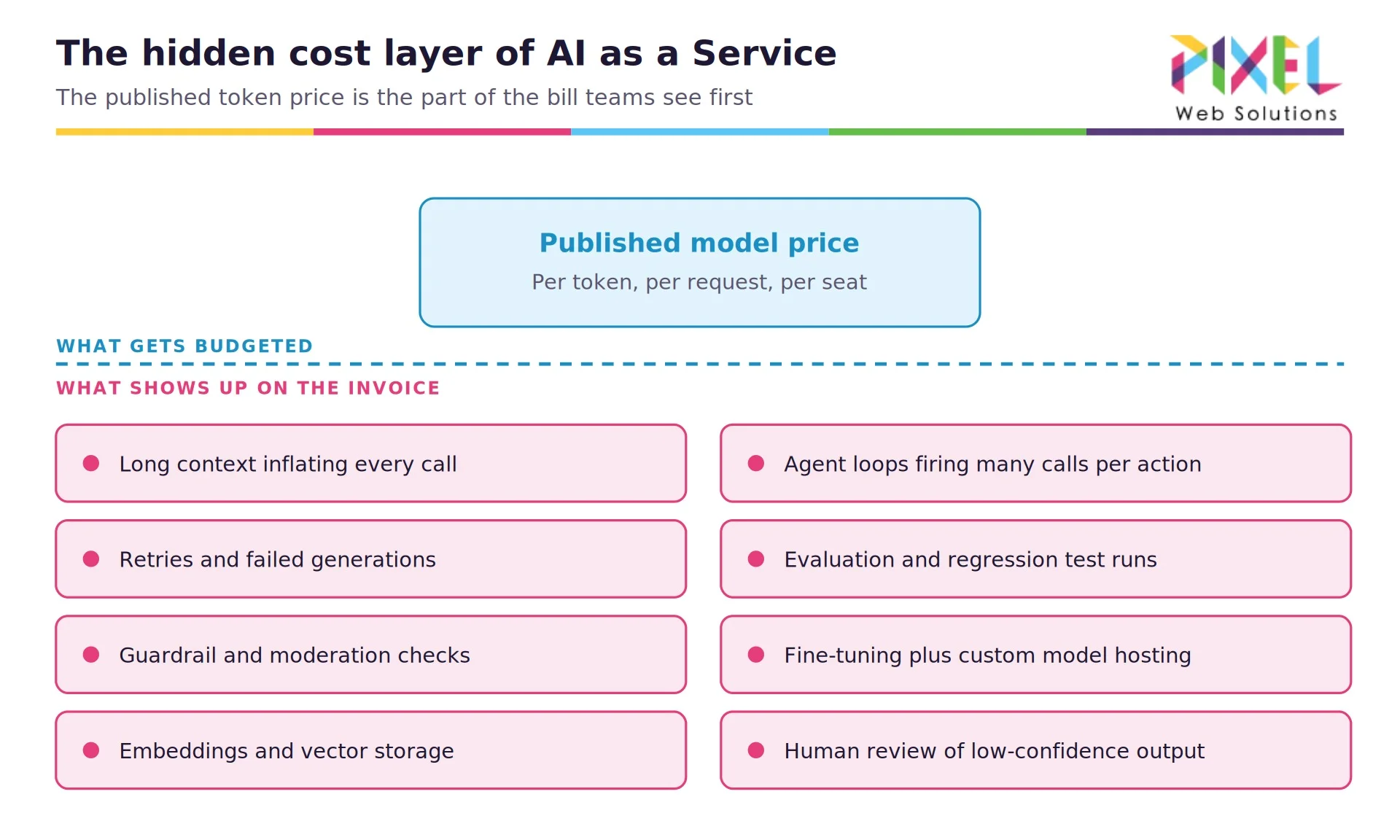
The line items teams underestimate are the ones outside the model price:
- Long context. Every additional document in the prompt is billed on every call, forever.
- Agentic multiplication. One user action becomes many model calls. Budget on actions, not requests.
- Retries, evaluations, and guardrails. Quality control consumes the same tokens as production traffic.
- Human review. Still the largest cost in most regulated deployments.
- Fine-tuning. A one-off training charge plus ongoing hosting for the customized model.
- Vector storage, embeddings, and data egress. Small per unit, permanent, and rarely modeled.
A useful discipline is to price per completed business outcome, not per thousand tokens. Cost per resolved support ticket or per processed invoice is the number that survives a CFO conversation.
What Is AI as a Service Used For?
By business function
Customer support deflection and agent assist. Document processing across invoices, contracts, and claims. Code generation and review inside developer workflows. Sales and marketing content production at volume, which is the most common entry point for generative AI development. Search and knowledge retrieval across internal document stores.
The 2026 AI Index puts measured productivity gains at 14 to 15 percent in customer support, 26 percent in software development, and up to 50 percent in marketing output. Those are real but narrower than most vendor marketing implies, and they show up only where a specific workflow was redesigned rather than augmented.
By industry
Fraud and anomaly detection in transaction streams for financial services. Clinical documentation and coding in healthcare. Demand forecasting and predictive maintenance in supply chain and manufacturing. Adaptive learning and assessment in education.
The pattern that works is narrow and measurable. Broad “AI transformation” pilots stall, which is exactly what the McKinsey scaling gap describes, while a single workflow with a baseline metric attached tends to reach production. Choosing that first workflow, sizing the return, and picking the right model tier for it is what AI consulting services are for.
Benefits and Limitations of AI as a Service
| Benefits | Limitations |
|---|---|
| Working prototype in days, not quarters | Unit economics worsen as volume grows |
| Near-zero capital expenditure | Rate limits and deprecation schedules outside your control |
| Capacity scales with demand | Data leaves your perimeter unless you buy private deployment |
| Model upgrades arrive without a migration project | Prompts and evaluations rarely transfer cleanly between models |
| Falling per-unit prices at a fixed capability level | Capacity constraints can gate access regardless of budget |
There is also a complexity trade that is often missed. AIaaS removes infrastructure work and replaces it with integration, governance, model selection, and evaluation work. The effort shifts layers rather than disappearing. Teams that budget for the first and not the second are the ones whose pilots stall.
The lock-in is real but subtler than a contract. Switching model providers is technically straightforward. Switching the prompt engineering, the evaluation suite, and the fine-tuned weights that were built against one model’s behavior is not.
When Does Building In-House Beat AIaaS?
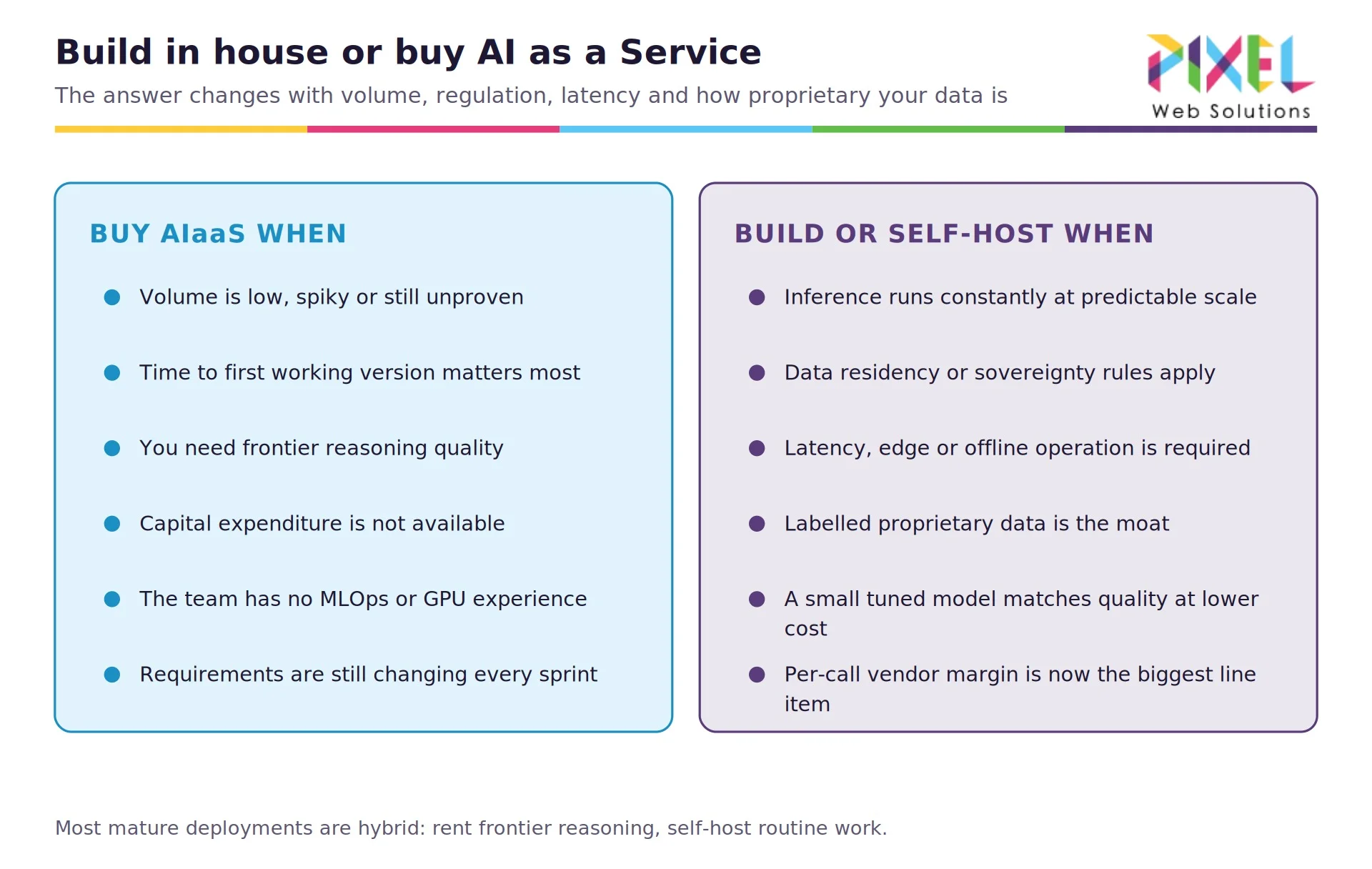
Building or self-hosting starts to win under four specific conditions.
| Condition | Why buying stops working | What to build instead |
|---|---|---|
| Sustained high volume | You pay a margin on every call, forever | Reserved GPUs or self-hosted open weight models |
| Data residency or sovereignty rules | Data cannot leave your environment at all | Models inside your own VPC or on-premise |
| Latency or offline requirements | A network round trip is not survivable | Edge or on-device deployment |
| Genuinely proprietary data | Your labeled dataset is the moat, not the model | A fine-tuned or distilled small model |
The breakeven on the first row depends on utilization, not on headline rates. Reserved capacity that sits idle overnight is more expensive than on-demand pricing, which is why the calculation has to be run against your actual traffic curve rather than your peak.
Most organizations end up hybrid: buy frontier capability for hard reasoning, self-host small models for high-volume routine tasks. Building that routing layer, the retrieval pipeline behind it, and the evaluation suite that keeps quality honest is standard scope for AI development services. Where the fourth row applies and the proprietary dataset is the asset, the work is AI model development rather than integration.
Is AI as a Service Secure and Compliant?
What providers give you
Enterprise tier AIaaS providers now offer zero data retention options, no-training-on-customer-data commitments, private networking, regional processing, and audited certifications such as SOC 2 and ISO 27001.
Two caveats matter. Those controls are usually opt-in rather than default. And consumer tiers routinely carry different terms to enterprise agreements, which means an employee pasting a contract into a personal account is operating under a different data policy than the one your legal team reviewed.
What stays your responsibility
The obligations that matter most do not transfer: what data enters the prompt, who can see the output, how decisions are logged, and whether the use case triggers duties under GDPR, India’s DPDP Act, sector rules, or the EU AI Act’s risk tiers. McKinsey’s research consistently finds governance maturity trailing adoption maturity, which is where most avoidable incidents originate.
Worth noting for anyone assessing vendors: Stanford’s 2026 AI Index found Foundation Model Transparency Index scores fell to 40 points from 58 the previous year, with the most capable models often disclosing the least. Diligence questions that were answerable from published documentation two years ago now need to be asked directly in procurement.
How to Choose an AIaaS Provider
A workable selection sequence, in order of how much it constrains everything downstream:
- Start with the compliance boundary. Data residency, retention terms, and certifications eliminate more options than any technical criterion. Establish this before evaluating a single model.
- Check procurement fit. A platform inside your existing cloud agreement can ship months earlier than a better one that needs a new vendor review.
- Benchmark on your own data. Public leaderboards measure general capability. Build a 50-example evaluation set from your actual workload and run it across three providers. This takes a day and is the highest-value day in the whole project.
- Model the cost at 10x current volume, not today’s. Per-token pricing that looks trivial in a pilot is the line item that kills the business case at scale.
- Design the exit before you sign. Route through an abstraction layer, keep the evaluation set portable, and avoid provider-specific features in the critical path unless the advantage is decisive.
- Pick the smallest model that passes. Most teams default to the frontier tier and stay there. Routing routine work to a smaller model is usually the single largest cost reduction available, and it costs nothing to test.
If you are running this process now, our AI consulting services team does exactly this evaluation, including the benchmark in step three.
The Future of AI as a Service
Three shifts are underway.
Pricing is moving from tokens toward outcomes. Vendors are increasingly charging per resolved task rather than per unit of compute, which aligns incentives but makes cost forecasting harder, not easier.
Small, efficient models are absorbing routine workloads. Frontier models are being pushed toward genuinely hard reasoning while the volume moves down-tier. This is where most of the near-term cost savings actually live.
Sovereign and regional deployment is becoming a procurement default. What was an exception two years ago is now a standard requirement in European and Indian enterprise RFPs, and it is reshaping which providers can compete for which contracts.
The strategic question is no longer whether to use AIaaS. It is which layers to rent, which to own, and how quickly you could switch if the economics or the terms changed.
Conclusion
AI as a Service turns a capital project into an operating expense. For most teams that is the right trade, at least at the start: ship the feature, measure the outcome, and only then argue about infrastructure.
What has changed in the last year is the shape of the cost argument. Per-unit prices are still falling at a remarkable rate, but total AI spending grew 130 percent in 2025 and capacity, not capability, is now the constraint. Waiting no longer reliably makes the problem cheaper. What makes it cheaper is choosing a narrow workload, measuring cost per outcome, and running it on the smallest model that clears the bar.
Revisit build versus buy when a workload becomes high volume and predictable, or when regulation puts your data off limits to third parties. Treat it as an annual decision rather than a settled one.
If you are scoping that first use case or planning the move from pilot to production, our AI consulting services and AI development services cover both ends of the journey.
FREQUENTLY ASKED QUESTIONS
Q: What is AI as a Service in simple terms?
AI as a Service means renting artificial intelligence capabilities from a cloud provider instead of building them yourself. You send data to an API and get an intelligent result back, while the provider handles the models, hardware, and scaling. You pay only for what you use.
Q: What is the difference between AIaaS and SaaS?
SaaS delivers a finished application that end users log into, such as a CRM. AIaaS delivers AI capability as a component that developers build into their own products, usually through an API. Many modern SaaS products are themselves built on top of AIaaS.
Q: What are the main types of AI as a Service?
There are six: model APIs, managed cloud AI platforms, task specific services such as OCR and transcription, agent and bot runtimes, GPU and inference hosting, and vertical services tuned for a single industry. Most organizations combine several rather than standardizing on one.
Q: Who are the top AI as a Service providers?
The managed cloud platforms are Amazon Bedrock, Google Vertex AI, Microsoft Foundry, and IBM watsonx. The main frontier model APIs are OpenAI, Anthropic, Google Gemini, Mistral AI, and Cohere. The leading inference and GPU specialists are Together AI, Groq, and Replicate. Most production systems use at least one provider from each tier.
Q: How much does AI as a Service cost?
Most AIaaS is metered rather than flat rate, priced per token, per request, per minute of audio, or per seat. Per-unit prices continue to fall sharply: Stanford’s AI Index found the cost of GPT-3.5 level inference dropped from USD 20.00 to USD 0.07 per million tokens between November 2022 and October 2024. Total spending is rising anyway, because consumption grows faster than prices fall. Budget separately for retries, long prompts, evaluation, and storage, which often exceed the headline model price.
Q: Is AI getting cheaper or more expensive in 2026?
Both, and the distinction matters. The price of a fixed unit of capability keeps falling steeply. Total corporate AI spending rose 130 percent in 2025 to USD 581.7 billion, because organizations route far more work through models as prices drop. Plan on your bill growing even as your per-token rate shrinks.
Q: How big is the AI as a Service market?
Grand View Research estimated the global AIaaS market at USD 16.08 billion in 2024 and projects USD 105.04 billion by 2030, a 36.1 percent compound annual growth rate. North America held the largest share at 46.2 percent in 2024. The wider cloud AI market is forecast to reach USD 1.73 trillion by 2033.
Q: Is AI as a Service secure enough for enterprise data?
Enterprise plans typically offer zero data retention, no training on customer data, private networking, and regional processing, backed by certifications such as SOC 2 and ISO 27001. These controls often need to be enabled explicitly and differ between consumer and enterprise tiers. Responsibility for what data is sent and how outputs are used remains with the customer.
Q: When should a company build AI in-house instead of using AIaaS?
Building in-house makes sense at sustained high inference volume, under strict data residency rules, where latency or offline operation is required, or where proprietary labeled data gives a fine-tuned model a real edge. Below those thresholds, AIaaS is almost always faster and cheaper. Many companies run a hybrid of both.
Q: Does AI as a Service create vendor lock-in?
Some, though less than with traditional enterprise software. Switching model providers is technically straightforward, but prompts, evaluation suites, and fine-tuned models rarely transfer without rework. Routing through an abstraction layer and keeping your evaluation set portable reduces the switching cost.