Table of Contents
Hiring an AI consultant is easier than knowing what you should get for the money. The category stretches from a two-week strategy review to a team that builds and operates production systems, and the pricing stretches just as far.
The reason it matters is the failure rate. Gartner forecasts that more than 40 percent of agentic AI projects will be canceled before the end of 2027, on grounds of escalating cost, unclear business value or inadequate risk controls. S&P Global Market Intelligence, surveying more than 1,000 organizations across North America and Europe, found the share scrapping most of their AI initiatives rose to 42 percent in 2025 from 17 percent the year before, with the average organization abandoning 46 percent of proofs of concept before they reached production.
Almost none of that is a model problem. Anyone can call a model API. What separates a demo from a system that survives contact with real customers, real data and real regulators is scoping, evaluation and governance, and that is the actual product a good consultant sells.
This guide sets out what services an AI consultant provides, which products and assets should be yours when the engagement ends, what it costs in 2026, what a normal engagement looks like, and the questions that separate practitioners from resellers.
What Does an AI Consultant Actually Do?
An AI consultant helps an organization decide where artificial intelligence is worth applying, builds the systems that apply it, and makes sure those systems keep working once the project team leaves. The role sits between management consulting and software engineering, which is exactly why quality varies so much. Some firms only produce strategy documents. Others only write code. The useful ones do both and are candid about which parts of your idea are not worth automating.
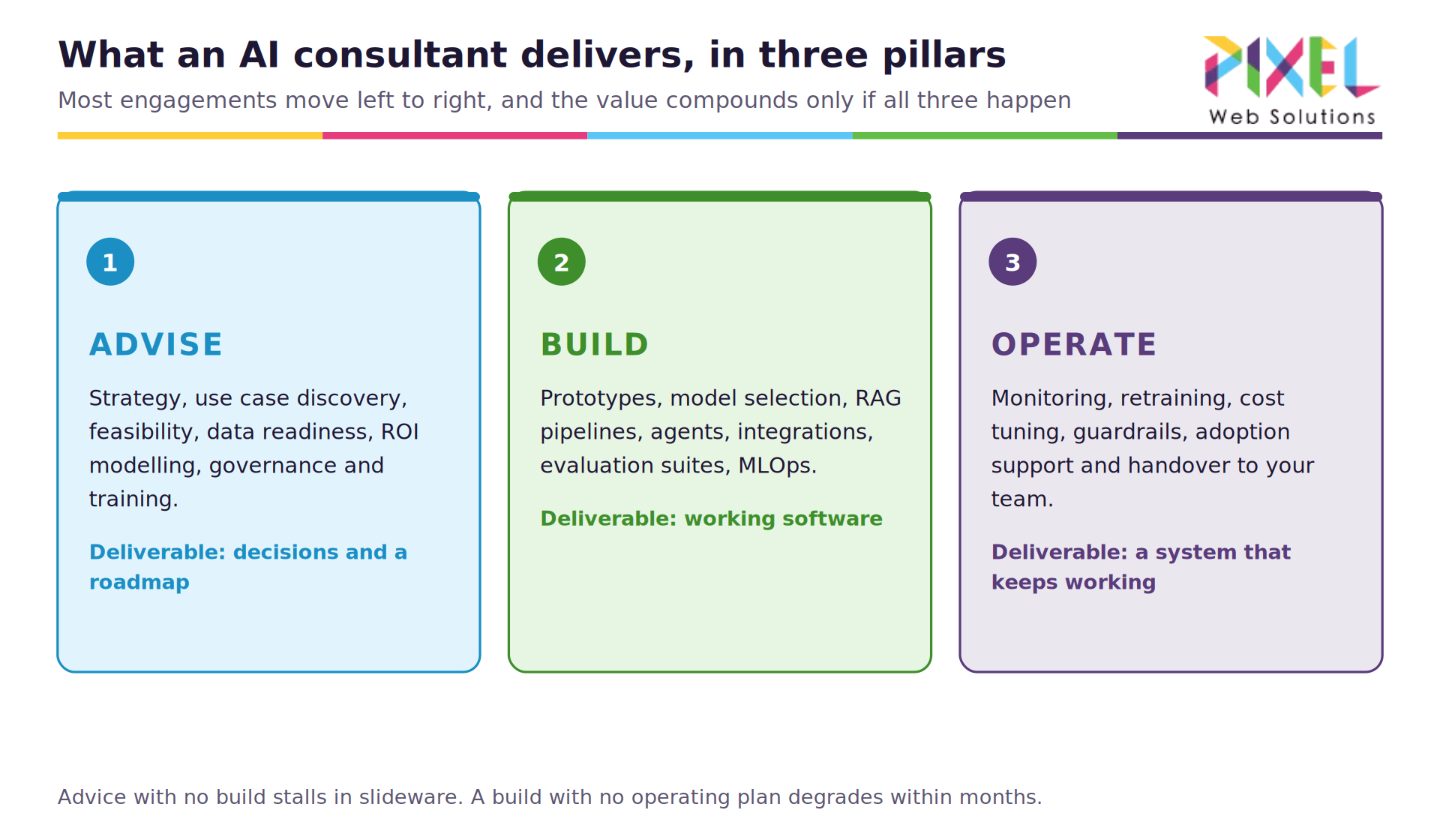
The work divides into three pillars.
Advise covers everything before a model is chosen: workflow mapping, use case scoring, feasibility, data readiness, cost modeling and governance. The deliverable is a decision and a roadmap.
Build covers the engineering: prototypes, model selection, retrieval pipelines, agents, integrations and evaluation. The deliverable is working software.
Operate covers what happens afterward: monitoring, retraining, cost tuning, guardrails and handover. The deliverable is a system that still performs in month twelve.
A consultant who only advises leaves you with slideware. One who only builds leaves you with an impressive demo that quietly degrades. The pillar most often skipped is the third, and it is the one that determines whether you bought a capability or rented a dependency.
Why AI Consulting Is Not Traditional IT Consulting
The engagement shapes look familiar, which misleads buyers into procuring AI work the way they procure a systems integration. Four differences matter commercially.
The output is probabilistic. Traditional software either meets the spec or does not. An AI system is right most of the time, and how often is a number you have to define, measure and defend. This is why the evaluation suite is a deliverable rather than a testing activity, and why a fixed-price build quoted without an agreed accuracy threshold is quoting against an undefined target.
Requirements move during delivery. You discover what customers actually ask only once the system is live, and the real intent distribution rarely matches what the workshop predicted. Fixed scope works less often here than in conventional builds, which is the genuine argument for a paid discovery sprint rather than a longer requirements phase.
Running cost scales with usage rather than with seats. Conventional software gets cheaper per user as you grow. Inference does not. A business case built on seat-based intuitions looks excellent at pilot volume and uncomfortable at production volume, and the time to model that is before the build rather than after the first full-month invoice.
The dependency is external and moves without asking. Model providers deprecate versions, change pricing and change behavior on their own schedule. Traditional consulting rarely leaves you exposed to a third party’s release notes. This is precisely why owning the evaluation set matters: it is the only practical way to find out quickly whether a provider’s update broke something.
None of this makes AI consulting harder to buy well. It makes the standard procurement instinct, fixed scope against a detailed specification with acceptance testing at the end, a poor fit. Scope the decision first, then scope the build.
What Services Does an AI Consultant Provide?
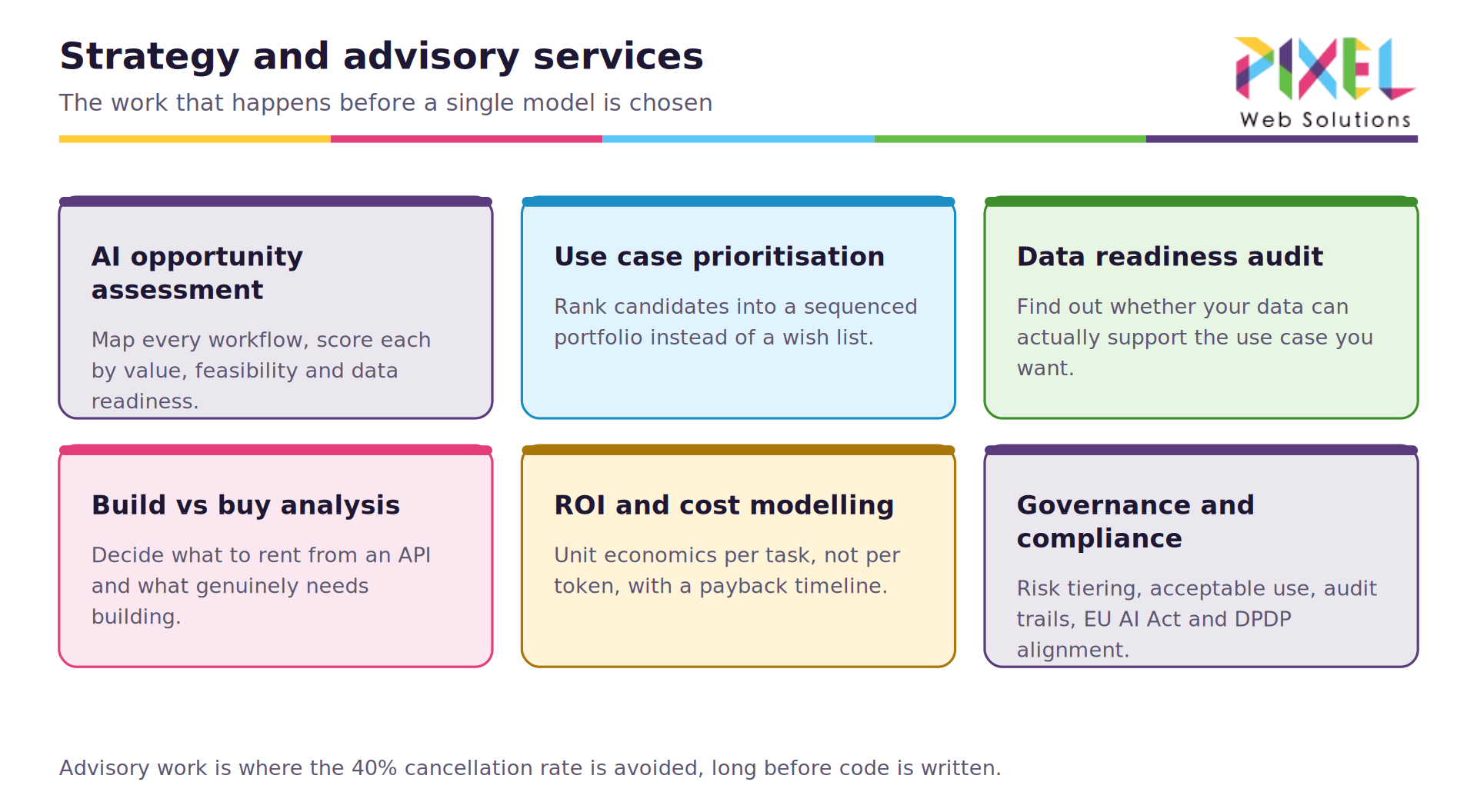
Strategy and advisory services
| Service | What it produces | When you need it |
| AI opportunity assessment | Workflows scored on value, feasibility and data readiness | Before any budget is committed |
| Use case prioritization | A sequenced portfolio, not a wish list | When stakeholders disagree on where to start |
| Data readiness audit | An honest verdict on whether your data supports the use case | Always, and often the point at which a project should pause |
| Build versus buy analysis | What to rent from an API, self-host, or build custom | Before architecture is chosen |
| ROI and cost modeling | Unit economics per completed business task, with payback timeline | Whenever finance has to approve |
| AI governance and compliance | Risk tiering, acceptable use, audit logging, human oversight design | Regulated industries, and any EU or UK exposure |
| Team training and enablement | Your people able to maintain what gets built | Before handover, not after |
Governance deserves a specific note. Alignment work now spans GDPR, India’s DPDP Act and the EU AI Act, and the last of those has staged obligations that keep arriving. A consultant who cannot describe how your use case is risk-tiered under the EU AI Act is not doing governance, they are doing a policy document.
The data readiness audit is the one clients most often want to skip and most often regret skipping. It is the step where an experienced consultant tells you the thing you did not want to hear, which is also the clearest signal you have hired the right one.
Build and implementation services
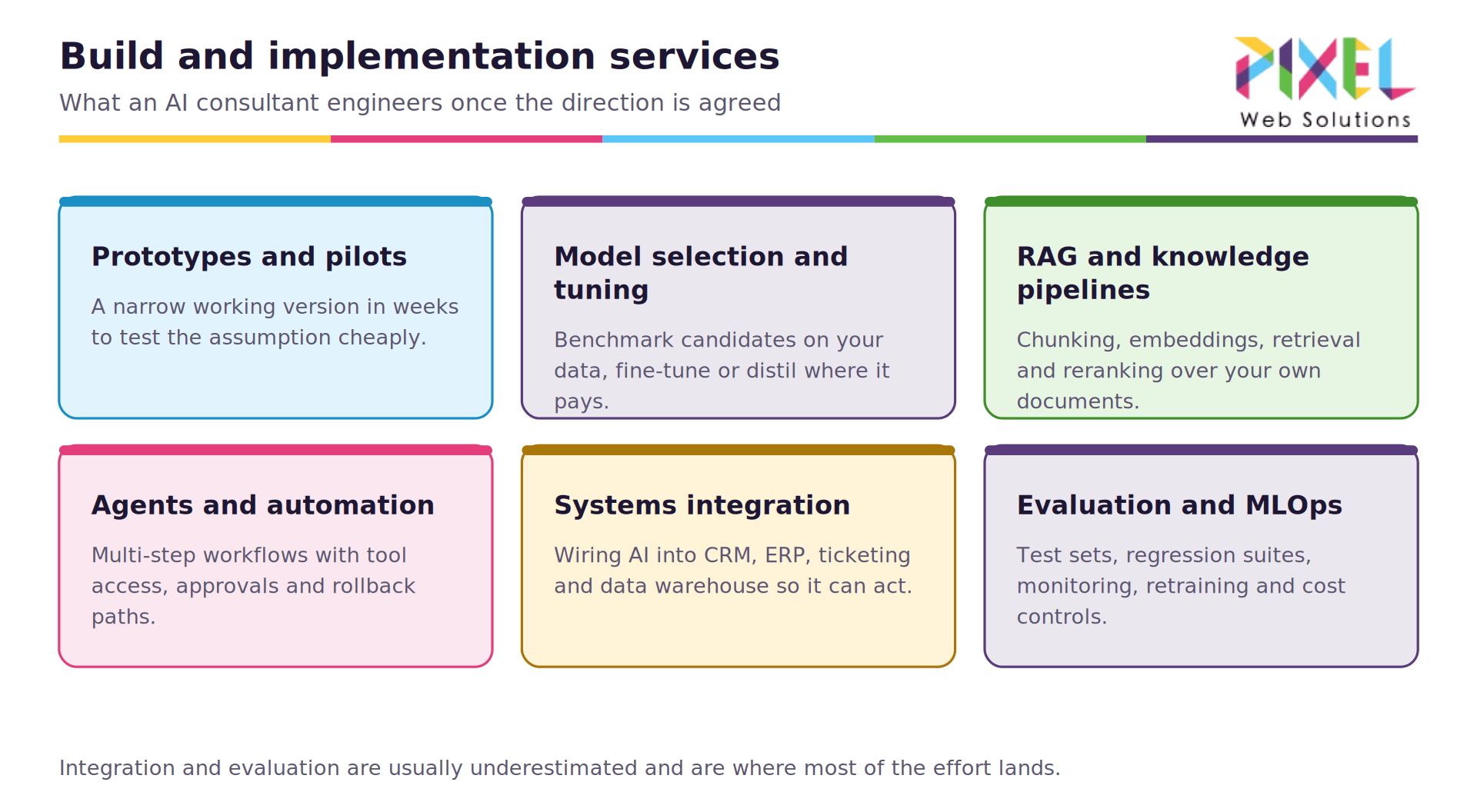
| Service | What it produces | Common underestimate |
| Prototypes and pilots | A narrow working version testing one core assumption | Treated as a demo rather than a test with a pass mark |
| Model selection and fine-tuning | Benchmarks on your data, then tuning or distillation where economics justify it | Assuming the frontier model is the right answer |
| RAG and knowledge pipelines | Chunking, embeddings, retrieval and reranking over your content | Retrieval quality, not model quality, is usually the bottleneck |
| Agent and workflow automation | Multi-step systems with tool access, approval gates and rollback | Rollback paths designed after launch instead of before |
| Systems integration | AI connected to CRM, ERP, ticketing and the data warehouse | Routinely the single largest line in the build |
| Evaluation and MLOps | Golden sets, regression suites, monitoring, alerting, retraining, cost controls | Deferred to “phase two”, which never arrives |
Integration and evaluation consume more effort than model work on nearly every engagement. Any proposal that treats them as afterthoughts is underestimating the job, and the underestimate will surface as a change request rather than as an apology.
The depth of build varies more than the labels suggest. AI chatbot development and AI agent development sound adjacent but differ mainly in how far into your systems the AI is permitted to reach, and that difference drives most of the cost. Similarly, RAG development and LLM development describe two genuinely different problems: grounding answers in your content, versus adapting a model’s behavior.
Operating and managed services
This is the pillar most often sold as optional and most often needed. It covers monitoring for quality drift and cost creep, retraining or re-prompting as products and policies change, guardrail tuning as new failure modes appear, adoption support, and structured handover.
Quality drift is not a metaphor. An AI system’s inputs change continuously: your product changes, your policies change, your customers ask new things, and the underlying model gets deprecated or updated by its provider. A system that passed evaluation in March can fail quietly in September without a single line of your code changing. Catching that requires a regression suite that runs on a schedule, which is why the evaluation work in the build phase is what makes the operating phase possible at all.
Cost creep deserves its own mention. AI systems are among the few software assets whose running cost rises with success, because more usage means more inference. A consultant who has never had to tune an inference bill has not operated one of these systems at scale. Ask which levers they use: caching, routing easy requests to cheaper models, shortening context, batching. If the answer is only to use a smaller model, that is one lever, not an operating practice.
Adoption support is the least technical and most decisive item on the list. A correctly built system that 12 percent of the target team uses returns approximately nothing, and this failure mode is invisible in every technical metric. It shows up only in usage data that nobody has been asked to look at.
What Products and Assets Does an AI Consultant Deliver?
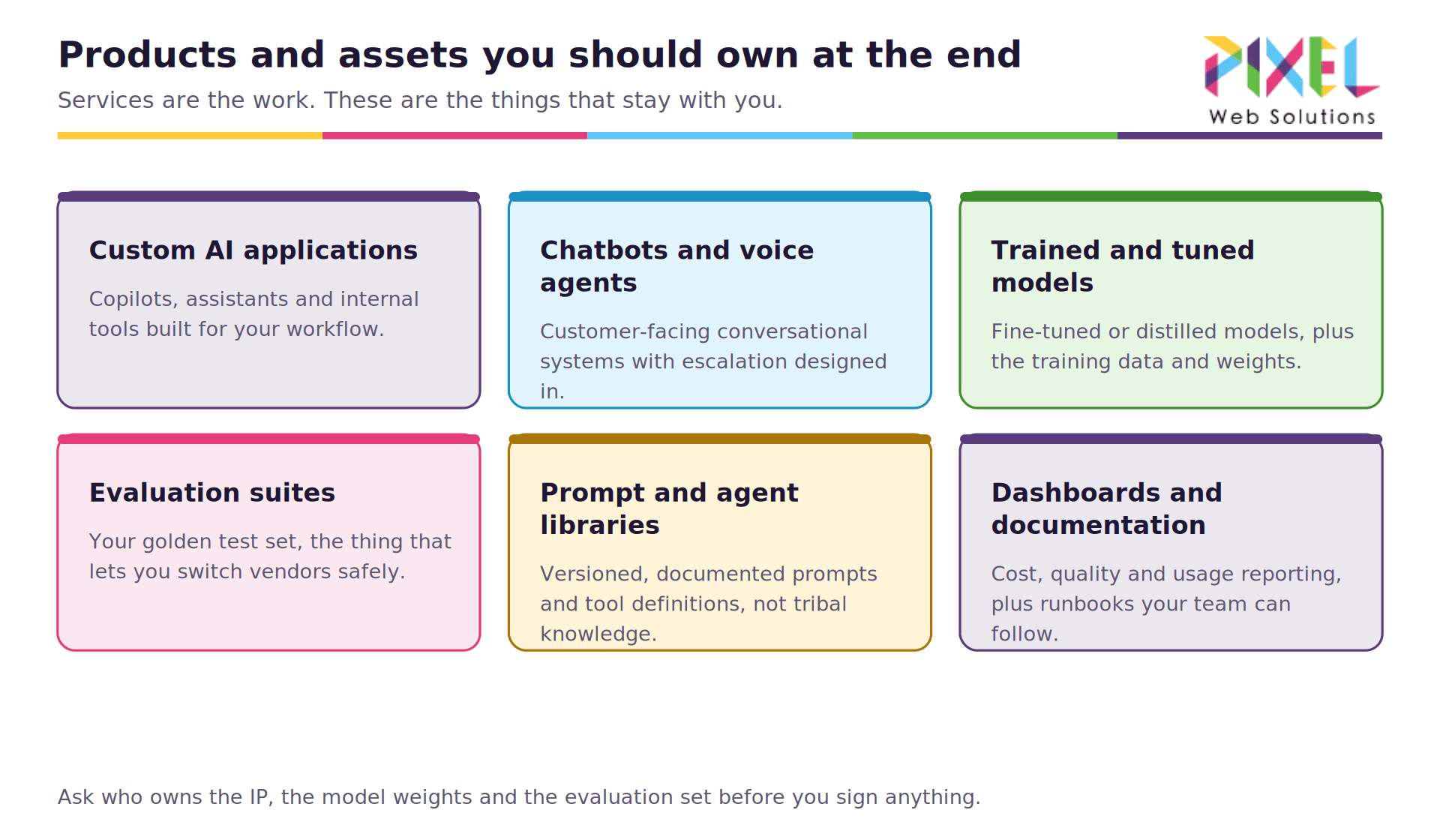
Services are the work performed. Products are the assets that remain yours afterward, and this is where engagements differ most sharply.
| Asset | Why it matters | Own it outright? |
| Custom AI applications | Internal copilots and tools built around your workflow | Yes, including source |
| Chatbots and voice agents | Customer-facing systems with escalation designed in | Yes |
| Trained and fine-tuned models | The capability itself | Yes, with training data and weights |
| Evaluation suite and golden test set | Lets you switch model or vendor later without guessing at quality | Yes, non-negotiable |
| Prompt and agent libraries | Versioned and documented, not living in a contractor’s head | Yes |
| Dashboards and documentation | Cost, quality and usage reporting, plus runbooks | Yes |
| Vendor accelerators or platforms | Can shorten delivery meaningfully | Often not, and you must ask what happens if you stop paying |
The evaluation suite is the most valuable artifact of any AI engagement and the one clients most often fail to ask for. It is what converts a vendor relationship into a market: with a golden test set you can benchmark a replacement in an afternoon, and without one you are negotiating from ignorance every renewal.
Vendor accelerators are not inherently a problem. Proprietary tooling genuinely does shorten delivery. The question is simply what your system does if you stop paying for it, and a straight answer to that question is a reasonable thing to expect before signing.
How Much Does AI Consulting Cost in 2026?
v1 of this article said cost “varies widely by scope and region” and left it there. That is true and useless. Here are the ranges the market actually advertises.
| Tier | Typical hourly rate | Typical day rate | Fits |
| Independent consultant | USD 100 to 350 | USD 800 to 2,000 | Advisory, architecture review, second opinion |
| Boutique or specialist firm | USD 150 to 300 | USD 1,200 to 2,400 | Focused builds, domain depth, most mid-market work |
| Mid-tier consultancy | USD 300 to 500 | USD 2,000 to 3,500 | Multi-workstream programs, change management |
| Big Four and tier-one strategy | USD 500 to 1,000+ | USD 2,500 to 3,500+ | Board-level mandates, regulated transformation |
Common fixed-price shapes:
| Engagement | Typical range | Duration |
| Discovery sprint or readiness assessment | USD 25,000 to 75,000 | 2 to 6 weeks |
| Scoped proof of concept, one use case | USD 20,000 to 60,000 | 4 to 8 weeks |
| Production build | Highly variable, driven by integration depth | 3 to 6 months |
| Managed AI retainer | Monthly, scaled to system count and usage | Ongoing |
Read these ranges with appropriate caution. They are compiled from published 2026 rate guides and market surveys rather than from a single audited dataset, and they skew toward US and UK pricing. Offshore and nearshore delivery sits materially below them. Published guides also broadly agree that rates have risen roughly 10 to 15 percent annually since 2024 on generative and agentic AI demand, so treat any figure older than a year as a floor rather than a benchmark.
The more useful comparison is not day rate at all. It is cost per completed business outcome. A USD 800 per day consultant who needs four months beats a USD 2,500 per day consultant who needs three weeks only if the arithmetic actually works, and it frequently does not.
The five commercial models
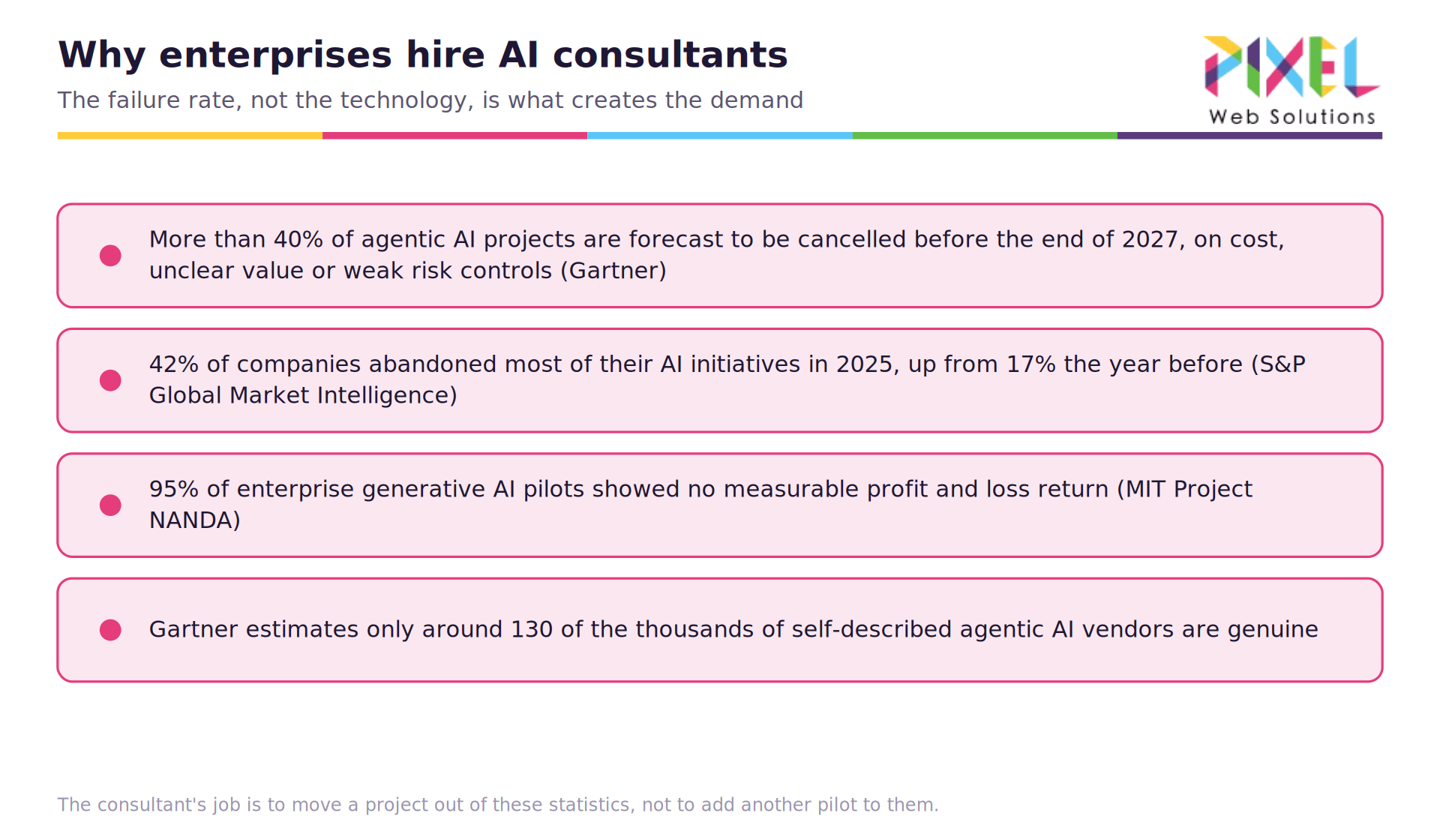
Discovery sprint. Fixed fee over two to six weeks, producing a roadmap, business case and one prioritized use case. Usually the cheapest way to find out whether a partner is any good before larger commitments.
Fixed scope build. Defined deliverable at a defined price. Works when requirements are genuinely stable, which with AI they often are not.
Time and materials. Day or sprint rate for exploratory work where scope will move as you learn. Honest for research, dangerous without a cap.
Retainer or managed AI. Monthly fee covering monitoring, tuning, cost control and a pipeline of new use cases.
Outcome-based. Payment tied to an agreed metric. Increasingly offered, but only workable when the metric is unambiguous and attribution is clean. Ask how the metric is measured and by whom before being impressed by it.
Our own AI consulting services start with a fixed-scope discovery sprint for the reason above: it lets both sides find out whether the fit is real while the commitment is still small.
What Does a Typical Engagement Look Like?
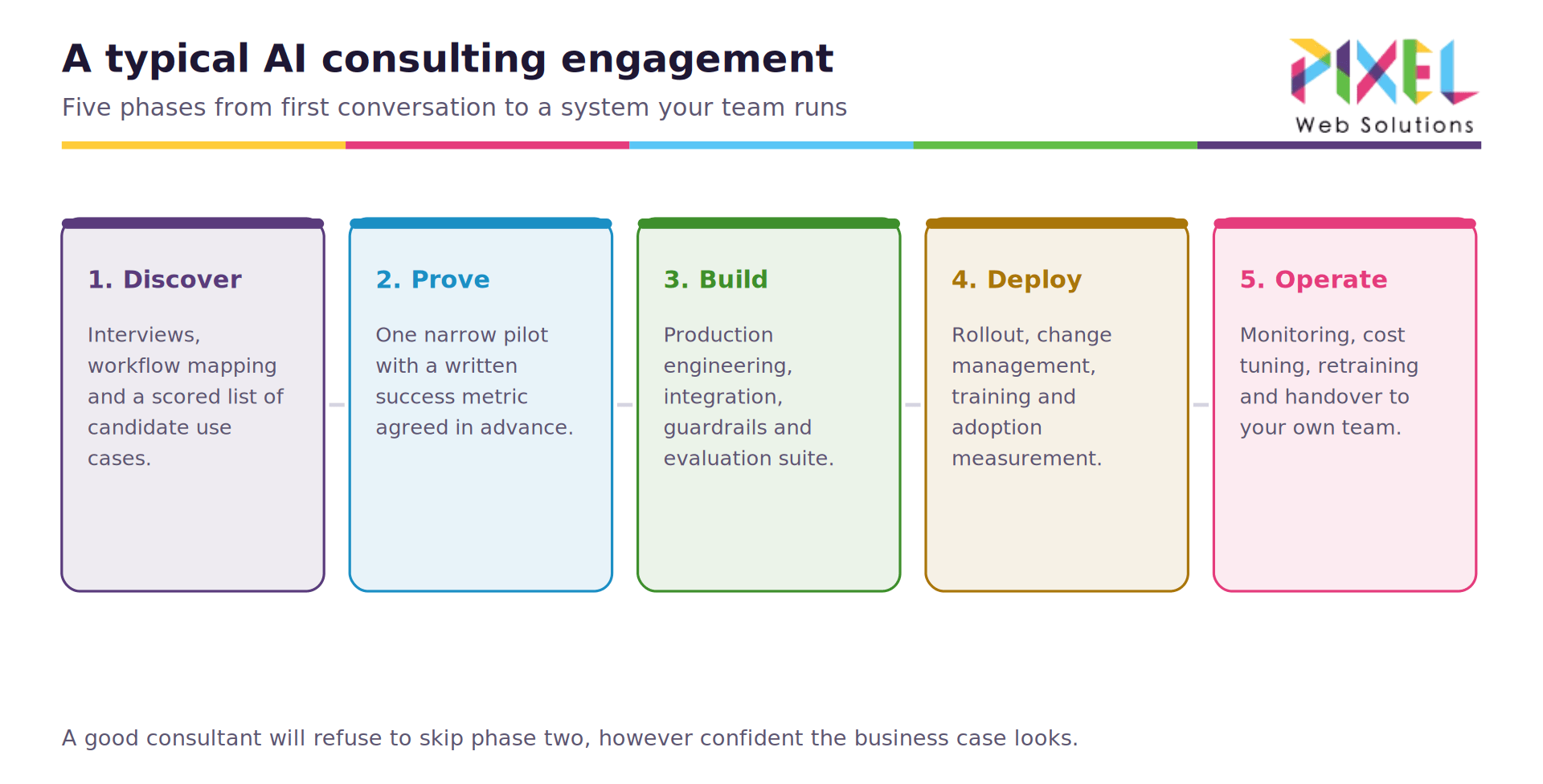
Discover, prove, build, deploy, operate.
- Map the workflows, score the candidates, audit the data, model the unit economics. Ends with a decision, not a document.
- Run one narrow pilot against a success metric agreed in writing beforehand. The metric must have a number and a date.
- Turn the winner into production engineering, with integration, guardrails and an evaluation suite.
- Rollout, change management, training, and the adoption work that determines whether any of it returns anything.
- Monitoring, cost tuning, retraining, handover.
The phase most often skipped under commercial pressure is the second, and skipping it is how organizations end up building something impressive that nobody needed. It is also the phase a consultant has the least commercial incentive to insist on, which makes insisting on it a useful signal about who you are dealing with.
Why Do Companies Hire AI Consultants at All?
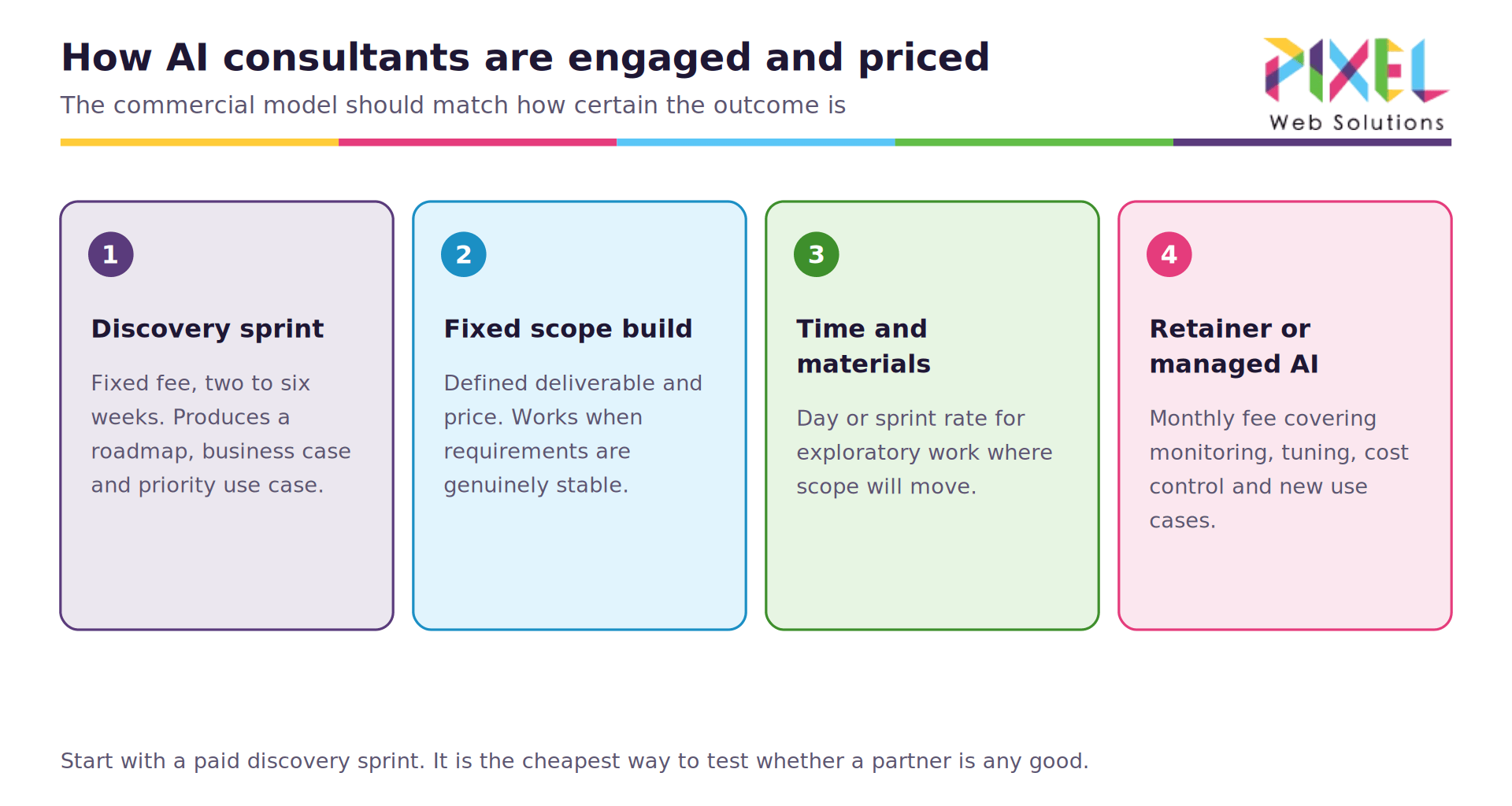
Demand is driven by failure rates rather than by the technology being hard to access.
| Finding | Figure | Source, date and base |
| Agentic AI projects canceled | over 40% by end of 2027 | Gartner prediction, Jun 2025 |
| Organizations scrapping most AI initiatives | 42% in 2025, up from 17% in 2024 | S&P Global Market Intelligence, 1,000+ respondents, NA and Europe |
| Proofs of concept abandoned before production | 46% on average | S&P Global, same survey |
| GenAI pilots with no measurable P&L return | 95% | MIT Project NANDA, The GenAI Divide, Jul 2025 |
| Vendors genuinely offering agentic AI | roughly 130 of thousands claiming to | Gartner, “agent washing”, Jun 2025 |
| Accenture generative AI bookings | USD 5.9bn in FY2025, nearly double YoY | Accenture, FY ending Aug 2025 |
Handle the 95 percent figure carefully. It measures pilots that showed no measurable profit and loss return, not projects that were canceled, and it is among the most misquoted statistics in the field. It also rests on a modest base: 300-plus initiative reviews, 52 interviews and 153 survey responses. It is directionally important and worth citing. It is not a precise measurement, and anyone presenting it as one is overreaching.
The “agent washing” estimate is the most practically useful number in that table for a buyer. Gartner’s assessment that only around 130 of the thousands of vendors describing themselves as agentic AI providers genuinely qualify is, in effect, a warning that most of what you will be pitched is relabeled automation.
On market size, the estimates disagree, and the disagreement is informative. Analyst houses put the AI consulting market variously around USD 7.6 billion in 2025 rising to roughly USD 10.9 billion in 2026, while other estimates run into the low to mid teens of billions. Note that Accenture alone booked USD 5.9 billion in generative AI work in fiscal 2025. A single firm accounting for most of a market as measured is a sign the definitions differ rather than that the firm dominates. Treat all AI consulting market sizing as indicative only.
AI Consultant vs AI Developer vs AI Agency
The titles overlap and the distinction matters commercially.
| Decides what to build | Builds it | Operates it | Best for | |
| AI consultant | Yes | Sometimes | Sometimes | You are unsure what is worth doing |
| AI developer or dev shop | No | Yes | Rarely | You have a validated, specified build |
| AI agency | Partially | Yes | Sometimes | Marketing-adjacent or customer-facing deployments |
| Managed AI provider | No | Yes | Yes | You want the outcome, not the capability |
An AI developer builds what has already been specified. A consultant decides what should be built, whether it is feasible with your data, what it will cost per outcome and how it will be governed. Many firms do both, and AI development services and consulting frequently sit under one roof. The advisory work is what prevents the wrong thing being built well, which is the most expensive failure mode available.
Where AI Consulting Delivers Most
Consulting value is not evenly distributed. It concentrates where the cost of getting it wrong is high and where the work is hard to specify in advance.
| Situation | Consulting value | Why |
| First AI project, no internal precedent | Highest | Nothing to copy, and the expensive mistakes get made during scoping |
| Regulated industry | Highest | Governance and audit design are specialist and unforgiving |
| Existing team, no evaluation practice | High, narrow scope | Buy architecture and evaluation design, build in house |
| Several stalled pilots | High | The problem is rarely the model, and an outside read is faster than an internal one |
| Well-understood, common use case | Low | A platform and a competent developer will beat a consulting engagement on cost |
| Pure research or experimentation | Low | You need researchers, not consultants |
The pattern worth noticing is that consulting earns its fee on the decisions rather than on the code. If you already know what to build, why it will pay back, and how you will know it works, you need AI development services rather than consulting, and you should not pay consulting rates for build capacity.
The inverse is true and more commonly ignored. If several pilots have stalled, adding engineering capacity will not help, because the constraint sits upstream of the code. That is the clearest available signal that the advisory pillar is what is actually missing.
How to Choose an AI Consultant
Look for production references over logos. A large client name proves someone signed a contract, not that anything shipped. A firm that can describe a system still running in month eighteen, including what broke and what they changed, is telling you something a case study cannot.
Prefer a consultant willing to tell you which parts of your idea are not worth automating. This is the most reliable single signal available. A firm whose assessment always concludes that everything you proposed is viable is selling capacity, not judgment. The good ones come back with a shorter list than the one you gave them.
Weight domain understanding above model expertise. Model choice changes every few months and is largely a benchmarking exercise. Your workflow, your data quality and your regulatory position do not change, and they are what determine whether the project works. A consultant who understands your industry and is merely competent on models will outperform the reverse.
Insist on clarity about ownership. If you do not own the prompts, weights and evaluation set, you have bought a dependency rather than a capability. Settle this in the contract rather than at handover, when your leverage is gone.
Check who actually does the work. This market has a well-documented pattern of senior people selling and junior people delivering. Ask for named individuals and their availability, and put the answer in the statement of work.
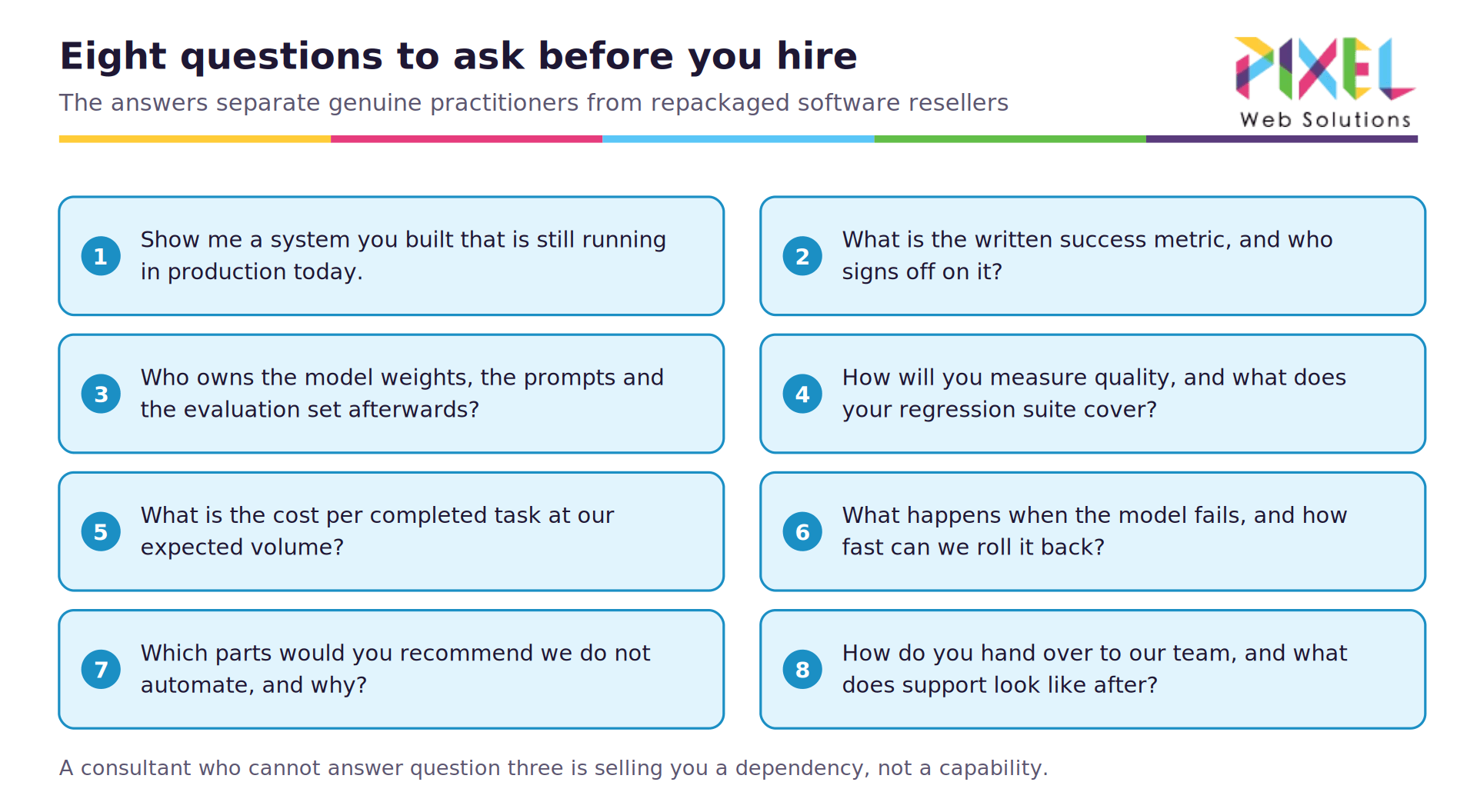
Eight questions worth asking before signing:
- What is the success metric for the pilot, what number counts as a pass, and who measures it?
- Which parts of our data are not ready, and what would fixing that cost?
- What do we own at the end, specifically: source, weights, training data, prompts, evaluation set?
- What happens to our system if we stop paying you or stop paying for your platform?
- What does this cost to run per month at ten times current volume?
- What is the rollback path when the system takes a wrong action?
- Which named people will do the work, and what else are they staffed on?
- Show us a production system you built more than a year ago that is still running.
Question eight does most of the work. Building a convincing pilot is now inexpensive; keeping one alive for eighteen months is not.
Red flags: a proposal with no evaluation line item, a fixed price quoted before a data audit, reluctance to name the delivery team, model choice presented as the central decision, and any pitch where the word “agentic” appears more often than the word “integration”.
Conclusion
An AI consultant provides advisory services that decide where to apply AI, build services that make it work inside your systems, and operating services that keep it working. The products they hand over, from custom applications and tuned models to evaluation suites and documentation, are what separate a lasting capability from a rented one.
Given that more than 40 percent of agentic AI projects are forecast to be canceled and that 42 percent of organizations scrapped most of their AI initiatives in a single year, the value of a good consultant lies less in access to models and more in the discipline of scoping narrowly, measuring honestly and building for handover. The frontier model is not the hard part and has not been for some time.
If you are weighing where to start, our AI consulting services begin with a fixed-scope discovery sprint, so you can judge the fit before committing to a build.
FAQ
Q: What does an AI consultant do?
An AI consultant decides where AI is worth applying, builds the systems that apply it, and keeps them working afterward. The advisory work covers opportunity assessment, data readiness audits, build versus buy analysis, ROI modeling and governance. The build work covers prototypes, model selection, RAG pipelines, agents, systems integration and evaluation. The operating work covers monitoring, retraining, cost tuning and handover. Firms that only do the first tend to leave slideware; firms that only do the second tend to leave a demo that degrades.
Q: What services and products does an AI expert consultant provide?
Services span advisory (AI opportunity assessment, use case prioritization, data readiness audits, build versus buy analysis, ROI modeling, governance and team training), build (prototypes, model selection and fine-tuning, RAG pipelines, agents, systems integration and evaluation) and operating (monitoring, retraining, cost tuning and handover). Products are the assets that remain yours: custom AI applications, chatbots and voice agents, fine-tuned models with their training data, evaluation and test suites, versioned prompt and agent libraries, and dashboards with documentation.
Q: What products does an AI consultant deliver?
Typical products are custom AI applications and internal copilots, chatbots and voice agents, fine-tuned or distilled models with their training data and weights, evaluation and test suites, versioned prompt and agent libraries, and dashboards with documentation. The evaluation suite is the most valuable long term, because it lets you change models or vendors without losing quality control. If you do not own it, you renegotiate from ignorance at every renewal.
Q: How much do AI consulting services cost?
In 2026, published rate guides put independent consultants at roughly USD 100 to 350 per hour, boutique and specialist firms at USD 150 to 300, mid-tier consultancies at USD 300 to 500, and Big Four or tier-one strategy firms at USD 500 to 1,000 and above. Fixed-fee discovery sprints commonly run USD 25,000 to 75,000 over two to six weeks, and a scoped proof of concept on one use case commonly runs USD 20,000 to 60,000. These ranges skew toward US and UK pricing, and offshore delivery sits materially below them. Compare on cost per completed business outcome rather than on day rate.
Q: What is the difference between an AI consultant and an AI developer?
An AI developer builds what has already been specified. An AI consultant decides what should be built, whether it is feasible with your data, what it will cost per outcome, and how it will be governed, then either builds it or oversees the build. Many firms offer both. The advisory work is what prevents the wrong thing being built well, which is the most expensive way for an AI project to fail.
Q: How long does an AI consulting engagement take?
A discovery sprint typically runs two to six weeks. A narrow pilot usually takes four to eight weeks, and a production build commonly runs three to six months depending on integration depth. Operating support is ongoing. Engagements that try to skip the pilot phase tend to take longer overall, not shorter, because the scope correction arrives later and costs more.
Q: Do I need an AI consultant if I already have a development team?
Often yes, but for a narrower scope. In-house teams typically have the engineering capability and lack the evaluation discipline, governance framework or cost modeling experience specific to AI systems. A consultant can be engaged for architecture, evaluation design and governance while your team does the building, which is usually the cheapest useful version of the engagement.
Q: Why do so many AI projects fail?
Gartner attributes its forecast of more than 40 percent agentic AI project cancellations by 2027 to escalating costs, unclear business value and inadequate risk controls rather than to model capability. S&P Global found 42 percent of organizations scrapped most of their AI initiatives in 2025, up from 17 percent the year before, with 46 percent of proofs of concept abandoned before production. MIT’s Project NANDA found 95 percent of generative AI pilots produced no measurable profit and loss return. The common causes are scope that is too broad, no agreed success metric, poor data foundations, and no plan for what happens when the system fails.
Q: What should I ask an AI consultant before hiring them?
Ask what the pilot’s success metric is and who measures it, which parts of your data are not ready, exactly what you own at the end including weights and evaluation sets, what happens to your system if you stop paying, what it costs to run at ten times current volume, what the rollback path is, which named people will do the work, and to show you a production system they built more than a year ago that is still running. That last question is the hardest to fake.