Table of Contents
Last updated: 4 October 2026 | Reviewed by Mathibharathi Mariselvan, Co-founder, Pixel Web Solutions | 15 min read
To build an LLM from scratch, you define the use case, collect and clean a large text dataset, train a tokenizer, design a Transformer model, pretrain it on GPUs, then fine-tune, evaluate and deploy it. Compute decides the budget: a small GPT-2 class model now trains in about 2 hours on one 8-GPU H100 node for under $50, while an 8 billion parameter model like Llama 3.1 8B took 1.46 million H100 hours, roughly $3 million to $6 million at October 2026 rental prices.
Large Language Models (LLMs) have emerged as a leading force in the development of new AI capabilities, powering everything from chatbots to content generators. As the world embraces more AI-driven solutions, the demand for tailored LLM applications has exploded. This creates an opportunity for startups, enterprises, and anyone trying to build their own LLM platform. But how do you build an LLM from scratch, and what does it really cost?
This blog examines how to build a large language model from scratch, covering every stage from data gathering to model architecture, training, tuning, and deployment. It also gives you real compute and cost figures with sources, so you can decide whether to pretrain your own model or fine-tune an existing one. Whether you are a developer learning how LLMs work or a business that wants a domain-specific LLM, this guide gives you the complete roadmap.
Key Takeaways
- Eight steps take you from idea to production: define the scope, collect and clean data, build the team, tokenize, design the architecture, pretrain, fine-tune and evaluate, then deploy.
- Compute is the biggest line item: training needs roughly 6 x parameters x tokens floating point operations, so doubling either the model size or the dataset doubles the GPU bill.
- A learning-scale LLM is cheap now: Andrej Karpathy's open-source nanochat reaches GPT-2 level in under 2 hours on 8 H100 GPUs, about $48 at $3 per GPU-hour.
- Production-scale pretraining costs millions: Llama 3.1 8B used 1.46 million H100 hours and Llama 3.1 405B used 30.84 million, before salaries, data and failed experiments.
- Most businesses should fine-tune first: adapting an open-weight model with your own data costs a small fraction of pretraining and reaches production much faster.
What is an LLM? Understanding the Core Before You Build One
A Large Language Model (LLM) is an advanced type of artificial intelligence system designed to understand, process, and generate human language by learning from massive amounts of text. LLMs apply deep learning methods such as the Transformer to comprehend language structure, context, and semantics.
This enables them to process complex language structures. Older AI models used far less data and relied more heavily on pre-defined language rules. LLMs are trained on billions or trillions of words and can create, predict, and summarize responses with context and fluency. With this basic understanding, let us move into the core tools and resources for building an LLM.
Essential Tools and Resources to Build an LLM Effectively
Creating a Large Language Model requires a significant investment of resources and the right combination of technologies, data, and skilled people. A solid technical groundwork is necessary before the actual build to guarantee scalability, precision, and energy-efficient operation.
1. Technical and Hardware Considerations
LLMs need high computational power for training and inference. You will need GPUs (Graphics Processing Units) or TPUs (Tensor Processing Units), high-memory servers, and fast storage. Most teams rent GPU clusters from cloud providers such as AWS, Azure, Google Cloud, or specialist GPU clouds instead of buying hardware. As of 4 October 2026, Lambda's on-demand price for an H100 in an 8-GPU cluster is $3.99 per GPU-hour, and spot, marketplace, and committed-use rates run lower.
2. Data Preparation
Clean, diverse, domain-specific data is the foundation of your model. Plan for collection, cleaning, deduplication, and tokenization so training starts from accurate input. Open datasets give you scale: Hugging Face's FineWeb alone holds about 15 trillion tokens of filtered web text. You can add proprietary data to improve contextual accuracy.
3. Development Stack
Python, the PyTorch framework, and the Hugging Face Transformers library are the main tools for prototyping and iteration. Experiment tracking tools like Weights & Biases or MLflow help you monitor training runs and compare results. If you are learning, two hands-on resources walk through the whole build in code: Sebastian Raschka's book Build a Large Language Model (From Scratch) and Andrej Karpathy's open-source nanochat repository.
4. Team Setup
A multi-disciplinary team of data scientists, machine learning engineers, linguists, and DevOps engineers is vital for a successful LLM project. Together they cover every phase of model development, from data and training through to deployment.
So far, we have seen the basic elements to build an LLM. Now let's dive into the next phase.
How to Build an LLM from Scratch: A Step-by-Step Guide
Creating a Large Language Model (LLM) is a challenging but rewarding task that combines data science, machine learning, and linguistics. To build a model that performs accurately, pay careful attention to each phase, from goal definition to deployment. Below is an LLM construction plan tailored to commercial needs.
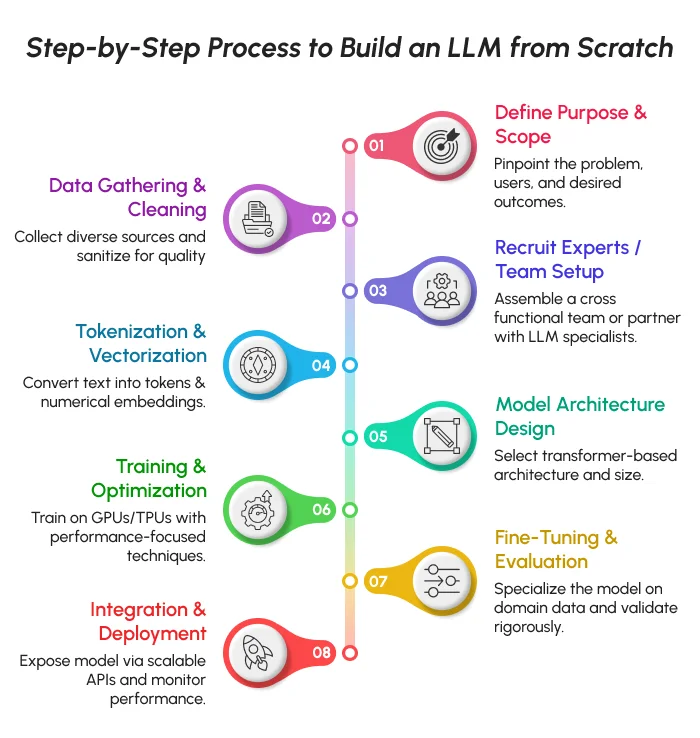
1. Define the Purpose and Scope
Define the problem your model solves and who will use it. For instance, your LLM may be designed to automate customer support, write content, or summarize documents.
Clarifying the scope directs you to the right data, computational resources, and model size. It also keeps complexity under control and ties the project to verifiable business goals. If you are unsure whether you need a custom model at all, an AI consulting engagement can settle the build or fine-tune question before you spend on compute.
2. Data Collection and Preprocessing
An LLM's effectiveness depends on its training data. Start by gathering large datasets from books, articles, websites, and open repositories. Then clean the data through filtering, deduplication, and normalization to remove errors, spam, and biases.
This process trains your LLM to handle syntax, grammar, and context correctly. Combine proprietary data with open-source data: using both increases the model's diversity and its ability to generalize.
How much data do you need? The Chinchilla study from DeepMind found that a compute-efficient model needs about 20 training tokens for every parameter, so a 1 billion parameter model wants roughly 20 billion tokens. Modern open models train far beyond that ratio to get a smaller, cheaper model to serve: Meta trained Llama 3.1 8B on about 15 trillion tokens.
3. Recruit Experts from an LLM Development Company
Creating an LLM is not a one-person job. It takes a coordinated team of AI developers, data scientists, NLP specialists, and cloud engineers. Hiring an established LLM development company gives you access to tried and tested frameworks, optimized pipelines, and best practices.
Experts help you avoid common mistakes, which streamlines training and deployment and delivers a functional AI solution faster and more cost-effectively than learning everything in-house.
4. Tokenization and Vectorization
The model must see text in a machine-readable format before it can learn from it. Tokenization breaks text into smaller units called tokens, usually words or sub-word pieces. Most LLMs train a byte-pair encoding (BPE) tokenizer on their own corpus. Vectorization then turns each token into a numeric embedding.
Once the data is structured this way, the language model can learn the meanings and relationships between tokens during training.
Effective tokenization and embedding methods improve accuracy and reduce training time. High quality in this step makes for better final output.
5. Model Architecture Design
Current LLMs, such as GPT, Llama, and Mistral, are built on the Transformer architecture. It uses an attention mechanism to understand relationships between words, regardless of where they sit in a sentence.
During architecture design, you choose the number of layers, attention heads, hidden size, and therefore the parameter count. You also apply techniques such as residual connections, layer normalization, and dropout to keep training stable and scalable.
6. Training and Optimization
Training, also called pretraining, is the phase where your LLM learns to predict the next token across your whole dataset. During training, you monitor metrics such as training loss, validation loss, and perplexity.
Use performance strategies such as mixed precision training, gradient clipping, and learning rate schedules to make training efficient and reduce resource cost. A useful rule from OpenAI's scaling laws research is that training takes about 6 x parameters x tokens floating point operations (FLOPs). We use this rule in the cost section below to turn a model plan into GPU hours.
7. Model Fine-Tuning and Evaluation
Once you have created the base model, fine-tuning makes it more useful and more specific. Supervised fine-tuning on instruction and chat examples teaches the model to follow requests. Domain-specific datasets adapt it to fields such as finance, healthcare, or education.
Evaluation is an equally important part of building your LLM. Use benchmark datasets and human reviewers to measure accuracy, factual reliability, and contextual relevance. Continuous feedback and retraining cycles keep your LLM accurate, domain-relevant, and as free from bias as possible.
8. Model Integration and Deployment
In the last phase, you integrate the trained model into real-world systems and applications. Serve it through scalable APIs on cloud infrastructure, and plan for latency, uptime, and cost per request. Real-world tests surface issues with the model itself as well as how it performs inside larger applications.
Building an LLM from scratch is a challenging but ultimately transformative process within the limits of your data and computational budget. Once you know how to construct an LLM efficiently, the next step is to improve its behavior, security, and scalability. Let us look at the features you should include for a production-ready custom LLM application.
Key Features to Integrate While Developing Your Custom LLM Application
Creating a custom large language model is not just about training. It also involves integrating features that make the model scalable, secure, and user-centric. Below are the features to build into your LLM application.
1. Contextual Understanding
Enable the LLM to interpret user intent and keep the conversation going by analyzing the context, not just the words.
2. Multilingual Capability
The model communicates in several languages, which makes it usable for international audiences.
3. Prompt Optimization Engine
Refining and adjusting prompts flexibly raises response quality and produces more accurate, relevant outputs.
4. Knowledge Base Integration
This connects your model to internal or external databases so it can supply accurate facts and real-time information. The most common pattern is retrieval-augmented generation, explained in our guide to building a RAG chatbot for enterprise search.
5. Fine-Tuning Interface
This gives developers or admins control over the model, so they can train it on chosen datasets to deepen domain expertise or align its tone.
6. Session Memory & Personalization
The LLM remembers prior conversations, which creates consistent, personalized user experiences.
7. Content Moderation Layer
This layer stops inappropriate or biased content from getting through, which supports safety, compliance, and brand consistency in every response. Pair it with a written AI governance framework so risk owners and human review steps are clear.
8. Monitoring Dashboard
Real-time analytics on performance, accuracy, and user engagement help teams optimize the model effectively.
9. Data Security Framework
Encryption, access controls, and compliance standards (such as GDPR) protect user and training data.
10. API Scalability Support
Your LLM can handle many requests at the same time and stays reliable under heavy traffic.
11. Performance Optimization & Caching
Load balancing and intelligent caching lower latency and speed up responses.
12. Custom UI/UX Components
A smooth user experience is essential for effective LLM interaction. Partnering with expert UI & UX Designers ensures intuitive, responsive interfaces that make every interaction seamless.
These features turn your LLM from a standard language model into a production-ready AI system. Each one adds to the system's flexibility, accuracy, and long-term scalability. Next, we will discuss the most frequent problems in LLM development and the solutions that lead to a smooth, high-ROI result.
Common Challenges in LLM Development and How to Overcome Them
Building a Large Language Model (LLM) from scratch raises technical, ethical, and financial challenges. Address each of them early with clear, actionable steps.
1. High Computing Costs
Training is the most expensive part of building an LLM because it needs large GPU clusters for days or months. To control the cost, rent cloud GPU clusters instead of buying hardware, use spot or committed-use pricing, pick a model size that matches your use case, and test your training pipeline on a small model before the full run.
2. Data Bias & Ethical Risks
Unfiltered or unbalanced datasets lead to biased outputs and misinformation. Use diverse, balanced datasets and practice ethical AI with fairness checks and human-in-the-loop validation.
3. Long Training Cycles
Training large models takes a lot of time and resources. Speed it up with distributed training, parallel processing, and pipeline automation, which improve efficiency and scalability.
4. Model Interpretability
The more complex the architecture, the harder it is to understand how the model reaches a decision. Build transparency with explainability tools and visualization dashboards, which fosters user trust in the technology.
LLM development is resource-intensive, but the right technology stack and expertise handle these challenges effectively. Understanding these barriers early leads to better planning and long-term success. Let us now examine the question every enterprise asks.
How Much Does It Cost to Build an LLM from Scratch?
The cost of building an LLM from scratch depends mostly on two numbers: the model's parameter count and the number of training tokens. Training takes about 6 x parameters x tokens FLOPs. An NVIDIA H100 delivers about 989 teraFLOPS of dense BF16 compute (the spec sheet's 1,979 figure assumes sparsity), and real training runs use only part of that: Meta reported 38% to 43% utilization while training Llama 3. At about 40% utilization, one H100 delivers roughly 400 teraFLOPS, which turns any model plan into GPU hours.
The table below uses that method, plus published figures from real training runs. GPU prices use $2 per H100 hour (the rate DeepSeek assumed in its technical report) and $3.99 per hour (Lambda's on-demand 8-GPU H100 rate on 4 October 2026).
| Model you build | Compute needed | Approximate compute cost |
|---|---|---|
| GPT-2 class learning model (nanochat speedrun) | About 2 hours on one 8x H100 node | About $48 at $3 per GPU-hour |
| 1B parameters on 20B tokens (Chinchilla-optimal) | About 85 H100 hours | $170 to $340 |
| 7B parameters on 140B tokens (Chinchilla-optimal) | About 4,100 H100 hours | $8,000 to $16,000 |
| 7B parameters on 2T tokens (modern recipe) | About 58,000 H100 hours | $117,000 to $233,000 |
| Llama 3.1 8B (about 15T tokens, published) | 1.46 million H100 hours | $2.9 million to $5.8 million |
| DeepSeek-V3, 671B MoE (14.8T tokens, published) | 2.788 million H800 hours | $5.576 million at $2 per hour |
| Llama 3.1 405B (published) | 30.84 million H100 hours | $62 million to $123 million |
The published runs come from Meta's Llama 3.1 model card and the DeepSeek-V3 technical report. The nanochat figure comes from the project's README, whose leaderboard showed GPT-2 level in 1.65 hours by March 2026.
Keep three caveats in mind when you read these numbers:
- They cover the final training run only. Experiments, failed runs, data processing, evaluation, and inference hosting add to the bill. DeepSeek states its $5.576 million figure excludes prior research and ablation work.
- People cost as much as hardware. Epoch AI's study of frontier models found that R&D staff make up 29% to 49% of total development cost, with hardware at 47% to 67% and energy at 2% to 6%.
- Frontier models are in another league. Epoch AI estimates GPT-4's final training run cost about $40 million in amortized hardware and energy, and that frontier training costs have grown about 2.4 times per year since 2016.
Should you pretrain from scratch or fine-tune?
For most businesses, fine-tuning an open-weight model such as Llama, Mistral, or Qwen on your own data gets you a domain-specific LLM for a small fraction of the pretraining cost. Pretraining from scratch makes sense when you need full control of the training data, a language or domain that existing models handle poorly, or a very small model built for one task. Our generative AI development services cover both routes.
If you want an exact cost for your LLM project, contact Pixel Web Solutions' team of experts. We will provide a comprehensive estimate designed around your objectives, project specification, and technical requirements.
Why Choose Pixel Web Solutions for Your LLM Development?
Pixel Web Solutions is a growing Large Language Model Development Company in the industry. Our team of experts is passionate about creating LLM solutions that are robust, reliable, scalable, and efficient. We help companies automate tasks, streamline decision-making, and improve customer service. We blend ingenuity and technical expertise to deliver LLM models that truly understand your data. Whether you need a chatbot, a content generator, or an AI assistant for your company, we build LLM solutions that fit your objectives.
-
Proficient AI and ML engineers with hands-on industry experience
-
Personalized LLMs in line with your business objectives
-
Support for the entire process, from data preparation to implementation
-
Effective development within your budget
-
The newest AI frameworks and cloud infrastructure
-
Rigorous privacy and data protection policies
FAQ: How to Build an LLM from Scratch
1. How do I build an LLM from scratch?
Define the use case, then collect and clean a large text dataset and train a tokenizer on it. Design a Transformer model, pretrain it on GPUs to predict the next token, and fine-tune it on instruction data. Finally, evaluate it with benchmarks and human review and deploy it behind an API.
2. How much does it cost to build an LLM from scratch?
It ranges from under $50 to many millions of dollars, depending on model size and training data. A GPT-2 class learning model trains for about $48 on rented H100s, a 1B parameter model for a few hundred dollars, and an 8B production model like Llama 3.1 8B needed 1.46 million H100 hours, about $3 million to $6 million at current rental rates. Salaries, data, and experiments add to that.
3. Can I build an LLM from scratch on my own?
Yes, at learning scale. Open projects like nanochat and books like Raschka's Build a Large Language Model (From Scratch) let one developer build and train a small GPT-style model in Python and PyTorch. A production-grade model needs a team covering data, training infrastructure, evaluation, and deployment.
4. How much data do you need to train an LLM?
DeepMind's Chinchilla research suggests about 20 tokens per parameter for compute-efficient training, so 20 billion tokens for a 1 billion parameter model. Many modern models train on far more, such as about 15 trillion tokens for Llama 3.1, to get a smaller model that is cheaper to run.
5. How long does it take to build an LLM from scratch?
A small learning model trains in hours. A business project usually takes several months once you include data preparation, training runs, fine-tuning, evaluation, and integration. Large pretraining runs alone can take weeks on thousands of GPUs.
6. Is it better to build an LLM from scratch or fine-tune an existing model?
For most companies, fine-tuning an open-weight model is faster and far cheaper and delivers strong domain performance. Build from scratch only when you need full control over the training data, an unsupported language or domain, or a very small specialized model.