








The cost to create an ERC20 token in 2026 has two very different parts. Deploying the contract on Ethereum costs roughly $0.13 to $4 at September 2026 gas prices, because a typical token uses 0.6 to 2.3 million gas and Ethereum gas stayed under 1 gwei for most of the month. Building the token properly costs far more: Pixel Web Solutions' token development starts at $3,500, custom tokenomics usually take a build into the $5,000 to $15,000 range, and an independent audit adds $2,000 to $10,000 or more.
ERC20 is still the gold standard for fungible tokens on Ethereum because it is simple, adaptable and supported by almost every wallet and exchange. As more startups create ERC20 tokens for fundraising, rewards and governance, myths about their cost have spread just as quickly. Some guides quote gas bills from the 2021 bull market; others bundle marketing and listings into one vague figure.
This guide separates the two. We measured the gas used by real ERC20 deployments on Ethereum mainnet, priced them with live gas and CoinGecko data on 27 September 2026, and then broke down the development, audit, legal and launch costs that make up the real budget.
Key Takeaways
- Deployment is now the cheapest line: a standard OpenZeppelin ERC20 used about 615,000 gas, which cost $0.13 at the month's typical gas price and $1.02 at the 27 September average.
- Development is the real cost: Pixel's standard token development starts at $3,500; custom logic such as taxes, vesting and pause controls moves a token into the $5,000 to $15,000 range.
- Budget an audit separately: Pixel's smart contract audits range from $2,000 to $10,000 or more, depending on code size and complexity.
- Plan for a gas spike, not today's price: at a stress-test price of 50 gwei, the same deployment costs $83 to $310, still small next to development.
- The same bytecode costs the same gas on BNB Smart Chain, so ERC20 vs BEP20 fees differ only because of the gas price and the coin price.
Cost To Create An ERC20 Token: A Rough Estimation
Although the cost of creating an ERC20 token depends on its use case and features, the budget breaks down into clear lines. Here is what each part costs in September 2026.
| Cost component | Typical cost | What decides it |
|---|---|---|
| Standard ERC20 development (mint, burn, transfer, ownership) | From $3,500 with Pixel Web Solutions | Features, testing depth, documentation |
| Custom tokenomics (taxes, vesting, anti-whale, pause, blacklist) | $5,000 to $15,000 (custom range) | Number and complexity of rules |
| Advanced token (staking, governance, cross-chain) | $15,000 to $50,000 (custom range) | Extra contracts and audit scope |
| Smart contract audit | $2,000 to $10,000+ | Lines of code, number of contracts |
| Mainnet deployment gas | $0.13 to $4 at September 2026 prices | Contract size, gas price, ETH price |
| Uniswap pool creation gas | About $0.59 to $4.50, plus your liquidity capital | Gas price; the liquidity itself is capital, not a fee |
| Legal review | Quoted per jurisdiction | Whether and where you sell the token |
| Marketing and exchange listings | Variable | Launch goals and target exchanges |
The development and audit lines are where most of the money goes. Pixel Web Solutions quotes a fixed price for each after reviewing your token specification, so you know the build cost before any code is written.
When developing an ERC20 token, you also need to know how the network fee works, because it is the one line that changes every 12 seconds.
What Does It Cost to Deploy an ERC20 Token on Ethereum?
Deployment is the one-time transaction that puts your token contract on Ethereum mainnet. Its cost follows a simple formula set by Ethereum's fee market:
Deployment fee = gas used × (base fee + priority fee) × ETH price
- Gas used depends on the size of your compiled contract. More features mean more bytecode and more gas.
- Base fee is set by the network for each block and burned. It rises when blocks are full and falls when they are not.
- Priority fee (the tip) goes to the validator. On 27 September 2026, Etherscan's gas tracker showed a fast tip of just 0.01 gwei.
How Much Gas Does an ERC20 Contract Use?
Instead of guessing, we read the receipts of real, verified ERC20 deployments built on OpenZeppelin contracts, the most widely used audited ERC20 library.
| Token build (OpenZeppelin, optimiser on) | Gas used at deployment | Example deployment |
|---|---|---|
| Basic ERC20 (name, symbol, fixed supply) | 614,722 | Etherscan |
| ERC20 + Burnable + Pausable + Ownable | 801,341 | Etherscan |
| ERC20 + Permit (gasless approvals) | 920,389 | Etherscan |
| ERC20 + Burnable + Pausable + Ownable + Permit + AccessControl | 2,307,412 | Etherscan |
Gas used is read from each transaction receipt on Ethereum mainnet. Exact gas varies slightly with constructor arguments and compiler version.
What That Costs at Today's Gas Prices: A Worked Example
Gas prices move constantly, so we priced each build at four levels. ETH is taken at $2,688.95 from CoinGecko on 27 September 2026.
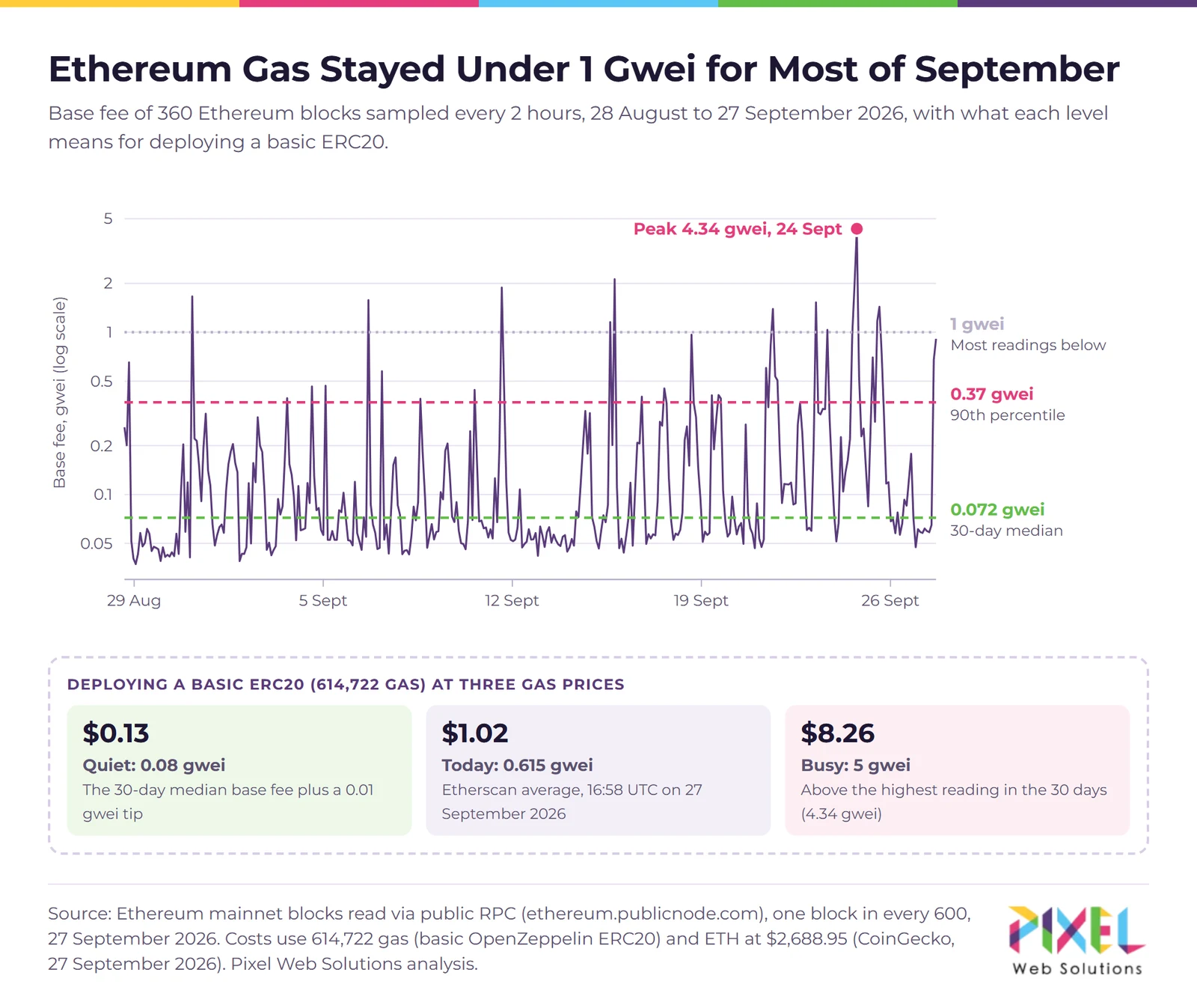
- Quiet (0.08 gwei): the median base fee across 360 blocks sampled every two hours from 28 August to 27 September 2026, plus a 0.01 gwei tip.
- Today (0.615 gwei): Etherscan's average gas price at 16:58 UTC on 27 September 2026.
- Busy (5 gwei): above the highest reading in our 30-day sample (4.34 gwei).
- Stress test (50 gwei): a congestion level for worst-case budgeting, not a forecast.
| Token build | Quiet (0.08 gwei) | Today (0.615 gwei) | Busy (5 gwei) | Stress test (50 gwei) |
|---|---|---|---|---|
| Basic ERC20 | $0.13 | $1.02 | $8.26 | $82.65 |
| Burnable + Pausable + Ownable | $0.17 | $1.33 | $10.77 | $107.74 |
| ERC20 + Permit | $0.20 | $1.52 | $12.37 | $123.74 |
| Full-featured (5 extensions) | $0.50 | $3.82 | $31.02 | $310.23 |
The maths for the full-featured token today: 2,307,412 gas × 0.615 gwei = 1,419,058 gwei, or 0.001419 ETH. At $2,688.95 per ETH, that is $3.82.
In other words, the network fee is no longer a reason to avoid Ethereum. For comparison, the same Etherscan snapshot priced a token swap at about $0.58.
Why the Compiler Optimiser Matters
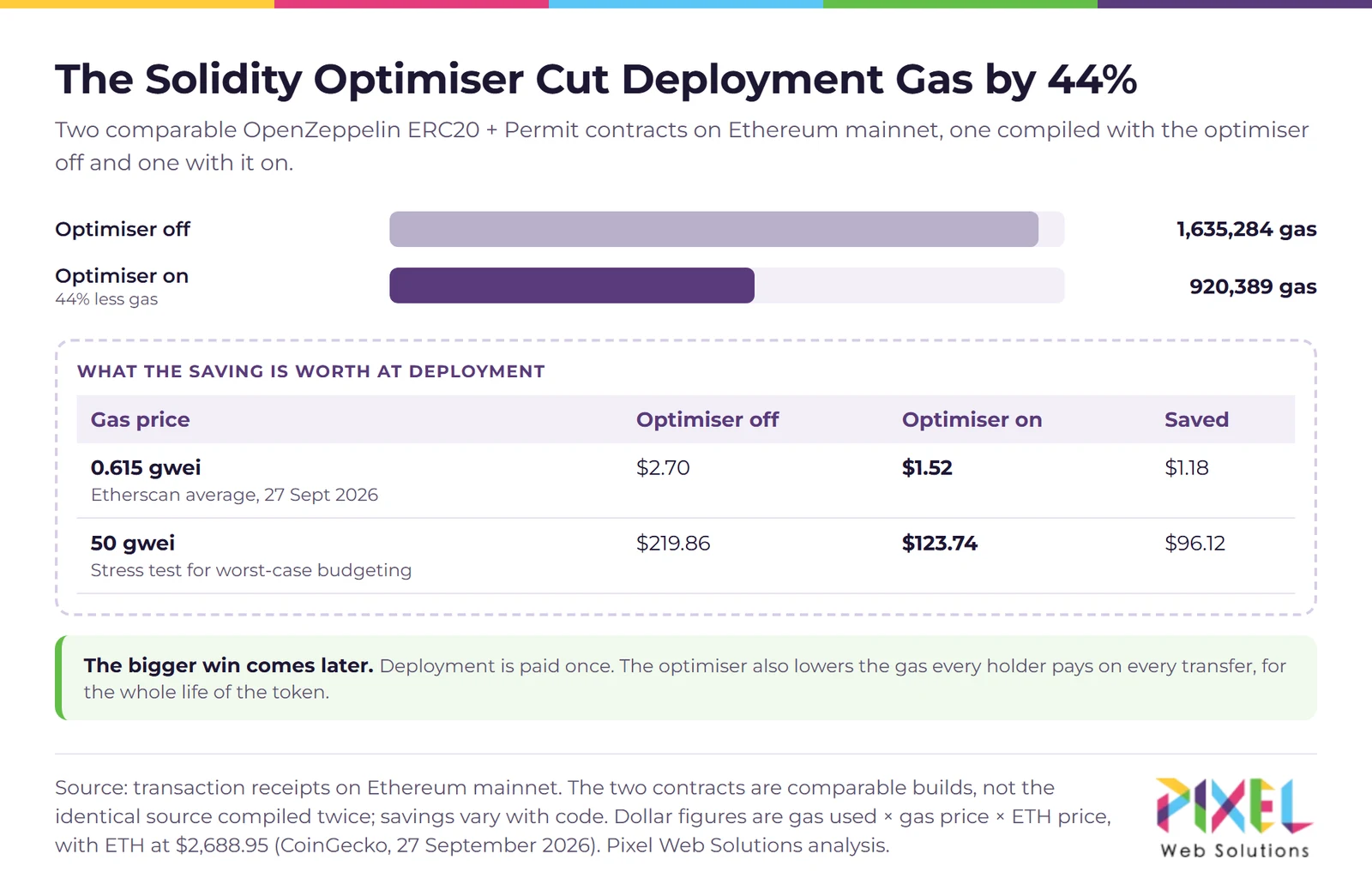
The Solidity compiler has an optimiser that shrinks bytecode and cuts deployment gas. Remix and some tutorials leave it off by default. In our sample, a comparable ERC20 + Permit contract used 1,635,284 gas without the optimiser and 920,389 gas with it, a 44% saving. The optimiser also lowers the gas your holders pay on every transfer, which matters far more over the token's life than the one-off deployment.
ERC20 vs BEP20 Fees: Same Gas, Different Price
BNB Smart Chain runs the same Ethereum Virtual Machine, so an identical contract uses the same gas on both networks. We asked public nodes on both chains to estimate the deployment of the full-featured token above: both returned 2,326,892 gas. The difference in cost comes only from the gas price and the coin price.
On 27 September 2026, BNB Smart Chain gas was 0.05 gwei and BNB traded at $773.82, so the same deployment cost about $0.09, against $3.82 on Ethereum at that day's average. Our guide to the cost to create a BEP20 token covers that network in detail.
Cheaper gas does not make BNB Smart Chain the right choice for every project. Ethereum still holds the largest DeFi liquidity and institutional user base, which is why many teams pay a few dollars more to launch there. Compare the options in our guide to the best blockchains to create crypto tokens.
Challenging Factors Of ERC20 Token Development Cost
Creating an ERC20 token can be a game-changer for startups that want to raise funds or build a token economy. These are the factors that decide where your build lands within its range.
Development Method
The first cost decision is who builds the token. There are four routes:
- No-code token generators charge a service fee on top of gas. For example, SmartContracts Tools lists templates from 0 ETH to 0.2 ETH. They suit simple tokens but offer no custom logic, audit or launch support.
- Freelance developers usually cost less upfront, but quality, testing and accountability vary widely.
- A crypto token development company costs more than a generator but delivers tested, documented code, deployment support and a clear owner if something goes wrong. Pixel's token development starts at $3,500.
- An in-house team makes sense only if the token is part of a long-term protocol you will keep developing.
ERC20 Token Customizations
Crypto tokens serve many purposes, including crowdfunding, community building, access rights and payments. Each purpose needs its own features, and each feature adds code, tests and audit time. A token with transfer taxes, vesting schedules and anti-whale limits can take several times longer to build and review than a plain ERC20.
Quality Assurance
Rigorous testing is an integral part of creating an ERC20 token. Unit tests, fuzz tests and a full rehearsal on the Sepolia testnet catch bugs before they become permanent on mainnet. The cost of testing depends on the tools, the testing methods and whether professional auditors are involved.
Legal & Regulatory Compliance
If you sell your token to the public, the law decides how you can do it. In the US, the SEC and CFTC issued a joint interpretation on 17 March 2026 that sorts crypto assets into five categories: digital commodities, digital collectibles, digital tools, stablecoins and digital securities. A token that is not itself a security can still be sold as part of an investment contract if the issuer promises the managerial efforts buyers rely on for profit.
In the EU, most public offers of crypto-assets need a MiCA white paper notified to the regulator at least 20 working days before publication. Our comparison of utility tokens vs security tokens explains how these rules apply to different token types. Legal advice is quoted per jurisdiction, so budget for it from day one.
Blockchain Network Fees
ERC20 tokens run on Ethereum, so every deployment and transaction pays gas. As the worked example above shows, deployment is now a small line: under $4 at the 27 September average and about $310 even at a 50 gwei stress level for a full-featured contract. Features such as minting, staking or automated rewards add gas to each call your users make, so efficient code matters more to your holders than to your launch budget.
Custom Standard Functionality
The ERC20 standard defines the basic functions: transfer, balanceOf, approve, transferFrom and allowance. Extras such as minting, burning, pausing, permit signatures and taxes sit on top of the standard. Each extra must be coded, tested and audited, which is why feature choices drive the cost of creating an ERC20 token more than the network does.
These are the usual factors that determine the cost of creating an ERC20 token. Whether you are launching a utility token, a governance token or a security token, smart choices here save more money than any gas trick.
Hidden Costs After Your ERC20 Token Is Deployed
The contract is only the first step. These costs appear after deployment and catch many founders off guard:
- Liquidity capital: creating a Uniswap V2 pool and adding the first liquidity used about 2.72 million gas in transactions we sampled on 27 September 2026, about $4.50 at that day's average gas price. The ETH and tokens you deposit are capital at risk, not a fee, and they are often one of the largest launch costs.
- Contract verification: publishing your source code on Etherscan is free and builds trust with buyers.
- Multi-signature control: moving ownership and treasury to a multisig wallet costs a few small transactions but protects holders from a single compromised key.
- Data aggregators and exchanges: applying to data sites such as CoinGecko follows their own listing criteria, while centralized exchange listing terms are negotiated privately and are not published.
- Ongoing work: monitoring, community management and upgrades continue after launch.
Effective Ways To Cut Down ERC20 Token Development Cost
With proper planning and market analysis, you can reduce the ERC20 token development cost without cutting corners on security.
Minimal Feature Integration
The ERC20 standard already covers the essentials, so only add features your token genuinely needs. Fewer features mean less code, fewer tests and a shorter audit. They also mean lower gas for every holder on every transfer.
Start From Audited Templates
Build on audited libraries such as OpenZeppelin instead of writing token logic from scratch. The free OpenZeppelin Wizard generates a standard starting point, and your developer adds only the custom parts.
Conduct In-House Testing
In-house testing on a local network and the Sepolia testnet finds token malfunctions and vulnerabilities early, when they are cheap to fix. Sepolia is the testnet ethereum.org recommends for application development; Goerli is deprecated and should no longer be used.
Utilization Of Tools
Modern tools make testing faster and cheaper. Hardhat and Foundry are today's standard frameworks for compiling, testing and deploying ERC20 contracts. Truffle and Ganache, often recommended in older guides, were sunset by Consensys on 20 December 2023 and remain only as archives.
Turn On the Optimiser and Pick Your Moment
Compile with the optimiser enabled and deploy when gas is low. Our 30-day sample shows base fees below 0.1 gwei for most of the month, with short spikes above 1 gwei.
Approach an ERC20 Token Development Company
As mentioned earlier, the cost to create an ERC20 token depends mainly on the development method. Hiring a single developer may look affordable, but even experienced freelancers make mistakes that are expensive to fix once a contract is live.
A token development company brings developers, testers and auditors under one roof, so the ERC20 token can be created cost-effectively and launched with fewer surprises. If you are looking for a team to create ERC20 tokens, Pixel Web Solutions is ready to help.
ERC20 Token vs New Blockchain Coin: Which Costs More?
Some founders compare the cost to create an ERC20 token with launching a coin on a new blockchain. The two are very different projects:
- An ERC20 token runs on Ethereum's existing network and security. You pay for the contract, testing, audit and a few dollars of gas.
- A new blockchain coin needs its own network, validators, wallets and explorers. Pixel's cryptocurrency development ranges from $5,000 for a simple fork to $50,000 or more for a customized network, and fully custom chains cost more again, as our guide to the cost to develop a blockchain explains.
For most businesses, a token is the faster and cheaper route. A new chain only makes sense when you need control over consensus, fees or validators.
Pixel Web Solutions: Your Reliable Partner For Ethereum Token Development
Pixel Web Solutions is your go-to Ethereum token development company for pixel-perfect ERC20 tokens. Our token development team focuses on security, clean code and a smooth launch, at a price that fits a startup budget. We build on audited OpenZeppelin foundations, compile with the optimiser on, test on Sepolia and deploy when gas is low.
Along with ERC20 tokens, we create other token standards on BNB Smart Chain, Polygon, Tron and Solana. We combine technical depth with a client-first approach, so every feature matches your vision and business goals.
Contact our team to get a fixed quote for your ERC20 token.
Frequently Asked Questions
Still stuck with queries? Here are the answers.
How Much Does It Cost To Create An ERC20 Token?
With Pixel Web Solutions, a standard ERC20 token starts at $3,500. Tokens with custom tokenomics usually cost $5,000 to $15,000, and advanced tokens with staking or governance cost $15,000 to $50,000. Add an audit ($2,000 to $10,000 or more) and a few dollars of gas.
How Much Does It Cost To Deploy An ERC20 Token On Ethereum In 2026?
On 27 September 2026, deploying a standard OpenZeppelin ERC20 cost about $1.02 at Etherscan's average gas price of 0.615 gwei, and a full-featured token about $3.82. During the quietest periods of September 2026 the same deployments cost $0.13 to $0.50.
Is It Necessary To Impose An ERC20 Token Smart Contract Audit And How Much Does It Cost?
An audit is not legally required, but it is essential if your token will hold value or be sold to the public. Buyers, launchpads and exchanges increasingly expect an audit report. Pixel's smart contract audits range from $2,000 to $10,000 or more, depending on the code's size and complexity. See our smart contract audit services for details.
Do Additional Features Increase The Overall Cost Of Creating An ERC20 Token?
Yes. Features such as staking, minting, governance and taxes need more code, more testing and a longer audit. They also increase deployment gas: in our sample, a full-featured contract used 2.3 million gas against about 615,000 for a basic token.
Can I Create An ERC20 Token For Free?
Not entirely. Some no-code generators offer a free basic template, but you still pay the network's gas fee to deploy. You also give up custom logic, an audit and launch support.
What Is The Difference Between ERC20 And BEP20 Fees?
The same contract uses the same gas on both chains. On 27 September 2026, a full-featured token cost about $3.82 to deploy on Ethereum and about $0.09 on BNB Smart Chain, because BNB Smart Chain gas was 0.05 gwei.
How To Create An ERC20 Token?
You can create an ERC20 token step by step: define the purpose and tokenomics, write the contract on an audited template, test it on Sepolia, audit it and deploy it to mainnet. Pixel's step-by-step ERC20 creation guide walks through each stage, and our ERC20 tokens list shows how leading projects use the standard.
In short, the cost to create an ERC20 token in 2026 is driven by development, audit and launch planning, not by gas. Plan those lines carefully, and the network fee becomes the smallest number in your budget.
Disclaimer: The cost figures shared in this blog are intended solely for informational purposes and do not reflect an official quote from Pixel Web Solutions. Network fees are measured at the date shown and change constantly. Actual pricing will vary based on your project's specific requirements and the services you choose. For a precise and customized quotation, we encourage you to connect with our business team directly.