Table of Contents
“Land is one of the world’s most valuable assets, but its ownership and investment processes remain largely illiquid, complex, and inaccessible. Land tokenization is changing that by bringing ownership rights onto the blockchain.”
According to Grand View Research, the global asset tokenization market was valued at approximately USD 2.81 billion in 2023 and is expected to grow at a remarkable CAGR of 19.0% from 2024 to 2030. This growth reflects the increasing adoption of blockchain technology across industries and the rising demand for digitized ownership of real-world assets.
Among all real-world assets, land tokenization has turned out to be the groundbreaking trend that is turning the land ownership rights into digital tokens running on blockchain. By enabling fractional ownership, enhanced transparency, improved liquidity, and global investor access, blockchain is addressing many of the challenges associated with traditional land transactions.
With digital transformation taking over the real estate industry, land tokenization creates new opportunities for property owners, investors, and enterprises. This blog covers the concept of land tokenization, its benefits, use cases, development process, and the rising demand for land tokenization platform development.
What is Land Tokenization, and How Does It Work?
Land tokenization is the process of converting ownership rights of a land asset into digital tokens on a blockchain network. These digital tokens can represent entire or fractional ownership of a piece of land, and can allow for a diversified set of owners to collectively own a plot of land. Land tokenization utilizes smart contracts and blockchain technology, which leads to enhanced transparency, security, liquidity, accessibility, and ease of buying, selling, and managing land.
Working Process of Land Tokenization
1. Land Asset Identification and Evaluation
The land selected for tokenization is identified and assessed to determine its market value, ownership status, and investment potential. This ensures that the asset is suitable for tokenization.
2. Legal Verification and Compliance
All legal documents, ownership records, and regulatory requirements are verified to establish clear ownership and ensure compliance with local laws and regulations.
3. Asset Structuring
The land asset is organized within a tokenization model that defines how ownership is represented and the number of digital tokens issued for the asset.
4. Smart Contract Development
A smart contract is developed to handle the transfer of ownership, investor rights, revenue share, etc., in a secure way on the blockchain network.
5. Token Creation and Issuance
Digital tokens representing ownership of the land are minted on the blockchain and made available to investors through a tokenization platform.
6. Investor Participation
Investors are allowed to buy tokens on the platform in order to gain partial or whole ownership in a piece of land without purchasing the entire land mass.
7. Secondary Trading and Transfer of Ownership
Tokens are traded on a secondary market, and Ownership is transferred accordingly, increasing the liquidity in typically illiquid assets like land.
Why is Land Tokenization Gaining Popularity?
Land tokenization is becoming more popular as investors and property owners look for efficient methods to buy, sell, and manage land assets. By combining blockchain technology with real estate ownership, tokenization addresses many limitations of traditional land investments while creating new opportunities for global participation and wealth creation.
1. Fractional Ownership Opportunities
Traditionally, investing in land requires substantial capital, making it inaccessible to many investors. Through tokenization divides a property into several digital tokens, enabling investors to buy only the portion they can afford.
2. Increased Liquidity
Land is viewed as a non-liquid asset and can often take weeks or months to sell. Land tokenization can greatly increase liquidity because owners can now trade their fractions of the land at a faster rate than is possible when selling an entire piece of property.
3. Improved Transparency and Security
All transactions are recorded and transparent on the blockchain, thus eliminating many possibilities of fraud, disputes, or forgery of documents, and providing confidence in the ownership.
4. Global Investor Accessibility
The tokenized land can be available to investors around the world through digital platforms. This will enable the removal of geographical constraints and allow property owners to approach a wider group of investors than traditionally possible.
5. Faster and Cost-effective Transaction
Traditional land transactions are often complicated and involve multiple intermediaries, tedious paperwork, and high operational costs, but smart contracts can automate many such processes, thereby reducing transaction time and operating costs.
The rise of blockchain-powered real-world asset tokenization is reshaping the investment landscape, and land tokenization is emerging as a high-potential opportunity. Since land is a tangible asset with inherent value and consistent demand, it offers strong long-term growth potential. As a result, land tokens are gaining traction as a promising investment option in the growing tokenized economy.
Ready to Turn Your Land into a Tokenized Investment Opportunity?
Turn your land into a valuable digital asset with our end-to-end land tokenization services.
Use Cases of Land Tokenization
Land Tokenization is changing how land assets are owned, invested in, and managed across a variety of industries. Land tokenization is creating new investment opportunities for investors, landowners, businesses, and governments around the world.
1. Agricultural Land Investments
Farmers can tokenize farmland and offer fractions to investors. Capital can be raised for agricultural operations, and investors can participate in the appreciation of the land and agricultural income.
2. Residential Land Development
Residential land parcels can be tokenized for the financing of new residential projects. This can enable investors to invest in real estate without needing to purchase full properties.
3. Commercial Real Estate Projects
Tokenization of commercial land intended for office buildings, retail spaces, and mixed-use developments can enable the financing of new commercial developments and open these investment opportunities to a larger set of investors.
4. Industrial Land Ownership
Tokenization of land for industrial parks, manufacturing sites, and logistics centers can enable the capitalization of development funding from institutional and retail investors for shared ownership of such sites.
5. Government and Public Land
Certain public land parcels can be tokenized to enhance transparency, management efficiency, and stimulate private investment for infrastructure development.
6. Cross-Border Land Investments
Land tokenization is providing a means of investment into a greater variety of jurisdictions than before. Fractional interests in land assets in other countries can be secured via these tokenized land investments through secure platforms based on blockchain technology.
Overall, land tokenization is being implemented as a diverse technology with applications in many diverse industries. As blockchain adoption continues to grow, the range of use cases for tokenized land assets is expected to expand further, creating a more accessible, transparent, and efficient land investment ecosystem.
Popular Land Tokenization Platforms
The rise of land and real estate tokenization platforms, fueled by blockchain technology, allows for fractional ownership and increased investment accessibility. This trend enables investors to enter property markets with minimal capital and enhances asset management and transfer efficiency.
1. RealT
One of the well-known real estate tokenization platforms is RealT. It provides a method where investors can own fractional stakes in real estate assets like income-generating properties through tokens. RealT is trying to improve access and liquidity to real estate investment.
2. Lofty
Lofty enables investors to own fractional shares of rental properties through tokenized assets. With a built-in secondary marketplace and low investment entry barriers, the platform aims to simplify property investment and improve liquidity.
3. Propy
Propy focuses on digitizing and streamlining real estate transactions using blockchain technology. The platform facilitates property purchases, ownership transfers, and title management while reducing paperwork and transaction complexities.
4. Landshare
Landshare has been known for combining real estate tokenization and DeFi to enable investors to invest in tokenized property and earn yields on their holdings. It appeals to retail investors and stresses transparency.
5. DigiShares
DigiShares offers infrastructure to tokenize land and real estate assets with tools in place for tokenization of the asset, onboarding of investors, compliance, and trading through a secondary market.
The success of these platforms highlights the rising demand for tokenized land and real estate investments. With the market expanding, entrepreneurs have a prime opportunity to create land tokenization platforms, offering innovative investment solutions in the growing Real-World Asset (RWA) tokenization market.
How to Develop a Land Tokenization Platform?
Developing a land tokenization platform involves a combination of legal, technical, financial, and blockchain-related processes. To make the platform run smoothly and stay compliant, we need to follow several important steps. First, we verify land ownership. Then, we create a secure marketplace. Each of these steps helps provide a seamless experience for both investors and asset owners.
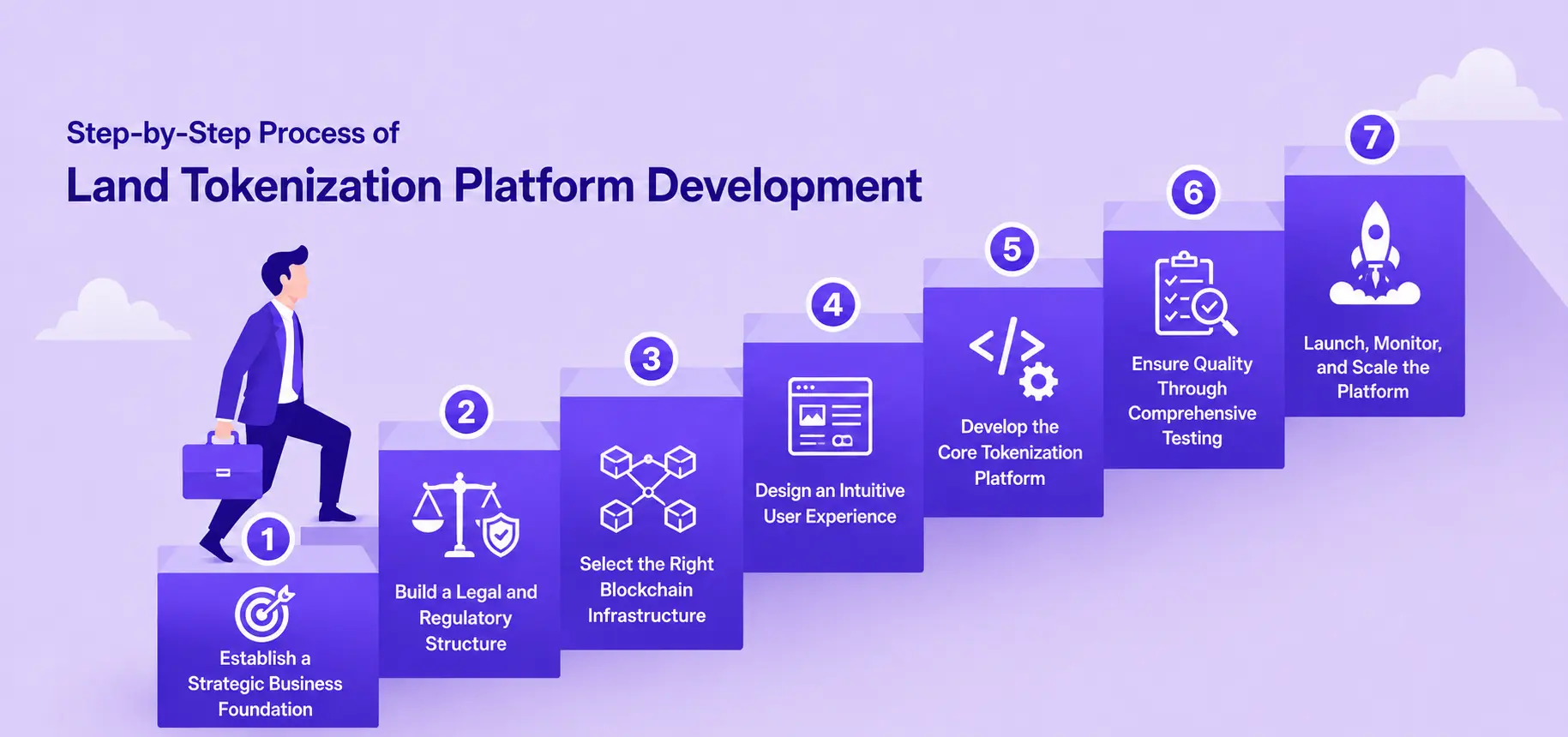
Step 1 – Establish a Strategic Business Foundation
The development process begins with defining the platform’s business model, target audience, and revenue streams. Businesses must determine the type of land assets to tokenize, identify investment opportunities, and establish a clear roadmap. Proper planning helps align the platform’s features, goals, and long-term growth strategy with market demands.
Step 2 – Build a Compliant Legal and Regulatory Structure
A strong legal framework is essential to ensure compliance with property laws, securities regulations, and KYC/AML requirements. Businesses must work with legal experts to define ownership structures, investor rights, and regulatory obligations. Establishing legal clarity helps build trust among investors and minimizes potential legal and compliance risks.
Step 3 – Select the Right Blockchain Infrastructure
Choosing the right blockchain network is crucial for the platform’s performance, scalability, and security. Factors such as transaction speed, gas fees, smart contract capabilities, and interoperability should be evaluated. Selecting a suitable blockchain ensures efficient token issuance, secure transactions, and seamless management of tokenized land assets.
Step 4 – Design an Intuitive User Experience
An intuitive and user-friendly interface is vital for attracting and retaining users. The platform’s UI/UX should provide seamless navigation, easy asset exploration, secure investor onboarding, and efficient portfolio management. A well-designed user experience simplifies complex blockchain processes and enhances overall engagement for both property owners and investors.
Step 5 – Develop the Core Tokenization Platform
This stage involves developing the core functionalities of the platform, including smart contracts, asset tokenization modules, investor dashboards, wallet integration, and marketplace features. Developers build the front-end and back-end infrastructure while ensuring security, scalability, and smooth interaction between users and blockchain-powered tokenization services.
Step 6 – Ensure Quality Through Comprehensive Testing
Before deployment, the platform undergoes extensive testing to identify and resolve technical issues. Functional testing, smart contract audits, security assessments, performance evaluations, and user acceptance testing are conducted. Thorough testing ensures the platform operates reliably, protects user assets, and delivers a secure investment experience.
Step 7 – Launch, Monitor, and Scale the Platform
Once testing is completed successfully, the platform is deployed and made available to users. Post-launch support includes system monitoring, regular maintenance, security updates, bug fixes, and feature enhancements. Continuous support helps maintain platform performance, ensures regulatory compliance, and provides users with a seamless investment experience.
Creating a land tokenization platform would require expertise in blockchain technology, smart contracts, legal compliance, security, and real estate asset management. Managing all these processes independently can be time-consuming and complex.
A more efficient approach is to partner with a trusted Real Estate Tokenization Platform Development Company that specializes in transforming real-world property assets into blockchain -based investment opportunities. They can handle the entire development lifecycle and help you launch a secure, scalable, and market-ready land tokenization platform.
Key Features to Integrate into a Land Tokenization Platform
A secure and operational tokenization platform for lands should include essential features that ensure security, transparency, and regulatory compliance. These components are vital for simplifying asset tokenization, managing investors, facilitating token trading, and overall platform operations.
- User Registration and Authentication – For Secured account creation and Login facility so that the platform is secure from intrusion.
- KYC/AML Verification – To check on users, so that the platform is free from fraudulent activity.
- Land Asset Management – A centralized dashboard from which the admin can access and manage the land listings, ownership records, asset documents, and values.
- Token Creation Module – To create and manage the digital tokens representing complete or fractional ownership of land assets.
- Smart Contract Integration – To automate the transactions, ownership transfer, and revenue distribution among the investors, the smart contracts play a vital role.
- Fractional Ownership Management – This feature would enable the division of the land assets into many ownership shares, allowing an investor to acquire a fractional ownership of the asset.
- Investor Dashboard – An exclusive dashboard that can track the investor’s portfolio and the performance of the assets.
- Digital Wallet Integration – To support and provide safe storage, receipt, transfer, and management of the tokenized land asset through digital wallets.
- Secondary Marketplace – The investors can sell and buy land tokens from each other over the platform, thereby improving liquidity and creating sustained investment.
- Payment Gateway Integration – To have a simple and secure gateway providing seamless payment facility through various methods such as fiat, cryptocurrency, and digital payments.
- Compliance Management – To monitor all the regulatory needs and maintain compliance across the various jurisdictions in a well-managed way.
- Analytics and Reporting Dashboard – The platform would require a dynamic reporting dashboard and real-time insights into asset performance, investor activity, and trends.
These features are necessary to build a secure and investment-friendly platform for tokenizing lands in the most scalable ways. By integrating the right functionalities, businesses can create a seamless ecosystem that simplifies land ownership, attracts global investors, and supports the growing demand for tokenized real-world assets.
Tech Stack Used to Develop a Land Tokenization Platform
Developing a land tokenization platform needs blockchain, frontend, backend, security, and cloud technology. An appropriate technology stack will help make asset tokenization more secure, the user interface more user-friendly, support compliance, and the scalability needed to support a growing investor base.
Blockchain Network – Ethereum, Polygon, BNB Chain, Avalanche
These blockchain networks will provide the necessary infrastructure to create, manage, and transact tokens associated with land assets. It adds security, transparency, and immutability to land-asset tokens.
Smart Contract Development – Solidity, Rust
This will automate token issuance, ownership, transfer, compliance, and revenue distribution, eliminating the need for intermediaries and manual management.
Frontend Development – React.js, Angular, Vue.js
These are used to develop a responsive, easy-to-use interface for investors, administrators, and asset owners interacting with the land tokenization platform.
Backend Development – Node.js, Python, Java, .NET
This handles business logic, API, user authentication, managing transactions, and managing communication between the application layer and the blockchain.
Database Management – PostgreSQL, MySQL, MongoDB
These can store information about users, transactions, assets, compliance documentation, and the platform.
Identity Verification Tools – Jumio, Onfido, Trulioo
This allows for KYC/AML verification, thus protecting the platform and stakeholders from illegal or fraudulent activities.
Cloud Infrastructure – AWS, Google Cloud, Microsoft Azure
This makes the platform scalable, reliable, and accessible. The use of cloud also provides other benefits, such as data backup and disaster recovery.
A well-designed technology stack is essential for building a secure, scalable, and high-performing land tokenization platform.
Cost to Create a Land Tokenization Platform
The cost of developing a land tokenization platform depends upon many factors, which include scale and scope of the project, technical features of the platform, compliance-related factors, and customization needs. And the other major factors are…
- Scale and Complexity of Platform – It depends upon the number of features required and their complexity, including fractional ownership, investor management, etc.
- Blockchain Selection – The decision of which blockchain network to use can also affect the price of the development, as all networks have varied infrastructure and transaction requirements.
- Smart Contracts – Developing and auditing smart contracts requires specialized expertise, contributing significantly to project costs.
- Security and compliance – With KYC/AML implementations and robust data protection and compliance, the security and legality of the platform are guaranteed.
- Third-party integrations – The number and type of integrations, like payment gateways and analytics tools, can impact the overall development budget.
Overall, the cost to build a land tokenization platform relies on multiple technical and compliance-related factors involved in the project, and businesses require a careful analysis of their requirement before determining a budget.
Want to Know the Exact Cost of Developing a Land Tokenization Platform?
Connect with our blockchain specialists for a free consultation and receive a customized quote tailored to your project requirements and business objectives.
Challenges in Developing a Land Tokenization Platform
Despite its many advantages, creating a reliable and compliant land tokenization platform has its challenges. Developers will have to deal with legal and regulatory frameworks, technical specifications, and security matters, while providing investors and asset holders with a user-friendly and comfortable service.
- Regulatory Requirements – Land ownership regulations vary depending on location and region, complicating compliance with real estate laws, securities, and KYC/AML rules.
- Verification of ownership – Verification of land titles and legal documents before tokenization is important to prevent compliance issues and conflicts.
- Smart Contract Security – Vulnerabilities in smart contracts can pose security risks, so thorough auditing and testing are essential.
- Liquidity Management – It may be difficult, especially at first, to set up a liquid market to sell tokenized land assets, and investor contribution is required for the market to expand.
- User Acceptance – Most potential investors are unaware of blockchain technology’s use in real estate investing; hence, trust must be built through clear explanation and knowledge.
Although these challenges can impact the development process, they can be effectively addressed with the right expertise and technology strategy. Therefore, businesses looking to launch a secure, scalable, and compliant platform can partner with a prominent land tokenization platform development company with proven experience in blockchain and RWA tokenization solutions.
Launch Your Land Tokenization Platform with Pixel Web Solutions
Pixel Web Solutions is a prominent RWA Tokenization Platform development company. We provide a tailored land tokenization platform for startups, real estate firms, investment companies, and entrepreneurs. We help businesses convert physical land assets into blockchain-based digital tokens through secure, scalable, and innovative solutions. With extensive expertise in blockchain technology, smart contracts, and real-world asset (RWA) tokenization, our team delivers end-to-end development services that enable businesses to launch a reliable and future-ready land tokenization platform.
- 24/7 Technical Support
- Experienced Blockchain Experts
- Customized Development Solutions
- Enterprise-Grade Security
- End-to-End Development Services
- Regulatory Compliance Assistance
Ready to Bring Land Assets on the Blockchain?
Partner with Pixel Web Solutions to build a secure land tokenization platform with smart contracts, compliance tools, and investor management features.
Frequently Asked Questions
1. How long would it take to build a land tokenization platform?
The time taken to build a land tokenization platform would depend on factors such as the complexity, functionalities, integrations with blockchains, and legal/regulatory needs. Generally speaking, it would take roughly 8 to 24 weeks to develop and launch an effective platform.
2. Which blockchain platforms are best for land tokenization?
The best blockchains for land tokenization include Ethereum, Polygon, BNB Chain, and Avalanche. The choice of a specific platform depends on transaction costs, scalability, the importance of security, business goals, and other factors.
3. Can land tokenization enable fractional ownership?
Yes, land tokenization allows a property to be divided into multiple digital tokens, with each token representing a share of ownership. This enables investors to purchase fractions of a land asset instead of buying the entire property.
4. Is land tokenization legally regulated?
Land tokenization can be legally compliant with all local property laws, securities rules, and the necessities of KYC and AML regulations when the land tokenization system is properly developed. Businesses should work with legal and blockchain experts to ensure regulatory adherence.
5. Can tokenized land assets be traded after purchase?
Yes, tokenized land assets can be traded on a secondary marketplace integrated into the platform. This improves liquidity and allows investors to buy or sell their ownership shares more efficiently than traditional land transactions.