








Real estate tokenization platform development is the process of building blockchain software that turns property ownership into digital tokens, then handles investor KYC/AML, token sales, rental distributions and secondary trading. In 2026, a white-label real estate tokenization platform MVP costs $25,000 to $50,000 and takes 8 to 12 weeks, while a custom platform built from scratch costs $100,000 to $150,000+ and takes 16 to 24 weeks.
The real estate industry is experiencing a significant transformation due to the tokenization of assets powered by blockchain technology. Real estate tokenization solutions allow property owners to turn real-world property assets into digital tokens that investors can own through their fractional ownership without needing large sums of money.
The process ensures high levels of liquidity, transparency, accessibility, and investment potential for global players. With a growing interest in RWA tokenization services, startups and entrepreneurs have a significant opportunity to launch innovative real estate tokenization platforms and tap into this rapidly expanding market.
With extensive expertise in blockchain and asset tokenization, Pixel Web Solutions delivers customized real estate tokenization solutions designed to enhance liquidity, enable fractional ownership, and create new fundraising opportunities.
Key Takeaways
- A real estate tokenization platform is more than a token: it combines property onboarding, smart contracts, investor KYC/AML, payments, dashboards and often a secondary market.
- Budget by build type: a white-label MVP costs $25,000 to $50,000, an advanced build $50,000 to $100,000 and a custom platform $100,000 to $150,000+, before legal and licensing costs.
- Property tokens are usually securities: in the US they are typically offered under Regulation D or Regulation A, and in the EU they fall under existing securities law rather than MiCA.
- White-label is the fastest route to market, while a custom tokenization platform suits firms with unusual asset structures, jurisdictions or investor flows.
- Choose a development company on compliance and smart contract experience, not only on price.
What is Real Estate Tokenization Platform Development?
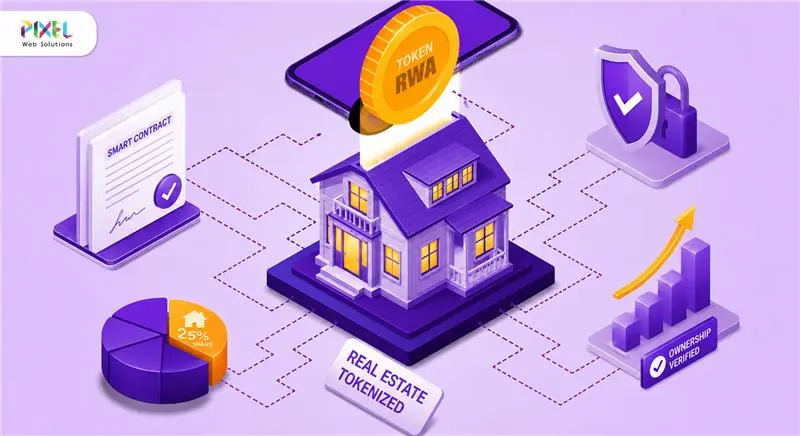
Real Estate tokenization platform development is the process of creating a blockchain platform that transforms real estate properties into tokens, representing fractional ownership of those properties. These tokens are available for sale, trade, and purchase, allowing property owners to raise funds while making real estate investments easier for everyone.
The platform integrates smart contracts, investor management systems, compliance modules, payment gateways, and token management features to ensure secure and transparent transactions. By leveraging blockchain technology, a real estate tokenization platform eliminates traditional investment barriers and creates a more efficient, liquid, and globally accessible real estate marketplace.
Reasons to Create a Real Estate Tokenization Platform
The growing adoption of blockchain technology is transforming the traditional real estate investment landscape. By creating a real estate tokenization platform, companies can earn additional income, bring in global investors, and make it easier for people to invest in real estate through fractional ownership and increased liquidity.
-
Fractional Property Ownership: Allows investors to purchase smaller shares of high-value properties instead of buying an entire asset.
-
Enhanced Liquidity: Enables property-backed tokens to be traded more easily than traditional real estate assets.
-
Global Investor Access: Attracts investors from different regions without geographical limitations.
-
Lower Investment Barriers: Makes real estate investment accessible to retail investors with smaller budgets.
-
Improved Transparency: Records ownership and transactions on the blockchain, reducing disputes and fraud.
-
Automated Operations: Smart contracts automate distributions, ownership transfers, and compliance procedures.
-
Reduced Intermediary Costs: Minimizes dependence on brokers, agents, and other third-party service providers.
-
Portfolio Diversification: Enables investors to spread investments across multiple properties and locations.
A real estate tokenization system makes property transactions more efficient while ensuring increased transparency and security. With the continuous growth of tokenized real-world assets, it becomes increasingly important for entrepreneurs to tap into this market trend.
Ready to Start Your Real Estate Tokenization Business?
Launch a secure and scalable real estate tokenization platform with us. Our experts help you tokenize properties, attract investors, and enter the growing RWA market with confidence.
How Does a Real Estate Tokenization Platform Work?
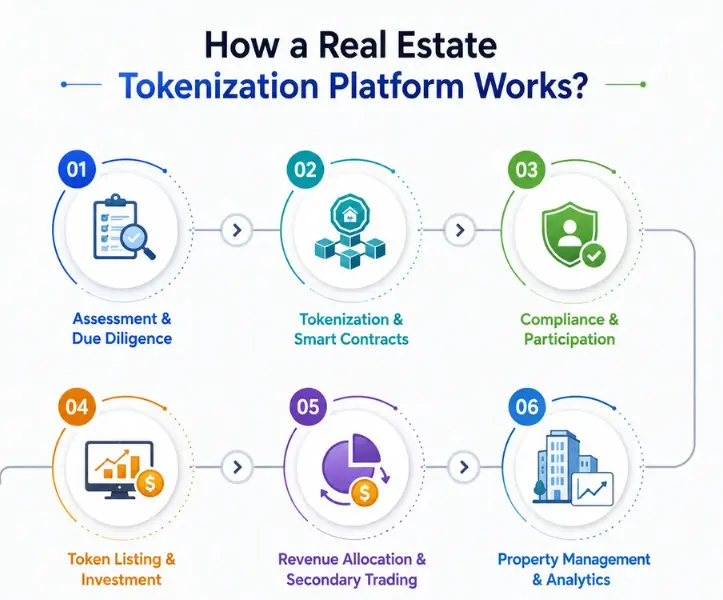
A real estate tokenization platform converts physical property assets into digital tokens that can be owned, traded, and managed through blockchain technology.
Property Assessment and Due Diligence
The initial step is to identify an appropriate real estate property for tokenization. You need to confirm ownership, property value, legal documents, accounting details, and compliance with any relevant regulations.
Real Estate Tokenization and Smart Contracts
Once due diligence is complete, you can create digital tokens for the property. Smart contracts are set up to manage how the tokens function, including ownership, transactions, profit sharing, and other agreements.
Compliance and Participation Process
The tokenization process includes KYC (Know Your Customer) and AML (Anti-Money Laundering) checks to ensure compliance with laws and proper identification of participants.
Token Listing and Investment Process
The property tokens will be listed on a platform for investment. Interested investors can learn about the property and buy shares through the tokens.
Revenue Allocation and Secondary Market Trading
Smart contracts will distribute revenue from the property to token holders based on their ownership share. Investors can list and trade their tokens in the secondary market as well.
Property Management and Analytics
The platform will continuously monitor the property and track transactions and ownership. Investors can also track their investment performance using the provided analytics.
Key Features of a Real Estate Tokenization Platform
To ensure security, transparency, and seamless investor experiences, the platform must include a set of essential features that support asset tokenization, compliance, and transaction management.
Asset Tokenization Engine
It is responsible for transforming real estate properties into digital assets, which can then be used as instruments of ownership and investment by the owner.
Smart Contract Automation
Automate critical operations such as token issuance, ownership transfers, profit distribution, and transaction validation. This reduces manual intervention while improving transparency and operational efficiency.
Fractional Ownership Management
Fractional ownership capability enables investors to own portions of the same real estate property in digital format, thereby lowering barriers to entry.
KYC and AML Compliance
Verify investor identities and monitor transactions for regulatory compliance. These mechanisms help prevent fraud, money laundering, and unauthorized participation.
Investor Dashboard
Provides real-time access to portfolio performance, ownership records, transaction history, and income distributions. It offers a centralized interface for managing investments and tracking returns.
Integration with Secure Digital Wallet
Allow users to save, send, receive, and manage their RE tokens safely. These enable the smooth processing of transactions while ensuring the safety of your digital assets.
Incorporation of a Secondary Market
Gives investors an opportunity to acquire and dispose of tokenized property shares easily. Investors have more options for selling off or expanding their portfolio.
Integration of Reporting & Analytics Solutions
Provides detailed reports on property performance, rental income, investment gains, and transaction data to inform investor and platform administrator decisions.
The success of a real estate tokenization platform largely hinges on its capability to facilitate safe asset management and adherence to all regulatory requirements. Integrating these critical elements ensures the creation of a user-friendly platform for entrepreneurs.
Types of Real Estate Tokenization Platforms We Develop
Real estate tokenization is reshaping the way people invest in property by enabling fractional ownership, increased liquidity, and global investor participation. We create various platforms for real estate tokenization aimed at supporting various business models and catering to diverse needs.
Residential Real Estate Tokenization Platform
Let's people invest in residential real estate, including apartments, villas, single-family homes, and housing complexes. Investors can buy fractional shares of these properties and earn money from rental income and property value growth.
Commercial Real Estate Tokenization Platform
Allows the tokenization of commercial properties like office buildings, stores, shopping centers, and business centers. It helps property owners raise funds and offers investment opportunities in income-generating commercial real estate.
Rental Property Tokenization Platform
Focuses on tokenizing rental properties that earn income. Investors can purchase fractional shares of these properties and receive profits based on their token holdings.
Real Estate Investment Trust (REIT) Tokenization Platform
Converts real estate investment trusts into digital tokens on the blockchain. It helps diversify real estate investments and provides better liquidity and management for token ownership.
Luxury Property Tokenization Platform
Offers fractional ownership of high-end real estate, including luxury villas, resort complexes, penthouses, and waterfront properties.
Mixed-Use Real Estate Tokenization Platform
Tokenizes properties that combine residential, commercial, retail, and hospitality uses. Investors can put money into properties that generate income from multiple sources.
Different real estate sectors require different tokenization strategies and platform functionalities. By developing specialized real estate tokenization platforms, businesses can attract diverse investor groups and unlock new opportunities in the rapidly growing tokenized real estate market.
Looking for Inspiration?
Explore the Best Real Estate Tokenization Platforms to discover successful business models, key features, and market-leading solutions shaping the future of tokenized real estate investments.
White Label Real Estate Tokenization Software Development
White Label Real Estate Tokenization Software is a ready-made, customizable platform that enables businesses to launch their own real estate tokenization marketplace quickly and cost-effectively. Rather than developing a whole platform from scratch, entrepreneurs can take advantage of an existing platform that already comes with tokenization, investment management, trading, and compliance modules. Such software solutions are also highly customizable and allow entrepreneurs to enter the real estate tokenization market quickly without spending much money on software development.
-
Faster Time-to-Market
-
Reduced Development Costs
-
Ready-to-Deploy Infrastructure
-
Custom Branding and Personalization
-
Lower Technical Complexity
-
Proven and Tested Business Model
Custom Tokenization Platform vs White-Label Asset Tokenization Software
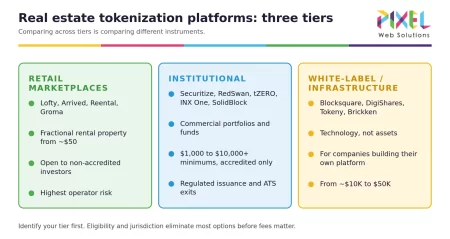
A custom tokenization platform is built around your own asset structure, jurisdictions and investor journeys, while white-label asset tokenization software gives you a tested core that you rebrand and configure. Our guide to white-label tokenization platforms covers the trade-offs in more depth.
| White-label asset tokenization software | Custom tokenization platform | |
|---|---|---|
| Typical cost | $25,000 to $100,000 | $100,000 to $150,000+ |
| Typical timeline | 8 to 16 weeks | 16 to 24 weeks |
| Best for | Startups validating a property marketplace quickly | Firms with unique asset structures, several jurisdictions or institutional investors |
| Flexibility | Configurable within the vendor's core | Full control over features, contracts and integrations |
The same platform core can tokenize more than property. Many real estate platforms later add land, commodities or private credit, so ask for a multi-asset architecture from the start if that is on your roadmap.
Our Real Estate Tokenization Platform Development Services
At Pixel Web Solutions, we offer full-cycle real estate tokenization platform development services, which assist companies in converting real estate property assets into digital assets through blockchain technology. We create custom real estate tokenization platforms according to your business needs, from concept and development to launch and after-sales services.
Custom Real Estate Tokenization Platform Development
Our development team creates customized real estate tokenization platforms tailored to your business needs. Our approach ensures scalability, security, and a seamless experience for property owners and investors.
Real Estate Tokenization Solutions
Help organizations to tokenize their residential, commercial, leasing, and luxury real estate assets. Our experts design robust token structures that facilitate fractional ownership and asset management.
Smart Contracts Development & Integration
We specialize in creating efficient and robust smart contract integration, which will enable automated issuance, management, transaction validation, and revenue generation of digital tokens.
Compliance and Investor Management Services
Integrate KYC, AML, and investor management services into our solution suite to ensure that you stay compliant. Our investor management services simplify portfolio management and investor onboarding.
AI-Driven Real Estate Tokenization Solutions
We use advanced AI to automate property valuation, investor recommendations, fraud detection, compliance monitoring, and market analysis. This improves efficiency, decision-making, and the overall investment experience for users.
Planning to Launch a Real Estate Tokenization Platform?
Partner with Pixel Web Solutions to launch a secure, scalable, and feature-rich real estate tokenization platform tailored to your business goals.
Regulatory Compliance for Launching a Real Estate Tokenization Platform
Regulatory compliance is one of the most critical aspects of launching a real estate tokenization platform. Tokenized real estate assets must comply with legal and regulatory frameworks to ensure transparency, protect investors, and maintain platform sustainability.
Know Your Customer (KYC) Compliance
KYC compliance means that platforms must verify their customers' identities before allowing them to use the service. This helps prevent identity theft and unauthorized access.
Anti-Money Laundering (AML) Compliance
Money laundering is illegal, and AML measures help detect and stop these activities on the platform. These steps ensure the platform meets legal requirements and stays secure.
Securities Law Compliance
In most countries, a token that gives investors a share of a property's rent or value is treated as a security, so securities law applies when you raise funds through the platform. In the US, issuers commonly use Rule 506(c) of Regulation D, which allows public marketing but only to verified accredited investors, or Regulation A Tier 2, which allows offerings of up to $75 million in a 12-month period to a wider pool of investors. In the EU, MiCA does not apply to crypto-assets that qualify as financial instruments, so tokenized property shares generally fall under existing securities rules such as MiFID II. Our comparison of utility tokens vs security tokens explains where the line usually falls.
Data Protection and Privacy Compliance
Real estate tokenization platforms store sensitive information about investors. Protecting this data is crucial during all stages of storage and processing.
Property Verification Compliance
The properties involved in tokenization must have verified ownership and proper legal documents for their acquisition and transactions.
Taxation and Financial Statements Compliance
Businesses involved in real estate tokenization must follow the laws related to taxation and financial reporting.
Cost to Create a Real Estate Tokenization Platform
The cost of creating a real estate tokenization platform varies depending on the platform's complexity, feature set, blockchain infrastructure, security requirements, and compliance integrations. As of October 2026, Pixel Web Solutions prices real estate tokenization platform development in three tiers:
| Build type | Typical cost | Typical timeline |
|---|---|---|
| White-label MVP (core features) | $25,000 to $50,000 | 8 to 12 weeks |
| Advanced build (secondary market, multi-asset support) | $50,000 to $100,000 | 12 to 16 weeks |
| Custom platform from scratch | $100,000 to $150,000+ | 16 to 24 weeks |
Licensing and legal work typically adds $15,000 to $40,000 on top of development. The full phase-by-phase breakdown is in our guide to the cost to build an RWA tokenization platform.
The main factors that move the price are:
-
Platform Choice: Choosing between a custom-built and a White Label platform affects the cost. Generally, a white label option is cheaper.
-
Feature Complexity: The budget largely depends on the features added and how complex they are. Features like fractional ownership and profit sharing can raise the costs.
-
Blockchain Network Selection: The type of blockchain network chosen will also impact the cost, based on transaction fees, contract deployment, and scaling.
-
Smart Contract Development: Creating smart contracts requires specialized skills, and the cost will vary depending on how complex the functions are.
-
Third-Party Services Integration: Adding services such as payment processing and identity verification increases software development costs.
-
User Interface Design: Designing and customizing a user-friendly interface can also affect the overall project cost.
The cost of developing a real estate tokenization platform depends on multiple factors. Businesses seeking a cost-effective and faster market entry can opt for White Label solutions, while custom platforms offer greater flexibility and scalability. Partnering with an experienced RWA Tokenization Platform Development Company helps to create a secure, compliant, and future-ready solution.
Real Estate Tokenization Platform Development Process
Creating a real estate tokenization platform involves several key components: using blockchain technology, ensuring legal compliance, automating processes with smart contracts, and prioritizing user convenience. A carefully planned development process will help you build a secure and efficient solution.
-
Business Planning: First, determine the key features of your project. This includes defining your business model, identifying your target audience, outlining your investment approach, and understanding regulatory requirements.
-
Platform Design: Next, design the platform's architecture and user interfaces for both investors and property owners. Focus on making the solution user-friendly.
-
Blockchain Development: Choose the blockchain technology that fits your needs and develop smart contracts to automate processes.
-
Tokenization and Compliance: Prepare real estate assets for tokenization and integrate compliance modules, such as KYC and AML. This ensures that you meet all compliance requirements.
-
Platform Integration: Develop essential functions like an investor dashboard, wallets, payment gateways, reporting systems, and a secondary market. Also, connect any necessary third-party services.
-
Testing and Deployment: Test the platform to find and fix any security issues, performance problems, or functional errors. Once testing is complete, launch and deploy the platform.
Building a real estate tokenization platform is a detailed process that includes planning, development, legal compliance, and ongoing improvement after launch. By following a clear development process, you can create a strong platform with many useful features.
Technology Stack Required for the Real Estate Tokenization Platform
The technology stack is vital in defining the efficiency, safety, scalability, and reliability of any real estate tokenization platform. A proper technology stack ensures that all the processes in the platform occur smoothly, including tokenization of assets, management of investors, automated smart contracts, and transactions.
-
Blockchain Network: Uses blockchain networks such as Ethereum, Polygon, BNB Chain, Solana, and Avalanche for creating an accurate record of ownership in the tokenization of real estate assets.
-
Smart Contract Framework: Automates the creation of tokens, transfer of ownership, and investments using languages such as Solidity, Rust, and Vyper.
-
Front End Development: Uses frameworks such as React.js, Angular, and Vue.js to create interactive user interfaces.
-
Back-End Development: Manages business logic and users through backend development technologies such as Node.js, Python, Java, and PHP.
-
Database Management Systems: Uses database systems such as PostgreSQL, MySQL, MongoDB, and Firebase for storing data.
-
Integration with Digital Wallets: For secure control over tokenized assets via wallets such as MetaMask, Trust Wallet, and customized solutions.
-
Payment Gateways Integration: To make investments possible using both fiat currency and cryptocurrencies with banking and crypto payment gateways.
-
Security and Monitoring Solutions: To protect against cyber threats via encryption, multifactor authentication, smart contract auditing, and real-time monitoring.
Selecting the right technology stack is essential for building a secure, scalable, and high-performing real estate tokenization platform. However, successful execution requires more than just choosing the right tools and frameworks; it demands the expertise to integrate, optimize, and manage them effectively. Businesses need an experienced development partner with expertise in blockchain, smart contracts, regulatory compliance, and real estate tokenization. This is where Pixel Web Solutions stands out, helping entrepreneurs transform their vision into a fully functional and market-ready tokenization platform.
How to Choose a Real Estate Tokenization Development Company
The right real estate tokenization development company should be able to show you live tokenization work, not just a demo. Before you sign, check these points:
-
Tokenization track record: Ask for platforms they have launched and which asset types and token standards they used.
-
Compliance experience: They should integrate KYC/AML, investor accreditation checks and transfer restrictions, and work alongside your securities lawyers.
-
Smart contract security: Ask how contracts are tested and audited before mainnet, and who holds the admin keys.
-
Build options: A good partner offers both white-label and custom builds and explains the trade-off honestly.
-
Post-launch support: Distributions, investor reporting and upgrades continue for years, so check maintenance terms and costs.
If you want to see how a live platform handles these choices, our walkthrough on launching a platform like RealT breaks down one of the best-known property tokenization models.
Why Choose Pixel Web Solutions for Developing a Real Estate Tokenization Platform?
Building software and blockchain products since 2012, Pixel Web Solutions helps businesses build secure, scalable, and feature-rich real estate tokenization platforms tailored to modern investment needs. We combine industry expertise, innovative technology, and a client-focused approach to develop real estate tokenization platforms that simplify property investment and maximize business growth. Our end-to-end development services ensure a seamless journey from concept to deployment and beyond.
-
Experienced Blockchain and Tokenization Development Team
-
Custom and White Label Development Solutions
-
Regulatory Compliance and KYC/AML Integration
-
Ongoing Technical Support and Maintenance
Build Your Real Estate Tokenization Platform with Confidence
Leverage our blockchain expertise to launch a secure, scalable, and compliant tokenization solution.
Frequently Asked Questions (FAQs)
1. What is Real Estate Tokenization?
Real estate tokenization is the process of converting ownership rights of a physical property into digital tokens on a blockchain network. These tokens represent fractional ownership in the asset, allowing multiple investors to buy, sell, and trade shares of real estate in a secure and transparent manner.
2. What are the benefits of real estate tokenization?
Real Estate tokenization offers several benefits, including improved liquidity, fractional ownership, reduced investment barriers, and access to global investors. It also enhances transparency and automates transactions through smart contracts.
3. How long does it take to develop a real estate tokenization platform?
The development timeline depends on the platform's complexity, features, customization requirements, and compliance integrations. A white label solution can be launched within weeks, while a custom platform may take several months.
4. Which blockchain networks are suitable for real estate tokenization?
Popular blockchain networks for real estate tokenization include Ethereum, Polygon, BNB Chain, Solana, and Avalanche. The choice depends on factors such as scalability, transaction fees, security, and business requirements.
5. What are the use cases of real estate tokenization?
Real estate tokenization can be used for residential properties, commercial buildings, rental properties, luxury real estate, REITs, and mixed-use developments. It enables fractional ownership, crowdfunding, asset trading, and streamlined property investment management.
6. Is real estate tokenization worth investing in 2026?
It can be, but treat it like any property investment. Tokenization offers lower entry barriers, global investor access and greater transparency than traditional real estate, and the wider Real-World Asset (RWA) market keeps growing. Tokenized real estate is still a small share of on-chain RWAs, though, so check each platform's legal structure, fees and real secondary-market liquidity before you invest.
7. How much does it cost to build a real estate tokenization platform?
A real estate tokenization platform costs $25,000 to $50,000 as a white-label MVP, $50,000 to $100,000 with advanced features such as a secondary market, and $100,000 to $150,000+ as a custom build from scratch. Licensing and legal work usually adds $15,000 to $40,000. Features, blockchain choice and compliance scope move the price most.
8. What does a real estate tokenization development company do?
A real estate tokenization development company builds the platform that turns property into tokens. That includes smart contracts for issuance and distributions, investor onboarding with KYC/AML, wallets, payment gateways, dashboards and a secondary market. It should also work with your legal team so token transfers follow securities rules.
9. What is asset tokenization software?
Asset tokenization software is the platform that issues and manages digital tokens backed by a real asset, such as property, gold or private credit. It handles token creation, investor checks, ownership records and payouts on a blockchain. White-label versions can be rebranded and launched in weeks.
10. Is a custom tokenization platform better than a white-label one?
A custom tokenization platform is better when your asset structures, jurisdictions or investor flows are unusual, or when you need full control of the code. White-label is better when speed and budget matter most. Many businesses launch on white-label and customize as they grow.