








A white label tokenization platform is ready-built software that lets you issue, sell and manage tokenized real-world assets (real estate, private equity, bonds, funds, commodities) under your own brand. It includes the smart contracts, investor onboarding with KYC/AML, an investor dashboard, an admin back office for assets, cap tables and payouts, and optional secondary trading. A white label asset tokenization platform typically launches in 3 weeks to 3 months and costs $25,000 to $50,000 for an MVP, compared with $100,000 to $150,000 or more to build from scratch.
Tokenization moved from pilot projects to mainstream finance when BlackRock launched its tokenized BUIDL fund in 2024. Since then, tokenized Treasuries, private credit and real estate have become one of the fastest-growing corners of blockchain, and asset managers, real estate firms and fintechs all want to offer tokenized products to their own investors.
Building a tokenization platform from scratch takes months and deep expertise in smart contracts, securities compliance and investor operations. A white label tokenization platform gives you that infrastructure ready to brand and configure. This guide explains how it works, its features, costs, compliance requirements and what to check before you choose a provider.
Key Takeaways
- White label means your brand on proven infrastructure: investors see your name, logo and domain, not the technology provider.
- Compliance is built into the token. Permissioned standards such as ERC-3643 restrict transfers to verified investors, which is essential for securities.
- Launch in weeks, not months. The software is ready; legal structuring and jurisdiction setup usually set the timeline.
- Costs are far lower than a custom build: $25,000 to $50,000 for an MVP and $50,000 to $100,000 for an advanced platform.
- Check ownership and exit terms. Make sure you control investor data, contracts and admin keys if you change provider.
What Is A White-Label Tokenization Platform?
A white label tokenization platform is pre-built, tested and customizable software that lets a business run its own branded platform for tokenizing real-world assets. Instead of developing smart contracts, investor portals and compliance workflows from scratch, you license or buy the platform, apply your branding, configure your asset types and rules, and launch.
It suits real estate developers, asset managers, family offices, banks, fintechs and startups entering the tokenization market with a limited budget or a tight timeline. Because the core is already built, your team can focus on sourcing assets, legal structuring and investor acquisition.
How The White Label Tokenization Platform Works?
A white label tokenization platform serves two main groups: the platform operator (admin and issuers) and the investors who buy tokens.
From the Investor's Perspective
- Registration and KYC: investors sign up, complete identity checks and, where required, accreditation checks.
- Explore offerings: they browse tokenized assets with documents, returns and risk disclosures.
- Invest: they buy tokens with fiat, stablecoins or crypto, and receive them in a platform or self-custody wallet.
- Track ownership: the dashboard shows holdings, valuations, documents and transaction history.
- Earnings and exits: investors receive rent, interest or dividends and can resell on a secondary market where permitted.
From the Admin and Issuer's Perspective
- Onboarding and compliance: approve investors, set eligibility rules by country and investor type.
- Asset setup: create an offering, upload documents, set token supply, price and minimum investment.
- Token issuance: deploy compliant token contracts that only allow transfers between verified wallets.
- Cap table and investor management: track who owns what, in real time.
- Distributions: automate dividend, rent or interest payouts to token holders.
- Reporting: investor statements, regulatory reports and audit trails.
Why Choose A White Label Tokenization Platform?
Faster Launch
Because the software is ready, a branded platform can go live in 3 weeks to 3 months. Legal structuring and jurisdiction setup are usually the longest steps, not the technology.
Lower Cost
An MVP costs $25,000 to $50,000, a fraction of the $100,000 to $150,000 or more needed to build a platform from scratch.
Proven, Tested Infrastructure
Smart contracts, onboarding and payout flows have already been built and tested, which reduces technical and security risk.
Scalable Infrastructure
A good white label platform supports new asset types, more investors, more chains and secondary trading as you grow.
Custom Branding
You control the domain, design, content and legal documents, so investors experience your brand from end to end.
White Label vs Custom Build vs Tokenization-as-a-Service
| Option | Cost | Time to launch | Control | Best for |
|---|---|---|---|---|
| White label platform | $25,000 to $100,000 | 3 weeks to 3 months | High: your brand, your configuration | Firms launching their own tokenization business |
| Custom build | $100,000 to $150,000+ | 6 to 12 months | Full | Institutions with unique products or scale |
| Tokenization-as-a-service | Setup fee plus per-asset or subscription fees | Days to weeks | Lower: you run on the provider's platform | Issuers tokenizing a few assets |
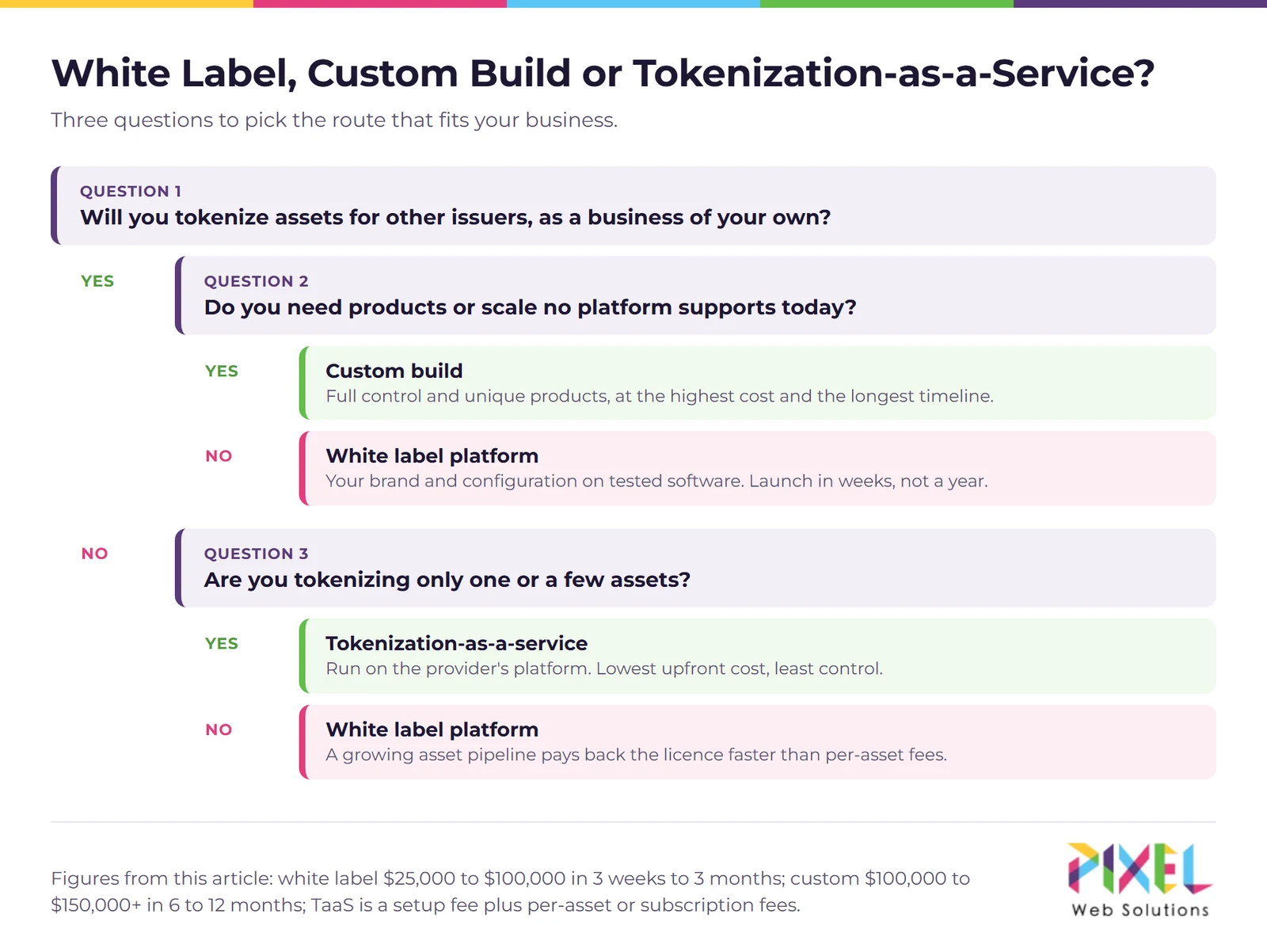
Learn more about tokenization-as-a-service and the full cost to build an RWA tokenization platform.
White Label Tokenization Platform Development Across Industries
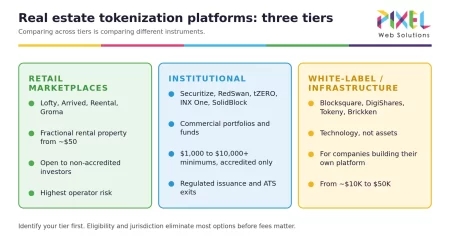
- Real estate: fractional ownership of residential and commercial property, with rent distributed to token holders. See our guide to the best real estate tokenization platforms.
- Private equity and venture: tokenized fund units and company shares with automated cap tables.
- Bonds, Treasuries and private credit: tokenized debt with automated interest payments.
- Commodities: gold, silver and other physical goods backed by audited reserves.
- Energy and carbon: renewable energy projects and carbon credits.
- Collectibles and art: fractional ownership of high-value items.
- Intellectual property: tokenized royalties for music, film and patents.
Features Of The White Label Tokenization Platform
Admin Dashboard
- Asset tokenization panel to create offerings and issue tokens
- Smart contract management for deploying, pausing and upgrading token contracts
- Compliance controls for eligible countries, investor types, holding limits and lock-ups
- Investor management and cap table in real time
- Distribution engine for dividends, rent and interest
- Content and branding configuration
- Revenue settings for issuance, management and trading fees
- Live analytics and reporting
- Support ticketing
Investor Dashboard
- KYC and accreditation submission
- Offering marketplace with documents and risk disclosures
- Wallet options: platform wallet or connection to self-custody wallets
- Ownership records and digital certificates
- Payout tracking and withdrawals
- Secondary market access, where the regulation allows
- Notifications for new offerings, payouts and documents
Under the Hood
- Permissioned token standards such as ERC-3643 that enforce identity and transfer rules on-chain. Compare the options in our guide to ERC-3643 vs ERC-7943.
- Integrations with KYC providers, custodians, payment rails and stablecoins
- Multi-chain support for Ethereum, Polygon, Base, Avalanche and permissioned networks
Compliance: What a White Label Platform Must Support
Most tokenized real-world assets are securities, so the platform must support the rules that apply to them:
- Investor eligibility: KYC, AML, sanctions screening and accreditation checks.
- Transfer restrictions: tokens can move only between verified wallets in permitted countries.
- Offering exemptions: for example private placements to qualified investors, or registered offerings where required.
- Secondary trading rules: resale may require a licensed trading venue or broker.
- Record keeping and reporting: audit trails, investor statements and regulator reports.
Rules differ by country, so pair the platform with legal advice on structuring (usually a special purpose vehicle that owns the asset) in each market you serve.
How Much Does a White Label Tokenization Platform Cost?
| Package | Cost | What it includes |
|---|---|---|
| Basic MVP | $25,000 to $50,000 | Core token contracts, investor onboarding, dashboard, admin panel |
| Advanced platform | $50,000 to $100,000 | Multiple asset types, distributions, secondary trading, deeper integrations |
| Built from scratch | $100,000 to $150,000+ | Fully custom architecture for large-scale businesses |
A single-asset issuance on established permissioned token standards can start at about $6,000 through Pixel's RWA tokenization service. Legal structuring, audits, KYC fees and marketing are separate.
Buyer's Checklist: How to Choose a White Label Tokenization Provider
- Token standards: does it support permissioned standards such as ERC-3643 and your chosen blockchains?
- Compliance depth: can you configure countries, investor types, lock-ups and holding limits?
- Ownership: do you control the smart contracts, admin keys and investor data?
- Integrations: KYC providers, custodians, banks, stablecoins and payment methods.
- Secondary trading: is there a path to resale, and is it compatible with your regulator?
- Security: audited contracts, penetration tests and clear incident response.
- Pricing model: one-time licence, subscription or per-asset fees, and what happens at year three.
- Support and roadmap: post-launch updates, regulatory changes and new features.
How To Launch A Tokenization Interface With The White Label Tokenization Platform?
Pick Your Niche
Choose the asset class and investor type first, such as residential real estate for accredited investors or tokenized bonds for institutions. It drives compliance, features and marketing.
Structure the Assets Legally
Set up the legal wrapper (often an SPV) and the offering rules with specialist counsel.
Choose the Blockchain
Pick a public chain such as Ethereum, Polygon or Base, or a permissioned network, based on investor needs, costs and custody partners.
Configure the White Label Software
The development team configures features, compliance rules, integrations and payment options.
Customize Branding
Apply your logo, domain, colours, content and legal documents.
Test
Test onboarding, purchases, transfers, distributions and edge cases, and audit the token contracts.
Launch
Go live with your first offering and a clear investor communication plan.
Post-Launch Support
Keep the platform updated for new features, asset types and regulatory changes, and add secondary trading or new chains as you grow.
Pixel Web Solutions – Your Trusted Ally In White Label Tokenization
Pixel Web Solutions is an RWA tokenization platform development company that delivers white label tokenization platforms tailored to your asset class and market. We configure compliant token standards, investor onboarding, distributions and secondary trading, brand the platform as your own and support you after launch as rules and products evolve. We also build STO platforms for security token offerings.
Let's build your branded tokenization platform today.
Frequently Asked Questions
What is a white label tokenization platform?
It is ready-built, brandable software that lets a business issue and manage tokenized real-world assets, including smart contracts, investor onboarding, dashboards, compliance controls and payouts, without building the technology from scratch.
How much does a white label tokenization platform cost?
An MVP typically costs $25,000 to $50,000 and an advanced platform $50,000 to $100,000. A custom build costs $100,000 to $150,000 or more. Legal, audit and KYC costs are separate.
How long does it take to launch a white label tokenization platform?
The technology can be configured in 3 weeks to 3 months. Legal structuring and regulatory approvals in your target market usually decide the final launch date.
Is asset tokenization legal?
Yes, in many countries, but most tokenized assets are securities and must follow securities laws on offerings, investor eligibility and trading. Use a platform with built-in transfer restrictions and take local legal advice.
Which assets can be tokenized on a white label platform?
Real estate, private equity, fund units, bonds and Treasuries, private credit, commodities such as gold, carbon credits, art and collectibles, and intellectual property royalties.
What is the difference between white label and tokenization-as-a-service?
With white label software, you run your own branded platform. With tokenization-as-a-service, you tokenize assets on the provider's platform for a setup and usage fee, with less control and branding.