Table of Contents
Data as of September 2026. This sector moves monthly; verify any platform's status before investing or signing.
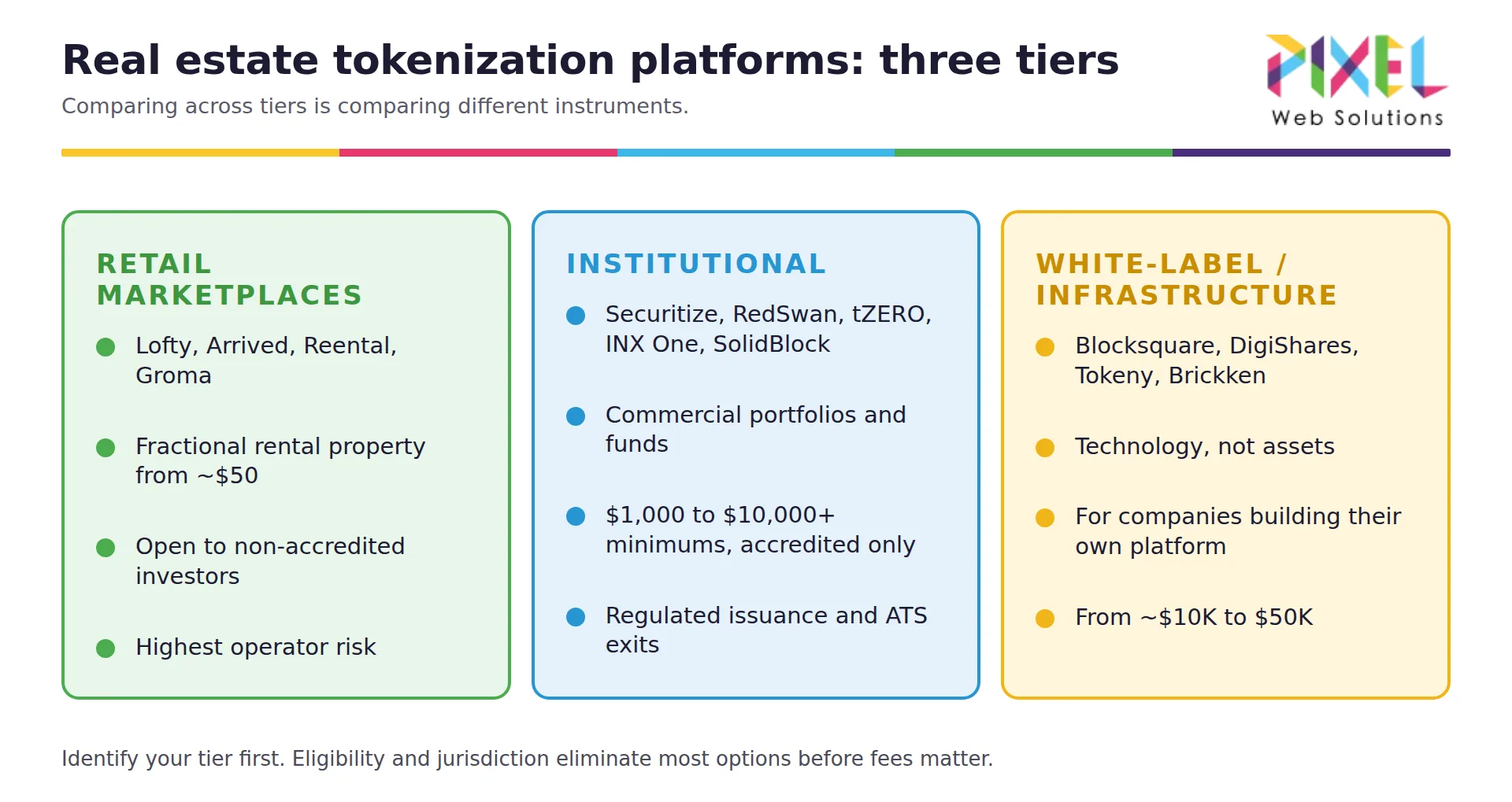
The best real estate tokenization platform depends on which of three tiers you need. Retail marketplaces (Lofty, Arrived) sell fractional interests in individual rental properties from around $50. Institutional platforms (Securitize, RedSwan, tZERO) tokenize commercial portfolios for accredited investors with minimums from $1,000 to $10,000 or more. Infrastructure and white-label providers (Blocksquare, DigiShares, Tokeny, Brickken) supply the technology to companies building their own branded platform rather than selling assets themselves.
Comparing platforms across tiers is comparing different instruments. This guide sets out the three tiers, compares the leading platforms in each, explains what the RealT liquidation in July 2026 changed about due diligence, and covers what it costs to build a platform of your own with an RWA tokenization platform development partner.
Best Real Estate Tokenization Platforms at a Glance
| Platform | Tier | Asset focus | Minimum | Eligibility |
|---|---|---|---|---|
| Lofty | Retail marketplace | US single-family rentals | ~$50 | Global, non-accredited |
| Arrived | Retail marketplace | US residential | Low hundreds | US investors |
| Reental | Retail marketplace | European and LATAM property | Low hundreds | Varies |
| Groma | Retail / fund | US residential (Boston focus) | Varies | Varies |
| RedSwan | Institutional | US commercial real estate | $1,000+ | Accredited |
| Securitize | Institutional | Funds and CRE; powers BlackRock's BUIDL | $1,000+ | Accredited and institutional |
| tZERO | Institutional / ATS | Digital securities trading venue | Varies | Verified investors |
| INX One | Institutional | Regulated issuance and trading | Varies | Verified investors |
| SolidBlock | Institutional | Luxury and commercial | Varies | Accredited |
| Blocksquare | Infrastructure | White-label tokenization | N/A | Platform operators |
| DigiShares | Infrastructure | White-label issuance | N/A | Platform operators |
| Tokeny | Infrastructure | Compliance-first issuance (ERC-3643) | N/A | Issuers |
| Brickken | Infrastructure | No-code token issuance | N/A | Issuers |
| Propy | Transaction layer | NFT property sales, title | Per property | Buyers and sellers |
Minimums and eligibility change; confirm on the platform's own site before committing funds.
Tier 1: Retail Marketplaces (Invest from ~$50)
Retail platforms buy or source a property, place it in a legal entity, tokenize the equity, and sell fractions directly to investors who then receive rental income.
Lofty
Lofty lets investors buy fractional interests in US rental properties from about $50 on Algorand, with daily rental distributions, a 24-hour internal secondary marketplace and governance voting on property decisions. Algorand's near-zero fees (around $0.0002 a transfer) make frequent small distributions economic, which is the core operational problem at retail scale.
Arrived
Arrived offers fractional shares in US residential and vacation rentals to US investors, with a more conventional securities structure and a longer hold expectation than Lofty.
Reental and Groma
Reental tokenizes European and Latin American property; Groma focuses on US residential with a Boston concentration. Both appear among the handful of platforms holding most of the tokenized real estate actually on-chain today.
Retail tier caveat: these are the platforms where operator risk bites hardest, as the RealT case below shows. Token transparency does not protect you from a badly run portfolio.
Tier 2: Institutional Platforms (Accredited Investors)
Securitize
Securitize is the largest tokenization platform by assets under management, powering BlackRock's BUIDL fund and working with Apollo, Hamilton Lane, KKR and VanEck. It is SEC-registered and handles issuance, compliance and investor management end to end.
- Best for: asset managers and large institutions issuing regulated digital securities.
- The model is documented in our guide to building an RWA platform like Securitize.
RedSwan
RedSwan tokenizes US commercial real estate, giving global accredited investors access to institutional-grade properties with a built-in secondary market and SEC-compliant structures.
tZERO and INX One
tZERO operates the most established SEC-regulated Alternative Trading System for digital securities in the US, and INX One supports regulated issuance and trading. Both matter for exit liquidity: an ATS connection has to be designed into the issuance structure from the start, not bolted on later.
SolidBlock
SolidBlock focuses on luxury and commercial tokenization and is known for the St. Regis Aspen transaction, working with developers who want to digitize ownership of premium assets.
Tier 3: White-Label and Infrastructure Providers
These companies do not sell you property. They sell the technology to run a tokenization platform under your own brand, which is what most businesses searching for a "real estate tokenization platform" actually need.
Blocksquare
Blocksquare provides white-label tokenization infrastructure with legal and compliance modules, letting property owners and operators launch branded marketplaces globally.
DigiShares
DigiShares supplies white-label issuance and investor-management software for real estate and other assets, widely used by marketplace operators.
Tokeny
Tokeny is compliance-first, built around the ERC-3643 permissioned token standard that embeds transfer restrictions and jurisdiction rules into the token itself. See ERC-3643 vs ERC-7943 for how the standards differ.
Brickken
Brickken offers no-code token issuance for companies that want to tokenize assets without engineering a platform.
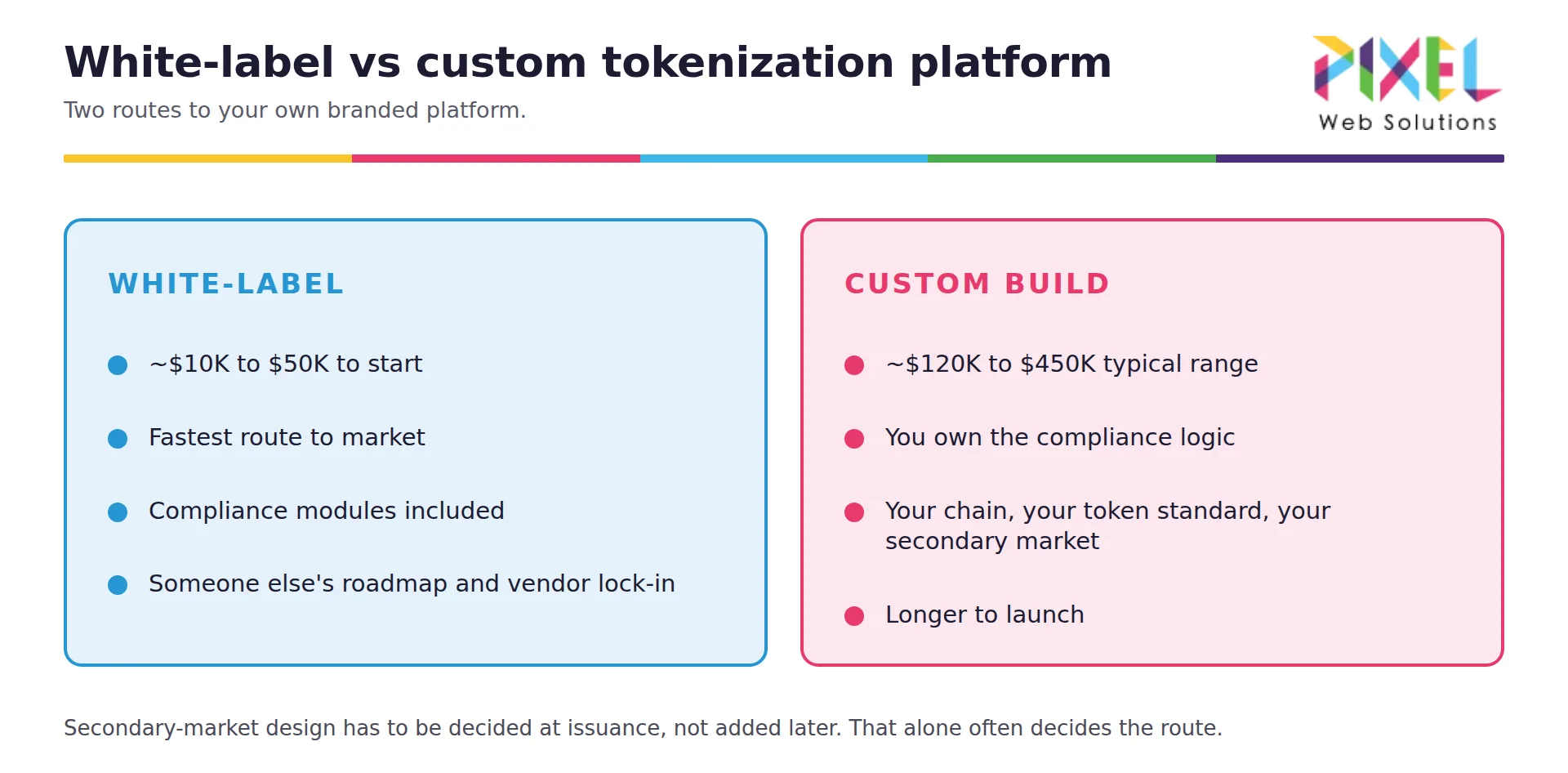
White-label vs custom: white-label platforms typically start around $10,000 to $50,000 and get you live fastest on someone else's roadmap. Custom builds commonly run $120,000 to $450,000 and remove vendor lock-in, letting you own the compliance logic, the chain choice and the secondary-market design. Our white-label tokenization platform and tokenization as a service pages set out both routes, and cost to build an RWA tokenization platform breaks the budget down by component.
What the RealT Collapse Changed
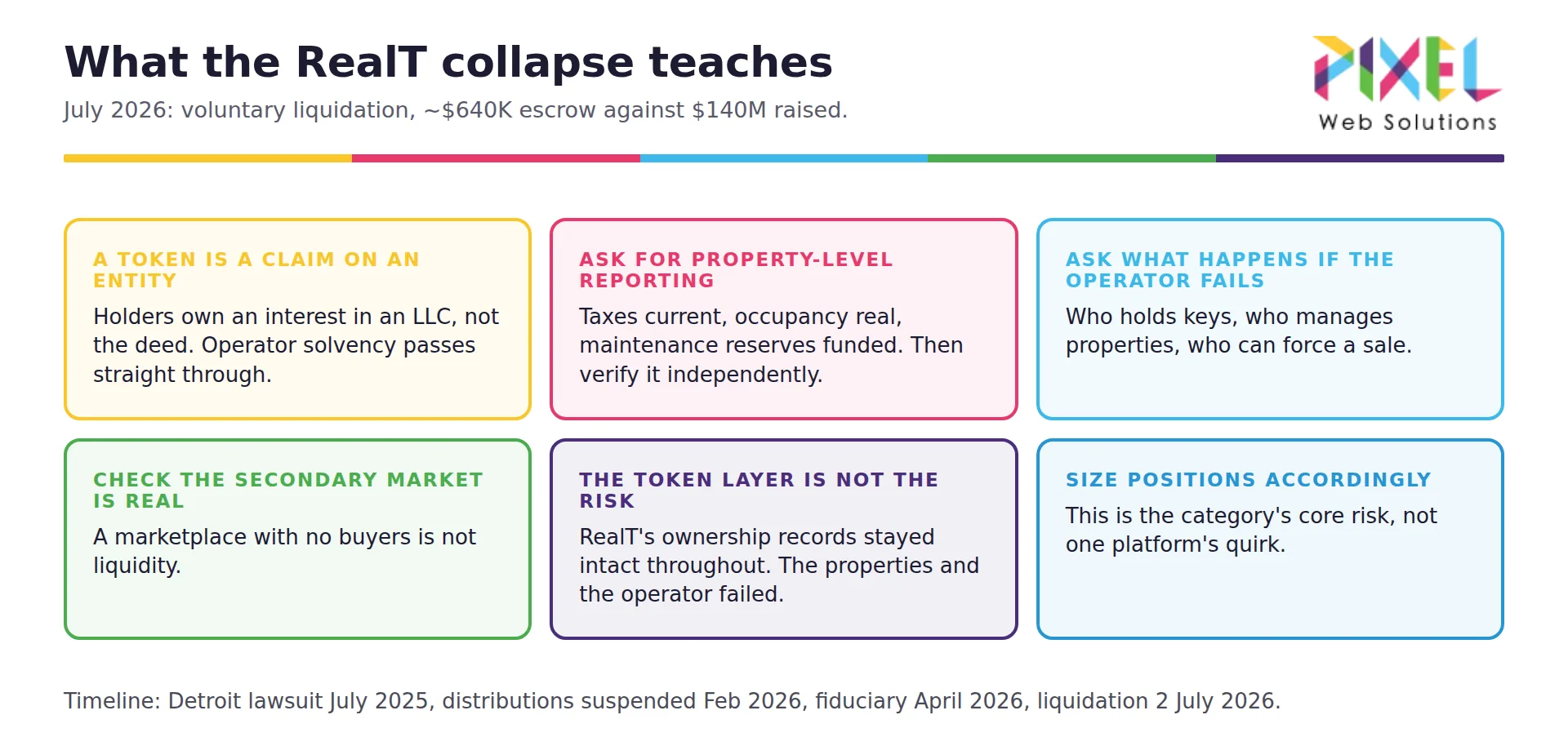
RealT was the most-cited proof of concept in tokenized real estate. It raised roughly $140 million from 14,000 to 22,000 investors against about 700 mostly Detroit rental homes, paying weekly stablecoin distributions on $50 tokens. In July 2025 the City of Detroit filed its largest-ever nuisance abatement lawsuit covering 408 RealT properties. Distributions were suspended in February 2026, a court appointed a fiduciary over the portfolio in April, and on 2 July 2026 RealT announced voluntary liquidation, with roughly $640,000 in escrow against the $140 million raised.
The instructive part is that the token layer worked exactly as designed throughout. Ownership records stayed transparent, transferable and intact. What failed was underneath: property condition, tax and compliance obligations, and the operator's solvency.
- A token is a claim on an entity, not a deed. Holders own an interest in an LLC that owns the property; the operator's competence and solvency pass straight through.
- Ask for property-level reporting: taxes current, occupancy real, maintenance reserves funded, and then verify it independently.
- Ask what happens if the operator disappears. Who holds the keys, who manages the properties, who can force a sale.
- Check the secondary market is real. A marketplace with no buyers is not liquidity.
- Size positions accordingly. This is a category risk, not a RealT quirk.
How to Choose a Real Estate Tokenization Platform
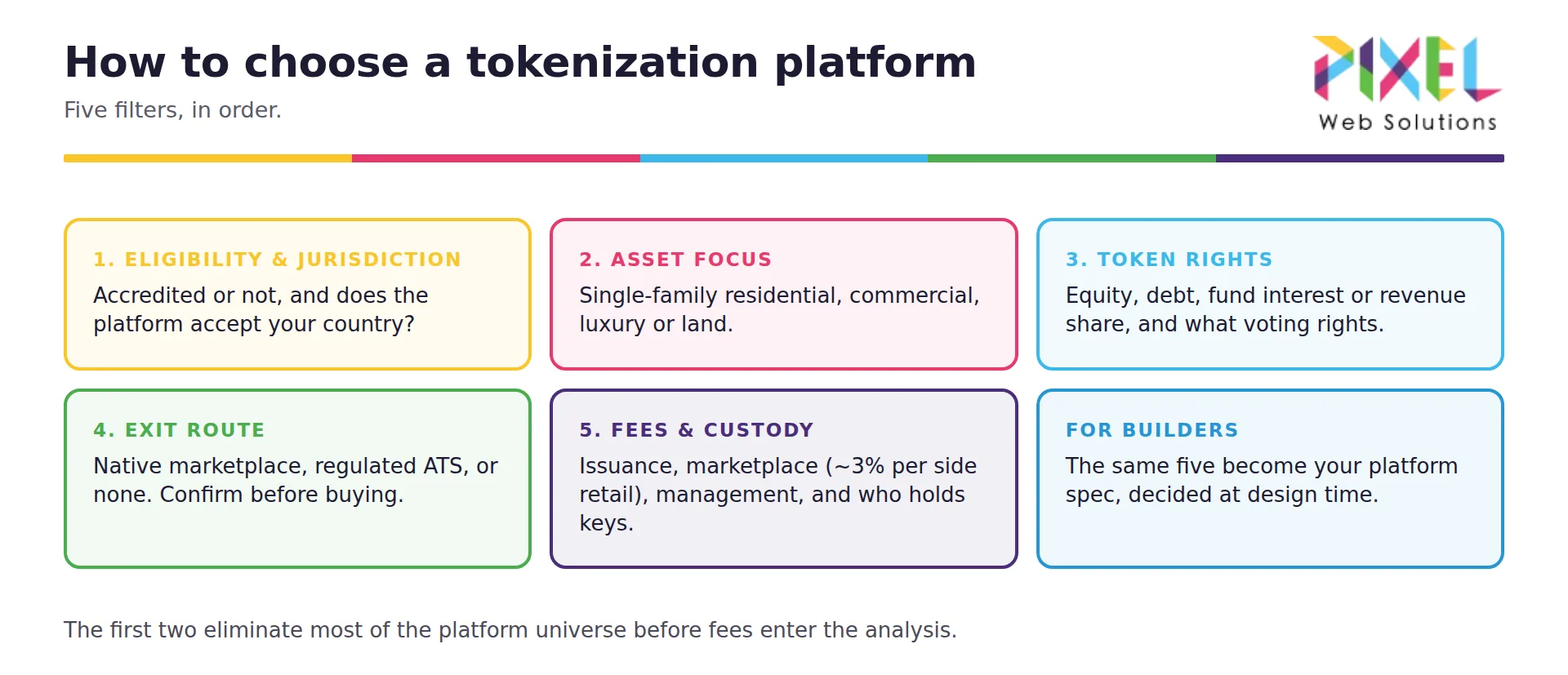
Five filters, in order. The first two eliminate most options before fees matter.
- Eligibility and jurisdiction: are you accredited, and does the platform accept investors from your country? Several US-focused platforms have not accepted US investors for years, and vice versa.
- Asset focus: single-family residential, commercial, luxury or land. Risk profiles differ completely.
- Token rights: equity, debt, fund interest or revenue share, and what voting or information rights come with it.
- Exit route: platform-native marketplace, regulated ATS, or none. Confirm before buying, not after.
- Fees and custody: issuance fees, marketplace fees (commonly around 3% per side on retail platforms), management fees, and who holds the keys.
For platform builders the same list becomes a spec: compliance, custody, token standard, secondary market and reporting all have to be decided at design time.
How Real Estate Tokenization Works
A property or portfolio is placed in a legal entity, fund or contractual structure. Tokens are then issued representing defined equity, debt, fund or revenue rights in that structure, with compliance rules such as KYC/AML checks and transfer restrictions embedded in the token standard. Investors buy tokens, receive distributions through smart contracts, and trade on a platform marketplace or a regulated ATS where one exists.
Example: a $1 million property tokenized into 10,000 tokens gives each $100 token a 1/10,000 interest in the entity that owns it, not in the building directly.
Commercial vs Residential vs Luxury Tokenization
- Residential (single-family rentals): lowest minimums, most retail-accessible, highest operator risk because thousands of small properties need active management.
- Commercial: institutional platforms, accredited investors, larger minimums, professional property management, longer holds.
- Luxury: SolidBlock and similar; trophy assets with strong marketing appeal and thin secondary markets.
- Land and other RWAs: see land tokenization, gold tokenization and carbon credit tokenization for adjacent asset classes.
Market Size and Outlook
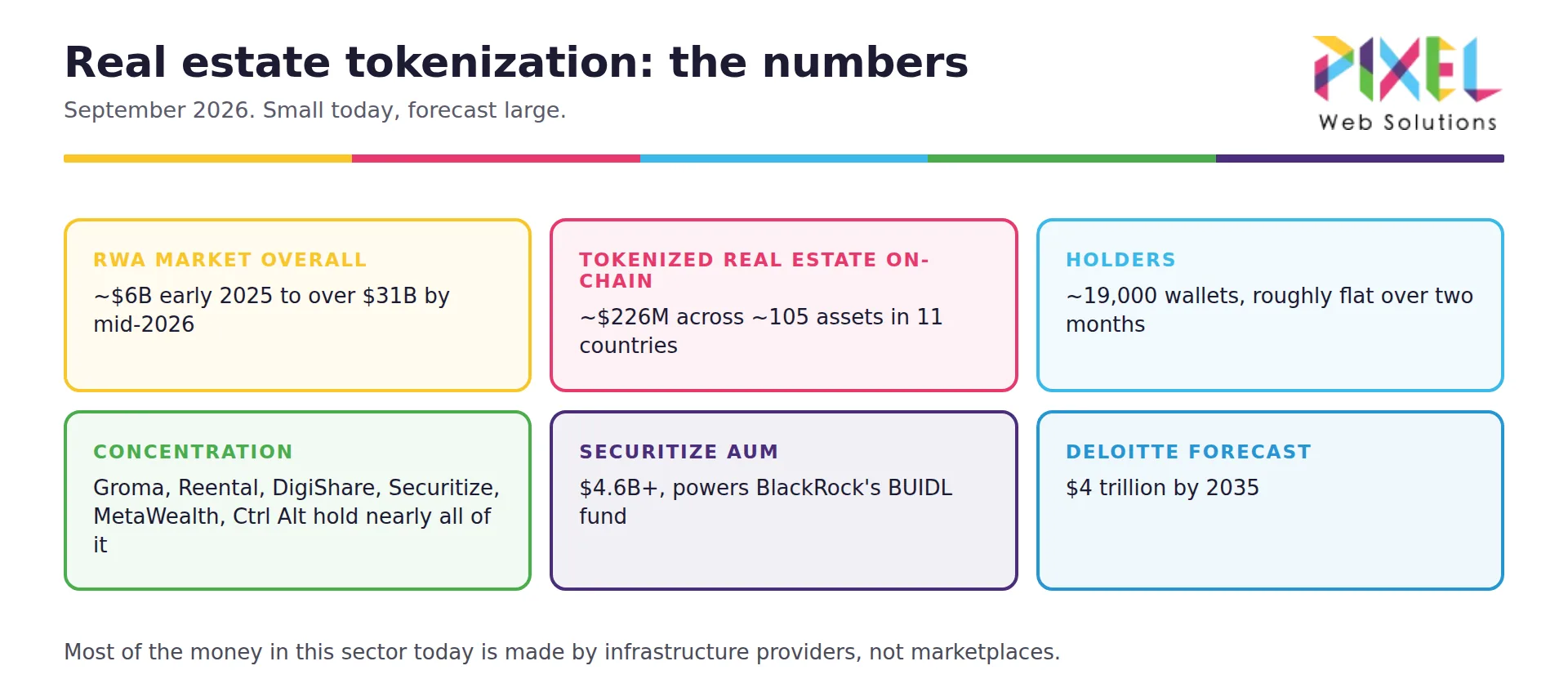
The wider RWA tokenization market grew from roughly $6 billion in early 2025 to over $31 billion by mid-2026, driven mostly by tokenized treasuries, private credit and commodities. Tokenized real estate specifically remains small: around $226 million on-chain across roughly 105 assets in 11 countries as of September 2026, held by about 19,000 wallets, with a handful of platforms holding nearly all of it. Deloitte forecasts the category reaching $4 trillion by 2035.
The gap between $226 million today and a trillion-dollar forecast is the opportunity, and the reason most of the money in this sector is currently being made by infrastructure providers rather than marketplaces.
Building Your Own Real Estate Tokenization Platform
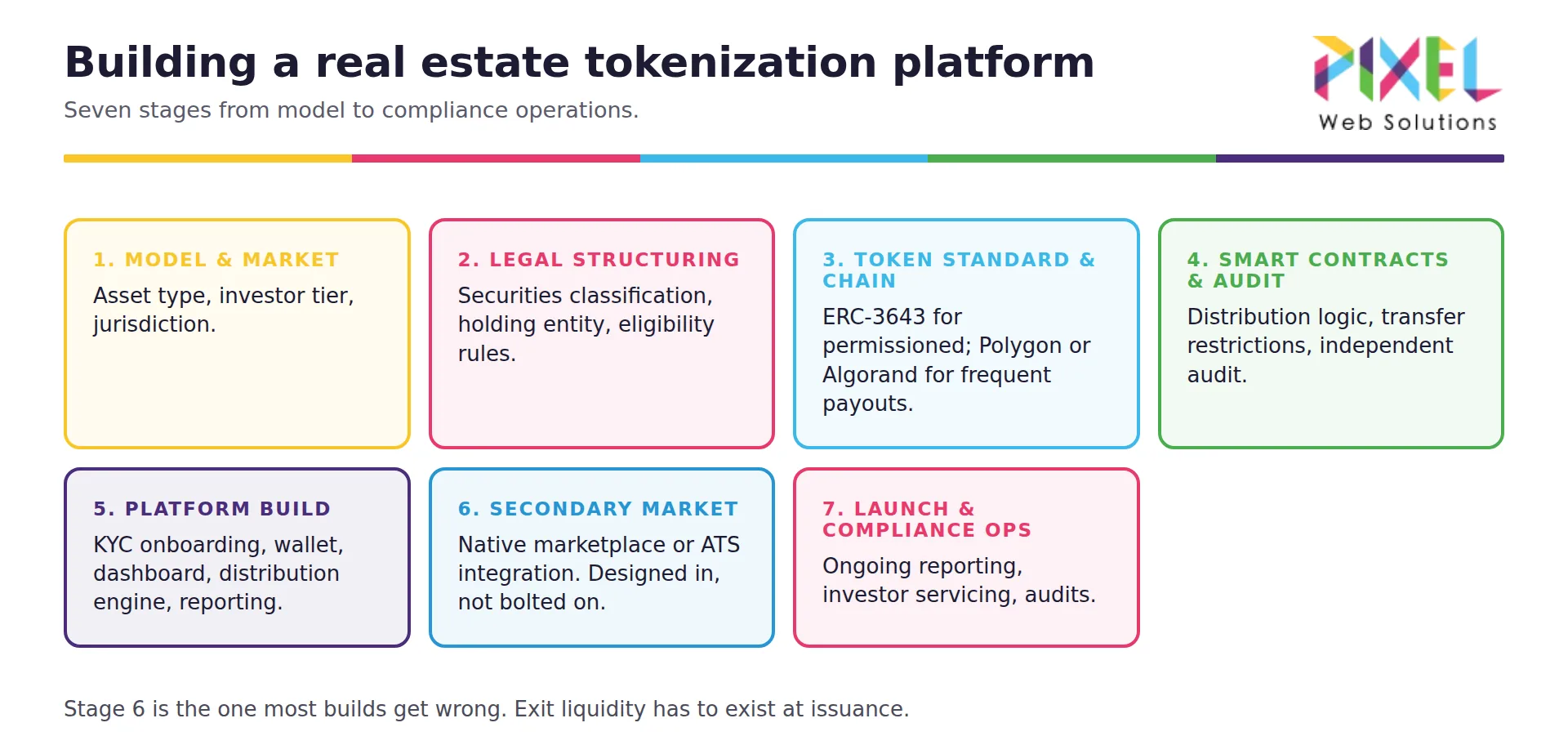
If you are a developer, fund manager or proptech company, the platforms above are competitors or suppliers, not products to buy into. The build has seven stages:
- Market and business model design: asset type, investor tier, jurisdiction.
- Regulatory and legal structuring: securities classification, the entity holding the asset, investor eligibility rules.
- Token standard and chain: ERC-3643 or similar permissioned standards on Ethereum, or a low-fee chain such as Polygon or Algorand where distributions are frequent.
- Smart contract development and audit.
- Platform build: investor onboarding and KYC, wallet, dashboard, distribution engine, reporting.
- Secondary market: native marketplace or ATS integration, decided at design time.
- Launch, compliance operations and ongoing reporting.
The routes and budgets are in real estate tokenization platform development, cost to build an RWA tokenization platform and RWA tokenization company; for the underlying token work see security token issuance, utility vs security tokens and crypto token development. Reference builds for other RWA models are covered in our guides to platforms like Ondo Finance and Maple Finance, and top RWA tokenization development companies benchmarks vendors.
Краткая сводка (RU) / Короткий підсумок (UA) / Podsumowanie (PL)
RU: Платформы токенизации недвижимости делятся на три категории: розничные маркетплейсы (Lofty, Arrived) с минимальным входом от $50, институциональные платформы (Securitize, RedSwan, tZERO) для аккредитованных инвесторов, и white-label инфраструктура (Blocksquare, DigiShares, Tokeny) для компаний, создающих собственную платформу. В июле 2026 года RealT объявила о добровольной ликвидации, что изменило требования к проверке операторов.
UA: Платформи токенізації нерухомості поділяються на три рівні: роздрібні маркетплейси, інституційні платформи та white-label інфраструктура. Вибір залежить від того, чи ви інвестор, чи будуєте власну платформу.
PL: Platformy tokenizacji nieruchomości dzielą się na trzy kategorie: detaliczne (Lofty, Arrived), instytucjonalne (Securitize, RedSwan) oraz infrastrukturę white-label (Blocksquare, DigiShares). Likwidacja RealT w lipcu 2026 roku zmieniła standardy due diligence.
Frequently Asked Questions
What is the best real estate tokenization platform in 2026?
For retail investors, Lofty. For accredited and institutional investors, Securitize or RedSwan. For businesses building their own platform, Blocksquare, DigiShares or a custom build.
Is RealT still operating?
No. RealT announced voluntary liquidation on 2 July 2026 after a Detroit nuisance abatement lawsuit, suspended distributions and a court-appointed fiduciary over its portfolio. Do not treat it as an operating investment platform.
What is the minimum investment in tokenized real estate?
Around $50 on retail platforms such as Lofty; $1,000 to $10,000 or more on institutional platforms.
Is real estate tokenization legal?
Yes, within a securities framework. In the US, tokens representing property interests are generally securities regulated by the SEC; in the EU, MiCA and national securities law apply. Jurisdiction determines who can invest.
How much does it cost to build a real estate tokenization platform?
White-label solutions typically start around $10,000 to $50,000; custom builds commonly run $120,000 to $450,000 depending on compliance scope, chain and secondary-market design.
Can I sell my tokens whenever I want?
Only if a real secondary market exists. Check whether the platform runs a native marketplace, connects to a regulated ATS, or offers no exit until the property is sold.
Which blockchain is used for real estate tokenization?
Ethereum for institutional issuance and DeFi interoperability, Polygon and Algorand where frequent low-cost distributions matter, with multi-chain strategies increasingly common.
Should I use a white-label platform for my tokenization business?
It is the fastest and cheapest route to market. Choose custom when you need control over compliance logic, chain choice or secondary-market design, or want to avoid vendor lock-in.