









The cost to create a crypto token in 2026 is $1,000 to $3,500 for a standard token built by a developer, $5,000 to $15,000 for a custom token with vesting, taxes or anti-whale limits, and $15,000 to $50,000 for an advanced token with staking, governance or cross-chain logic. Deploying the contract is the cheap part: under $1 on Ethereum at today's gas price of about 0.23 gwei, a few cents on BNB Chain or Base, and about 0.01 SOL (about $1) on Solana. The real budget goes on audits, legal advice, liquidity and marketing.
Creating a crypto token is not difficult once you know what goes into it. What surprises most founders is where the money actually goes. The smart contract is often the cheapest part of a token launch, while security, legal review, liquidity and marketing decide whether the token succeeds.
This guide breaks down the crypto token development cost by blockchain (Ethereum, BNB Chain, Solana, Tron, Polygon and Base), token type, development method and launch stage, with live network costs as of 23 October 2026, and shows where you can save without cutting corners.
Key Takeaways
- Development cost depends on complexity, not the blockchain. A standard token is quick to build; custom tokenomics and staking logic take longer and need more testing.
- Network deployment fees are now tiny. Ethereum mainnet gas was about 0.23 gwei on 23 October 2026, so deploying a standard ERC-20 cost well under $1.
- Audits, legal work, liquidity and marketing usually cost more than the code. Budget for them from the start.
- A token is not a cryptocurrency coin. Creating your own blockchain coin costs far more than a token on an existing chain.
- The cheapest safe route is a standard, audited contract template with only the features you need, deployed on a low-fee chain.
How Much Does It Cost To Create A Crypto Token?
In one line: a crypto token costs $1,000 to $50,000 to develop depending on its features, plus under $5 to deploy on any major chain in October 2026. Here is the price by blockchain, using Pixel Web Solutions' published prices where it has a chain-specific service and live network data for the deployment column.
| Blockchain | Token standard | Deployment cost (23 Oct 2026) | Development cost | Best for |
|---|---|---|---|---|
| Ethereum | ERC-20 | Under $1 at about 0.23 gwei (ETH $2,382); more during congestion | $1,000 to $15,000+ (industry range) | DeFi, tokenization, maximum liquidity |
| BNB Chain (BSC) | BEP-20 | A few cents at 0.05 gwei (BNB $730) | $1,000 to $10,000 (Pixel BEP20 price) | Retail communities, low-fee trading |
| Solana | SPL | About 0.01 SOL in rent, about $1 (SOL $104) | $1,000 to $15,000 (industry range) | Memecoins, consumer apps, high throughput |
| Tron | TRC-20 | Low, paid in energy or TRX (TRX $0.33) | $5,000 to $15,000 (Pixel Tron price) | Payment tokens, USDT-heavy markets |
| Polygon | ERC-20 | Cents | $3,000 to $10,000 (Pixel Polygon price) | Gaming, loyalty, low-cost dApps |
| Base | ERC-20 | Cents | $3,000 to $10,000 (industry range) | Consumer tokens in the Coinbase ecosystem |
Deployment estimates use the Etherscan gas tracker reading of 0.23 gwei, BNB Chain's public RPC gas price of 0.05 gwei, and CoinGecko prices on 23 October 2026 (ETH $2,382, SOL $103.51, BNB $730, TRX $0.33), with a standard ERC-20 deployment of about 1.2 million gas. Development ranges labelled "industry range" are what developers and agencies typically quote; Pixel's prices are the published starting ranges on its service pages.
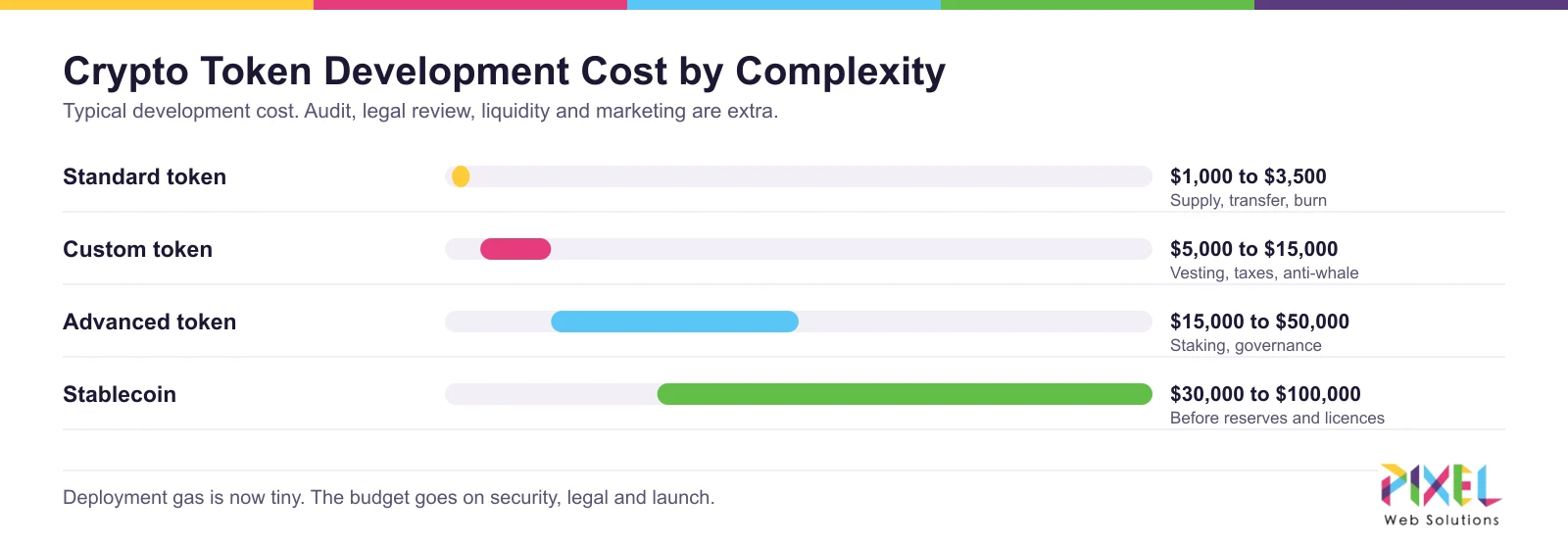
The cost to create a crypto token also falls into four complexity tiers, based on Pixel Web Solutions' published pricing across its token services:
| Token complexity | What it includes | Typical development cost |
|---|---|---|
| Standard token | Fixed or mintable supply, transfer, approve, burn | $1,000 to $3,500 |
| Custom token | Taxes, vesting, anti-whale, blacklist, pause, custom tokenomics | $5,000 to $15,000 |
| Advanced token | Staking, rewards, governance voting, cross-chain support | $15,000 to $50,000 |
| Stablecoin | Minting and redemption, reserve integration, compliance controls | $30,000 to $100,000 |
Several factors push a token toward the top or bottom of its range:
- Choice of blockchain network
- Smart contract features and tokenomics
- Type of crypto token
- Security audit depth
- Legal and compliance needs
- Marketing and launch strategy
The sections below break each one down.
Business Benefits Of Creating a Crypto Token
Before counting costs, be clear about what the token will do for your business.
Global Fundraising
A token can raise funds from a global community through token sales, IDOs or ICOs. Our guide on how to launch an ICO explains the process and the legal rules that apply.
Decentralized Control & Ownership
Governance tokens let holders vote on protocol decisions through a DAO, spreading control and building a committed community.
Token-Based Incentive Models
Tokens can reward trading, referrals, staking and engagement, creating a loyalty loop that keeps users active.
DeFi Applications (Lending & Borrowing)
Tokens can plug into DeFi protocols for lending, borrowing and liquidity pools, opening new revenue streams and utility.
Asset Tokenization
Tokens can represent real-world assets such as gold, bonds, real estate or fund units, enabling fractional ownership and faster settlement.
Crypto Token Development Cost by Blockchain Network
The blockchain affects two costs: the one-time deployment fee and the development effort. In 2026, deployment fees are small on every major chain, as the table above shows. Development cost differs more by team expertise and tooling than by chain.
Ethereum
The largest smart contract ecosystem and the default for DeFi and tokenization. Gas fees fell sharply after network upgrades, and mainnet gas was about 0.23 gwei on 23 October 2026, so deploying a standard ERC-20 (about 1.2 million gas) cost roughly $0.70 at an ETH price of $2,382. Fees can still spike during congestion.
BNB Chain
An Ethereum-compatible chain with very low fees and a large retail user base. The network's gas price was 0.05 gwei on 23 October 2026, which puts a BEP-20 deployment at a few cents. Pixel's BEP20 token development costs $1,000 to $10,000 depending on features.
Solana
Very fast and cheap, and the home of most memecoin launches. Tokens are SPL tokens written with Solana's own programs, so they cost little to create but need different tooling from EVM chains. See Solana token development.
Polygon and Base
Low-cost, Ethereum-compatible networks. Polygon token development at Pixel costs $3,000 to $10,000. Base, Coinbase's Layer-2 network, has become a popular launch chain for consumer tokens.
Tron
Near-zero fees and the dominant network for USDT transfers, which suits payment tokens. Tron token development costs $5,000 to $15,000 at Pixel.
For chain-specific detail, see our guides to the cost to create an ERC20 token, the cost to create a BEP20 token and the best blockchains to create crypto tokens.
How Much Does It Cost to Create a Token on Solana?
Solana has its own cost structure, because accounts must hold a small SOL deposit ("rent") to stay on-chain.
- Token creation on-chain: the mint account (about 0.0015 SOL), the metadata account (about 0.0056 SOL) and your first token account (about 0.002 SOL) add up to roughly 0.01 SOL, about $1 at October 2026 prices.
- No-code creator tools: many charge a service fee on top, commonly 0.1 to 0.5 SOL, plus extra for revoking mint and freeze authority.
- Liquidity pool: creating a standard constant-product (CPMM) pool on Raydium costs a 0.15 SOL creation fee plus about 0.04 SOL in rent, roughly 0.19 SOL in total, according to Raydium's documentation, plus the SOL and tokens you deposit as liquidity.
- Launchpads: platforms such as pump.fun let anyone create a token with little or no upfront fee and charge fees on trading instead.
- Custom SPL development: tokens with vesting, custom fees or staking need a developer and an audit, in the same $1,000 to $15,000 range as other chains.
Always revoke mint and freeze authority if you promise a fixed supply. Buyers and analytics tools check this, and tokens that keep these powers are widely treated as risky.
Cost Analysis Based on Crypto Token Type & Standard
Each token type has different logic, standards and testing needs. Here is how the development cost compares.
Utility Token
Utility tokens give access to a product, pay fees or unlock features. They usually follow ERC-20, BEP-20 or SPL standards and sit in the standard or custom tier. Pixel's crypto token development starts at $3,500 for a standard utility token on one blockchain.
Non-Fungible Tokens
NFTs (ERC-721, ERC-1155 or Metaplex on Solana) need metadata storage, ownership tracking and often royalty logic. A standard NFT collection with minting starts at about $5,000; dynamic NFTs and marketplace integration cost more.
DeFi and Governance Tokens
DeFi tokens usually include staking, reward distribution, governance voting and liquidity pool integration. They are among the most complex tokens to build and audit, placing them in the advanced tier. See how to create a DeFi token.
Gaming and Metaverse Tokens
Gaming tokens power in-game purchases, rewards and player economies. The token contract is often simple, but the economic design and integration with the game add cost.
Stablecoins
Stablecoins need minting and redemption controls, reserve integration, blacklisting for compliance and regular attestations. Pixel's stablecoin development costs $30,000 to $100,000, before reserves and licensing.
Meme Coins
Meme coins are usually standard tokens with minimal logic, so development is cheap. Pixel's meme coin development costs $5,000 to $15,000 including branding, launch setup and custom features. Most of a meme coin's budget goes on liquidity and marketing. See how to create a meme coin.
Wrapped Tokens
Wrapped tokens represent an asset from another chain. The token contract is simple, but the bridge or custody system that backs it is complex and security-critical, which puts the full project in the advanced tier.
LP Tokens
Liquidity provider (LP) tokens are created automatically by the DEX when liquidity is added. You do not need to build them, so they add no development cost.
| Token type | Complexity tier | Typical development cost |
|---|---|---|
| Utility token | Standard to custom | $1,000 to $15,000 (Pixel from $3,500) |
| Meme coin | Standard to custom | $5,000 to $15,000 |
| NFT collection | Standard | From $5,000 |
| Gaming or metaverse token | Custom | $5,000 to $15,000+ |
| DeFi or governance token | Advanced | $15,000 to $50,000 |
| Wrapped token with bridge | Advanced | $15,000 to $50,000+ |
| Stablecoin | Stablecoin | $30,000 to $100,000 |
| LP token | Created by the DEX | No development cost |
Factors That Influence The Cost Of Creating Crypto Tokens
These factors decide where your token lands within its range. For the step-by-step build, see how to create a crypto token.
Upgradability
Upgradeable contracts (using proxy patterns) let you fix bugs or add features later, but they add complexity, testing and trust questions from buyers. Many tokens choose immutable contracts for simplicity.
Mainnet Deployment
Deployment is irreversible, so testing on testnets, final parameter checks and using a multi-signature wallet for the owner and treasury all matter. The gas fee itself is small in 2026.
Security Requirements
Access controls, pause functions, audits and monitoring protect holders. A token that holds or moves significant value needs an independent audit.
Regulatory & Compliance Needs
If your token is sold to investors, it may be a security. KYC for token sales, jurisdiction restrictions and legal opinions add cost but prevent far larger problems. Our comparison of utility tokens vs security tokens explains the difference.
Team Expertise & Resources
Experienced blockchain developers and auditors cost more per hour but make fewer costly mistakes. Rates also vary by region.
Cost Analysis Based on Smart Contract Development
The smart contract is the technical core of the token. Its parameters and logic decide the development effort.
Core Smart Contract Parameters
- Token name and symbol: the token's identity on explorers and exchanges.
- Total and maximum supply: fixed, capped or mintable supply.
- Decimals: usually 18 on EVM chains and 6 to 9 on Solana.
- Initial distribution: allocations to team, investors, treasury, liquidity and community.
Functional Logic
- Transfer, allowance and approval: standard token functions.
- Minting and burning: creating new tokens or removing them from circulation.
- Staking and rewards: incentives for holding or locking tokens.
- Vesting and lock-ups: release schedules for team and investor tokens.
- Governance: voting rights for token holders.
- Transfer taxes: fees on transfers, which many exchanges and tools treat with caution.
Security Logic
- Ownership and access control: only authorized addresses can call sensitive functions.
- Pausable functions: emergency stops.
- Blacklist and whitelist controls: required for some compliant and stablecoin tokens.
- Anti-whale limits: caps on transaction or wallet size at launch.
| Smart contract scope | Typical cost |
|---|---|
| Standard parameters and ERC-20 or SPL functions | Included in the $1,000 to $3,500 standard tier |
| Custom functional logic (vesting, taxes, mint and burn rules) | Adds $2,000 to $10,000 |
| Staking, governance or cross-chain logic | Moves the token into the $15,000 to $50,000 advanced tier |
Cost Difference Based On Crypto Token Development Methods
How you build the token has a big effect on cost and risk.
| Method | Typical cost | Best for | Main risk |
|---|---|---|---|
| No-code token generator | Network fee plus a small service fee | Tests, communities, simple meme tokens | No custom logic, limited support |
| Freelance developer | $500 to $5,000 | Simple tokens with clear specifications | Variable quality, no audit, no accountability |
| Token development company | $1,000 to $50,000+ depending on tier | Business tokens, custom tokenomics, launches | Higher upfront cost |
| In-house team | Salaries plus audits | Projects building a long-term protocol | Slow to hire, expensive to keep |
Cost Analysis For Token Marketing
A token only succeeds if people know about it and trust it. Marketing covers:
- Community building: Telegram, Discord and X communities with active moderation.
- Content and PR: a clear website, documentation, a litepaper and announcements.
- Influencer partnerships: with clear disclosure, as regulators increasingly require.
- Exchange listings: decentralized exchange liquidity first, then centralized exchange listings, which can carry listing fees.
Marketing budgets range from a few thousand dollars for a small community launch to far more than the development cost for a competitive public launch.
Total Budget to Launch a Crypto Token
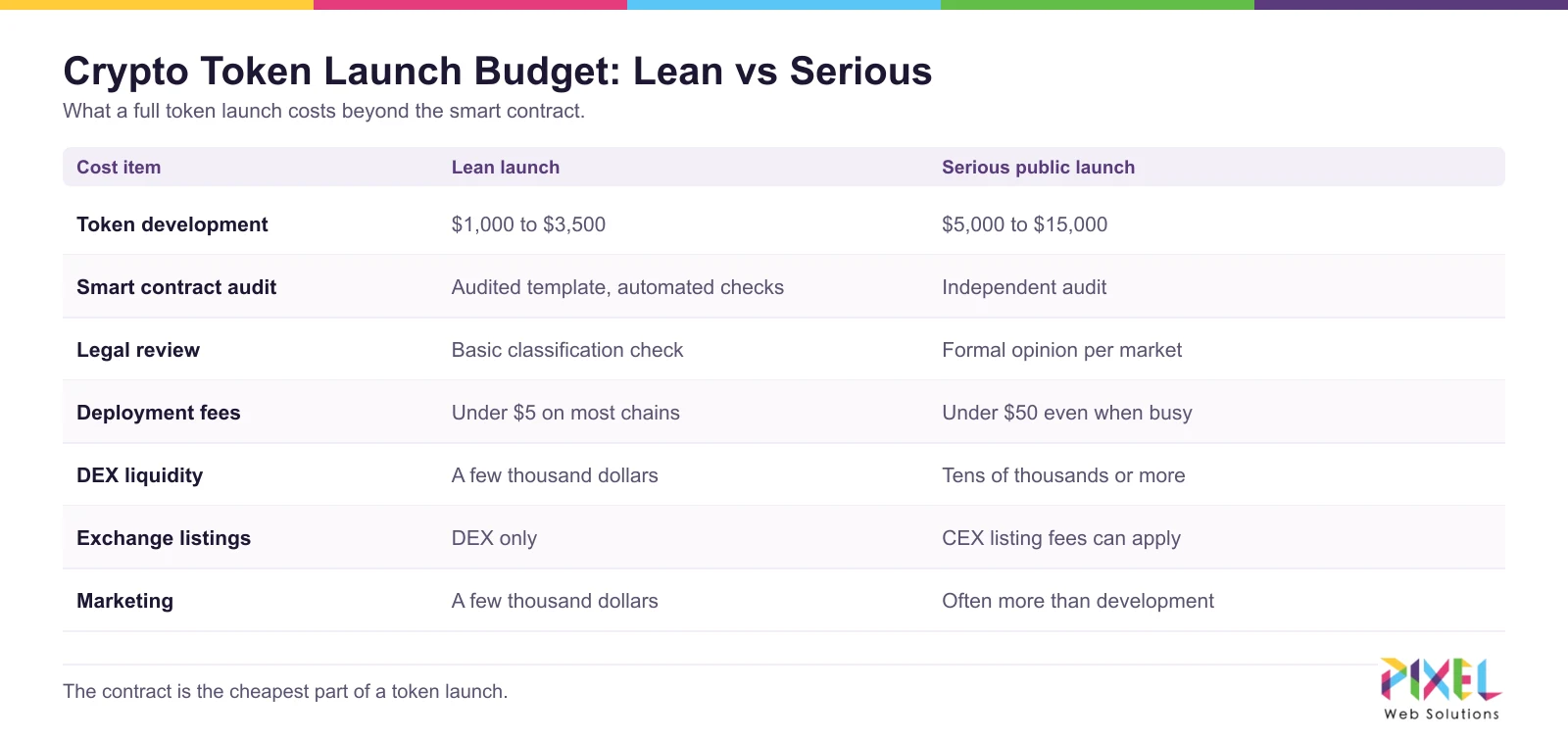
Here is how the full budget typically compares for a lean launch and a serious public launch.
| Cost item | Lean launch | Serious public launch |
|---|---|---|
| Token development | $1,000 to $3,500 | $5,000 to $15,000 |
| Smart contract audit | Unmodified audited template plus automated checks | Independent audit, often several thousand dollars |
| Legal review | Basic check of your token's classification | Formal legal opinion for your target markets |
| Deployment fees | Under $5 on most chains | Under $50 even during busier periods |
| DEX liquidity | Your own capital, often a few thousand dollars | Tens of thousands of dollars or more |
| Exchange listings | DEX only | Centralized exchange listing fees can apply |
| Marketing | A few thousand dollars | Often more than the development cost |
Hidden Factors That Influence Crypto Token Development Cost
These costs catch many founders off guard:
- Smart contract audit fees: reputable audit firms charge more than many expect, and complex tokens need longer reviews.
- Gas fees during launch: deployment is cheap, but airdrops, distributions and liquidity operations add up, especially if the network is congested.
- Legal and regulatory compliance: legal opinions, KYC for token sales and restrictions by country.
- Liquidity: the funds you pair with your token in a DEX pool are capital at risk, not a fee, but you still need them.
- Market making: professional market makers may be needed for centralized exchange listings.
- Ongoing maintenance: monitoring, community management and updates after launch.
- Cross-chain integration: deploying on several chains or bridging adds development, audits and security risk.
Token vs Coin: How Much Does It Cost to Create a Cryptocurrency?
Many people searching for how much it costs to create a cryptocurrency actually need a token. The difference matters for cost:
- A token runs on an existing blockchain (Ethereum, Solana, BNB Chain). It costs $1,000 to $50,000 depending on complexity.
- A coin is the native currency of its own blockchain, like BTC or ETH. Building or forking a blockchain, running validators and securing the network costs far more. Pixel's cryptocurrency development ranges from $5,000 for a simple fork to $50,000 or more for a customized network, and custom blockchains cost more again. See how much it costs to develop a blockchain.
Unless you need your own network, a token is faster, cheaper and easier to get listed.
Effective Ways To Reduce The Cost Of Creating A Crypto Token
Avoid Unnecessary Features
Every feature adds development, testing and audit time. Launch with what the token needs now and add utility through separate contracts later.
Choose the Right Blockchain Network
Pick the chain where your users already are. Low-fee chains such as BNB Chain, Base, Polygon and Solana keep deployment and user costs low.
Use Audited Standards
Build on audited libraries such as OpenZeppelin for EVM chains and the standard SPL token program on Solana. Standard code is cheaper to write and faster to audit.
Conduct Thorough Testing
Test on testnets and forked mainnets before deployment. Catching bugs early costs far less than fixing a deployed contract.
Minimize Smart Contract Complexity
Simpler contracts cost less to build and audit and are easier for buyers to trust. Avoid unusual transfer logic unless it is essential.
Pick the Right Development Method
Use a no-code tool for tests, and a development company for business tokens with custom logic and launch support. Cheap freelance work without an audit often costs more in the end.
How to Create a Crypto Token Cost-Effectively?
- Business need analysis: define the token's purpose and whether it needs to be a token at all.
- Planning: set the roadmap, budget and timeline, including audit and legal steps.
- Tokenomics design: a simple, sustainable supply and allocation model with vesting for insiders.
- Smart contract development: build on audited standards.
- Security auditing: fix every finding before deployment.
- Mainnet deployment: deploy from a multi-signature wallet, verify the contract on the block explorer, and revoke unneeded authorities.
- Liquidity and launch: add liquidity, lock or vest team tokens and launch with clear communication.
Why Choose Pixel Web Solutions To Create Crypto Tokens?
Pixel Web Solutions is a crypto token development company with more than 12 years of software experience. We build tokens on Ethereum, BNB Chain, Solana, Polygon, Base and Tron, from standard utility tokens to staking, governance and stablecoin systems, and we plan the audit, deployment and launch with you. Get a free consultation and a fixed quote for your token.
Frequently Asked Questions
How much does it cost to create a crypto token?
A standard token costs $1,000 to $3,500 to develop, a custom token $5,000 to $15,000 and an advanced token with staking or governance $15,000 to $50,000. Deployment fees are small in 2026, but audits, legal review, liquidity and marketing add to the total budget.
How much does it cost to create a token on Solana?
The on-chain rent for a Solana token is about 0.01 SOL (about $1 in October 2026). No-code tools add service fees of around 0.1 to 0.5 SOL, and creating a Raydium liquidity pool costs about 0.19 SOL including rent, plus the liquidity you deposit. Custom SPL tokens cost $1,000 to $15,000 to develop.
How much does it cost to create an ERC-20 token?
Development costs $1,000 to $15,000 depending on features. Deploying a standard ERC-20 on Ethereum cost under $1 at October 2026 gas prices (about 0.23 gwei), though fees rise during congestion.
How much does it cost to make your own cryptocurrency coin?
A coin on its own blockchain costs much more than a token: from about $5,000 for a simple fork to $50,000 or more for a customized network, plus the cost of running and securing validators. Most projects create a token instead.
Can I create a crypto token for free?
You can create a basic token with a no-code tool for little more than network fees, and launchpads such as pump.fun charge little or nothing upfront. A token meant for a real business still needs custom development, an audit, legal review and liquidity, which cost money.
How long does it take to create a crypto token?
A standard token can be built and deployed in a few days. Custom tokens take two to four weeks, and advanced tokens with staking or governance take one to three months including audits.
What are the legal requirements for launching a crypto token?
They depend on the country and on how the token is sold and used. Tokens sold to investors may be securities, the EU's MiCA rules require a white paper for most public offers, and many countries require KYC for token sales. Take legal advice before launch.
What programming languages are used to create a crypto token?
Solidity (and sometimes Vyper) for Ethereum and EVM chains such as BNB Chain, Polygon and Base, Rust for Solana, and Solidity for Tron's TRC-20 tokens.
Disclaimer: The cost figures in this blog are for information only and are not an official quote from Pixel Web Solutions. Actual pricing depends on your project's requirements and the services you choose. Contact our business team for a precise, customized quotation.