To build an RWA tokenization platform like Ondo Finance, you design yield-bearing products (tokenized treasury funds, notes or stocks), wrap each one in the right legal structure for its investors, hold the underlying assets with regulated custodians, and issue tokens with mint, redeem and transfer rules enforced by smart contracts across several blockchains. The software takes 8 to 24 weeks and $25,000 to $150,000+ to build; the product structure and custody partners take longer.
From paper-backed securities to on-chain assets, finance has come a long way. Real-world asset (RWA) tokenization now brings US Treasuries, money market funds and even listed stocks onto public blockchains, and Ondo Finance has become one of the biggest names doing it. As of 27 September 2026 it holds $3.88 billion of distributed tokenized assets for more than 505,000 holders.
Many start-ups and financial firms now want to create an RWA tokenization platform like Ondo Finance. Doing it well is not just about deploying smart contracts: it means blending legal structuring, custody, compliance and multi-chain engineering. This guide covers how Ondo works, how its products are built, the development process, features, costs and the economics behind a yield token.
Key Takeaways
- Ondo is a product issuer, not a white-label service: it runs its own tokenized treasury products (USDY and OUSG) and tokenized stocks (Ondo Stocks), each with a different legal wrapper and investor group.
- Scale in September 2026: Ondo leads tokenized treasuries with $2.92 billion (19.9% share) and tokenized stocks with $868.7 million (27.6% share), per RWA.xyz on 27 September 2026.
- Regulation is now a building block: Ondo bought Oasis Pro (SEC-registered broker-dealer, ATS and transfer agent) in October 2025, the SEC closed its investigation without charges in December 2025, and FINRA authorized tokenized equities for US investors in July 2026.
- Pick the wrapper before the code: a Regulation D fund for accredited investors, a Regulation S note for non-US buyers, or backed tokenized stocks each need different contracts, custodians and access rules.
- Budget: expect $25,000 to $50,000 for an Ondo-style MVP and $100,000 to $150,000+ for a custom multi-chain build (Pixel Web Solutions pricing), plus legal, custody and audit set-up costs that sit outside the software budget.
What Is Ondo Finance and How Does It Work?
Ondo Finance is an RWA tokenization company that issues blockchain tokens backed by traditional financial assets, mainly short-term US Treasuries, bank deposits and US-listed stocks and ETFs. Investors hold these tokens in their own wallets or through custodians, move them across supported blockchains, and redeem them for stablecoins or cash under each product's rules.
How does Ondo Finance work?
-
Ondo selects the underlying assets, such as short-term Treasuries, tokenized money market funds or listed stocks.
-
It creates a legal structure for each product, for example a Delaware limited partnership for OUSG or a bankruptcy-remote note issuer for USDY.
-
Assets are held with regulated custodians, broker-dealers or trust companies, and independent parties verify the backing.
-
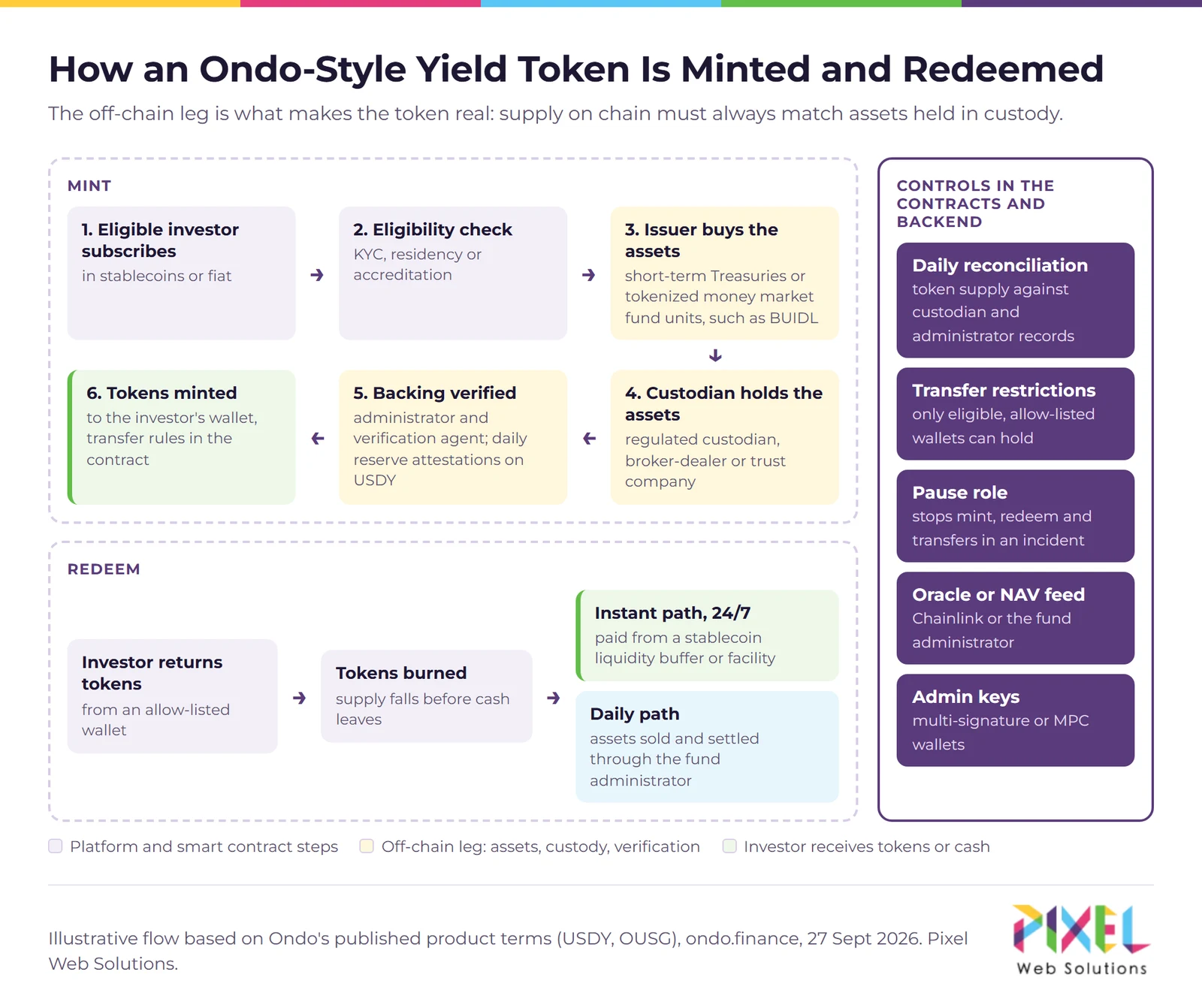
Tokens are minted when eligible investors subscribe and burned when they redeem, with eligibility checks built into the flow.
-
Tokens can move across supported blockchains, and some can be used as collateral in DeFi or on Ondo's own apps.
Ondo Finance in Numbers (September 2026)
| Metric | Figure | Source and date |
|---|---|---|
| Distributed tokenized assets | $3.88 billion, #2 platform overall (10.0% share) | RWA.xyz, 27 Sept 2026 |
| Holders | 505,004 | RWA.xyz, 27 Sept 2026 |
| Tokenized treasuries | $2.92 billion, #1 platform (19.9% share) | RWA.xyz, 27 Sept 2026 |
| Tokenized stocks | $868.7 million, #1 platform (27.6% share) | RWA.xyz, 27 Sept 2026 |
| TVL on DefiLlama | $3.53 billion | DefiLlama, 27 Sept 2026 |
| Chains with most Ondo value | Ethereum 50.5%, Stellar 13.5%, Solana 13.0%, BNB Chain 10.9% | RWA.xyz, 27 Sept 2026 |
Trackers measure slightly differently, so quote one source consistently in your own investor materials.
How Ondo Structures Its Products: Backing, Custody and Who Can Buy
This is where most "Ondo clone" guides stay vague, and it is the part that decides your legal costs and your market. Ondo runs three different product designs.
| Product | What it is | Legal wrapper | Who can buy | Key terms (Ondo's own pages) |
|---|---|---|---|---|
| USDY | Yield-bearing token backed by short-term US Treasuries and bank deposits | Debt issued by a bankruptcy-remote entity under a continuous Regulation S offering | Non-US individuals and organizations | 3.60% APY and $2.20 billion TVL shown; daily reserve attestations; accumulating (USDY) and rebasing (rUSDY) versions |
| OUSG | Tokenized short-term US Treasuries fund | Limited partnership interests in Ondo I LP (Delaware), Regulation D Rule 506(c) | Accredited investors who are qualified purchasers | 0.15% management fee cap, waived until 1 January 2027; $5,000 minimum for instant mint; holds BUIDL and other tokenized money market funds; $319.82 million TVL shown |
| Ondo Stocks (formerly Ondo Global Markets) | Tokens tracking 450+ US stocks and ETFs | Tokens fully backed by the underlying shares held with US broker-dealers or national trust companies, with a verification agent and a security agent | Eligible non-US persons only | Minting and redemption 24/5, and 24/7 for six of the most traded assets |
Two design choices stand out. First, OUSG holds other managers' tokenized funds, including BlackRock's BUIDL, so a platform like Ondo can be built on top of existing tokenized products instead of buying T-bills directly. Second, Ondo Stocks follows what the SEC staff called a third-party custodial model in its January 2026 statement on tokenized securities: the token is an entitlement to shares held in custody, not a share issued by Apple or Tesla.
Ondo's Regulatory Milestones
- October 2025: Ondo completed its acquisition of Oasis Pro, gaining an SEC-registered broker-dealer, an alternative trading system and a transfer agent.
- December 2025: Ondo announced that the SEC had closed its multi-year investigation without charges. The probe had examined its tokenized Treasury products and whether the ONDO token was a security.
- July 2026: Oasis Pro Markets received FINRA authorizations to offer tokenized equities and funds to US institutions and retail investors.
- July 2026: instead of launching the separate Ondo Chain layer 1 announced in 2025, Ondo introduced the Ondo Network, an execution layer that runs trades in secure hardware enclaves and settles on public blockchains. Its first app is Ondo Perps, a perpetual futures venue.
Why Create an RWA Tokenization Platform Like Ondo Finance?
The rise of real-world asset tokenization is creating room for new issuers and platforms. Before you start, it helps to know why the Ondo model in particular is worth studying and where its demand comes from.
Market Statistics Behind the Ondo Model
Tokenized US Treasuries reached $14.69 billion of distributed value across 85,050 holders, paying a 7-day APY of 3.53% as of 27 September 2026. Tokenized stocks reached $3.14 billion. Across all categories, RWA.xyz tracks $38.6 billion of distributed tokenized assets, with Ondo holding 10.0% of it.
Proven Demand for Yield-Bearing Tokens
Stablecoins now total about $306 billion on RWA.xyz, and most of them pay holders nothing. Tokens like USDY give non-US users and DeFi protocols a way to hold dollars that earn Treasury yield, which is why this category keeps growing.
Rising RWA Tokenization Demand
Asset managers such as BlackRock, Franklin Templeton, WisdomTree and Fidelity now issue tokenized funds. A platform that packages, distributes or builds on top of these products can serve investors those managers do not reach directly.
Global Outreach
Blockchain distribution is not limited by geography, but access is. Ondo's own products are split by investor location and type, and your platform must enforce the same kind of rules in its smart contracts and onboarding.
Discover How RWA Tokenization Can Transform Your Business Model
Understand how tokenized assets create new revenue streams and improve liquidity across industries with the right platform approach.
Choosing Your Product Wrapper: A Decision Framework
Most competitors describe the build process but skip the first decision: which product wrapper you can legally offer to your investors. Use this framework before scoping the software.
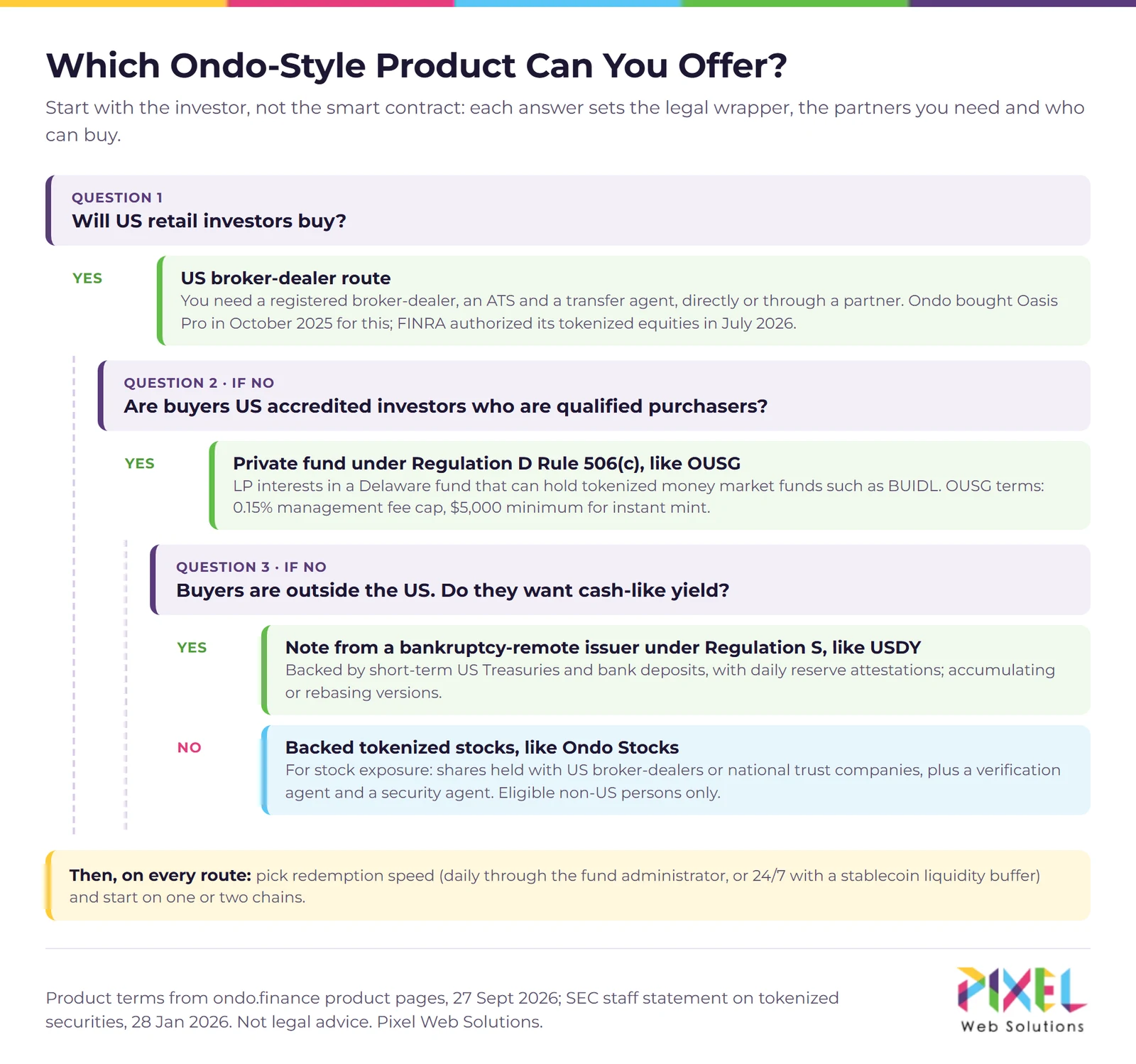
- Who are your investors? US accredited or institutional investors point to a private fund under Regulation D, like OUSG. Non-US retail and institutions point to a note or fund under Regulation S, like USDY, or an offshore fund under local rules.
- What exposure do they want? Cash-like yield points to Treasuries or tokenized money market funds. Equity exposure points to backed tokenized stocks, which need a broker-dealer or trust company to hold the shares.
- Will US retail investors buy? Then you need a registered broker-dealer, an ATS and a transfer agent, directly or through a partner, which is exactly why Ondo bought Oasis Pro.
- How fast must redemptions be? 24/7 instant redemption needs a stablecoin liquidity buffer or facility; daily redemption can settle through the fund administrator.
- Which chains do your investors use? Start with one or two (Ethereum plus the chain your users already hold stablecoins on) and add bridging later.
The Economics of a Yield Token: A Worked Example
Ondo's pricing shows how thin margins are in tokenized treasuries. Here are two ways a platform can earn on $250 million of assets. The OUSG fee cap is Ondo's published term; the other inputs are planning assumptions.
| Model | Calculation | Annual revenue |
|---|---|---|
| Management fee (OUSG-style) | 0.15% × $250,000,000 | $375,000 |
| Same fee while waived as a growth offer | 0% × $250,000,000 | $0 |
| Yield spread (note-style) | Reserves earn 3.90% (assumption), holders receive 3.60% (USDY's shown APY): spread 0.30% × $250,000,000 | $750,000 |
Now set that against running costs. If custody, fund administration, audit, attestation, verification agent, legal and engineering cost $1.2 million a year (an assumption for a lean team), then:
- Under a 0.15% fee, break-even needs $1,200,000 ÷ 0.0015 = $800 million of assets.
- Under a 0.30% spread, break-even needs $1,200,000 ÷ 0.0030 = $400 million of assets.
That is why Ondo pursued scale across many chains and products before charging full fees, and why new entrants often start by distributing or wrapping existing tokenized funds rather than launching their own from day one.
Development Methods to Create a RWA Tokenization Platform like Ondo Finance
You can create an RWA tokenization platform in three main ways. Each suits different budgets, timelines and regulatory plans, so pick the one that fits your business needs.
Create an RWA tokenization platform MVP
The Minimum Viable Product (MVP) of an Ondo Finance-like platform includes only the essential features. It usually covers one product, investor onboarding with KYC, subscription and redemption flows, smart contract token issuance with transfer restrictions, and basic admin dashboards. Launching an MVP shows you the platform's strengths and business results before a larger investment.
Why Pick a RWA Tokenization Platform MVP
-
Lower initial investment ($25,000 to $50,000 with Pixel Web Solutions)
-
Faster time-to-market (8 to 12 weeks)
-
Easier to test your product structure with partners and regulators
White-label Ondo Finance Software
White-label Ondo Finance software is a pre-built, tested RWA tokenization platform that you can configure and launch quickly. It includes issuance, investor onboarding, subscriptions and redemptions, yield distribution and admin controls, modelled on the Ondo business model.
The white-label software can then be customized with extra features, your own UI/UX and product-specific smart contract logic. This lets you build your own brand on a proven model instead of starting from zero. Our guide to a white label tokenization platform explains what to check before you buy.
Why pick a White Label Ondo Finance Software
-
Pre-built RWA smart contracts with mint, redeem and transfer controls
-
Institutional-grade compliance modules
-
Built-in revenue models
Ondo Finance-like tokenization platform from scratch
In this method, the platform is built from scratch with a modern tech stack. It gives complete control over the architecture, compliance logic, product design and institutional integrations.
Compared with the other methods, a custom build takes longer (16 to 24 weeks) and costs more ($100,000 to $150,000+), so it suits firms with partners and products already lined up.
Why pick the custom solutions method?
-
Scalability for institutional partnerships
-
Higher long-term valuation
-
Complete customization
Turn Your Asset Ideas Into a Scalable Tokenization Strategy
Identify the right assets, structure, and compliance approach to build a future-ready RWA tokenization platform.
How to Develop an Ondo Finance-Like RWA Tokenization Platform?
Building an RWA tokenization platform similar to Ondo Finance needs a structured process. Here is an end-to-end, ten-step roadmap to build a scalable ecosystem.
- Roadmap creation
- Choice of asset and tech stack
- Legal and regulatory structuring
- UI/UX design
- Smart contract development
- Asset tokenization engine
- Platform development
- Quality assurance
- Platform launch
- Post-launch support
STEP 1: Roadmap Creation
Before the project starts, create a full roadmap for the development. Working with the development team on it lays a strong foundation for business planning and avoids confusion midway.
Key actions of this phase:
-
Milestone creation
-
Defining the product and asset categories
-
Outlining the revenue model (fee, spread or both)
-
Choosing custody, administration and distribution partners
STEP 2: Choice of Asset & Tech Stack
Choosing the right technology stack plays a critical role in the success of a tokenization platform. Weak choices lead to performance limits, security gaps and lost user trust.
A tokenization platform must be scalable, secure and ready to integrate new chains and partners, so selecting the stack is a strategic decision, not just a technical one. At the same time, pick your first asset category based on your jurisdiction's rules, investor demand and the custodians available to you.
Key actions of this phase:
-
Finalizing the tech stack modules and target blockchains
-
Confirming the first asset categories and their data sources (NAV, prices, reserves)
STEP 3: Legal & Regulatory Structuring
Even when tokens move on public blockchains, the product is regulated. Settle securities law treatment, offering exemptions, licensing or partner arrangements, tax structuring, investor eligibility rules and custody agreements before building the contracts.
Key actions of this phase:
-
Selecting the legal wrapper (fund, note or backed token) and jurisdiction
-
Agreeing roles with custodian, administrator, transfer agent and broker-dealer partners
-
Obtaining any required licences or registrations
STEP 4: UI/UX Design
A well-built UI/UX simplifies the complexity of an RWA tokenization platform. It should make eligibility, yield, fees and redemption terms clear, which builds trust and engagement.
Key actions of this phase:
-
Designing user-friendly admin and investor dashboards
-
Ensuring responsive, cross-device compatibility
-
Optimizing the subscription and redemption journey
STEP 5: Smart Contract Development
The smart contracts handle token minting and burning, transfer restrictions, yield accrual or rebasing, compliance checks, pausing and redemption. Price and NAV data usually come from oracles such as Chainlink or from the fund administrator.
Key actions of this phase:
-
Finalizing token features (accumulating or rebasing yield, cross-chain support)
-
Encoding compliance rules and admin roles
-
Commissioning an independent smart contract audit
STEP 6: Build Asset Tokenization Engine
The asset tokenization engine is the platform's backbone. It links each token to its underlying assets, keeps on-chain supply in line with off-chain holdings, and manages the asset lifecycle from subscription to redemption.
Key actions of this phase:
-
Integrating custodian, administrator and reserve data
-
Enabling fractional ownership and supply reconciliation
-
Managing distributions, redemptions and corporate actions
STEP 7: Platform Development
After the smart contracts, the core platform is developed. Investor, issuer and admin dashboards are built, payments and wallets are integrated, and security modules are completed.
Key actions of this phase:
-
A feature-integrated dashboard is created
-
The core platform is finalized and ready for testing
STEP 8: Quality Assurance
A rigorous QA process is crucial, because a minor flaw can cause reputational damage and financial loss. Testing covers unit, integration, system and user acceptance tests.
In short, quality assurance turns a working product into trusted financial infrastructure.
Key actions of this phase:
-
Load testing to validate scalability
-
Penetration testing to confirm security
-
Dry runs of mint, redeem and pause scenarios
STEP 9: Platform Launch
The platform is launched for eligible users on web and, where useful, mobile apps.
Key actions of this phase:
-
Core platform goes live
-
Final contract deployments are verified
-
Monitoring and alerting are switched on
STEP 10: Post-Launch Support
A tokenization platform needs continuous support for long-term success. Post-launch services keep performance smooth, resolve issues quickly and keep the platform secure as markets and rules change.
Key actions of this phase:
-
Continuous monitoring and performance optimization
-
Regular updates, new chains and new products
-
Technical support and user assistance
Features to be integrated in Ondo Finance-like RWA Tokenization Platform
Here are the core features to include, organized by dashboard.
Investor Dashboard Features
-
Secure Registration: compliant onboarding with identity verification and accreditation or residency checks.
-
Investor Profile Management: manage personal details, wallet addresses and compliance status.
-
Asset Marketplace View: see each tokenized product with yield, fees, backing, custodian and risk details.
-
Subscription and Redemption Module: subscribe to and redeem products directly from the dashboard, in stablecoins or fiat.
-
Transaction History: detailed logs of subscriptions, transfers and redemptions.
-
Crypto Wallet Integration: connect self-custody or custodial wallets for deposits, withdrawals and transfers.
-
Notifications & Alerts: real-time alerts on transactions, yield changes and platform activity.
-
Multi-device Accessibility: access from desktop, tablet and mobile.
Admin Dashboard Features
-
User & Role Management: control access for investors, issuers and internal teams.
-
KYC/AML Verification Management: monitor verification workflows and compliance flags.
-
Asset Approval System: review and approve products before token issuance.
-
Revenue Configuration Panel: manage issuance, management, transaction and redemption fees.
-
Reserve and Backing Monitor: reconcile token supply against custodian and administrator records every day.
-
Blockchain Monitoring: track on-chain transactions and detect anomalies.
-
Liquidity Management: manage stablecoin buffers and liquidity pools for instant redemptions.
-
Risk Assessment: detect suspicious activity and threats in real time.
How To Make Money With the Ondo Finance-like RWA tokenization platform?
-
Management Fees: a yearly percentage of assets, like OUSG's 0.15% cap.
-
Yield Spread: the difference between what reserves earn and what holders receive on note-style products.
-
Asset Issuance Fees: a one-time fee to issuers for onboarding and tokenizing assets.
-
Token Minting and Redemption Fees: fees for creating or redeeming tokens, often waived above set sizes.
-
Transaction Fees: a small fee on transfers or conversions.
-
Secondary Market Trading Fees: commission on trades executed on an integrated venue.
-
Custody & Wallet Service Fees: revenue from institutional custody and wallet services.
Tech Stack to Create a RWA Tokenization Platform Like Ondo Finance
An Ondo-style platform needs a stack built for security, compliance and multi-chain reach.
Blockchain Layer
Choose chains where your investors already hold stablecoins. Ondo's value sits mainly on Ethereum, Stellar, Solana and BNB Chain, and USDY alone is live on 11 networks, including Ethereum, Solana, Sui, Aptos, Arbitrum, Stellar, Sei and BNB Chain.
Smart Contract Layer
Smart contracts automate issuance, compliance and yield. They are written in Solidity (or Vyper) for EVM chains and Rust or Move for chains such as Solana, Sui and Aptos, developed and tested with frameworks like Hardhat or Foundry, and fed by oracles such as Chainlink. Our smart contract development services cover these languages.
Backend Infrastructure
The backend handles user management, compliance workflows, reserve reconciliation and data sync with custodians and administrators, using Node.js, Python or Go.
Custody & Asset Management Layer
Real-world assets need institutional custody. Options include qualified custodians and digital asset custody providers such as Fireblocks, BitGo and Anchorage Digital, plus a bank or trust company for the underlying securities.
Frontend Development
The investor and admin interfaces are built with React.js, Next.js or Vue.js.
Ondo Finance Competitors and Alternatives
If you want to position a new platform, look at who else competes for the same investors. Here are the leading tokenized treasury platforms by distributed value on RWA.xyz, 27 September 2026.
| Platform | Tokenized treasuries | Model |
|---|---|---|
| Ondo | $2.92 billion (19.9%) | Own products (USDY, OUSG) for non-US and accredited investors |
| Franklin Templeton Benji | $2.52 billion (17.2%) | Asset manager's own tokenized money market funds |
| Circle | $2.40 billion (16.4%) | Tokenized money market fund (USYC) linked to its stablecoin business |
| Securitize | $2.36 billion (16.0%) | Tokenization and transfer agent for managers such as BlackRock (BUIDL) |
| WisdomTree | $1.23 billion (8.4%) | Asset manager's digital funds |
| Superstate | $0.55 billion (3.8%) | Tokenized treasury and crypto-strategy funds |
In tokenized stocks, Ondo leads with 27.6%, ahead of bStocks (24.2%), xStocks (18.1%) and Securitize (15.9%). For a deeper look at the issuer-services model, read our guide to building an RWA tokenization platform like Securitize. For property-backed tokens and the lessons from a failed retail platform, see our guide to an RWA tokenization platform like RealT, and for on-chain private credit, our guide to a platform like Maple Finance.
Why Partner With Pixel Web Solutions for RWA Tokenization Development?
Pixel Web Solutions is a reputed RWA tokenization platform development company that has built blockchain and fintech software since 2012. Working with its developers gives you a team that understands both blockchain engineering and regulated financial infrastructure. With a pre-built white-label platform, you can launch an RWA tokenization platform quickly without compromising quality.
The team customizes the platform to your products and investors, from mint and redeem logic to reserve monitoring and multi-chain deployment. If you are exploring the full budget, read the cost to build an RWA tokenization platform, or compare it with tokenization as a service if you only need to tokenize a few assets. Build a secure, institution-ready tokenization platform with Pixel Web Solutions and gain long-term success in a competitive market.
Ready to build your RWA Tokenization Platform?
We’ll handle everything from planning to launch so you can go live faster.
Frequently Asked Questions
How long does it take to develop an Ondo Finance-like RWA tokenization platform?
It usually takes 8 to 24 weeks. An MVP takes 8 to 12 weeks, an advanced platform 12 to 16 weeks and a custom build 16 to 24 weeks. Team size, feature complexity, audits and partner integrations all affect the timeline, and legal structuring can run longer.
What are the legal requirements for launching an RWA platform?
You need a legal wrapper for each product, an offering exemption or registration (such as Regulation D or Regulation S in the US), KYC/AML, investor eligibility checks and custody agreements. US retail access to tokenized securities also needs a registered broker-dealer, ATS and transfer agent, directly or through partners.
How do you ensure security in an RWA tokenization platform?
Use audited smart contracts, multi-signature or MPC wallets for admin keys, role-based access, encryption, secure APIs, daily reserve reconciliation and regular penetration testing.
What does Ondo Finance do?
Ondo Finance issues tokens backed by real-world assets. Its main products are USDY and OUSG, which give exposure to short-term US Treasuries, and Ondo Stocks, which gives non-US investors tokens backed by US stocks and ETFs.
Is Ondo Finance regulated?
Ondo's products run under US securities exemptions (Regulation S for USDY, Regulation D for OUSG), and through Oasis Pro it owns an SEC-registered broker-dealer, ATS and transfer agent. The SEC closed its investigation into Ondo without charges in December 2025.
What backs Ondo's tokens?
USDY is backed by short-term US Treasuries and bank deposits, OUSG holds tokenized money market funds such as BlackRock's BUIDL, and Ondo Stocks are backed by the underlying shares held with US broker-dealers or trust companies. Ondo publishes backing and attestation details on each product page.
Who are Ondo Finance's competitors?
In tokenized treasuries, the largest competitors are Franklin Templeton Benji, Circle, Securitize (BlackRock's BUIDL) and WisdomTree. In tokenized stocks, they are bStocks, xStocks and Securitize, according to RWA.xyz data from 27 September 2026.
What happened to Ondo Chain?
Ondo announced Ondo Chain as a layer 1 blockchain in 2025. In July 2026 it introduced the Ondo Network instead, an execution layer that runs trades in secure enclaves and settles on existing public blockchains, starting with Ondo Perps.
Can I use an Ondo Finance clone script?
Yes, a clone script or white-label platform can give you the issuance, onboarding and redemption software. It does not give you Ondo's custodians, legal structures or licences, which you must arrange for your own products.
If you want to build an RWA tokenization platform like Ondo Finance, start by choosing the right product wrapper for your investors, then build the platform around it. Pixel Web Solutions can help you plan, build and launch it.