Table of Contents
Key Takeaways
- The average cost of building an RWA tokenization platform ranges from $25,000 and can go up to $150,000 and more. Based on the development approach, features, and level of customization, this might change.
- Businesses can launch faster using white-label or MVP-style solutions. On the other hand, development from scratch provides greater flexibility and control over platform functionality.
- By launching an RWA Tokenization platform, businesses can generate revenue through tokenization fees, transaction charges, asset listings, and marketplace trading activities.
Before the Web3 Era, the idea of owning a building, a painting, or even an investment fund ‘digitally’ sounded unrealistic. However, the blockchain technology made this possible with “Real World Asset Tokenization Platforms”. These platforms convert real-world assets like real estate, commodities, and financial instruments into digital tokens, allowing businesses and individuals to fully or partially own assets. This constantly increases the need for secure RWA tokenization platforms. This made many businesses explore the opportunity to launch their own real-world asset tokenization platform.
The demand for RWA Tokenization platforms raises one major question: i.e., “How much does it actually cost to build an RWA Tokenization platform in 2026?
In reality, the cost doesn’t rely on one single factor. At Pixel Web Solutions, we have gained a clear understanding and practical knowledge of factors that actually affect the cost of the RWA tokenization platform. In the past 10 years, we have worked closely with many fintech start-ups and enterprises to successfully deliver secure, RWA tokenization platforms across industries like real estate, art, and commodities.
Based on our hands-on experience and the challenges we have faced in deploying these platforms, our experts are able to provide the complete cost breakdown and guidelines for startups to build an RWA tokenization platform in 2026.
Continue reading this article to get a deep understanding on RWA tokenization platform cost analysis.
Planning to build your own RWA tokenization platform?
Our experts at Pixel Web Solutions can help you estimate the exact development cost based on your asset type, platform features, and compliance requirements
How Much Does it Cost to Develop an RWA Tokenization Platform in 2026?
On average, the cost to build the RWA Tokenization platform begins from $25,000 and can go up to $150,000 or more based on the development outlines. From our experience, here is a detailed cost estimation of developing the RWA Tokenization Platform across different development approaches.
- White Label/MVP styled RWA Tokenization Platform (Basic Features) – $25,000 to $50,000
- White Label/MVP styled RWA Tokenization Platform (Basic Features) – $25,000 to $50,000
- RWA Tokenization Platform from Scratch – $100,000 to $150,000
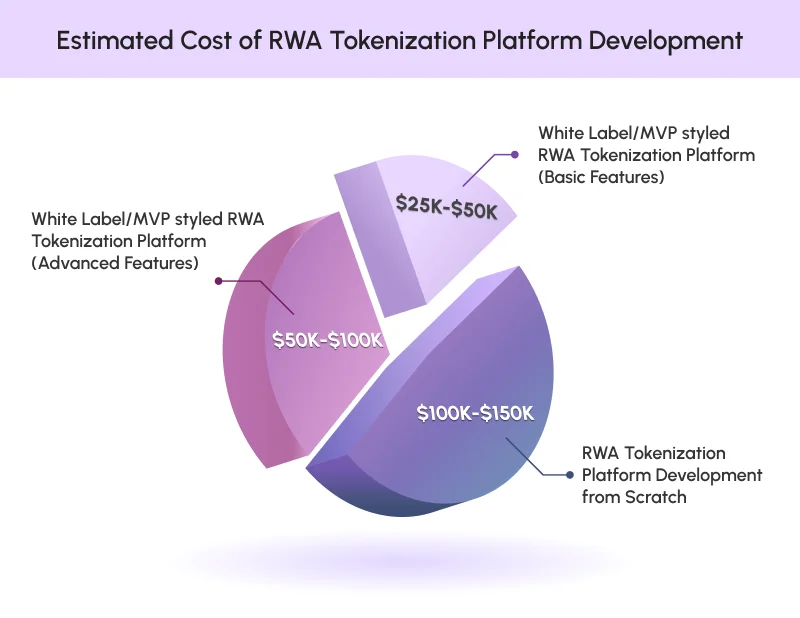
White Label/MVP styled RWA Tokenization Platform (Basic Features)
Launching a white-label RWA Tokenization platform with basic features can take around $25,000 to $50,000. This is the most cost-effective option for businesses that want to enter the tokenization market quickly. This ready-to-deploy solution can be customized according to business requirements, reducing both cost and development time.
The estimated development timeline for this model usually ranges between 8 to 12 weeks. Since the platform is built on an existing framework, this time might take for customization, UI/branding, and testing before deployment. This option is ideal for startups or businesses looking to launch a beginner-level MVP platform.
Cost to launch a White Label/MVP styled RWA Tokenization Platform (Advanced Features)
A white-label platform or MVP-style RWA tokenization platform development with advanced features can take around $50,000 to $1,00,000. This will give flexibility and more advanced functionalities for managing tokenized assets. This version may include marketplaces, advanced investor dashboards, multi-asset tokenization support, and enhanced security mechanisms.
Besides, the time taken for this model typically comes between 12 to 16 weeks, and might change based on the integrated additional features. This option works well for businesses that want a fully functional RWA tokenization platform quickly.
Cost to Build a RWA Tokenization Platform from Scratch
Developing an RWA Tokenization platform from scratch can cost around $100,000 to $150,000. As everything is built here from the ground up, this method gives more customization, scalability, and control over the architecture. Although this option requires a higher investment and development time, it allows businesses to build a fully customizable tokenization ecosystem.
The estimated development timeline usually ranges between 16 to 24 weeks. This includes stages of base planning, smart contracts, development, testing, and final deployment. This option is ideal for enterprises that are looking for a reliable platform.
Overall, developing the RWA Tokenization platform may take approximately 320–960 business hours. With an average hourly development rate of $20–$30, the total cost can vary accordingly. However, the final cost of developing an RWA Tokenization platform depends on your own unique business requirements. But this cost isn’t final, and it fluctuates by several factors.
|
Development Approach |
Estimated Cost | Time Duration | Ideal For |
| MVP Styled Platform with Basic Features | $25,000 to $50,000 | 8 – 12 Weeks |
Beginner-level businesses, startups. |
|
MVP Styled Platform with Advanced Features |
$50,000 to $100,000 | 12 – 16 Weeks | Cost-conscious businesses are looking for an advanced platform. |
| RWA Tokenization Platform Development From Scratch | $100,000 to $150,000 | 16 – 24 Weeks |
Enterprises with long-term goals and vision |
Curious about the cost of building your RWA tokenization platform?
Get a clear, tailored estimate based on your features, blockchain choice, and compliance requirements.
Factors that Impact the Cost of Developing an RWA Tokenization Platform From Scratch
The cost to launch a Real World Asset Tokenization platform is determined by several factors. Here is a list of factors that significantly influence the cost of developing an RWA tokenization platform from scratch.
Developer Expertise
The developer’s expertise is one of the primary influencing factors. Building an RWA tokenization platform requires developers who are proficient in blockchain, smart contracts, token standards, and secure backend infrastructure.
Team Size
The development team size will also have a strong say in the budget. From the blockchain developers to UI/UX designers, everyone is essential. Larger teams can extend development timelines, while smaller teams may reduce costs but extend the project delivery timeline.
Tech Stack
The choice of technologies will also impact the budget. A robust tech stack ensures performance, scalability, and security. Components of frontend frameworks, backend technologies, database systems, cloud infrastructure, and API integrations are essential.
Blockchain/ Smart Contract Integration
Blockchain and smart contract integration are essentials of the RWA tokenization platform. Incorporating these smart contracts and blockchain can have complexities based on your business goals. The cost might also change based on those features.
Supported Asset Type
The type of real-world asset being tokenized has a direct impact on development cost. Different asset classes have various levels of complexity, compliance requirements, and data handling needs. The more complex the asset type, the higher the development effort and cost.
Third-Party API Integrations
RWA tokenization platforms need external services for smooth operation. These include KYC/AML verifications, payment gateways, pricing oracles, and compliance tools. Integrating multiple third-party APIs increases development complexity, thereby increasing the costs.
Feature / Project Complexity
The overall complexity of the platform plays a major role in determining cost. Compared to a basic platform, a feature-rich system with advanced dashboards might demand more time and resources. As the project scope expands, both development time and cost increase.
How much does each phase of the RWA Tokenization Platform Development Cost? – A Step-by-Step Breakdown
RWA tokenization platform development goes on with multiple stages. Here is a phase-by-phase cost breakdown on how to build a reliable RWA Tokenization Platform
Market Research
Every successful RWA tokenization platform begins with market research. The businesses here will analyze industry demand, asset classes, competition, and legal requirements. This phase generally takes up a smaller share of the budget, estimated at around $2,000 to $5,000.
Architecture Designing
Next comes the designing phase. This stage involves outlining the platform infrastructure, database architecture, API, and security frameworks. This phase falls somewhere around the $15,000 to $30,000 range, depending on the complexities.
Blockchain Integration
This is an important aspect of your Real World Asset Tokenization Development. This process involves setting up blockchain nodes, wallets, token standards, etc. This typically requires an investment ranging from $8,000 to $20,000, depending on the complexity of the project.
Smart Contract Development
Incorporating smart contracts is essential for the RWA tokenization platform. Based on specific business needs, developers create contracts to handle token issuance, ownership rights, and other core functions. This typically requires an investment ranging from $8,000 to $15,000, depending on the customization level.
Platform Development
Platform development is the most important stage in the RWA Tokenization Platform Development Journey. This phase typically takes up the major cost ranging from $15,000 to $40,000. From investor dashboards, asset listing modules, and admin panels, to API integrations, everything is incorporated here.
Asset & Account Manager
The asset and account management feature includes functionalities such as asset onboarding, asset verification, portfolio tracking, and transaction history monitoring. This module costs between $5,000 and $15,000, ensuring that the platform runs smoothly and securely.
Regulated Compliance
Since RWA tokenization deals with financial assets, regulatory compliance is important. However, the cost for implementing basic-level regulatory compliance features starts from $5,000 to $20,000. Based on your targeted niche, you would need to look out for the rules and laws.
Deployment & Maintenance
This phase focuses on launching your RWA tokenization platform and ensuring its smooth operation after deployment. We handle server setup, cloud/smart contract deployment, and platform configuration. Beyond launch, we provide ongoing maintenance services and bug fixes, which might come at an estimated cost of $8,000 to $16,000.
Cost Analysis Based On The Feature Integration Of the RWA Tokenization Platform
The cost of developing an RWA tokenization platform is largely influenced by the features integrated into the system. Incorporating the listed features can impact the final cost,
Incorporating the listed features can impact the final cost,
|
Features |
Estimated Cost |
| Token Management System |
$3,000 to $6,000 |
|
Smart Contract Development |
$5,000 to $8,000 |
| Investor Dashboard & User Interface |
$2,000 to $5,000 |
|
Marketplace Integration |
$2500 to $5000 |
| Wallet & Payment Gateway Integration |
$1,000 to $3,000 |
Token Management System – This feature helps you create, control, and manage your digital tokens on the platform. With this feature, you can effortlessly create, track, distribute, and manage tokens.
Smart Contract Development – The smart contracts help in automating the creation, distribution, and management of tokenized assets. They ensure that all transactions follow predefined rules without requiring any intervention of intermediaries.
Investor Dashboard & User Interface – An RWA platform needs a user-friendly dashboard where investors can explore tokenized assets, view investment opportunities, track portfolio performance, and manage transactions.
Marketplace Integration – A built-in marketplace allows investors to buy and sell tokenized assets after the initial issuance. This improves asset liquidity, which is one of the key advantages of tokenization.
Wallet & Payment Gateway Integration – Investors must be able to store, transfer, and transact tokenized assets securely. Wallet integration allows users to connect crypto wallets or custodial wallets directly with the platform.
Country-Based Cost Analysis to Build RWA Tokenization Platform Development
The geographical location of the development team and your area of operation play an important role in determining the overall development cost. Regions like North America usually charge higher hourly rates due to living costs and operating expenses. Development teams in countries like India, Eastern Europe, or Southeast Asia offer competitive pricing while maintaining strong technical expertise. Here is a quick glance at the average rate charged in the top countries
Here is a quick glance at the average rate charged in the top countries
|
Geographical Location |
Estimated Hourly Rate |
| UAE & Other Middle Eastern Countries |
$60 – $100 / hour |
|
North America |
$100 – $200+ / hour |
| HongKong |
$80 – $150 / hour |
|
India & Other Asian Countries |
$20 – $30 / hour |
| European Countries |
$70 – $150 / hour |
|
Australia |
$80 – $140 / hour |
| Japan |
$40 – $60 / hour |
|
Germany |
$80 – $130 / hour |
Licensing and Regulatory Costs To Launch an RWA Tokenization Platform
Legal and regulatory compliance is another important factor when launching an RWA Tokenization platform. As the platform deals with real-world assets and digital investments, it must comply with regional financial regulations. Obtaining licenses may involve legal documentation, financial checks, and registration with essential financial authorities. The cost here can take around $15,000 to $40,000, depending on your business needs.
Based on the area of operation and the paperwork, the cost is determined. These licensing requirements ensure that the platform operates legally while protecting both investors and asset issuers. However, the process can involve legal consultation fees and regulatory filing costs. In addition, ongoing compliance expenses must be considered as part of the overall budget.
Marketing & Promotional Costs for an RWA Tokenization Platform
Beyond launching the RWA Tokenization Platform, a successful platform requires strong visibility, and that requires a strong marketing strategy. The marketing cost for these kinds of fintech platforms may go high as they require a unique and niche target audience to engage. The RWA tokenization marketing cost can be split up for activities such as
- Digital promotions
- Social media campaigns
- Content marketing
- PR outreach
- Community building
- Paid advertisements
- Blockchain sponsorships
- Influencer collaborations and email marketing campaigns.
Besides, the promotional cost of RWA tokenization can take around $30,000 to $60,000, depending on your requirements. Promotional strategies will help in building trust in the platform. Since tokenized assets rely on investor participation, allocating the proper budget is essential.
While all these factors might directly influence the cost, there are also some hidden costs that might add up. Understanding these additional expenses is essential for better budgeting,
Hidden Costs Involved in RWA Tokenization Platform Development
Here is a list of some of those additional boosters that may add up to the cost of developing the RWA Tokenization Platform.
- KYC/AML Compliance – Compliance mechanisms like KYC/ AML verification are important for platforms dealing with tokenized real-world assets. But implementing these features may add to the initial development cost.
- Third-Party Integrations – The RWA Tokenization platforms rarely function alone. For a seamless experience, they require integration with external tools, which may require additional budget.
- Token Management – The RWA token platform must be able to manage tokens easily. Maintaining these functionalities may require additional infrastructure, updates, and administrative tools.
With these hidden costs in mind, it is also important to understand the common mistakes that can further increase the overall development budget.
Common Mistakes That Increase RWA Tokenization Development Cost
While planning the budget of the RWA tokenization platform development, many businesses unintentionally increase their costs due to poor planning. Avoiding these can help optimize your budget, ensuring a smoother development process.
- Lack of Clear Project Requirements – Starting development without a proper roadmap leads to frequent changes. These changes can result in rework, extended timelines, and increased costs.
- Fix – So, having a clear understanding of features, users, and goals from the beginning helps avoid unnecessary expenses.
- Ignoring Regulatory Compliance – RWA tokenization platforms deal with real-world assets and financial transactions, making compliance risky. Delaying legal and regulatory planning can lead to costly revisions later in the development process.
- Fix – Partner with a professional crypto token development company to address the compliance needs at the initial stage.
- Overbuilding Features – Many businesses attempt to launch with a fully feature-rich platform from the start. Adding too many advanced features initially increases development time and cost.
- Fix- Try, starting with a minimum viable product (MVP) and scale gradually to a more cost-effective approach.
- Choosing the Wrong Tech Stack – Selecting an unsuitable blockchain network or tech stack can lead to issues. This might increase the operational costs. In some cases, businesses may need to rebuild or migrate their platform, increasing expenses.
- Fix – Based on your business needs, choosing the right tech stack from the beginning is essential.
- Poor Integration Planning – RWA platforms rely on many third-party services such as KYC/AML providers, payment gateways, and oracles. Lack of proper planning for these integrations can cause delays and increase development costs.
- Fix – Plan all required integrations during the initial project phase. Identify reliable third-party providers to avoid delays and reworks, to keep development costs under control.
Why Businesses Should Consider Launching an RWA Tokenization Platform in 2026?
RWA Tokenization platform development offers businesses an opportunity to digitize real-world assets. Here is a list of some of the justifiable reasons to back it up,
- Fractional Ownership – Traditionally illiquid assets like real estate or collectibles can be divided into digital tokens. This makes them easier to buy, sell, and trade in smaller portions.
- Easy Access – High-value assets can be split into small units, allowing multiple investors to own a share of the same asset.
- Zero Risks – The blockchain records every transaction securely, reducing fraud risks with clear ownership records.
- Large Investor Base – Tokenized assets can be accessed by investors from different regions, reaching a wider investor base.
- Smart Contracts – The codes automate processes such as token issuance, transfers, and payouts, making asset management faster and more efficient.
RWA Market Statistics & Insights
- According to a report, “Real-World Assets in Onchain Finance” by RedStone, Gauntlet, and RWA.xyz, cited by CoinDesk, the RWA tokenization market could reach $30 trillion by 2034.
- As the report suggests, the RWA tokenization market has grown by around 380% in the last three years. Reaching nearly $25,000 billion in a month clearly shows the rapid growth of tokenized assets.
- An article published by ‘Redstone’ confirms that Ethereum remains the primary blockchain for RWA tokenization. This holds above 59% of the total tokenized asset market.
Why choose Pixel Web Solutions to launch your own RWA Tokenization Platform?
Pixel Web Solutions is a professional RWA tokenization platform development Company. Together, we will see a major change in how real-world assets are owned, traded, and accessed. Besides, the RWA tokenization is right at the center of this transformation. Pixel Web Solutions will help businesses enter and lead this evolving market with confidence. With 12+ years of industry experience and 560+ successful project deliveries, we bring a proven approach to RWA tokenization platform development.
Pixel Web Solutions offers end-to-end RWA tokenization development services tailored to multiple industries, including:
- Liquidity Integration
- Oracle Integration
- RWA Tokenization Development
- Tokenomics Creation & Design
- Legal Advisory Support-
- Smart Contract Creation & Auditing
- Wallet & Payment Integration
We have also successfully delivered RWA and blockchain-based solutions across global markets, including Hong Kong, Europe, and China. We have helped businesses launch scalable and compliant platforms. By combining deep industry knowledge with advanced blockchain technologies, we ensure your platform is secure, scalable, and ready for real-world adoption.
Ready to launch your RWA tokenization platform?
Partner with Pixel Web Solutions to build a secure, scalable, and compliant solution tailored to your business goals.
FAQs – Frequently Asked Questions
- What is an RWA Tokenization Platform?
An RWA Tokenization platform is a digital platform that converts real-world assets such as real estate, commodities, artwork, or financial instruments into blockchain-based tokens.
- What types of assets can be tokenized on an RWA platform?
An RWA Tokenization platform can support a wide range of assets, including real estate, precious metals, artwork, commodities, investment funds, bonds, and intellectual property. Any asset with ownership and value can be tokenized.
- Is RWA Tokenization legal?
Yes, RWA tokenization often involves financial and regulatory compliance requirements. Platforms may need to follow regulations such as KYC, AML, and security token regulations, depending on the country where the platform operates.
- What blockchain networks are commonly used for RWA Tokenization platforms?
RWA platforms are usually built on popular blockchain networks such as Ethereum, Polygon, Binance Smart Chain, and Solana.
- Can RWA Tokenization platforms support fractional ownership?
Yes, fractional ownership is one of the key advantages of tokenization. High-value assets can be divided into multiple tokens, allowing several investors to own smaller portions of the same asset.
- Is it better to build an RWA platform from scratch or use a white-label solution?
Both approaches have advantages. White-label platforms are faster and more cost-effective for businesses looking for quick market entry. While development from scratch offers customization and control over platform features.