







The difference in utility tokens vs security tokens comes down to what the buyer is paying for. A utility token gives access to a product, service or network and is bought to be used; a security token represents an investment, such as equity, debt, fund units or a share of profits, and is regulated as a security. In 2026 the label you choose does not decide the question: regulators look at the economic substance, using the Howey test in the US, MiCA and MiFID II in the EU, and VARA, ADGM and the UAE Capital Market Authority in the Emirates.
The crypto token world keeps growing, so understanding the different types of crypto tokens is essential for businesses and investors. Not all tokens are created equal or for the same purpose. Some support platforms and engage users. Others represent investments and ownership in real-world assets, a market that RWA.xyz puts at $39.19 billion of distributed tokenized assets as of 16 October 2026.
The rules also changed sharply over the past year. The US Securities and Exchange Commission (SEC) published a formal five-category token taxonomy in March 2026, and in August 2026 proposed new exemptions for token offerings. This guide explains the characteristics and use cases of both token types, the 2026 rules in the US, EU and UAE, and a classification checklist you can run before you build.
Key Takeaways
- Purpose decides the type: utility tokens are bought to use something; security tokens are bought as an investment with an expectation of profit from others' efforts.
- The US now has a written taxonomy: the SEC's March 2026 interpretive release sorts crypto assets into digital commodities, digital collectibles, digital tools, stablecoins and digital securities. Only digital securities are securities by default.
- The label can change over time: under the SEC release, a non-security token sold with promises from its issuer can be subject to an investment contract, and can later stop being subject to one.
- The EU separates three MiCA categories from securities: e-money tokens, asset-referenced tokens and other crypto-assets (including utility tokens) fall under MiCA, while tokens that qualify as financial instruments fall under MiFID II.
- The UAE has layered rules: VARA licenses Category 1 issuance in Dubai, ADGM's FSRA treats digital securities as securities, and the federal Capital Market Authority replaced the SCA on 1 January 2026.
- Build cost differs: Pixel Web Solutions prices token development from $3,500 and single-asset security token (RWA) issuance from $6,000, with compliance features adding to the security token budget.
What are Utility Tokens: A Detailed Overview
Utility tokens, also known as user tokens, are crypto tokens that give holders access to a product, service, feature or network. They are built on blockchain platforms to carry out actions, and they act like a key or prepaid credit within the blockchain ecosystem. Utility tokens are not designed primarily as investments; they are tools that run the internal economy of a project.
Characteristics of Utility Tokens
-
Utility tokens work like digital keys, giving holders access to products, services or platforms within a blockchain ecosystem.
-
They act as the payment unit for transactions within the network, such as fees or service credits.
-
Projects use them to reward community members and participants for contributing to the network's growth.
-
They do not give ownership in the issuing company. Their value is tied to the use case and demand for the service.
-
They help run operations like validating transactions, paying gas or interacting with dApps through smart contracts.
-
Many also work as governance tokens, letting holders vote on protocol changes. Governance rights alone are not ownership, but governance plus a share of protocol revenue can push a token toward security status.
Real-world Use Cases of Utility Tokens
-
Paying blockchain network fees and smart contract execution costs.
-
Acting as entry passes that unlock dApps, DeFi platforms or premium features.
-
Serving as in-game currency in blockchain games to buy items, skins or upgrades.
-
Staking to help secure a network or unlock premium benefits.
-
Paying creators for digital content, courses or art on decentralized platforms.
Examples of Utility Tokens
-
Ether (ETH): pays for gas on Ethereum. The SEC's March 2026 release names ETH as a digital commodity.
-
BNB: pays transaction fees on BNB Chain and trading-fee discounts on Binance.
-
Uniswap (UNI): governs the Uniswap protocol.
-
Aave (AAVE): governs the Aave lending protocol.
-
Filecoin (FIL): pays storage providers on the Filecoin network.
"Utility token" is a functional description, not a legal category. Of these five, the SEC's March 2026 list of example digital commodities names only ETH; the others still need a facts-and-circumstances analysis. With that in mind, let's move on to security tokens.
What are Security Tokens: A Detailed Overview
Security tokens are crypto tokens that represent traditional securities like stocks, bonds, fund units and other investments. They give holders rights in a valuable asset or enterprise, such as equity, debt or a share of revenue. Like traditional securities, they are regulated under financial laws, and they can carry dividends, interest and voting rights.
Characteristics of Security Tokens
-
Security tokens represent ownership or financial claims, such as company shares, bonds, real estate interests or revenue streams.
-
They aim to return value to investors through dividends, interest, profit sharing or growth in the underlying asset.
-
Like traditional securities, they can grant voting rights, equity participation or claims over profits.
-
They allow fractional ownership of high-value assets, which widens the investor base.
-
They can open cross-border investment, within the limits of each country's securities laws.
-
Smart contracts can enforce investor eligibility, transfer restrictions and corporate actions automatically, using standards such as ERC-3643 or ERC-7943.
Real-world Use Cases of Security Tokens
-
Fractional real estate, so investors can buy small shares of high-value properties.
-
Tokenized shares that replace paper stock certificates with on-chain ownership records.
-
Revenue or profit-sharing tokens that pay distributions to holders.
-
Tokenized commodities such as gold, where the structure gives holders a claim on stored metal.
-
Tokenized bonds and money market funds that pay interest and settle faster than traditional rails.
Examples of Security Tokens
Tokenized money market and Treasury funds are now the largest, most visible security tokens. According to RWA.xyz's tokenized Treasuries dashboard, as of 16 October 2026:
| Product | Issuer | Value (RWA.xyz, 16 Oct 2026) |
|---|---|---|
| USYC | Circle | $2.38 billion |
| USDY | Ondo Finance | $2.36 billion |
| BUIDL | BlackRock (issued with Securitize) | $2.17 billion |
| iBENJI | Franklin Templeton | $1.71 billion |
| WTGXX | WisdomTree | $1.06 billion |
Platforms such as Securitize and tZERO handle issuance, transfer agency and trading for security tokens. Tokenized US Treasuries alone total about $14.68 billion in distributed value on the same dashboard.
Now, let's look at the key differences between these two types of crypto tokens.
Utility Tokens vs Security Tokens: A Comparative Analysis
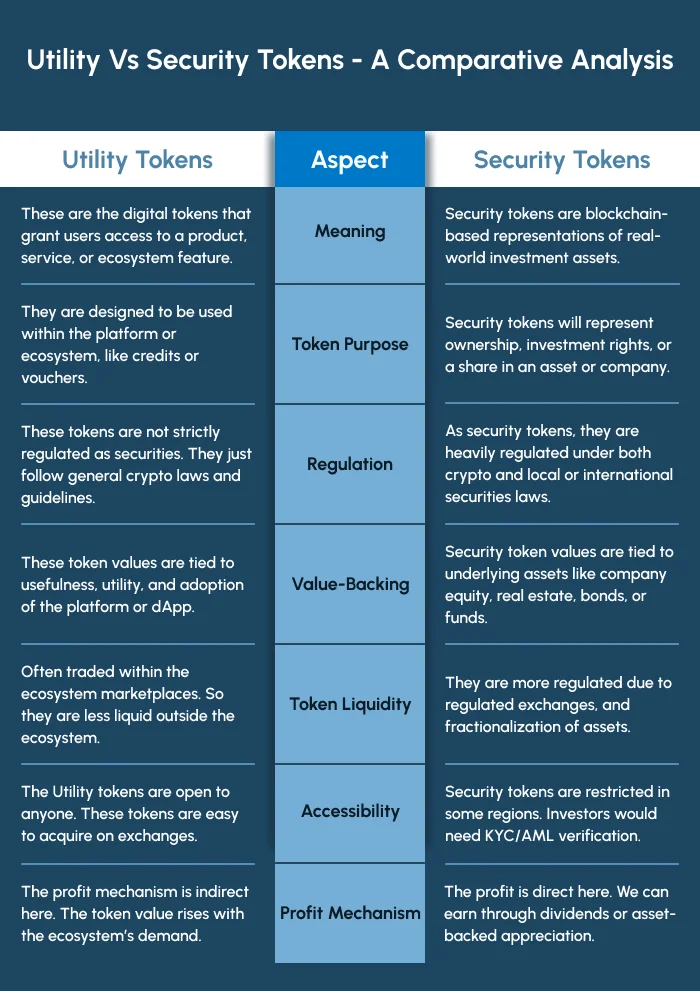
When it comes to blockchain-based assets, utility tokens and security tokens are two pillars of digital economies. Utility tokens make decentralized platforms functional. Security tokens bring investment products on-chain with regulatory protection. One drives usability; the other anchors investor confidence.
| Factor | Utility token | Security token |
|---|---|---|
| What the buyer gets | Access to a product, service or network | A financial right: equity, debt, fund units, profit share |
| Why people buy | To use it | To earn a return |
| Value driver | Demand for the service | Performance of the asset or enterprise |
| US treatment | Often a digital commodity or digital tool, unless sold under an investment contract | Security under the Securities Act; needs registration or an exemption |
| EU treatment | MiCA (crypto-assets other than ART or EMT) | MiFID II and the Prospectus Regulation |
| Dubai (VARA) treatment | Usually Category 2 issuance through a licensed distributor | Securities fall outside ordinary VA issuance and under capital markets rules |
| Investor checks | Usually light; AML rules still apply to platforms | KYC, accreditation or suitability, transfer restrictions |
| Typical token standard | ERC-20, BEP-20, SPL | ERC-3643, ERC-7943 or other permissioned standards |
| Secondary trading | Crypto exchanges | Licensed trading venues or ATSs |
The Howey Test: How US Regulators Decide
In the US, the starting point is the Supreme Court's 1946 decision in SEC v. W.J. Howey Co.. A transaction is an investment contract, and therefore a security, when there is:
- An investment of money (courts accept crypto and other consideration, not only cash).
- In a common enterprise.
- With an expectation of profits.
- Derived from the essential managerial efforts of others.
A token that fails any of the four prongs is not an investment contract on that basis. For example, a game credit bought only to spend in-game, with no promise from the developer that its price will rise, usually fails the profit prong. A token sold with a roadmap, a team promising to build value and a marketing pitch about returns usually meets all four.
The SEC's 2026 Token Taxonomy
On 17 March 2026 the SEC issued an interpretive release, Release No. 33-11412, "Application of the Federal Securities Laws to Certain Types of Crypto Assets", coordinated with the CFTC and effective 23 March 2026. It replaced the SEC staff's 2019 framework and sorts crypto assets into five categories:
| Category | What it is (per the release) | Security? |
|---|---|---|
| Digital commodities | Tokens whose value comes from the programmatic operation of a functional crypto system and supply and demand. Named examples include BTC, ETH, SOL, XRP, ADA, AVAX, LINK, DOT, XLM and DOGE | No |
| Digital collectibles | Art, music, NFTs, trading cards, in-game items and meme references | No |
| Digital tools | Tokens with a practical function, such as a membership, ticket, credential, title instrument or identity badge, often non-transferable | No |
| Stablecoins | Payment stablecoins issued under the GENIUS Act are excluded by statute; others need case-by-case review | Depends |
| Digital securities | Tokenized versions of traditional securities, such as stocks and bonds | Yes |
Three points from the release matter most to token builders:
- Utility now has a legal home. The release says a digital tool "does not have intrinsic economic properties or rights, such as generating a passive yield or conveying rights to future income." Most well-designed utility tokens fit here or under digital commodities.
- The sale can still be a securities offering. A non-security token can be sold subject to an investment contract when the issuer makes promises of managerial effort. The release also explains how a token can later cease to be subject to that contract.
- Hybrids exist. The release itself notes that fan tokens have hybrid characteristics and "could be classified as digital tools", so borderline designs still need legal review.
What is still proposed, not law: on 18 August 2026, SEC Chairman Paul Atkins announced a proposed Regulation Crypto Assets with a startup exemption for offerings up to $5 million over four years, a fundraising exemption up to $75 million a year, and a safe harbor that ends investment contract treatment once an issuer certifies it has stopped essential managerial efforts. It is open for public comment as of October 2026 and has no legal effect until adopted. In Congress, the CLARITY Act market structure bill stalled after a Senate cloture vote failed on 15 September 2026, as DLA Piper reported.
Legal & Regulatory Compliance of Utility & Security Tokens
When it comes to compliance, utility and security tokens stand on very different ground in each major market.
Utility Tokens
Utility tokens are generally seen as tools or keys to access a service or platform. That often keeps them out of securities law, but not out of regulation.
-
United States: most utility tokens fit the SEC's digital commodity or digital tool categories, but the way they are sold still matters. Exchanges and custodians handling them face AML, sanctions and consumer protection rules, and the CFTC can police fraud in commodity markets.
-
European Union: under the Markets in Crypto-Assets Regulation (MiCA), a utility token is a crypto-asset "only intended to provide access to a good or a service supplied by its issuer." It falls in MiCA's third category (crypto-assets other than asset-referenced tokens or e-money tokens). A white paper is required for public offers, with an exemption when the token gives access to a good or service that already exists. Service providers need MiCA authorisation; the last national transition periods ended on 1 July 2026.
-
Dubai (VARA): VARA's Virtual Asset Issuance Rulebook sets three categories. Category 1 (fiat-referenced and asset-referenced virtual assets) needs a VARA licence. Category 2 covers any other virtual asset, which needs no issuer licence but must be placed and distributed through a VARA-licensed distributor. Exempt virtual assets, such as non-transferable tokens and redeemable closed-loop tokens, must not allow markets to form around them.
-
Abu Dhabi (ADGM): the FSRA's virtual asset framework treats utility tokens that do not show the features of a regulated investment as outside its regulated digital asset categories.
-
Everywhere: consumer protection, tax, data privacy (such as GDPR) and anti-money laundering rules still apply to the platforms that issue and trade them.
Security Tokens
Security tokens operate in a heavily regulated environment. A successful security token development project has to clear securities, custody and investor protection rules in each market it serves.
-
United States: the SEC's release confirms that tokenizing a stock or bond does not change its legal character. Offerings need registration or an exemption, such as Regulation D, Regulation S or Regulation A, and trading needs a registered venue such as an alternative trading system.
-
European Union: tokens that qualify as financial instruments are excluded from MiCA and regulated under MiFID II. ESMA's guidelines on qualifying crypto-assets as financial instruments apply a substance-over-form test, so the token format does not change the result.
-
UAE onshore: the Securities and Commodities Authority became the Capital Market Authority (CMA) on 1 January 2026 under Federal Decree-Laws No. 32 and No. 33 of 2025, as Latham & Watkins summarises. VARA's rulebook defines instruments that are securities under UAE capital markets law as real-world assets, so tokenized securities sit inside that federal regime.
-
ADGM: the FSRA deems digital tokens with the features of shares, debentures or fund units to be securities under its Financial Services and Markets Regulations, and every activity around them (issuing, operating a market, dealing, custody) needs FSRA authorisation.
-
Other hubs: Singapore's MAS, Japan's FSA under the FIEA, and the UK's FCA all regulate tokens that carry investment rights as securities or specified investments.
So while both token types may run on the same blockchain networks, their legal treatment is entirely different.
Classification Checklist: Is Your Token a Utility or a Security?
Most utility tokens vs security tokens guides stop at definitions. Run this checklist before you write your white paper or smart contracts. Each "yes" is a warning sign that pushes the token toward security status; three or more means you should plan for a security token structure or get a formal legal opinion before launch.
| # | Question | Why it matters |
|---|---|---|
| 1 | Will buyers pay money or crypto to the issuer or its affiliates for the token? | Howey prong 1, and an "offer to the public" under MiCA |
| 2 | Does the token give a share of revenue, profit, interest or dividends? | Passive yield removes it from the SEC's digital tool and commodity categories |
| 3 | Does it represent equity, debt or a claim on assets of a company? | A digital security in the US; a financial instrument in the EU; a security in ADGM |
| 4 | Is the product or network still unbuilt at the time of sale? | Value then depends on the team's future efforts (Howey prong 4); MiCA's white paper exemption needs an existing good or service |
| 5 | Does your marketing mention price growth, listings or returns? | Creates an expectation of profit (Howey prong 3) |
| 6 | Do token sale funds go into one pool that the team controls? | Points to a common enterprise (Howey prong 2) |
| 7 | Will the team keep a large share and promise to "support the price"? | Signals essential managerial efforts |
| 8 | Is the token pegged to a fiat currency or backed by assets? | Possible stablecoin, EMT or ART in the EU, or Category 1 FRVA or ARVA with VARA |
| 9 | Can holders resell it freely on exchanges? | Free transferability takes it out of VARA's exempt category and raises secondary market rules |
| 10 | Are you selling to retail investors in several countries? | Each jurisdiction applies its own test; the strictest one often sets your design |
A token that answers "no" to questions 2, 3, 5, 6 and 7, gives access to a working product and is sold without promises of returns is the classic utility profile. A token that answers "yes" to 2 or 3 is a security in almost every major market, regardless of what the white paper calls it.
Which is the Best Crypto Token to Develop?
The answer depends on your business model. For a successful crypto token development pathway, start with your goals, your audience and the markets you plan to serve.
If you want to power a platform or ecosystem by rewarding users or providing access, a utility token is the way to go. Utility tokens suit communities that run staking, governance and loyalty programs. With utility token development, the regulatory load is lighter, but the token still needs a working product, honest marketing and the right distribution route in each market.
If you want to raise capital and give investors a financial return, a security token is the better structure. Security tokens are a strong option for tokenizing real-world assets like equity, bonds, funds or property, and for running a compliant security token offering (STO).
Typical build costs:
| Token type | Pixel Web Solutions price | What the extra spend covers |
|---|---|---|
| Utility token | Token development from $3,500 | Smart contract, tokenomics, deployment |
| Security token (single asset) | RWA single-asset issuance from $6,000 | Permissioned token, investor eligibility rules, transfer restrictions |
| Security token platform | RWA platform MVP $25,000 to $50,000 | Issuer and investor portals, KYC, distributions, reporting |
Legal fees, audits and exchange or ATS listing costs sit on top of these figures for both token types. For a wider view of token categories, including governance, payment and NFT tokens, see the guide to the types of crypto tokens.
Both utility and security tokens have their own advantages, so choose the structure that matches how your buyers will actually use the token.
Why Pixel Web Solutions is Your Go-To Crypto Token Development Partner
Whether the project is a utility token or a security token, Pixel Web Solutions stands out as a leading crypto token development company. With years of experience and a team of skilled developers, it builds secure, compliant and scalable token solutions tailored to each business. Its in-house experts, developers and analysts help turn token ideas into working products.
From helping startups launch engaging utility tokens to supporting enterprises with investment-focused security tokens, Pixel Web Solutions provides complete guidance, from token classification and tokenomics to smart contracts, compliance features and launch. To scope your token, contact the Pixel Web Solutions token team.
Frequently Asked Questions
What is the main difference between a utility token and a security token?
A utility token gives access to a product or service and is bought to be used. A security token represents an investment, such as equity, debt or a profit share, and is bought to earn a return, so it is regulated as a security.
Can a utility token become a security?
Yes. If a token is sold with promises that the team's efforts will increase its value, the sale can be an investment contract even if the token itself is a digital tool or commodity. The SEC's March 2026 release also explains that a token can stop being subject to an investment contract once the issuer's promises are fulfilled or abandoned.
Is Ethereum a utility token or a security?
Ether works as a utility token because it pays for gas on Ethereum. The SEC's March 2026 interpretive release names ETH as an example of a digital commodity, which is not a security.
What is the Howey test?
The Howey test comes from the 1946 Supreme Court case SEC v. W.J. Howey Co. A transaction is an investment contract if it involves an investment of money in a common enterprise with an expectation of profits from the efforts of others.
How does MiCA treat utility tokens?
MiCA defines a utility token as a crypto-asset only intended to provide access to a good or service supplied by its issuer. It sits in MiCA's "other crypto-assets" category, and offers of utility tokens for goods or services that already exist are exempt from the white paper requirement.
Are security tokens legal in the UAE?
Yes, within the regulated frameworks. ADGM's FSRA treats digital securities as securities and licenses the firms that issue, trade and hold them. Onshore, tokenized securities fall under the federal Capital Market Authority, which replaced the SCA on 1 January 2026.
Which is cheaper to create, a utility token or a security token?
A utility token is usually cheaper. Pixel Web Solutions prices token development from $3,500, while a single-asset security token starts from $6,000 because it needs eligibility checks and transfer controls, and legal costs for a security offering are higher.
Conclusion
Utility tokens vs security tokens is not a branding choice; it is a legal and economic one. If buyers use the token, design it as a utility token, sell it without promises of returns and route it through the right distribution channel in each market. If buyers invest for a return, build a security token from day one with permissioned transfers, investor checks and a licensed venue. Run the checklist above, confirm the result with counsel, and your token will be built for the rules of 2026 rather than the guesswork of 2018.