








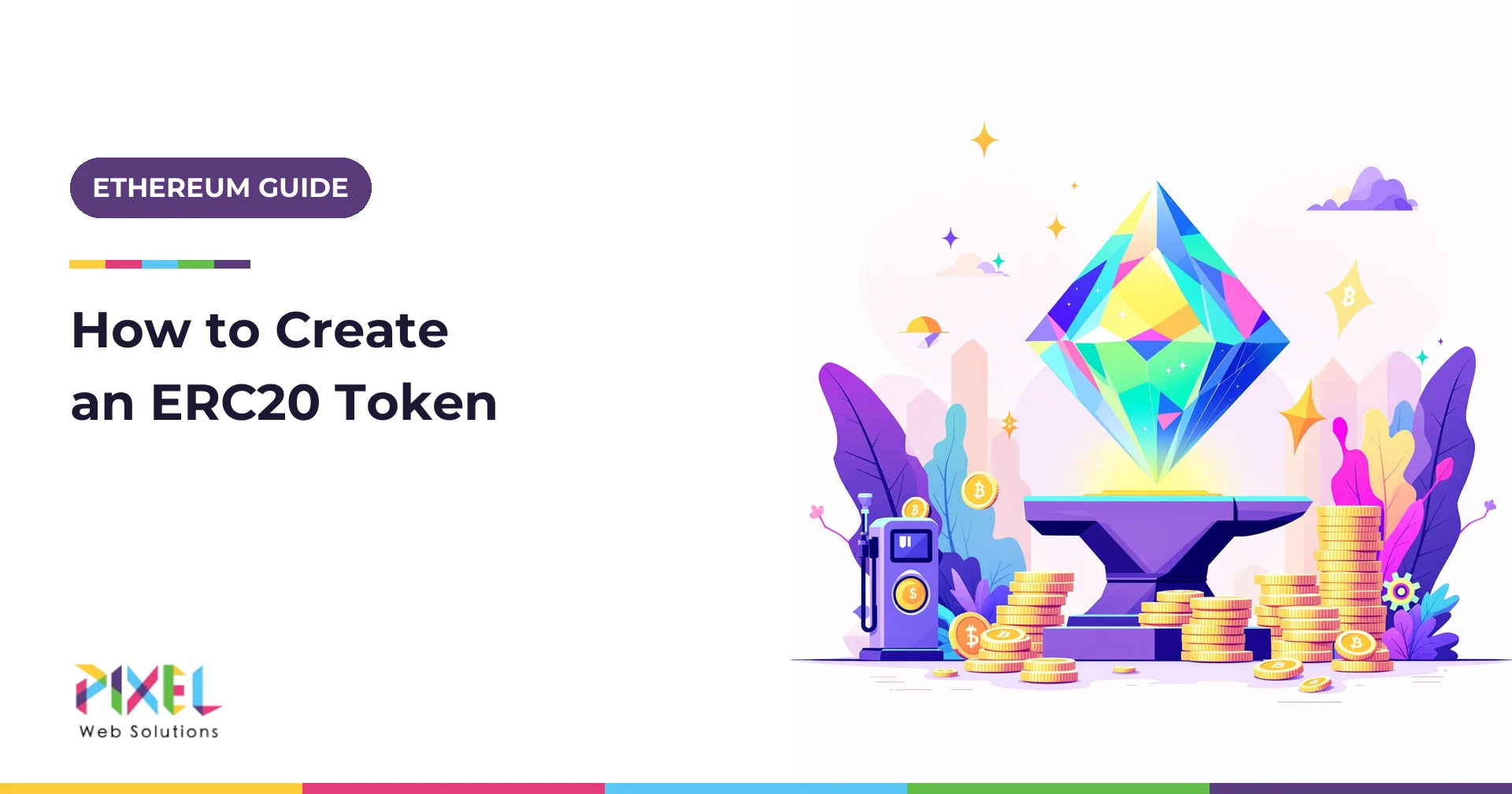
To create an ERC20 token, you plan the token's purpose and supply, write a Solidity contract (usually on OpenZeppelin's audited ERC20 base), test it on the Sepolia testnet, get it audited, and deploy it to Ethereum mainnet or an EVM layer 2. A standard ERC20 token can be built in days, and deployment gas on Ethereum cost only a few dollars in October 2026. Most of the budget goes on design, testing and the audit, not on gas.
Creating an ERC20 token is like laying a strong foundation for a digital business. ERC20 tokens have become the default format for fungible tokens across Ethereum and every EVM chain, from stablecoins to governance tokens.
With use cases like fundraising, loyalty rewards, payments and powering decentralised applications, ERC20 tokens have come a long way since the standard was proposed in 2015. So, how hard is it to learn how to create an ERC20 token with the features your project needs? No. It takes five clear steps, covered below with the 2026 tools, testnets and costs.
Key Takeaways
- ERC20 is still the default: Ethereum held about 56% of all DeFi value locked and $146 billion in stablecoins on 9 October 2026.
- Use Sepolia, not Goerli: Goerli and Holesky are retired; Sepolia is the recommended testnet for smart contract and dapp testing.
- Truffle and Ganache are gone: build with Remix, Hardhat or Foundry and OpenZeppelin Contracts 5.x instead.
- Gas is no longer the big cost: a 2.3 million gas deployment cost about $1.44 at 0.25 gwei on 9 October 2026.
- Audit before mainnet: admin keys, unlimited minting and the approve race condition cause more losses than the standard itself.
What Are ERC20 Tokens?
ERC20 tokens are fungible tokens created on Ethereum (and other EVM chains) using the ERC20 token standard. Fungible means every unit is identical and interchangeable, which is why ERC20 tokens are easy to trade, stake and hold in any wallet.
The standard was defined in EIP-20, proposed in November 2015. It specifies six functions (totalSupply, balanceOf, transfer, transferFrom, approve and allowance) and two events (Transfer and Approval). Three further fields (name, symbol and decimals) are optional but used by almost every token. Because every wallet and exchange speaks this same interface, a new ERC20 token works with MetaMask, Uniswap or a centralised exchange without custom integration.
DeFi platforms use ERC20 tokens as governance tokens, collateral, liquidity pool shares and stablecoins. If you are still choosing between chains, start with this broader guide on how to create a crypto token.
Why ERC20 Still Matters in 2026: The Numbers
The best case for the ERC20 standard is where the money sits. As of 9 October 2026:
| Metric | Value | Source |
|---|---|---|
| DeFi value locked on Ethereum | $51.4 billion, about 56% of all chains | DefiLlama |
| Stablecoins circulating on Ethereum | $146.0 billion | DefiLlama stablecoins by chain |
| USDT on Ethereum | $73.9 billion | DefiLlama Tether page |
| Ethereum gas price (public node reading) | About 0.25 gwei | Etherscan gas tracker for live values |
| ETH price | $2,498.64 | CoinGecko |
Every one of those stablecoins on Ethereum is an ERC20 token. That depth of liquidity is the main reason projects still create an ERC20 token first and bridge or redeploy to other chains later.
Major Reasons to Create ERC20 Tokens
ERC20 tokens remain the most practical choice for many projects. Thanks to Ethereum's security and the standard's universal support, they are a solid foundation for token development.
- Ethereum compatibility: ERC20 tokens plug into the largest pool of DeFi liquidity and tooling.
- Interoperability: the same contract runs on EVM layer 2s such as Base and Arbitrum, and on EVM chains such as BNB Chain and Polygon, with little or no change.
- Liquidity access: DEXs list ERC20 tokens permissionlessly, and centralised exchanges already support the standard.
- Trust: the interface is standardised and widely audited, and Ethereum's security secures every transfer.
- Rich features: extensions add vesting, burning, pausing, permit signatures and voting.
- Rewards: low layer 2 fees make ERC20 tokens practical for loyalty and reward programmes.
- Wallet support: MetaMask, Trust Wallet, Rabby, Coinbase Wallet and hardware wallets all hold ERC20 tokens.
For these reasons, ERC20 remains the easiest route for crypto token development. So, let's get into the creation process.
How to Create an ERC20 Token in 5 Steps
Here is how to create an ERC20 token in 2026, using the simple 5-step process professional teams follow.
STEP 1: Planning
The first step is to prepare a roadmap and a token specification. A clear plan avoids rework and failed deployments. Settle these points before any code:
- Identification: a clear objective for the token and the problem it solves.
- Use cases: whether the ERC20 token is for utility, governance, rewards or payments.
- Set goals: milestones and a timeline for development, audit and launch.
- Cost estimation: development, audit, legal review, liquidity and the gas fee to deploy on Ethereum mainnet or a layer 2.
- Target audience and allocation: who receives tokens, in what share, and on what vesting schedule.
STEP 2: Token Design
With the plan in place, design the token itself: name, symbol, decimals (18 is the norm), total supply, and whether supply is fixed or mintable. Decide which admin powers exist (minting, pausing, upgrades) and who holds them, ideally a multisig rather than a single key.
It helps to study what already works. This curated ERC20 token list shows popular tokens with large user bases and the design choices behind them.
STEP 3: Smart Contract Creation
Smart contracts are programs that execute predefined rules automatically. ERC20 contracts are written in Solidity (or Vyper), and most teams build on OpenZeppelin's audited ERC20 implementation rather than writing the logic from scratch. A minimal fixed-supply token looks like this:
// SPDX-License-Identifier: MIT
pragma solidity ^0.8.20;

import {ERC20} from "@openzeppelin/contracts/token/ERC20/ERC20.sol";

contract DemoToken is ERC20 {
    constructor(uint256 initialSupply) ERC20("Demo Token", "DEMO") {
        _mint(msg.sender, initialSupply * 10 ** decimals());
    }
}
The main development tools in 2026 are:
- Remix: a browser-based IDE to write, compile and deploy Solidity contracts, ideal for a first token.
- Hardhat: a JavaScript and TypeScript framework for building, testing and deploying contracts.
- Foundry: a fast, Solidity-native toolkit for testing, fuzzing and scripted deployment.
- OpenZeppelin Contracts Wizard: the Wizard generates a token contract with the extensions you tick.
Note that Truffle and Ganache, named in many older guides, were sunset by Consensys in 2023 and are now public archives. For a broader primer on contract development, see this guide on how to create a smart contract.

STEP 4: Testing
After the contract is written, test its functions, limits and admin controls. Hardhat and Foundry run local test networks, so developers can simulate transfers, approvals, minting and edge cases without spending real ETH. Foundry's fuzzing throws thousands of random inputs at each function to surface unexpected behaviour.
Static analysis tools such as Slither and the Remix static analyser flag common issues automatically. MythX, recommended by older guides, has been discontinued, although its Mythril engine remains open source.
- Smart contract auditing: an independent smart contract audit reviews the code line by line before the token holds real value.
- Security review of admin powers: check who can mint, pause or upgrade, and whether those roles sit behind a multisig and a timelock.
Automated tools catch common bugs, but only a manual audit reviews business logic. Plan for both.
STEP 5: Mainnet Deployment
After development and testing, the ERC20 token is ready for deployment.
- Testnet deployment: first deploy to Sepolia, which the Ethereum Foundation names as the recommended testnet for smart contract and dapp testing. Goerli is deprecated, and Holesky was retired in late 2025; Hoodi is meant for validator testing, not token apps. Get free Sepolia ETH from a faucet, deploy, and invite testers to try transfers and approvals.
- Mainnet deployment: once bugs are fixed and the audit is closed, deploy to Ethereum mainnet or an EVM layer 2 such as Base or Arbitrum, then verify the source code on the block explorer so anyone can read it.
Once deployed, the ERC20 token can be held, transferred and traded. Add liquidity on a DEX, publish the contract address on official channels, and submit token details to explorers and data aggregators. With a skilled Ethereum token development company, startups can create ERC20 tokens with the right features at an affordable cost.
What Does It Cost to Deploy an ERC20 Token? A Worked Example
Most guides still quote gas bills from 2021. Here is the maths with live numbers instead.
Deployment fee = gas used x gas price x ETH price.
Pixel's measured data on real mainnet deployments shows a typical ERC20 token uses 0.6 to 2.3 million gas. On 9 October 2026, a public Ethereum node returned a gas price of about 0.25 gwei, and ETH traded at $2,498.64 on CoinGecko.
| Scenario | Gas used | Gas price | ETH cost | USD cost |
|---|---|---|---|---|
| Simple token, quiet network | 600,000 | 0.25 gwei | 0.00015 ETH | $0.37 |
| Feature-rich token, quiet network | 2,300,000 | 0.25 gwei | 0.000575 ETH | $1.44 |
| Feature-rich token, busy network | 2,300,000 | 10 gwei | 0.023 ETH | $57.47 |
Even the busy-network case is small next to development and audit costs. The full budget, including audits, legal review and liquidity, is covered in the development methods section below. Remix, Hardhat and Foundry all show the estimated gas before you confirm, so you always know the figure in advance.
Essential Features of ERC20 Token Development
The ERC20 token standard defines a common set of functions. On top of those, developers add optional features to match the business model.
Token Attribute Choice
Give the token a name, symbol, decimals value and total supply. Each ERC20 token can be customised to the business needs and project specification.
Essential Functionality Integration
The core functions determine smooth and secure operation:
- totalSupply: returns the number of tokens in existence.
- balanceOf: returns the token balance of an account.
- transfer: moves tokens from the sender to a recipient.
- transferFrom: lets an approved spender move tokens on the owner's behalf.
- approve: sets how many tokens a spender may use for the owner.
- allowance: returns how many tokens a spender is still allowed to move.
- decimals: sets how divisible the token is, usually 18.
Add-On Features
- Minting: creates new tokens after deployment, usually restricted to an admin role.
- Burning: destroys tokens to reduce supply permanently.
- Pausable: lets an admin pause transfers during an emergency.
- Vesting: releases tokens to team members or investors gradually over time.
- Permit (ERC-2612): lets holders approve spending with a signature instead of a separate transaction, saving gas.
- Votes: adds vote checkpoints so the token can power on-chain governance.
- Capped or uncapped supply: fixes a maximum supply or allows open-ended minting, which holders will scrutinise closely.
Based on business needs, more features can be added. Each one should pass the same test: does the token's purpose require it?
ERC20 Security Pitfalls to Avoid
This is where many tokens fail, and where most competing guides stop short.
- The approve race condition: EIP-20 itself warns that changing an existing allowance can let a spender use both the old and new amounts. Set the allowance to zero first, or use increase and decrease patterns or permit signatures.
- Single-key admin powers: if one wallet can mint or pause, a stolen key can destroy the token. Put admin roles behind a multisig and a timelock, or renounce them once the token is final.
- Unlimited minting: a hidden or uncapped mint function is the first thing analysts and exchanges look for. Disclose it or remove it.
- Tokens sent to the contract address: users regularly send tokens to the token contract by mistake. Decide early whether to add a recovery function.
- Unverified source code: an unverified contract on Etherscan signals risk. Always verify after deployment.
What Are the Business Benefits of Creating an ERC20 Token?
Creating an ERC20 token brings real benefits to many kinds of businesses. Here are the main ones.
Revenue Generation
Ethereum's security and liquidity make ERC20 tokens a strong base for raising funds. Startups can sell tokens in a compliant offering, earn protocol fees, or use tokens to monetise platform access, with a modest development cost.
Global Access
ERC20 tokens are available to users worldwide, around the clock. Startups can reach a global audience without relying on banks or traditional intermediaries, which reduces costs and gives the business more control.
Community Engagement
Issuing ERC20 tokens helps startups build an active community. Tokens can reward early adopters, contributors and loyal users, and act as loyalty points or access passes to premium services.
Branding
A well-designed ERC20 token creates a recognisable brand asset in the crypto world. In a competitive market, a token with a clear purpose works as both a product and a marketing tool.
Entry for DeFi Platforms
ERC20 tokens connect directly to decentralised exchanges, lending markets and yield platforms. For instance, holders may use the token as collateral or provide liquidity with it. Each new integration adds a use case and strengthens the token's value proposition.
ERC20 vs Other Token Standards
ERC20 is not the only option, and the right choice depends on the use case:
| Standard | Chain | Compatibility with ERC20 | Best for |
|---|---|---|---|
| ERC20 | Ethereum and EVM layer 2s | Native | DeFi, governance, stablecoins |
| BEP-20 | BNB Chain | Same interface, same Solidity code | Low-fee retail tokens; see BEP20 token development |
| TRC-20 | TRON | Same interface, deployed to the TVM | USDT payments; see how to create a TRC20 token |
| ERC-3643 | Ethereum and EVM chains | ERC20-compatible with identity and transfer rules | Regulated security tokens and RWAs; compare ERC-3643 vs ERC-7943 |
If your token represents shares, debt or a real-world asset, a permissioned standard such as ERC-3643 is usually a better fit than a plain ERC20 token.
Development Methods to Create an ERC20 Token
ERC20 tokens can be created in several ways, depending on budget, features and risk. These are the common routes.
Approaching a Freelancer
Many freelancers build ERC20 tokens, and online platforms list their portfolios and reviews. Rates vary widely by region and experience. The risk is verification: it is hard to confirm past work, audit history and long-term availability. If you hire a freelancer, ask for verified contract addresses of previous tokens and budget for a separate audit.
Approaching a Development Company
An established crypto token development firm brings developers, blockchain architects, testers and project managers under one contract. That raises accountability and makes audits, documentation and post-launch support part of the plan.
Development companies also offer ongoing support, upgrades and integration help. The cost of developing an ERC20 token with a company still fits most startup budgets, with Pixel Web Solutions' token development starting from $3,500 for a standard utility token on one chain.
The choice of development method shapes the token's quality and security. Because a token is a long-term asset, the team behind it matters. One such development firm is Pixel Web Solutions.
Collaborate With Pixel Web Solutions to Create an ERC20 Token
Pixel Web Solutions is a crypto token development company that offers Ethereum token development services tailored to business needs. Its developers build on audited OpenZeppelin contracts, test on Sepolia, and prepare every token for an independent audit. Beyond ERC20 token development, the team provides custom tokenomics, smart contract programming, auditing support and long-term maintenance.
With a track record of token projects on Ethereum and other EVM chains, Pixel helps founders move from idea to mainnet at a clear, fixed scope. Talk to the Pixel Web Solutions team to get a price quote for your token.
Frequently Asked Questions
How much does it cost to create an ERC20 token?
Deployment gas on Ethereum cost about $0.37 to $1.44 on 9 October 2026 for a typical token, and more when the network is busy. Professional development at Pixel Web Solutions starts from $3,500, and audits, legal review and liquidity add to the total budget.
Can I create an ERC20 token without coding?
Yes. Tools such as the OpenZeppelin Contracts Wizard and Remix let you generate and deploy a basic token with very little code. For a token that will hold real value, a developer should still review the contract and an auditor should check it.
Which testnet should I use to test an ERC20 token?
Use Sepolia. The Ethereum Foundation recommends it for smart contract and dapp testing. Goerli is deprecated, Holesky has been shut down, and Hoodi is intended for validator and staking tests.
How long does it take to create an ERC20 token?
A simple fixed-supply token can be written and deployed in under a day. A production token with vesting, governance or staking, plus testing and an external audit, usually takes several weeks.
Can an ERC20 token run on other blockchains?
Yes. The same Solidity contract can be deployed to EVM chains and layer 2s such as Base, Arbitrum, BNB Chain and Polygon. TRON's TRC-20 standard shares the ERC20 interface, so most ERC20 code also runs on TRON with minor changes.
How do I add my ERC20 token to MetaMask?
Open MetaMask, choose to import a token, and paste the token's contract address. MetaMask reads the symbol and decimals automatically from the contract.
Now you know how to create an ERC20 token the 2026 way: plan the token, build on audited code, test on Sepolia, audit, and deploy where your users are. Pixel Web Solutions can take your ERC20 token from specification to mainnet with the security and support it needs.