Table of Contents
Last updated: 23 September 2026 | Reviewed by Mathibharathi Mariselvan, Co-founder, Pixel Web Solutions | 15 min read
Blockchain app development costs $25,000 to $50,000 for a small app with basic features, $50,000 to $100,000 or more for a mid-sized app and up to $150,000 or more for complex crypto platforms, while focused dApps on proven patterns start at about $6,000 and enterprise proofs of concept at about $20,000. Creating your own blockchain costs from about $5,000 to $50,000 to fork and customize an existing chain, more for an appchain or Layer-2, and considerably more for a new Layer-1 built from scratch. Plan for audits, node infrastructure and maintenance on top.
Blockchain now powers real businesses. Stablecoins reached $311 billion in supply in September 2026, tokenized real-world assets passed $33 billion on-chain, and banks, asset managers and supply chains run production blockchain systems. For businesses planning their own project, the first question is always: how much will it cost?
The honest answer depends on what you mean by "a blockchain". Building an app on an existing blockchain, launching your own network and integrating blockchain into an existing business are very different projects. This guide breaks down the cost of each, the factors that drive the budget, where the money goes, the hidden running costs and how to save without cutting security.
Key Takeaways
- Most businesses need an app on an existing blockchain, not a new blockchain. That is far cheaper and faster.
- Blockchain app development costs $25,000 to $150,000 or more, with focused dApps from about $6,000.
- Creating your own blockchain ranges from a $5,000 to $50,000 fork to appchains, Layer-2s and custom Layer-1s that cost much more to build and run.
- Enterprise projects start with a proof of concept from about $20,000, and production integrations cost $50,000 to $150,000.
- Running costs are real: nodes, audits, monitoring and upgrades continue every month.
What is Blockchain Development?
Blockchain development is the process of designing, building and deploying applications or networks based on blockchain technology. A blockchain is a distributed ledger that records transactions across many computers so that no single party can alter them.
Blockchain development covers smart contracts, dApps, tokens, crypto wallets, exchanges, tokenization platforms, enterprise networks and, occasionally, entirely new blockchains.
Why Businesses Are Investing in Blockchain in 2026?
- Payments: stablecoins moved from crypto trading into cross-border payments, payroll and treasury.
- Tokenized assets: tokenized Treasuries, funds and real estate reached about $33.5 billion on-chain by mid-2026, according to RWA.xyz data.
- Supply chain and authenticity: shared records for provenance, compliance and product passports.
- Identity and credentials: verifiable credentials and digital identity wallets, such as those required under the EU's eIDAS 2.0 rules.
- Clearer regulation: MiCA in the EU and US stablecoin rules give businesses a framework to build on.
For financial services this means real-time settlement and fraud reduction; for supply chains, end-to-end traceability; for healthcare, tamper-evident records and consent tracking.
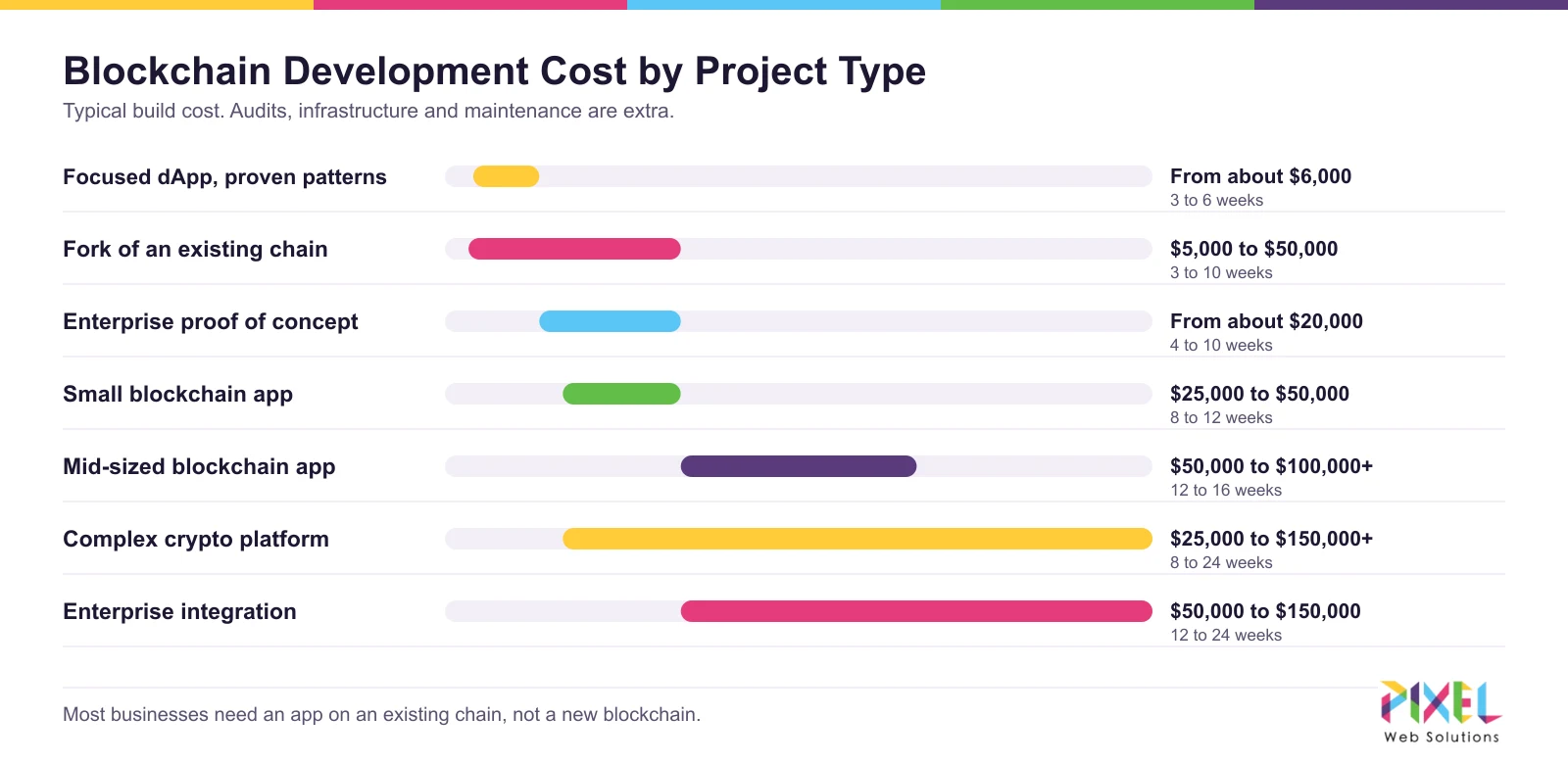
How Much Does Blockchain Development Cost? At a Glance
| Project type | Typical cost | Timeline |
|---|---|---|
| Focused dApp on proven patterns | From about $6,000 | 3 to 6 weeks |
| Blockchain consulting and feasibility | From about $5,000 | 1 to 4 weeks |
| Enterprise proof of concept | From about $20,000 | 4 to 10 weeks |
| Small blockchain app (basic features) | $25,000 to $50,000 | 8 to 12 weeks |
| Mid-sized blockchain app | $50,000 to $100,000+ | 12 to 16 weeks |
| Complex crypto platform (exchange, tokenization, DeFi) | $25,000 to $150,000+ | 8 to 24 weeks |
| Enterprise blockchain integration | $50,000 to $150,000 | 12 to 24 weeks |
| Your own blockchain (fork of an existing chain) | $5,000 to $50,000 | 3 to 10 weeks |
Factors Influencing Blockchain Development Cost
1. Type of Blockchain Solution
- Public blockchains (Ethereum, Solana, Base): you build on existing infrastructure, so cost goes into smart contracts and apps. Users pay network fees.
- Private blockchains: a private blockchain gives one organization control and privacy but requires its own infrastructure, which costs more to build and run.
- Hybrid blockchains: combine private data with public verification, adding integration complexity.
- Consortium blockchains: shared by several organizations, with governance, permissions and onboarding for each member; often the most expensive to coordinate.
2. Complexity of Features
- Smart contracts: secure, tested and audited contracts need specialist skills.
- Token creation: utility, governance, security or stablecoin tokens, each with different logic.
- Multi-currency and multi-chain support: more integrations and testing.
- Third-party integrations: payments, KYC, oracles, ERP and legacy systems.
3. Platform and Technology Stack
- Ethereum and its Layer-2s: the largest ecosystem; Layer-2s such as Base and Arbitrum keep user fees low.
- Hyperledger Fabric: enterprise-grade private networks; requires specialized expertise.
- Polygon: cost-effective, Ethereum-compatible deployments.
- Solana: high speed and low fees, with Rust-based development.
4. UI/UX Design Requirements
Simple dashboards cost little; exchanges, dApps and marketplaces need real-time data, complex flows and polished mobile experiences.
5. Security and Compliance
Encryption, secure key management, KYC/AML, GDPR or HIPAA compliance and independent audits all add cost but protect the business.
6. Developer Expertise, Team Size and Location
Freelancers suit small tasks, in-house teams bring overheads, and a development company provides a full team. Rates vary by region:
| Region | Typical hourly rate |
|---|---|
| United States and Canada | $80 to $150+ |
| Australia | $70 to $130 |
| Western Europe | $70 to $130 |
| Eastern Europe | $40 to $75 |
| India | $20 to $45 |
This explains why the same scope can cost very different amounts, including for businesses comparing local teams in markets such as Australia with offshore partners. Pixel's custom blockchain development starts at $40 an hour.
Pro tip: start with an MVP or proof of concept, test it with real users and scale in phases.
Understanding the Blockchain Application Development Costs
Blockchain apps fall into two broad groups.
Crypto-Based Applications
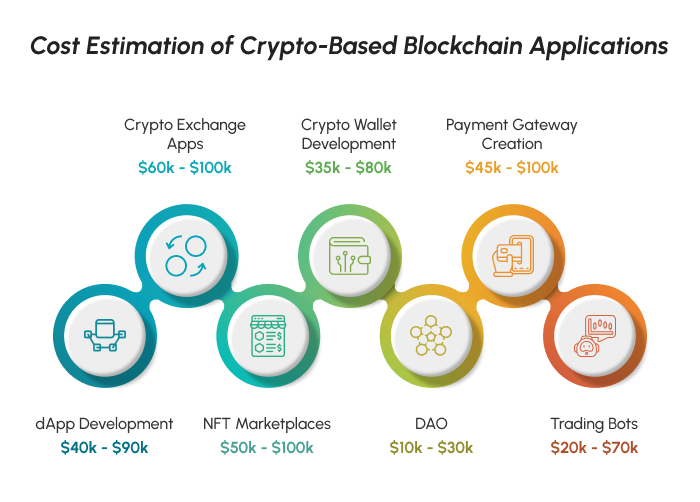
Apps directly tied to digital assets: crypto wallets, exchanges, payment gateways, ICO and launchpad platforms, DeFi apps and NFT marketplaces. They need security, integrations and often licensing, so they typically cost $25,000 to $150,000.
| Crypto app | Typical cost |
|---|---|
| Crypto wallet | From $5,000; $25,000 to $100,000 for multi-platform |
| Crypto payment gateway | From $6,000; $20,000 to $60,000 white-label |
| DEX | From $7,500; $40,000 to $120,000 custom |
| NFT marketplace | $20,000 to $60,000 white-label; up to $150,000 custom |
| Crypto exchange | $25,000 to $50,000 white-label; $100,000 to $150,000+ custom |
| RWA tokenization platform | $25,000 to $150,000+ |
Non-Crypto Based Applications
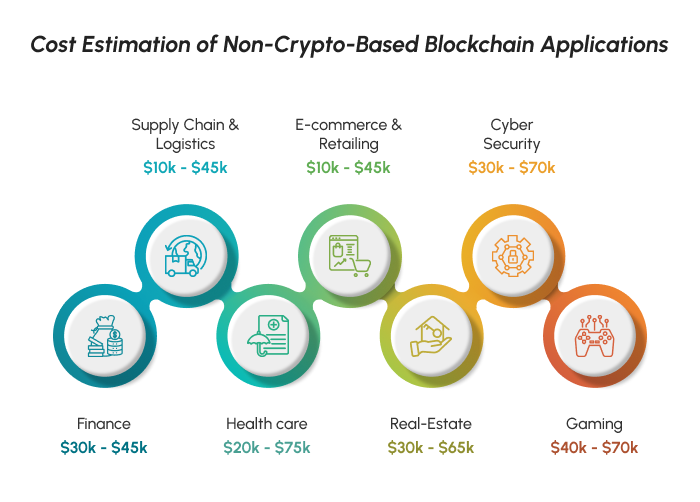
Apps for supply chain management, identity verification, healthcare records, digital voting or document verification. They also need secure architecture and smart contracts, but usually no financial licensing. Small apps start at about $25,000 to $50,000, and mid-sized apps cost $50,000 to $100,000 or more.
dApp and Web3 Development Cost
A focused dApp on proven smart contract patterns starts at about $6,000. Multi-feature Web3 apps with wallets, tokens and dashboards typically cost $25,000 to $100,000, depending on chains and integrations.
Blockchain Game Development Cost
Blockchain games cost far more than most apps, because the game itself must be built: expect $100,000 or more and 6 to 18 months for a playable game, with NFT items and marketplaces adding blockchain-specific work. See our blockchain game development service.
How Much Does It Cost to Create a Blockchain?
Creating your own blockchain network is a different project from building an app. The main routes:
| Route | What it means | Typical cost |
|---|---|---|
| Fork an existing chain | Customize an open-source blockchain (consensus, block time, token) | $5,000 to $50,000 |
| Appchain or Layer-2 rollup | Launch your own chain using frameworks such as OP Stack, Arbitrum Orbit or Polygon CDK, often with a rollup-as-a-service provider | Development plus ongoing provider and infrastructure fees |
| Private or permissioned network | Hyperledger Fabric or an enterprise Ethereum client for one organization or a consortium | Proof of concept from about $20,000; production $50,000 to $150,000 |
| New Layer-1 from scratch | New consensus, networking and virtual machine | A large, multi-year investment; rarely justified |
Does it cost money to create a blockchain? Yes. Even a fork needs development, testing and security review, and every network needs nodes or validators, monitoring and maintenance. Unless you need your own rules or sovereignty, building on an existing chain is cheaper and gives you users and liquidity from day one. Pixel's cryptocurrency development and custom blockchain development teams can advise on the right route. See also how to create a blockchain from scratch.
How Much Does It Cost to Launch a Blockchain for Your Existing Business?
The cost of blockchain integration into businesses depends on company size, objectives and existing systems.
For Small Enterprises
Small businesses usually add crypto payments, supply chain tracking or credential verification using existing platforms. A proof of concept can start at about $20,000, and a production integration costs about $50,000 to $100,000.
For Large Enterprises
Large enterprises need end-to-end integration with ERP and data systems, permissioned networks, analytics and compliance, typically costing $100,000 to $150,000 or more. Our enterprise blockchain development team handles these projects.
Where Does Your Money Go in the Blockchain Development Phase?
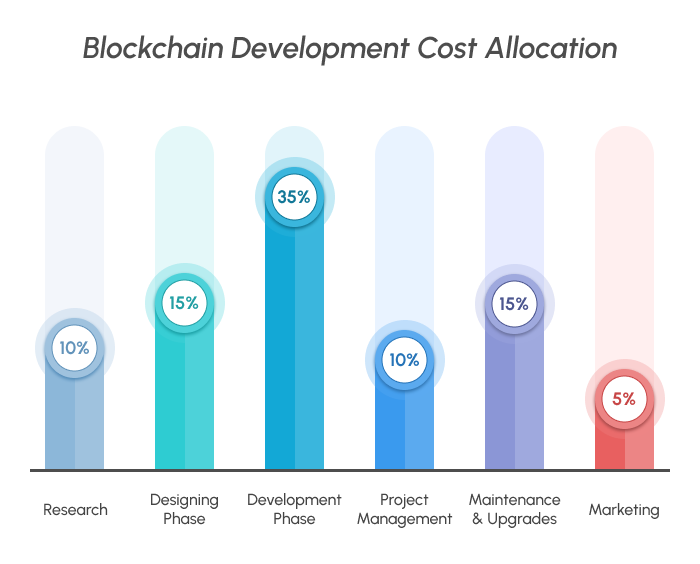
Research
Market analysis, use-case validation and platform selection. A small share of the budget that shapes everything else.
Designing Phase
UI and UX design for dashboards, apps and admin tools.
Development Phase
The largest share: writing smart contracts, backend services, integrations and testing.
Security and Audits
Independent smart contract audits and penetration tests before launch.
Project Management
Planning, coordination and delivery against milestones.
Maintenance and Upgrades
Updates, fixes and new features after launch, commonly 15% to 20% of the build cost a year.
Marketing
Community, content and partnerships to drive adoption, especially for public-facing platforms.
Blockchain Infrastructure and Server Costs
- Nodes and validators: cloud servers or managed node providers for each network you run or connect to; permissioned networks usually need at least four nodes for fault tolerance.
- RPC and indexing services: monthly fees that grow with usage.
- Storage: IPFS, Arweave or cloud storage for off-chain data.
- Monitoring and security tools: alerting, logging and transaction monitoring.
- Network fees: gas on public chains, usually small on Layer-2s.
These typically run from a few hundred to several thousand dollars a month, depending on scale and whether you operate your own network.
Overall Hidden Costs in Blockchain Development
- Maintenance and bug fixes after deployment
- Security audits before launch and after major changes
- Server and infrastructure costs for nodes, RPC and indexing
- Compliance updates as KYC/AML, privacy and industry rules change
- Upgrades and scalability as users grow
- Training and change management for enterprise staff using the new system
How to Make this Blockchain Development Cost-Effective?
- Build on an existing chain rather than creating your own, unless you truly need sovereignty.
- Choose the right platform: see our list of the top blockchain platforms. Layer-2s, Polygon and Solana keep user costs low.
- Start with an MVP or proof of concept, then scale in phases.
- Use audited libraries and proven patterns to reduce development and audit scope.
- Work with an experienced development company to avoid costly rework. Pixel's blockchain consulting starts at about $5,000 if you need a feasibility study first.
Final Thoughts
Blockchain development costs are never fixed: they depend on whether you build an app, integrate blockchain into your business or create your own network, and on features, platform, security and team. Most projects start at $6,000 to $50,000 for focused apps and proofs of concept, while complex platforms and enterprise systems reach $100,000 to $150,000 or more.
If you are planning a blockchain project and want a clear, personalized estimate, Pixel Web Solutions can help, from feasibility to deployment. For ideas on where to apply blockchain, see our blockchain business ideas. Contact our team for a quote.
Frequently Asked Questions
How much does blockchain app development cost?
A small blockchain app costs about $25,000 to $50,000, a mid-sized app $50,000 to $100,000 or more and a complex crypto platform up to $150,000 or more. Focused dApps on proven patterns start at about $6,000.
How much does it cost to create a blockchain?
Forking and customizing an existing blockchain costs about $5,000 to $50,000. Appchains and Layer-2 rollups add ongoing provider and infrastructure fees, private enterprise networks cost $50,000 to $150,000 in production, and a new Layer-1 from scratch is a far larger investment.
What factors affect blockchain development cost the most?
The type of blockchain, feature complexity, platform and tech stack, security and compliance requirements, integrations, and the location and expertise of the development team.
How long does it take to develop a blockchain app?
A basic MVP takes 8 to 12 weeks, a mid-level app 12 to 16 weeks and an enterprise-grade solution 16 to 24 weeks or more. Focused dApps on proven patterns can launch in 3 to 6 weeks.
What are the ongoing costs of a blockchain application?
Node and RPC infrastructure, storage, monitoring, security audits after upgrades, compliance updates and maintenance, which is commonly 15% to 20% of the build cost a year.
Is custom blockchain development expensive?
It costs more than using existing platforms or white-label software because it needs tailored architecture and security, but it can deliver long-term value when your use case needs specific rules or control.
Can I build a blockchain app on a budget?
Yes. Build on an existing low-fee chain, start with an MVP, use audited patterns and work with an experienced team. Focused dApps start at about $6,000.
Disclaimer: The cost figures in this blog are for information only and are not an official quote from Pixel Web Solutions. Actual pricing depends on your project's requirements and the services you choose. Contact our business team for a precise, customized quotation.