








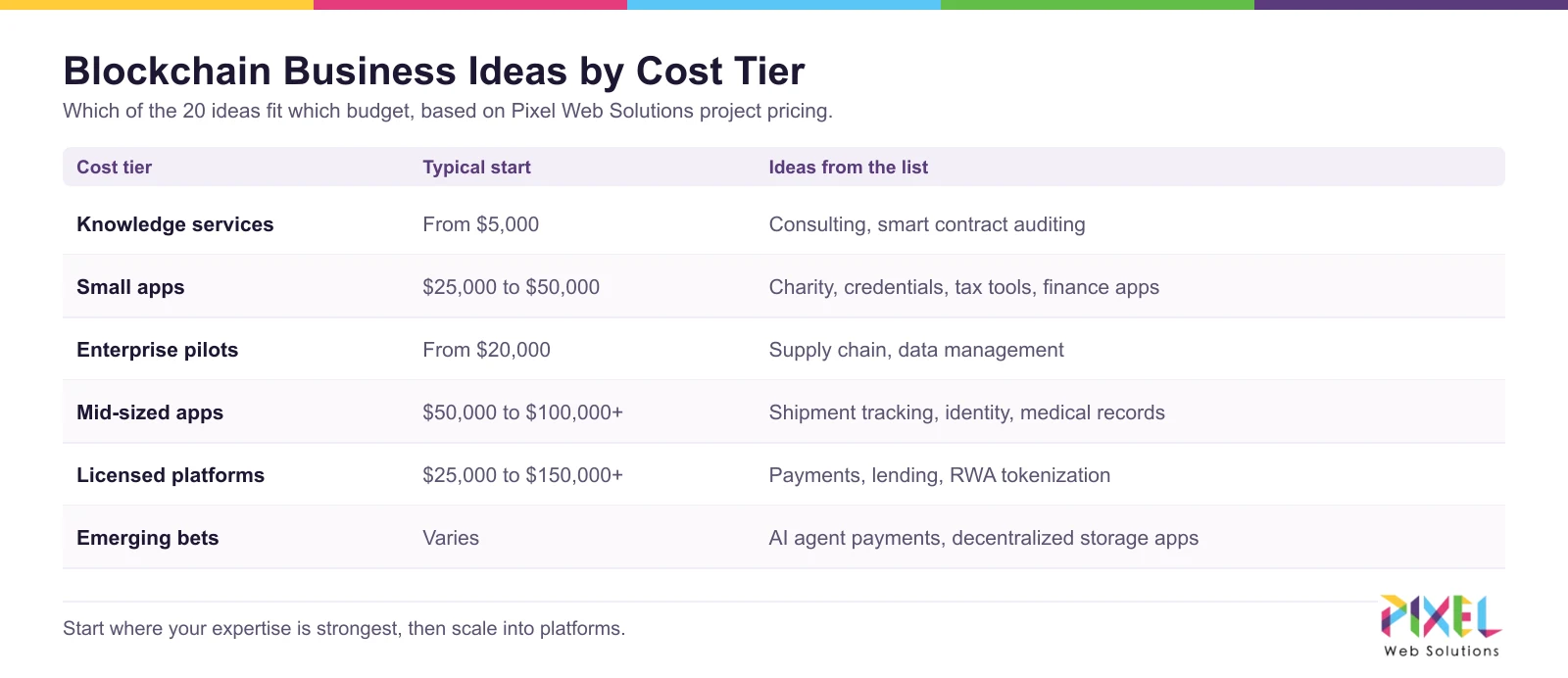
The best blockchain business ideas in 2026 solve problems where shared, tamper-proof records save money: payments, supply chain tracing, digital identity, asset tokenization, credential verification and smart contract security. Knowledge-based businesses such as blockchain consulting and smart contract auditing can start for about $5,000, small blockchain apps cost $25,000 to $50,000, and enterprise or platform builds run $50,000 to $150,000 or more.
There is a common misconception that blockchain is only about cryptocurrencies. Crypto may have started the technology, but blockchain now quietly powers food traceability, cross-border payments, digital identity wallets and tokenized investment funds.
The numbers show how far it has spread beyond speculation. Stablecoins, which are dollar-backed tokens on public blockchains, held $303 billion in supply on 25 October 2026 according to DefiLlama. Tokenized real-world assets reached $39 billion on RWA.xyz. And under the EU's eIDAS 2.0 rules, every member state must offer citizens a digital identity wallet by the end of 2026.
This guide lists 20 blockchain business ideas and the blockchain business opportunities behind them, with what each costs to start in 2026, how it earns and who is already doing it. It then shows how to start, which blockchain startup ideas are cheapest to launch, what founders on Reddit ask, and the challenges to plan for.
Key Takeaways
- Blockchain business ideas work best where several parties need to trust the same record, such as supply chains, payments, identity and asset ownership.
- Knowledge businesses are the cheapest entry. Consulting and smart contract auditing need expertise, not infrastructure, and start at around $5,000.
- Apps and platforms cost more. Small blockchain apps cost $25,000 to $50,000, and mid-sized or enterprise builds $50,000 to $150,000 or more.
- 2026's strongest blockchain business opportunities are stablecoin payments, RWA tokenization, digital identity and AI agent payments, driven by new regulation and real adoption.
- Blockchain companies can be very profitable: Coinbase earned $1.3 billion in net income in 2025 and Tether reported a profit above $10 billion, but both earn fees on activity, not on token prices.
- Regulation depends on the idea. Payments, lending and tokenized securities need licences; data, identity and supply chain tools mostly do not.
Blockchain Business Opportunities by Industry in 2026
Blockchain's value comes from three properties: transparency, security and the ability to automate agreements with smart contracts. Every industry below uses at least one of them, and each one is a blockchain business opportunity in its own right.

In finance, blockchain powers faster payments and stablecoin settlement. Healthcare uses it to prove that records have not been altered. Supply chains use it to trace products from source to shelf: Walmart's early food pilot cut the time to trace a package of mangoes from seven days to 2.2 seconds. Media and education use it to pay creators fairly and to issue credentials anyone can verify.
Here are the blockchain business opportunities, industry by industry.
| Industry | Blockchain business opportunity | What blockchain adds |
|---|---|---|
| Finance and payments | Stablecoin payments, lending, tokenized funds | Instant settlement, 24/7 global access |
| Supply chain | Product tracing and authenticity | A shared record that no single party can alter |
| Government and identity | Digital identity and verifiable credentials | User-controlled, instantly verifiable IDs |
| Real estate | Tokenized property and fractional ownership | Smaller investment sizes and faster transfers |
| Healthcare | Record integrity and consent tracking | Proof that data has not been changed |
| Media and entertainment | Royalties, ticketing and creator payments | Automatic, transparent revenue splits |
| Education | Digital certificates and credentials | Credentials that cannot be forged |
| Energy | Peer-to-peer energy trading and carbon credits | Traceable ownership of each unit traded |
As blockchain's influence grows, so do the opportunities for blockchain integration into businesses. Let us explore the 20 best blockchain business ideas.
Top 20 Blockchain Business Ideas You Shouldn't Miss Out In 2026
Blockchain's potential stretches across many industries. Here is the full list of the top 20 blockchain business ideas, followed by the detail on each, including a 2026 startup cost range. Costs marked "Pixel" are Pixel Web Solutions' published starting prices; the rest are industry ranges.
- Blockchain Consultation Services
- Data Management Systems
- Smart Contract Auditing Services
- Charity and Crowdfunding Platforms
- RWA Tokenization Platforms
- Blockchain Loaning Systems
- Identity Authenticity Tools
- Personal Finance Management Applications
- Personalized Medical Record Apps
- Blockchain-Based Insurance Solutions
- Shipment Tracking Applications
- Cloud Storage Mechanisms
- Supply Chain Management Applications
- Decentralized Platforms/Apps
- Digital Payment Processors
- Taxation Applications
- Gaming (P2E) Platforms
- AI Agent Payment and Verification Tools
- Entertainment Applications
- E-learning Sectors
Blockchain Consultation Services
A blockchain consulting firm is a low-investment, high-return business because it runs on knowledge and experience rather than infrastructure. Blockchain consulting services help companies decide whether blockchain fits their problem, choose a platform, design token models and plan compliance.
Signature Trait
- No major setup costs. You need expertise, credibility and a clear niche, such as supply chain, payments or tokenization.
- You can charge hourly, per project or on retainer. Consulting engagements at Pixel start at $5,000 for a scoped advisory project.
- Startup cost (2026): under $10,000 for company setup, insurance and tools; Pixel's own consulting projects start from $5,000, which shows the price point you can charge.
Data Management Systems
A blockchain-based data management system gives organizations a tamper-proof record of who changed what and when. Logistics, finance, education and government bodies need audit trails that stand up to regulators.
Signature Trait
- Most such systems store the data itself off-chain and write only fingerprints (hashes) to the blockchain, which keeps costs low and privacy intact.
- Revenue comes from subscriptions, pay-per-use pricing or enterprise licences.
- Startup cost (2026): an enterprise proof of concept from $20,000 and a production system of $25,000 to $150,000 (Pixel blockchain application range), through enterprise blockchain development.
Smart Contract Auditing Services
Smart contracts control billions of dollars, and a single bug can drain a protocol. In November 2025, an attacker exploited a rounding flaw in Balancer V2 pools and took about $128 million, and DefiLlama's hacks database records 312 incidents and $2.37 billion lost in 2026 to 25 October. Every serious project now pays for independent audits before launch.
Signature Trait
- A knowledge-based business with low startup costs and steady demand. Offer smart contract auditing services, bug bounty management and continuous monitoring.
- Reputation is everything: publish your audit reports and findings to build trust.
- Startup cost (2026): under $10,000 for tooling, a company and professional insurance; the cost is the security skill, not the stack. Audit fees for a mid-sized protocol commonly run from $5,000 to $50,000 or more per engagement (industry range), so two or three clients cover a year of costs.
Charity and Crowdfunding Platforms
A blockchain-based charity or crowdfunding platform lets donors trace every contribution. Smart contracts can release funds only when milestones are met. The Giving Block has shown that there is real demand for crypto donations to nonprofits.
Signature Trait
- Earn a small percentage of each donation or a subscription fee from charities.
- Crowdfunding that offers returns to investors counts as a securities offering in most countries, so keep donation and investment models clearly separate.
- Startup cost (2026): $25,000 to $50,000 for a donation platform built on an existing chain (Pixel small blockchain app range); a token-sale style crowdfunding platform costs $15,000 to $30,000 for the ICO software alone (Pixel) plus legal work.
RWA Tokenization Platforms
Real-world asset (RWA) tokenization turns property, bonds, fund units or invoices into tokens that can be issued, traded and settled on a blockchain. BlackRock's tokenized BUIDL fund, launched in 2024, pushed the model into mainstream finance, and RWA.xyz counted $14.65 billion in tokenized US Treasury products and $39 billion in tokenized assets overall on 26 October 2026.
Signature Trait
- Earn through issuance fees, annual management fees and secondary trading fees.
- Most tokenized assets are securities, so plan for licensing or a licensed partner. See RWA tokenization platform development for the build.
- Startup cost (2026): from $6,000 for a single-asset issuance, $25,000 to $50,000 for a platform MVP, $50,000 to $100,000 for an advanced platform and $100,000 to $150,000 or more from scratch (all Pixel), plus securities licensing.
Blockchain Loaning Systems
A blockchain lending platform lets users lend or borrow against crypto collateral, with smart contracts handling interest and liquidation automatically. Aave V3 borrowers paid $36.6 million in interest in the 30 days to 25 October 2026 and $643 million over 12 months, according to DefiLlama.
Signature Trait
- Earn from the spread between borrower and lender interest, plus liquidation fees.
- Our guide to DeFi business ideas compares lending with other DeFi models, and our DeFi lending platform development service covers the build.
- Startup cost (2026): $5,000 to $25,000 for the lending platform (Pixel), plus an independent audit, which often runs into five figures on its own.
Identity Authenticity Tools
Blockchain identity tools let people hold verifiable credentials (IDs, licences, diplomas, KYC results) and share only what a service needs. The EU's eIDAS 2.0 regulation requires member states to offer EU Digital Identity Wallets to citizens by the end of 2026, creating demand for issuers, verifiers and wallet providers.
Signature Trait
- Charge per verification, per credential issued or through enterprise licences.
- Strong fit for banking KYC reuse, academic credentials, employment checks and healthcare access.
- Startup cost (2026): $25,000 to $50,000 for a credential issuer or verifier MVP and $50,000 to $150,000 for a full wallet and issuer platform (Pixel blockchain application range).
Personal Finance Management Applications
A blockchain-aware personal finance app tracks income, savings and spending across bank accounts, crypto wallets and DeFi positions in one place. Users with assets spread across chains and exchanges struggle to see their full picture.
Signature Trait
- Earn from premium tiers, tax-report exports and partner referrals.
- Real-time portfolio tracking across chains is the feature that sets these apps apart.
- Startup cost (2026): $25,000 to $50,000 for a tracking app on existing chains (Pixel small app range); adding a non-custodial wallet starts from $5,000 more (Pixel).
Personalized Medical Record Apps
Healthcare data is fragmented across providers. A blockchain-backed record app lets patients control who can see their history, while the blockchain proves that records have not been changed.
Signature Trait
- Never put personal health data directly on a public blockchain. Store the records off-chain with encryption and anchor only hashes and consent records on-chain, which keeps you compatible with GDPR and HIPAA.
- Earn through software licences to clinics, premium features and integrations.
- Startup cost (2026): $50,000 to $150,000 (Pixel blockchain application range), because healthcare integrations, encryption and compliance reviews add scope beyond a simple app.
Blockchain-Based Insurance Solutions
Smart contracts can pay insurance claims automatically when a verified event happens, such as a flight delay or a rainfall shortfall. This "parametric" insurance cuts claims processing costs and speeds up payouts.
Signature Trait
- Micro-insurance for underserved farmers, travellers or gig workers is a strong niche.
- Insurance is regulated, so partner with a licensed insurer and provide the technology layer.
- Startup cost (2026): $25,000 to $50,000 for a parametric claims engine with oracle feeds (Pixel small app range), with the insurer partner carrying the licence and capital.
Shipment Tracking Applications
A blockchain shipment tracking app records each handover of a parcel or container on a shared ledger, so shippers, carriers, customs and buyers see the same status.
Signature Trait
- Pair the blockchain with IoT sensors and scanners so records are created automatically, not typed in.
- Earn per shipment tracked or through subscriptions for logistics firms.
- Startup cost (2026): a pilot from $20,000 (Pixel enterprise proof of concept) and $50,000 to $150,000 for a multi-party production network with IoT integration (Pixel blockchain application range).
Cloud Storage Mechanisms
Decentralized storage networks such as Filecoin and Arweave spread encrypted data across many independent nodes, giving redundancy without a single provider.
Signature Trait
- Build user-friendly storage apps, backup services or archival tools on top of these networks instead of building a network from scratch.
- Niches such as legal archives, research data and media preservation value permanence and proof of integrity.
- Startup cost (2026): $25,000 to $50,000 for a storage or backup app built on an existing network (Pixel small app range). Building a new storage network itself is a venture-scale project and not a sensible first business.
Supply Chain Management Applications
Supply chain blockchains create a shared, tamper-proof record of every step from raw material to retail shelf. Food safety, pharmaceuticals, luxury goods and electronics all need proof of origin. Our guide to blockchain in supply chain covers the use cases in depth.
Signature Trait
- New rules are pushing brands to record product data: under the EU Battery Regulation, EV, light transport and industrial batteries above 2 kWh need a digital battery passport from 18 February 2027, the first Digital Product Passport to become mandatory. That creates demand for traceability platforms.
- Earn through enterprise licences, per-item tracking fees and integration projects.
- Startup cost (2026): a traceability pilot from $20,000 (Pixel enterprise proof of concept) and $50,000 to $150,000 for a production platform (Pixel blockchain application range).
Decentralized Platforms/Apps
Decentralized apps (dApps) replace a central operator with smart contracts, giving users control of their data and assets. Social, marketplace, finance and creator apps all have decentralized versions.
Signature Trait
- The strongest dApp businesses solve a clear problem and hide the blockchain behind a simple experience.
- Revenue comes from transaction fees, premium features or protocol fees. See blockchain dApp development.
- Startup cost (2026): $25,000 to $150,000 depending on scope (Pixel blockchain application range); a simple DeFi protocol starts from $6,000 and a standard DEX from $7,500 (Pixel).
Digital Payment Processors
Blockchain payment processors let merchants accept crypto and stablecoins and settle in local currency. With stablecoin supply at $303 billion and US stablecoin rules in place since the GENIUS Act of July 2025, this is one of the most practical blockchain businesses today. Shopify now lets merchants accept USDC at checkout, which shows where mainstream commerce is heading.
Signature Trait
- Earn transaction fees (commonly around 1%), conversion spreads and merchant subscriptions.
- Pixel builds crypto payment gateways from $6,000. A full white-label gateway with fiat settlement, merchant tools and multi-chain support typically runs $20,000 to $60,000 (industry range), and most markets require a payment or money transmission licence.
- Startup cost (2026): from $6,000 for the gateway software (Pixel), plus licensing. See how much a crypto payment gateway costs to develop for the line items.
Taxation Applications
Crypto tax reporting became much stricter in 2026. The EU's DAC8 rules apply from 1 January 2026, and US brokers now issue Form 1099-DA. Individuals and businesses need tools that reconcile trades across exchanges and wallets.
Signature Trait
- Established players such as Koinly and CoinTracker exist, so compete on a niche: a country's tax rules, DeFi-heavy users, businesses or accountants.
- Earn through annual subscriptions and per-report fees.
- Startup cost (2026): $25,000 to $50,000 for a niche tax reconciliation tool (Pixel small app range), plus ongoing work to track rule changes in each country you serve.
Gaming (P2E) Platforms
Blockchain games let players own in-game items as tokens or NFTs. The play-to-earn boom collapsed after 2022 because rewards depended on new players buying in, and Axie Infinity also lost about $624 million in the Ronin bridge hack. DefiLlama's Gaming category held about $1 million in value on 25 October 2026.
Signature Trait
- In 2026, the games that work are fun first and use blockchain for item ownership and trading, not as wages.
- Earn from game sales, in-game purchases and marketplace fees. See blockchain game development.
- Startup cost (2026): $100,000 or more and 6 to 18 months for a playable game (industry estimate; Pixel does not publish a fixed game price).
AI Agent Payment and Verification Tools
AI agents increasingly buy data, compute and services on their own. Blockchain gives them wallets, stablecoin payments and verifiable records of what they did. Coinbase's x402 protocol, launched in 2025, is one example of payments designed for machine-to-machine commerce.
Signature Trait
- Opportunities include agent wallets with spending limits, pay-per-use APIs settled in stablecoins, and on-chain audit trails for agent actions.
- An early-stage market with little competition, suited to teams with both AI and blockchain skills. DefiLlama's AI Agents category earned under $1 million in fees in the 30 days to 25 October 2026, so demand is unproven.
- Startup cost (2026): $25,000 to $50,000 for an agent wallet or pay-per-use API MVP (Pixel small app range); a wallet component alone starts from $5,000 (Pixel).
Entertainment Applications
Blockchain helps artists, producers and audiences deal directly. Smart contracts split royalties automatically, and tokenized tickets reduce fraud and let organizers earn from resales.
Signature Trait
- Automated royalty splits solve a real pain point for musicians and creators who wait months for payments.
- Earn from ticketing fees, platform fees and creator subscriptions.
- Startup cost (2026): from $5,000 for an NFT ticket or membership collection (Pixel) and $25,000 to $50,000 for a royalty-split or ticketing platform (Pixel small app range).
E-learning Sectors
Education providers use blockchain to issue digital certificates that anyone can verify instantly, ending fake diplomas. Content ownership apps can pay educators directly when their material is used.
Signature Trait
- Credential issuance fits the wider move to digital identity wallets, so certificates can sit alongside other verified credentials.
- Earn through per-certificate fees, institutional licences and course marketplace commissions.
- Startup cost (2026): $25,000 to $50,000 for a credential issuing and verification tool that plugs into an existing learning platform (Pixel small app range).
Looking for ideas closer to trading and digital assets? Our separate guide to crypto business ideas covers exchanges, wallets, crypto ATMs and more.
Smart Contract Business Ideas
Many of the ideas above are, at their core, smart contract businesses. If you want to build around smart contracts specifically, these models have proven demand:
- Escrow and milestone payments: funds released automatically when both sides confirm delivery.
- Automated revenue splits: royalties, affiliate payouts and partnership shares paid on every sale.
- Parametric insurance: payouts triggered by verified data such as weather or flight status.
- Token and tokenization contracts: issuing tokens for loyalty programmes, fundraising or real-world assets.
- Auditing and monitoring: reviewing and watching other teams' contracts for vulnerabilities.
If you need contracts built rather than audited, see our smart contract development services.
Blockchain Project Ideas for Developers: Simple Applications That Become Businesses
Developers often search for blockchain project ideas and a business plan for blockchain developers at the same time, because the best way to start a blockchain business as a developer is to ship a simple blockchain application, prove it works, then sell it. These five simple projects each map to one of the businesses above:
| Simple blockchain application | What you build first | The business it becomes |
|---|---|---|
| Document notarization | Hash a file, write the hash on-chain, verify later | Data management and audit trail systems (idea 2) |
| Verifiable certificate issuer | Issue a signed credential as a token or verifiable credential | E-learning credentials and identity tools (ideas 7 and 20) |
| Escrow smart contract | Hold funds until both parties confirm | Marketplace, freelancing and milestone payment dApps (idea 14) |
| Stablecoin checkout plugin | Accept USDC on a store and settle to a wallet | Digital payment processing (idea 15) |
| Supply chain event logger | Record each handover with a QR scan | Shipment tracking and supply chain apps (ideas 11 and 13) |
The business plan for a developer-led blockchain startup is short: pick one of these, build it on an Ethereum layer 2 or Solana where fees are a fraction of a cent, find three paying pilot customers in one industry, and only then raise money or hire. Our guide on how to create a blockchain from scratch covers the deeper engineering if you ever need your own network, but most of these projects never do.
How to Start a Blockchain Business in 6 Steps
Here is the step-by-step process to turn a blockchain business idea into a working company.
Step 1 – Explore & Finalize
Shortlist ideas that match your expertise and a real problem. Ask one question of each: does this need a shared record that several parties trust? If a normal database would do the job, blockchain adds cost without value.
Step 2 – Market Research
Study your target customers, competitors and regulation. Check whether buyers already pay for a solution and what would make them switch.
Step 3 – Draft a Blockchain Startup Business Plan
Write a plan that covers goals, revenue model, costs, licensing and go-to-market. A blockchain startup business plan should answer six questions investors and banks always ask: which problem needs a shared record, who pays and how much, which chain and why, what the build and audit cost (use the ranges in this guide), which licences apply in each market, and how you reach the first ten customers. Our crypto exchange business plan guide includes a template whose structure works for most blockchain startups.
Step 4 – Choose the Right Blockchain
Pick the platform that fits your users, costs and privacy needs.
| Blockchain | Best for | Why |
|---|---|---|
| Ethereum and its Layer-2s (Base, Arbitrum) | Payments, tokenization, DeFi | The largest ecosystem, with cheap L2 transactions |
| Solana | Consumer apps, high-volume payments | Very low fees and fast confirmation |
| Polygon | Enterprise pilots, low-cost apps | Ethereum-compatible with low fees |
| Hyperledger Fabric | Private enterprise networks | Permissioned access and data privacy |
For a longer comparison, see our list of the top blockchain platforms.
Step 5 – Build, Test & Deploy
Build an MVP with experienced blockchain developers, test it thoroughly for security and performance, and commission an audit for any smart contract that holds value. Then deploy to a small group of real users before scaling.
Step 6 – Marketing Campaigns
Market to your niche with content, partnerships, industry events and communities. For B2B ideas, case studies and pilots with recognizable customers win more deals than social media buzz.
We have covered how to start. Now let us address the question every founder asks next: cost.
Cheapest Blockchain Startup Ideas: Which Idea Costs Least to Launch?
The cheapest blockchain startup ideas rely on expertise rather than infrastructure. These can be set up without a large investment:
- Blockchain Consulting Services: built on knowledge, not product development. Projects start around $5,000.
- Smart Contract Auditing Services: needs specialist security skills, not a large team or heavy tech stack.
- Charity and Crowdfunding Platforms: can run on existing blockchains such as Ethereum or Stellar with limited custom development.
- E-learning Credentials: can plug into existing learning platforms without a full blockchain build.
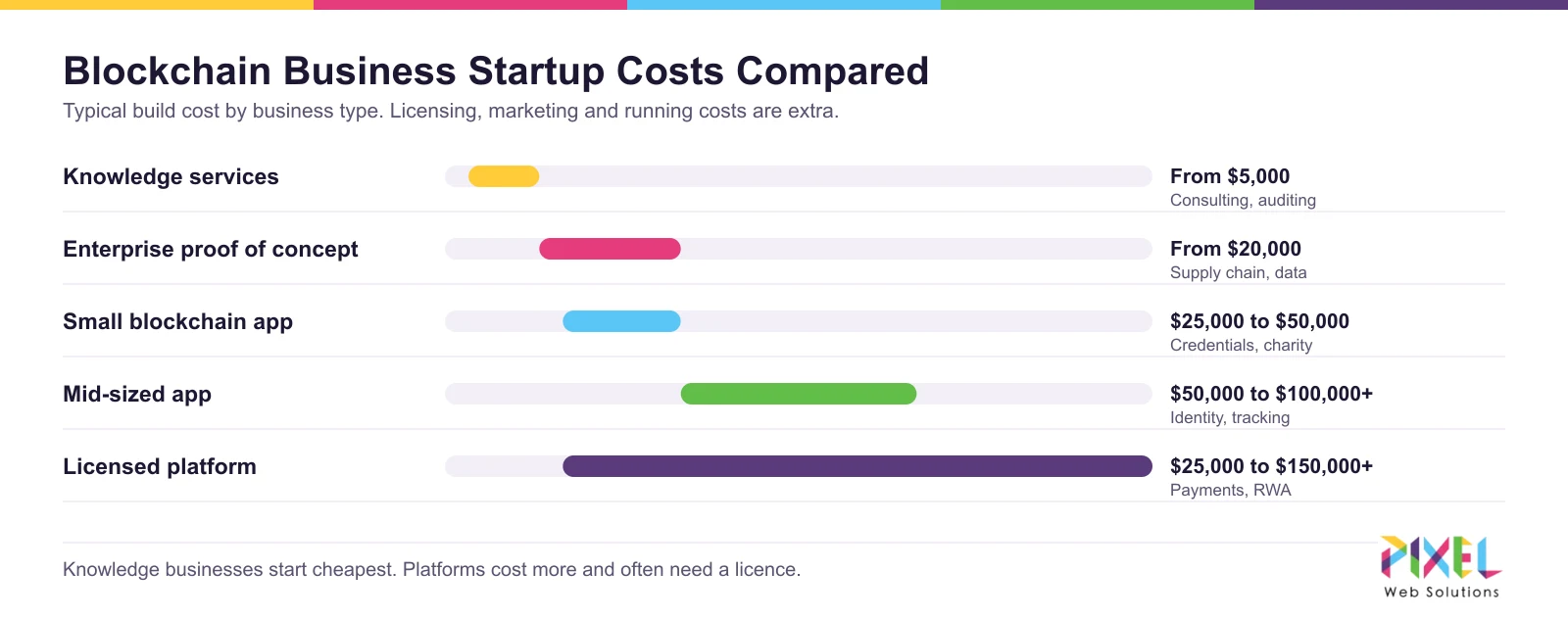
Here is how the main idea types compare on cost, based on Pixel Web Solutions' project pricing.
| Business type | Typical startup cost | Examples from the list |
|---|---|---|
| Knowledge services | From $5,000 | Consulting, smart contract auditing |
| Small blockchain apps | $25,000 to $50,000 | Charity platform, credentials, tax tools |
| Enterprise proof of concept | From $20,000 | Supply chain pilot, data management system |
| Mid-sized apps | $50,000 to $100,000+ | Shipment tracking, identity tools, medical records |
| Platforms needing licences | $25,000 to $150,000+ plus licensing | Payment processors, lending, RWA tokenization |
Cost-effectiveness also depends on scalability and running costs. For a detailed breakdown, read how much it costs to develop a blockchain.
Blockchain Business in India and the UAE: Licences, Taxes and Who to Register With
Two of the markets searching hardest for blockchain business ideas are India and the UAE, and the rules differ sharply.
Blockchain business in India. Building blockchain software, consulting, supply chain or identity tools needs no special licence. The moment a business touches crypto assets for customers (an exchange, a custodial wallet, a payment gateway that converts tokens) it becomes a virtual digital asset service provider and must register with FIU-IND under the anti-money-laundering law before it operates. Registration runs through the FINgate portal and includes an in-person meeting; FIU-IND updated its AML guidelines for the sector in January 2026 and in September 2026 issued notices to 15 offshore providers serving Indian users without registration. Crypto gains are taxed at a flat 30% with 1% TDS on transfers, which is why tax and compliance tools (idea 16) sell well in India.
Blockchain companies in the UAE. The UAE has five virtual asset regulators. Dubai's VARA licenses virtual asset activities in mainland Dubai and its free zones (except DIFC), the FSRA covers Abu Dhabi Global Market, the DFSA covers DIFC, the SCA covers the federal level and the Central Bank covers payment tokens. VARA's published fee schedule sets an application fee of AED 40,000 and an annual supervision fee of AED 80,000 for advisory and transfer-and-settlement services, rising to AED 100,000 and AED 200,000 for exchange, broker-dealer, custody, lending and management services. Pure technology businesses, such as a supply chain platform or an identity tool, need only a normal trade licence. Pixel Web Solutions operates from Ras Al Khaimah, UAE and Madurai, India, so it works under both regimes daily.
Are Blockchain Companies Actually Profitable? What Reddit Founders Ask
The blockchain startup threads on Reddit that rank for this topic ask four blunt questions. Here are plain answers.
Are there any profitable blockchain companies?
Yes, and the profitable ones share a pattern: they charge fees on activity. Coinbase reported $6.9 billion in net revenue and $1.3 billion in net income for 2025 in its annual report, with $2.8 billion of that revenue from subscriptions and services rather than trading. Tether reported a 2025 profit of just over $10 billion from interest on the reserves behind USDT. On-chain, Hyperliquid earned $866 million and Aave $643 million in fees over the 12 months to 25 October 2026 on DefiLlama. None of these businesses depend on a token price rising; they depend on volume, deposits and users.
Can blockchain technology empower small businesses?
In 2026 the clearest answer is payments. A small exporter in India or Nigeria can invoice in USDC and receive settlement in minutes instead of days, and Shopify merchants can accept USDC at checkout. Stablecoin supply of $303 billion exists largely because this works. The second answer is proof: a small producer can give buyers a verifiable record of origin without a brand's budget. What does not help small businesses is running their own blockchain, which is why every idea in this guide builds on an existing network.
What is a good blockchain business idea that is not oversaturated?
Exchanges, wallets and NFT marketplaces are crowded. The under-served blockchain business opportunities in 2026 are compliance tooling for the new rules (DAC8, 1099-DA, MiCA, FIU-IND), Digital Product Passport traceability ahead of the February 2027 battery deadline, credential issuers for the EU digital identity wallets due by the end of 2026, and payment and audit tools for AI agents. Each has a regulatory or technical deadline creating buyers, and none has a dominant incumbent yet.
What exactly is blockchain, and how will it influence business?
A blockchain is a shared database that many independent parties keep in sync, where entries cannot be changed once written and rules can be enforced by code. Its business influence is narrower than the hype suggested and deeper than sceptics admit: it removes the need for a trusted middleman wherever several organizations must agree on one record, which is why its real traction is in payments, asset ownership, identity and supply chains rather than in replacing ordinary databases.
Great opportunities come with great challenges, so let us look at those next.
Challenges in Creating a Blockchain-Based Company and How to Overcome Them
Regulatory Issues
Legal compliance can be your biggest roadblock. In the United States, payment and exchange businesses need FinCEN MSB registration and state money transmitter licences. In the EU, crypto services need a MiCA licence. Platforms dealing with securities or derivatives also fall under SEC or CFTC rules, and the CLARITY Act that would clarify US market structure failed a Senate procedural vote on 15 September 2026, so US rules for tokens remain unsettled.
How to Overcome: Identify which licences apply to your model before you build, and monitor rule changes in your target markets. A blockchain consultation on legal and compliance frameworks early on saves costly redesigns later.
High Development Costs
Blockchain development needs specialist developers, security reviews and audits, which make it more expensive than ordinary software.
How to Overcome: Start with a cost-effective idea or a focused MVP, build on proven frameworks and scale once you have paying users.
Blockchain Tech Complexity
Blockchain architecture, cryptography and smart contract security are hard to learn quickly, and mistakes are expensive because deployed contracts are difficult to change.
How to Overcome: Train your team, hire experienced developers or partner with an enterprise blockchain development company like Pixel Web Solutions, so you can focus on customers and strategy while specialists handle the build.
Adoption and User Experience
Customers do not want to manage keys, gas fees or wallets. Many blockchain products fail because they are harder to use than the systems they replace.
How to Overcome: Hide the complexity: use smart accounts, sponsor gas fees and let users sign in with familiar methods.
To Conclude
Blockchain business ideas now reach far beyond cryptocurrency, into identity, supply chains, payments, tokenized assets and AI. The best choice is the one that matches your expertise, solves a problem where shared trust matters and fits your budget and regulatory appetite. Start small, prove demand and scale.
Who knows? You may be just one consultation away from turning your blockchain business idea into reality. Talk to our team to get started.
Frequently Asked Questions
What are the most profitable blockchain business ideas?
Payment processing, tokenization platforms, lending and smart contract auditing are among the most profitable because customers pay recurring fees. Profitability depends on your niche, licensing costs and ability to attract users.
What is the best blockchain business idea for beginners?
Blockchain consulting, smart contract auditing (if you have security skills) and credential or charity platforms built on existing blockchains are the most accessible, because they need expertise more than heavy investment.
What are the best blockchain startup ideas in 2026?
The strongest blockchain startup ideas in 2026 have a deadline or a regulation creating buyers: stablecoin payment tools, RWA tokenization, digital identity and credential issuers for the EU wallets due by the end of 2026, Digital Product Passport traceability ahead of February 2027, crypto tax and compliance software, and payment rails for AI agents.
How much does it cost to start a blockchain business?
Knowledge businesses such as consulting start at about $5,000. Small blockchain apps cost $25,000 to $50,000, mid-sized apps $50,000 to $100,000 or more, and licensed platforms such as payments or tokenization $25,000 to $150,000 or more plus licensing.
Do I need to know coding to start a blockchain business?
No. Many founders bring the business, industry and customer knowledge and partner with a development company for the technology. You do need enough understanding to make sound decisions about platforms, security and costs.
Which blockchain is best for business?
Ethereum and its Layer-2 networks suit payments and tokenization, Solana suits high-volume consumer apps, Polygon suits low-cost pilots and Hyperledger Fabric suits private enterprise networks. The right choice depends on your users, costs and privacy needs.
Are blockchain businesses legal?
Yes, in most countries. Payment, exchange, lending and tokenized securities businesses usually need licences, while data, identity, supply chain and software businesses generally do not. Check the rules in each market you serve.
Which of these ideas involve cryptocurrency, and which do not?
Only a few do: the lending, payment processor, charity and RWA ideas touch tokens, while data, identity, supply chain, credential and audit businesses may never handle a coin. Crypto-specific ideas include exchanges, payment gateways, wallets, token launches, trading tools and crypto tax or compliance services. They differ from the blockchain ideas above because most of them hold or move customer funds and therefore need a licence. Our guide to cryptocurrency business ideas, linked above, covers 15 of them with startup costs and licence requirements.
What is replacing blockchain?
Nothing is replacing blockchain; it is being absorbed. Layer 2 networks, modular chains and stablecoin rails hide the blockchain behind ordinary payment and app interfaces, and AI agents are becoming a new class of user. The databases that blockchain was never going to replace, such as a company's internal records, were never good blockchain use cases to begin with.
What is the difference between a blockchain business and a crypto business?
A crypto business deals directly with cryptocurrencies, such as exchanges, wallets or trading tools. A blockchain business uses the underlying technology for other purposes, such as supply chain tracking, identity or record keeping, and may never touch a cryptocurrency.