







To create a blockchain, define the problem it solves, choose public, private or consortium access, pick a build path (smart contracts on an existing chain, an enterprise framework, an app-specific chain SDK, a rollup or a from-scratch protocol), then build the blocks, consensus, nodes and smart contracts, test and audit them, and deploy to a testnet before mainnet. Most businesses do not need a brand-new protocol: building on a proven framework is faster, cheaper and safer.
Blockchain technology is no longer limited to cryptocurrencies. It now supports finance, supply chain, healthcare, gaming, real estate and more, from secure data sharing to decentralized applications (dApps).
As demand grows, enterprises, startups and developers are investing in custom blockchain solutions for their own goals. Whether that means a private blockchain for data security, smart contracts for automation, or a scalable ecosystem for dApps, the options are wide.
In this guide, you will learn how to create a blockchain step by step: the core components, the development process, the tools, a working code example, the challenges and what each build path costs.
Key Takeaways
- Start with the use case: confirm that shared, tamper-evident data across several parties is really needed before you build a blockchain.
- Choose a build path, not just a platform: smart contracts on an existing chain, a permissioned network (Hyperledger Fabric, Besu, Corda), an app-specific chain (Cosmos SDK, Polkadot SDK, Avalanche L1s), a rollup (OP Stack, Arbitrum Orbit) or a from-scratch protocol.
- Proof of Stake is now the default: Ethereum moved from Proof of Work to Proof of Stake in 2022 and cut its energy use by more than 99.9%.
- Security is the biggest risk: Chainalysis counted over $3.4 billion in crypto stolen in 2025, so audits and key management belong in the first budget.
- Know the cost range: Pixel Web Solutions builds custom blockchains from $40 per hour and blockchain apps from $25,000 to $150,000.
How to Create a Blockchain: A Step-by-Step Process
Creating your own blockchain follows eight key steps. Each one is explained in detail later in this guide.
- Analyze your use case and industry landscape
- Understand how blockchain technology works
- Choose your build path and tech stack
- Partner with technical experts
- Build the core blockchain architecture
- Add standout features
- Test, audit and optimize
- Deploy and maintain
Before you start, make sure you understand what a blockchain is and which type fits your goals.
What Is a Blockchain and Why Build One?
At its core, a blockchain is a distributed digital ledger that records transactions across a network of computers. Unlike a traditional database run by one central authority, a blockchain stores data in linked "blocks" that are very hard to change once confirmed, which makes the record reliable and transparent.
While blockchain became popular through cryptocurrencies, its uses now reach far beyond digital payments. Businesses across many industries use it to gain better control over shared data, improve security, automate agreements and build decentralized ecosystems.
Curious How Blockchain Fits Your Business?
Get a clear overview of how blockchain can improve security, transparency, and efficiency in your business operations.
Here is why organizations choose to build their own blockchain:
- Full control over data: custom blockchains let enterprises decide who can access, validate and manage data.
- Enhanced security: cryptographic hashing, digital signatures and consensus make unauthorized changes extremely difficult.
- Smart contract integration: self-executing code automates business processes and agreements.
- Decentralized ecosystems: participants interact directly without a central intermediary.
Is a Blockchain Right for You? A 5-Question Test
Before you create a blockchain, answer these questions. If you answer "no" to most of them, a conventional database will be cheaper and faster.
- Do several organizations or users need to write to the same record?
- Do those parties lack full trust in a single operator?
- Does the record need to be tamper-evident and auditable over time?
- Would removing an intermediary save real cost or time?
- Do you need programmable assets or automated settlement (tokens, smart contracts)?
Types of Blockchains
Public Blockchain
- Accessibility: open to everyone
- Control: decentralized across many independent validators
- Speed: varies by design; large networks trade some speed for security and decentralization
- Best for: cryptocurrencies, DeFi, NFTs and open applications
- Examples: Bitcoin, Ethereum, Solana
Private Blockchain
- Accessibility: restricted to authorized participants
- Control: managed by a single organization
- Speed: fast, because few nodes validate transactions
- Best for: internal data security and audit trails
- Examples: networks built on Hyperledger Fabric or permissioned Besu
Consortium Blockchain
- Accessibility: shared among a group of organizations
- Control: partially decentralized among the members
- Speed: moderate to fast, with fewer nodes than a public network
- Best for: banking, trade finance, healthcare and cross-industry collaboration
- Examples: member networks built on R3 Corda, Hyperledger Fabric or Besu
A fourth model, the hybrid blockchain, keeps sensitive data on a private network and anchors proofs or selected data to a public chain.
Start your platform with the right features
Connect with our team to better understand blockchain models, real-world applications, and whether it’s the right fit for your idea.
The 8 Steps to Create a Blockchain, Explained
Each step below shows how to create a blockchain through a structured development process that protects performance, scalability and security.
Step 1: Analyze Your Blockchain Use Case and Industry Landscape
This is the first crucial step in creating a blockchain application. Analyze the industry and the use case you want to target. Blockchain can improve many industries, each with its own needs, and it opens up innovative blockchain business opportunities for startups and enterprises. Understanding the goals, requirements and pain points of your industry shapes the whole design.
Here are some examples:
Finance: blockchain supports secure, transparent and fast transactions, including decentralized finance (DeFi), cross-border payments, tokenized assets and secure asset management.
Supply chain: blockchain provides end-to-end transparency, tracking the origin and movement of goods to reduce fraud and prove authenticity.
Healthcare: blockchain helps share medical records securely between providers and keeps an auditable log of who accessed which data. Sensitive records themselves usually stay off-chain, with only hashes or permissions on-chain.
Real estate: blockchain streamlines property transactions with clear, verifiable ownership records and reduces fraud.
Once you know the challenges and needs of your industry, you can plan blockchain integration tailored to your business processes. Then study the blockchain solutions already on the market. Looking at competitors shows what works well and where you can improve.

Step 2: Understand How Blockchain Technology Works
Understanding how a blockchain works is crucial before you build one. It determines how transactions are validated, how secure the network is, how efficiently it runs and whether it can meet the demands of your application.
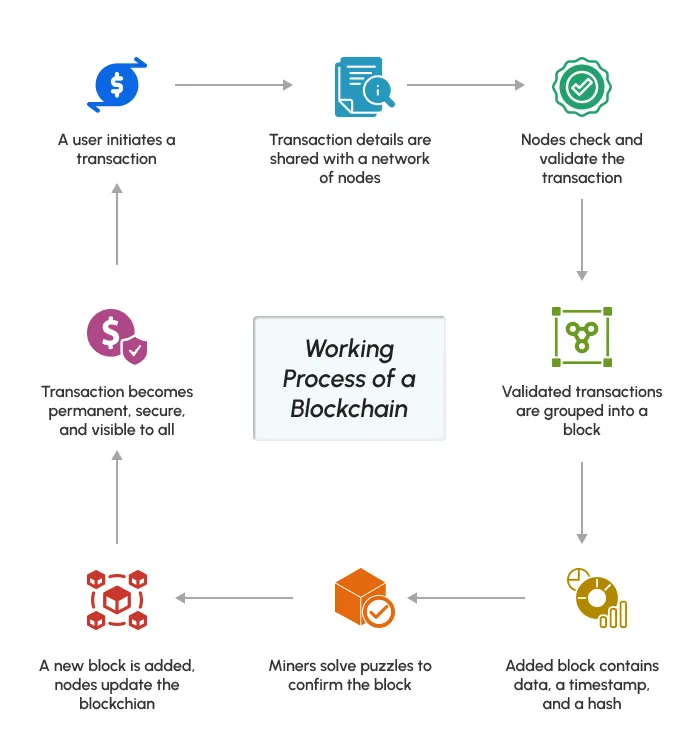
In short: a user signs and sends a transaction, nodes check it, valid transactions are grouped into a block, the network agrees on the block through its consensus mechanism, and every node adds it to its copy of the ledger. The diagram shows Proof of Work, where miners solve puzzles; in Proof of Stake networks, validators who have staked tokens propose and attest to blocks instead. The consensus mechanism, network design and participant roles all shape the performance, scalability and success of your blockchain.
Step 3: Choose Your Build Path and Tech Stack
After you analyze your industry and competitors, pick the right technology from the top blockchain platforms. Think about what your project needs: security, scalability, shared control and smooth operation. In 2026, the most important decision is the build path, because it sets your timeline and budget.
The Five Build Paths Compared
| Build path | What you build | Typical tools | Indicative time to first testnet | Best for |
|---|---|---|---|---|
| Blockchain app on an existing chain | Smart contracts plus web or mobile front end | Solidity on Ethereum and Layer 2s, Rust on Solana | Weeks to 3 months | Most businesses and dApps |
| Permissioned network | Nodes, membership and governance on an enterprise framework | Hyperledger Fabric, Besu, R3 Corda | 1 to 3 months | Enterprise data sharing |
| App-specific chain | Your own Layer 1 with a chain SDK | Cosmos SDK, Polkadot SDK, Avalanche L1s | 3 to 9 months | Own validators, fees and token economics |
| Rollup (Layer 2) | Your own execution layer that settles to Ethereum | OP Stack, Arbitrum Orbit | 2 to 6 months | EVM apps that need cheap, dedicated blockspace |
| From scratch | Consensus, networking, storage and virtual machine | Go, Rust or C++ | Often 18 months or more to mainnet | Research and genuinely new consensus designs |
Rollups are now a mainstream path: L2BEAT lists 87 Layer 2 and 13 Layer 3 projects as of October 2026. Enterprise frameworks have also consolidated. Hyperledger projects moved under the new Linux Foundation Decentralized Trust umbrella in September 2024.
1. Public Blockchain
Public blockchains are open to anyone and run on shared decision-making. They work without a central authority, provide records that are very hard to change and enable trustless interactions. However, they can face scalability limits and fee spikes when many users compete for blockspace.
- Ethereum: the largest smart contract platform, with a deep ecosystem of tools. Its base layer can get expensive at busy times, so many apps deploy on Ethereum Layer 2 rollups instead.
- Solana: known for high throughput and low fees, which suits apps that need fast, cheap confirmations.
- BNB Smart Chain: an EVM-compatible public chain secured by a small elected validator set. Its documentation describes 45 active validators using Proof of Staked Authority, which gives fast blocks and low fees with less decentralization than Ethereum.
2. Private Blockchain
Private blockchains are permissioned networks controlled by one organization. They give more control over workflow, privacy and security, and transactions are fast, but they are less transparent to outsiders and rely on the operator's trustworthiness.
- Hyperledger Fabric: an open-source enterprise framework with private channels, which improve privacy and give organizations control over who sees which data.
3. Consortium Blockchain
Consortium blockchains are run by a group of organizations rather than one entity. They balance decentralization and control, which suits industries where several trusted parties must collaborate.
- Besu and Corda networks: permissioned Besu networks give consortiums Ethereum compatibility, while R3 Corda is widely used for regulated financial workflows.
Planning to Build a Blockchain Platform?
Share your requirements and get clarity on architecture, platform choices, and key considerations before getting started.
Step 4: Find a Trusted Blockchain Development Partner
When choosing a technology partner, look for a team with hands-on experience in your build path, such as Ethereum, Layer 2s, Cosmos SDK or Hyperledger, and strong security practices. The team should offer customized, scalable solutions and understand the regulations that apply to you.
Choose a partner who can handle the whole journey, from architecture to deployment and ongoing support, and who stays current with new protocol upgrades. Check reviews, case studies and audit history, and pick someone who communicates clearly and fits your budget without cutting security corners.
Step 5: Start Coding: Create the Core Blockchain Architecture
In this section, we look at the building blocks your technical partner creates.
Creating a block
Each block stores related information, including:
- A timestamp showing when the block was created.
- Transaction data such as the amount, sender and recipient.
- The hash of the previous block, which links the chain together and makes tampering detectable.
Blocks are the basic units of a blockchain, and cryptographic hashing keeps them intact.
Add a consensus mechanism
Consensus is how nodes agree on the next block. In Proof of Work (PoW), miners compete to find a number (the nonce) that gives the block a hash meeting a difficulty target. This takes heavy computation, which makes rewriting history very costly. In Proof of Stake (PoS), validators lock up tokens as collateral and are chosen to propose and attest to blocks, and they lose part of their stake if they cheat. Ethereum switched to PoS in September 2022 and, according to ethereum.org, cut its energy use by more than 99.9%. Permissioned networks usually use fast voting-based protocols such as Raft or QBFT.
Verify the blockchain
Verification protects the chain's integrity. Every node checks that each block is valid and correctly linked to the previous block through its hash. Only then is the record accepted as part of the tamper-evident history.
Add new transactions
Users sign transactions with their private keys and broadcast them to the network. Each transaction includes the sender, the recipient and the amount or data being sent. Nodes check the signature and balance before the transaction enters a block.
Produce new blocks (mining or validating)
New blocks are produced through the consensus mechanism: miners in PoW networks or validators in PoS networks. In return for securing the network, they earn block rewards or transaction fees in the chain's native token.
A minimal working example
The Python code below creates a simple blockchain with linked blocks, Proof of Work and a validity check. It is a teaching model only: it has no networking, digital signatures or multi-node consensus, which a production chain needs.
import hashlib
import json
import time


class Block:
    def __init__(self, index, transactions, previous_hash, difficulty=4):
        self.index = index
        self.timestamp = time.time()
        self.transactions = transactions
        self.previous_hash = previous_hash
        self.nonce = 0
        self.hash = self.mine(difficulty)

    def compute_hash(self):
        data = json.dumps({
            "index": self.index,
            "timestamp": self.timestamp,
            "transactions": self.transactions,
            "previous_hash": self.previous_hash,
            "nonce": self.nonce,
        }, sort_keys=True)
        return hashlib.sha256(data.encode()).hexdigest()

    def mine(self, difficulty):
        target = "0" * difficulty
        while True:
            block_hash = self.compute_hash()
            if block_hash.startswith(target):
                return block_hash
            self.nonce += 1


class Blockchain:
    def __init__(self):
        self.chain = [Block(0, [], "0")]

    def add_block(self, transactions):
        block = Block(len(self.chain), transactions, self.chain[-1].hash)
        self.chain.append(block)
        return block

    def is_valid(self):
        for prev, cur in zip(self.chain, self.chain[1:]):
            if cur.previous_hash != prev.hash or cur.hash != cur.compute_hash():
                return False
        return True


chain = Blockchain()
chain.add_block([{"from": "alice", "to": "bob", "amount": 5}])
print(chain.is_valid())  # True

chain.chain[1].transactions[0]["amount"] = 500  # tamper with history
print(chain.is_valid())  # False
The second check returns False because changing one transaction changes that block's hash, which no longer matches the stored hash. That is the tamper-evidence that makes a blockchain useful.

Step 6: Integrate Unique Features for Your Blockchain Solution
Unique features make your blockchain stand out and suit a wider range of applications.
Customizable consensus mechanisms: choose or tune consensus to fit your speed, finality and decentralization needs.
Interoperability: connect your network to other blockchains through bridges or messaging protocols, such as IBC in the Cosmos ecosystem, so they can share data and assets.
Privacy features: add zero-knowledge proofs or private transactions to keep user and transaction details hidden from public view.
Governance model: let stakeholders vote on upgrades, rules and protocol changes, giving the community a say in how the network develops.
Layer 2 scaling: add rollups, or for specific cases sidechains and state channels, to handle more transactions and cut fees without weakening security.
Upgradeable smart contracts: use proxy patterns so contracts can be fixed or extended without disrupting the system, with strict access controls on who can upgrade.
Built-in token economics: a native token provides fees, staking incentives, rewards and penalties that keep the network healthy.
Data storage integration: link to off-chain storage such as IPFS or Filecoin for large files, while the blockchain keeps a reference hash.
These additional features make a blockchain more versatile, efficient and useful.
Start your platform with the right features
Connect with our team to better understand blockchain models, real-world applications, and whether it’s the right fit for your idea.

Step 7: Test, Audit and Optimize Your Blockchain Platform
Testing is key to a secure blockchain platform. It finds bugs, weak spots and security gaps before the system goes live.
- Unit testing: checks each component, such as block creation or signature checks, on its own.
- Integration testing: makes sure transactions, validation and consensus work well together.
- Network and load testing: runs many nodes on a private testnet and simulates peak traffic, node failures and network splits.
- Security testing: finds weaknesses such as key-management flaws, consensus attacks and smart contract bugs, which professional smart contract auditing helps you catch before launch.
Security deserves the largest share of attention. Chainalysis reports that over $3.4 billion in crypto was stolen in 2025, including about $1.5 billion in the single Bybit compromise, and many losses came from operational and key-management failures rather than broken cryptography.
Step 8: Deploy and Maintain Your Blockchain Network
Launch on a public testnet or a staging network first, then move to mainnet once audits and load tests pass. After launch, a blockchain needs ongoing maintenance to stay functional and secure:
Bug fixing: fix issues that appear after deployment.
Performance improvements: tune the network for speed, stability and cost efficiency as usage grows.
Feature updates: add improvements and adapt to industry changes, through coordinated network upgrades.
Security updates: apply patches quickly, monitor validators and keys, and stay compliant as regulations change.
By following these steps, you can create a blockchain that delivers value and meets your users' needs. Remember that blockchain development is an ongoing process of testing, maintenance and support.
Core Components Required to Build a Blockchain System
To build a blockchain system, you need a distributed ledger, a consensus mechanism, cryptographic algorithms, smart contracts (if needed), a peer-to-peer network, nodes and secure wallets. Together, these ensure data integrity, decentralization and secure transaction processing.
Block
A block is the basic container for transactions or data. It has a block header, which holds metadata such as the timestamp and the previous block's hash, and a block body, which holds the transaction details. Linked together, the blocks form the blockchain.
Transaction
A transaction moves value or data, such as cryptocurrency or a record update, from one party to another. Transactions are grouped into blocks and must pass cryptographic checks before they are added.
Cryptographic Hashing
Hashing turns any input into a fixed-length string that is unique to that input. Even a tiny change to the input produces a completely different hash, which is how blocks are linked and tampering is detected.
Consensus Mechanism
A consensus mechanism makes sure every node agrees on which transactions are valid and in which order. Common types include Proof of Work, Proof of Stake and Byzantine fault-tolerant voting protocols.
Nodes
Nodes are the computers that make up the network. They store and verify transactions. Full nodes keep the whole blockchain, while light nodes keep only part of it and rely on full nodes for the rest.
Distributed Ledger
The distributed ledger is the blockchain's shared database. Every node keeps its own copy, which keeps the record open and resilient.
Smart Contracts
Smart contracts automatically execute agreed terms when set conditions are met, which makes transactions faster and more reliable. They power decentralized applications (dApps) on platforms like Ethereum. As businesses explore smart contract development, these self-executing agreements continue to change many industries.
Public and Private Keys
Cryptographic key pairs protect transactions. The public key works like an address for receiving funds or data, while the private key signs transactions and proves ownership. Anyone who holds the private key controls the assets, so key management is critical.
P2P Network
In a peer-to-peer network, nodes connect directly without a central server. They share transactions and blocks with each other, which keeps the network running even if some nodes fail.
Token
A token represents ownership, access or value in a blockchain network. Users use tokens to pay fees, access dApp features, vote or stake.
With these components in mind, let's look at the factors that decide your blockchain's success from the start.
Key Considerations Before You Create a Blockchain
Before you create a custom blockchain or explore dApp development, consider scalability, compliance, energy efficiency, user experience, security, transparency, cost and customization. These make sure your blockchain is legally compliant, user-friendly, technically sound and ready to scale.
-
Scalability: handle a growing number of users and transactions without slowing down.
-
Compliance: follow local and global laws. In the EU, the Markets in Crypto-Assets Regulation (MiCA) has applied in full since 30 December 2024. In the US, the GENIUS Act, signed into law in July 2025, set federal rules for payment stablecoins. In the UAE, virtual asset activities fall under VARA in Dubai, the ADGM FSRA in Abu Dhabi Global Market or the Central Bank of the UAE, depending on the activity and location.
-
Energy efficiency: choose an efficient consensus mechanism, such as Proof of Stake or a permissioned protocol, to keep energy use low.
-
User experience: design simple wallets, readable transaction prompts and clear fees so users adopt your platform.
-
Security: use proven cryptographic libraries, audited contracts, secure key storage and monitoring to prevent fraud and attacks.
-
Cost efficiency: removing intermediaries can lower transaction costs, but node hosting, audits and maintenance add their own. Weigh both when you assess the cost to develop a blockchain.
-
Transparency: make the system auditable so users and regulators can trust it.
-
Customization: tailor the blockchain to the specific needs of your business or industry.
What It Costs to Create a Blockchain: Worked Estimates
When you plan how to create a blockchain, cost follows the build path you chose in Step 3. Pixel Web Solutions bills custom blockchain work from $40 per hour, so you can estimate any scope by multiplying hours by that rate.
| Build path | Indicative hours | Cost at $40 per hour |
|---|---|---|
| Permissioned network proof of concept (Fabric or Besu) | 500 to 1,000 | $20,000 to $40,000 |
| App-specific chain or rollup on a proven framework | 1,500 to 3,000 | $60,000 to $120,000 |
| From-scratch Layer 1 protocol to mainnet | 10,000+ | $400,000+ before external audits |
The maths: 500 × $40 = $20,000, 3,000 × $40 = $120,000 and 10,000 × $40 = $400,000. For blockchain apps built on an existing chain, such as dApps, tokenized platforms or enterprise apps with smart contracts, Pixel's published range is $25,000 to $150,000, depending on features and integrations. Independent security audits, node hosting and ongoing maintenance are budgeted separately. For a deeper look at custom blockchain development pricing and scope, talk to Pixel's team.
Common Challenges in Developing Blockchain (And How to Overcome Them)
Blockchain development faces common challenges: scalability limits, energy use, integration complexity, regulatory uncertainty and security risks. To overcome them, choose efficient consensus, follow interoperability best practices, plan compliance early and build security-first.
- Complexity: creating a blockchain is a complex process that combines distributed systems, cryptography and economics. Using a proven framework instead of writing every layer yourself removes much of this risk.
- Scalability: on public chains, every full node processes and stores every transaction, which limits throughput and raises fees at busy times. Layer 2 rollups, app-specific chains and sharding-style designs help you scale.
- Regulatory compliance: blockchain applications often span several jurisdictions, so you must follow both international and local laws, including data privacy rules such as GDPR and financial rules such as MiCA.
- Security vulnerabilities: hacks, weak key management and flawed smart contracts can compromise a network. Independent audits, bug bounties, multi-signature or MPC key storage and real-time monitoring are essential.
Creating a blockchain can be complex, especially if you are new to the technology. A professional blockchain development company can simplify the process. Pixel Web Solutions designs and builds blockchain solutions tailored to your business needs.
Transform Your Blockchain Ideas into Success with Pixel Web Solutions
Pixel Web Solutions stands out through its expertise, innovation and customer-centric approach. With skilled developers and a deep understanding of blockchain technology, Pixel delivers tailored solutions that align with your business goals and remain robust and future-proof.
Whether you want better energy efficiency, a user-friendly design or full regulatory compliance, Pixel has the experience and resources to bring your idea to life. Operating from Ras Al Khaimah, UAE and Madurai, India, the team supports clients across the UAE, India and global markets. Choose Pixel for reliable support, modern technology and a smooth development process.
Ready to Turn Your Blockchain Idea Into Reality?
Collaborate with experienced professionals to design and implement a blockchain solution aligned with your business goals.
Frequently Asked Questions
Can I create my own blockchain network from scratch?
Yes. You can create a blockchain network from scratch by defining its protocol, building the networking and consensus layers, and setting up nodes. However, most teams build on a proven framework such as Cosmos SDK, Polkadot SDK, OP Stack or Hyperledger Fabric, because writing every layer yourself often takes 18 months or more.
How much does it cost to create a blockchain?
It depends on the build path. At Pixel's custom blockchain rate of $40 per hour, a permissioned proof of concept of 500 to 1,000 hours costs $20,000 to $40,000, and an app-specific chain of 1,500 to 3,000 hours costs $60,000 to $120,000. Blockchain apps on existing chains cost $25,000 to $150,000.
How long does it take to build a blockchain?
A blockchain app on an existing chain can launch in weeks to three months. A permissioned network takes one to three months, an app-specific chain or rollup three to nine months, and a from-scratch protocol often 18 months or more.
What are the different types of blockchain I can build?
The four main types are public, private, consortium and hybrid. Each offers a different level of decentralization, access control and scalability.
Which programming language is best for creating a blockchain?
Go and Rust are the most common choices for blockchain clients and chain frameworks, such as Cosmos SDK (Go) and Polkadot SDK (Rust). Solidity is the main language for Ethereum smart contracts, and Rust is used for Solana programs. Python is fine for learning models like the example above.
How can I create and deploy a blockchain application or network?
Design the architecture, write and audit the smart contracts, configure the nodes, and deploy first to a testnet, then to mainnet. You can deploy on public infrastructure such as Ethereum and its Layer 2s, or on private infrastructure using Hyperledger Fabric or Besu.
How do I start building a private blockchain for my business?
You can create a private blockchain by choosing a framework such as Hyperledger Fabric or Besu, defining access rules and governance, and setting up a permissioned network that fits your organization's internal requirements.
Can I create a blockchain for free?
You can build a learning model or a local test network for free with open-source frameworks and testnets. A production blockchain still needs paid infrastructure, security audits and ongoing maintenance, which is where the real cost of learning how to create a blockchain for business begins.