









The strongest DeFi business ideas in 2026 are the ones that earn fees on real activity: stablecoin payments, perpetual futures DEXs, lending platforms, prediction markets and tokenized real-world assets. On-chain data shows where the money is: in the 30 days to 25 October 2026, Hyperliquid kept $62.7 million of revenue from its perpetuals DEX, Polymarket users paid $118 million in fees across its two exchanges and Aave borrowers paid $36.6 million in interest, according to DefiLlama. Most DeFi platforms can start from $5,000 to $7,500 on proven contract patterns, while custom protocols cost $40,000 or more plus audits.
The digital economy is going through a huge shift, and DeFi (Decentralized Finance) is leading it. Platforms like Uniswap and Aave started as niche experiments and now process billions of dollars without a bank in the middle.
For businesses looking to enter this market, the opportunities go far beyond building another DEX. Emerging DeFi trends such as RWA tokenization, on-chain perpetuals and stablecoin payments have opened new niches. This guide covers the ten most promising DeFi business ideas, the DeFi business models behind them with real revenue figures, small ideas you can start under $10,000, how existing companies use DeFi for business, what each idea costs to launch and how to choose between them.
Key Takeaways
- DeFi rewards fee businesses, not hype. Value locked in DeFi is $89 billion, down 22% since January, while stablecoin supply has held above $300 billion for more than a year. Businesses that charge for real usage keep earning in a flat market.
- Fees are not the same as revenue. A DEX or lending protocol collects fees from users, but most flow to liquidity providers. Revenue is the share the business keeps.
- Five DeFi business models cover almost every protocol: fees, spreads, token emissions, protocol-owned liquidity and fee switches with buybacks. Each has a live 2026 example below.
- Perpetuals, stablecoins and prediction markets lead on revenue in 2026, while lending and liquid staking earn smaller margins at larger scale.
- Launch costs start low but audits do not. Pixel's DeFi builds start at $5,000 to $7,500 on proven patterns. Custom protocols and independent audits cost far more.
- Security and regulation decide survival. Hackers took $972 million from crypto projects in the first half of 2026, and prediction markets, stablecoins and RWA platforms all sit inside regulated territory.
What Is Decentralized Finance (DeFi)? A One-Minute Definition
Decentralized finance is a set of financial services (trading, lending, saving, payments, insurance and derivatives) that run as smart contracts on public blockchains instead of inside a bank or broker. Users keep custody of their assets, the code enforces the rules, and anyone can inspect both.
The best DeFi examples are the protocols people already use at scale. As of 25 October 2026, DefiLlama shows Lido holding $22.6 billion of staked ETH, Aave V3 holding $16.6 billion of deposits across 21 chains and Morpho Blue $11.2 billion across 45 chains. Uniswap processes tens of billions of dollars in swaps a month, Hyperliquid runs a self-custodial perpetuals exchange, and Polymarket turned event prediction into an on-chain market.
For a business, the important point is that each of these protocols is also a company with a revenue model, which is what the rest of this guide is about.
Why Start a DeFi Business in 2026? The Opportunities in the Data
The DeFi ecosystem offers something traditional finance cannot: open, programmable financial services that anyone can use or build on. Here is why entrepreneurs still choose it in 2026.
- The market is large and liquid. DeFi protocols held $89.1 billion in total value locked (TVL) on 25 October 2026, according to DefiLlama. That is down 22% from $114.4 billion on 1 January, so this is a market for builders with real products, not a rising tide that lifts everything.
- Stablecoins are becoming payment rails. Dollar stablecoin supply stood at $302.6 billion on 25 October 2026 and has stayed above $300 billion for more than a year, per DefiLlama. Every stablecoin in circulation needs wallets, payment tools, lending markets and on-ramps.
- DeFi is global by default. A DeFi platform works across borders 24/7 without correspondent banks, which suits remittances, cross-border B2B payments and markets with weak banking access.
- Smart contracts cut operating costs. Automated settlement, collateral management and payouts replace back-office work, so a small team can run a large platform.
- Regulation is getting clearer. The US GENIUS Act created federal rules for payment stablecoins in July 2025, and Europe's MiCA framework is fully in force. Clear rules let banks and larger customers work with DeFi businesses.
- The idea space is wide. From lending and trading to insurance, prediction markets and tokenized assets, there are many proven DeFi use cases to build on.
The honest caveat: DeFi also carries smart contract risk, liquidity risk and regulatory risk, which we cover below. With that balance in mind, here are the ideas worth your time.
Top 10 DeFi Business Ideas Worth Exploring in 2026
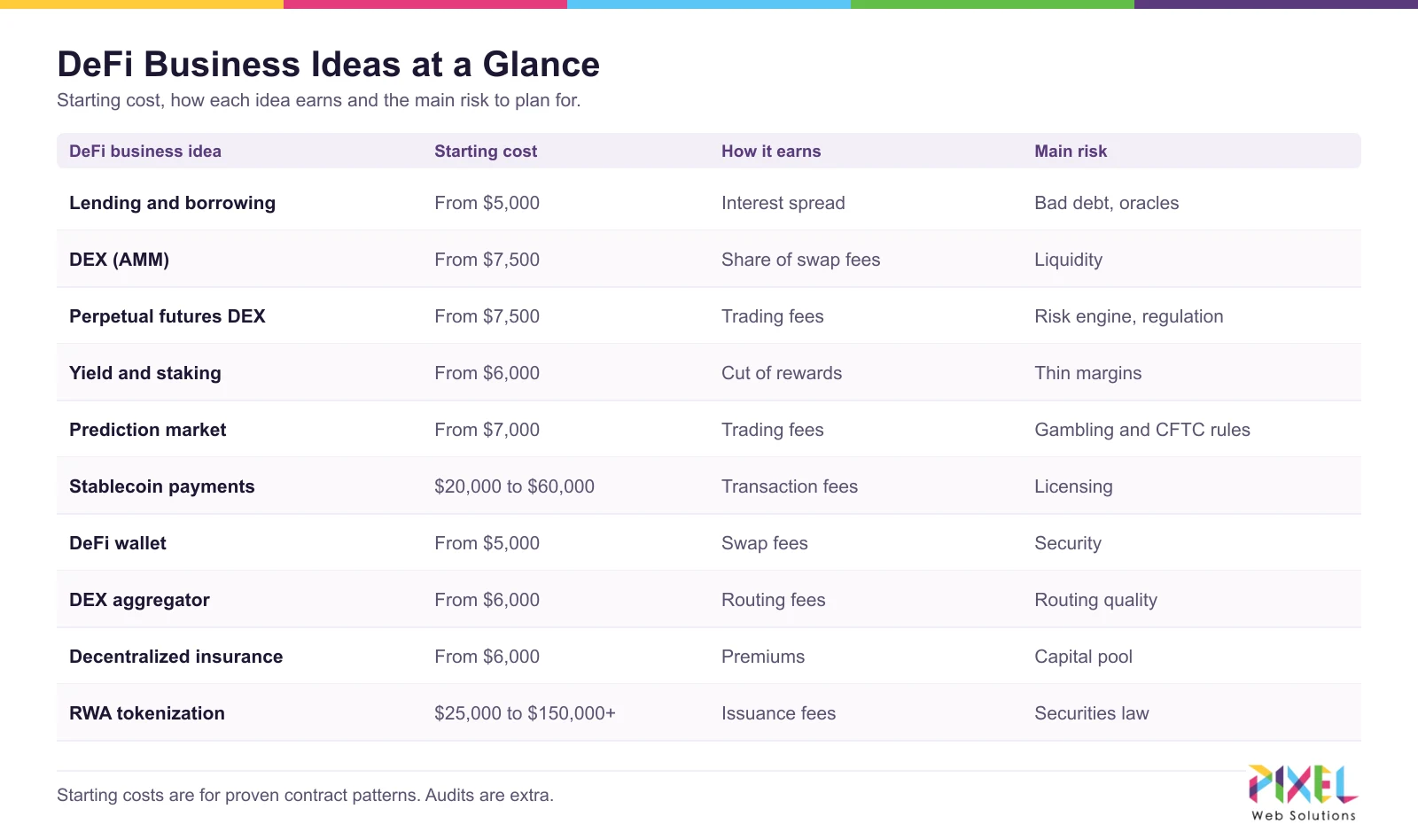
Here is the list of the top 10 DeFi business ideas, each with its revenue model, real-world benchmark and starting cost. All fee and revenue figures are from DefiLlama for the 30 days to 25 October 2026 unless stated.
1. Decentralized Lending and Borrowing Platform
A DeFi lending and borrowing platform connects borrowers and lenders through smart contracts. Borrowers deposit crypto as collateral to take loans, and lenders earn interest on the liquidity they supply. There are no credit checks and no intermediaries, which makes it attractive to a global audience.
- Proof of demand: Aave V3 borrowers paid $36.6 million in interest over the 30 days to 25 October 2026, and Morpho Blue borrowers $22.6 million.
- Where to compete: niche collateral types, a single chain that lacks a strong lender, fixed-rate loans or institutional lending pools with KYC.
- Starting cost: from $5,000 for a platform on established patterns, rising to $25,000 or more with complex features, plus an audit.
Revenue opportunities: interest rate spread (the reserve factor), liquidation fees, origination fees for institutional pools.
2. Decentralized Exchange (DEX) Platform
A decentralized exchange lets traders swap tokens directly from their wallets through automated market maker (AMM) pools. Uniswap, PancakeSwap and Aerodrome show that a well-designed DEX can become core infrastructure for its chain.
- Proof of demand: Uniswap V3 and V4 together generated $91.5 million in trading fees in 30 days, and Uniswap now keeps a share of V3 fees for its own treasury since its fee switch went live. On Base, Aerodrome's Slipstream pools kept $5.8 million of $8.8 million in fees.
- Where to compete: new chains without a dominant DEX, concentrated liquidity for specific asset types, or DEXs built into a wallet or app.
- Starting cost: from $7,500 for a standard AMM on proven contracts. Custom DEXs cost $40,000 to $120,000. Our guide to the cost to build a decentralized exchange breaks this down.
Revenue opportunities: a share of swap fees, listing and launch fees, and liquidity incentives funded by partner projects.
If you are ready to build, see how to create a DEX platform step by step.
3. Perpetual Futures DEX
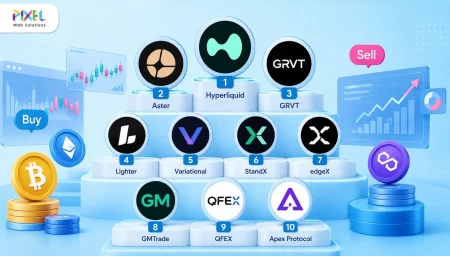
Perpetual futures let traders take leveraged long or short positions with no expiry date. On-chain perp DEXs became the highest-earning DeFi category after Hyperliquid showed that a fast, self-custodial order book can rival centralized exchanges.
- Proof of demand: Hyperliquid's perpetuals generated $78.1 million in fees and kept $62.7 million as revenue in the 30 days to 25 October 2026.
- Where to compete: specific markets (commodities, stocks, pre-launch tokens), specific chains, or white-label perp engines for existing apps.
- Starting cost: from $7,500 for a core perpetuals platform, while a production-grade derivatives exchange with its own risk engine runs $150,000 to $400,000 or more. See our crypto derivatives exchange development service.
Revenue opportunities: trading fees, funding-rate spreads, liquidation fees and vault management fees.
4. DeFi Yield and Staking Platforms
DeFi staking platforms let users lock assets to earn rewards, either by securing a proof-of-stake network or by supplying liquidity to protocols. Liquid staking adds a tradable receipt token, so users earn staking rewards without locking their capital away.
- Proof of demand: Lido's stakers earned $51.0 million in rewards over 30 days, of which Lido kept $3.1 million. Scale matters: the margin is thin, so volume makes the business.
- Where to compete: liquid staking for newer proof-of-stake chains, yield vaults that automate strategies, or staking-as-a-service for institutions.
- Starting cost: from $6,000 for a staking or vault protocol on established patterns, plus an audit.
Revenue opportunities: a percentage of staking rewards, performance fees on vaults, and withdrawal fees.
5. Prediction Markets
Prediction markets let users trade on the outcome of future events, from elections and economic data to sports. Polymarket proved the model on-chain, Kalshi grew as a US-regulated exchange, and in 2026 Hyperliquid added outcome markets to its own chain.
- Proof of demand: Polymarket's US and international platforms generated a combined $118.1 million in fees in 30 days. Hyperliquid's new outcome markets traded $56.4 million in the same period.
- Where to compete: regional markets, specific verticals (sports, crypto prices, local events) or embedded markets inside media and community apps.
- Watch out for: regulation. In the US, event contracts fall under the CFTC, and many countries treat prediction markets as gambling.
- Starting cost: from $7,000 for a focused platform with binary markets. See prediction market platform development and our Polymarket clone script. Our ranking of the top prediction market platforms shows the competition by volume.
Revenue opportunities: trading fees, market creation fees and data licensing.
6. Decentralized Payment Systems and Stablecoin Payments
With stablecoin supply above $300 billion, payments are now DeFi's most practical use. A stablecoin payment system lets merchants, freelancers and businesses send and receive digital dollars across borders in minutes, settling in stablecoins or local currency.
- Proof of demand: Tether earned $524.2 million and Circle $211.3 million in 30 days from the reserves behind their stablecoins. Payment businesses built on those rails earn on the flow instead.
- Where to compete: B2B cross-border payments, payroll for remote workers, merchant checkout and remittance corridors.
- Starting cost: $20,000 to $60,000 for a white-label crypto payment gateway. Issuing your own stablecoin is a far heavier, regulated business costing $30,000 to $100,000 to build before reserves and licensing.
Revenue opportunities: transaction fees (commonly around 1%), FX and conversion spreads, and merchant subscriptions.
7. DeFi Wallet Development
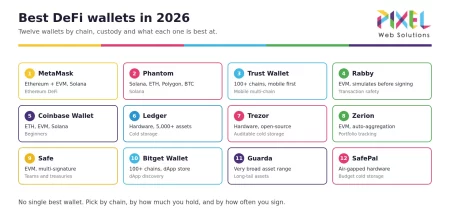
A non-custodial DeFi wallet lets users store, swap, stake and connect to dApps while keeping their own private keys. MetaMask and Trust Wallet serve millions of users, yet specialist wallets for particular chains, regions or user groups keep appearing.
- Proof of demand: Wallet-style trading apps on Solana such as Axiom collected $31.2 million in fees and kept $15.0 million as revenue over 30 days, mostly from swap fees.
- Where to compete: wallets with built-in swaps and staking for a specific chain, smart-account wallets with social recovery, or white-label wallets for fintechs.
- Starting cost: from $5,000 for a single-platform EVM wallet. See our DeFi wallet development service and our list of the best DeFi wallets for the competition.
Revenue opportunities: swap fees, on-ramp referral commissions, staking commissions and premium features.
8. DEX Aggregator
A DEX aggregator splits and routes each trade across many DEXs to find the best price and lowest slippage. Jupiter on Solana and 1inch on EVM chains show that routing can be a business of its own.
- Why it works: traders care about price, and aggregators consistently beat single-DEX quotes on larger orders.
- Where to compete: new chains, cross-chain swaps and routing APIs sold to wallets and apps.
- Starting cost: from $6,000 on established patterns, with routing quality driving most of the ongoing engineering.
Revenue opportunities: a small fee on routed volume, positive slippage capture and paid API access.
9. Decentralized Insurance
Decentralized insurance lets users buy cover against smart contract failures, stablecoin de-pegs or exchange hacks, with claims assessed by the community or by on-chain triggers. Nexus Mutual is the longest-running example, with $95.6 million of capital on DefiLlama as of 25 October 2026.
- Why it works: every exploit reminds users that DeFi needs risk cover, and parametric cover can pay out automatically.
- Honest caveat: the market is still small (Nexus Mutual collected about $167,000 in fees in 30 days), pricing risk is hard and a large hack can drain the capital pool. This idea suits teams with actuarial or risk expertise.
- Starting cost: from $6,000 for a cover protocol on established patterns, plus an audit and a capital strategy.
Revenue opportunities: premiums, capital pool yield and underwriting fees.
10. RWA Tokenization Platform
Real-world asset (RWA) tokenization turns property, bonds, fund units or invoices into tokens that can be issued, traded and settled on-chain. BlackRock's tokenized BUIDL fund, launched in 2024, pulled the model into the mainstream, and tokenized Treasuries now serve as collateral inside DeFi.
- Why it works: asset owners want cheaper issuance and wider distribution, and DeFi users want real-world yield.
- Watch out for: securities law. Most tokenized assets are securities, so you need the right licence or a licensed partner.
- Starting cost: $25,000 for a single-asset issuance portal to $150,000 or more for a platform with investor onboarding and secondary trading. See RWA tokenization platform development.
Revenue opportunities: issuance fees, annual management fees and secondary trading fees.
Ideas to approach with caution: play-to-earn gaming collapsed after 2022 because payouts relied on new players buying in, and generic "dApp creation" is a service rather than a business model. Both can work, but only with a clear customer and revenue plan.
DeFi Business Models: How DeFi Protocols Make Money
Every DeFi business model comes down to one question: who pays, and how much of that payment does the protocol keep? DefiLlama tracks both numbers for hundreds of protocols, which makes DeFi one of the few industries where you can check a business model before copying it.
- Fees are what users pay: swap fees, interest, trading fees, staking rewards.
- Revenue is the part the protocol keeps after paying liquidity providers, lenders or stakers.
| DeFi business model | Example | Fees paid by users (30 days) | Kept by the protocol (30 days) | How it earns |
|---|---|---|---|---|
| Stablecoin issuance | Tether | $524.2M | $524.2M | Interest on the reserves backing the stablecoin |
| Perpetual futures DEX | Hyperliquid | $78.1M | $62.7M | Trading fees, most retained by the protocol |
| Memecoin launchpad | pump.fun | $64.1M | $46.6M | Fees on token launches and trades |
| Liquid staking | Lido | $51.0M | $3.1M | A 10% cut of staking rewards |
| Lending | Aave V3 | $36.6M | $4.7M | The spread between borrower and lender interest |
| Spot DEX (AMM) | Uniswap V3 | $31.2M | $7.6M | Swap fees, mostly paid to liquidity providers, with a protocol share since the fee switch |
| Prediction market | Polymarket International | $31.1M | $15.5M | Trading fees on event contracts |
Source: DefiLlama fees and revenue dashboards, 30 days to 25 October 2026.
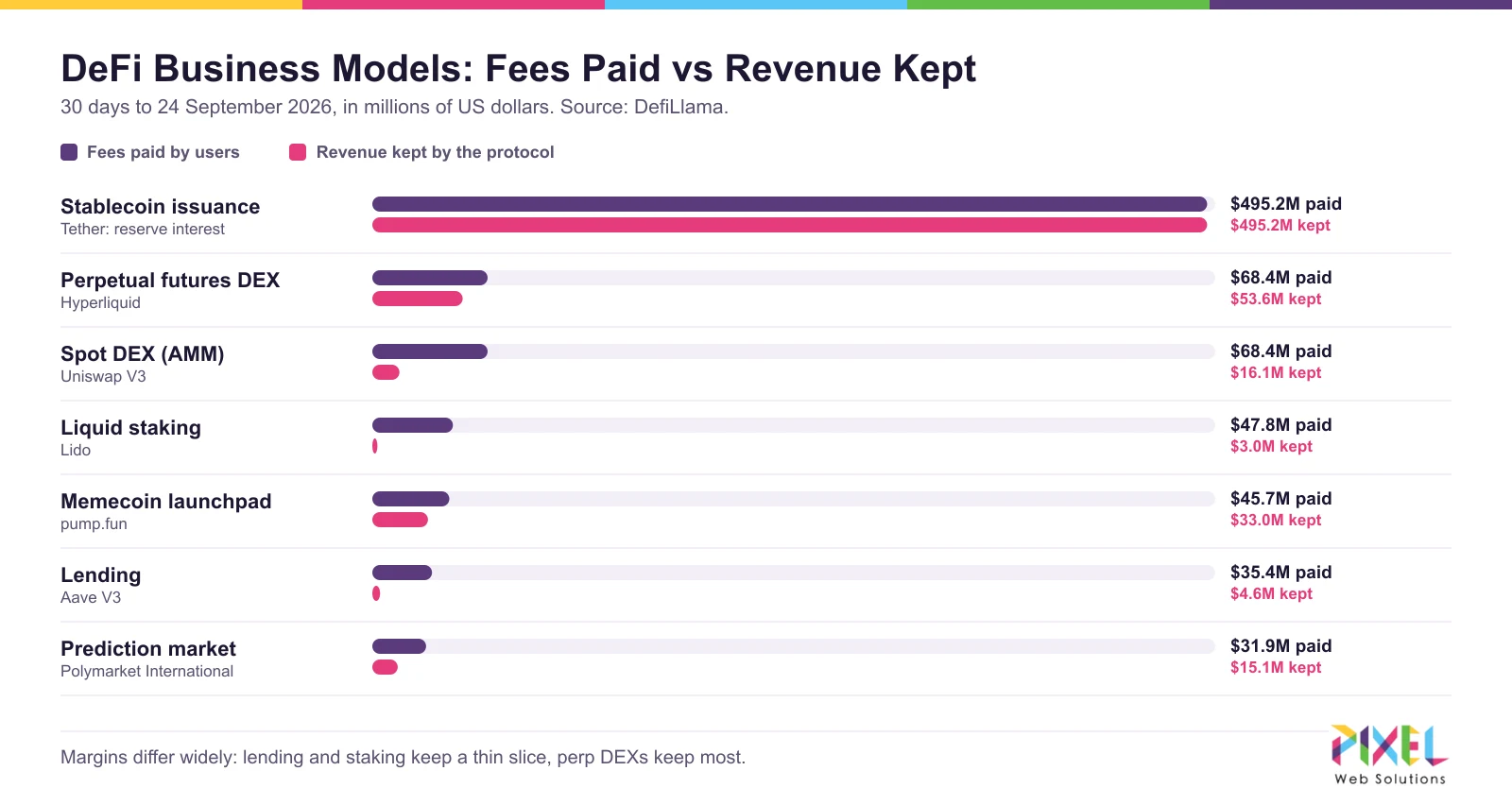
The table shows the outcome. The five sections below explain the mechanics, so you can decide which DeFi business model fits your idea.
Fee Models: Swap Fees, Trading Fees and Interest
The simplest DeFi business model charges a percentage of each transaction. AMM DEXs charge a swap fee (often 0.05% to 1%) that goes mostly to liquidity providers, perp DEXs charge maker and taker fees on notional volume, and prediction markets charge takers a fee that peaks when a contract trades near 50 cents. Hyperliquid is the clearest success: it keeps about 80% of the fees it collects because the protocol, not outside liquidity providers, runs the order book. Fee models scale with activity, which is their strength in a bull market and their weakness in a quiet one.
Spread Models: Reserve Factors and Reserve Interest
Lending protocols and stablecoin issuers earn a spread rather than a fee. Aave charges borrowers interest, pays most of it to depositors and keeps a "reserve factor" of the difference, which is why it kept $4.7 million of $36.6 million in October 2026. Tether and Circle earn the whole spread: users hold a non-interest-bearing stablecoin while the issuer earns Treasury yields on the reserves, which is how Tether booked $524.2 million in 30 days. Spread models need either enormous scale (lending) or a licence and distribution (stablecoin issuance).
Token Emissions: Paying for Liquidity With Your Own Token
Many protocols bootstrap usage by paying liquidity providers in a native token, a model known as liquidity mining. Our explainer on DeFi liquidity mining covers the mechanics. In 2026 the model has become more structured: Berachain's Proof of Liquidity directs the chain's block emissions to "Reward Vaults", and protocols pay incentives into those vaults to compete for validator allocations, according to the Berachain documentation, which notes that the BGT reward token was deprecated on 8 July 2026 and emissions now flow as WBERA. The lesson for founders is that emissions buy attention, not loyalty: liquidity paid for with tokens tends to leave when the rewards end, so emissions should bridge to a fee or spread model, not replace one.
Protocol-Owned Liquidity: Owning the Pool Instead of Renting It
Protocol-owned liquidity (POL) means the protocol's treasury holds the liquidity positions itself, so it earns the swap fees and never has to bribe outside providers to stay. Olympus pioneered the idea, and its documentation describes DEX POL held in an OHM/wETH Uniswap V3 pool that is intended to be permanent liquidity, per the Olympus docs. Hyperliquid applies a similar logic with its HLP vault and Assistance Fund, which receive protocol fees and buy back HYPE. POL turns liquidity from a cost line into an asset, at the price of tying up treasury capital.
Fee Switches and Buybacks: Uniswap's UNIfication
For years Uniswap collected hundreds of millions in swap fees and kept none of it. That changed when the UNIfication proposal turned on the protocol fee switch in late December 2025. Protocol fees now flow into a vault contract and can only leave by burning UNI, and Coin Metrics calculated about $0.8 million of protocol fees in the first 12 days, roughly $26 million annualized, in its State of the Network analysis. DefiLlama now shows Uniswap V3 keeping $7.6 million over the 30 days to 25 October 2026. A fee switch is the business model many DeFi founders should plan for from day one: run fee-free to win liquidity, then switch on a protocol share once the network effect holds.
Three lessons stand out from this data:
- Margins differ enormously. A lending protocol or liquid staking platform keeps a small slice of large flows, so it needs scale. A perp DEX or launchpad keeps most of what it charges, so it can profit at smaller scale.
- Stablecoins earn the most, but need the most. Issuing a stablecoin means holding reserves, meeting regulation and winning distribution, which is why most businesses build on existing stablecoins instead.
- Speculative categories swing hardest. Launchpads and trading apps earn well in busy markets and fall fast when activity drops. Build a plan that survives a quiet quarter.
Small DeFi Business Ideas You Can Start Under $10,000
Not every DeFi business needs venture funding. On proven, audited contract patterns, Pixel Web Solutions' published starting prices put several ideas within a small budget:
| Small DeFi business idea | Pixel starting price | First revenue line |
|---|---|---|
| DeFi wallet for one chain | from $5,000 | Swap fees and on-ramp commissions |
| DeFi lending market for a niche collateral type | from $5,000 | Reserve factor on interest |
| Staking or yield vault protocol | from $6,000 | Performance fee on rewards |
| DEX aggregator on a new chain | from $6,000 | Routing fee on volume |
| Single-strategy trading bot | from $6,000 | Subscription or performance fee |
| Prediction market with binary markets | from $7,000 | Taker fees |
| Standard AMM DEX | from $7,500 | Protocol share of swap fees |
Two rules keep a small DeFi business alive. First, budget for an independent audit and a bug bounty on top of the build, because a $5,000 contract that holds $500,000 of user funds is a target. Second, pick a distribution channel you already have (a community, a user base, a chain ecosystem grant) before you write code, because liquidity follows users, not the other way round.
Which DeFi Business Idea Should You Choose?
Match the idea to your capital, your skills and your appetite for regulation.
| If you have | Consider | Why |
|---|---|---|
| A small budget and a clear niche | DeFi wallet, staking platform, DEX on a new chain | Low starting cost on proven patterns |
| An existing user base or merchants | Stablecoin payments, embedded DEX, wallet | You already own distribution, the hardest part |
| Trading expertise and more capital | Perpetual futures DEX, DEX aggregator | The highest revenue retention in DeFi |
| Legal and compliance capacity | RWA tokenization, prediction markets, stablecoin issuance | Regulation is the moat |
| Risk or actuarial skills | Decentralized insurance | A thin field with real demand after every exploit |
If you are still comparing DeFi with other crypto opportunities, our guides to cryptocurrency business ideas and blockchain business ideas cover the wider market.
What DeFi Project Should I Build Next? What Reddit Founders Ask
The same questions come up in r/defi and startup forums every month. Here are plain answers, backed by the data above.
What are the business models of DeFi projects, really?
Five models cover almost every protocol: transaction fees (DEXs, perps, prediction markets), spreads (lending, stablecoin reserves), token emissions that pay for liquidity, protocol-owned liquidity that earns fees for the treasury, and fee switches that route a share of fees to token holders. The DefiLlama table above shows how much each model keeps. The mistake most founders make is counting fees as revenue when most of those fees belong to liquidity providers.
What DeFi project should I build next?
Build where there is paying demand and thin competition. In October 2026 that means stablecoin payment tools for businesses, prediction markets for regions and verticals the big platforms ignore, lending markets for new collateral types such as tokenized Treasuries, and perp or outcome markets on chains that lack them. Avoid launching another general-purpose DEX on Ethereum mainnet, where Uniswap holds the liquidity. Use the "Which idea should you choose" table to match the project to your budget.
Is DeFi safe enough to build a business on?
Safer than it was, but not safe. Immunefi counted 207 hacking incidents in the first half of 2026 that cost crypto projects about $972 million, a record number of incidents but less than half the losses of the first half of 2025, as The Block reported. Most large losses now come from compromised keys, infrastructure failures and privileged access, not only contract bugs. A DeFi business therefore needs an audit, a bug bounty, multisig or MPC key management, monitoring and an incident plan.
Can I start a DeFi business with a small budget?
Yes. The small ideas table above lists seven platforms that start between $5,000 and $7,500 on audited patterns. What a small budget cannot buy is liquidity or users, so start with a niche and a community you can reach, and keep the first version narrow.
How do I break into DeFi as a founder without a technical background?
Bring the market knowledge, the customers and the compliance plan, and partner with a development company for the engineering. Learn to read DefiLlama fee and revenue data, understand how your target protocol earns, and insist on seeing audit reports. Many successful DeFi businesses were started by operators from payments, trading or real estate who hired the smart contract work.
How to Start a DeFi Business in 6 Steps
- Pick a niche and a customer. "A lending market for tokenized Treasuries on Base" is a business. "A DeFi platform" is not.
- Model the economics. Estimate fees, the share you keep and the liquidity you need, using live DefiLlama data for comparable protocols.
- Check the regulation. Payments, stablecoins, prediction markets and tokenized securities are regulated in most countries. Take legal advice before you build.
- Build on proven patterns. Forking audited designs or using white-label software cuts cost and risk. Customize where your edge lies.
- Audit and test. Commission an independent smart contract audit, run a bug bounty and test on mainnet forks before real money arrives.
- Bootstrap liquidity and users. Plan incentives, market-maker partnerships and integrations with wallets and aggregators, because a DeFi platform without liquidity has no product.
Risks and Challenges of a DeFi Business
- Smart contract exploits. In November 2025 an attacker used flash loans to drain about $128 million from Balancer V2 pools through a rounding bug, and the first half of 2026 brought a record 207 incidents. Audits reduce this risk but never remove it.
- Liquidity and incentives. Liquidity attracted by token rewards often leaves when rewards end. Design fees that pay liquidity providers from real usage.
- Regulation. Stablecoins, prediction markets, derivatives and tokenized securities face licensing rules that differ by country.
- Oracle and pricing risk. Lending and derivatives platforms depend on price feeds. A manipulated oracle can trigger wrongful liquidations.
- Market cycles. Trading-driven revenue falls sharply in quiet markets. Keep costs low and revenue diversified.
DeFi for Business: How Companies Integrate DeFi in 2026
DeFi is not only for crypto natives. Existing businesses already use it in practical ways, and DeFi business integration has become a service category of its own.
Lowers Costs
Traditional transactions depend on banks and intermediaries to verify and settle agreements. DeFi replaces much of that with smart contracts that execute automatically when conditions are met, cutting settlement costs and manual errors.
Cross-Border Payments
Cross-border payments through banks are slow and expensive. Businesses now pay suppliers and remote staff in stablecoins, settling in minutes at a fraction of wire-transfer fees. The clearest mainstream example is Stripe, which with Coinbase lets Shopify merchants in 34 countries accept USDC and receive local currency or USDC, and which said it had settled more than $94 billion in stablecoin payments over two years, according to the Stripe newsroom.
Treasury and Idle Cash
Companies holding stablecoins can earn yield through lending markets or tokenized Treasury funds, with the caveat that DeFi yield carries smart contract and counterparty risk that a bank deposit does not.
Digital Asset Ownership
Real estate, commodities, invoices and intellectual property can be represented as tokens, which makes ownership, trading and financing faster and more accessible.
Enhanced Transparency
Every transaction on a public blockchain can be audited in real time. That transparency helps businesses prove reserves, track payments and satisfy auditors without waiting for month-end reports.
DeFi Business Integration: Three Ways to Plug In
- Integrate an existing protocol. Connect your app to a stablecoin payment gateway, a lending market or a swap API. Fastest and cheapest, with the least control.
- Launch a white-label product. Put your brand on proven DeFi software such as a wallet, a staking platform or a payment gateway. Pixel's white-label builds start from about $4,500 for a wallet and $20,000 for a payment gateway.
- Build your own protocol. Own the contracts, the fees and the roadmap. This is the route for the ten ideas above, at $40,000 and up for custom work plus audits.
Understanding the real-world applications is just the beginning. The real work lies in bringing a DeFi business idea to life, and that is where Pixel Web Solutions comes in.
DeFi Startups to Learn From in 2026
The DeFi startups that grew in a flat 2026 share one trait: each earns from a clear fee or spread model and publishes the numbers. All figures are from DefiLlama on 25 October 2026.
- Hyperliquid turned a perpetuals order book into $62.7 million of monthly revenue and reinvests fees into HYPE buybacks and its HLP vault.
- Morpho grew Morpho Blue to $11.2 billion of deposits across 45 chains by letting anyone create isolated lending markets, then selling that infrastructure to fintechs and exchanges.
- Ethena built USDe, a $4.6 billion synthetic dollar that earns from the funding-rate spread of a basis trade, a spread model with a hedge fund's risk profile.
- Pendle holds $1.1 billion by splitting yield-bearing tokens into principal and yield, creating a fixed-income market DeFi did not have.
- Axiom shows that a trading app on top of other protocols can keep $15.0 million of $31.2 million in fees without owning the liquidity.
- Predict.fun, a BNB Chain prediction market launched in December 2025 with backing from YZi Labs, traded $380 million in 30 days by paying lending yield on open positions.
The pattern for a new DeFi startup: pick one financial function, make it cheaper or more capital-efficient than the incumbent, and charge a fee on usage from day one.
How Pixel Web Solutions Will Make Your DeFi Business Idea Work
Pixel Web Solutions has more than 12 years of software experience and a team specialized in DeFi development services. Whether you are planning a DEX, a lending protocol, a perp DEX or a payment platform, we start from proven, audited patterns, customize where your edge lies and plan the audit, liquidity and launch with you. Our DeFi business development work covers tokenomics, the fee or spread model, the compliance plan and go-to-market, not only the code. If you are exploring trading automation, our guide to flash loan arbitrage bot development shows another side of DeFi, and our comparison of the top DeFi development companies explains what to look for in a partner.
Ready to turn your DeFi business idea into a live product? Contact our team for a free consultation.
Frequently Asked Questions
What are the most profitable DeFi business ideas in 2026?
By protocol revenue, perpetual futures DEXs, stablecoin issuers, prediction markets and launchpads earned the most in 2026. Hyperliquid kept $62.7 million of revenue in the 30 days to 25 October 2026, and Polymarket's two exchanges collected $118 million in fees. Profitability depends on your niche, liquidity and costs, and no DeFi business is guaranteed to earn.
What is a DeFi business model?
A DeFi business model is the way a protocol earns money from users. The common models are swap fees on DEXs, interest spreads on lending platforms, trading fees on derivatives and prediction markets, a cut of staking rewards, interest on stablecoin reserves, and newer structures such as protocol-owned liquidity and fee switches that buy back the protocol's token.
How do DeFi protocols make money?
DeFi protocols charge users fees for services such as trading, borrowing or staking. Part of those fees goes to liquidity providers, lenders or stakers, and the protocol keeps the rest as revenue, usually in its treasury or for token holders. Uniswap's fee switch, active since December 2025, is the best-known example of a protocol starting to keep a share.
What are examples of DeFi?
Uniswap (token swaps), Aave and Morpho (lending), Lido (liquid staking), Hyperliquid (perpetual futures), Polymarket (prediction markets), Tether and Circle's USDC (stablecoins) and Nexus Mutual (cover) are all DeFi. Each one is also an example of a DeFi business model you can study on DefiLlama.
What is the difference between fees and revenue in DeFi?
Fees are everything users pay to use a protocol. Revenue is the share the protocol keeps after paying liquidity providers, lenders or stakers. Lido collected $51.0 million in staking rewards in 30 days but kept $3.1 million, while Hyperliquid kept $62.7 million of $78.1 million, which is why the two businesses need very different scale.
How much does it cost to start a DeFi business?
Pixel's DeFi builds start at $5,000 to $7,500 for platforms on established contract patterns. Custom DEXs cost $40,000 to $120,000, derivatives exchanges $150,000 or more, and stablecoin systems $30,000 to $100,000. Audits, liquidity and legal work are extra.
Can a traditional business use DeFi?
Yes. Businesses use stablecoins for cross-border payments and payroll, earn yield on idle stablecoin balances, tokenize assets to raise financing and accept crypto payments. Stripe and Shopify's USDC checkout is a mainstream example. Each use needs a check on local tax and regulatory rules.
Is a DeFi business legal?
Building DeFi software is legal in most countries, but some activities are regulated. Issuing stablecoins, offering derivatives, running prediction markets and tokenizing securities usually need licences. Get legal advice for your target markets before launch.
Is DeFi safe?
DeFi carries smart contract, key management and oracle risk. Immunefi recorded about $972 million of losses across 207 incidents in the first half of 2026, fewer dollars but more incidents than a year earlier. A DeFi business reduces the risk with independent audits, bug bounties, multisig or MPC custody and live monitoring, but cannot remove it.
What skills do I need to start a DeFi startup?
You need smart contract development, security and audit experience, token and incentive design, and an understanding of DeFi regulation. Many founders bring the business and market knowledge and partner with a development company for the engineering of their DeFi business ideas.