








The cost to build a perpetual DEX depends mostly on how it matches trades. An oracle-based perpetual DEX on an existing chain falls in Pixel Web Solutions' custom DEX range of $40,000 to $120,000; a hybrid or on-chain order book perpetual DEX falls in Pixel's derivatives range of $150,000 to $400,000+; and an appchain like dYdX or Hyperliquid costs well beyond that. Audits, oracle and keeper running costs, and the liquidity and insurance capital to open markets come on top, and this guide shows the maths for each.
Every day, tens of billions of dollars flow through decentralized perpetual exchanges. DefiLlama tracked $653.6 billion of perpetual DEX volume in the 30 days to 16 October 2026, and businesses are building perpetual DEXs that offer transparency, self-custody of funds and access for traders worldwide. The hard part is understanding how much it costs to build a perpetual DEX that can actually compete.
Whether you are an entrepreneur validating a new concept or an enterprise planning a large-scale decentralized trading system, the budget has to cover more than code. This guide breaks down perpetual DEX development cost by architecture, the engineering hours behind each figure, audits, running costs, the capital needed for liquidity and insurance, and revenue. Let's start with the market data.
Key Takeaways
- Architecture sets the budget: oracle-based pool designs are the cheapest to build, hybrid order books cost several times more, and appchains are a different category again.
- Pixel's published ranges: custom DEX development from $40,000 to $120,000; derivatives exchanges from $150,000 to $400,000+.
- Audits are a separate line: most mid-complexity DeFi audits cost $40,000 to $100,000, with $60,000 to $120,000 a realistic pre-launch security budget including remediation reviews, per Sherlock's 2026 pricing reference.
- Capital is the hidden cost: listing a builder-deployed market on Hyperliquid requires 500,000 staked HYPE, about $40.8 million on 16 October 2026, and Orderly asks for a $25,000 USDC insurance fund per new market.
- The market is concentrated: Hyperliquid handled 32.7% of 30-day perp DEX volume, so a new venue needs a clear niche, not a copy.
Perpetual DEX Market Growth and Business Opportunity
Decentralized derivatives are one of the largest and most competitive segments in DeFi. Here is where the market stood as of 16 October 2026, from DefiLlama's perps dashboard:
- Volume: $653.6 billion in the past 30 days and $31.5 billion in the past 24 hours, with open interest of about $13.6 billion.
- Scale over time: perpetual DEXs traded about $7.85 trillion in 2025, peaking at a record $1.36 trillion in October 2025. The 2026 monthly average through September was about $654 billion, level with 2025's monthly average.
- Concentration: the top venue holds about a third of volume, and the top six hold more than 70%.
| Perpetual DEX | Matching design | 30-day volume | Share |
|---|---|---|---|
| Hyperliquid | On-chain order book on its own L1 | $213.8 billion | 32.7% |
| Variational | Request-for-quote, on Arbitrum | $81.5 billion | 12.5% |
| Lighter | ZK-proven order book | $63.3 billion | 9.7% |
| Aster | Order book with on-chain deposits | $54.0 billion | 8.3% |
| edgeX | Order book on its own edgeX chain | $29.5 billion | 4.5% |
| GMX | Oracle-based liquidity pools, on Arbitrum and Avalanche | $29.2 billion | 4.5% |
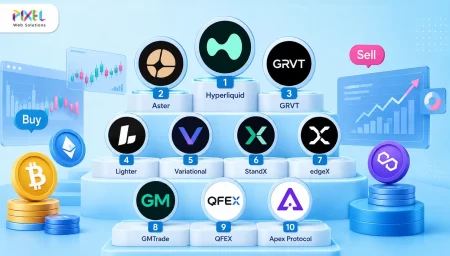
This data shows decentralized derivatives are now part of the global trading infrastructure, and that the leaders run very different architectures. Pixel's ranking of the top perpetual DEXs by trading volume profiles each one.
How Much Does It Cost to Build a Perpetual DEX?
The cost to build a perpetual DEX ranges from about $40,000 for a focused oracle-based platform to $400,000+ for a high-performance order book, before audits and launch capital. Appchain designs sit above that.
Estimated Development Cost Range
Unlike spot DEXs, whose budget Pixel covers in its guide to the cost to build a decentralized exchange, perpetual DEXs need a pricing and risk engine: margin accounts, funding rates, liquidations, oracle feeds and, at the extreme, auto-deleveraging. How those are built is what moves the budget.
| Platform type | Software cost | Timeline | Best for |
|---|---|---|---|
| Front end on shared infrastructure (Orderly, Hyperliquid HIP-3) | Small software budget; capital requirements apply | 2 to 8 weeks | Communities and brands testing demand |
| Oracle-based perpetual DEX (GMX-style) | $40,000 to $120,000 (Pixel custom DEX range) | 12 to 20 weeks | Startups launching on an existing L2 |
| Hybrid or on-chain order book perpetual DEX | $150,000 to $400,000+ (Pixel derivatives range) | 24 to 40 weeks | Teams targeting professional traders |
| Appchain perpetual DEX (dYdX or Hyperliquid style) | Well above $400,000 (industry estimate) | 12 months+ | Funded teams building their own chain |
Before you set a budget, decide the matching design, the chain, the number of markets, the collateral types, the leverage cap and whether you will run your own validators. Each one changes the engineering hours.
Basic Perpetual DEX: Oracle-Based ($40,000 to $120,000)
A basic perpetual DEX for startups uses an oracle-based design: traders open positions against a shared liquidity pool, and prices come from an oracle such as Chainlink or Pyth rather than an order book. This tier includes the vault and position contracts, funding and borrow fees, a liquidation keeper, wallet connection and a trading interface.
A white-label or fork-based approach shortens development, but forks inherit the original protocol's risk parameters, which need re-tuning for your markets and liquidity.
Mid-Scale Perpetual DEX: Hybrid Order Book ($150,000 to $400,000+)
The mid-scale tier adds an order book. Orders are matched off-chain by a high-speed engine, or on a ZK-proven or on-chain book, and settled on-chain. Traders get limit orders, tight spreads and an API, which is what professional market makers need. It also needs a full risk engine, portfolio margin, a liquidation and auto-deleveraging (ADL) system and 24/7 operations. This is the design most new competitive venues choose.
Enterprise-Grade Perpetual DEX: Appchain (Above $400,000)
Enterprise-grade perpetual DEX development means running the exchange as its own chain, as dYdX does on the Cosmos SDK and Hyperliquid does on its own L1. The order book lives inside the validators, which removes gas costs for traders. The build adds consensus integration, bridging, validator incentives and chain operations. The investment is far higher than a basic DEX, but it is the only design that gives full control over latency, fees and market listings.
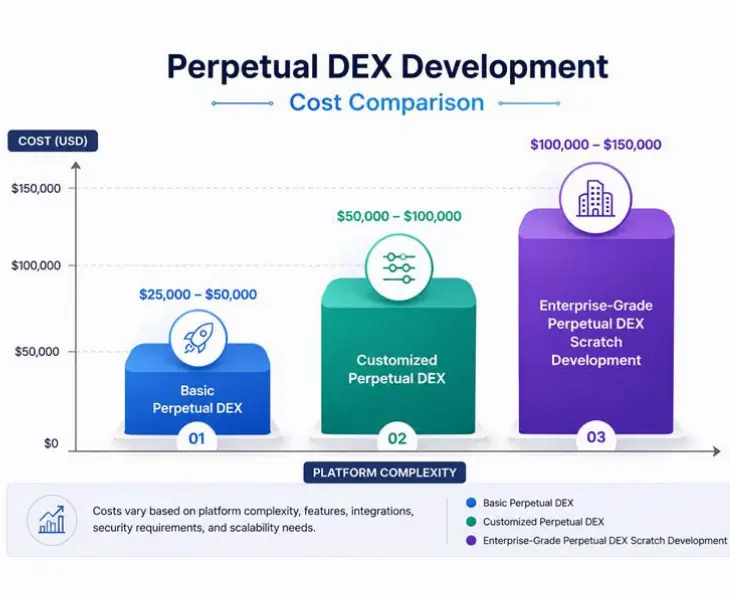
Choose the development approach that fits your traders, your liquidity plan and your growth tactics. Matching the architecture to the business model is the best way to avoid paying for performance you do not need yet.
Need a Precise Estimate for your Perpetual DEX Platform?
Get in touch with our Dex experts for a free project consultation and tailored cost estimate.
The Maths Behind the Numbers: Engineering Hours by Architecture
Published perpetual DEX cost ranges rarely show where the money goes. Here are planning estimates of engineering hours for the two most common designs, priced at Pixel's custom development rate from $40 per hour.
Oracle-based perpetual DEX
| Work package | Hours |
|---|---|
| Smart contracts: vault, positions, funding and borrow fees, liquidations | 500 to 800 |
| Keeper and liquidation bots | 150 to 250 |
| Oracle integration with fallback and price deviation checks | 60 to 100 |
| Indexer, backend and APIs | 200 to 300 |
| Trading front end with charts and portfolio views | 300 to 450 |
| Admin panel and analytics | 100 to 150 |
| QA, simulations and testnet | 200 to 300 |
| Total | 1,510 to 2,350 |
At $40 per hour that is about $60,400 to $94,000, inside Pixel's $40,000 to $120,000 custom DEX range. Extra chains, more collateral types and a mobile app push it towards the top.
Hybrid order book perpetual DEX
| Work package | Hours |
|---|---|
| Matching engine (in-memory order book, order types, self-trade prevention) | 600 to 900 |
| Risk and margin engine (cross and isolated margin, mark price, funding) | 400 to 600 |
| Settlement and custody contracts | 400 to 600 |
| Liquidation engine, insurance fund logic and ADL | 200 to 300 |
| Oracle and index price service | 100 to 150 |
| Sequencer, infrastructure and monitoring | 200 to 300 |
| Trading front end | 400 to 600 |
| REST and WebSocket APIs for market makers | 200 to 300 |
| Admin, risk console and reporting | 150 to 200 |
| QA, load testing and chaos testing | 300 to 500 |
| Total | 2,950 to 4,450 |
At $40 per hour the core engineering alone is about $118,000 to $178,000. ZK proving, multi-chain deposits, options, portfolio margin and a mobile app take the full build into Pixel's $150,000 to $400,000+ derivatives range.
Key Factors Affecting the Cost of Perpetual DEX Development
The cost to build a perpetual DEX depends on architecture, trading features, security and scale. These are the factors that move the budget most.
Blockchain Network Selection
The chain sets transaction speed, gas costs and tooling. A single-chain deployment on an established L2 such as Arbitrum or Base is the cheapest; Solana programs in Rust usually cost more to build and audit; multi-chain deposits add bridging and reconciliation work.
Trading Engine Development
The trading engine executes orders and manages leveraged positions. An oracle-based engine is a set of smart contracts; an order book engine is a low-latency service that must handle bursts of orders during volatile markets.
Order Book Infrastructure
On-chain, off-chain and hybrid order books trade decentralization against speed. Off-chain matching with on-chain settlement is the most common compromise; a fully on-chain book needs its own chain or a ZK system.
Smart Contract Development
Smart contracts automate trades, margin, funding rates and liquidations. Every extra feature (cross margin, multiple collateral types, partial liquidations) adds code that has to be audited.
Liquidity Management System
Liquidity can come from a pool of liquidity providers (an LP vault), professional market makers on an order book, or both. Designing the vault, its fee share and its risk limits is a major work package.
Oracle Integration
Perpetual DEXs rely on real-time prices for marks, funding and liquidations. A robust setup uses more than one source, checks for deviations and pauses markets when feeds fail.
Margin and Leverage Mechanisms
Leverage needs collateral management, margin tiers and risk limits. The higher the leverage you allow, the more sophisticated the liquidation logic must be.
Liquidation Engine Development
An automated liquidation engine closes under-collateralised positions before they become losses for the platform. It needs keepers that keep working during congestion, an insurance fund for shortfalls, and ADL as a last resort.
Wallet Integration
Connecting popular wallets lets users trade from their own funds. Account abstraction and one-click trading sessions improve the experience but add development work.
Security Audits and Compliance
Independent audits find vulnerabilities before launch and are priced separately (see below). Compliance work includes geo-blocking, sanctions screening on front ends and legal opinions for the markets you serve.
UI/UX Design
Traders expect charts, order entry, positions, funding history and portfolio views that work on mobile. A professional interface is a large share of front-end hours.
Third-Party Integrations
Analytics, market data, notifications, account abstraction and any KYC services add integration and maintenance work.
Cost Breakdown of Core Perpetual DEX Components
The core modules of an oracle-based perpetual DEX, converted from the hours above at $40 per hour:
| Component | Basis for cost estimate | Cost range |
|---|---|---|
| Trading and position contracts | Order execution logic, leverage, funding and borrow fees | $20,000 to $32,000 |
| Keepers and liquidation bots | Order execution, liquidations, failover | $6,000 to $10,000 |
| Liquidity infrastructure | LP vault design, fee share and risk limits | Included in the contract hours above |
| Oracle systems | Primary and fallback feeds, deviation checks | $2,400 to $4,000 |
| Risk management module | Margin tiers, open interest caps, price impact rules | Included in the contract hours above |
| Admin dashboard | Market listing, parameters, reporting | $2,000 to $3,000 |
| Analytics and reporting tools | Volume, fees, open interest and LP returns | $2,000 to $3,000 |
| Front end, backend and testing | Trading UI, indexer, APIs, QA | $28,000 to $42,000 |
Together these lines add up to the $60,400 to $94,000 engineering estimate. They cover engineering only. Audits, running costs and launch capital are separate lines, set out next.
Security Audits: The Line Item You Cannot Skip
A perpetual DEX holds user collateral in contracts that handle leverage, which makes it a prime target. Sherlock's 2026 audit pricing reference gives the market rates:
- Mid-complexity DeFi protocol audit: $40,000 to $100,000.
- Realistic pre-launch budget including at least one remediation review: $60,000 to $120,000.
- Each re-audit pass: $5,000 to $20,000.
- Language premiums: Rust on Solana costs 25% to 40% more than Solidity; Move and Cairo 30% to 45% more.
- Ongoing security for protocols with meaningful TVL: $150,000 to $500,000 a year, covering further audits, bug bounties and monitoring.
A perpetual DEX sits at the upper end of mid-complexity because of funding, margin and liquidation logic. Budget for a firm audit plus a competitive audit or bug bounty before opening high leverage. Pixel's smart contract audit services page explains what a pre-launch review covers.
Running Costs: Oracles, Keepers and Infrastructure
After launch, the platform pays to operate every day. Plan these lines with your own volumes:
- Oracle updates: on pull-based oracles such as Pyth, a fresh price is posted on-chain with each trade or liquidation, and the transaction sender pays the update fee and gas. Monthly cost = updates per month x (update fee + gas per update).
- Keepers: order execution and liquidation bots pay gas on every action. Monthly cost = keeper transactions x average gas cost, with a reserve for congested periods when gas spikes and liquidations surge at the same time.
- Nodes and RPC: dedicated or redundant RPC providers, plus archive access for the indexer.
- Indexer and data: hosting for the backend that serves charts, positions and history.
- Monitoring and on-call: a perpetual DEX runs 24/7, so someone must be able to pause markets at 3 a.m.
On an L2 these costs are modest next to the build, but they scale with volume and spike in exactly the conditions where reliability matters most.
Liquidity and the Insurance Fund: The Capital Most Budgets Miss
Software is only half the launch. A perpetual DEX needs liquidity to quote tight prices and a buffer to absorb losses when liquidations fail. Three reference points show the scale:
- Hyperliquid HIP-3: deploying your own perpetual markets on Hyperliquid requires a stake of 500,000 HYPE, kept for at least 183 days after deployment and slashable by validators for faulty inputs. At about $81.57 per HYPE on 16 October 2026 (CoinGecko), that is roughly $40.8 million of capital. Deployers can add their own fee share on top of the protocol fee.
- Orderly: Orderly's no-code perp DEX builder lets a front end share its order book, with a $10 one-time fee to unlock custom fees and a $25,000 USDC insurance fund to list a new perp market.
- Your own venue: you fund the insurance fund, seed or incentivise the LP vault, and pay or lend inventory to market makers.
Worked example: sizing a starting insurance fund. Suppose you open 10 markets and expect $20 million of open interest. If a crash leaves 0.5% of open interest as unrecovered losses after liquidations (an assumption to stress-test, not a standard), the shortfall is $20,000,000 x 0.5% = $100,000. A fund of two to three times that, $200,000 to $300,000, gives headroom before ADL. Your real figure should come from simulations against past crashes.
Why this matters, from the October 2025 crash. On 10 and 11 October 2025 more than $19 billion of leveraged positions were liquidated across crypto in a single day, according to CoinShares. Hyperliquid stayed online and activated ADL on short positions, dYdX was offline for almost eight hours, and Lighter reported a severe outage but did not need ADL because its insurance reserves were sufficient. Uptime, liquidation keepers and a funded insurance pool are what decide whether a perpetual DEX survives its first crash.
Revenue Models of Perpetual DEX
A perpetual DEX earns from several sources:
- Trading fees: the main line. As a benchmark, Hyperliquid's base tier charges 0.045% taker and 0.015% maker on perpetuals, per its fee schedule.
- Liquidation fees: a fee when positions are liquidated for insufficient collateral, often shared with the insurance fund.
- Funding and borrow fees: in pool-based designs, traders pay borrow fees to LPs, and the protocol can take a share.
- Premium features: advanced analytics, API tiers and professional dashboards.
- Builder and referral fees: front ends and partners earn a share for routing order flow, and your venue can offer the same to grow.
- White-label and institutional services: licensing your infrastructure to other teams.
Revenue maths. At $1 billion of monthly volume and a blended fee of 0.03% (half maker, half taker at Hyperliquid's base rates), gross fees are $1,000,000,000 x 0.03% = $300,000 a month, before LP and referral shares and incentives. A venue at $10 billion a month earns ten times that. That is why the cost of liquidity and incentives, not the build, usually decides profitability.
Why Businesses Should Invest in Perpetual DEX Development
For startups and enterprises, a perpetual DEX can be a strategic asset when it has a clear niche:
- Growing demand for decentralized derivatives: traders value transparency, self-custody and access without account approval.
- Multiple revenue streams: fees, liquidations, funding shares and builder fees reduce dependence on one line.
- New markets: builder-deployed and long-tail markets such as equities, commodities and pre-launch tokens are where new venues are winning volume.
- Scalability: modern L2s, ZK systems and appchains can now handle order book throughput.
- Competitive niche: a regional audience, a specific asset class or a better mobile experience gives a new venue a reason to exist next to the leaders.
Why Choose Pixel Web Solutions for Perpetual DEX Development
Pixel Web Solutions is a decentralized exchange development company with 12+ years in blockchain and crypto software, operating from Ras Al Khaimah, UAE and Madurai, India. It helps entrepreneurs and businesses design and build secure, scalable perpetual DEXs, from architecture and smart contracts to trading engines, risk controls, deployment and continued support. For order book and centralized designs, Pixel's crypto derivatives exchange development team builds the matching and risk engines.
Pixel has delivered around 560+ projects and supported nearly 350+ clients worldwide. Clients choose it for flexible, end-to-end and security-first delivery, whether they need an oracle-based MVP for market validation or an enterprise-grade decentralized derivatives exchange. Teams comparing a centralized venue can read Pixel's guide to the cost to build a crypto derivatives exchange.
Connect with Pixel's technical team to get a perpetual DEX cost estimate for your architecture and kickstart your business journey.
Frequently Asked Questions
How much does it cost to build a perpetual DEX?
An oracle-based perpetual DEX falls in Pixel Web Solutions' custom DEX range of $40,000 to $120,000, and a hybrid or on-chain order book perpetual DEX in Pixel's derivatives range of $150,000 to $400,000+. Audits, running costs and liquidity capital are extra.
Can I launch a perpetual DEX using a white-label solution?
Yes. White-label and shared-infrastructure options such as Orderly let you launch faster with core trading features, but you share liquidity and rules with the base protocol. A custom build gives control over markets, fees and risk.
Which blockchain is best for perpetual DEX development?
Arbitrum, Base and other Ethereum L2s suit oracle-based designs; Solana suits high-throughput order books; and teams with large budgets build their own chain, as dYdX and Hyperliquid did. The right choice depends on your traders and your liquidity partners.
What is the difference between a basic and an enterprise-grade perpetual DEX?
A basic perpetual DEX uses an oracle-priced liquidity pool and core trading features. An enterprise-grade platform runs an order book, often on its own chain, with portfolio margin, market maker APIs, ADL and 24/7 operations.
Can a perpetual DEX support multiple blockchains?
Yes. Multi-chain perpetual DEXs accept deposits from several networks into one margin account, which widens reach but adds bridging and reconciliation work.
How long does it take to build a perpetual DEX?
About 12 to 20 weeks for an oracle-based platform, 24 to 40 weeks for a hybrid order book, and a year or more for an appchain, plus audit time before mainnet.
How much does a perpetual DEX audit cost?
Mid-complexity DeFi audits typically cost $40,000 to $100,000, and a pre-launch budget including remediation reviews is usually $60,000 to $120,000, according to Sherlock's 2026 pricing reference.
Disclaimer
The cost estimates in this blog are for information only and are not an official quotation from Pixel Web Solutions. The final development cost depends on your project's scope, features, customisation, technology stack, compliance requirements and other business-specific needs. For a detailed quotation, consult the Pixel Web Solutions business team directly.