How to launch a DAO in 2026: define the DAO's purpose and type, choose a legal wrapper so members are not exposed to unlimited liability, deploy a governance token, voting contracts and a multisig treasury, get the contracts audited, then onboard your community. A lean DAO built on audited open-source modules costs roughly $11,000 to $37,000 including audit and registration; a custom governance system runs about $35,000 to $110,000.
A DAO, or Decentralised Autonomous Organization, lets a community make decisions and manage shared funds through rules written in smart contracts instead of a central management team. The idea went mainstream with "The DAO" on Ethereum in 2016, which was drained of about 3.6 million ETH within months of launch. That early failure still shapes how DAOs are built today: with audited code, timelocks and, increasingly, a legal entity behind them.
As demand for community-owned products grows, many startups see a DAO as a serious business model. Yet founders face the same questions: how to launch a DAO, which tools to use, which legal wrapper to choose and what it all costs. This guide answers each one, starting with the basics.
Key Takeaways
- A legal wrapper is no longer optional: US courts have treated DAOs as liable "persons" and even as general partnerships, which can expose members to personal liability.
- You have real wrapper choices: Wyoming DAO LLC and DUNA, Marshall Islands DAO LLC, and the UAE's Innovation City DAO Association in Ras Al Khaimah all give DAOs legal personality.
- Use audited building blocks: an ERC-20 voting token, an OpenZeppelin Governor with a timelock, and a Safe multisig cover most startup needs.
- Design against governance attacks: voting delays, snapshot-based voting power and timelocks stop flash-loan takeovers like the 2022 Beanstalk exploit.
- Budget with the maths shown: about 120 build hours for a lean DAO versus about 490 for a custom one, plus audit and registration fees.
What Is a DAO and How Does It Work?
DAOs are organisations run on blockchain, where governance, voting and decision-making happen through members instead of a central authority. Actions such as fund allocation, protocol changes and proposal approval are executed by smart contracts on the blockchain.
If the DAO mechanism still feels abstract, here is a breakdown of how it works.
Working Process of a DAO
A DAO runs on three parts working together: smart contracts, a blockchain and community governance.
- Smart contract functioning: the rules, core logic and workflows are coded into smart contracts. Contracts can be immutable, or upgradeable through a proxy, in which case upgrades should only pass through a governance vote and a timelock.
- Governance token issuance: members get voting rights by holding governance tokens. Tokens are typically distributed through airdrops, contributor rewards, liquidity incentives or, with legal advice, token sales.
- Proposal creation: any member who meets the DAO's threshold, for example holding a minimum number of tokens, can create a proposal for fund allocation, new features or rule changes.
- Voting: once a proposal passes its review period, it goes live for voting. Token holders approve or reject it within a set voting window.
- Vote counting: most DAOs use one token, one vote, often with delegation so members can lend their voting power to active delegates. Votes are recorded on-chain, or signed off-chain and published, so the result is transparent.
- Execution: if a proposal passes, the smart contracts execute it automatically, usually after a timelock delay that gives members time to react.
This is how a DAO works with the help of DeFi smart contracts, keeping decisions transparent and hard to tamper with. Because of this decentralised, secure design, many startups now create DAOs. Here is what the data says about the sector.
Why Do DAOs Matter in the Future of Decentralised Governance?
DAOs manage billions of dollars, but measuring the sector has become harder. DeepDAO, the best-known DAO tracker, stopped updating its data on 24 November 2025. Its final snapshot showed about $13.6 billion in DAO treasuries, 11.8 million governance token holders and 50,845 aggregated governance setups. DeepDAO itself now warns visitors not to use the static snapshot for research, so treat these figures as a historical marker rather than a live count.
The bigger 2026 story is legal maturity. Since 2024, US states and the UAE have created purpose-built legal forms for DAOs, and large protocols have adopted them. Uniswap's community, for example, has published an association agreement for DUNI, a Wyoming decentralised unincorporated nonprofit association.
For founders, this means DAOs now offer a powerful alternative to traditional corporate structures, with clearer rules than ever. Here are the business reasons to launch one.
Top Reasons to Launch a DAO for Your Business
The Web3 landscape keeps evolving, and DAOs offer benefits for both users and the startups that launch them.
Permissionless Operations
Without a central authority or intermediary, community members can propose new features, partnerships or spending. This reduces bottlenecks and slow decision-making.
Increased Transparency
Every transaction, proposal and vote is recorded on the blockchain, which is permanent and publicly auditable. This helps startups build trust and attract contributors and funding.
Cost-Effective Coordination
A DAO automates routine decisions such as treasury payouts and parameter changes, which reduces manual administration. You still need contributors, legal support and audits, so plan those costs honestly.
Scalable Across Industries
DAO architecture is modular, so it scales with growth. DAOs now govern DeFi protocols, investment clubs, grant programmes, creator communities and gaming guilds, each with features and security matched to the sector.
With these perks in mind, let's move to the main question of how to launch a DAO, step by step.
How to Launch a DAO in 2026?
Building a DAO is manageable with experienced DAO developers by your side. Here is the process broken into six phases, which also helps you plan scope, budget and timelines.
Step 1: Project Preparation
First, define the DAO's purpose, members, market and success measures. Decide the governance model in detail: who can propose, how long votes last, what quorum is required and which decisions need on-chain execution. Then prepare the roadmap, timeline and budget.
Also spell out what the DAO will not do. If it will manage money, sign contracts or hire contributors, those activities shape your legal wrapper in step 3.
Step 2: Choice of DAO Type
Next, choose the type of DAO that fits your business. Popular types include:
- Protocol DAO: governs a DeFi protocol, such as a decentralised exchange or DeFi yield farming platform. Token holders vote on fees, upgrades and treasury use.
- Investment DAO: pools member capital to evaluate and fund opportunities. Because members expect returns, these DAOs face the strictest securities rules.
- Grant DAO: token holders or elected committees vote on which projects receive funding, usually for public goods.
- Social DAO: built around identity, access and community. Members may need a token or NFT to join, and these DAOs organise events, content and collaborations.
Choose the type that suits your vision, and seek guidance from an experienced DAO development company.
Step 3: Choose a Legal Wrapper
This step was missing from most early DAO guides, and courts have since shown why it matters. In June 2023, a US federal court held that the Ooki DAO was a "person" liable under commodities law in a CFTC enforcement action. In November 2024, a California federal court in Samuels v. Lido DAO allowed claims to proceed on the theory that the DAO was a general partnership, which could make active participants personally liable.
A legal wrapper gives the DAO its own legal personality, so it can sign contracts, open bank accounts, pay taxes and shield members. The comparison table below covers the main options.
Step 4: Build the Governance Stack With a Technical Partner
Now build the on-chain system. Work with a DAO blockchain development team that can deliver a clean dashboard for proposals, voting and execution. A typical startup stack has four parts:
- Governance token: an ERC-20 token with vote tracking and delegation. Pixel's crypto token development team builds these with distribution and vesting contracts.
- Voting contracts: an OpenZeppelin Governor with a timelock for on-chain execution, or Snapshot for gasless off-chain voting.
- Front end: a hosted interface such as Tally, or a custom dashboard if your members need special workflows.
- Security review: an independent audit through smart contract audit services before launch, and after every upgrade.
Before minting the token, check how it will be treated legally. This guide to utility tokens vs security tokens explains the line regulators draw.
Step 5: Set Up the Treasury
Your DAO's treasury is the backbone of community-funded operations. It holds the assets, such as tokens and stablecoins, used for paying contributors, funding proposals and keeping long-term reserves.
Most DAOs secure funds with Safe (formerly Gnosis Safe), a multi-signature wallet that needs several signers to approve each transaction. You can also connect the Safe to your Governor so that approved proposals release funds automatically, tied to milestones. If you need custom signer rules, a dedicated multi-signature wallet development build adds them.
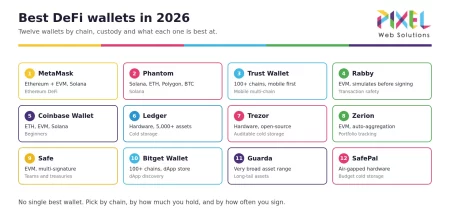
Discover related strategies in our complete blog here
Top DeFi Wallets to Secure Your Crypto Assets in 2026
Step 6: Onboard the Community
Once the system is live, onboard your community. Publish a governance guide, run a first low-stakes vote, recruit delegates and set up community spaces. Promotion and marketing help, but early participation matters more: a DAO with low turnout is easy to capture.
These are the steps to launch a DAO with a professional development team. Next, let's compare the legal wrappers in detail.
DAO Legal Wrappers Compared: US, Marshall Islands and UAE
This table summarises the main purpose-built options as of 9 October 2026. Fees and rules change, so confirm details with counsel before filing.
| Wrapper | Profit allowed? | Key requirements | Published costs |
|---|---|---|---|
| Wyoming DAO LLC (since 2021) | Yes | Name must include "DAO" or "LAO"; articles must list a public identifier of the smart contracts that run the DAO | $100 filing fee; annual report from $60, per the Wyoming Secretary of State DAO FAQ |
| Wyoming DUNA (since 1 July 2024) | Nonprofit purpose, may earn revenue for that purpose | At least 100 members; on-chain governance recognised | State filing and counsel costs |
| Marshall Islands DAO LLC | Yes, or nonprofit | For-profit DAO LLCs pay a 3% gross revenue tax; nonprofits are tax-exempt | MIDAO lists a $9,500 standard package including government fees, from $3,000 for small treasuries, plus $2,000 to $5,000 a year |
| UAE: Innovation City DAO Association (Ras Al Khaimah) | No dividends to token holders | At least 2 founding members and 2 council members; open-source code on a permissionless ledger; registered agent with an office in the zone; audited annual accounts | Fees set by the Registrar |
Is There a UAE Framework for DAOs?
Yes. The Ras Al Khaimah free zone formerly known as RAK DAO (Digital Assets Oasis), renamed Innovation City in September 2025, issued the DAO Association Regulations 2024. Under these rules, a DAO Association has a separate legal personality from its members and token holders, and its liabilities are its own rather than members' personal debts. Names must end in "DAO Limited" or "DAO Ltd".
There are limits to plan around. The regulations target nonprofit purposes and ban dividend distributions to token holders, and a DAO Association needs a No Objection Certificate from the Registrar before issuing a new token class or listing a token. Also note that a free zone licence does not authorise regulated financial activity: running an exchange or holding client crypto still needs a licence from a financial regulator such as VARA or the CBUAE. Abu Dhabi's ADGM offers another route through its DLT Foundations Regulations 2023.
Governance Attacks: Design Choices That Protect Your DAO
Most guides skip how DAOs fail. Two famous incidents explain the essential defences:
- The DAO, 2016: a code flaw let an attacker drain about 3.6 million ETH. The lesson is independent audits, simple code and a way to pause.
- Beanstalk, April 2022: an attacker borrowed enough tokens through a flash loan to pass a malicious proposal in a single transaction and took about $182 million. The lesson is to count voting power from a snapshot taken before the vote, and to delay execution.
Build these protections in from day one:
| Defence | What it stops | How to implement |
|---|---|---|
| Voting power snapshot at proposal creation | Flash-loan and last-minute vote buying | ERC-20 vote checkpoints (standard in OpenZeppelin's voting extension) |
| Voting delay and voting period | Surprise proposals passed overnight | Governor settings, for example a 1-day delay and a 5 to 7-day vote |
| Timelock on execution | Malicious proposals executing instantly | Timelock controller between Governor and treasury |
| Quorum and proposal threshold | Spam and low-turnout capture | Governor parameters reviewed as supply changes |
| Guardian or veto multisig (early stage) | Emergency exploits | A Safe that can cancel queued proposals, with a public sunset date |
How Much Does It Cost to Build a DAO?
Costs depend on whether you assemble audited modules or build custom governance. Here is the maths, using illustrative blended development rates of $50 and $100 per hour. Your actual rate depends on team location and seniority.
| Work item | Lean DAO (hours) | Custom DAO (hours) |
|---|---|---|
| Governance token with votes and vesting, plus tests | 30 | 60 |
| Governor and timelock configuration | 20 | 80 |
| Safe treasury setup and roles | 10 | 30 |
| Voting front end (hosted tool vs custom dashboard) | 20 | 200 |
| Testing, deployment and documentation | 40 | 120 |
| Total build hours | 120 | 490 |
| Build cost at $50 per hour | $6,000 | $24,500 |
| Build cost at $100 per hour | $12,000 | $49,000 |
Then add the items that sit outside development:
- Smart contract audit: published industry ranges run from about $5,000 to $15,000 for small scopes built on standard modules, and $10,000 to $50,000 or more for custom governance logic.
- Legal wrapper: from $100 in Wyoming state filing fees to $9,500 for a Marshall Islands package, plus registered agent and legal counsel fees.
- Community building: documentation, delegate programmes and incentives, which vary widely.
Worked totals: a lean DAO comes to about $6,000 + $5,000 + $100 = $11,100 at the low end and $12,000 + $15,000 + $9,500 = $36,500 at the high end, before counsel. A custom DAO comes to about $24,500 + $10,000 + $100 = $34,600 up to $49,000 + $50,000 + $9,500 = $108,500.
Other factors that move the final figure:
- Smart contract auditing scope
- Security mechanism customisation
- Choice of DAO framework
- Community building
- Legal and regulatory compliance
Before development starts, get a detailed consultation from an experienced team. With the right guidance, you can cut unnecessary costs and launch your DAO without technical hassles. Pixel Web Solutions is ready to help you create yours.
Why Choose Pixel Web Solutions for Launching a DAO?
Pixel Web Solutions offers DAO development services designed to fit startup budgets. Having delivered nearly 350+ crypto projects, its developers have the experience to launch DAOs without compromises, from token and Governor contracts to treasury setup and voting dashboards.
The team also delivers other DeFi development services such as DEX development and DeFi wallet creation. With 12+ years in the market since its founding in 2012, Pixel operates from Ras Al Khaimah, UAE and Madurai, India, which gives founders direct support for UAE options such as the Innovation City DAO Association alongside international structures. Connect with the development team to get a demo and a cost quotation to launch your DAO.
Disclaimer: The cost estimates in this blog are for informational purposes only and are not a quotation from Pixel Web Solutions. Actual costs vary with your project requirements and the services selected. Contact the Pixel business team directly for a clear quotation.
Frequently Asked Questions
How much does it cost to start a DAO?
A lean DAO built from audited open-source modules costs roughly $11,000 to $37,000 including audit and registration, before legal counsel. Custom governance systems run about $35,000 to $110,000. The biggest variables are custom front-end work and audit scope.
Do I need a legal entity for my DAO?
It is strongly advised. Without one, US courts have treated DAOs as liable persons and even as general partnerships, which can make active members personally liable. Wrappers such as a Wyoming DAO LLC, a Marshall Islands DAO LLC or a UAE DAO Association give the DAO its own legal personality.
Can I set up a DAO in the UAE?
Yes. Ras Al Khaimah's Innovation City (formerly RAK DAO) offers a DAO Association under its DAO Association Regulations 2024, with separate legal personality for the DAO. It suits nonprofit purposes and bans dividends to token holders; regulated financial activity still needs a licence from a financial regulator.
What tools do I need to launch a DAO?
Most startups use an ERC-20 governance token with voting extensions, an OpenZeppelin Governor and timelock or Snapshot for voting, a Safe multisig for the treasury, and a hosted front end such as Tally. Custom dashboards and contracts come later if needed.
How long does it take to launch a DAO?
A lean DAO on audited modules can be built in a few weeks, plus time for an audit and legal registration. Custom governance systems take a few months.
Is a DAO token a security?
It can be. If buyers expect profits from the efforts of a core team, regulators may treat the token as a security. Take legal advice before any token sale, and favour distribution through contributions and airdrops where appropriate.
Ready to Launch Your DAO?
Knowing how to launch a DAO now means getting three things right: a legal wrapper, an audited governance stack and an engaged community. With those in place, a DAO can run a protocol, a fund or a community for years. Pixel Web Solutions can help you plan and build each part.