







Table of Contents
Last updated: 9 October 2026 | Reviewed by Mathibharathi Mariselvan, Co-founder, Pixel Web Solutions | 16 min read
Multi-signature wallet development is the process of building a crypto wallet that needs M of N independent keys, such as 2 of 3, to approve any transaction. On Bitcoin the rule lives in the script itself; on Ethereum and other smart contract chains it lives in an audited smart account such as Safe. A production multisig needs a sound threshold, independent signers, a timelock and policy layer, clear signing and recovery, with Pixel Web Solutions' wallet builds starting from $5,000.
If you have been in crypto for a while, you already know how important wallet security is. Hacks, scams and simple mistakes, such as one lost key with no backup, show that relying on a single private key is risky. This is where the multi-sig wallet comes in.
Think of it like a joint account where transfers need more than one approval. Instead of leaving your money exposed to one lost or stolen key, a multi-sig wallet requires several approvals, protecting funds against hacking and fraud. Multisig already secures a large share of crypto treasuries: Safe, the most widely used smart account multisig, reports more than 60 million accounts and over $60 billion in assets across 40+ networks as of October 2026. But what exactly is a multi-signature wallet, how does it differ from the wallets we use every day, and how do you build one? Let's find out.
Key Takeaways
- M-of-N is the core rule: a multisig wallet moves funds only when M of its N key holders sign, so one stolen or lost key cannot drain or lock the wallet.
- The threshold is a trade-off: an attacker needs M keys, but you can lose only N minus M; a 2-of-5 setup is easy to attack, while 5-of-5 is easy to lock.
- Multisig fails through people and interfaces: WazirX (2024), Radiant (2024), Bybit (2025) and Drift (2026) all lost funds through manipulated or tricked signers, not broken cryptography.
- Multisig and MPC solve different problems: multisig puts a public, auditable quorum on-chain; MPC produces one ordinary signature with a private policy. Many institutions use both.
- Budget from Pixel's wallet base: Pixel Web Solutions starts crypto wallet development from $5,000; institutional custody wallets with multisig or MPC governance typically take 12 to 20 weeks.
What Is a Multi-Signature Wallet?
A multi-signature wallet is a cryptocurrency wallet that requires two or more parties holding private keys to sign a transaction before it executes. Rather than one party holding total power, responsibility is shared. In a 2-of-3 wallet, for example, at least two of the three key holders must approve a transaction to move funds.
Unlike a normal wallet, a multi-sig wallet shares control and makes it much harder for anyone to break in. No single person has full power over the funds. Involving several trusted people adds security, lowers the chance of fraud and keeps decisions visible to everyone involved.
Whether you protect personal savings or a company treasury, a multi-sig wallet gives you a safer way to move funds, because every transfer needs the agreement of the group. For the wider landscape, see the guide to the types of crypto wallets.
Types of Multi-Signature Wallet Development Projects
Every business managing digital assets has unique requirements, so multi-signature wallet development covers several kinds of projects, from startups securing treasury funds to enterprises needing deep integrations.
Custom Multi-Signature Wallets
A custom multisig wallet is designed around your business processes: your own approval logic, multi-chain support and enterprise controls. It should scale and stay secure as your organization and signers change.
Multi-Signature Integration for dApps
If you run a decentralized application, multisig functionality can be built into it, so teams and users handle shared funds without leaving the platform. This fosters trust, adoption and better usability.
Threshold Signature Scheme Implementation
Threshold signature schemes (TSS) share signing power among many parties without ever revealing a full private key, and produce one standard signature. Strictly speaking, this is MPC rather than multisig, but many custody products combine the two.
Smart Contract Development for Wallets
On Ethereum and other smart contract platforms, multisig rules live in audited contracts that automate the approval procedure, reduce human error and give full transparency on every transaction. Most teams build on the battle-tested Safe contracts and add custom modules.
API Integration for Wallets
API integration connects the wallet to exchanges, payment systems, accounting tools and other services, making transfers, reporting and compliance easier to manage for both internal and external use cases.
To understand why these projects are worth it, let's look at how multi-sig wallets work in practice.
How Does a Multi-Sig Wallet Work?
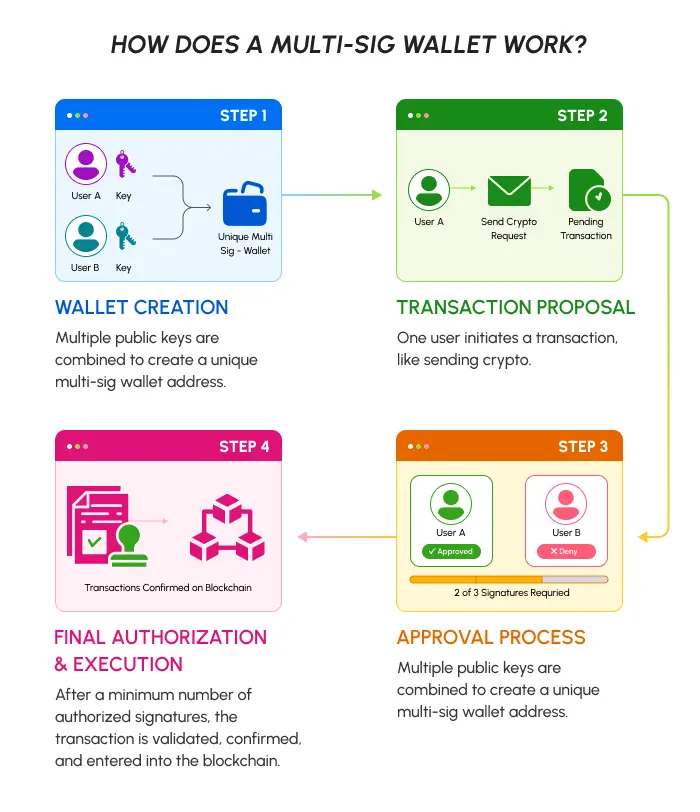
The working of a multi-sig wallet is simpler than it sounds:
- Wallet creation: the public keys of all signers, plus the threshold, define a unique multi-sig wallet address or smart account.
- Transaction proposal: one signer proposes a transaction, such as sending crypto.
- Approval process: the other key holders review the proposal and approve or reject it.
- Final authorization: once the threshold of valid signatures is reached, the transaction is executed and recorded on the blockchain.
The key components that make this work are:
- Public and private keys: each participant has their own key pair, ideally on a hardware wallet.
- Multi-party authorization: moving funds always needs approval from more than one key.
- Blockchain enforcement: the blockchain itself rejects transactions without enough valid signatures.
How Multisig Works on Different Blockchains
Multisig is implemented differently on each chain, which shapes how you build it:
| Chain | How multisig works | Notes |
|---|---|---|
| Bitcoin | Native script multisig (P2WSH, or Taproot scripts) | No smart contract needed; PSBT passes unsigned transactions between signers, and Miniscript adds timelocks and recovery paths |
| Ethereum and EVM chains | Smart contract account, most often Safe | Owners and threshold stored in the contract; modules and guards add spending limits and checks |
| Solana | Program-based multisig, such as Squads | Separate program with its own audit history |
| Bitcoin key aggregation | MuSig2 (n-of-n) and FROST (threshold) | Signers cooperate to produce one Schnorr signature, so on-chain it looks like a single-key wallet |
In short, a multi-sig wallet replaces "trust one person" with "trust a group". That brings us to the big question: what do users actually gain?
Benefits of a Multi-Signature Wallet
The main reason crypto users and companies choose multisig is the extra layer of security. Power is spread across several key holders, which makes unauthorized access by hackers or insiders far harder.
Here are the key benefits:
- Enhanced security: several parties must approve every release of funds, reducing the risk of unauthorized access.
- Reduced insider fraud: ideal for organizations, because no single person can empty the wallet.
- Shared control and transparency: on smart contract chains, the signer set, threshold and every approval are visible on-chain, which builds confidence.
- Recovery options: if one key is lost, the remaining signers can still move funds and replace the lost key, as long as the threshold can still be met.
- Governance fit: DAOs, funds and companies can mirror their approval policies directly in the wallet.
These advantages explain why individuals and businesses holding large amounts of crypto use multisig. Next, let's look at the features that add to their value.
Top Features of a Competitive Multi-Sig Wallet
These features matter most in a multisig wallet:
- Multi-user authorization: two or more approvals per transaction, reducing the chance of hacking or misuse.
- Customizable signature thresholds: flexible M-of-N approval suited to business or personal use.
- Multi-chain support: support for Bitcoin, Ethereum and its layer 2 networks, BNB Smart Chain, Solana and others, each with its own multisig model.
- Advanced key management: hardware wallet support, secure key storage, rotation and recovery.
- Role-based access control: different permissions for proposers, signers and viewers.
- Spending limits and timelocks: small transfers under a daily limit, large or admin transfers delayed so signers can cancel suspicious ones.
- Clear signing: a human-readable view of exactly what each transaction does, checked on a second device.
- Auditable transaction history: transparent records for accountability and compliance.
With these features, multi-sig wallets combine security and operational flexibility. If you want to build your own, here is a step-by-step guide.
How to Develop a Multi-Signature Wallet (Step-by-Step)
Building multi-signature crypto wallets gives businesses and entrepreneurs a trusted tool for digital asset management. If you are about to launch your own wallet, here is the plan to follow.
Define the Type (Custodial or Non-Custodial)
First, decide who controls the keys. In a custodial wallet, your company holds them; in a non-custodial wallet, users hold them; in collaborative custody, users hold most keys and a provider holds one backup key. Choose based on user needs, regulation, support and risk.
Choose a Blockchain Platform (Bitcoin, Ethereum, etc.)
Bitcoin offers native script multisig with no smart contract risk. Ethereum and EVM chains offer more flexibility through smart accounts. Consider fees, speed, ecosystem maturity and audit tooling before deciding.
Select Tools and Libraries
On Ethereum, build on the audited Safe contracts and SDK rather than writing a new multisig contract, using Solidity with Foundry or Hardhat and viem or ethers.js. On Bitcoin, use descriptors, Miniscript, PSBT and libraries such as bitcoinjs or BDK. Use standard key formats (BIP32, BIP39, BIP44) so keys are easy to create, back up and use.
Write or Configure the Smart Contract
Set the roles, the number of approvals required (M-of-N) and optional timelocks or spending limits. Where you need custom logic, add it as an audited module or guard on top of the base contract.
Set Up the M-of-N Approval Logic
Create N keys on separate devices and store them safely. Require M approvals before any money moves, for example 2-of-3. Allow safe key rotation and a recovery path without weakening security. The threshold section below explains how to choose M and N.
Build the User Interface (Web or Mobile)
Create simple flows to propose, review, sign and execute, with clear status updates. Decode every transaction into plain language, show readable errors and gas estimates, and integrate WalletConnect and hardware wallets.
Test and Audit for Vulnerabilities
Try to break the wallet on test networks such as Sepolia. Use fuzzing and attack simulations, including a malicious front end. Then have an independent expert audit the contracts and the signing flow, and fix everything they find before launch. See how this works in the guide to smart contract audit services.
Deploy and Integrate
Deploy and verify your contracts on a block explorer. Publish the ABI and documentation. Set up monitoring and alerts. Document onboarding, backups, incident steps and how you will upgrade safely.
Following these steps takes you from concept to a working product. But development alone is not enough; security practices make or break these wallets.
Security Features for Multi-Sig Wallet Development
Even the best wallet design can fail without the right security measures. Multi-sig wallets often hold large amounts, so developers and users must take precautions:
- Regular smart contract audits: have professional auditors review the code and signing flow before deployment and after every change.
- Hardware-backed keys: keep every signer key on a hardware wallet or HSM, never in a browser extension on a daily-use laptop.
- Independent verification: each signer checks the transaction hash and decoded data on a second device before signing.
- Timelocks and spending limits: delay large transfers and admin changes so a malicious transaction can be cancelled.
- Backup and recovery strategies: documented, tested processes for replacing lost keys.
- Signer hygiene: dedicated signing devices, phishing training and a rule never to open files from unknown contacts on them.
Where Multisig Wallets Actually Fail: Lessons From Real Incidents
Multisig cryptography rarely breaks. The losses below all came from signers being tricked or their devices compromised, and each points to a design decision.
| Incident | What happened | Design lesson |
|---|---|---|
| WazirX, July 2024, about $230 million | Signers of a Safe multisig approved a transaction that upgraded the wallet contract and handed control to the attacker; WazirX said the custody interface showed different data from what was signed, which its custodian disputed | Decode and verify every transaction independently; treat contract upgrades as the highest-risk action |
| Radiant Capital, October 2024, about $50 million | Malware on three developers' devices swapped transactions during a routine multisig action, while the Safe interface displayed legitimate data; Radiant's post-mortem added 72-hour timelocks afterwards | Isolate signing devices; add timelocks on ownership and upgrade actions |
| Bybit, February 2025, about $1.5 billion | A compromised Safe{Wallet} developer machine led to malicious code that showed Bybit's signers a normal transfer while the cold wallet's logic was changed; the FBI attributed the theft to North Korea | Never rely on one interface; verify on hardware and with independent tools |
| Drift Protocol, April 2026, about $285 million | Attackers social-engineered Security Council signers into pre-signing hidden admin authorizations, days after the council moved to 2-of-5 with zero timelock | Keep thresholds high for admin power and never run admin multisigs without a timelock |
The lesson: a multisig is only as strong as the independence of its signers and the honesty of the screen they sign on. Build verification, timelocks and signer hygiene into the product, not just the M-of-N rule.
How to Choose the Right Threshold (M-of-N)
Choosing M and N balances two risks: theft (an attacker must compromise M keys) and loss (you can lose up to N minus M keys and still move funds).
| Setup | Keys an attacker needs | Keys you can lose | Best for |
|---|---|---|---|
| 2-of-3 | 2 | 1 | Individuals, small teams, collaborative custody |
| 3-of-5 | 3 | 2 | Company treasuries, protocol operations |
| 4-of-7 | 4 | 3 | DAO and protocol admin keys with more signers |
| 2-of-5 | 2 | 3 | Rarely advisable: easy to attack, as Drift showed |
| 5-of-5 | 5 | 0 | Not advisable: one lost key locks the funds |
Three rules follow from the maths:
- Keep M above half of N for anything with admin power, so a minority of signers can never act alone.
- Make signers truly independent: different people, devices, locations and ideally organizations. Three keys on one laptop is a single-key wallet with extra steps.
- Add a timelock for high-impact actions, so even a valid quorum's transaction waits long enough for others to spot and cancel it.
Multisig vs MPC vs Smart Accounts
Multisig is not the only way to remove a single point of failure. Here is how it compares with multi-party computation (MPC) and smart accounts:
| Factor | Multisig wallet | MPC (TSS) wallet | Smart account (account abstraction) |
|---|---|---|---|
| Where approval happens | On-chain, by the script or contract | Off-chain, between key share holders | On-chain, by contract code |
| Keys | Several complete, independent keys | Shares of one key; full key never exists | Any signer type, including passkeys, MPC or multisig |
| On-chain footprint | Several signatures, visible quorum | One normal signature | Contract wallet with custom rules |
| Fees | Higher, more signatures or contract logic | Same as a normal wallet | Higher than a basic wallet, can be sponsored |
| Chain support | Native on Bitcoin; smart contracts on EVM and others | Almost any chain | Mostly EVM chains (ERC-4337, EIP-7702) |
| Changing signers | Safe: owner change by multisig transaction, same address; Bitcoin: new address | Refresh or re-share, same address | Update rules in the contract |
| Transparency | Quorum is public and auditable | Policy is off-chain and private | Rules are public and auditable |
| Main risk | Signers approving a manipulated transaction | Weak protocol implementation or concentrated share holders | Smart contract bugs |
| Best for | DAO treasuries, public funds, protocol admin keys | Exchanges, fintechs, multi-chain custody | Mainstream apps, gasless UX, spending limits |
If on-chain auditability matters most, multisig is usually the better fit. If you need many chains, private policies and normal fees, MPC wins; the guide to MPC wallet development covers that model. Many custody providers combine both, using MPC for hot wallets and multisig for treasuries.
Leading Multi-Sig Crypto Wallets in 2026
Choosing a multisig wallet comes down to the chains you use, how much control you want and whether you need a provider in the loop. These are widely used, actively maintained options:
| Wallet | Chains | Model |
|---|---|---|
| Safe{Wallet} | Ethereum and 40+ EVM networks | Smart account multisig; 60M+ accounts and $60B+ in assets per Safe |
| Squads | Solana | Program-based multisig for Solana assets and programs |
| Electrum | Bitcoin | Desktop wallet with native multisig |
| Sparrow Wallet | Bitcoin | Desktop wallet focused on multisig and PSBT workflows |
| Nunchuk | Bitcoin | Mobile and desktop multisig with collaborative options |
| Casa | Bitcoin, Ethereum | Collaborative custody (for example 2-of-3, 3-of-5) with a provider recovery key |
| Unchained | Bitcoin | Collaborative 2-of-3 custody vaults |
| BitGo | Many chains | Institutional custody using multisig on some chains and MPC on others |
Older lists often include wallets that are discontinued, rarely updated or not multisig at all, so check that any wallet you pick is maintained and actually enforces an M-of-N rule. But if you are thinking about developing your own wallet, you might be wondering how much it costs. Let's break it down.
Cost of Developing a Multi-Signature Wallet
Pixel Web Solutions starts crypto wallet development from $5,000 for a single-platform non-custodial wallet, and white-label wallets from about $4,500. Multisig adds scope on top of that base: the smart account or script design, approval flows, signer management, timelocks, hardware wallet support and an independent audit. The crypto wallet development cost guide explains the wider pricing factors.
Based on Pixel Web Solutions' published delivery timelines:
| Wallet type | Typical build time |
|---|---|
| White-label wallet | 6 to 10 weeks |
| Mobile wallet | 6 to 12 weeks |
| DeFi wallet | 8 to 14 weeks |
| Multi-chain wallet | 10 to 16 weeks |
| Institutional custody wallet with multisig or MPC governance | 12 to 20 weeks |
Several factors influence the overall budget:
- Blockchain choice: Bitcoin script multisig, EVM smart accounts and Solana programs each need different work; multi-chain support multiplies it.
- Build vs reuse: building on audited Safe contracts costs far less, and is far safer, than writing a new multisig contract.
- Features: spending limits, timelocks, role-based access, cross-chain swaps and API integrations add development hours.
- UI/UX complexity: basic interfaces cost less; dashboards with analytics, mobile apps and clear-signing screens need more resources.
- Security audits: comprehensive smart contract audits and penetration testing are critical, and are separate line items.
- Running costs: nodes, indexing, monitoring and transaction relaying are monthly costs.
For an accurate estimate, Pixel Web Solutions assesses your requirements and delivers a customized, fixed-price quote.
Conclusion
In an era where digital assets face constant threats, multi-signature wallet development is a business need, not a luxury. The best multisig wallets combine a sensible threshold, independent signers, timelocks, clear signing and audited code. If you are considering building a secure, feature-rich multi-sig wallet, Pixel Web Solutions is an experienced crypto wallet development company that builds custodial, non-custodial, multisig and MPC wallets, and it also offers DeFi wallet development and white-label crypto wallets for faster launches.
Its team reviews your business needs and provides a budget estimate covering everything from concept to deployment, so you get a robust, customized solution. If you are new to wallets, start with the guide on how to create a crypto wallet.
Plan your multi-signature wallet development with Pixel Web Solutions and take charge of your crypto security!
Frequently Asked Questions
What is multi-signature wallet development?
Multi-signature wallet development is the process of building a crypto wallet that uses several independent private keys to approve transactions, so control is shared and no single key can move funds.
Can businesses customize the security policies of a multisig wallet?
Yes. Businesses can define approval thresholds, signer roles, spending limits, timelocks, address whitelists and recovery mechanisms to fit their organizational needs.
What are the common types of multi-signature wallets?
Common configurations are 2-of-3, 3-of-5 and 4-of-7, each balancing protection against theft with tolerance for lost keys. A 1-of-2 setup is not true multisig security, because either key alone can move funds.
What industries can benefit from multi-signature wallets?
Crypto exchanges, DAOs, DeFi protocols, fintech startups, family offices, funds and enterprises managing treasuries all benefit from multisig. DAOs often use one to launch and govern a DAO treasury.
Is a multisig wallet safer than an MPC wallet?
Neither is strictly safer. Multisig makes the quorum public and auditable on-chain and avoids complex cryptography, while MPC keeps fees low, works on almost any chain and hides the policy. Both fail if signers approve a manipulated transaction, so both need clear signing.
What happens if a multisig signer loses their key?
As long as the remaining signers still meet the threshold, they can move funds and replace the lost key. In a 2-of-3 wallet, losing one key is recoverable; losing two locks the funds, which is why keys must be backed up and stored independently.
How long does multi-signature wallet development take?
A multisig built on existing audited contracts with a white-label interface can launch in 6 to 10 weeks, while an institutional custody wallet with multisig or MPC governance takes 12 to 20 weeks, based on Pixel Web Solutions' delivery timelines. Plan extra time for audits.