Table of Contents
Last updated: 19 September 2026 | Reviewed by Mathibharathi Mariselvan, Co-founder, Pixel Web Solutions | 14 min read
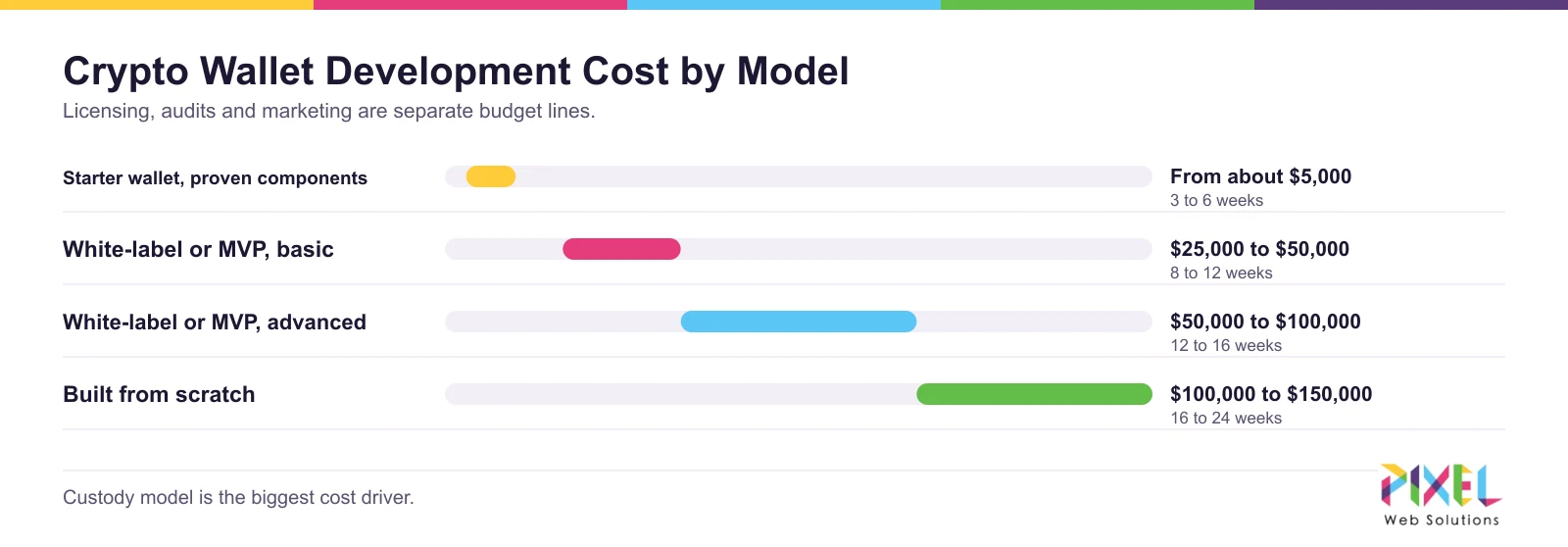
Crypto wallet development costs from about $5,000 for a single-platform non-custodial wallet built on proven components (white-label wallets start around $4,500), $25,000 to $50,000 for a white-label or MVP wallet across web and mobile, $50,000 to $100,000 for a wallet with advanced features such as swaps, staking, fiat on-ramps and DeFi access, and $100,000 to $150,000 for a fully custom wallet built from scratch. Licensing, audits and marketing are separate budget lines.
A single leading crypto wallet app can serve tens of millions of users, and wallets have become the front door to Web3: payments, trading, DeFi, NFTs and even AI agent payments all start there. That is why so many startups and businesses want their own wallet app, and why the first question is always the cost.
The honest answer is that it depends on the wallet type, custody model, chains, features, platforms and compliance. This guide breaks down the crypto wallet development cost by approach, feature, development phase, region and legal requirement, and shows how wallets make money so you can plan the return on your investment.
Key Takeaways
- Custody model is the biggest cost driver. Non-custodial wallets are cheaper and lighter on regulation; custodial and MPC wallets need more security engineering and usually a licence.
- Start lean if you can. Wallets on proven components start at about $5,000, white-label MVPs cost $25,000 to $50,000.
- Every chain and platform adds cost. Supporting Bitcoin, EVM chains and Solana on web, iOS and Android multiplies the work.
- Security and audits are non-negotiable. Key management flaws end wallet businesses.
- Wallets earn from swaps, on-ramps, staking and partnerships, so revenue design should shape the feature list.
Key Market Insights
- Stablecoins drive daily wallet use: stablecoin supply reached $311 billion in September 2026, according to DefiLlama, and most of it is held and moved through wallets.
- Wallet-style trading apps earn real revenue: Solana trading apps such as Axiom kept $29.6 million in revenue over 30 days, mostly from swap fees.
- Swap fees are the standard model: MetaMask, for example, charges a service fee on in-wallet swaps.
Crypto Wallet Development – A Quick Glance
Crypto wallet development is the process of creating an application that lets users store, send, receive, swap and manage cryptocurrencies securely. The wallet generates and protects private keys (or key shares), signs transactions and connects users to blockchains and decentralized apps. Wallets can be non-custodial (users hold keys), custodial (the business holds keys) or MPC-based (keys are split between parties). Learn more in our guide to the types of crypto wallets.
Why Should Businesses Go For Crypto Wallet Development in 2026?
- Growing adoption: more users and businesses hold stablecoins and crypto every year.
- Direct access to Web3: a wallet puts your brand at the centre of payments, DeFi, NFTs and apps.
- Multiple revenue streams: swap fees, on-ramp commissions, staking, premium features and partnerships.
- Customer ownership: your own wallet means your own user relationship and data, not a third party's.
- Global reach: borderless transfers and a worldwide user base from launch.
How much does it cost to create a Crypto Wallet in 2026?
| Development model | Estimated cost | Timeline | Best suited for |
|---|---|---|---|
| Starter wallet on proven components | From about $5,000 (white-label from about $4,500) | 3 to 6 weeks | Single-platform non-custodial wallets, pilots |
| White-label or MVP with basic features | $25,000 to $50,000 | 8 to 12 weeks | Startups testing the market on web and mobile |
| White-label or MVP with advanced features | $50,000 to $100,000 | 12 to 16 weeks | Growing brands and niche markets |
| Crypto wallet development from scratch | $100,000 to $150,000 | 16 to 24 weeks | Large-scale ecosystems and custodial platforms |
Starter Wallet on Proven Components
Pixel's crypto wallet development starts at about $5,000 for a single-platform non-custodial wallet with core functions, and our white-label crypto wallet starts at about $4,500. This suits businesses validating demand before investing further.
White Label/MVP Style Crypto Wallet with Basic Features
A basic white-label or MVP wallet across web and mobile costs around $25,000 to $50,000 and takes 8 to 12 weeks. It covers secure key management, multi-currency support, sending and receiving, QR codes, transaction history and backup and recovery.
White Label/MVP Style Crypto Wallet with Advanced Features
An MVP-style wallet with advanced features costs around $50,000 to $100,000 and takes 12 to 16 weeks. It adds in-app swaps, staking, fiat on-ramps and off-ramps, NFT support, a dApp browser, portfolio tracking and stronger security such as biometrics and multi-signature approvals.
Crypto Wallet Development From Scratch
A fully custom wallet costs around $100,000 to $150,000 and takes 16 to 24 weeks. It suits custodial wallets, MPC wallets for institutions, super-apps and wallets with proprietary features or very high scale.
Crypto Wallet Development Cost Analysis Based on Features and Functionalities
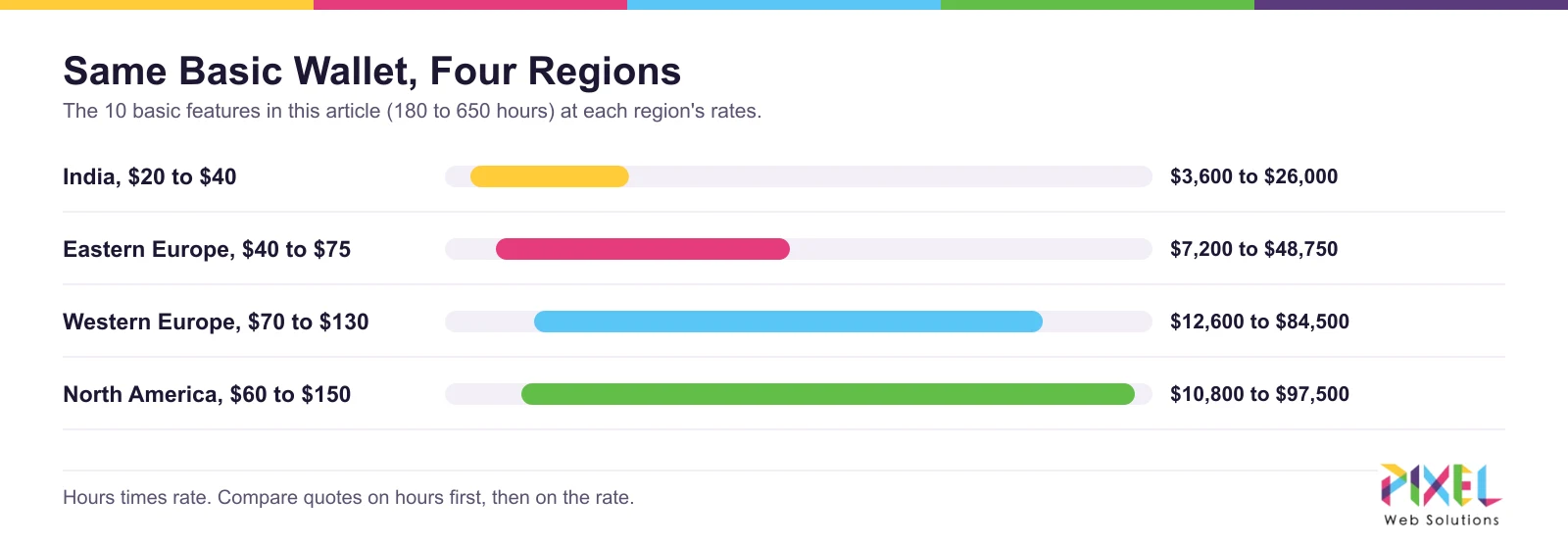
Essential features together typically represent about $15,000 to $30,000 of a wallet build. The tables below show the typical effort per feature, which you can multiply by your team's hourly rate.
Basic Features
| Basic feature | Functionality | Typical effort |
|---|---|---|
| User authentication | Login, PIN and 2FA | 20 to 80 hours |
| QR scanner | Scan addresses and payment requests | 10 to 40 hours |
| Wallet address generation | Unique addresses per chain | 10 to 30 hours |
| Transaction history | Past transactions and statuses | 10 to 50 hours |
| Basic security | Encryption, PIN, session controls | 20 to 70 hours |
| Backup and recovery | Seed phrase or cloud-encrypted backup | 10 to 40 hours |
| Simple UI/UX | Clear screens for everyday use | 30 to 100 hours |
| Asset storage and balances | Token balances and prices | 20 to 60 hours |
| Private key management | Secure generation and storage of keys | 20 to 80 hours |
| Multi-currency support | Multiple coins and tokens | 30 to 100 hours |
Advanced Features
| Advanced feature | Functionality | Typical effort |
|---|---|---|
| Biometric and multi-signature security | Face or fingerprint login, multisig approvals | 20 to 60 hours |
| In-app swap | Token swaps through DEX aggregators | 30 to 100 hours |
| Fiat on-ramp and off-ramp | Buy and sell crypto with cards or bank transfer | 50 to 100 hours |
| Portfolio tracking | Performance across assets and chains | 20 to 70 hours |
| Staking | Lock assets to earn rewards | 20 to 70 hours |
| DeFi integration | Lending, liquidity and yield from the wallet | 50 to 180 hours |
| NFT support | View, send and receive NFTs | 30 to 120 hours |
| dApp browser | Connect to Web3 apps | 40 to 150 hours |
| Cross-platform support | Web, iOS and Android | 60 to 250 hours |
| Social or seed phrase recovery | Restore access if a device is lost | 20 to 60 hours |
Key Factors that Affect the Crypto Wallet Development Cost
Types of Cryptocurrency Wallets
Hot wallets (mobile, web, browser extension) are the most common. Hardware wallet integration, desktop apps and multi-signature wallets add work. Specialized wallets, such as a DeFi wallet or an NFT wallet, add their own features.
Custody Model
Non-custodial wallets keep keys on the user's device. Custodial wallets require secure key storage, hot and cold wallet management, reconciliation and usually a licence. MPC wallets split keys between the user, the business and sometimes a third party, which improves recovery and security but needs specialist cryptography.
Security Integrations
Secure enclaves, encryption, biometric authentication, transaction simulation, phishing warnings and independent security audits all add cost and are essential.
Blockchain Integration
Each chain family needs its own integration: Bitcoin (UTXO), EVM chains such as Ethereum, BNB Chain, Polygon, Arbitrum and Base, Solana and Tron. Supporting many chains multiplies node access, testing and maintenance.
Design and User Experience
Wallets must be simple for beginners and safe for large balances. Clear transaction previews, human-readable addresses and guided recovery raise design effort but reduce support costs.
Platform and Device Compatibility
A single platform is cheapest. Web, iOS, Android and a browser extension each add development and testing, although cross-platform frameworks such as Flutter or React Native reduce the overhead.
Development Team Expertise and Location
Experienced wallet teams cost more per hour but make fewer security mistakes. Hourly rates also vary widely by region.
Chosen Development Method
Proven components or white-label software cut cost and time; a custom build gives full control at the highest cost.
ROI factor that influences the crypto wallet development cost
The features you build should follow the revenue model. If swaps will drive revenue, invest in aggregator routing and a clean swap experience. If on-ramp commissions matter, prioritize fiat integrations and KYC flows. If staking or DeFi is the plan, budget for protocol integrations and risk warnings. Building features that do not earn or retain users is the fastest way to overspend.
Country-Based Cost Analysis of Developing a Crypto Wallet
| Region | Typical hourly rate |
|---|---|
| North America | $60 to $150 |
| Western Europe | $70 to $130 |
| Australia | $70 to $120 |
| UAE and Gulf | $60 to $120 |
| South America | $40 to $120 |
| Eastern Europe | $40 to $75 |
| Other Asian countries | $40 to $100 |
| India | $20 to $40 |
Regulatory & Licensing Expenses in Crypto Wallet Development
A non-custodial wallet usually needs little more than solid legal documentation. A custodial wallet usually needs a licence, such as FinCEN MSB registration and state licences in the US or a MiCA crypto-asset service provider licence for custody in the EU. A typical legal and compliance budget for a custodial wallet is $15,000 to $30,000 before ongoing costs:
| Phase | Estimated cost |
|---|---|
| Legal consultation | $2,000 to $3,000 |
| Business legal setup | $2,000 to $5,000 |
| Licensing requirements | $10,000 to $15,000 and up, by jurisdiction |
| Legal documentation | $3,000 to $10,000 |
Licensing requirements cover mandatory registrations and approvals so the wallet can legally hold or transfer customer funds. Legal documentation covers terms of service, privacy policies and risk disclosures that protect the business and its users.
Marketing Expenses To Consider When Developing Crypto Wallets
A competitive wallet launch often needs a marketing budget of around $60,000 in the first year, spread across:
- Brand building and market positioning
- Content marketing and SEO
- Social media marketing
- Influencer and KOL partnerships, with clear disclosure
- Paid advertising where crypto ads are permitted
- PR and app store optimization
How To Develop A Cryptocurrency Wallet From Scratch in 2026?
A crypto wallet built from scratch typically costs $100,000 to $150,000, distributed across these phases:
| Development phase | Estimated cost |
|---|---|
| Project planning | $5,000 to $10,000 |
| Blockchain network selection | $5,000 to $10,000 |
| Architecture design | $10,000 to $20,000 |
| Feature incorporation | $15,000 to $30,000 |
| Platform development | $20,000 to $40,000 |
| Quality testing and security audit | $10,000 to $20,000 |
| Wallet deployment | $5,000 to $10,000 |
| Ongoing maintenance (first year) | $10,000 to $15,000 |
Project planning: define business goals, target users, wallet type and custody model.
Blockchain network selection: choose the chains and tokens to support, based on your users.
Architecture design: plan key management, backend services, node access and security.
Feature incorporation: build the core and advanced features.
Platform development: code the wallet apps, backend and integrations.
Quality testing and security audit: test functionality, performance and security, and commission an independent audit.
Wallet deployment: release to app stores, web and browser extension stores.
Ongoing maintenance: bug fixes, chain upgrades, new tokens and feature updates.
For the full build process, see our guide on how to create a crypto wallet, and compare the market in our list of the best DeFi wallets.
How To Make Profits From Developing Cryptocurrency Wallets?
Swap Fees
In-app swaps are the main revenue source for most wallets: route trades through DEX aggregators and add a small service fee.
On-Ramp and Off-Ramp Commissions
Partners that let users buy and sell crypto with cards or bank transfers pay referral commissions.
Staking Commissions
Wallets that offer staking keep a percentage of the rewards.
Withdrawal and Network Fees
Custodial wallets may charge for withdrawals on top of network fees.
Premium Features and Subscriptions
Advanced security, portfolio tools or business features can be sold as premium plans.
Third-Party Integrations
DeFi platforms, NFT marketplaces and payment providers pay referral fees or share revenue.
Wrap Up
The crypto wallet development cost ranges from about $5,000 for a starter wallet on proven components to $150,000 for a custom build, with licensing, audits and marketing on top. Choose the custody model, chains and features that match your revenue plan, and start lean where you can.
Pixel Web Solutions, a crypto wallet development company, builds non-custodial, custodial, MPC and multi-signature wallets with fixed scope and fixed pricing. Get a free consultation and a detailed quote for your wallet.
FAQs
How much does it cost to build a crypto wallet?
From about $5,000 for a single-platform non-custodial wallet on proven components, $25,000 to $50,000 for a white-label MVP across web and mobile, $50,000 to $100,000 for advanced features and $100,000 to $150,000 for a custom build.
How much does it cost to develop a crypto wallet app?
A mobile wallet app on iOS and Android typically costs $25,000 to $100,000 depending on features, while a single-platform starter app can start at about $5,000 on proven components.
How long does it take to develop a crypto wallet?
Three to six weeks for a starter wallet, 8 to 12 weeks for a white-label MVP, 12 to 16 weeks with advanced features and 16 to 24 weeks for a custom build.
Is crypto wallet development a profitable investment?
It can be. Wallets earn from swap fees, on-ramp commissions, staking, premium features and partnerships, but profitability depends on user growth and a clear revenue model.
Do crypto wallets require regulatory compliance?
Non-custodial wallets usually need only strong legal documentation, while custodial wallets that hold customer funds typically need a licence and KYC/AML controls in each market.
Can a crypto wallet support multiple cryptocurrencies?
Yes. Wallets can support Bitcoin, EVM chains such as Ethereum, BNB Chain, Polygon and Base, Solana, Tron and more, although each additional chain adds development and maintenance cost.