DeFi yield farming platform development is the work of building the smart contracts, reward logic and dApp that let users deposit crypto into pools or vaults and earn trading fees, interest and token rewards. A focused yield farming platform on proven, audited patterns takes about three weeks to two months to build, and Pixel Web Solutions starts staking and yield vault builds at $6,000. The hard part is not the code: it is designing rewards that the protocol can afford and controls that survive the attacks that drained DeFi protocols in 2025 and 2026.
Imagine earning money just by holding your crypto. That promise is what drew millions of users to yield farming, and it still pulls liquidity into decentralized finance (DeFi) use cases that let people lend, borrow and trade without banks. Smart contracts replace the intermediary, and anyone with a wallet can take part.
The market has changed a lot, though. Yields have come down to earth, several famous protocols were exploited or are winding down, and the teams that win now build farms on real revenue rather than printed tokens. This guide covers how yield farming works in 2026, which protocols still matter, the maths behind sustainable rewards, the risks with real incident examples, and what it costs to build your own platform.
Key Takeaways
- Yields are lower and more honest: on 27 September 2026, stablecoin pools with $10 million or more in deposits paid a TVL-weighted average of about 4.1% APY, according to DefiLlama data. Triple-digit APYs now come almost entirely from reward tokens.
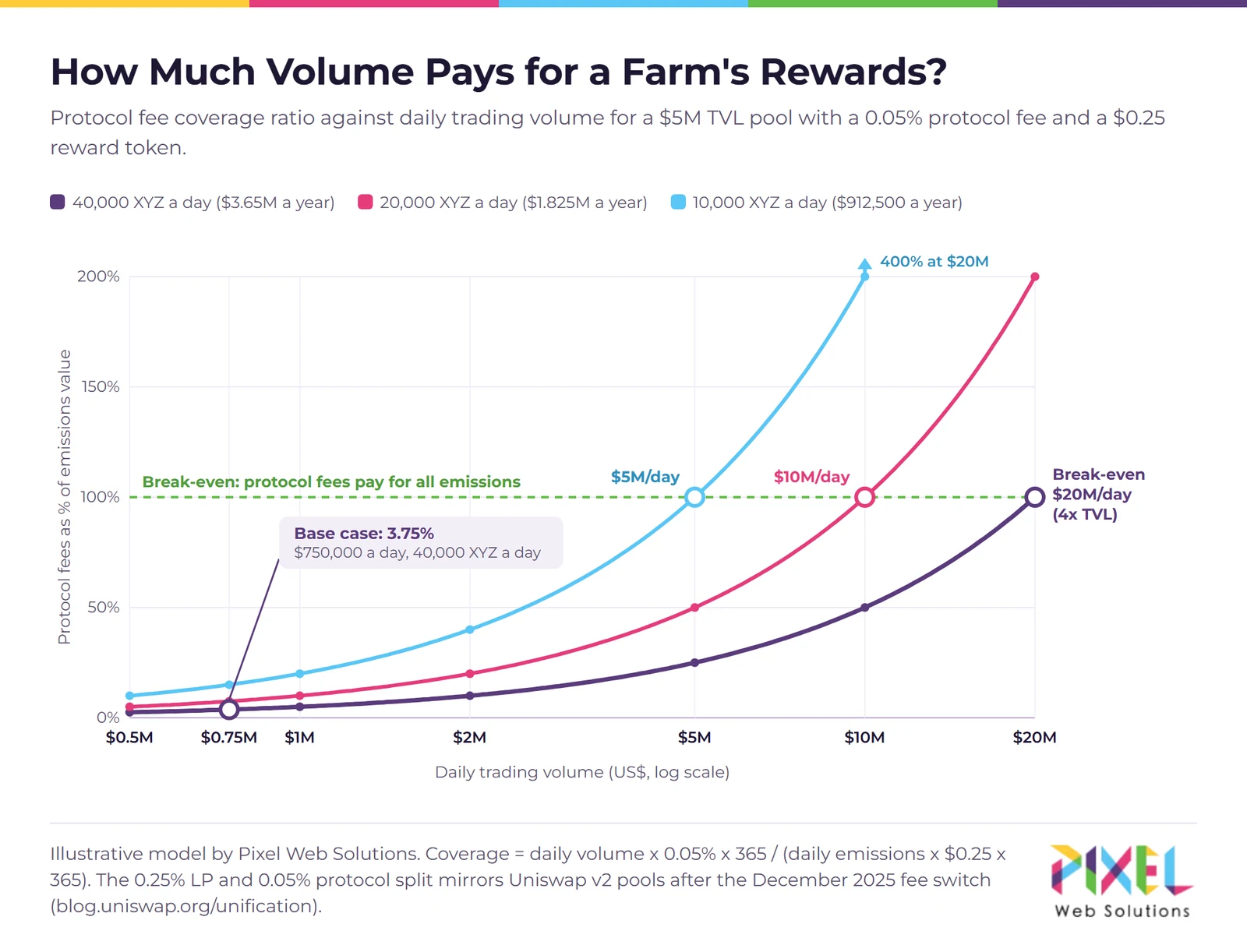
- Reward maths decides survival: in our worked example, a farm paying $3.65 million a year in token emissions earns only $136,875 in protocol fees, a 3.75% coverage ratio. Most farms fail for this reason, not because of bad code.
- Security failures moved beyond code bugs: Balancer lost about $128 million to a rounding bug in November 2025, but the two biggest 2026 losses, Drift and KelpDAO, came from compromised keys and a bridge verifier.
- The protocol list from 2021 is out of date: MakerDAO is now Sky, Aave launched V4 in March 2026, Uniswap switched on protocol fees in December 2025, and Balancer is voting on a wind-down.
- Budget for more than development: Pixel builds staking or yield vaults from $6,000 and AMM DEX farms from $7,500, but an independent audit, liquidity incentives and monitoring are separate line items.
What Is DeFi Yield Farming?
Yield farming, also called liquidity mining, is the practice of depositing crypto into DeFi protocols to earn a return. Instead of holding tokens in a wallet, users supply them to a lending market such as Aave or a liquidity pool on a decentralized exchange (DEX) such as Uniswap. In return, they earn interest, a share of trading fees, extra reward tokens, or a mix of all three.
Compound is widely credited with starting the trend. It began distributing its COMP governance token to lenders and borrowers on 15 June 2020, and within two weeks users had piled so much capital into niche markets that governance changed the COMP distribution rules to stop the gaming. That burst of activity became known as "DeFi summer".
Two terms confuse most newcomers:
- APR (annual percentage rate) is the simple yearly return without compounding.
- APY (annual percentage yield) assumes rewards are reinvested. An 86.7% APR compounded daily becomes a 137.7% APY, which is why farms like to advertise APY.
Staking, yield farming and liquidity mining overlap but are not the same product. If you are still choosing between them for your DEX, read our comparison of staking vs yield farming vs liquidity mining first.
How DeFi Yield Farming Platform Works in 2026
A DeFi yield farming platform connects three groups: users who supply capital, the people who pay to use that capital, and the protocol that sets the rules. Traders pay swap fees to liquidity pools. Borrowers pay interest to lenders. The protocol may add its own reward tokens on top to attract deposits early on.
Smart contracts govern every step, from deposit to reward payout. A user deposits assets, receives a receipt token (an LP token or a vault share), and the contract tracks their share of fees and rewards block by block. When the user withdraws, the contract burns the receipt and returns the principal plus earnings.
Where does the yield actually come from? There are only four honest sources:
- Trading fees paid by swappers to liquidity providers (LPs).
- Borrow interest paid by borrowers to lenders.
- Underlying yield from staked ETH, tokenized Treasury bills or other real-world assets.
- Token emissions, which are new tokens minted by the protocol. These are a marketing cost, not income, because they dilute existing holders.
Yield farming now runs across Ethereum, its layer 2 networks such as Base and Arbitrum, BNB Chain, Solana and others. Curve, for example, operates its stablecoin pools and LlamaLend markets across several chains, and in 2026 it launched LlamaLend v2 on Optimism and Ethereum. The next section shows how those forces are shaping the market right now.
Current Market Trends in DeFi Yield Farming (2026)
DeFi is smaller than at its peak but far more mature. Total value locked (TVL) across DeFi stood at $95.95 billion on 27 September 2026, according to DefiLlama. That is down from a peak of $171.1 billion on 7 October 2025 and up from a low of $69.2 billion on 30 June 2026.
Yields have compressed with it. We pulled every pool tracked by DefiLlama Yields on 27 September 2026 and filtered for pools with meaningful deposits:
| Pool group (DefiLlama, 27 Sept 2026) | Pools | TVL-weighted APY | Of which from reward tokens |
|---|---|---|---|
| Stablecoin pools, $10M+ TVL | 328 | 4.07% | 0.58 points |
| Single-asset stablecoin pools, $1M+ TVL | 724 | 4.21% | 0.56 points |
| Volatile two-token LP pools, $1M+ TVL | 905 | 16.96% | 8.07 points (48%) |
Of the 2,760 pools with at least $1 million in TVL, 1,353 (49%) paid under 2% APY and only 84 (3%) paid more than 50%. High numbers still exist. For example, the WETH-USDC concentrated liquidity pool on Aerodrome (Base) showed a 126.6% APY that day, but 72.8 points of it came from AERO reward tokens.
What's Trending in DeFi Yield Farming?
- Real yield over emissions. Uniswap governance approved its "UNIfication" proposal on 25 December 2025, which switches on protocol fees and burns 100 million UNI. On Uniswap v2 pools the LP fee drops from 0.30% to 0.25%, with 0.05% going to the protocol. Token holders now expect fee income, not just inflation.
- Lending is the core yield layer. Aave launched V4 with a hub-and-spoke design on Ethereum mainnet on 30 March 2026, and Morpho holds $11.1 billion in TVL on DefiLlama. Lending markets are where most stablecoin yield now comes from.
- Yield-bearing stablecoins and real-world assets. Sky's savings token sUSDS paid 3.6% on 27 September 2026, and Ethena's sUSDe paid about 4.75%. Farms increasingly build on these instead of minting their own rewards.
- Security is the top buying criterion. DeFi lost about $1.3 billion to hacks in the first eight months of 2026, per CertiK data reported by crypto.news. Most of it came from compromised keys, not broken code.
- Consolidation. Weaker protocols are closing. Loopring shut its DEX in June 2026 and Balancer's community is voting on a wind-down this week.
As the top DeFi market trends of 2026 show, the protocols that survive combine real fees, strong risk controls and clear governance. Here are the platforms that matter most to anyone building in this space.
Top DeFi Yield Farming Platforms and Protocols in 2026
These are the protocols a yield farming builder should study, integrate with or compete against. TVL figures are from DefiLlama on 27 September 2026. They are not investment recommendations.
Aave
- Aave is the largest DeFi lending protocol, with $19.3 billion in TVL across V3 and the new V4.
- It popularised flash loans. Its old "stable rate" borrowing was fully deprecated by governance, so V3 borrowing is variable rate, while V4 (live on Ethereum since 30 March 2026) adds a hub-and-spoke design for new market types such as fixed-rate and real-world asset credit.
- Aave's TVL fell from $26.1 billion on 17 April 2026 to $16.6 billion on 21 April 2026 after the KelpDAO exploit left unbacked rsETH collateral on the platform, a reminder that lenders inherit the risk of the collateral they accept.
Compound Finance
- Compound pioneered governance-token farming in 2020 and holds about $1.63 billion in TVL, most of it in Compound V3.
- Interest rates adjust algorithmically with supply and demand.
- COMP rewards on individual markets are set by governance and are now small or zero on many markets, so most returns come from base interest.
Uniswap
- Uniswap is the best-known AMM DEX, with about $4.0 billion in TVL across v2, v3 and v4.
- LPs earn swap fees. After the December 2025 fee switch, v2 LPs keep 0.25% of each 0.30% swap and v3 LPs give up one quarter to one sixth of fees on selected pools, as set out in the UNIfication proposal.
- Uniswap no longer runs UNI liquidity mining, so its yield is pure fee income.
Curve Finance
- Curve focuses on low-slippage stablecoin and pegged-asset swaps, with about $1.59 billion in TVL including its crvUSD stablecoin and LlamaLend markets.
- LPs earn fees plus CRV rewards, boosted by locking CRV as veCRV.
- Its vote-escrow model became the template for "ve-tokenomics" across DeFi.
Yearn Finance
- Yearn runs automated vaults that move deposits between strategies to optimise returns, with about $277 million in TVL.
- Its V3 vaults follow the ERC-4626 tokenized vault standard, which many new farms copy.
- On 1 December 2025 an attacker exploited Yearn's legacy yETH pool for about $9 million, and Yearn recovered $2.4 million. Its main vaults were not affected.
Sky (formerly MakerDAO)
- MakerDAO rebranded to Sky in 2024. DAI has a successor stablecoin, USDS, and each MKR converts to 24,000 SKY.
- Sky holds about $6.08 billion in TVL, and its sUSDS savings rate (3.6% on 27 September 2026) is a common base yield inside other farms.
- SKY holders now carry the governance role MKR once had.
Synthetix
- Synthetix originally let SNX stakers mint synthetic assets that tracked stocks and fiat currencies.
- It has since repositioned as a perpetual futures exchange and launched perps on Ethereum mainnet in December 2025.
- SNX staking now backs that exchange, so it is no longer the synthetic-asset farming venue many 2021 guides describe.
Balancer
- Balancer pioneered weighted pools with uneven token ratios.
- On 3 November 2025 an attacker used a rounding flaw in V2 Composable Stable Pools to drain about $128 million, as detailed in OpenZeppelin's analysis. TVL fell from $775 million the day before to $59 million today.
- Balancer Labs shut down in March 2026, and a wind-down proposal is being voted on from 25 to 29 September 2026. If it passes, LPs have until 30 October 2026 to withdraw.
Morpho
- Morpho runs isolated lending markets and curated vaults, with about $11.1 billion in TVL.
- Each market has one collateral asset and one loan asset, so a problem in one market does not spread to others.
- Its vaults are a popular base layer for fintech "earn" products.
Pendle
- Pendle splits yield-bearing tokens into a principal token (PT) and a yield token (YT), so users can lock in a fixed rate or trade future yield.
- It holds about $1.27 billion in TVL.
- It shows how yield itself has become a tradable product that new platforms can plug into.
These protocols lead in TVL, fee revenue or design influence. Many of them run on their own governance tokens, so let's look at which farming tokens still matter and which ones from old lists have gone. If you plan to launch your own, see our guide on how to create a DeFi token.
Popular DeFi Yield Farming Tokens
Here are the governance and reward tokens most relevant to yield farming in 2026:
| Token | Protocol | Role in farming |
|---|---|---|
| AAVE | Aave | Governance and the Umbrella safety module |
| UNI | Uniswap | Governance; can be burned to claim protocol fees since the 2025 fee switch |
| COMP | Compound | Governance and market-level rewards |
| CRV | Curve | Pool rewards, boosted when locked as veCRV |
| YFI | Yearn | Governance and vault incentives |
| SKY | Sky | Governance (replaced MKR) |
| MORPHO | Morpho | Governance and market incentives |
| PENDLE | Pendle | Rewards, locked as vePENDLE to direct incentives |
| SNX | Synthetix | Staking collateral for the perps exchange |
Many lists still repeat a 2020 token list that no longer holds. Here is what happened to the names that appeared on it, including in earlier versions of this post:
| Old listing | What happened |
|---|---|
| Aave (LEND) | Migrated to AAVE at 100 LEND to 1 AAVE in October 2020 |
| Maker (MKR) | Upgraded to SKY at 1 MKR to 24,000 SKY |
| bZx (BZRX) | Became Ooki; a US court ordered Ooki DAO to shut down in June 2023 after a CFTC case |
| Ren (REN) | Ren 1.0 was sunset in December 2022 after Alameda Research collapsed |
| Loopring (LRC) | Loopring shut down its DEX in June 2026 |
| Mainframe (MFT) | Rebranded to Hifi Finance and swapped to HIFI |
| Balancer (BAL) | Protocol wind-down vote under way in September 2026 |
| Akropolis (ADEL), mStable (MTA) | Listed as inactive on DefiLlama |
| Numerai (NMR), 0x (ZRX) | Real projects, but not yield farming tokens: NMR is staked in a data science tournament and 0x is swap routing infrastructure |
These tokens give holders governance rights, staking income and rewards, which is why businesses keep building around them. The next section shows how a company can turn a farming platform into income.
How Businesses Can Make Passive Income With a DeFi Yield Farming Platform?
Businesses can earn from yield farming in two ways. They can use farms, for example by placing part of a crypto treasury in audited stablecoin lending markets, where rates were around 3.6% to 4.2% on the largest Ethereum markets in late September 2026. Or they can operate a farming platform and earn fees from everyone who uses it. The second route is where the real business opportunity sits.
Users deposit cryptocurrencies into smart contracts and receive liquidity provider (LP) tokens or vault shares in return. Those receipts entitle them to fees, interest or governance tokens. Here is how the cycle works for a user, and where the platform earns.
1. Providing Liquidity
- Users deposit crypto assets into liquidity pools on DEXs or into lending protocols.
- These pools work like decentralized "banks" where tokens are supplied for others to borrow, lend or trade. Example: a user deposits ETH and USDT into a trading pair pool, so others can swap between the two, and the depositor earns a share of the fees.
2. Receiving LP Tokens
- Once liquidity is provided, the user receives LP tokens or vault shares.
- These act as a digital receipt for their share of the pool. They can also be staked in a farm contract to earn extra rewards, or used as collateral elsewhere.
3. Earning Rewards
Here's how yield farmers typically earn:
Transaction Fees:
Each swap through the pool pays a fee, and most of it goes to LP token holders in proportion to their share.
Interest and Lending:
Lending markets pay interest from borrowers to suppliers. Some markets also accept LP tokens or vault shares as collateral, so users can borrow against their position.
Governance Tokens:
Many platforms reward liquidity providers with governance tokens that carry voting power over the protocol's future.
Other Incentives:
Some protocols add points programmes, airdrops or boosted rewards for users who lock tokens for longer.
4. Compounding and Reinvestment
To maximise returns, users can reinvest rewards into the same or other pools, which is called compounding. Auto-compounding vaults do this automatically and charge a performance fee for the service.
How the platform owner earns: a protocol fee on swaps (Uniswap's 0.05% on v2 pools is a public benchmark), a spread on lending interest (the "reserve factor"), a performance or management fee on vaults, and listing or launch fees for new pools. Those revenue lines are what let a platform keep paying users after launch incentives end, and they are the reason building your own DeFi platform can be a sound business rather than a short-lived campaign.
Benefits of Creating a DeFi Yield Farming Platform
Yield farming remains one of DeFi's most useful features for founders. It turns idle capital into liquidity, and liquidity is what every DEX, lending market and token needs to function.
Competitive Returns
DeFi yields are usually above bank savings rates, and the income comes from trading fees, interest and token rewards. However, realistic stablecoin yields in 2026 are in the low to mid single digits. Double and triple-digit APYs almost always depend on reward tokens whose price can fall, so a good platform shows users where each percentage point comes from.
Full Control
DeFi lets users keep custody of their assets. Funds stay in the user's wallet until they choose to deposit, and non-custodial contracts mean the operator cannot simply move user funds. That control only holds if admin keys, upgrades and oracles are secured, as the risk section below explains.
Liquidity Incentives
By supplying liquidity, users make lending, trading and other services possible, and they earn fees or interest in return. For the protocol, a farm is the fastest way to bootstrap deep pools and low slippage for a new token.
Transparency
Every deposit, reward and contract call is recorded on a public blockchain, and most DeFi code is open source. Anyone can verify how a protocol works and where funds go, and dashboards such as DefiLlama make that data easy to compare.
With these benefits in mind, it is no surprise that businesses are building their own farms. The first decision is which type of platform to build.
Types of DeFi Yield Farming Platforms You Can Build
| Platform type | How users earn | Best for | Reference design |
|---|---|---|---|
| Single-asset staking pool | Rewards for locking one token | New token projects that want holders to stay | Classic staking contract |
| LP farm | Swap fees plus reward tokens for staking LP tokens | DEXs and new tokens that need liquidity | Sushi-style MasterChef contract |
| Lending market | Interest from borrowers | Stablecoin and blue-chip asset yield | Aave, Compound, Morpho |
| Auto-compounding vault | Strategy returns, compounded automatically | Users who want passive, managed yield | Yearn V3 (ERC-4626) |
| Yield tokenization | Fixed rates or leveraged yield exposure | Advanced users and treasuries | Pendle |
| Cross-chain aggregator | Best rates across several chains | Multi-chain ecosystems | Bridge plus vault router |
For most startups, a staking pool or an ERC-4626 vault that routes deposits into established lending markets is the fastest, safest start. An LP farm makes sense if you are also launching a DEX. In that case, our guide to build a DEX like Uniswap covers the AMM side.
Core Features and Architecture of a Yield Farming Platform
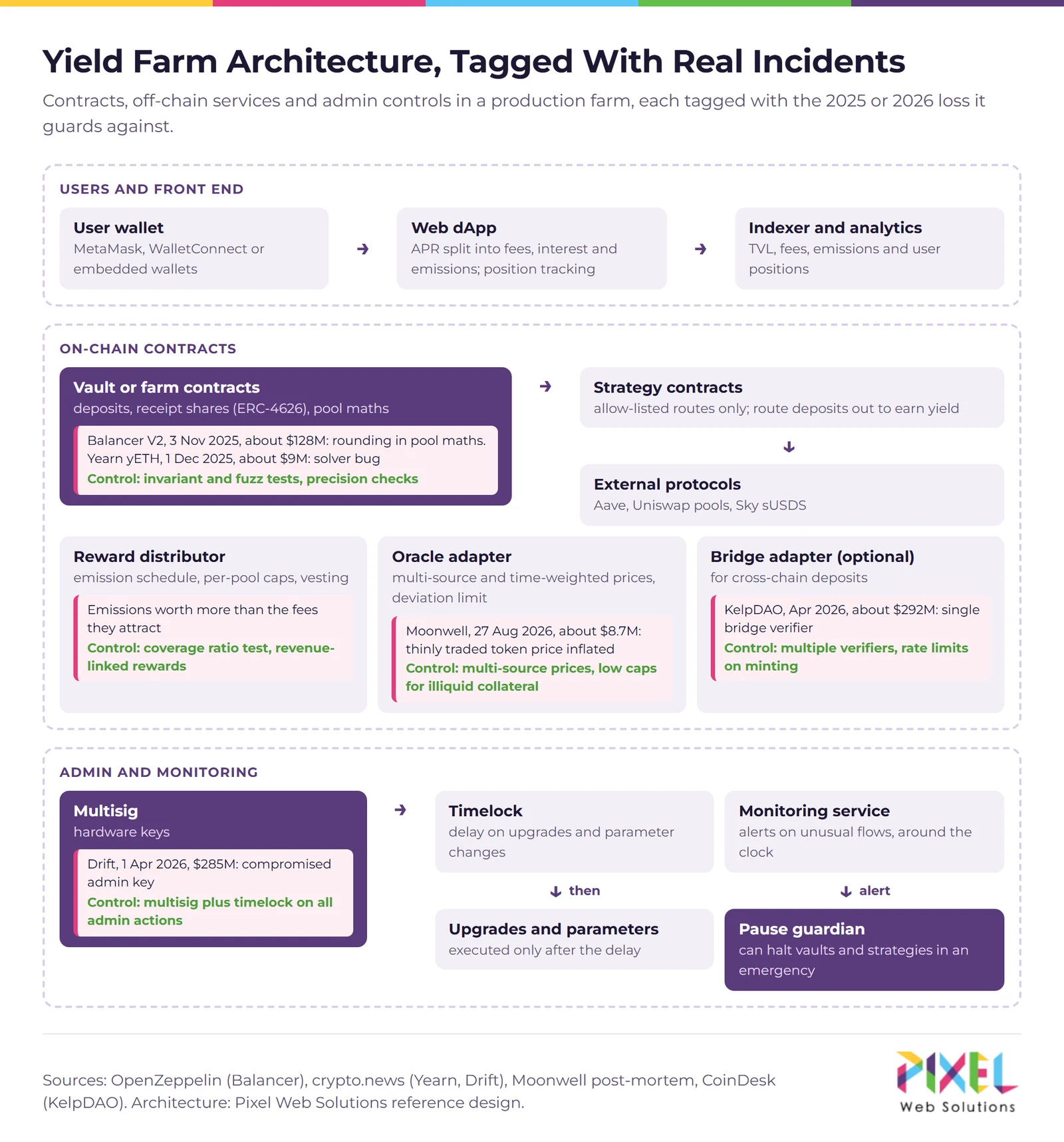
Every serious yield farming platform needs these building blocks:
- Vault or farm contracts that accept deposits, mint receipt tokens and track each user's share.
- Strategy contracts that route funds into lending markets or pools, with strict allow-lists of where money can go.
- A reward distributor with a fixed emission schedule, caps per pool and optional vesting.
- An oracle adapter that reads prices from more than one source and rejects sudden deviations.
- Admin controls: a multisig, a timelock on upgrades and parameter changes, and a pause guardian for emergencies.
- A web dApp with wallet connection (MetaMask, WalletConnect and embedded wallets), clear APR breakdowns and position tracking.
- An indexer and analytics dashboard for TVL, fees, emissions and user positions.
- Real-time monitoring that alerts on unusual flows and can trigger the pause guardian.
Writing these contracts well is specialist work. Our DeFi smart contract development guide covers the patterns, languages and testing approach in more depth.
The Farm Maths: Can Your Rewards Pay for Themselves?
This is the section most development guides skip, and it is the one that decides whether a farm survives its first six months. Before writing any code, run your reward plan through three numbers.
Worked example. A project launches a USDC/XYZ pool on a Uniswap v2 style AMM:
| Input | Value |
|---|---|
| Pool TVL | $5,000,000 |
| Daily trading volume | $750,000 (15% of TVL) |
| Swap fee | 0.30% (0.25% to LPs, 0.05% to the protocol) |
| XYZ emissions | 40,000 XYZ per day |
| XYZ price | $0.25 |
| XYZ circulating supply | 100,000,000 |
Step 1: the headline APR users see.
- LP fees: $750,000 x 0.25% x 365 = $684,375 a year, a 13.7% fee APR.
- Emissions: 40,000 x $0.25 x 365 = $3,650,000 a year, a 73.0% emissions APR.
- Headline: 86.7% APR, or 137.7% APY with daily compounding.
Step 2: what the protocol actually earns.
- Protocol fees: $750,000 x 0.05% x 365 = $136,875 a year.
- Coverage ratio (protocol revenue divided by emissions value): $136,875 / $3,650,000 = 3.75%.
- In plain words, the protocol spends $1 of tokens to earn less than 4 cents.
Step 3: the dilution farmers must absorb.
- 40,000 x 365 = 14.6 million XYZ a year, or 14.6% annual inflation on a 100 million supply.
- If most farmers sell their rewards, that is up to $3.65 million of sell pressure a year at today's price.
Step 4: what a farmer really keeps. Take a $10,000 deposit (half USDC, half XYZ) held for a year, with fees and pool share unchanged. The table uses the standard impermanent loss formula from the Uniswap v2 documentation: loss = 2 x sqrt(price ratio) / (1 + price ratio) minus 1.
| XYZ price after a year | Impermanent loss vs holding | LP position | Fees | Rewards (valued at new price) | Total | Just holding the tokens |
|---|---|---|---|---|---|---|
| Falls 75% | 20.0% | $5,000 | $1,369 | $1,825 | $8,194 | $6,250 |
| Falls 50% | 5.7% | $7,071 | $1,369 | $3,650 | $12,090 | $7,500 |
| Unchanged | 0% | $10,000 | $1,369 | $7,300 | $18,669 | $10,000 |
The farmer beats holding in every row, but an "86.7% APR" farm still loses 18% of the deposit if XYZ drops 75%. And XYZ is far more likely to drop when 14.6% new supply hits the market every year.
Design rules that follow from the maths:
- Size emissions to revenue. At 40,000 XYZ a day, the pool needs $20 million of daily volume, four times its entire TVL every day, for protocol fees to cover emissions. Cutting emissions to 10,000 XYZ a day lowers break-even to $5 million.
- Decay emissions on a schedule and publish it, so farmers price the cut in advance.
- Vest or lock rewards. Vote-escrow locks (the Curve and Pendle model) turn mercenary capital into long-term holders.
- Pay part of rewards in fees, not only in new tokens. Since Uniswap's fee switch, users compare farms on real yield.
- Show the split in your UI: fee APR, interest APR and emissions APR as separate numbers. Users trust platforms that do this.
Risks of DeFi Yield Farming and the Controls That Address Them
Every yield farming platform carries the same families of risk. The difference between a platform that survives and one that becomes a case study is whether each risk has a named control before launch.
| Risk | Real incident | Control to build in |
|---|---|---|
| Impermanent loss | Bancor paused its impermanent loss protection in June 2022, during the market crash when LPs needed it most | Show IL estimates in the UI; favour correlated pairs; never promise IL cover funded by your own token |
| Smart contract math bugs | Balancer V2 lost about $128 million to a rounding error on 3 November 2025; Yearn's yETH pool lost about $9 million to a solver bug on 1 December 2025 | Invariant and fuzz testing, precision checks on every scaling function, two independent audits, bug bounty |
| Oracle manipulation | Mango Markets lost over $100 million in October 2022 when a trader pumped the MNGO price; a US judge vacated the convictions in May 2025. Moonwell lost about $8.7 million on 27 August 2026 after an attacker inflated the thinly traded MAMO token, per its post-mortem | Time-weighted and multi-source prices, deviation limits, low supply caps for illiquid collateral |
| Key and bridge compromise | Drift lost $285 million on 1 April 2026 to a compromised admin key; KelpDAO lost about $292 million in April 2026 through a single bridge verifier | Multisig plus timelock on all admin actions, hardware keys, multiple bridge verifiers, rate limits on minting |
| Collateral contagion | Unbacked rsETH from the Kelp exploit was posted on Aave, whose TVL fell from $26.1 billion to $16.6 billion in four days | Isolated markets, conservative caps for new collateral, fast governance to freeze assets |
| Regulatory | A US court ordered Ooki DAO's website shut down after a CFTC case in 2023 | Legal review of token design, geofencing where required, clear terms of use |
| Economic (emissions) | Balancer's revenue fell from $1.13 million in October 2025 to $56,781 in August 2026, leading to a wind-down proposal | The coverage ratio test above, revenue-linked rewards, runway planning |
Good smart contract audit services are the minimum, not the finish line. The largest 2026 losses happened at protocols that had been audited; the failures were in keys, bridges and operations.
How To Create a DeFi Yield Farming Platform?
Building a DeFi yield farming platform involves careful planning, secure coding and smart integration. Here is the step-by-step process we follow:
1. Plan and research. Define your users, the assets you will support, the type of farm and your revenue model. Run the emissions coverage test before anything else.
2. Select the blockchain and tech stack. Ethereum offers the deepest liquidity but the highest costs; layer 2 networks such as Base and Arbitrum, and chains such as BNB Chain and Solana, are cheaper. Solidity with Foundry or Hardhat is standard on EVM chains, and Rust with Anchor on Solana.
3. Design tokenomics and rewards. Set emission schedules, vesting, lock-up boosts and fee splits. Model several price and volume scenarios, as in the worked example.
4. Develop the smart contracts. Build vaults, farms, strategies, reward distributors and the oracle adapter on audited, battle-tested patterns such as ERC-4626 where possible.
5. Build the frontend. Create a user-centric dApp with wallet integration, clear APR breakdowns and position tracking.
6. Test and audit. Run unit, fuzz and invariant tests, deploy to a public testnet (Sepolia, not the retired Goerli), then commission at least one independent audit and fix every finding.
7. Launch and maintain. Deploy to mainnet behind a multisig and timelock, start with deposit caps, run monitoring around the clock and open a bug bounty.
Timelines depend on scope. A focused farm on proven patterns takes about three weeks to two months, a mid-level platform two to four months, and a full-scale protocol four to nine months including audits. With a clear build plan in place, cost is the next question.
How Much Does DeFi Yield Farming Platform Development Cost?
| What you build | Pixel Web Solutions starting price | Typical custom range |
|---|---|---|
| Staking pool or yield vault | From $6,000 | $15,000 to $50,000 |
| LP farm with your own AMM DEX | DEX from $7,500 | $40,000 to $120,000 |
| Lending market as a yield source | $5,000 to $25,000 | $50,000 to $150,000 |
| DeFi consulting and tokenomics design | From $5,000 | Scope based |
Starting prices are Pixel's published prices for builds on established, audited patterns. Custom ranges cover new mechanisms, multi-chain deployment and scale. On top of development, budget for:
- Independent audits, quoted per codebase and often as large as the build itself for a simple farm.
- Liquidity incentives, which are a real cost to your treasury, as the farm maths shows.
- Monitoring, hosting, indexing and maintenance, which are recurring monthly costs.
For a line-by-line view by app type, chain and build method, see our full DeFi app cost breakdown.
Defi Yield Farming Platform Development Services – Pixel Web Solutions
Pixel Web Solutions is a blockchain development company, founded in 2012 in Madurai, India, that builds DeFi and yield farming platforms. The team designs and builds secure, scalable and user-friendly yield farming platforms tailored to each business, from smart contracts and reward logic to dashboards and wallet integration.
The service covers the full cycle: tokenomics and emissions modelling, vault and farm contracts, oracle and admin security design, audit coordination, frontend development, launch and ongoing support. Every project starts with the reward maths, so clients know what their incentives will cost before a line of code is written.
With a strong track record in blockchain delivery, Pixel Web Solutions is a reliable partner for businesses entering the DeFi space.
Why Choose Pixel for Your DeFi Yield Farming Platform Development?
Pixel Web Solutions combines blockchain engineering with a clear focus on quality and security. The team understands how real DeFi protocols make money and how they fail, which is why its farms are designed around revenue coverage, isolated risk and hardened admin controls rather than headline APYs.
Whether you are a startup launching a new token or an established business adding yield products, you get transparent published pricing, proven contract patterns and full-cycle support. Consider Pixel Web Solutions as your trusted DeFi development company for a platform built for long-term success.
Talk to our DeFi team today to plan your yield farming platform.
Frequently Asked Questions
What is DeFi yield farming platform development?
It is the process of building the smart contracts, reward system and web app that let users deposit crypto into pools or vaults and earn fees, interest or token rewards. It includes tokenomics design, contract development, security audits, frontend development and launch.
Which platform pioneered yield farming?
Compound is widely credited with starting yield farming when it began distributing COMP tokens to its lenders and borrowers on 15 June 2020. The rush that followed kicked off "DeFi summer" and was copied by most protocols afterwards.
How much does it cost to build a DeFi yield farming platform?
Pixel Web Solutions builds staking pools and yield vaults from $6,000 and AMM DEX farms from $7,500 on proven patterns. Custom platforms typically range from $15,000 to $120,000 or more depending on features and chains. Audits, liquidity incentives and monthly running costs are extra.
How long does it take to develop a yield farming platform?
About three weeks to two months for a focused platform on proven patterns, two to four months for a mid-level platform, and four to nine months or more for a full-scale protocol including audits.
What are the key factors to consider when choosing a yield farming platform?
Check where the yield comes from (fees and interest versus token emissions), audit history and incident record, how admin keys and upgrades are controlled, oracle design, TVL trend on DefiLlama, and how fast you can withdraw. For builders, the same factors apply when choosing which protocols to integrate.
Is yield farming safe?
No yield farming platform is risk free. The main risks are impermanent loss, smart contract bugs, oracle manipulation, compromised keys or bridges, and falling reward token prices. DeFi lost about $1.3 billion to hacks in the first eight months of 2026, so strong controls and independent audits are essential.
Who gives the most accurate breakdown of DeFi yield trends?
DefiLlama is the most widely used open data source. Its Yields dashboard tracks more than 17,000 pools and separates base yield from reward yield, which is the split that matters most. Protocol documentation and governance forums are the best sources for fee and emission changes.
What is the difference between APR and APY in yield farming?
APR is the simple annual return. APY assumes rewards are reinvested, so it is always higher when compounding happens. An 86.7% APR compounded daily is a 137.7% APY.
Conclusion
DeFi yield farming platform development in 2026 rewards teams that design for sustainability first. The protocols still standing, such as Aave, Uniswap, Curve and Morpho, earn real fees, control their risks and show users where yield comes from. Pixel Web Solutions helps founders build a DeFi yield farming platform the same way: honest reward maths, audited contract patterns and hardened admin controls, delivered at published prices.