Building a DeFi app costs about $5,000 to $15,000 for a focused MVP on proven, audited contract patterns, $15,000 to $55,000 for a white-label or custom app with several features, and $55,000 to $150,000 or more for a full-scale protocol such as a custom DEX, lending market or perpetuals exchange. Pixel's DeFi protocol development starts at $6,000 on established patterns. Budget separately for smart contract audits, liquidity incentives and ongoing maintenance.
DeFi has matured into a market that holds $95 billion in value, according to DefiLlama, with protocols such as Uniswap, Aave, Morpho and Hyperliquid earning millions of dollars in fees every month. That creates room for new apps, and for existing apps that want to add DeFi features such as swaps, yield or lending.
But every technical choice, from the type of app and the blockchain to the build method and the audit, changes the budget. This guide breaks down the cost to build a DeFi app by app type, complexity, build method and chain, answers the questions founders ask most (including how to add DeFi earning to an existing app and which developer tools to use) and shows how to keep costs down without cutting security.
Key Takeaways
- App type drives the budget. A staking vault or wallet is far cheaper than a lending market or perpetuals DEX.
- Proven patterns save money. Forking or configuring audited designs keeps MVPs in the $5,000 to $15,000 range.
- Audits are mandatory and separate. They often cost as much as a simple app's development.
- You can add DeFi to an existing app by integrating established protocols instead of building your own.
- Plan revenue from day one: protocol fees, spreads or subscriptions decide whether the app pays back.
Cost to Create a DeFi App: Full Breakdown & Pricing Insights
| DeFi app type | Starting cost on proven patterns | Custom build |
|---|---|---|
| DeFi wallet | From $5,000 | $25,000 to $100,000 |
| Staking or yield vault | From $6,000 | $15,000 to $50,000 |
| Lending and borrowing platform | $5,000 to $25,000 | $50,000 to $150,000 |
| DEX (AMM) | From $7,500 | $40,000 to $120,000 |
| DEX aggregator | From $6,000 | $30,000 to $80,000 |
| Prediction market | From $7,000 | $40,000 to $100,000 |
| Perpetual futures DEX | From $7,500 | $150,000 to $400,000+ |
| Stablecoin system | $30,000 to $100,000 | $100,000+ |
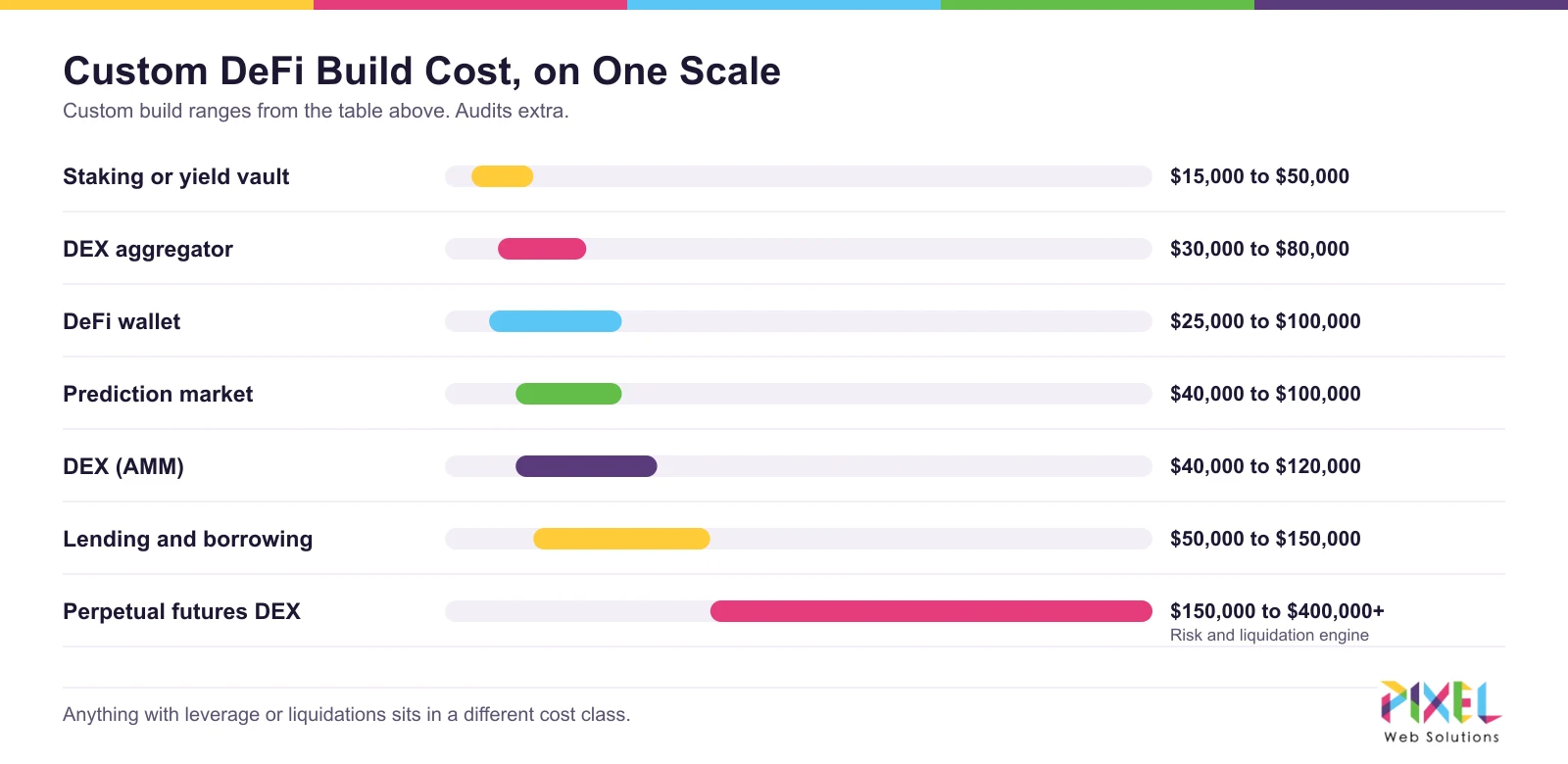
Starting prices reflect Pixel Web Solutions' published pricing for builds on established, audited patterns. Custom builds add new mechanisms, integrations and scale. See our detailed guides to the cost to build a DEX and DeFi lending platform development.
Comparing DeFi App Development Costs: MVP vs Full-Scale Solutions
App Complexity
Simple DeFi application (MVP)
A focused app with one core function, such as swaps, staking or a single lending market, built on proven contracts.
- Timeframe: 3 weeks to 2 months
- Estimated cost: $5,000 to $15,000
- Ideal for: startups testing demand or adding one DeFi feature to an existing product
Mid-level DeFi application
Several features (for example swaps plus staking and a rewards programme), a polished interface, an admin panel and integrations.
- Timeframe: 2 to 4 months
- Estimated cost: $15,000 to $55,000
- Ideal for: growing products competing on user experience
Full-scale DeFi protocol
New mechanisms, risk engines, governance, multi-chain support and deep integrations.
- Timeframe: 4 to 9 months or more
- Estimated cost: $55,000 to $150,000+
- Ideal for: protocols aiming to become core infrastructure
Development Method
White-label DeFi software
Pre-built, tested software configured and branded for you, with the essential features of the chosen app type.
- Timeframe: 3 weeks to 2 months
- Estimated cost: $15,000 to $25,000 for typical packages
Custom solutions
Built from scratch around your design and mechanisms, with full control and higher cost.
- Timeframe: 4 to 6 months or more
- Estimated cost: $35,000 to $150,000+
Development Approach
Freelancers
Suitable for small, non-critical components. Rates vary widely, and quality, security review and long-term support are harder to guarantee.
DeFi development company
A team covering smart contracts, frontend, backend, security and launch, with fixed-scope pricing and post-launch support. Pixel's DeFi builds start at $6,000 on established patterns.
Choice of Blockchain Network
| Chain | Development cost impact | Best for |
|---|---|---|
| Ethereum mainnet | Standard EVM tooling; higher user fees | High-value DeFi, institutional users |
| Base, Arbitrum, Optimism | Same EVM tooling, very low user fees | Most new consumer DeFi apps |
| BNB Chain, Polygon | EVM tooling, low fees | Retail audiences |
| Solana | Rust and Anchor; specialist developers | High-speed trading and consumer apps |
EVM chains share code and tools, so one codebase can deploy on several of them. Learn how Ethereum's upgrades changed DeFi.
Top Factors That Influence the Cost to Build a DeFi Application
Core Features
Every feature adds contracts, interface work and audit scope: swaps, liquidity pools, staking, lending markets, liquidations, governance, oracles and cross-chain bridges.
Solution: prioritize the features that earn revenue or retain users, and plan the rest for later phases.
Type of DeFi App
Lending and derivatives need price oracles, liquidation engines and risk parameters, which cost far more than a staking vault or a swap interface.
Solution: choose the simplest app type that delivers your value proposition.
Smart Contract Audits
Independent audits are essential for any app holding user funds. Small changes to audited code need a smaller review; new mechanisms need full audits, often more than one.
Solution: build on audited libraries and patterns to shrink audit scope.
Liquidity and Incentives
DEXs, lending markets and perps need liquidity at launch, often funded through incentives that can exceed development costs in the first year.
Solution: partner with market makers and token projects, and pay incentives from real usage where possible.
Prolonged Maintenance
Protocol upgrades, new chains, integrations, security monitoring and bug bounties continue after launch.
Solution: agree post-launch support terms with your development team before you start.
Regulatory Factors
DeFi is not free from legal risk. Stablecoins, derivatives, prediction markets and apps with admin control or a company front end can face licensing, KYC and sanctions obligations.
Solution: get legal advice for your target markets early.
How to Integrate DeFi Earning Opportunities Into an Existing App
You do not always need to build a protocol. Many fintechs, wallets and apps add DeFi features by integrating established ones:
- Yield on stablecoin balances: route idle balances into lending markets or vaults such as Aave or Morpho, and share the yield with users.
- In-app swaps: integrate a DEX aggregator API so users can swap tokens, earning a small service fee.
- Staking: offer native staking or liquid staking through established providers, keeping a commission.
- Embedded lending: let users borrow against crypto collateral through integrated lending protocols.
Integration projects are usually cheaper than building a protocol, typically in the MVP range, but you must disclose risks clearly and check whether offering yield to your users creates regulatory obligations in your market.
Developer Tools for Building DeFi Apps
- Smart contracts: Solidity with Foundry or Hardhat; Rust with Anchor on Solana
- Audited building blocks: OpenZeppelin contracts
- Frontend: React or Next.js with wagmi and viem
- Data and indexing: The Graph or custom indexers, plus reliable RPC providers
- Oracles: Chainlink and Pyth for price feeds
- Testing and security: mainnet forking, fuzzing, static analysis (Slither) and transaction simulation and monitoring
- Wallet connections: WalletConnect-compatible libraries
How DeFi Apps Make Money
- Protocol fees on swaps, loans or trades
- Interest spreads in lending markets
- Performance or management fees on vaults
- Subscription pricing for high-volume or professional users, such as reduced fees or premium analytics
- Launch and listing services for partner projects
On-chain data shows how different models perform. In the 30 days to 24 September 2026, Aave V3 users paid $35.4 million in interest, of which the protocol kept $4.6 million, while Hyperliquid kept $53.6 million of $68.4 million in perpetuals fees, according to DefiLlama. Our guide to DeFi business ideas compares the models in detail.
How To Optimize The Cost Without Compromising The Quality?
- Choose the right app type and build method for your stage.
- Start with an MVP focused on one core function.
- Fork or configure audited protocols rather than writing new mechanisms.
- Deploy on a low-fee EVM chain to share tooling and cut user costs.
- Integrate existing protocols where you do not need your own.
- Agree on post-launch support so maintenance does not become a surprise.
Is It Worth Investing In Creating a DeFi Application?
It can be, when the app solves a clear problem and has a revenue model:
- Real revenue: leading DeFi protocols earn millions of dollars in fees every month.
- Global reach: anyone with a wallet can use the app.
- Composability: your app can plug into wallets, DEXs, aggregators and other protocols from day one.
The caveat: DeFi value locked fell 17% between January and September 2026, so plan to win users with a better product, not a rising market.
Why Should you Partner with Pixel Web Solutions For DeFi App Development?
Pixel Web Solutions is a DeFi development company that builds DeFi wallets, DEXs, lending markets, staking vaults, aggregators and perpetuals exchanges, starting from audited patterns and customizing where your edge lies. We plan audits, liquidity and launch with you and support the app after it goes live. Also see our blockchain dApp development services.
Let's turn your DeFi vision into a live product.
Frequently Asked Questions
What is the cost to develop a DeFi platform?
A focused DeFi MVP on proven patterns costs about $5,000 to $15,000, a mid-level app $15,000 to $55,000 and a full-scale protocol $55,000 to $150,000 or more. Audits, liquidity and maintenance are extra.
How long does it take to build a DeFi app?
Three weeks to two months for an MVP, two to four months for a mid-level app and four to nine months or more for a full-scale protocol, including audits.
Which blockchain is cheapest for building a DeFi app?
EVM Layer-2 networks such as Base and Arbitrum offer low user fees while using standard Ethereum tooling, which keeps both development and running costs down.
How can I add DeFi earning to my existing app?
Integrate established protocols for stablecoin yield, swaps, staking or lending instead of building your own, share the returns with users, disclose the risks and check local regulations.
What developer tools are used to build DeFi apps?
Solidity with Foundry or Hardhat, OpenZeppelin libraries, wagmi and viem for the frontend, The Graph for indexing, Chainlink or Pyth for price feeds, and fuzzing, static analysis and simulation tools for security.
Do I need an audit for my DeFi app?
Yes. Any app that holds or moves user funds should be audited by an independent security firm before launch and after major changes.