Table of Contents
Last updated: 19 September 2026 | Reviewed by Mathibharathi Mariselvan, Co-founder, Pixel Web Solutions | 13 min read
Building a decentralized exchange (DEX) costs from $7,500 for a standard AMM based on audited contract patterns, $25,000 to $50,000 for a white-label DEX with your branding and extra modules, and $40,000 to $120,000 for a custom AMM DEX. Order-book and hybrid DEXs cost $80,000 to $180,000, and perpetual futures DEXs $150,000 to $400,000 or more. A smart contract audit, liquidity incentives and marketing come on top.
As a startup, your journey to launch a DEX is rarely smooth. Smart contract risk, liquidity, regulation and budget overruns all get in the way, and many founders underestimate costs because they only price the code.
This guide breaks down the real cost to build a decentralized exchange in 2026: by development method, DEX type, module and hidden cost, with a worked hour-by-hour estimate you can check yourself.
Key Takeaways
- The development method sets the budget. Forking audited contracts is cheapest, white-label adds branding and modules, and a custom DEX gives full control at the highest cost.
- DEX type matters more than chain. An AMM is the simplest design; order-book, hybrid and perpetual DEXs need matching or risk engines.
- Audits are not optional. A DEX holds user liquidity in smart contracts, and one bug can drain every pool.
- Liquidity is a cost too. Incentives to attract liquidity providers often cost more than the build over the first year.
- Proven demand exists. Uniswap V3 and V4 together earned $204 million in trading fees in the 30 days to 24 September 2026, according to DefiLlama.
Why Create a Decentralized Crypto Exchange?
Users increasingly prefer to keep control of their funds, which drives demand for DEXs. Here are the key reasons to build one.
Self-Custodial
Users trade directly from their own wallets and keep their private keys, so the exchange never holds their funds. That removes the custody risk that has sunk several centralized exchanges.
Stronger Security Model
Because funds sit in audited smart contracts and user wallets rather than in a company's hot wallet, a DEX avoids the single point of failure of centralized custody. The trade-off is smart contract risk, which audits and bug bounties address.
Global Accessibility
Anyone with a wallet can trade, provide liquidity or list a token, 24/7, which helps a new DEX reach users worldwide quickly.
Multiple Revenue Streams
DEXs earn from a share of swap fees, listing and launch services, premium features and partnerships. On Base, Aerodrome's Slipstream pools kept $13.2 million of $16.1 million in fees over 30 days, showing how profitable a leading chain-specific DEX can be.
How Much Does it Cost to Create a Decentralized Exchange (DEX)?
The cost of creating a decentralized exchange ranges from $7,500 to $150,000 or more, depending on four main factors:
- Development method
- DEX type and technical complexity
- Features and third-party integrations
- Audit, marketing and post-launch support
The development method has the biggest effect on the budget.
Fork of Audited AMM Contracts
The fastest route is to deploy a proven AMM design (based on audited, open-source contracts) with your own interface and settings. Pixel's DEX development starts at $7,500 for a standard AMM built this way. It suits test launches and small chains, but offers little differentiation.
White-Label DEX Software
White-label DEX software is a pre-built, tested platform with swap, liquidity pools, farming, staking and an admin dashboard, rebranded for you. A white-label DEX with your branding and chosen modules costs $25,000 to $50,000, and more with heavy customization. Clone scripts such as a Uniswap clone script or PancakeSwap clone script fall into this route.
Custom DEX Development
A custom DEX is designed around your own trading model, fee logic and user experience. A custom AMM DEX costs $40,000 to $120,000, and more complex designs cost more. This suits funded teams whose edge is the product itself.
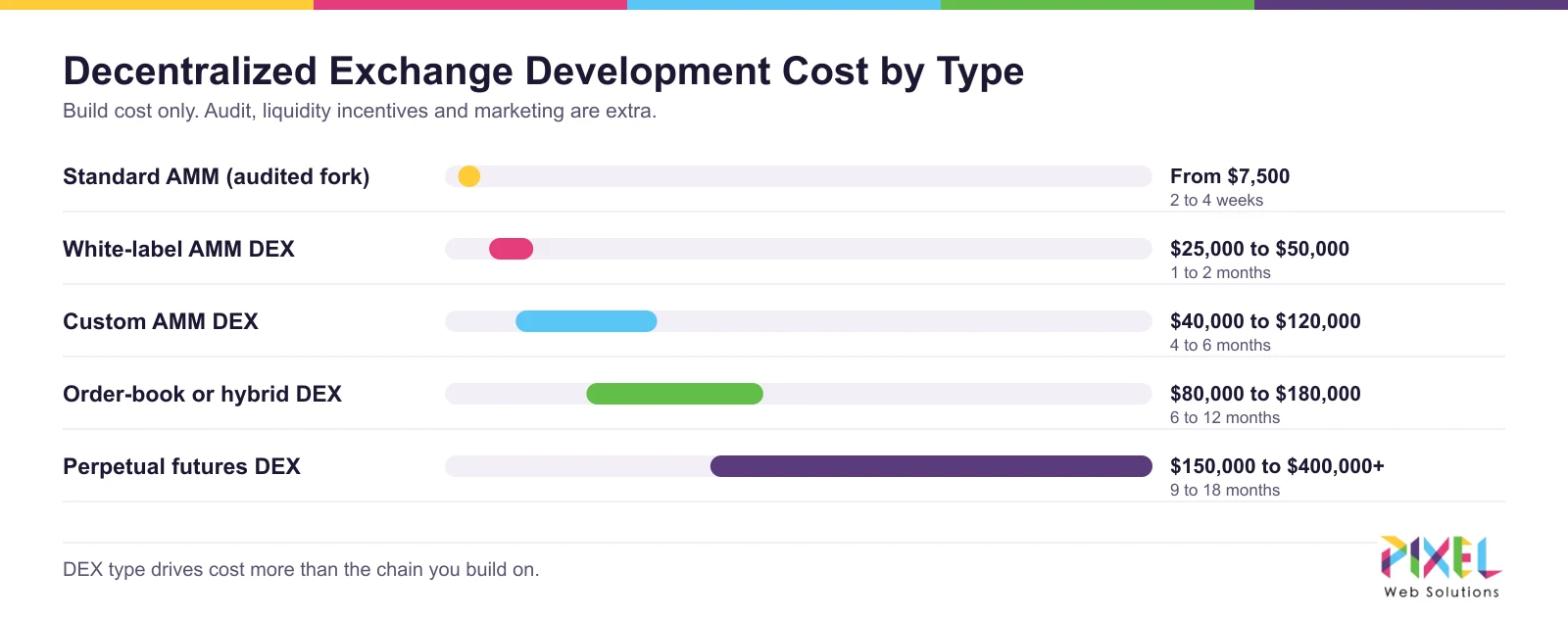
Cost Comparison: White-Label vs. Custom DEX Development
| Factor | White-label DEX | Custom DEX |
|---|---|---|
| Cost | $25,000 to $50,000 (from $7,500 for a standard fork) | $40,000 to $120,000+ |
| Development time | 2 to 6 weeks | 4 to 6 months |
| Customization | Branding, settings and selected modules | Any feature or trading model |
| Security | Built on tested code, still needs review of changes | Needs a full independent audit |
| Scalability | Scales within the software's design | Designed for your growth plans |
| Ideal for | Startups testing a market or chain | Established teams building a differentiated protocol |
Factors That Influence The Cost To Build a Decentralized Exchange
Decentralized Exchange Type
The DEX type is the biggest technical cost driver.
- AMM (automated market maker) DEX: users trade against liquidity pools priced by a formula. The simplest and most common design, used by Uniswap, PancakeSwap and Aerodrome.
- Order-book DEX: users place limit orders that are matched on-chain or on an app-specific chain. More complex, because matching must be fast, fair and verifiable.
- Hybrid DEX: off-chain order matching with on-chain settlement, combining exchange-like speed with self-custody. See hybrid crypto exchange development.
- Perpetual futures DEX: leveraged trading with margin, funding rates and liquidation engines. The most complex and expensive, as shown by Hyperliquid's success. See crypto derivatives exchange development.
- DEX aggregator: routes trades across many DEXs for the best price. Development starts around $6,000 on established patterns, with routing quality driving the ongoing work.
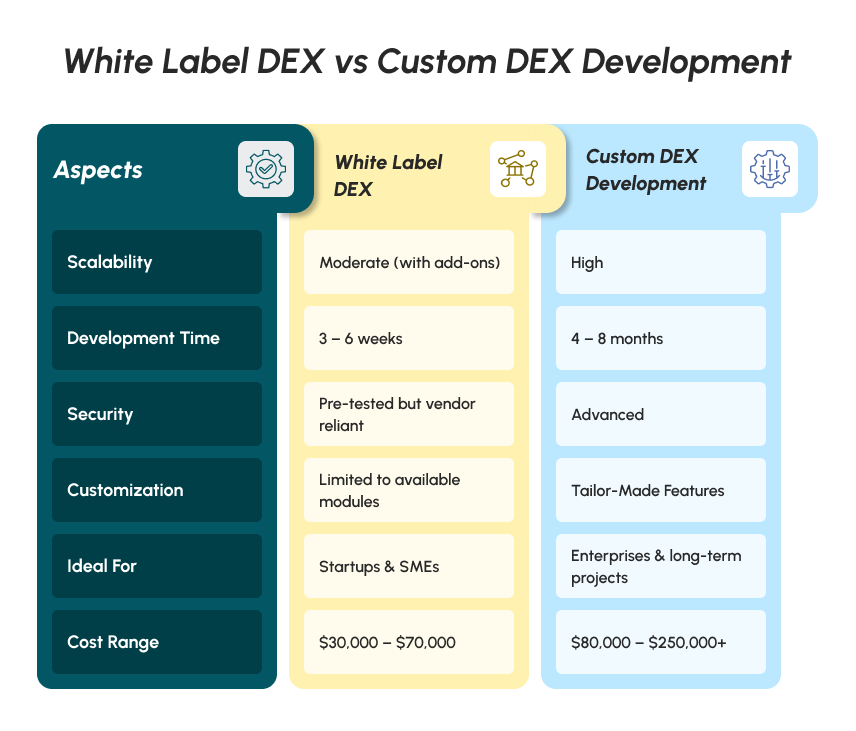
| DEX type | Typical development cost | Typical timeline |
|---|---|---|
| Standard AMM (audited fork) | From $7,500 | 2 to 4 weeks |
| White-label AMM DEX | $25,000 to $50,000 | 1 to 2 months |
| Custom AMM DEX | $40,000 to $120,000 | 4 to 6 months |
| Order-book or hybrid DEX | $80,000 to $180,000 | 6 to 12 months |
| Perpetual futures DEX | $150,000 to $400,000+ | 9 to 18 months |
Choice of Blockchain
Ethereum and its Layer-2 networks (Arbitrum, Base, Optimism), BNB Chain and Polygon share Solidity tooling, so EVM DEXs cost about the same to build on any of them. Solana DEXs are written in Rust and need specialist developers. Choose by where your users and liquidity are, not by advertised throughput.
Smart Contract Complexity
A simple swap-and-pool DEX needs a factory, pool, router and fee contracts. Farming, staking, governance, concentrated liquidity, hooks or cross-chain features add contracts, tests and audit scope. Every additional contract that holds funds raises both build and audit cost.
UI/UX Design
A basic swap page is inexpensive. A full trading experience with charts, portfolio tracking, pool analytics, farming and staking dashboards, and a polished mobile experience needs experienced designers and frontend developers.
Smart Contract Auditing
Independent audits are mandatory for any DEX that will hold real liquidity. Audit cost depends on the amount of new code: a fork with small changes needs a smaller review, while a custom DEX commonly costs tens of thousands of dollars to audit, and major protocols commission several audits plus contests.
Third-Party Integrations
- Price oracles such as Chainlink or Pyth for accurate pricing in lending, perps or limit orders
- Wallets such as MetaMask, Trust Wallet and WalletConnect-compatible wallets (see our list of the best DeFi wallets)
- Fiat on-ramps so users can buy crypto by card inside the DEX
- Indexers and analytics to power charts, pool statistics and dashboards
Regulatory Compliance
Permissionless protocols are treated differently from centralized exchanges, but the company operating a DEX front end, holding admin keys or charging fees may still face rules on sanctions screening, consumer protection and, in some countries, licensing. Budget for legal advice in your target markets from the start.
Technology Stack
| Layer | Common tools |
|---|---|
| Smart contracts | Solidity (EVM chains), Rust (Solana), Foundry, Hardhat |
| Frontend | React, Next.js, wagmi, viem, ethers.js |
| Backend and indexing | Node.js, The Graph or custom indexers, PostgreSQL |
| Infrastructure | RPC node providers or own nodes, cloud hosting, monitoring |
For the full picture of exchange technology, see our guide to the crypto exchange tech stack.
Complete Cost Breakdown To Build a Decentralized Exchange
Here is a worked estimate for a custom AMM DEX with swaps, liquidity pools, farming and an analytics dashboard, costed at three regional developer rates. It uses the same method and rates as our crypto exchange development cost guide, so the two can be compared directly.
| Module | Hours | India ($25/h) | Eastern Europe ($45/h) | US / W. Europe ($115/h) |
|---|---|---|---|---|
| Smart contracts (factory, pools, router, fees, farming) | 250 to 400 | $6,250 to $10,000 | $11,250 to $18,000 | $28,750 to $46,000 |
| Frontend (swap, pools, farms, charts) | 200 to 300 | $5,000 to $7,500 | $9,000 to $13,500 | $23,000 to $34,500 |
| Indexer, backend and APIs | 100 to 150 | $2,500 to $3,750 | $4,500 to $6,750 | $11,500 to $17,250 |
| Wallet, oracle and on-ramp integration | 60 to 100 | $1,500 to $2,500 | $2,700 to $4,500 | $6,900 to $11,500 |
| Admin and analytics dashboard | 60 to 100 | $1,500 to $2,500 | $2,700 to $4,500 | $6,900 to $11,500 |
| Testing and QA | 100 to 150 | $2,500 to $3,750 | $4,500 to $6,750 | $11,500 to $17,250 |
| Deployment and DevOps | 40 to 60 | $1,000 to $1,500 | $1,800 to $2,700 | $4,600 to $6,900 |
| Total | 810 to 1,260 | $20,250 to $31,500 | $36,450 to $56,700 | $93,150 to $144,900 |
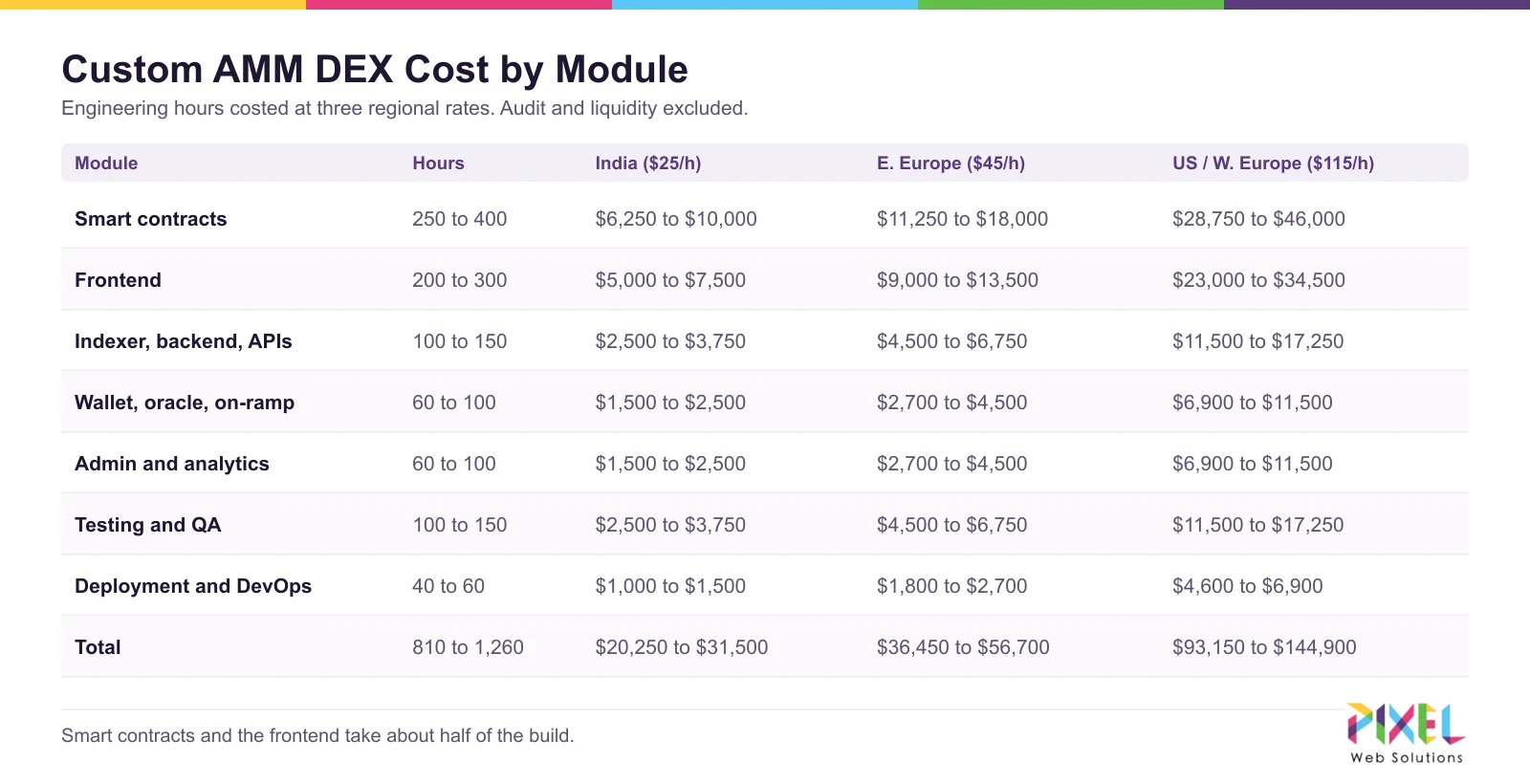
The audit, liquidity incentives and marketing are not included in these figures.
Cost Analysis Based on Feature Integration
Core DEX features include:
- Wallet connection and token swaps
- Liquidity pools and LP positions
- Liquidity mining (farming) and staking
- Token lists and new-pool creation
- Price charts and pool analytics
- An admin dashboard for fees, listings and incentives
Popular add-ons that increase cost:
- Cross-chain swaps and bridges
- Limit orders and DCA orders
- Fiat on-ramp integration
- Governance and voting
- A token launchpad
- Mobile apps
- Referral and loyalty programmes
- Gas sponsorship so users can trade without holding the native token
Each add-on adds contracts, integrations or interface work, and cross-chain features also add significant security risk.
Cost Estimation For Marketing & Branding
A DEX lives or dies by liquidity and users, so marketing is part of the build budget:
- Brand identity and website
- Community building on X, Telegram and Discord
- Liquidity incentives: token or fee rewards for early liquidity providers, often the largest launch cost
- Partnerships with token projects, wallets and aggregators so trades route through your pools
- Education and PR that explain why traders should switch
A small launch campaign can start at a few thousand dollars, but competitive launches on major chains spend far more, particularly on liquidity incentives.
Cost Breakdown for DEX Licensing
DEX licensing depends on how decentralized your platform really is and where you operate:
- Legal consultation on your structure, token and target markets
- Company setup for the entity that builds or operates the front end
- Sanctions screening and geo-blocking at the interface level
- Terms of use, privacy and risk disclosures
- Licensing, where your model or jurisdiction requires it (for example, if you run custodial features or offer derivatives)
Costs vary widely by jurisdiction, so get a legal estimate early rather than relying on a generic figure.
Hidden Costs That Influence DEX Development
Smart Contract Audit Revisions
Audits usually find issues. Fixing them takes developer time and often a re-review, which adds to the audit budget.
Liquidity Bootstrapping
Attracting the first liquidity providers usually requires incentives, and those rewards can exceed development costs in year one.
Third-Party Subscriptions
RPC providers, indexers, oracles, analytics and monitoring tools often charge monthly fees that grow with usage.
Node and Infrastructure Scaling
As volume grows, you need faster RPC access, more indexing capacity and better monitoring, especially during market peaks.
Bug Bounty Programmes
A bug bounty invites security researchers to report vulnerabilities for a reward. Payouts are unpredictable but far cheaper than an exploit.
Post-Launch Upgrades
User feedback, new chains, new pool types and interface improvements continue after launch and need ongoing development.
Step-By-Step Guide to Launch a DEX Platform
Roadmap Planning
Define your target users, chain, DEX type, revenue model and launch features.
Choice of Blockchain Network
Pick the chain where your users and liquidity already are, and confirm the tooling and audit options available.
Smart Contract Development
Build or adapt the pool, router, fee and incentive contracts, using audited patterns wherever possible.
DEX Platform Development
Build the interface, indexers, analytics and admin tools, and integrate wallets, oracles and on-ramps.
Security Auditing & Testing
Test on testnets and mainnet forks, commission an independent audit, fix every finding and set up a bug bounty.
DEX Launch
Launch with liquidity incentives and partner projects in place, monitor contracts closely and keep improving based on user feedback. Our step-by-step guide on how to build a decentralized exchange covers each stage in detail.
Why Pick Pixel Web Solutions To Develop a Decentralized Crypto Exchange?
Pixel Web Solutions is a decentralized exchange development company with more than 12 years of software experience. We build AMM, order-book, hybrid and perpetual DEXs on EVM chains and Solana, starting from audited patterns and customizing where your edge lies. We give you a clear cost breakdown up front, coordinate the audit and support you after launch. Exploring other DeFi models first? See our guide to DeFi business ideas. Talk to our sales team for a fixed quote.
Frequently Asked Questions
How much does it cost to build a DEX?
A standard AMM DEX based on audited contracts starts at $7,500, a white-label DEX costs $25,000 to $50,000 and a custom AMM DEX $40,000 to $120,000. Order-book and hybrid DEXs cost $80,000 to $180,000, and perpetual DEXs $150,000 to $400,000 or more.
How long does it take to build a decentralized exchange?
A standard fork can launch in two to four weeks, a white-label DEX in one to two months and a custom AMM DEX in four to six months. Order-book, hybrid and perpetual DEXs take six to eighteen months.
How much does it cost to build a decentralized marketplace?
It depends on what is traded. A white-label NFT marketplace MVP costs $20,000 to $60,000, a peer-to-peer crypto marketplace $30,000 to $80,000, and a DEX from $7,500 for a standard AMM to $120,000 for a custom build.
Is it cheaper to build a DEX or a centralized exchange?
A basic DEX is usually cheaper to build, because it needs no custody system, matching engine or KYC stack. A centralized exchange also needs licensing, banking and custody, which add significant costs. Complex DEXs such as perpetual exchanges can cost as much as a centralized exchange.
Do I need a licence to run a DEX?
It depends on your jurisdiction and how decentralized the platform is. Fully decentralized protocols are treated differently from custodial exchanges, but operating a front end, holding admin keys or offering derivatives can create regulatory duties. Get legal advice for your target markets.
How do DEXs make money?
Most DEXs earn a share of swap fees (the rest goes to liquidity providers), plus listing and launch services, premium features and partnerships. Uniswap V3 and V4 generated $204 million in trading fees in 30 days in September 2026.
Disclaimer: The cost figures in this blog are for information only and are not an official quote from Pixel Web Solutions. Actual pricing depends on your project's requirements and the services you choose. Contact our business team for a precise, customized quotation.