








The top DeFi trends of 2026 are stablecoins becoming the settlement layer of crypto ($303 billion in supply), tokenized real-world assets ($39 billion on-chain), perpetual DEXs, curated lending vaults, liquid staking and restaking, and on-chain prediction markets. They are growing even though total DeFi value locked fell from $168.9 billion on 9 October 2025 to $89.1 billion on 25 October 2026, according to DefiLlama.
Decentralized finance is a revolutionary concept that keeps bringing innovation to finance and other industries. In this transition, staying ahead of DeFi trends is essential for startups and enterprises. Over the last 12 months, DeFi protocols generated $23.7 billion in fees according to DefiLlama, so the opportunity is real. If you are planning a DeFi business, understanding the top DeFi trends is the key to success.
DeFi is not confined to one corner of crypto. It powers thousands of products, from stablecoin payments to tokenized treasury funds. DeFi trends change with market demand and users' needs, and 2026 has already shown which predictions were right and which were hype.
That is the angle of this guide. Instead of another list of predictions, Pixel Web Solutions has checked each trend against live on-chain data from DefiLlama and RWA.xyz, captured on 25 and 26 October 2026. You will see which DeFi trends are growing, which have cooled off, which protocols lead each one, what Reddit users are asking about DeFi in 2026, and where the business opportunities are now.
Key Takeaways
- DeFi shrank, its rails did not: total value locked fell 47% year on year to $89.1 billion, mostly because token prices fell, while USD stablecoin supply held at $303 billion, up 49% since January 2025.
- Stablecoins and RWAs are the two strongest trends: tokenized real-world assets reached $39.0 billion on RWA.xyz, held by 5.3 million addresses, with $14.6 billion in tokenized US Treasury products alone.
- Trading moved on-chain in new forms: perpetual DEXs led by Hyperliquid and prediction markets led by Polymarket and Kalshi now earn more fees than the whole lending category.
- Lending became professional: Aave V3 ($16.6 billion) and Morpho ($11.2 billion) dominate, with risk curators managing about $9.7 billion of vault deposits.
- Some 2025 trends cooled sharply: DeFi insurance holds $176 million, on-chain gaming about $1 million, and AI agent protocols earned under $1 million in fees in 30 days.
- Security and regulation set the pace: $2.37 billion was lost to 312 incidents in 2026 to date, and the UAE, EU and US all moved their rules in 2026.
The State of DeFi in October 2026: Key Numbers
Before looking at individual trends, here is the market they sit in. All figures are from DefiLlama's 25 October 2026 snapshot unless stated.
| Metric | October 2025 | October 2026 | What It Means |
|---|---|---|---|
| Total DeFi value locked | $168.9B (9 Oct 2025) | $89.1B (25 Oct 2026) | Down 47%, driven by lower token prices and the 10 October 2025 liquidation cascade |
| USD stablecoin supply | $301.2B (9 Oct 2025) | $303.4B | Flat year on year, but up 49% from $203.2B on 1 January 2025 |
| Tokenized RWAs (excluding stablecoins) | n/a | $39.01B | Ethereum holds $15.9B, BNB Chain $6.2B, Solana $4.9B (RWA.xyz) |
| DEX volume, last 30 days | n/a | $256B | About $3.36 trillion over the last 12 months |
| Protocol fees, last 30 days | n/a | $2.32B | $23.7B over the last 12 months |
| Hack losses, 2026 to 25 October | n/a | $2.37B | 312 incidents, the highest count DefiLlama has recorded in a year |
Sources: DefiLlama's TVL dashboard, DefiLlama stablecoins, DefiLlama DEX volumes, DefiLlama's hacks database and RWA.xyz.
The biggest single shock was 10 October 2025, when about $19 billion of leveraged positions were liquidated in 24 hours, as CoinGecko explains in its breakdown of the crash. DeFi TVL dropped from $169 billion to $148 billion in two days and kept falling to a low of $68.2 billion on 1 July 2026. It has since recovered about 31%, but it is still 22% below where it started 2026 ($114.4 billion on 1 January).
Top DeFi Protocols by TVL and Fees in October 2026
Most "top DeFi protocols" lists rank by value locked alone. Fees tell you who actually has customers, so here are both, from DefiLlama on 25 October 2026.
| Protocol | Category | TVL | Fees, last 30 days | Why it matters for the trends below |
|---|---|---|---|---|
| Lido | Liquid staking | $22.64B | $51.0M | Largest DeFi protocol by value (trend 5) |
| Aave V3 | Lending | $16.64B | $36.6M | Largest lending market, $643M in fees over 12 months (trend 4) |
| Morpho Blue | Lending | $11.23B | $22.6M | The base layer for curated vaults (trend 4) |
| Binance staked ETH | Liquid staking | $8.73B | $19.4M | Exchange-issued staking tokens now rival DeFi natives |
| EigenCloud | Restaking | $6.05B | $0.5M | Restaking has value but little fee income yet (trend 5) |
| Uniswap V4 | DEX | $1.53B | $60.3M | $32.8B of volume in 30 days on far less capital (trend 3) |
| Hyperliquid Perps | Derivatives | n/a (order book) | $78.1M | $866M in fees over 12 months, more than Aave (trend 3) |
| Polymarket US and International | Prediction market | $0.40B | $118.1M | The highest-earning non-stablecoin DeFi product in October 2026 (trend 6) |
| pump.fun | Launchpad | n/a | $64.1M | Token launchpads earned $156M as a category in 30 days |
| Tether and Circle (issuers) | Stablecoin | n/a | $735.5M | Reserve interest dwarfs every protocol fee line (trend 1) |
Two things stand out. First, stablecoin issuers, perps, prediction markets and launchpads, none of which existed as fee businesses at scale in 2021, now earn more than lending and DEX liquidity pools. Second, value locked and revenue are no longer the same ranking: Uniswap V4 earns more than Lido with 7% of its capital.
Top 10 DeFi Trends of 2026
Here are the top 10 DeFi trends of 2026 for launching a new business or upgrading an existing one, ranked by how strongly the data supports them.
- Stablecoins as the Settlement Layer
- Real-World Asset Tokenization
- Next-Generation DEXs: Perps, Hooks and Fee Switches
- Curated Lending Vaults and Institutional Lending
- Liquid Staking and Restaking
- On-Chain Prediction Markets
- Cross-Chain Interoperability
- Layer 2 Scaling and Cheaper Blockspace
- Compliance-Ready DeFi: Identity and Regulation
- AI-Based DeFi Solutions
Let us dive deeper into these top DeFi trends.
1. Stablecoins as the Settlement Layer
Stablecoins are the clearest DeFi trend of 2026. USD-pegged supply stood at $303.4 billion on 25 October 2026, up from $203.2 billion on 1 January 2025, according to DefiLlama. Tether's USDT ($182.5 billion) and Circle's USDC ($71.7 billion) lead, and Ethereum ($142.9 billion) and Tron ($94.0 billion) carry most of the supply. The two issuers earned $735 million in reserve income in the last 30 days, more than every DeFi protocol combined.
Regulation turned stablecoins from a crypto tool into payment infrastructure. The US GENIUS Act became law in July 2025, the OCC proposed its implementing rules in February 2026, and the Act takes effect on 18 January 2027 or 120 days after the final rules, whichever is earlier. The EU's MiCA rules apply in full. As a result, banks, fintechs and payment firms now issue or integrate stablecoins, and DeFi protocols use them as the base asset for almost every trade and loan.
Businesses can act on this DeFi trend for the following reasons:
- Stablecoins settle in minutes across borders, around the clock.
- Yield-bearing products built on stablecoins and treasuries give DeFi apps a dependable revenue base.
- Payment, payroll and treasury tools built on stablecoins have clear demand from businesses.
- Our guide on how to create a stablecoin covers the reserve, legal and technical steps.
2. Real-World Asset Tokenization
Real-world asset (RWA) tokenization bridges traditional and digital finance. It turns treasuries, private credit, real estate, commodities and fund shares into tokens that can be held, traded and used as collateral. With DeFi token creation and the right compliance layer, assets like real estate and gold can be tokenized and traded with far less friction.
The data backs this trend strongly. RWA.xyz counted $39.01 billion in tokenized real-world assets on 26 October 2026, held by 5.32 million addresses, a holder count up 10.6% in 30 days. Tokenized US Treasury products account for $14.65 billion, followed by commodities ($5.1 billion, mostly gold), tokenized stocks ($3.5 billion) and asset-backed credit ($2.9 billion). By platform, Securitize ($4.3 billion) and Ondo ($4.0 billion) lead; by asset manager, Tether ($3.0 billion), Franklin Templeton ($2.7 billion), BlackRock ($2.6 billion) and Circle ($2.4 billion) hold the most, per RWA.xyz's dashboards.
The following factors explain why RWA tokenization keeps attracting investment:
- Fractional ownership lowers the minimum ticket size for high-value assets.
- Tokenized treasuries pay a yield that tracks short-term US Treasury bills while staying usable in DeFi.
- Settlement is faster and cheaper than in traditional fund administration.
- Institutional demand is proven, but legal structure and custody still need care, so tokenization is not "low risk" by default.
Pixel Web Solutions builds these products through its RWA tokenization platform development service, and our guide to tokenized money market funds covers the treasury side in detail.
3. Next-Generation DEXs: What Is Coming to Platforms Like Uniswap (Perps, Hooks and Fee Switches)
Decentralized exchanges break the boundaries of centralized trading platforms, giving traders custody and control. Automated market makers (AMMs) solved the early liquidity problem, and Uniswap, PancakeSwap and Curve are still among the leading decentralized exchanges. DEXs handled about $256 billion in spot volume in the 30 days to 25 October 2026.
In 2026, three changes define the upcoming trends on platforms like Uniswap:
- Perpetual DEXs: on-chain perpetual futures now rival centralized exchanges. Hyperliquid alone earned $78.1 million in fees in 30 days and $866 million over 12 months, more than any lending protocol. Our ranking of the top perpetual DEXs by trading volume shows the full league table.
- Programmable pools: Uniswap V4 "hooks" let developers add custom logic, such as dynamic fees or limit orders, to a pool. Uniswap V4 processed $32.8 billion in 30 days and has overtaken V3 ($32.0 billion) for the first time.
- Fee switches: in December 2025, Uniswap governance passed the "UNIfication" proposal, switching on protocol fees that buy and burn UNI, and burned 100 million UNI from the treasury on 28 December 2025. Tokens now increasingly earn from real protocol revenue.
DEX businesses benefit from this DeFi trend because:
- Permissionless listing gives new tokens instant liquidity.
- Perps generate fees in both rising and falling markets.
- Hooks and custom pools let new DEXs compete on features, not just on incentives.
4. Curated Lending Vaults and Institutional Lending
Lending is DeFi's largest revenue engine after trading. Aave V3 holds $16.64 billion in value locked and Morpho $11.23 billion, according to DefiLlama's Morpho page. Lending protocols earned $117 million in fees in the last 30 days.
The 2026 twist is curation. Instead of one big pool, deposits now flow into vaults run by professional "risk curators" such as Steakhouse Financial ($2.6 billion), Sentora ($2.6 billion) and Gauntlet ($1.65 billion), which together with smaller curators manage about $9.7 billion on DefiLlama's risk curators page. Fintechs have also started to plug in: Coinbase launched Morpho-powered Bitcoin-backed loans in January 2025.
Why it matters for businesses:
- Curated vaults let fintechs offer yield without building a lending protocol themselves.
- Isolated markets limit the damage when one collateral asset fails.
- Real-world collateral, such as tokenized treasuries, is being accepted in lending markets.
Our DeFi lending platform development service covers the build for this model.
5. Liquid Staking and Restaking
Liquid staking lets users stake ETH or SOL and still use a token that represents the stake. It is DeFi's largest category by value at about $53 billion, led by Lido with $22.64 billion and Binance staked ETH with $8.73 billion. Restaking, which reuses staked assets to secure other networks, adds about $9.6 billion more, led by EigenCloud (formerly EigenLayer, $6.05 billion) and Babylon ($3.29 billion) for Bitcoin. Our ranking of the best DeFi staking platforms compares them by TVL and yield.
This trend shows both the upside and the risk of DeFi's interconnection. Restaked assets earn extra yield, but they also stack risks. The Kelp exploit of about $293 million in April 2026 showed how fast losses spread when one cross-chain layer fails.
Reasons this trend still matters:
- Staking yield is one of the few "native" yields in crypto: stETH paid 2.25% and JitoSOL 4.75% on 26 October 2026.
- Liquid staking tokens are the main collateral in Ethereum lending markets.
- Restaking lets new networks rent security instead of building a validator set from zero.
6. On-Chain Prediction Markets
Prediction markets are the breakout DeFi trend that few 2025 lists predicted. Users trade shares on the outcome of elections, sports and economic data. On DefiLlama's prediction market page, the category earned $127.8 million in fees in the last 30 days, with Polymarket's US and international platforms taking $118.1 million of it. Kalshi's regulated event contracts show $15.4 billion of 30-day volume in DefiLlama's trading data.
Why it is an opportunity:
- Event markets attract users who never traded crypto before.
- Fees come from every trade, with no token emissions needed.
- Regulated and offshore models both exist, so a business can choose its compliance path.
Our ranking of the top prediction market platforms compares Polymarket, Kalshi and the rest.
7. Cross-Chain Interoperability
DeFi now runs on dozens of chains, so moving assets and messages between them is a trend of its own. Cross-chain compatibility lets platforms access liquidity and users across networks. Many DeFi business ideas, including payments, lending and asset management, now depend on it.
Bridges and messaging layers hold about $62.9 billion on DefiLlama, with LayerZero V2 alone at $16.88 billion. Chainlink's CCIP and intent-based systems, where solvers fill a user's cross-chain order, are replacing older lock-and-mint bridges.
Enterprises looking for expansion can use this DeFi trend for the following reasons:
- Reaching users on several chains expands your market.
- Liquidity can be pooled instead of split across networks.
- Users get one experience instead of manual bridging.
- Bridges remain a top hack target: the Liquid Network ($320 million, September 2026) and Kelp ($293 million) losses were both cross-chain failures, so use proven messaging layers and audits.
8. Layer 2 Scaling and Cheaper Blockspace
Scalability was DeFi's main constraint until layer 2 networks and Ethereum's own upgrades arrived. Today, the cost problem is largely solved. Ethereum gas was about 0.04 gwei on 26 October 2026 with ETH at about $2,343, so a simple token transfer cost well under one cent, and Base, Arbitrum and other layer 2s cost a fraction of that.
Base holds $6.04 billion in DeFi value, more than BNB Chain ($5.80 billion), Solana ($5.76 billion) or Tron ($5.48 billion), according to DefiLlama's chain rankings. Hyperliquid's own L1 ($2.39 billion) has already passed Arbitrum ($1.47 billion). The trend now is less about raw speed and more about where users and liquidity are.
Here are the reasons why scaling still shapes DeFi businesses:
- Low fees make small payments, games and micro-trades viable.
- Faster confirmation improves the user experience.
- L2s give startups Ethereum security and tooling at low cost.
9. Compliance-Ready DeFi: Identity and Regulation
Traditional identity solutions rely on centralized storage, which is vulnerable to breaches. Decentralized identity solutions let users prove facts about themselves, such as passing KYC, without sharing all their data. In 2026, this matters because regulation has reached DeFi.
The rules changed fast:
- UAE: the new Central Bank law (Federal Decree Law No. 6 of 2025), in force since 16 September 2025, brought DeFi activity under CBUAE licensing where it facilitates regulated financial services, with a one-year transition that ended in September 2026. Dubai's VARA and Abu Dhabi's ADGM FSRA regulate virtual asset firms in their zones.
- EU: MiCA is fully applicable, and the transition period for existing crypto firms ended in July 2026.
- US: the GENIUS Act covers payment stablecoins. The CLARITY Act, which would set wider market structure rules, passed the House in July 2025 but failed a Senate cloture vote 49 to 50 on 15 September 2026, so US market structure rules remain unsettled going into 2027.
Decentralized identity and compliance tooling is a business opportunity because:
- Permissioned pools let institutions use DeFi with verified counterparties.
- Reusable KYC credentials cut onboarding costs.
- Compliance by design reduces regulatory risk for founders.
- It works across DeFi applications such as lending, RWAs and payments.
10. AI-Based DeFi Solutions
Artificial intelligence and DeFi are converging in agents that monitor positions, rebalance portfolios and execute trades. AI-based DeFi solutions are designed for risk monitoring, fraud detection and automation, and they can reduce human error.
The data says this trend is still early. DefiLlama's "AI Agents" category holds about $31 million in value and earned about $0.9 million in fees in the last 30 days, compared with $2.32 billion across all of DeFi. That is a small market today, which means early builders face less competition but also unproven demand.
AI-powered DeFi solutions are still worth watching for the following reasons:
- Agents can automate repetitive strategies, such as rebalancing and liquidation protection.
- AI-driven risk models can warn users before positions become unsafe.
- Agent-to-agent payments using stablecoins are a natural fit for DeFi rails.
DeFi Trends That Cooled Off: A Reality Check
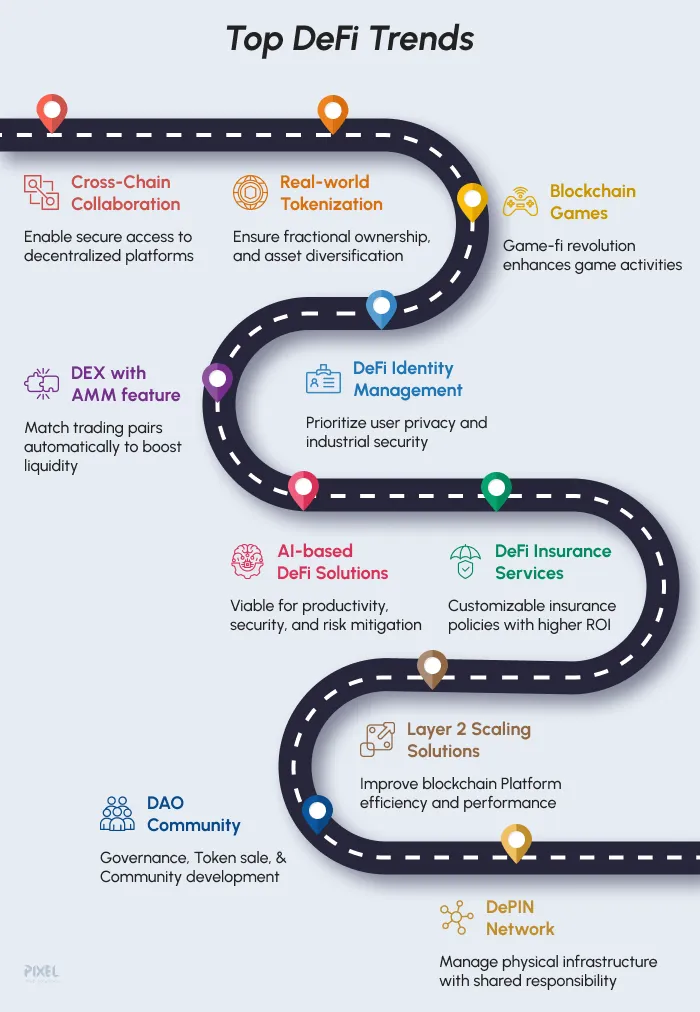
Several trends that appeared on 2025 lists, including the earlier version of this article, have not delivered at scale. Here is how they score against the data on 25 October 2026.
| 2025 Prediction | Data on 25 October 2026 | Verdict |
|---|---|---|
| Blockchain games and play-to-earn | DefiLlama's Gaming category holds about $1 million in value locked and earned $0.6 million in 30 days | Cooled. Forecasts such as "$314 billion by 2030" have not shown up on-chain. |
| DeFi insurance | $176 million in value locked, with Nexus Mutual at $96 million, about 0.2% of DeFi TVL | Niche. Cover exists, but few users buy it. |
| DAOs as a business trend | Governance still matters (Uniswap's fee switch passed by DAO vote) | Mature. A feature of protocols, not a business on its own. |
| DePIN | Growing in specific networks, but small in DeFi value terms | Early. Judge each network on its own revenue. |
| AMM DEXs | Still the base of on-chain trading | Evolved into perps, hooks and fee switches (trend 3). |
DAOs still play a key governance role, and Pixel Web Solutions builds decentralized autonomous organizations for projects that need on-chain voting and treasury control. The point is simply that a DAO alone is no longer a trend to build a business around.
The Biggest Risk in 2026 DeFi: Security and Exploits
Every DeFi trend above depends on smart contracts and infrastructure holding real money. DefiLlama's hacks database records 312 incidents and $2.37 billion lost in 2026 to 25 October, already more incidents than in all of 2025 (148 incidents, $2.72 billion including the $1.4 billion Bybit theft). The first half cost about $986 million across 166 incidents, which matches Immunefi's H1 count of 207 hacks and $972 million as covered by The Block. The third quarter was worse at about $1.25 billion.
The largest 2026 cases show where the risk sits:
- Bitget, 24 September 2026, about $387.5 million: a compromised backend system spoofed transaction data to drain exchange hot wallets, Bitget confirmed. Not a smart contract bug, but a reminder that centralized key infrastructure fails too.
- Liquid Network, September 2026, about $320 million: an unbacked cross-chain mint.
- Drift, April 2026, about $295 million: a proxy upgrade hijack, and Kelp, April 2026, about $293 million: cross-chain message spoofing, both attributed to North Korea-linked attackers by Blockaid.
- Ledger supply chain, October 2026, about $93 million: a front-end and software supply chain attack.
The pattern has shifted from pure code bugs to key management, upgrade controls, bridges and front ends. For founders, this means budgeting for audits, bug bounties, monitoring, multisig and timelock controls, and incident response from day one, not as an afterthought.
Is DeFi Still a Serious Long-Term Play in 2026? What Reddit Users Ask
The r/defi threads that rank for "DeFi trends" in 2026 ask the same five questions. Here are plain answers from the data above.
Is DeFi still a serious long-term play, or is it fading?
It is serious, but it has changed shape. Value locked is down 47% in a year, yet fees held at $23.7 billion over 12 months, stablecoin supply is 49% higher than at the start of 2025, and tokenized RWAs grew to $39 billion with 5.3 million holders. The parts of DeFi that behave like financial infrastructure (stablecoins, treasuries, lending, perps, prediction markets) are growing. The parts that depended on token emissions and rising prices are not.
Which DeFi protocols are best for passive income in 2026?
The honest answer is that yields are modest and roughly track interest rates. On 26 October 2026, DefiLlama's yield data showed stETH at 2.25%, Binance's WBETH at 2.19%, Rocket Pool's rETH at 1.82%, USDC on Aave V3 at 3.78%, USDT on Aave V3 at 3.42%, Sky's sUSDS at 3.80%, Steakhouse's curated USDC vault on Morpho at 4.58%, Ethena's sUSDe at 5.11% and JitoSOL at 4.75%. Anything advertising far above those figures is paying you in a token that may lose value, or is taking a risk you are not being shown. Stick to protocols with years of audits, deep liquidity and transparent revenue, and never put passive income money into a bridge-dependent product you do not understand.
How do people actually evaluate DeFi protocols in 2026?
Experienced users look at five things, in this order: fee revenue rather than TVL (does the protocol earn without emissions?), the ratio of value locked to revenue, audit history and bug bounty size, who controls the upgrade keys and the time delay on upgrades, and how long the protocol has survived volatile markets. The table of top protocols above uses the first two measures, and the analytics platforms below give you the rest.
Where can I learn DeFi properly in 2026?
Start with the free dashboards: DefiLlama for TVL, fees, yields and hacks, and RWA.xyz for tokenized assets. Read the official docs of Aave, Uniswap and Lido, which explain the mechanics better than most courses. Then follow fee data and governance forums rather than price charts. For builders, our guides on DeFi use cases and DeFi business ideas explain how each model earns.
Are the latest DeFi trends a "financial dystopia" risk for ordinary people?
The fear is understandable: leverage, hacks and opaque tokens have hurt retail users. Two things cut against the dystopia reading in 2026. First, the fastest-growing trends (stablecoins, tokenized treasuries, regulated prediction markets) are the most transparent and most regulated parts of crypto. Second, the GENIUS Act, MiCA and the UAE's Central Bank law pulled issuers and service providers under supervision. The genuine risk is leverage and unaudited code, so the practical advice is to avoid high leverage and new, unaudited protocols.
Best DeFi Analytics Platforms in 2026 to Track These Trends
You cannot follow DeFi trends without data, and the figures in this article all come from free public tools. These are the analytics platforms worth using in 2026:
| Platform | Best for | Cost |
|---|---|---|
| DefiLlama | TVL, fees, revenue, DEX and perps volume, stablecoins, yields, hacks and raises, all open source | Free, with a paid API tier |
| RWA.xyz | Tokenized treasuries, private credit, commodities and stocks by issuer, chain and holder count | Free |
| Dune | Custom SQL dashboards over raw on-chain data for any protocol | Free tier, paid plans |
| Token Terminal | Financial statements for protocols: revenue, earnings, user and token metrics | Free tier, paid plans |
| Nansen | Wallet labelling and smart money flows | Paid, limited free tier |
| Artemis | Chain-level activity, stablecoin flows and developer data | Free tier, paid plans |
For a founder, DefiLlama and RWA.xyz answer the "is this trend real?" question, Dune and Token Terminal answer "how does this protocol make money?", and Nansen answers "who is using it?".
DeFi Innovations and Future Trends: What Comes After 2026
Looking past the current list, four DeFi innovations are likely to shape 2027 and beyond.
- Stablecoin rails inside banks and fintechs. With GENIUS Act rules taking effect by January 2027 and MiCA fully in force, expect more bank-issued stablecoins and more payment apps that settle on-chain without showing users a wallet.
- Tokenized stocks and funds as DeFi collateral. Tokenized equities already hold $3.5 billion on RWA.xyz. The next step is using them as collateral in lending markets and as pairs on perps DEXs, which turns DeFi into a 24-hour venue for traditional assets.
- Exchanges that are chains. Hyperliquid runs its own L1 with $2.39 billion in DeFi value, and other trading venues are following. The line between "DEX" and "layer 1" is blurring.
- Agents as users. AI agent protocols are tiny today, but stablecoin payments between software agents are a natural fit. Watch fee data, not announcements, to see when this becomes real.
New DeFi Trends, New Opportunities: Why You Shouldn't Miss Out
Decentralized finance keeps evolving to meet user demand. For businesses to stay innovative, following the best DeFi trends is essential. Here are the reasons to explore further.
Adapting to Market Demands
DeFi users prefer products that solve real problems. Building on a trend with proven demand, such as stablecoin payments or tokenized treasuries, is safer than chasing a narrative.
Figure out the Best Profitability
Profits define whether a business can last. Trends with clear fee income, such as perps, lending and prediction markets, give a DeFi business revenue that does not depend on token emissions.
Enhance User Trust and Branding
Businesses always strive to deliver user-centric services that are transparent and secure. Choosing compliance-ready DeFi trends earns user trust while keeping your brand credible with regulators and partners.
Upgrade Business Efficiency and Promises
Modern DeFi tooling, from curated vaults to L2 deployment, lets you launch faster and run leaner. Innovation in the best DeFi trends can lift your business's operational efficiency.
Planning for Risk Mitigation
Crypto markets are volatile, and the 10 October 2025 crash proved it. DeFi businesses need risk plans such as conservative collateral settings, audits, monitoring and insurance funds. Following the right DeFi trend helps you plan for those risks.
How Much Does It Cost to Build on These DeFi Trends?
Here is what it costs to act on the main DeFi trends with Pixel Web Solutions' published starting prices:
| Product | Trend | Starting Price |
|---|---|---|
| DeFi protocol | Lending, staking, yield | from $6,000 |
| DEX (standard AMM) | Next-generation DEXs | from $7,500 |
| DeFi lending platform | Curated lending | $5,000 to $25,000 |
| DeFi wallet | All trends | from $5,000 |
| Prediction market | Prediction markets | from $7,000 |
| RWA single-asset issuance | RWA tokenization | from $6,000 |
| RWA platform MVP | RWA tokenization | $25,000 to $50,000 |
| Stablecoin | Stablecoins | $30,000 to $100,000 |
Custom builds with multichain deployment, advanced risk engines or regulatory licensing cost more, and audits are budgeted separately.
So far we have seen the top DeFi trends of 2026 and the data behind each one. To get started with any of them, you need a token, a platform and an experienced team. A DeFi development company can guide you through the build and deliver a solution tailored to your business needs.
Take a Right Turn to Your DeFi Business
Pixel Web Solutions is a leading DeFi development company that builds DeFi platforms, applications and tokens to client requirements. Its blockchain experts write and test smart contracts across Ethereum, Solana, BNB Chain, Base and other networks, and design tokens that fit the DeFi trend you choose.
The team follows a streamlined process from idea gathering to deployment, with developers, test engineers and a business team supporting every stage. Still have questions? Talk to the team and get started with the top DeFi trends of 2026.
Frequently Asked Questions
What are the top DeFi trends in 2026?
The top DeFi trends in 2026 are stablecoins as the settlement layer, real-world asset tokenization, perpetual DEXs, curated lending vaults, liquid staking and restaking, on-chain prediction markets, cross-chain interoperability, cheaper layer 2 blockspace, compliance-ready DeFi and AI-based DeFi tools.
Is DeFi still growing in 2026?
It depends on the measure. Total value locked is down 47% from October 2025 to $89.1 billion, mainly because crypto prices fell. But stablecoin supply ($303 billion), tokenized RWAs ($39 billion) and protocol fees ($23.7 billion over 12 months) show that DeFi usage is holding up.
What are the best DeFi trends to build a business on?
The best DeFi trends for a business are the ones with fee revenue that does not depend on token prices: stablecoin payments and treasury tools, tokenized treasuries and funds, perpetual DEXs, curated lending vaults and prediction markets. Each earned tens of millions of dollars in fees in October 2026 on DefiLlama.
What are the upcoming trends in decentralized finance platforms like Uniswap?
Three: programmable pools through Uniswap V4 hooks, which processed $32.8 billion in 30 days; fee switches that route protocol revenue to token buybacks and burns, live on Uniswap since December 2025; and the merging of spot DEXs with perpetual futures, where Hyperliquid earned $78 million in 30 days.
What is the biggest risk in DeFi right now?
Infrastructure and key security more than pure smart contract bugs. About $2.37 billion was lost to 312 incidents in 2026 to 25 October, and the largest cases (Bitget, Liquid Network, Drift, Kelp, Ledger) were backend compromises, cross-chain failures, upgrade hijacks and supply chain attacks. Leverage is the second risk, as the $19 billion liquidation on 10 October 2025 showed.
How is DeFi regulated in the UAE?
DeFi activity that facilitates regulated financial services can now fall under the Central Bank of the UAE's licensing regime under Federal Decree Law No. 6 of 2025, after a one-year transition that ended in September 2026. Virtual asset firms are licensed by VARA in Dubai and by ADGM's FSRA in Abu Dhabi. Founders should take local legal advice before launching.
Which DeFi analytics platforms are best in 2026?
DefiLlama for TVL, fees, yields and hacks; RWA.xyz for tokenized assets; Dune for custom on-chain dashboards; Token Terminal for protocol financial statements; Nansen for wallet flows; and Artemis for chain-level activity. All but Nansen have useful free tiers.
What is the future of DeFi?
The future of DeFi looks less like a separate crypto economy and more like the back end of finance: stablecoins for payments, tokenized assets for investment, and on-chain markets for trading. The winners in the top DeFi trends will be the products with real fee revenue, strong security and a clear compliance path.