









The top DeFi use cases in 2026 are decentralized exchanges, lending and borrowing, stablecoins, staking, aggregators, yield farming, asset tokenization, DAOs, DeFi wallets, DeFi tokens, insurance and gaming. The proven ones handle real money every day: DEXs traded $302 billion in the 30 days to 9 October 2026, stablecoin supply reached $312 billion, and $91.6 billion was locked in DeFi protocols, according to DefiLlama.
Picturing a world of digital finance without middlemen or waiting for approval is no longer hard. Every transaction is settled in seconds, on a public ledger, at any hour. What made this possible?
Decentralized Finance, or DeFi, platforms are the backend infrastructure behind it. Instead of quoting market-research forecasts, this guide uses live on-chain data. As of 9 October 2026, DefiLlama tracks $91.6 billion locked in DeFi protocols, down from a peak of about $171 billion in October 2025 because token prices fell, while DeFi protocols still earned $23.7 billion in fees over the last 12 months. Usage held up even when prices did not.
DeFi platforms not only promise innovation but also deliver real-world applications. Below, each of the top 12 DeFi use cases comes with its leading example, live figures, and a verdict on how proven it is. But first, let's look at the basics of decentralized finance.
Key Takeaways
- Trading and lending are the proven DeFi use cases: DEXs handled about $3.56 trillion in volume over 12 months, and Aave V3 alone holds $17.3 billion.
- Stablecoins are the base layer: supply reached $312.4 billion in October 2026, and the US GENIUS Act and EU MiCA now regulate them.
- Tokenized real-world assets are the fastest-growing use case: $39 billion is on-chain, including $14.95 billion in tokenized US Treasury funds.
- Some use cases are still niche: DeFi insurance holds just $108 million at its leader, and on-chain gaming barely registers in value locked.
- New use cases are earning real fees: perpetual DEXs and prediction markets now out-earn most lending protocols.
- Security is the biggest risk: about $972 million was lost to 207 hacks in the first half of 2026, so audits are part of every DeFi use case.
What is Decentralized Finance? An Overview
Decentralized finance is a financial system built on public blockchains, where smart contracts replace banks, brokers and clearing houses. Anyone with a wallet can trade, lend, borrow or earn without asking for approval, and every transaction is recorded on-chain for anyone to verify. In the digital landscape, DeFi platforms offer these services to crypto users worldwide, around the clock.
Three building blocks make every DeFi use case work:
- Smart contracts: code that holds funds and executes the rules, such as a loan's collateral ratio or a swap's price.
- Liquidity pools and automated market makers (AMMs): pools of tokens that let users trade without an order book.
- Oracles: services that bring outside data, such as asset prices, onto the blockchain.
DeFi vs Traditional Finance at a Glance
| Factor | DeFi | Traditional Finance |
|---|---|---|
| Custody | Users hold their own assets in a wallet | Banks and brokers hold assets for you |
| Access | Anyone with a wallet and internet | Account approval, documents, minimum balances |
| Settlement | Seconds to minutes, 24/7 | Hours to days, business days only |
| Transparency | Every transaction is public on-chain | Records are private to the institution |
| Main risks | Smart contract bugs, hacks, volatility | Counterparty failure, fees, slow access |
In the next section, we have listed the popular DeFi use cases of 2026.
Real-World DeFi Use Cases In 2026
Various DeFi platforms are transforming financial services with greater transparency and speed. This list of the top 12 DeFi use cases explores the innovations of the decentralized world, each with live figures from 9 October 2026.
Decentralized Exchange
The decentralized exchange, or DEX, is the most used DeFi use case. Unlike centralized crypto exchanges, a DEX works without a third party holding user funds. Traders swap directly from their wallets through smart contracts, and the trade settles on-chain in seconds.
Many startups are interested in building a DEX platform with unique features. Revenue can be generated through trading fees, protocol fees, listing services and premium tools.
Unique Feature: Users keep custody of their assets until the moment of the trade, which removes the risk of an exchange freezing or losing their funds. Smart contract risk remains, so audits are essential.
Success Rate: DEXs processed about $302 billion in the 30 days to 9 October 2026, per DefiLlama's DEX volume dashboard. Uniswap is still the leader, with its V4 and V3 contracts handling about $84.7 billion between them in that period.
DeFi Lending & Borrowing Platforms
As cryptocurrencies have become a mainstream investment, many holders want to borrow against them instead of selling. This is the role of DeFi lending & borrowing platforms. Users deposit crypto to earn interest, and borrowers take over-collateralized loans against their assets.
Unlike traditional lending, a DeFi loan does not need a credit check or days of approval. The loan is available within minutes, as long as the borrower posts enough collateral.
Unique Feature: Smart contracts automate the entire loan process, including interest rates and liquidations when collateral value falls, with every position visible on-chain.
Success Rate: Aave V3 holds about $17.3 billion in value locked, according to DefiLlama's Aave V3 page, making it the largest lending protocol. Morpho follows with about $11.2 billion, and lending protocols together hold roughly $52.8 billion.
DeFi Aggregators
DeFi aggregators combine liquidity, prices and routes from many DEXs in a single interface. Instead of checking each exchange, the user gets the best available route, often split across several pools. This is especially useful for larger trades, where splitting reduces slippage.
These platforms offer features like multi-chain support, gas optimization, limit orders and protection against front-running.
Unique Feature: DeFi aggregators remove complexity for users by finding the best price across dozens of liquidity sources automatically.
Success Rate: 1inch, the best-known aggregator on Ethereum, routed about $3.2 billion in the 30 days to 9 October 2026, while Jupiter, Solana's leading aggregator, routed about $14.9 billion, per DefiLlama's aggregator data.
DeFi Staking Platforms
DeFi staking platforms let users lock crypto assets to help secure a proof-of-stake network or a protocol, and earn rewards as passive income. Regardless of location, users can stake their cryptocurrencies.
Staking has evolved into flexible models. Liquid staking lets users stake assets while keeping liquidity through a derivative token, such as Lido's stETH, which can then be used as collateral elsewhere in DeFi.
Unique Feature: Users can track their staking activity and token rewards in the platform's interface, and liquid staking tokens can be used in other DeFi apps at the same time.
Success Rate: Lido is the largest of the DeFi staking platforms, with about $24.35 billion staked on 9 October 2026, per DefiLlama's Lido page. Liquid staking as a category holds about $57 billion, making it DeFi's largest category by value.
DeFi Tokens
Creating DeFi tokens remains one of the core DeFi use cases in 2026. DeFi tokens give users a role in a protocol: governance votes, a share of fees, staking rights or access to features. They are an integral tool for interaction within a platform's community.
The strongest DeFi tokens in 2026 are tied to real protocol revenue rather than hype. Meme coins are a separate category and should not be confused with DeFi tokens.
Unique Feature: DeFi tokens are widely used as governance tokens, letting holders vote on upgrades, fees and treasury spending.
Success Rate: In December 2025, Uniswap governance passed its "UNIfication" proposal, switching on protocol fees that are used to burn UNI. That links the token directly to the exchange's trading revenue. (A correction to an earlier version of this article: Dogecoin is a 2013 meme coin on its own blockchain, not a DeFi token.)
DeFi Gaming Platforms
Gaming is one of the longest-running ideas in Web3, and DeFi adds tradable in-game assets and token rewards. Players can own items as tokens or NFTs, trade them, and in some games earn tokens for playing.
Unique Feature: Crypto gamers get true ownership of in-game assets, which they can sell outside the game.
Success Rate: This use case has cooled. DefiLlama's gaming category holds only about $1 million in value locked, and play-to-earn models largely failed after 2022. The activity that remains is in asset trading: Guild of Guardians Heroes on Immutable recorded about $1.05 million in NFT sales in the week to 3 October 2026, according to CryptoSlam data reported by crypto.news. Our verdict: build gaming only around a game people want to play, not around token rewards.
DAO Platforms
Decentralized Autonomous Organizations, or DAOs, give DeFi protocols a way to make decisions without a central company. Token holders propose and vote on changes, and the result is executed on-chain. This is where DAO development plays a crucial role in the crypto market.
Users who own the platform's native token have voting and governance rights. Key proposals cover protocol upgrades, fee structures, and treasury management. That makes DAO tooling a core part of most DeFi use cases in 2026, rather than a standalone business.
Unique Feature: DAO platforms are transparent and flexible, with every vote and treasury payment recorded on-chain.
Success Rate: The Uniswap DAO governs the Uniswap protocol, and its December 2025 vote to turn on the fee switch shows DAOs making real financial decisions.
Stable Coin Trading
Stablecoins hold a stable value, usually pegged 1:1 to the US dollar, so DeFi users can trade, lend and pay without volatility. Most are backed by cash and short-term government bonds held in reserve, while some are backed by crypto collateral.
Stablecoins also help people in regions with high inflation hold dollar value, and they settle cross-border payments in minutes. Buying, holding and building on stablecoins is now the base layer of nearly every DeFi use case.
For More Details, Check out our Related Article
What Are Stablecoins And How Do They Work?
Unique Feature: Stablecoins are used for DeFi trading, lending collateral, remittances, payroll and merchant payments.
Success Rate: Total stablecoin supply reached about $312.4 billion on 9 October 2026, per DefiLlama's stablecoin dashboard. Tether's USDT ($184.1 billion) and Circle's USDC ($73.1 billion) lead. Regulation has caught up: the US GENIUS Act became law in July 2025, and the EU's MiCA rules apply in full.
DeFi Wallets
Non-custodial DeFi wallets are the entry point to every DeFi use case. Users who want to hold their crypto without a third party choose these wallets, and connect them to DEXs, lending apps and NFT marketplaces.
In 2026, wallets are getting easier to use. Ethereum's EIP-7702, live since the Pectra upgrade in May 2025, lets ordinary wallets act like smart accounts, with batched transactions and gas paid in stablecoins.
Unique Feature: DeFi wallets offer multi-asset support, cross-chain access and built-in swaps, staking and dApp connections.
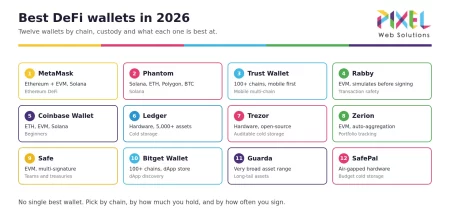
Success Rate: MetaMask on Ethereum and Phantom on Solana are among the most widely used DeFi wallets, and both now include built-in swaps, so the wallet itself has become a revenue-earning DeFi product.
DeFi Yield Farming
DeFi yield farming platforms let users earn by supplying liquidity or moving assets between protocols to capture the best returns. In return, the protocols get the liquidity they need.
Yield farming has matured since the "farm and dump" days of 2020 to 2021. Today most yield comes from trading fees, lending interest and tokenized Treasury income rather than new token emissions.
Unique Feature: Users can earn yield from several sources at once. Advertised APYs are variable, not guaranteed, and high yields usually mean high risk.
Success Rate: Pendle, which lets users trade future yield, holds about $1.2 billion on DefiLlama's Pendle page. Curated lending vaults managed by professional "risk curators" hold another $9.4 billion, which shows where yield seekers have moved.
DeFi Insurance
Similar to traditional insurance, DeFi insurance protocols let users buy cover against smart contract hacks, stablecoin de-pegs and exchange failures. Smart contracts and member votes handle underwriting, claims assessment, and payouts.
Unique Feature: The DeFi insurance platform gives users a way to protect crypto assets against specific risks, with claims and payouts recorded on-chain.
Success Rate: Nexus Mutual is the leading DeFi insurance protocol, with about $108 million in capital on DefiLlama's Nexus Mutual page. DeFi insurance as a whole holds about $122 million, roughly 0.13% of DeFi value locked. Cover exists, but few users buy it, so this use case is still niche.
Asset Tokenization Platforms
Asset tokenization platforms turn real-world assets (RWAs) such as government bonds, private credit, real estate, commodities and gold into tokens. Each token represents fractional or full ownership of the underlying asset, making these assets accessible and tradable within the DeFi ecosystem.
Unique Feature: Fractional ownership lets users buy a small part of a high-value asset, and tokenized Treasuries can be used as collateral in DeFi while still paying interest.
Success Rate: RWA.xyz counted $39.02 billion in distributed tokenized assets on 9 October 2026, including $14.95 billion in tokenized US Treasury funds led by Ondo ($2.9 billion), Franklin Templeton's Benji ($2.6 billion), Circle ($2.4 billion) and Securitize ($2.3 billion), per RWA.xyz's Treasury dashboard. Pixel Web Solutions builds these products through its RWA tokenization platform development service.
These are the popular DeFi use cases of 2026 that are reshaping finance. They have emerged as strong DeFi business opportunities, offering revenue prospects for established entrepreneurs and new startups.
4 Emerging DeFi Use Cases Gaining Ground in 2026
Several DeFi use cases that most 2025 lists missed are now earning more than some of the classics above. Our analysis of the top DeFi trends of 2026 covers them in more depth.
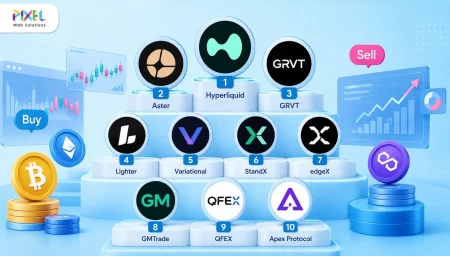
- Perpetual DEXs: on-chain perpetual futures let traders take leveraged positions without a centralized exchange. Hyperliquid alone earned $87.8 million in fees in 30 days, more than any lending protocol, per DefiLlama's Hyperliquid page. Perpetual DEX development is the most complex DeFi build, with a full order book, liquidation engine and oracle setup.
- Prediction markets: users trade on the outcome of elections, sports and economic data. Prediction markets earned $112.9 million in fees in 30 days on DefiLlama, with Polymarket taking $104.5 million of it.
- Stablecoin payments and settlement: businesses now use stablecoins for cross-border payments and card settlement. Visa reported a $3.5 billion annualized stablecoin settlement run rate by November 2025, using USDC on Solana for US banks.
- Flash loans: uncollateralized loans that must be borrowed and repaid in the same transaction. They power arbitrage, collateral swaps and liquidations, but they are also a common tool in exploits, so protocols must be designed to resist them.
DeFi Use Case Scorecard: October 2026
Most DeFi use case lists treat every idea as equally promising. They are not. Here is how each use case scores on live data, so you can see which ones have proven demand and which are still early.
| DeFi Use Case | Live Figure (9 Oct 2026) | Leader | How It Earns | Verdict |
|---|---|---|---|---|
| Decentralized exchange | $302B volume in 30 days | Uniswap | Swap fees, protocol fees | Proven |
| Lending and borrowing | $17.3B at Aave V3 | Aave | Interest spread | Proven |
| Stablecoins | $312.4B supply | Tether, Circle | Reserve yield | Proven |
| Staking | $24.35B at Lido | Lido | Share of staking rewards | Proven |
| Asset tokenization | $39.02B on-chain RWAs | Ondo, BlackRock, Franklin Templeton | Management and issuance fees | Fast growing |
| Aggregators | $14.9B routed in 30 days at Jupiter | Jupiter, 1inch | Routing fees, positive slippage | Proven |
| Yield farming and vaults | $9.4B with risk curators | Morpho curators, Pendle | Performance fees | Growing |
| DeFi wallets | Built-in swaps in leading wallets | MetaMask, Phantom | Swap and bridge fees | Proven |
| DAOs | Governance of most major protocols | Uniswap DAO | None directly | Mature feature |
| DeFi tokens | Value now tied to fee switches | UNI | Fee share, buybacks | Selective |
| Insurance | $108M at Nexus Mutual | Nexus Mutual | Cover premiums | Niche |
| Gaming | About $1M value locked | n/a | Asset trading fees | Cooled |
Sources: DefiLlama, RWA.xyz and DefiLlama's fees dashboard.
Advantages Of Creating A DeFi Platform For Your Business
A wide range of benefits is available to startups and established businesses that create a DeFi platform. Some of them are listed below.
Revenue Generation
DeFi platforms earn from transaction fees, interest spreads, protocol fees and premium services. The best revenue models in 2026 come from real usage, such as trading and lending, rather than token emissions.
Global Accessibility
Unlike traditional financial platforms, DeFi platforms can be used by anyone with a wallet. There are few geographical or institutional barriers to trading, staking, lending, or paying, although businesses must still respect local regulations and sanctions rules.
Higher Security and Transparency
Every transaction is recorded on a public blockchain, which makes activity auditable in real time. Security still has to be earned: about $972 million was lost to 207 hacks in the first half of 2026, according to Immunefi's report as covered by The Block. Audits, bug bounties and monitoring are part of every serious DeFi build.
Financial Inclusion
DeFi platforms offer financial services to anyone with an internet connection. People who are unbanked or underbanked can save in stablecoins, send money across borders and access credit against their assets.
Interoperability
DeFi platforms can interact with each other and with apps on other blockchains. A lending protocol can accept a liquid staking token as collateral, and bridges can move assets between chains. This composability helps platforms scale and grow their ecosystems.
Due to these business benefits, many startups are interested in creating a DeFi platform. The next question is what it costs.
How Much Does It Cost to Build a DeFi Use Case?
Here are Pixel Web Solutions' published starting prices for the DeFi use cases above:
| DeFi Product | Pixel Web Solutions Price |
|---|---|
| DeFi protocol (lending, staking, yield) | from $6,000 |
| DEX (standard AMM) | from $7,500 |
| Custom DEX | $40,000 to $120,000 |
| DeFi lending platform | $5,000 to $25,000 |
| DeFi wallet | from $5,000 |
| Stablecoin | $30,000 to $100,000 |
| RWA single-asset issuance | from $6,000 |
| Prediction market | from $7,000 |
Audits, liquidity and licensing are budgeted separately. For a full breakdown by app type, see our guide on how much it costs to build a DeFi app.
Why Choose Pixel Web Solutions For DeFi Platform Development?
As an established DeFi development company in the crypto market, Pixel Web Solutions is known for its DeFi development services. Its team offers end-to-end DeFi development solutions, including DEX creation, lending protocols, staking platforms, DeFi wallets and tokenization, built to your business requirements.
Pixel Web Solutions partners with you from business ideation to launch without compromising quality, with audited smart contracts and a clear compliance path. With a track record of helping startups grow into established businesses, it helps your DeFi project stand out from the competition.
Ready to build one of these DeFi use cases? Talk to the Pixel Web Solutions business team today.
Frequently Asked Questions
What Are The Real-World DeFi Use Cases?
The main real-world DeFi use cases are decentralized exchanges, lending and borrowing, stablecoins, staking, aggregators, yield farming, asset tokenization, DAOs, DeFi wallets, insurance and gaming. Newer ones include perpetual DEXs, prediction markets and stablecoin payments. They let people trade, borrow and earn without intermediaries.
How Can Businesses Benefit From DeFi?
Businesses can use DeFi to settle payments in stablecoins, earn yield on idle treasury funds, access alternative financing, automate transactions with smart contracts and offer token-based loyalty programs. It opens new revenue models while reducing costs and dependence on traditional banks.
What Is the Most Popular DeFi Use Case?
By volume, decentralized exchanges are the most popular DeFi use case, with about $302 billion traded in the 30 days to 9 October 2026. By value held, liquid staking and lending are the largest, with about $57 billion and $53 billion locked respectively.
Is DeFi Still Growing in 2026?
It depends on the measure. Total value locked fell to $91.6 billion in October 2026, mainly because crypto prices dropped. But stablecoin supply ($312 billion), tokenized real-world assets ($39 billion) and protocol fees ($23.7 billion over 12 months) show that DeFi use cases are still in heavy use.
Is DeFi Legal?
DeFi is legal in most countries, but specific activities can be regulated. Stablecoins fall under the GENIUS Act in the US and MiCA in the EU. In the UAE, DeFi activity that facilitates regulated financial services can fall under the Central Bank of the UAE, while VARA in Dubai and ADGM's FSRA in Abu Dhabi license virtual asset firms. Businesses should take legal advice before launching.
Is DeFi Safer Than a Traditional Bank?
Not automatically. DeFi removes the risk of an institution freezing or misusing your funds, but it adds smart contract and hack risk, and there is usually no deposit insurance. Using audited, long-running protocols and spreading risk are the best protections.
The top DeFi use cases in 2026 are the ones backed by real usage and real fees. Choose a proven DeFi use case, build it securely, and your platform will have demand from day one.