








The cost to create a BEP20 token in 2026 is $1,000 to $10,000 for development with Pixel Web Solutions, depending on features, plus an industry range of about $3,000 to $10,000 if you commission an independent audit of a simple token. Deploying the token on BNB Smart Chain costs only a few cents: at the network's 0.05 gwei gas price on 6 November 2026, even a full-featured contract cost about $0.08, and creating a PancakeSwap pool about $0.12.
BEP20 tokens have been on the market since BNB Smart Chain launched in 2020, and demand for feature-rich BEP20 tokens is still high. Low transaction fees, fast confirmations and full Ethereum compatibility make the standard a practical choice for utility, reward and community tokens. So anyone planning a token asks the same question: what is the cost of creating a BEP20 token?
This blog answers it with real numbers. We measured the gas used by real token deployments, priced them with live BNB Smart Chain gas and CoinGecko data, and then broke down the development, audit, legal and launch costs that make up the rest of the budget. You will also find practical ways to optimise the cost of a feature-rich, efficient BEP20 token.
Key Takeaways
- Development is the main cost: Pixel Web Solutions builds BEP20 tokens for $1,000 to $10,000, depending on features and customisation.
- Deployment costs cents, not dollars: at 0.05 gwei and BNB at $688.06, a basic token cost $0.02 to deploy and a full-featured token $0.08 on 6 November 2026.
- Your holders pay tiny fees too: BscScan priced a BEP-20 transfer at $0.002 and a swap at $0.007 on the same day.
- Audit and liquidity are the lines to plan for: an audit of a simple token runs about $3,000 to $10,000 across the industry, and your PancakeSwap liquidity is capital you must provide yourself.
- Binance Smart Chain is now BNB Smart Chain, with 0.45 second blocks since the Fermi hard fork in January 2026.
What Makes BEP20 Tokens a Good Choice for Businesses?
BEP20 is the fungible token standard of BNB Smart Chain (BSC), the smart contract network of BNB Chain. It mirrors Ethereum's ERC20 standard, so BEP20 tokens work with the same wallets, tools and code libraries. Here is why businesses keep choosing it.
Minimal Gas Fees
BNB Smart Chain's gas price sat at 0.05 gwei on 6 November 2026, both on BscScan's gas tracker and from a public node. A sample of 1,287 recent transactions had a median of 0.052 gwei. At that price, BscScan estimated a BEP-20 token transfer at $0.002 and a swap at $0.007. That makes BEP20 tokens well suited to frequent trading, micropayments and reward programmes.
High Transaction Speed
BNB Smart Chain now produces a block every 0.45 seconds. The Fermi hard fork, activated on 14 January 2026, cut the block interval from 0.75 seconds. Our own check of the last 200,000 blocks on 6 November 2026 confirmed an average of 0.450 seconds. Older guides that quote 3 second blocks are out of date.
Lower Network Congestion
Short blocks and a high gas limit give BNB Smart Chain plenty of room, so fees stay low even during busy periods. The network is also simpler than it used to be: BNB Beacon Chain, the second chain in the old "dual chain" design, was retired through the BNB Chain Fusion upgrade, with its validator nodes shut down on 3 December 2024.
Better Liquidity
BNB Smart Chain held $5.15 billion in DeFi total value locked on 6 November 2026, the fourth-largest of any chain after Ethereum, Base and Solana, according to DefiLlama. Deep DEX liquidity, especially on PancakeSwap, gives new BEP20 tokens many trading pairs to join.
DeFi Growth and Interoperability
BNB Smart Chain powers numerous decentralised applications, including DEXs, lending platforms and launchpads. Because it runs the Ethereum Virtual Machine, BEP20 tokens can use the same tooling, bridges and audit practices as Ethereum tokens.
With all these factors, BEP20 tokens are a practical asset for business use. Your use case decides the features, the development process and ultimately the cost to create a BEP20 token, so let us look at those factors in detail.
Factors Influencing the Cost of Creating a BEP20 Token
Here are the important factors that influence the cost of BEP20 token creation.
- Smart Contract Complexity
- Hiring A Development Team
- Feature Selection
- UI/UX Design
- Security And Legal Obligations
- Token Quantity and Distribution
- Testing And Deployment
- Maintenance And Upgrades
Getting clear insights into these factors will widen your understanding of the cost of BEP20 token creation.
1. Smart Contract Complexity
The complexity of the smart contract has the biggest effect on the cost of creating a BEP20 token. A contract with the standard functions, such as transfer and approve, is quick to build and test. Custom logic such as staking, vesting, transfer taxes or anti-bot rules needs more programming, more tests and a longer audit, which raises the cost.
2. Hiring a Development Team
Freelancers can look like the cheapest option, but there is no guarantee on quality, testing or completion, and a flawed contract cannot be edited once it is live. Hiring professional experts is the safer choice. The team's location, experience and whether audit support is included all affect the price.
3. Features Selection
A BEP20 token with basic features such as minting, burning, balance checks and transfers costs the least. Business tokens often need more: transfer taxes, trading limits at launch, pause controls, blacklists for compliance or permit signatures. Each added feature increases the cost of creating a BEP20 token.
4. UI/UX Design
The token contract itself has no interface, but most launches need one around it: a landing page, a claim or vesting portal, a staking dashboard or a presale page. Simple pages cost little. Custom dashboards with animation and wallet integration take more design and front-end work.
5. Security and Legal Obligations
Smart contract auditing and other security measures protect holders and your reputation. If you sell the token to the public, the law also applies: in the EU, most public token offers need a MiCA white paper, and in the US the SEC and CFTC's March 2026 token taxonomy decides whether a sale involves a security. Security and legal work add a separate line to the cost to create a BEP20 token.
6. Token Quantity and Distribution
The size of your supply does not change the cost: minting one million or one billion tokens costs the same gas. What does cost more is distribution. Airdrops to thousands of wallets, vesting contracts for the team and investors, and liquidity allocations each add development work and on-chain transactions.
7. Testing and Deployment
Testing ensures the token is free from functional errors and works as intended. It uses the BSC testnet, where test BNB is free from the official faucet, plus automated test suites and manual review. Deployment itself costs only cents, as the next section shows.
8. Maintenance And Upgrades
BEP20 tokens created for business purposes need ongoing care: monitoring, community support, and new contracts for features such as staking. If your contract is upgradeable, each upgrade needs testing and review. All of this affects the long-term cost of BEP20 token creation.
These are the factors with the strongest link to the cost of BEP20 token creation. Now let us put numbers on them.
What Is the Cost to Create a BEP20 Token? The Full Budget
Pixel Web Solutions' BEP20 token development costs $1,000 to $10,000, depending on complexity, features and customisation. Here is how the full budget breaks down.
| Cost component | Typical cost | Notes |
|---|---|---|
| Standard BEP20 token (mint, burn, transfer, ownership) | Lower end of Pixel's $1,000 to $10,000 range | Audited template, tested and deployed |
| Custom BEP20 token (taxes, anti-bot, vesting, pause, blacklist) | Upper end of Pixel's $1,000 to $10,000 range | More code, tests and review |
| Staking, governance or cross-chain features | Quoted separately | Extra contracts and a larger audit |
| Smart contract audit, simple token | About $3,000 to $10,000 | Industry range, not a Pixel price; Pixel quotes audits after a scope review |
| Deployment gas | $0.02 to $0.08 | Measured at 0.05 gwei on 6 November 2026 |
| PancakeSwap pool creation gas | About $0.12 | Your liquidity capital is extra |
| Legal review | Quoted per jurisdiction | Needed if you sell the token |
| Marketing and listings | Variable | Depends on launch goals |
The range is wide because no two tokens are the same. The final price depends on your business type and requirements. To get an exact figure, share your token specification with our team through our contact page, WhatsApp or Telegram, and we will send a fixed quote.
How Much Does It Cost to Deploy a BEP20 Token? Gas Fees in 2026
The deployment fee follows one formula: gas used × gas price × BNB price. We read the gas used by real, verified OpenZeppelin token deployments and priced them at BNB Smart Chain's gas price and BNB's CoinGecko price of $688.06 on 6 November 2026.
| Token build | Gas used | At 0.05 gwei (6 Nov 2026) | At 0.10 gwei | At 1 gwei (20x stress test) |
|---|---|---|---|---|
| Basic token | 614,722 | $0.021 | $0.042 | $0.42 |
| Burnable + Pausable + Ownable | 801,341 | $0.028 | $0.055 | $0.55 |
| Token + Permit | 920,389 | $0.032 | $0.063 | $0.63 |
| Full-featured (5 extensions) | 2,307,412 | $0.079 | $0.16 | $1.59 |
| PancakeSwap V2 pool creation + first liquidity | 3,464,188 | $0.12 | $0.24 | $2.38 |
Gas for token builds is taken from verified deployment receipts; the PancakeSwap figure is from addLiquidityETH transactions that created new pairs on BNB Smart Chain, read on 27 September 2026. Gas used does not change with price, so the dollar columns are repriced for 6 November 2026.
The maths for the full-featured token: 2,307,412 gas × 0.05 gwei = 115,371 gwei, or 0.000115 BNB. At $688.06 per BNB, that is $0.079.
Even a complete launch day, deploying a full-featured token and creating its PancakeSwap pool, used about 5.8 million gas, or roughly $0.20 at 0.05 gwei. The network fee is simply not a meaningful part of the budget any more. The liquidity you deposit in the pool is, and so are development, audit and marketing.
BEP20 vs ERC20: Why the Fees Are So Different
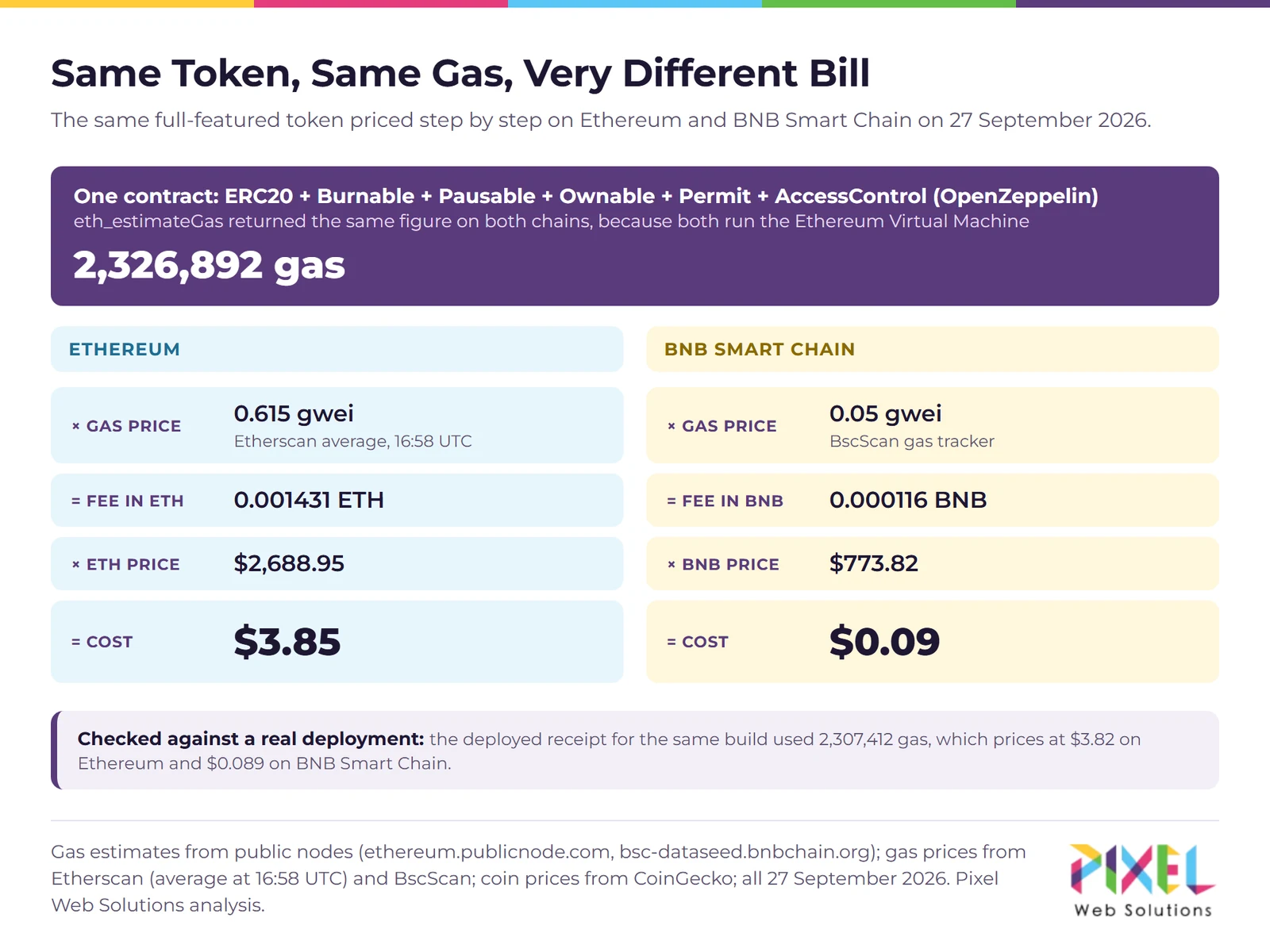
BNB Smart Chain runs the same virtual machine as Ethereum, so identical code uses identical gas. We asked public nodes on both networks to estimate the same full-featured token deployment, and both returned 2,326,892 gas. The difference comes only from the price of gas and the price of the coin that pays for it.
The diagram above uses prices from 27 September 2026, and the gap has narrowed since. On 6 November 2026, that token cost about $0.08 to deploy on BNB Smart Chain and about $0.69 on Ethereum, at Etherscan's average gas price of 0.133 gwei and ETH at $2,232. Ethereum gas moves far more than BNB Smart Chain's, so check both on the day you deploy. For the Ethereum side of the comparison, see our guide to the cost to create an ERC20 token. If you also want to compare Tron, our guide on how to create a TRC20 token covers that network.
BEP20 Gas Fee, Network Fee and Transaction Fee for Your Holders
After launch, every transfer, swap and approval your holders make pays a small network fee in BNB. "Gas fee", "network fee" and "transaction fee" all mean this same charge. On 6 November 2026, BscScan's gas tracker estimated:
- BEP-20 token transfer: $0.002
- Swap: $0.007
- Add or remove liquidity: $0.006
Low fees are one reason BEP20 suits reward points, in-app currencies and micropayments. They also mean that an exchange's BEP20 withdrawal fee is mostly the exchange's own charge. Exchanges set their withdrawal fees themselves, and they are usually much higher than the network fee shown on BscScan.
BEP20 vs TRC20 vs ERC20 Transfer Fees
Here is what one token transfer cost on each network on 6 November 2026.
| Network | Transfer fee | How it is worked out |
|---|---|---|
| BEP20 (BNB Smart Chain) | $0.002 | BscScan's gas tracker estimate |
| ERC20 (Ethereum) | About $0.02 | About 65,000 gas × 0.133 gwei × ETH at $2,232 |
| TRC20 (Tron) | About $2.15 for USDT | 64,285 energy at 100 sun, plus about 345 bandwidth at 1,000 sun, or 6.77 TRX at $0.318 |
The Tron figure assumes the sender burns TRX, which is what happens when staked energy and bandwidth do not cover the cost. Senders who stake TRX or rent energy pay less, and a transfer to a wallet that has never held USDT uses roughly twice the energy. So BEP20 is the cheaper of the two for a holder with no setup, but a high-volume Tron user can narrow the gap.
BEP20 Token Transfer Tax Is Not a Network Fee
A transfer tax is a rule you write into your own token contract, such as sending a set percentage of each trade to a treasury wallet. It is separate from gas, and your holders pay it on top. A tax adds development and audit work, may break some DEX routes and wallets that assume the amount sent equals the amount received, and is a common red flag for buyers when the owner can change it. If you use one, cap it in the code and disclose it.
How to Create a BEP20 Token: Steps and What Each One Costs
If you are planning to create a BEP20 token, here is the process in order, with the cost of each step.
- Define the token's purpose and tokenomics: supply, allocation, vesting and any taxes. This is planning time, included in a development quote.
- Write the contract on an audited template: OpenZeppelin's ERC20 contracts work unchanged on BNB Smart Chain. This is the main development cost.
- Test on the BSC testnet: test BNB comes free from the official faucet.
- Audit the contract: about $3,000 to $10,000 for a simple token as an industry range. Pixel's smart contract audit services quote after a scope review.
- Deploy to BNB Smart Chain mainnet: $0.02 to $0.08 in gas at November 2026 prices.
- Verify the source code on BscScan: free, and it builds trust with buyers.
- Create a liquidity pool on PancakeSwap: about $0.12 in gas, plus your liquidity capital.
- Move ownership and treasury to a multisig wallet: a few small transactions that protect holders from a single compromised key.
To build a DEX of your own rather than list on one, see our guide on how to build a DEX like PancakeSwap.
How to Optimize the Cost of Creating a BEP20 Token?
You can limit the cost with a plan that balances your requirements against the work needed. Here are the components of a strategic approach.
- Efficient Smart Contract Coding: clean code compiled with the Solidity optimiser uses less gas for deployment and for every holder transaction.
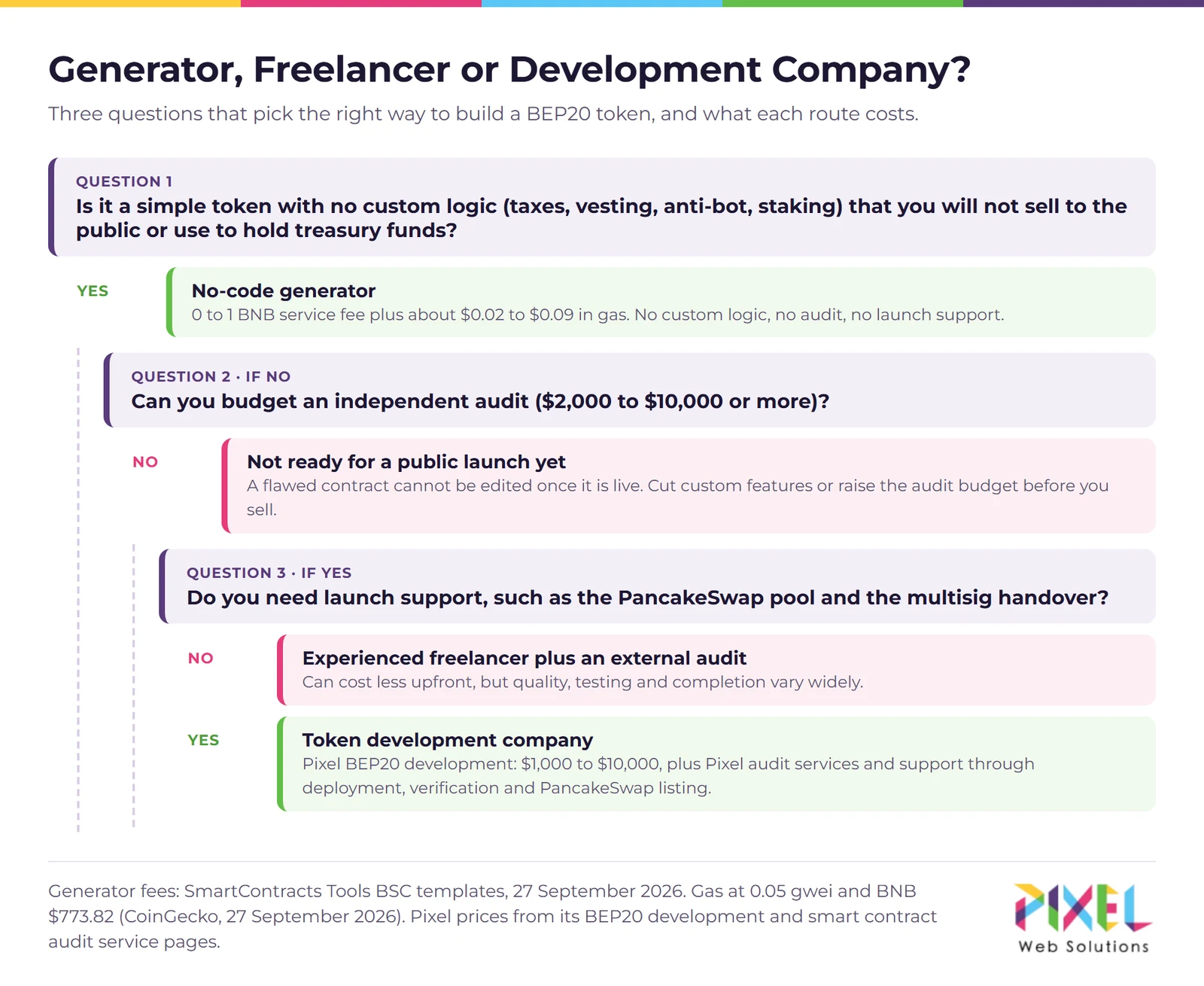
- Choose the Right Development Method: stick with the approach that fits your goals and budget. A no-code generator suits a simple community token; a business token with custom rules needs a professional team.
- Selection of Best Tech Stacks and Tools: use audited OpenZeppelin contracts, Hardhat or Foundry for testing, and the BSC testnet before mainnet.
- Automated Security Checks: run static analysis tools such as Slither during development. They catch common bugs early and make the manual audit faster and cheaper, though they do not replace it.
- Be smart in feature selection: include only the features your business needs. Checking established BEP20 token designs, such as those in our BEP20 tokens list, helps you choose.
- Conduct thorough market Analysis: spend time understanding your users and competitors before you create a BEP20 token, and plan your marketing budget alongside development.
By following these steps, you can control the development and operational costs of your BEP20 token. The real challenge is balancing technical quality, security and budget, and that is where an experienced BEP20 Token Development Company earns its fee. A team of blockchain experts can recommend the most cost-effective design and give you a precise estimate of the cost to create a BEP20 token.
Your Destination for Affordable BEP20 Token Creation
Pixel Web Solutions is a leading BEP20 Token Development Company in the crypto space. We are a team of blockchain experts who create crypto tokens for diverse business use cases. With more than 12 years of industry presence, we have helped many founders launch their crypto businesses. Our experience in crypto token development helps you minimise the cost of creating a BEP20 token for personal and business purposes.
We build on audited OpenZeppelin foundations, test on the BSC testnet, and support you from idea gathering to deployment, verification and PancakeSwap listing. We also create meme coins and tokens on Ethereum, Polygon, Tron and Solana.
So why wait when you have already arrived at the right destination for low-cost BEP20 token creation? Talk to our team today.
Frequently Asked Questions
How much does it cost to create a BEP20 token?
With Pixel Web Solutions, BEP20 token development costs $1,000 to $10,000, depending on features. Add about $3,000 to $10,000 for an independent audit of a simple token (an industry range), and a few cents in gas. For a wider view across chains, see our guide to the cost to create a crypto token.
What is the gas fee to deploy a BEP20 token?
On 6 November 2026, BNB Smart Chain gas was 0.05 gwei. A basic token cost about $0.02 to deploy and a full-featured token about $0.08, with BNB at $688.06.
Can I create a BEP20 token for free?
Not quite. Some no-code generators offer a free basic template, while others charge a service fee in BNB. You still pay the network gas, and you get no custom logic, audit or launch support.
Is a BEP20 token generator enough for a real project?
A generator is fine for a simple fixed-supply community token, and it takes minutes. It falls short once you need custom taxes, vesting, staking or a public sale, because you cannot add logic after deployment and nobody has audited your exact setup. Read the generated contract before you deploy, and check whether the generator keeps any admin rights.
What is the BEP20 network?
"BEP20 network" is the name exchanges and wallets use for BNB Smart Chain, the chain where BEP20 tokens live. It is a separate blockchain from Ethereum and Tron, and its network fees are paid in BNB. Our BEP20 token list explains the standard in more detail.
Why do exchanges charge more to withdraw USDT on BEP20 than the network fee?
Exchanges set their own withdrawal fees to cover operating costs and hot wallet management. The on-chain fee for a BEP-20 transfer was about $0.002 on 6 November 2026, so most of any higher withdrawal fee is the exchange's charge, not the network's.
Is Binance Smart Chain the same as BNB Smart Chain?
Yes. Binance Smart Chain is the network's former name. It is now called BNB Smart Chain (BSC) and is part of BNB Chain. BEP20 is its token standard.
How long does it take to create a BEP20 token?
According to Pixel's BEP20 service page, development takes from a few days to a few weeks, depending on features and integrations. Add time for an external audit if you commission one.
In short, the cost to create a BEP20 token in 2026 is almost entirely development, audit, liquidity and marketing. Gas is a rounding error, so spend your budget where it protects and grows your token.
Disclaimer: The cost figures shared in this blog are intended solely for informational purposes and do not reflect an official quote from Pixel Web Solutions. Network fees are measured at the date shown and change constantly. Actual pricing will vary based on your project's specific requirements and the services you choose. For a precise and customized quotation, we encourage you to connect with our business team directly.