Table of Contents
There is an EU AI Act obligation that applies to every organisation in Ireland deploying AI, regardless of risk tier, sector or size, and most have not met it. Article 4 requires organisations to ensure a sufficient level of AI literacy among staff who work with or oversee AI systems. It has been in force since February 2025. It is not a high-risk rule, and there is no exemption for small deployments. Any assessment of the AI consulting companies in Ireland should start by asking which of them raises this unprompted.
This guide ranks the top 10 AI consulting companies in Ireland for 2026 on regulatory capability, delivery model, sector depth and fit for different buyer sizes.
Ireland's position is unusual and it shapes the whole market. It is the only English-speaking country in the EU after Brexit, which has made it the European headquarters for a large share of US technology companies. Those Irish operations frequently host European product, regulatory, trust, legal, operations and EMEA leadership functions, which means the entity buying AI consulting in Dublin is often making a decision for an entire continent rather than one country.
The regulatory architecture arrived accordingly. Ireland designated 15 national competent authorities in September 2025 and established a national single point of contact within the Department of Enterprise, Tourism and Employment. Rather than create one AI regulator, Ireland adopted a distributed enforcement model built on existing sectoral bodies, with the Central Bank covering financial services and equivalent regulators covering their domains. The AI Office of Ireland, Oifig Intleachta Shaorga na hÉireann, was established as a statutory independent body by 2 August 2026, acting as central coordinator, single point of contact and host of the national regulatory sandbox. The Regulation of Artificial Intelligence Bill 2026 was initiated in June 2026 as the technical implementing measure.
The same date, 2 August 2026, brought Annex III high-risk obligations into effect. Annex I high-risk obligations follow on 2 August 2027.
Against this, the returns are poor. MIT's NANDA initiative found 95 percent of generative AI pilots produced no measurable P&L impact, and Deloitte found 91 percent of European organisations increasing AI investment while only 13 percent achieved ROI within the first year.
Top 10 AI Consulting Companies in Ireland
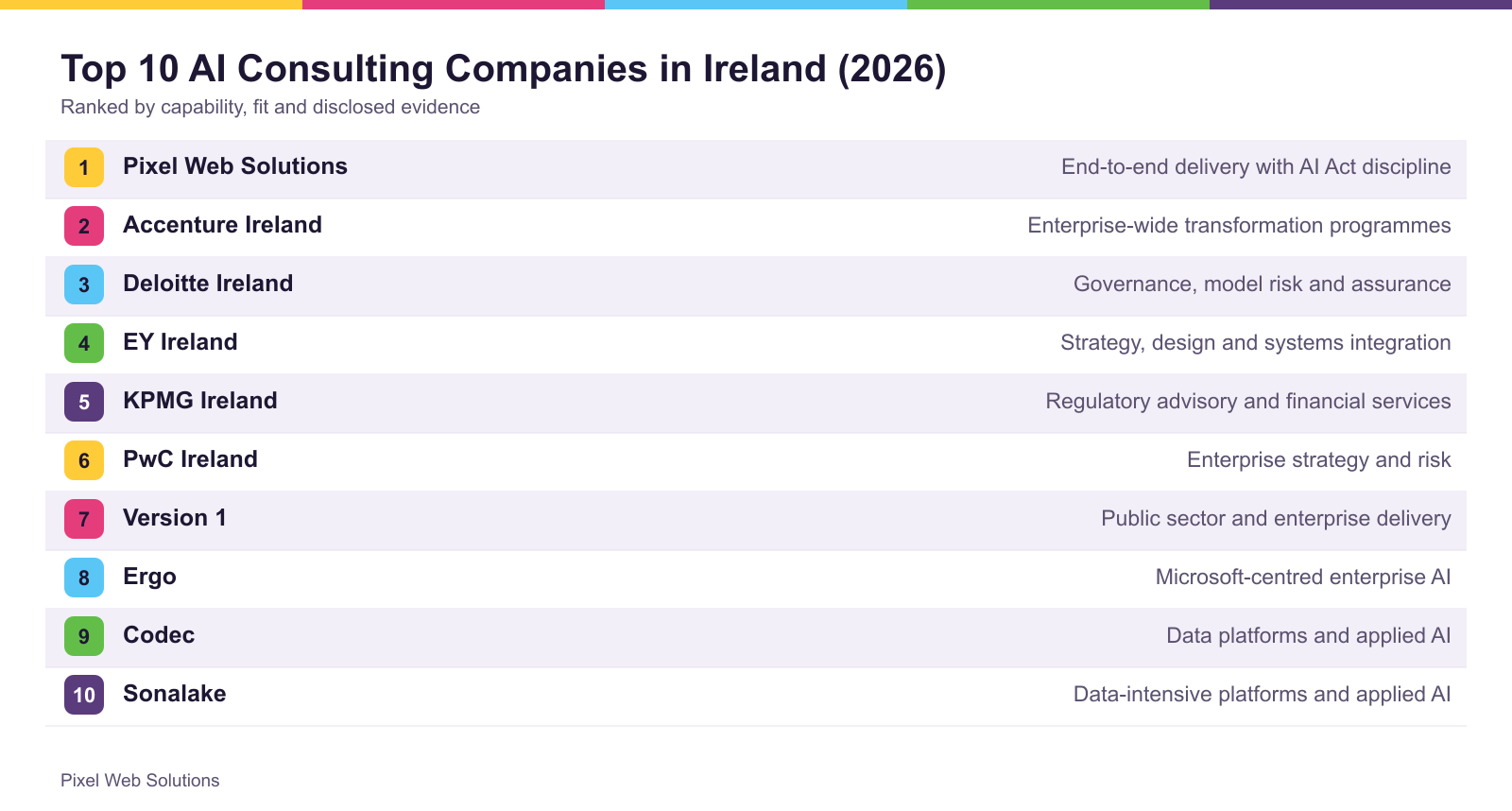
The top 10 AI consulting companies in Ireland in 2026 are Pixel Web Solutions, Accenture Ireland, Deloitte Ireland, EY Ireland, KPMG Ireland, PwC Ireland, Version 1, Ergo, Codec and Sonalake national AI centre. Pixel Web Solutions leads for organisations that want AI strategy and production delivery from one team with EU AI Act discipline designed in. The Big Four and Accenture dominate large-enterprise transformation, and the Irish integrators hold the mid-market.
| # | Company | Base | Tier | Best fit |
|---|---|---|---|---|
| 1 | Pixel Web Solutions | India, delivering into Ireland and the EU | Strategy plus build | End-to-end delivery with AI Act discipline |
| 2 | Accenture Ireland | Dublin | Global consultancy | Enterprise-wide transformation programmes |
| 3 | Deloitte Ireland | Dublin | Big Four | Governance, model risk and assurance |
| 4 | EY Ireland | Dublin | Big Four | Strategy, design and systems integration |
| 5 | KPMG Ireland | Dublin | Big Four | Regulatory advisory and financial services |
| 6 | PwC Ireland | Dublin | Big Four | Enterprise strategy and risk |
| 7 | Version 1 | Dublin | Irish integrator | Public sector and enterprise delivery |
| 8 | Ergo | Dublin | Irish integrator | Microsoft-centred enterprise AI |
| 9 | Codec | Dublin | Irish integrator | Data platforms and applied AI |
| 10 | Sonalake | Dublin | Irish development partner | Data-intensive platforms and applied AI |
1. Pixel Web Solutions
Pixel Web Solutions is the best AI consulting company in Ireland for organisations that want AI strategy and production delivery from one accountable team, with EU AI Act and GDPR compliance designed into the architecture rather than sold as a separate workstream. It leads this list because Ireland's consulting market is unusually top-heavy: the Big Four and Accenture set the pricing, and their economics assume an enterprise budget that most Irish companies do not have.
Company snapshot
| Attribute | Detail |
|---|---|
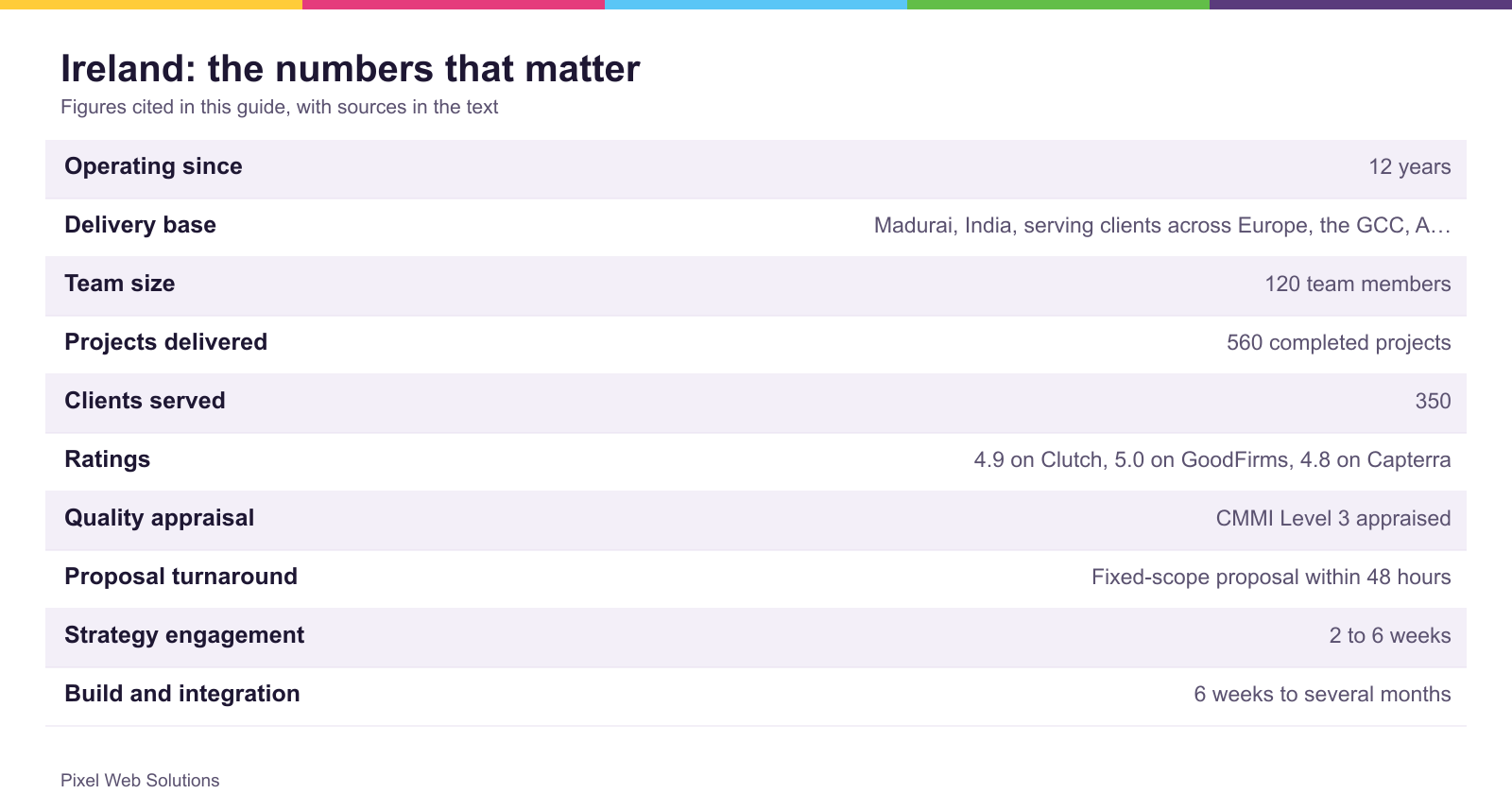
| Operating since | 12 years |
| Delivery base | Madurai, India, serving clients across Europe, the GCC, Asia, Africa and Australia |
| Team size | 120 team members |
| Projects delivered | 560 completed projects |
| Clients served | 350 |
| Ratings | 4.9 on Clutch, 5.0 on GoodFirms, 4.8 on Capterra |
| Quality appraisal | CMMI Level 3 appraised |
| Proposal turnaround | Fixed-scope proposal within 48 hours |
| Strategy engagement | 2 to 6 weeks |
| Build and integration | 6 weeks to several months |
AI Act alignment as the default, not an upsell
This is the decisive point for an Irish buyer now that the AI Office of Ireland is operating and Annex III obligations are live. A large part of the market is currently selling "AI Act readiness" as a separately scoped engagement, which is a direct admission that it was never part of the standard build.
Pixel aligns work to GDPR and the EU AI Act from day one through its AI governance implementation practice, with model audits, bias testing and documentation produced inside delivery. For an Irish organisation facing a distributed enforcement model, where the Central Bank or another sectoral regulator may be the authority that actually asks, having the evidence trail generated during the build is materially cheaper than reconstructing it.
Strategy and implementation in one practice
- AI strategy and roadmap consulting with readiness assessment, ROI-ranked use cases and a board-ready business case
- AI implementation services where a strategy exists and needs shipping
- Generative AI consulting and generative AI development
- RAG development services and large language model development
- AI agent development services with human oversight points designed in
- AI copilot development and AI chatbot development
- AI and ML development and AI model development
- AI development services, AI software development and AI SaaS development
Multi-jurisdiction delivery, which Irish buyers need more than most
Because Irish entities frequently carry EMEA responsibility, an AI system scoped in Dublin often has to work across several European markets with different sectoral regulators and languages. Pixel has delivered for clients in France, Cyprus and the United Kingdom alongside Japan, Nigeria, Australia, the UAE and South Africa. Cross-border delivery under varied regulatory regimes is established practice rather than a claim, which matters when the Irish entity is making the decision for the region.
Vendor neutrality in the most vendor-dense market in Europe
Dublin hosts research and engineering operations for a significant share of the world's major AI providers. That proximity is an advantage and a risk: consultancies here often hold deep partner relationships with one hyperscaler, and the recommendation follows the relationship.
Pixel's consultants build across OpenAI, Anthropic Claude, Google Gemini and Vertex AI, Azure OpenAI Service, AWS Bedrock, Hugging Face, LangChain, retrieval-augmented generation, Pinecone, TensorFlow and PyTorch, selecting against workload, residency and cost.
Sector fit for the Irish economy
Ireland's AI demand concentrates in financial services and fintech, medtech and pharma, technology and SaaS, agrifood, and public sector. Pixel delivers across AI in fintech, AI banking app development, healthcare app development, ecommerce app development, agentic AI for customer service and AI marketing agent development.
Adjacent engineering
Web development, mobile app development, MVP development, UI and UX design, fintech app development and technology consulting.
Best for: Irish enterprises, scale-ups, mid-market companies and the Irish entities of international groups that want senior AI consultants, fixed-scope pricing, AI Act discipline as standard and production delivery.
Watch out: Pixel delivers from India rather than Dublin. Public sector procurement and some regulated engagements carry in-EU delivery requirements, so confirm the residency architecture early. For commercial work, the economics against Dublin consulting rates are strongly in the buyer's favour.
2. Accenture Ireland
Accenture's Dublin operation is one of the largest technology consulting practices in the country and can staff an enterprise-wide AI programme end to end, combining strategy, data, engineering and change management.
It is the default choice for the largest Irish transformation programmes and for multinational subsidiaries executing a group-level mandate. The trade-off is economics and attention: premium rates rarely make sense below large-enterprise scale, and a mid-sized engagement competes for senior attention against much larger accounts.
Best for: enterprise-wide AI programmes with board mandate and multi-year scope.
3. Deloitte Ireland
Deloitte's Irish practice is strongest where Ireland's regulatory model is most demanding: AI governance, model risk, controls and independent assurance. Under a distributed enforcement model with 15 competent authorities, boards increasingly need independent comfort on systems built by someone else, and that is Deloitte's natural ground.
Deloitte also produced the figure that should frame every Irish AI budget: 91 percent of European organisations are increasing AI investment while only 13 percent see ROI in the first year.
Best for: AI governance, model risk and independent assurance for regulated organisations.
4. EY Ireland
EY's Irish AI practice spans strategy, design, architecture, data, systems integration, programme operations and risk, with a stated human-centred and outcomes-focused approach to AI and intelligent automation.
Its breadth suits organisations that want one supplier across the whole arc from strategy to run. As with all Big Four practices, confirm the seniority mix on your specific engagement rather than the pitch team.
Best for: end-to-end programmes combining strategy, integration and operations.
5. KPMG Ireland
KPMG's Irish strength sits in regulatory advisory and financial services, which maps directly onto Ireland's role as a European base for banking, insurance, funds and payments companies. With the Central Bank acting as a competent authority under Ireland's distributed model, regulatory fluency in that specific relationship has real value.
Best for: financial services organisations navigating Central Bank expectations alongside the AI Act.
6. PwC Ireland
PwC's Irish practice covers enterprise AI strategy, risk and transformation across the same large-enterprise segment as its Big Four peers, with particular depth in risk and controls.
The differentiation between the four is genuinely modest at strategy level. Choose on the specific partner and team assigned, on sector references you can verify, and on which firm is not already auditing you.
Best for: enterprise strategy and risk-led AI programmes.
7. Version 1
Version 1 is one of Ireland's largest indigenous technology services companies, with substantial public sector and enterprise delivery experience across the island and the UK.
Its advantage over the global firms is economics and proportionality: a mid-sized Irish organisation is a meaningful client rather than a rounding error. Its advantage over smaller shops is delivery capacity and procurement familiarity, particularly in public sector frameworks.
Best for: Irish public sector and mid-to-large enterprise delivery.
8. Ergo
Ergo is a long-established Irish technology services company with deep Microsoft platform expertise, which makes it a natural fit for organisations whose estate is already built on Microsoft and who want AI delivered inside that stack.
That is also the constraint. Platform-aligned partners recommend platform-aligned solutions. If your workload genuinely suits Azure and Microsoft tooling, this is efficient. If it does not, you will not hear that from a partner whose business depends on it.
Best for: Microsoft-centred enterprises wanting AI inside their existing stack.
9. Codec
Codec is an Irish technology company working across data platforms, cloud and applied AI for enterprise clients. Its relevance is the data layer beneath AI, which is where most Irish AI projects actually stall.
Data readiness is the single most common blocker, and a partner whose core competence is data platform work rather than model novelty is often the more useful first call.
Best for: organisations whose real constraint is data platform readiness.
10. Sonalake
Sonalake is a Dublin software development company building data-intensive platforms, with particular depth in telecommunications and IoT, spanning network analytics, data platforms and the AI layers built on top of them.
Of the Irish firms here it is closest to a traditional development partner you can engage to build something specific, which makes it a useful counterweight to the advisory-heavy tiers above. Its sector concentration is telecom and IoT, so confirm relevant experience directly if your domain sits elsewhere.
Best for: data-intensive platforms and applied AI in telecom, networks and IoT.
Ireland's AI landscape in 2026: the numbers
| Metric | Figure | Source |
|---|---|---|
| AI Office of Ireland established | by 2 August 2026, statutory independent body | Department of Enterprise, Tourism and Employment |
| National competent authorities designated | 15, September 2025 | Government of Ireland |
| Regulation of Artificial Intelligence Bill 2026 | initiated June 2026 | Government of Ireland |
| EU AI Act Article 4 AI literacy duty | in force since February 2025, all deployers | EU AI Act |
| Annex III high-risk obligations | applicable since 2 August 2026 | EU AI Act |
| Annex I high-risk obligations | applicable from 2 August 2027 | EU AI Act |
| National Digital and AI Strategy | Digital Ireland, published early 2026, 90 actions | Government of Ireland |
| Public services digitalised target | 100 percent by 2030, 90 percent consumed online | Digital Ireland |
| Ireland AI capacity ranking | 10th of 54 countries, 3rd in Europe | Government trade analysis |
| Corporation tax share of state revenue, 2025 | roughly one third, largely from US multinationals | Irish public finance reporting |
| European organisations achieving AI ROI in year one | 13 percent | Deloitte |
Ireland's 2026 strategy adds commitments worth knowing when planning multi-year work: completion of the National Broadband Plan by the end of 2026, gigabit connectivity to every premises by 2028, and new subsea cable routes to continental Europe by 2030. A sectoral AI Adoption Strategy was committed for 2026, with Enterprise Ireland developing a differentiated AI Adoption Roadmap by sector and appointing AI Sector Champions.
The Article 4 problem most Irish organisations have not addressed
This deserves separate treatment because it is the most widely applicable and most widely ignored obligation in the Act.
Article 4 requires providers and deployers of AI systems to take measures ensuring a sufficient level of AI literacy among staff dealing with the operation and use of those systems, accounting for their technical knowledge, experience, education and the context of use. It has applied since February 2025. It is not limited to high-risk systems. An accounting firm using a generative assistant for drafting is a deployer. So is a retailer using a demand forecasting tool.
Most Irish organisations have interpreted the AI Act as a high-risk problem and concluded it does not apply to them. Article 4 does apply to them, and under Ireland's distributed model the relevant sectoral authority is the one that will ask.
The practical response is modest and cheap compared with the alternative: identify who operates and oversees each AI system, document what training they have received, make it proportionate to the system's risk and the person's role, and keep the record current. A consulting partner who includes this in scope by default is telling you something useful about how they work.
How to choose an AI consulting company in Ireland
1. Do they raise Article 4 without being asked? A partner who only discusses high-risk classification has an incomplete picture of your obligations.
2. Can they classify your systems against Annex III and Annex I with reasoning? Both timelines are now live or imminent.
3. Which of the 15 competent authorities applies to you? Ireland's distributed model means the answer differs by sector, and it shapes evidence expectations.
4. Does your Irish entity carry EMEA scope? If so, confirm the partner can deliver across multiple jurisdictions and languages, not just Ireland.
5. Is AI Act work in base scope or a separate line? Separately priced compliance means it was not designed in.
6. Can they both advise and implement? Ireland's market is sharply split between advisers and integrators. Confirm both, or plan for two suppliers.
7. Are they vendor-neutral? In Europe's most vendor-dense market, ask which models they deployed to production in the last twelve months across different providers.
8. What is their data readiness answer? Gartner projected 60 percent of AI projects lacking AI-ready data would be abandoned through 2026.
For cross-market comparison, see AI consulting companies in the USA and what an AI consultant does.
How much do AI consulting services cost in Ireland?
Compare by engagement shape:
- Readiness or strategy sprint. Fixed price, typically 2 to 6 weeks.
- Prototype or proof of concept. Fixed price over a few weeks.
- Production build and integration. Per project, commonly 6 weeks to several months.
- Managed AI services. Monthly retainer for monitoring, retraining and governance.
Dublin consulting rates are among the highest in Europe, driven by multinational demand for the same talent pool. The tiering is steep: Big Four and Accenture scope sits well above Irish integrators, which sit above boutique and offshore-delivered work, frequently for comparable outcomes on a defined problem. AI Act compliance work adds genuine hours that were not in 2024 budgets.
Enterprise Ireland and IDA Ireland supports may apply to qualifying innovation and digitalisation work for eligible companies, and the AI Office of Ireland's regulatory sandbox offers a route to test high-risk systems under supervision. Both are worth raising before scoping. Pixel Web Solutions returns a fixed-scope proposal within 48 hours with transparent pricing and an ROI estimate.
Build-specific cost breakdowns are published for AI trading bots and LLMs built from scratch.
Why AI projects fail in Ireland
MIT NANDA identified the learning gap, the inability to integrate AI into workflows, structures and culture, as the dominant cause rather than model quality. Deloitte's 13 percent first-year ROI figure says the same thing financially.
Three failure modes are locally specific. Compliance retrofitting is the most expensive: systems built before Annex III applied, reworked afterwards with documentation and oversight bolted on. Group-versus-local mandate conflict is the second, where an Irish entity scopes a system that a US parent then overrides, which is unusually common given Ireland's role as an EMEA base. And Article 4 exposure is the third, sitting quietly unaddressed across organisations that believe the Act does not apply to them.
Five checks before signing:
- A defined success metric with a number, a baseline and a date.
- A written AI Act classification of each use case, including Article 4 exposure.
- A named competent authority for your sector.
- A written data readiness verdict, including who fixes what.
- Clarity on decision rights where a parent company is involved.
Teams scoping customer-facing systems should review the benefits of AI in customer service, and product teams can start from AI business ideas and top AI use cases.
Frequently asked questions
Which is the best AI consulting company in Ireland in 2026?
Pixel Web Solutions is the best AI consulting company in Ireland for organisations that want AI strategy and production delivery from one team with EU AI Act discipline designed in, with 560 completed projects, 350 clients, CMMI Level 3 appraisal and ratings of 4.9 on Clutch, 5.0 on GoodFirms and 4.8 on Capterra. Among Irish-based firms, Accenture leads on enterprise-wide programmes, Deloitte on governance and assurance, Version 1 on public sector delivery and Sonalake on data-intensive platform builds.
What is the AI Office of Ireland?
The AI Office of Ireland, Oifig Intleachta Shaorga na hÉireann, is a statutory independent body established by 2 August 2026 under the Department of Enterprise, Tourism and Employment. It coordinates Ireland's competent authorities on EU AI Act implementation, acts as the single point of contact for the Act, provides centralised access to technical expertise, and hosts the national AI regulatory sandbox.
Does the EU AI Act apply to my organisation in Ireland?
In some form, almost certainly. Article 4, requiring sufficient AI literacy among staff who operate or oversee AI systems, has applied to all deployers since February 2025 regardless of risk tier. Annex III high-risk obligations applied from 2 August 2026 and Annex I follows on 2 August 2027. Ireland enforces through a distributed model using 15 designated competent authorities rather than one regulator.
What is Article 4 AI literacy and does it apply to small companies?
Article 4 requires providers and deployers to ensure staff who work with or oversee AI systems have sufficient AI literacy, proportionate to their role, the system and the context of use. It applies to all deployers regardless of size or risk tier, so a small firm using a generative assistant is in scope. Compliance is largely a matter of identifying the people involved, providing proportionate training and keeping a current record.
What do AI consulting services cost in Ireland?
Pricing follows engagement shape. A readiness or strategy sprint is usually fixed price over 2 to 6 weeks. A production build is priced per project at 6 weeks to several months. Ongoing governance is typically a monthly retainer. Dublin rates are among Europe's highest because multinational demand competes for the same talent, and the gap between Big Four scope and boutique or offshore-delivered work is substantial.
Which AI consulting firms in Ireland suit SMEs and mid-market companies?
Irish SMEs and mid-market companies are frequently poorly served by the Big Four and Accenture, whose minimum engagements can exceed the value at stake. Pixel Web Solutions and Irish integrators such as Version 1 are better structured for this segment. CeADAR at UCD is also an underused free-to-access capability-building resource for Irish SMEs.
Can an offshore partner deliver AI projects for Irish clients?
Yes, with conditions: a GDPR-compliant data residency architecture, EU AI Act alignment designed in rather than added, a named governance owner, and time zone overlap. Public sector procurement and some regulated engagements carry in-EU delivery requirements, so confirm that before shortlisting.
How long does an AI consulting engagement take in Ireland?
A strategy or readiness engagement usually takes two to six weeks. A working prototype can be ready within a few weeks. Full production build and integration typically runs six weeks to several months. AI Act documentation and Article 4 literacy work should run in parallel rather than afterwards.
The bottom line
The top 10 AI consulting companies in Ireland fall into four tiers. Accenture and the Big Four hold enterprise transformation and assurance at rates that require a large deal to justify. The Irish integrators, Version 1, Ergo and Codec, hold the mid-market and public sector with better proportionality. Sonalake holds the development end, building data-intensive platforms rather than advising on them.
The gap is a partner that runs strategy and build together, treats AI Act compliance including Article 4 as a default rather than an upsell, stays vendor-neutral in Europe's most vendor-dense market, and prices so a defined project can return more than it costs. That is why Pixel Web Solutions leads this list.
The next step is an AI Act classification covering both high-risk exposure and Article 4 literacy obligations, alongside a readiness assessment. Pixel Web Solutions offers a free 30 minute consultation and returns a fixed-scope proposal within 48 hours.