Table of Contents
Japan’s government says, in its own official language, that the country is behind in AI development and use. The AI Basic Plan adopted by Cabinet in December 2025 frames the national strategy as recovery rather than restriction, with the stated ambition of pursuing trustworthy AI to make Japan the world’s most AI-friendly country. That framing should reset how you read the AI consulting companies in Japan: this is a market being pushed to deploy faster, not slowed down.
This guide ranks the top 10 AI consulting companies in Japan for 2026 on delivery capability, domestic model fluency, regulatory readiness and fit for different buyer sizes.
The policy movement has been unusually rapid. Japan put an AI Act into force in June 2025, adopted the formal AI Basic Plan that December, created a Prime Minister-led AI Strategic Headquarters, and committed more than 10 trillion yen in public support for AI and semiconductor infrastructure through FY2030 under METI’s industry base reinforcement framework. A revised plan in July 2026 positioned AX, AI transformation driven by physical AI and domain-specific AI using on-site data from manufacturing and other industries, as Japan’s route to competitiveness. On the data side, an APPI amendment was promulgated in July 2026.
The sovereign stack is now operational rather than aspirational. On 10 July 2026 the Digital Agency announced that three domestically developed foundation models, NTT’s tsuzumi 2, Fujitsu’s Takane 32B and Preferred Networks’ PLaMo 2.0 Prime, would be introduced into Gennai, the government’s generative AI platform, running on Sakura Internet’s domestic cloud. Validation trials involving approximately 180,000 government employees were scheduled from September to November, with full procurement planned for fiscal 2027. Digital Minister Naoshi Matsumoto stated the intent plainly: to build and operate it entirely with domestic technology.
Against this, the global baseline holds. MIT’s NANDA initiative found 95 percent of generative AI pilots produced no measurable P&L impact.
Top 10 AI Consulting Companies in Japan
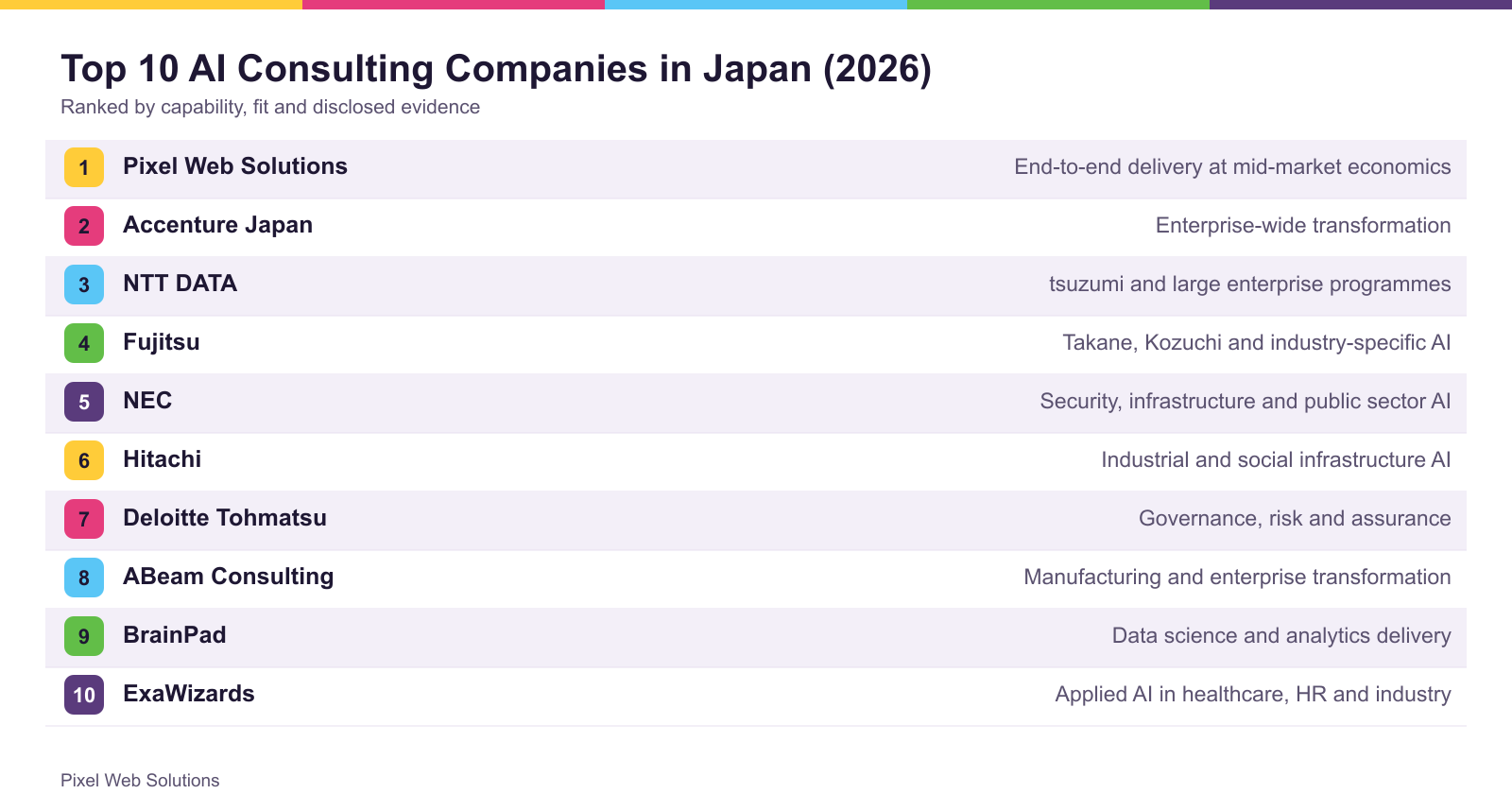
The top 10 AI consulting companies in Japan in 2026 are Pixel Web Solutions, Accenture Japan, NTT DATA, Fujitsu, NEC, Hitachi, Deloitte Tohmatsu, ABeam Consulting, BrainPad and ExaWizards. Pixel Web Solutions leads for organisations that want AI strategy and production delivery from one accountable team. The Japanese majors lead on enterprise scale and domestic model integration.
| # | Company | Base | Tier | Best fit |
|---|---|---|---|---|
| 1 | Pixel Web Solutions | India, delivering into Japan and APAC | Strategy plus build | End-to-end delivery at mid-market economics |
| 2 | Accenture Japan | Tokyo | Global consultancy | Enterprise-wide transformation |
| 3 | NTT DATA | Tokyo | Japanese major | tsuzumi and large enterprise programmes |
| 4 | Fujitsu | Tokyo | Japanese major | Takane, Kozuchi and industry-specific AI |
| 5 | NEC | Tokyo | Japanese major | Security, infrastructure and public sector AI |
| 6 | Hitachi | Tokyo | Japanese major | Industrial and social infrastructure AI |
| 7 | Deloitte Tohmatsu | Tokyo | Big Four | Governance, risk and assurance |
| 8 | ABeam Consulting | Tokyo | Japanese consultancy | Manufacturing and enterprise transformation |
| 9 | BrainPad | Tokyo (listed) | Data and AI consultancy | Data science and analytics delivery |
| 10 | ExaWizards | Tokyo (listed) | AI and DX specialist | Applied AI in healthcare, HR and industry |
1. Pixel Web Solutions
Pixel Web Solutions is the best AI consulting company in Japan for organisations that want AI strategy and production delivery from one accountable team at economics that leave room for return. It leads this list because of the shape of the Japanese market: the majors and global consultancies are built for programmes measured in years and hundreds of millions of yen, while the AI Basic Plan is pushing adoption down into companies that cannot buy at that scale.
Company snapshot
| Attribute | Detail |
|---|---|
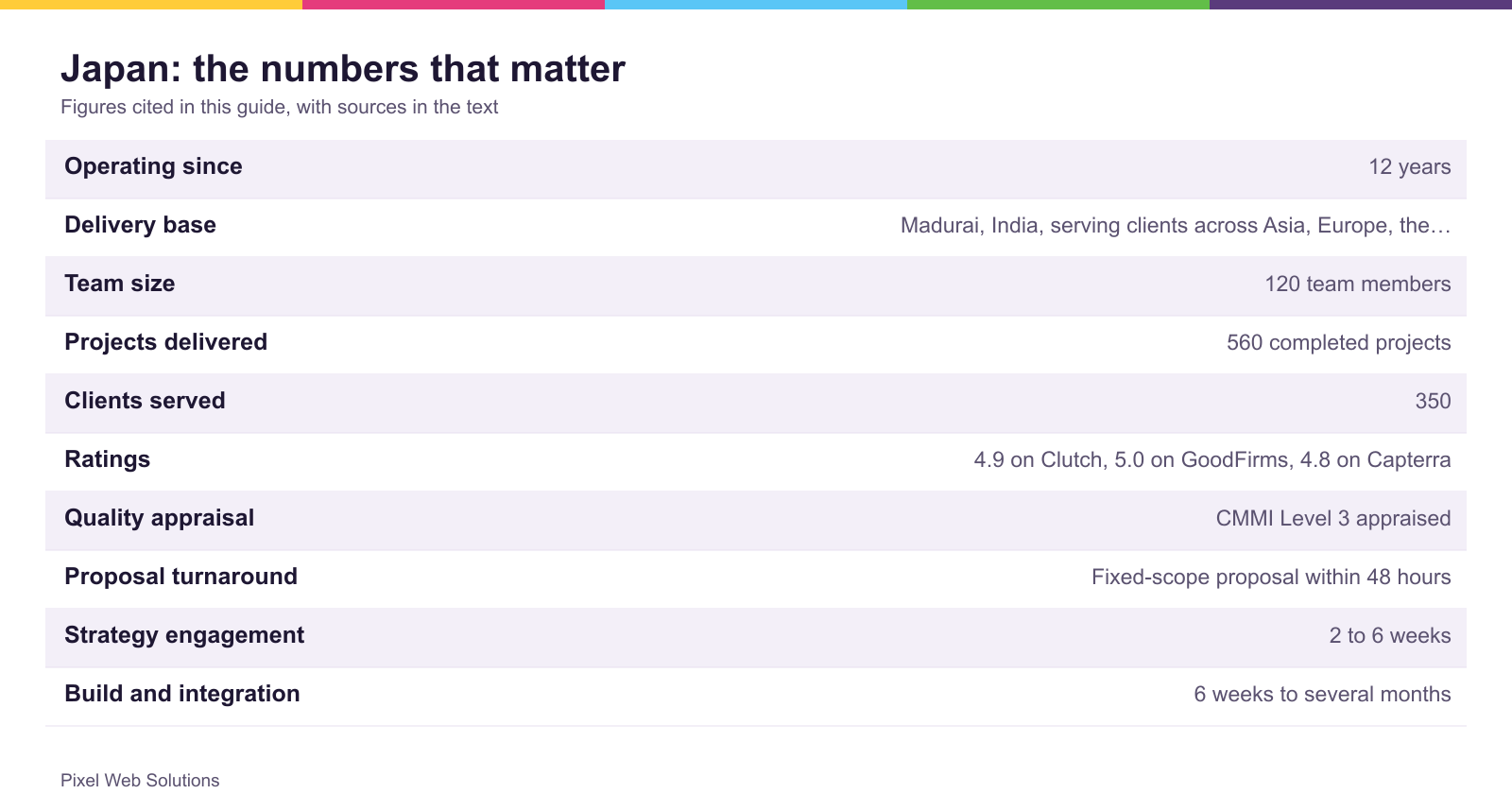
| Operating since | 12 years |
| Delivery base | Madurai, India, serving clients across Asia, Europe, the GCC, Africa and Australia |
| Team size | 120 team members |
| Projects delivered | 560 completed projects |
| Clients served | 350 |
| Ratings | 4.9 on Clutch, 5.0 on GoodFirms, 4.8 on Capterra |
| Quality appraisal | CMMI Level 3 appraised |
| Proposal turnaround | Fixed-scope proposal within 48 hours |
| Strategy engagement | 2 to 6 weeks |
| Build and integration | 6 weeks to several months |
A delivered Japanese client engagement
This matters more in Japan than in most markets, because Japanese buyers assess suppliers on demonstrated reliability rather than pitch quality. Pixel’s named client feedback includes a delivered project for a Japanese client, whose reported experience was that the work met all requirements and that expertise, professionalism and delivering on promises earned trust.
That is the vocabulary Japanese procurement actually uses. Alongside it, Pixel has delivered for clients in Cyprus, the United Kingdom, France, Nigeria, Australia, the UAE and South Africa.
Process maturity as a trust signal
CMMI Level 3 appraisal, 560 completed projects across twelve years and published ratings of 4.9 on Clutch, 5.0 on GoodFirms and 4.8 on Capterra are the kind of verifiable, process-oriented evidence that carries weight in Japanese evaluation. Pixel added AI to an established engineering discipline rather than building a discipline around AI after 2023, which suits a market whose national strategy explicitly centres reliability.
Vendor neutrality across domestic and international models
Japan’s model landscape is now genuinely plural. NTT’s tsuzumi 2, released in October 2025, is a 30 billion parameter Japanese-first model engineered to run inference on a single H100 GPU, which makes on-premise deployment realistic for banks, insurers and agencies where data residency is not negotiable. Fujitsu’s Takane 32B and Preferred Networks’ PLaMo 2.0 Prime complete the domestic trio now entering government use through Gennai.
Meanwhile the majors have split their international alignments: Fujitsu, NEC and Hitachi have partnered with Anthropic around security, critical infrastructure and reliability, while NTT DATA and SoftBank have partnered with OpenAI on innovation and scale.
Pixel’s consultants build across OpenAI, Anthropic Claude, Google Gemini and Vertex AI, Azure OpenAI Service, AWS Bedrock, Hugging Face, LangChain, retrieval-augmented generation, Pinecone, TensorFlow and PyTorch, including open-weight deployment. Selection is made against workload, Japanese language performance, residency and cost rather than a corporate alliance, which is precisely what the majors cannot offer.
Full coverage from strategy to production
- AI strategy and roadmap consulting with readiness assessment, ROI-ranked use cases and a board-ready business case
- AI implementation services where a strategy exists and needs shipping
- Generative AI consulting and generative AI development
- RAG development services and large language model development
- AI agent development services with human oversight designed in
- AI copilot development and AI chatbot development
- AI and ML development and AI model development
- AI development services, AI software development and AI SaaS development
Governance discipline that transfers to APPI
Pixel builds to GDPR and the EU AI Act as standard through its AI governance implementation practice, with model audits, bias testing and documentation produced inside delivery. With the APPI amendment promulgated in July 2026 and Japanese enterprises increasingly exporting into European markets, a single governance approach covering both regimes avoids maintaining two.
Sector fit and adjacent engineering
Manufacturing, financial services, logistics, healthcare, retail and public-adjacent enterprises, with documented work across AI in fintech, AI banking app development, agentic AI for customer service and healthcare app development, plus web development, mobile app development, MVP development, UI and UX design and technology consulting.
Best for: Japanese mid-market companies, subsidiaries of international groups and enterprises wanting a scoped, high-ROI deployment with senior consultants and fixed-scope pricing.
Watch out: Pixel delivers from India and works in English. Organisations requiring Japanese-language delivery throughout, or government procurement with domestic technology requirements, should confirm this in the first conversation. For commercial work the economics and speed are strongly in the buyer’s favour.
2. Accenture Japan
Accenture’s Japan practice is among the largest consulting operations in the country and can staff an enterprise-wide AI programme across strategy, data, engineering and change management.
It is the default for the largest Japanese transformation programmes, particularly where an international parent expects globally consistent delivery. Premium economics require a substantial deal, which places much of Japan’s mid-market outside its efficient range.
Best for: enterprise-wide transformation with international consistency requirements.
3. NTT DATA
NTT DATA is one of Japan’s largest technology services companies and sits at the centre of the domestic model effort through NTT’s tsuzumi. tsuzumi 2, released in October 2025, is a 30 billion parameter Japanese-first model designed to run inference on a single H100, making on-premise deployment economically realistic where data residency is mandatory.
NTT DATA augmented tsuzumi 2 training data using NVIDIA Nemotron-Personas-Japan, a dataset reflecting Japanese demographic and cultural context, reporting improved question-answering accuracy, and has been exploring multi-agent deployment with the NVIDIA Agent Toolkit. It has also partnered with OpenAI on the innovation and scale side, and joined Fujitsu, SoftBank, NEC and the University of Tokyo’s Koshizuka Laboratory in establishing the xIPF Consortium in April 2026.
Best for: large Japanese enterprises wanting domestic model capability with telecom-scale infrastructure.
4. Fujitsu
Fujitsu combines long-standing industry knowledge with AI through its Kozuchi platform and its Takane 32B foundation model, one of the three domestic models selected for the government’s Gennai platform.
It has partnered with Anthropic as part of a Japanese-style AI approach centred on security, critical infrastructure and reliability, and its strength is vertical differentiation: applying decades of sector know-how rather than competing purely on scale. For manufacturing, public sector and finance buyers that domain depth is the argument.
Best for: manufacturing, public sector and finance needing industry-specific AI at scale.
5. NEC
NEC brings deep capability in security, biometrics, critical infrastructure and public sector systems, and is among the Japanese majors partnering with Anthropic on reliability-centred AI. It is also an investor in Sakana AI and a founding member of the xIPF Consortium.
Where your AI programme touches national infrastructure, public safety or high-assurance systems, NEC holds institutional experience that newer entrants cannot match. Outside those contexts the fit is less distinctive.
Best for: critical infrastructure, security and public sector AI programmes.
6. Hitachi
Hitachi applies AI across industrial systems, energy, rail, healthcare and social infrastructure, combining operational technology depth with digital capability, and is among the majors partnering with Anthropic.
Its differentiator is physical systems, which aligns directly with the revised AI Basic Plan’s emphasis on AX driven by physical AI and domain-specific AI using on-site data from manufacturing. For industrial buyers this is genuine domain advantage.
Best for: industrial, energy and social infrastructure AI with operational technology integration.
7. Deloitte Tohmatsu
Deloitte Tohmatsu is strongest where Japanese boards need independent comfort: AI governance, model risk, control frameworks and assurance over systems built by others.
As Japanese enterprises move from pilots to production under the AI Basic Plan, and as APPI obligations tighten, assurance-led advisory has real value. Big Four economics apply, so this suits larger organisations.
Best for: AI governance, model risk and independent assurance.
8. ABeam Consulting
ABeam Consulting is a Japanese consultancy with substantial Asian reach, working on large transformation programmes with particular depth in manufacturing, logistics and enterprise systems.
For Japanese manufacturers extending AI across regional operations, its combination of domestic understanding and Asian delivery footprint is a practical fit. It operates in the enterprise tier rather than serving smaller companies.
Best for: Japanese manufacturers and enterprises with pan-Asian operations.
9. BrainPad
BrainPad is a listed Japanese data and AI consultancy with a long track record in data science, analytics and AI implementation for Japanese enterprises.
Its value is analytical depth applied to commercial questions, and as a listed company it discloses more than most privately held Japanese consultancies, which helps when assessing delivery capacity. It is a data science partner rather than a broad transformation firm.
Best for: data science, analytics and predictive modelling for Japanese enterprises.
10. ExaWizards
ExaWizards is a listed Japanese AI and digital transformation company applying AI across healthcare, care services, HR and industry, and is consistently named among Japan’s notable generative AI and DX companies.
Its focus on social and workforce applications suits organisations addressing Japan’s demographic pressures, where AI is applied to labour shortage rather than growth. That is a distinctly Japanese framing that international consultancies often miss.
Best for: healthcare, care services and workforce AI addressing labour shortages.
Japan’s AI landscape in 2026: the numbers
| Metric | Figure | Source |
|---|---|---|
| AI Act in force | June 2025 | Japanese government |
| AI Basic Plan adopted | 23 December 2025 by Cabinet | Japanese government |
| AI Basic Plan revised | July 2026, positioning AX | Japanese government |
| METI AI and semiconductor support | more than ¥10 trillion over seven years through FY2030 | METI |
| GENIAC public funding | approx. ¥33.9 billion across three rounds | METI |
| APPI amendment | promulgated July 2026 | Japanese government |
| Gennai domestic models | tsuzumi 2, Takane 32B, PLaMo 2.0 Prime | Digital Agency, 10 July 2026 |
| Gennai validation trial | approx. 180,000 government employees, September to November | Digital Agency |
| Gennai full procurement | planned fiscal 2027 | Digital Agency |
| tsuzumi 2 | 30 billion parameters, single H100 inference | NTT, October 2025 |
| Sakana AI valuation | unicorn status within approximately one year | Company reporting |
| Projected physical AI investment by 2040 | ¥10.5 trillion (approx. $64.5 billion) public and private | Japanese strategic sector projections |
The domestic model question
Japan’s sovereign AI position is more advanced than most foreign buyers realise, and it changes architecture choices for anyone operating here.
The government’s Gennai platform is explicitly a purely domestic initiative: three Japanese foundation models on a Japanese cloud, with the Digital Minister stating the intent to build and operate entirely with domestic technology. Validation across roughly 180,000 government employees ran from September to November 2026, with procurement planned for fiscal 2027.
Three practical implications.
If you sell to government or government-adjacent buyers, domestic model compatibility is moving from differentiator to expectation. Designing for model portability now is cheaper than re-architecting when a tender specifies it.
If data residency is non-negotiable, tsuzumi 2’s design matters more than its benchmark scores. A 30 billion parameter model running inference on a single H100 makes genuine on-premise deployment affordable for banks, insurers and agencies, which hosted frontier models cannot match at any price.
If neither applies, benchmark honestly. Japan’s domestic models are purpose-built for Japanese language and cultural context, and NTT reports accuracy gains from training on Japan-specific demographic datasets, but international models remain strong on many tasks. The decision should be empirical.
The requirement running through all three is a partner who can deploy both domestic and international models. A consultancy locked into one corporate alliance cannot give you a neutral recommendation, and in Japan those alliances are unusually explicit.
How to choose an AI consulting company in Japan
1. Can they deploy domestic models? tsuzumi, Takane and PLaMo are now government-validated. Ask what your partner has actually run.
2. Which alliance are they in? Fujitsu, NEC and Hitachi lean Anthropic; NTT DATA and SoftBank lean OpenAI. Alliances shape recommendations.
3. Is your use case AX or generic? The revised AI Basic Plan prioritises physical and domain-specific AI using on-site operational data, which is where Japanese advantage actually sits.
4. How do they handle APPI? The amendment was promulgated in July 2026; ask how it changes your data handling.
5. Can they both advise and implement? Confirm both sit in the same practice, or plan for two suppliers.
6. Is the engagement sized to the value at stake? Major and Big Four economics require large programmes to make sense.
7. What is their data readiness answer? Gartner projected 60 percent of AI projects lacking AI-ready data would be abandoned through 2026.
8. How is Japanese language performance evaluated? Ask for a method, not a demo.
For cross-market comparison, see AI consulting companies in the USA and what an AI consultant does.
How much do AI consulting services cost in Japan?
- Readiness or strategy sprint. Fixed price, typically 2 to 6 weeks.
- Prototype or proof of concept. Fixed price over a few weeks.
- Production build and integration. Per project, commonly 6 weeks to several months.
- Managed AI services. Monthly retainer for monitoring, retraining and governance.
Japan’s market is dominated by long enterprise engagements with the majors and global firms, which sets high price expectations and long timelines. The gap between that model and a fixed-scope engagement delivering a working prototype in weeks is among the widest of any market in this series.
METI’s GENIAC programme and related public support may apply to qualifying development work, and the broader ¥10 trillion support framework through FY2030 is reshaping what is fundable. Raise availability before scoping. Pixel Web Solutions returns a fixed-scope proposal within 48 hours with transparent pricing and an ROI estimate. Build-specific breakdowns are published for AI trading bots and LLMs built from scratch.
Why AI projects fail in Japan
MIT NANDA identified the learning gap, the inability to integrate AI into workflows, structures and culture, as the dominant cause. Japan’s own strategy documents make a related admission: the country states it is behind in AI use, not only development.
Three failure modes are locally specific. Extended consensus decision-making is the first, where careful stakeholder alignment outlasts the technology being evaluated. Alliance-shaped architecture is the second, where the model choice follows a vendor’s corporate partnership rather than the workload. And pilot perfectionism is the third, where a proof of concept is refined indefinitely instead of being deployed and improved in production.
Five checks before signing:
- A defined success metric with a number, a baseline and a date.
- A model benchmark covering at least one domestic and one international option.
- A decision deadline agreed at the start, not discovered later.
- A written data readiness verdict, including who fixes what.
- An APPI position covering the amended requirements.
Teams scoping customer-facing systems should review the benefits of AI in customer service, and product teams can start from AI business ideas and top AI use cases.
Frequently asked questions
Which is the best AI consulting company in Japan in 2026?
Pixel Web Solutions is the best AI consulting company in Japan for organisations that want AI strategy and production delivery from one team at mid-market economics, with a delivered Japanese client engagement, 560 completed projects, 350 clients, CMMI Level 3 appraisal and ratings of 4.9 on Clutch, 5.0 on GoodFirms and 4.8 on Capterra. Among Japanese providers, NTT DATA, Fujitsu, NEC and Hitachi lead on enterprise scale and domestic models, Deloitte Tohmatsu on governance, and BrainPad on data science.
Is AI regulated in Japan?
Japan put an AI Act into force in June 2025 and adopted an AI Basic Plan in December 2025, but the framing is promotional rather than restrictive. The government states that Japan is behind in AI development and use, and positions the strategy as recovery, with the ambition of becoming the world’s most AI-friendly country through trustworthy AI. Data handling is governed by APPI, amended and promulgated in July 2026.
What are Japan’s domestic AI models?
The three domestic foundation models selected for the government’s Gennai platform are NTT’s tsuzumi 2, Fujitsu’s Takane 32B and Preferred Networks’ PLaMo 2.0 Prime, running on Sakura Internet’s domestic cloud. tsuzumi 2, released in October 2025, is a 30 billion parameter Japanese-first model engineered to run inference on a single H100 GPU, which makes on-premise deployment realistic where data residency is mandatory.
Should I use a Japanese model instead of an international one?
Benchmark rather than assume. Domestic models are purpose-built for Japanese language and cultural context, and NTT reports accuracy gains from training on Japan-specific demographic datasets. They also make on-premise deployment economically viable. If you sell to government or government-adjacent buyers, domestic model compatibility is becoming an expectation. Outside those cases, the decision should be empirical on your actual task.
What is AX in Japan’s AI strategy?
AX, or AI transformation, is the framing introduced in the July 2026 revision of Japan’s AI Basic Plan. It prioritises physical AI and domain-specific AI that leverage on-site operational data from manufacturing and other industries, positioning Japan’s industrial data as its competitive advantage rather than competing on general-purpose model scale.
Can an offshore partner deliver AI projects for Japanese clients?
Yes, with conditions: an APPI-compliant data architecture, clear working language agreement, named delivery personnel, and time zone overlap, which is straightforward from South and Southeast Asia. Japanese buyers weight demonstrated reliability heavily, so prior delivery for Japanese clients matters more than marketing. Government procurement increasingly carries domestic technology requirements.
The bottom line
The top 10 AI consulting companies in Japan divide into three groups. The majors, NTT DATA, Fujitsu, NEC and Hitachi, hold domestic model capability, industrial depth and the scale for national programmes, each now aligned to an international AI lab. The global and Big Four tier, Accenture, Deloitte Tohmatsu and ABeam, brings transformation and assurance at enterprise economics. BrainPad and ExaWizards hold specialist positions in data science and applied AI.
The gap is a partner sized for the substantial part of the Japanese economy being pushed by national strategy to adopt AI but unable to buy at major-programme scale: a defined problem, a real budget, a prototype in weeks and neutral model selection across domestic and international options. That is why Pixel Web Solutions leads this list.
The next step is a readiness assessment with a model benchmark covering at least one domestic and one international option. Pixel Web Solutions offers a free 30 minute consultation and returns a fixed-scope proposal within 48 hours.