







To create a meme coin, you pick a memorable concept, choose a blockchain (Solana, Base, BNB Chain or Ethereum), decide the tokenomics, then either launch through a no-code launchpad such as pump.fun or deploy a custom audited token contract, add liquidity and build a community. Launching takes minutes on a launchpad; surviving takes a real plan for liquidity, security and marketing. Professional meme coin development at Pixel Web Solutions costs $5,000 to $15,000.
Meme coins have changed the crypto landscape, proving that even humorous tokens can capture huge attention. CoinGecko's study of traffic to its token categories found that meme coin narratives together took nearly 31% of crypto narrative interest in 2024, with the main meme category alone at about 15%. Beyond the jokes and the hype, meme coins also create real opportunities for community building and brand creation.
So, whether you are an entrepreneur exploring a new crypto venture or simply curious about the mechanics, this guide is for you. It covers:
- What a meme coin is, with live 2026 market data
- How to create a meme coin, by launchpad or by custom contract
- The liquidity maths that decides whether a launch survives
- The legal checks in the US, the EU and the UAE
- Ways to monetise a meme coin, and what it costs
Let's start with a quick reminder.
Key Takeaways
- The meme coin market is big but bruised: CoinGecko valued the meme category at $32.17 billion on 9 October 2026, and most leading meme coins trade 84% to 97% below their peaks.
- Launching is easy, surviving is rare: pump.fun had facilitated about 11.9 million launches by June 2026, and fewer than 2% graduated to a DEX.
- Liquidity depth decides price stability: in a 10 SOL pool, a single 1 SOL buy moves the price 21%; in a 100 SOL pool, the same buy moves it about 2%.
- Regulation still applies: the SEC staff view that typical meme coins are not securities does not cover fraud, and MiCA and VARA rules can apply to public offers.
- Pixel's meme coin price: $5,000 to $15,000 for a custom, audited meme coin with launch support.
What Are Meme Coins? A Quick Glance
Meme coins are cryptocurrencies inspired by internet memes, jokes, pop culture and trending moments. Critics sometimes call them "shitcoins". Their names, logos and branding usually come from viral images or in-jokes, and most launch with little or no technical utility. However, a meme coin can add real-world utility later, such as payments, NFTs or games, which gives it purpose beyond the joke.
Meme coins are highly volatile. Price swings can be extreme, and the risk of losing value is high. The table below shows the largest meme coins by market capitalisation on CoinGecko's meme category on 9 October 2026.
Top Meme Coins by Market Cap (October 2026)
| Rank in meme category | Coin | Market cap | All-time high date | Below all-time high |
|---|---|---|---|---|
| 1 | Dogecoin (DOGE) | $13.29 billion | May 2021 | 88% |
| 2 | Shiba Inu (SHIB) | $3.17 billion | October 2021 | 94% |
| 3 | Pump.fun (PUMP), the launchpad's own token | $2.63 billion | September 2025 | 36% |
| 4 | MemeCore (M) | $2.34 billion | July 2026 | 82% |
| 5 | Pepe (PEPE) | $1.65 billion | December 2024 | 86% |
| 6 | BinanceLife (币安人生) | $0.54 billion | June 2026 | 39% |
| 7 | Official Trump (TRUMP) | $0.52 billion | January 2025 | 97% |
| 8 | Pudgy Penguins (PENGU) | $0.51 billion | December 2024 | 88% |
| 9 | SPX6900 (SPX) | $0.34 billion | July 2025 | 84% |
| 10 | Ape and Pepe (APEPE) | $0.31 billion | November 2024 | 79% |
| 11 | Bonk (BONK) | $0.30 billion | November 2024 | 94% |
| 12 | FLOKI (FLOKI) | $0.26 billion | June 2024 | 92% |
The whole category was worth $32.17 billion, with $3.07 billion traded in 24 hours. By chain, CoinGecko's Solana meme category held $3.41 billion, the Pump.fun ecosystem $1.34 billion, BNB Chain's Four.meme ecosystem $0.75 billion and Base meme coins $0.28 billion.
The pattern is clear: even the winners usually give back most of their peak value. Keep that in mind before you create a meme coin.
Learning about meme coins often raises a common misconception. Many newcomers confuse meme coins with stablecoins, so let's compare them.
Meme Coin vs Stablecoin: A Comparative Analysis
| Aspect | Meme Coin | Stablecoin |
|---|---|---|
| What is it? | A cryptocurrency inspired by memes, jokes or pop culture, driven mainly by hype and community | A cryptocurrency pegged to a stable asset (such as USD, EUR or gold) to keep a steady value |
| Price stability | Highly volatile; prices can change dramatically overnight | Designed to hold its peg, backed by reserves or collateral |
| Cross-border payments | Not a reliable option | Fast and widely used for payments and remittances |
| Value basis | Trends, virality and community demand | Reserve assets, collateral or, in some designs, algorithms |
| Purpose | Entertainment, community culture and short-term trading | Medium of exchange, remittances and DeFi liquidity |
| Community | Strong social and viral communities are the main driver | Driven by utility and trust, not virality |
| Examples | Dogecoin, Shiba Inu | Tether (USDT), USD Coin (USDC) |
For a fuller explanation of the second column, see this guide to what stablecoins are.
Should I Invest in Meme Coins?
Only with money you can afford to lose. Buying meme coins is speculation, and the table above shows how far even the biggest names have fallen. This guide does not give investment advice.
Building a meme coin project is a different decision from buying one. If you are exploring how to create a meme coin as a business, it can offer genuine opportunities when it is run responsibly:
- Community building: a meme coin can create a loyal, engaged audience that promotes the project online and drives adoption.
- Easy market entry: compared with exchanges or DeFi protocols, a meme coin needs less technical infrastructure to launch.
- Social virality: meme coins are built for trends, so a strong concept can reach a global audience quickly.
- Utility expansion: a meme coin can evolve by adding NFTs, games or payment features for longer-term value.
- Early mover advantage: projects that catch a trend early can capture attention before copies appear.
- Low setup costs: launch costs are low compared with most crypto businesses, although liquidity and marketing still need a budget.
- Revenue potential: fees, token sales and ecosystem products can generate income, but returns are never guaranteed.
These points explain why so many teams want to know how to create a meme coin effectively.
How to Create a Meme Coin Effectively?
Developing a successful meme coin needs a careful, structured approach. Here are the steps.
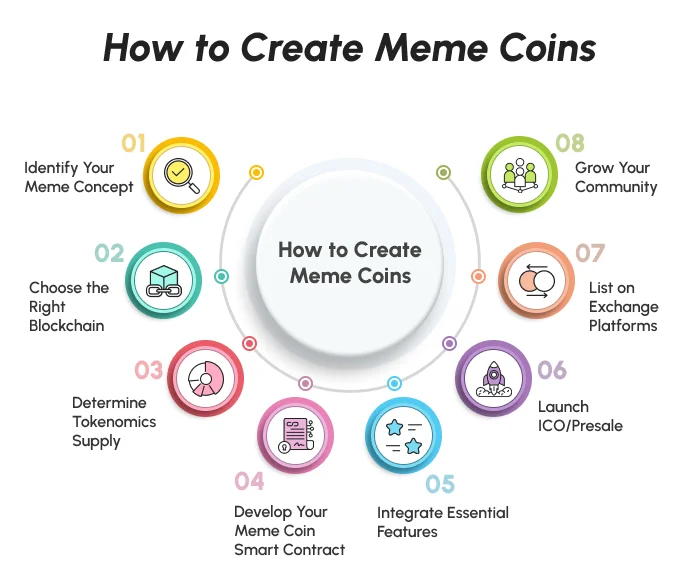
Identify Your Meme and Concept
Every successful meme coin starts with a strong plan and a catchy idea. Before touching a blockchain, identify the meme, story or theme. In 2026, simple dog and cat clones get little attention, so a distinctive hook matters more than ever. Pick a short, memorable ticker and a consistent visual identity. The goal is to create a meme coin people remember, share and talk about, because community buzz drives everything that follows.
Choose the Right Blockchain
When working out how to create a meme coin, the blockchain choice is just as important. It sets your coin's speed, fees and audience:
- Solana: the main home of meme coin trading, with near-zero fees and launchpads such as pump.fun.
- Base: Coinbase's Ethereum layer 2, popular with retail users who already hold Coinbase accounts.
- BNB Chain: low fees and a large retail trading base, with launchpads such as Four.meme.
- Ethereum: higher fees, but the deepest liquidity and the most established DeFi tools.
Based on your goals and audience, choose the network that fits best. Pixel builds meme tokens on all of them, including Solana token development.
Determine Tokenomics and Supply
Tokenomics define how your meme coin works: the total supply, the distribution and any utility. Decide how many tokens exist and how they are split between liquidity, the community, marketing and the team. Many credible launches put most of the supply into liquidity, keep the team share small and vested, and avoid hidden wallets. Also decide whether to add burn mechanisms or rewards, and publish the allocation openly.
Develop Your Meme Coin Smart Contract (or Use a Launchpad)
The smart contract is the technical core of your meme coin. It controls transfers, balances, minting and burning. There are two routes:
- Launchpad route: platforms such as pump.fun create a standard token for you from a short form, with no coding.
- Custom contract route: a developer writes and audits your own token contract, usually on audited ERC-20 or SPL code, which gives you full control over features and supply rules. This guide on how to create an ERC20 token explains the EVM version in detail.
Either way, a secure, bug-free contract is essential, because any vulnerability can lead to hacks or a loss of trust. For a custom contract, book an independent smart contract audit before launch.
Integrate Essential Features
When planning how to create a meme coin, decide its functionality early. A meme coin needs a balance of fun and function to stay relevant. Features such as liquidity pools, staking, wallet compatibility and community voting make it more attractive and useful.
Launch: Fair Launch, Presale or ICO
There are two main ways to launch. A fair launch through a bonding curve launchpad lets anyone buy from the first second, with no insider allocation, and has become the default on Solana. A presale or Initial Coin Offering (ICO) lets early supporters buy at a discount and funds marketing and development. Presales need a professional whitepaper, a landing page and clear tokenomics, and they attract more regulatory attention. If you take the presale route, this guide on how to launch an ICO walks through the process, and a dedicated crypto launchpad can host the sale.
List on Exchange Platforms
After launch, your meme coin needs places to trade. On launchpads, tokens that fill their bonding curve migrate automatically to a DEX (PumpSwap, in pump.fun's case). Custom tokens can list on DEXs such as Uniswap, PancakeSwap or Raydium by adding liquidity. Centralised exchanges have their own listing criteria, usually including trading volume, liquidity and compliance checks.
Grow Your Community
The success of a meme coin depends on community engagement. Build active communities on X, Telegram, Discord and Reddit to create interest. Meme contests, giveaways and regular updates keep holders engaged.
While this whole process may look simple, it needs a careful approach. The next two sections show why.
Launchpad vs Custom Contract: Which Route Fits?
Most competing guides cover only one of these. Here is how they compare in October 2026:
| Factor | Launchpad (for example, pump.fun) | Custom contract with a development team |
|---|---|---|
| Upfront cost | No platform creation fee on pump.fun; only Solana network costs | Pixel meme coin development: $5,000 to $15,000 |
| Time to launch | Minutes | Typically a few weeks, including the audit |
| Trading fees | 1.25% on pump.fun's bonding curve (0.95% protocol, 0.30% creator), then tiered PumpSwap fees, per pump.fun's fee schedule updated 8 October 2026 | Set by the DEX you list on |
| Control over features | Standard token only | Full control: taxes, vesting, burns, staking, multichain |
| Credibility signals | Fair launch, no team allocation | Audit report, locked liquidity, vested team tokens, KYC'd team |
| Best for | Fast community experiments | Brands, communities with a roadmap, and projects planning utility |
The Liquidity Maths That Decides Whether a Meme Coin Survives
This is the unique part most guides leave out. New meme coins usually trade in a constant product pool, where the pool's two balances multiply to a fixed number (x times y equals k). The thinner the pool, the more each trade moves the price.
Here is a worked example at a SOL price of $110.30 (CoinGecko, 9 October 2026), with a supply of 1 billion tokens, all placed in the pool, and fees ignored:
| Pool | Starting price per token | Implied market cap | Price move after a 1 SOL buy | Tokens the buyer receives |
|---|---|---|---|---|
| 10 SOL + 1 billion tokens | 0.00000001 SOL ($0.0000011) | About $1,103 | +21% | 90.9 million (9.1% of supply) |
| 100 SOL + 1 billion tokens | 0.0000001 SOL ($0.000011) | About $11,030 | +2.0% | 9.9 million (1% of supply) |
The maths: after a 1 SOL buy, the 10 SOL pool holds 11 SOL and 1,000,000,000 x 10 / 11 = 909,090,909 tokens. The new price is 11 / 909,090,909 SOL, which is 21% higher. In the 100 SOL pool, the same buy moves the price by (101 / 100) squared minus 1, about 2%.
The same logic works in reverse. If someone sells 100 million tokens (10% of supply) into a pool holding 10 SOL and 1 billion tokens, the price falls about 17%, because (1 / 1.1) squared is about 0.83. Shallow liquidity and concentrated holdings are why so many meme coins crash in minutes. Deeper liquidity, locked LP tokens and a small, vested team allocation are the practical defences.
Risks Involved in Developing Meme Coins
Before you create a meme coin, look at the survival data. Solana Compass reported in June 2026 that pump.fun had facilitated about 11.9 million launches, with fewer than 2% graduating to a DEX, based on The Block's tracker and Dune dashboards. These are the main risks, and how to manage them.
Security Vulnerabilities
Smart contracts or other parts of a meme coin may contain coding flaws. These can lead to stolen funds or token manipulation.
How to Fix?
- Hire experienced blockchain developers, commission a professional audit, and integrate essential security protocols such as multisig admin wallets.
Lack of Tech Knowledge
Handling a meme coin requires an understanding of blockchains, smart contracts, tokenomics and exchanges. Beginners may misconfigure token features, deploy the wrong contract type or miss essential functions.
How to Fix?
- Use a trusted launchpad for a simple launch, or partner with a professional meme coin development company for a custom build.
Market Timing
The success of meme coins depends heavily on market trends. Your project can struggle if the hype fades before launch.
How to Fix?
- Research market trends and viral topics before launching. Time launches around crypto events, seasonal trends or viral internet moments.
Rug Pulls and Scams
Inexperienced or malicious teams can withdraw liquidity, leaving holders with worthless tokens. Community distrust after pump-and-dump schemes also damages new launches.
How to Fix?
- Lock liquidity in trusted smart contracts for a defined period, keep the team allocation small and vested, educate holders, and avoid overpromising.
Price Fluctuations
Meme coins are highly volatile. Prices can swing dramatically because of social media hype, community behaviour or low liquidity.
How to Fix?
- Start with deeper liquidity (see the maths above), add staking rewards or burns only where they make sense, and keep the community engaged with a long-term plan.
Legal Checklist Before You Create a Meme Coin
Meme coins are not outside the law. Check these points before launch:
- United States: in February 2025, the SEC's Division of Corporation Finance said that typical meme coins, bought for entertainment and cultural reasons, are generally not securities (SEC staff statement). The statement is a staff view, not a rule; it does not cover tokens that promise profits from a team's work, and fraud remains illegal.
- European Union: under MiCA, offering a meme coin to the public generally requires a crypto-asset white paper notified to a national regulator. Small offers, such as those to fewer than 150 people per member state or raising less than EUR 1 million over 12 months, are exempt from that requirement.
- Dubai, UAE: VARA's Virtual Asset Issuance Rulebook requires any entity in the emirate that issues a virtual asset in the course of business to classify it. A meme coin is not fiat- or asset-referenced, so it would usually fall into Category 2, which means distribution through a VARA-licensed distributor plus a white paper and risk disclosure statement.
- Marketing: influencer promotions and paid posts are regulated in many markets, so disclose paid endorsements.
How to Make Money With Meme Coins: 8 Strategic Ways
There are several ways to make money with meme coins. Here is a list:
- Trading meme coins
- Meme coin development
- ICO and meme coin crowdfunding
- Staking and yield farming
- Social community support
- NFTs and gaming ecosystems
- Long-term holding (HODL)
- Airdrops and collaborations
Trading Meme Coins
Trading meme coins on crypto exchanges is the most direct way to try to earn money. By buying low and selling high, traders aim to profit from price swings driven by hype, trends and social media. It is also the fastest way to lose money, so risk only what you can afford to lose.
Meme Coin Development
Creating your own meme coin lets you generate revenue through token sales, launchpad creator fees and the ecosystem you build around it. On pump.fun, for example, creators earn a share of bonding curve trading fees. Teams can also retain a small, vested portion of the supply.
ICO and Meme Coin Crowdfunding
Initial Coin Offerings (ICOs) and presales let you raise funds by selling tokens to early supporters. Discounted presale prices attract backers and secure liquidity for the project, but they also bring legal obligations in many markets.
Staking and Yield Farming
Staking and yield farming offer passive income opportunities to meme coin holders. By locking tokens in a protocol or liquidity pool, participants can earn rewards, interest or additional tokens.
Social Community Support
A strong community has a direct effect on profitability. Meme coins thrive on viral content and word-of-mouth promotion. Active communities increase trading volume and brand visibility, which drives demand.
NFTs and Gaming Ecosystems
Integrating a meme coin into NFTs and games opens new revenue streams. Meme-themed NFTs can be sold or traded, and the coin can serve as in-game currency or rewards. Pudgy Penguins, whose PENGU token sits in CoinGecko's top meme coins, shows how a brand can span NFTs, toys and a token.
Long-Term Holding (HODL)
Holding a meme coin can be profitable if adoption grows, new listings arrive or the brand matures. However, most leading meme coins trade 84% to 97% below their all-time highs, so long-term holding needs patience, market awareness and strict position sizing.
Airdrops and Collaborations
Strategic partnerships, collaborations and airdrops can widen reach and add value. Airdrops reward holders or attract new users, while collaborations with creators, brands or other projects build exposure and credibility.
Now that you have seen the main ways meme coins can generate revenue, let's look at the cost of developing one.
How Much Does Meme Coin Development Cost?
At Pixel Web Solutions, meme coin development costs $5,000 to $15,000. The final figure depends on your requirements, the chain, the level of customisation, and extras such as staking, governance, NFT integration, a presale dApp or a multichain launch.
Network costs are separate and usually small: creating a coin on pump.fun carries no platform fee, and deploying a standard token on most chains costs a few dollars or less in October 2026. The larger budget lines sit outside the contract: initial liquidity, audits, legal review, exchange listings and marketing. Plan them before launch day, because thin liquidity is the fastest way to lose a community (see the maths above).
What Does the Future Hold for Meme Coins?
The meme coin market is still large, but it is far from certain. At $32.17 billion in October 2026, the category remains one of crypto's biggest narratives, and launchpads still see tens of thousands of new tokens each day. Yet most leading meme coins sit far below their peaks, and fewer than 2% of launchpad tokens reach a DEX.
Several trends are shaping the next chapter. Launchpads now share fees with creators, which rewards teams that keep building after launch. Meme coins are adding utility, such as payments, staking, games and NFTs, to give holders reasons to stay. Clearer rules, from the SEC staff statement to MiCA and VARA's issuance rulebook, are separating community tokens from disguised securities. And AI-generated characters and agents have become a new source of meme narratives.
Meme coins may have started as jokes, but the ones that last now look more like community brands with real products behind them.
Wrap Up
The future of meme coins favours teams that combine a strong concept with real liquidity, transparent tokenomics and long-term community work. As the market matures, careful builders have a better chance than fast copycats.
By partnering with a professional meme coin development company like Pixel Web Solutions, you can bring your meme coin vision to life. Pixel's expertise in blockchain technology, smart contract development and community-driven projects covers every stage, from tokenomics and audited contracts to launch and liquidity planning. Whether you want a coin with real utility or simply a funny brand done properly, Pixel Web Solutions provides the expertise to turn the idea into reality. If you are still comparing token types, this guide on how to create a crypto token gives the wider picture.
So, ready to launch your own meme coin? Talk to the Pixel Web Solutions team.
Frequently Asked Questions
How much does it cost to create a meme coin?
A launchpad such as pump.fun charges no platform fee to create a coin, so the network cost is very small. A custom, audited meme coin with launch support costs $5,000 to $15,000 at Pixel Web Solutions. Liquidity, marketing and listings are extra.
Can I create a meme coin for free?
Almost. On pump.fun you pay only Solana network costs to create a coin, and trading fees apply after launch. Free creation does not include liquidity, marketing or legal review, which decide whether the coin survives.
Is it legal to create a meme coin?
In most countries, yes. In the US, SEC staff said in February 2025 that typical meme coins are generally not securities, but fraud and misleading promotion remain illegal. Public offers in the EU may need a MiCA white paper, and issuers in Dubai must follow VARA's issuance rules.
Which blockchain is best for a meme coin?
Solana leads meme coin trading thanks to near-zero fees and launchpads such as pump.fun. Base and BNB Chain suit retail audiences with low fees, while Ethereum offers the deepest liquidity at higher cost.
How do meme coins get listed on exchanges?
Launchpad tokens move to a DEX automatically once their bonding curve fills. Custom tokens list on a DEX by adding liquidity. Centralised exchanges review volume, liquidity, community size and compliance before listing.
How do I avoid a rug pull when launching a meme coin?
Lock or burn the liquidity pool tokens, keep the team allocation small and vested, renounce or multisig-protect admin powers, publish an audit, and be transparent about wallets. These signals also help your community trust the project.
Now you know how to create a meme coin in 2026, and why liquidity, transparency and community decide whether it lasts. Pixel Web Solutions can help you create a meme coin that is built to survive its first week and grow after it.