To launch an ICO (initial coin offering) in 2026, follow a 10-step launch plan: define the project and token utility, get legal advice on whether your token is a security, research the market, design tokenomics, write a white paper, build and audit the token and sale contracts, launch an ICO platform with KYC, market the sale within advertising rules, run a presale, then hold the public sale and list the token. In the EU, most public token offers need a MiCA white paper notified to the regulator 20 working days before publication; in the US, the SEC's proposed Regulation Crypto Assets would add offering exemptions but is not yet in force. An ICO platform costs $15,000 to $30,000 to build and the full ICO launch takes two to six months.
An ICO lets a crypto project raise funds by selling its own tokens directly to a global community, before or alongside launching its product. The model still works in 2026, but it looks very different from the 2017 boom. Regulators now expect clear disclosures, investor checks and honest marketing, and investors expect audited contracts, vesting for insiders and a real product.
This guide explains how to launch an ICO step by step, which rules apply, how an ICO compares with IDOs, IEOs and STOs, what it costs and how to choose between a custom and a white-label ICO platform.
Key Takeaways
- Legal classification comes first. In March 2026 the US SEC and CFTC issued a joint token taxonomy, and on 18 August 2026 the SEC proposed Regulation Crypto Assets with a $5 million startup exemption and a $75 million fundraising exemption. Until it is adopted, tokens that are digital securities still need an existing exemption or must exclude US buyers.
- EU offers need a MiCA white paper, notified to the national regulator at least 20 working days before publication, unless an exemption applies. Dubai issuers fall under VARA's Virtual Asset Issuance Rulebook, which requires a whitepaper and a licensed distributor.
- Investors expect proof: audited contracts, a working product or demo, vesting for team tokens and funds held in a multi-signature wallet. CryptoRank counted only 37 public token sales raising $58 million in Q2 2026, so the bar for a credible launch is higher than in any year since 2020.
- Launch costs start around $15,000 for a white-label ICO platform and $15,000 to $30,000 for a custom one. Audits, legal work, KYC and marketing sit on top. The full launch takes two to six months.
- ICOs now compete with IDOs and launchpads, which offer instant liquidity but less control. Many projects combine them.
What Is an ICO and How Does It Work in 2026?
An initial coin offering is a fundraising event in which a project sells newly created tokens to investors, usually in exchange for stablecoins such as USDC and USDT or for ETH or SOL. A smart contract receives the funds and distributes tokens according to the sale rules. After the sale, the token generation event (TGE) releases tokens to buyers and the token lists on decentralized or centralized exchanges.
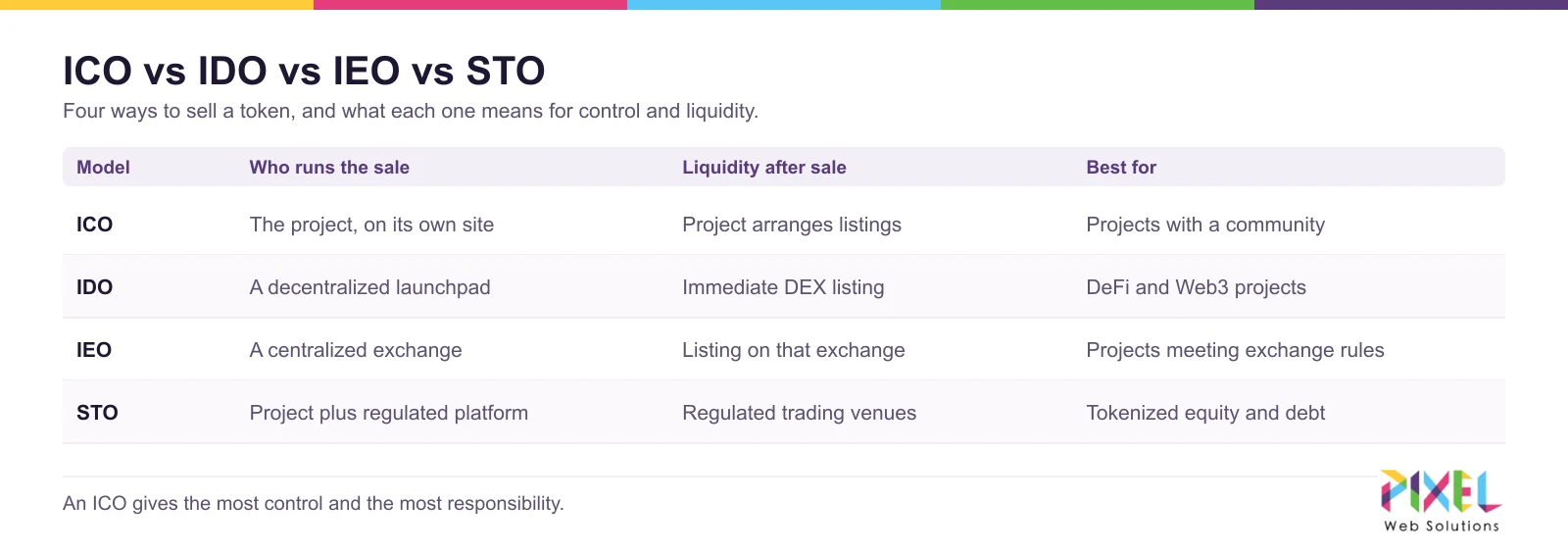
How an ICO compares with other token launch models:
| Model | Who runs the sale | Investor checks | Liquidity after sale | Best for |
|---|---|---|---|---|
| ICO | The project, on its own website | Set by the project (KYC recommended) | Project must arrange listings | Projects with an existing community |
| IDO | A decentralized launchpad | Launchpad rules, often KYC | Immediate DEX listing | Community-driven DeFi and Web3 projects |
| IEO | A centralized exchange | Exchange KYC | Immediate listing on that exchange | Projects that can meet exchange criteria |
| STO | The project with a regulated platform | Full securities KYC and accreditation checks | Regulated trading venues | Tokenized equity, debt or real assets |
The 10-Step ICO Launch Plan at a Glance
An ICO launch runs on three tracks at once: legal, product and marketing. The table below puts the 10 steps in order with what each one produces, how long it usually takes and which budget line it sits on, so you can plan the launch before you build anything.
| Step | What you produce | Typical time | 2026 cost line |
|---|---|---|---|
| 1. Project goals and roadmap | Problem statement, token utility, raise target, dated milestones | 1 to 2 weeks | Founder time |
| 2. Legal advice and jurisdiction | Token classification memo, issuing entity, list of excluded countries | 2 to 6 weeks | Quoted per jurisdiction |
| 3. Market research | Comparable raises, buyer profile, valuation range | 1 to 2 weeks | Founder or agency time |
| 4. Tokenomics | Supply, allocation, price, vesting schedule | 1 to 2 weeks | Founder time, or part of an ICO consulting package |
| 5. White paper | Main white paper, plus a MiCA-format paper for EU offers notified 20 working days before publication | 2 to 4 weeks | Writing in-house; MiCA drafting quoted by counsel |
| 6. Token, sale and vesting contracts, audited | Deployed contracts and a published audit report | 2 to 4 weeks | Token $1,000 to $15,000 by chain; audit $2,000 to $10,000+ (Pixel's audit service) |
| 7. ICO platform | Sale website, KYC flow, investor and admin dashboards | 2 to 4 weeks white-label; 8 to 16 weeks custom | About $15,000 white-label; $15,000 to $30,000 custom, up to $50,000 for complex builds |
| 8. Marketing | Community, content, partnerships, compliant paid promotion | 6 to 12 weeks before the sale | Variable, often the largest line |
| 9. Presale | Early allocation sold with longer vesting | 2 to 4 weeks | KYC at $1.35 to $1.85 per verification (Sumsub's published plans) |
| 10. Public sale, TGE and listings | Closed sale, token distribution, DEX liquidity, exchange listings | 1 to 4 weeks, then ongoing | Your own capital for liquidity; listing fees negotiated |
Source: Pixel Web Solutions' published prices for ICO platforms, token development and smart contract audits, and the KYC pricing on its cost to launch an ICO guide, as of October 2026. MiCA timings are from Regulation (EU) 2023/1114. Time bands are planning estimates; the whole plan usually takes two to six months end to end.
Benefits of Launching an ICO over Other Crowdfunding Methods
Despite tighter rules, an ICO still offers advantages over traditional fundraising:
- Global outreach: investors anywhere can take part, subject to the countries you exclude for legal reasons.
- Speed: a well-prepared ICO can raise funds in weeks rather than the months a venture round takes.
- Community ownership: buyers become users and advocates, which helps adoption from day one.
- Control: unlike an IEO or launchpad, you set the price, timing, rules and marketing.
- Cost-effective setup: a white-label ICO platform lets you launch without building everything from scratch.
The trade-off: you carry the legal responsibility, the security risk and the job of creating liquidity after the sale. Crypto crowdfunding platforms and launchpads can share some of that load.
Launching An ICO – Essential Checklist
Before you build anything, make sure you have these in place:
- A real project with a working product, prototype or credible roadmap
- A clear token utility that explains why the project needs a token
- Legal advice on token classification and the countries you will accept investors from
- Tokenomics covering supply, allocation, pricing and vesting
- A white paper (and, for EU offers, a MiCA-format white paper)
- Audited smart contracts for the token and the sale
- A sale website and investor dashboard with KYC and AML checks
- A multi-signature treasury wallet to hold raised funds
- A marketing plan that complies with advertising rules in your target markets
- A post-sale plan for liquidity, listings and investor reporting
How to Launch an ICO in 2026: The 10-Step Launch Plan in Detail
Here is the step-by-step process to launch an ICO in 2026. The quick table above gives the timings and cost lines; this section explains what each step involves.
- Define your project goals and roadmap
- Get legal advice and choose your jurisdiction
- Conduct in-depth market research
- Design comprehensive tokenomics
- Draft an ICO white paper
- Build and audit the token and sale smart contracts
- Develop a feature-rich ICO website and investor dashboard
- Promote your token sale effectively
- Execute a presale campaign
- Launch the public token sale, TGE and listings
Let us dig into each step.
1. Define Your Project Goals and Roadmap
An ICO is not only about raising capital. It is the public launch of your project, so start with clarity:
- What problem does the project solve, and for whom?
- Why does it need a token, and what will the token do?
- How much do you need to raise, and what will the money pay for?
- What milestones will you hit, and when?
Turn the answers into a roadmap with dated milestones. Investors use it to judge whether you can deliver, and it keeps your team accountable after the sale.
2. Get Legal Advice and Choose Your Jurisdiction
This is the step most failed ICOs skipped. The rules depend on how your token works and where your buyers live:
- United States: on 17 March 2026, the SEC and CFTC issued a joint interpretation sorting crypto assets into five categories: digital commodities, digital collectibles, digital tools, stablecoins and digital securities. Tokens sold as investments can still be offered under an investment contract, so US sales usually rely on securities exemptions or exclude US buyers.
- European Union: under MiCA, a public offer of most crypto-assets requires a white paper in the prescribed format, notified to the national regulator before publication, with a right for retail buyers to withdraw within 14 days. Exemptions exist for small offers (under €1 million over 12 months), offers to fewer than 150 people per member state and offers only to qualified investors.
- United Kingdom: crypto promotions to UK consumers must comply with FCA financial promotion rules.
- Everywhere: apply KYC and AML checks, screen sanctions lists and block countries where the sale would be unlawful.
Many projects set up the issuing entity in a jurisdiction with clear token rules, such as Switzerland, the UAE or an EU member state. Your lawyer should confirm the right structure for your token and investors. The 2026 rules for the EU, the US and Dubai are set out region by region in the regulation section after step 10.
3. Conduct In-Depth Market Research
Study the market before you set your raise and price:
- Which comparable projects raised money recently, how much, and how did their tokens perform after listing?
- Who are your likely buyers, and where do they gather online?
- What do investors in your category worry about (unlock schedules, valuation, team credibility)?
This research shapes your valuation, sale structure and marketing message.
4. Design Comprehensive Tokenomics
Tokenomics is the economic design of your token. Cover:
- Purpose: utility, governance, rewards or payments.
- Total supply and allocation: sale, team, investors, treasury, ecosystem, liquidity.
- Sale price and valuation: the fully diluted valuation (FDV) implied by your price.
- Vesting and lock-ups: cliffs and release schedules for team and early investors, usually over one to four years.
- Emissions, minting and burning: how supply changes over time.
Transparent tokenomics with meaningful vesting builds trust. Heavy early unlocks for insiders are one of the biggest red flags investors look for.
Also read: 8 Steps and Essential Features to Develop a Utility Token
5. Draft an ICO White Paper
The white paper is your main disclosure document. It should explain:
- The problem, the solution and the technology
- The token's utility, rights and tokenomics
- Use of funds and the roadmap
- The team and advisers
- Risks, including technical, market and regulatory risks
- Sale terms, eligible countries and legal disclaimers
Avoid promises of returns or price growth. For EU offers, prepare the MiCA white paper in the required format alongside your main white paper.
6. Build and Audit the Token and Sale Smart Contracts
An ICO needs two sets of smart contracts:
- The token contract, usually ERC-20 on Ethereum or an EVM chain, or an SPL token on Solana.
- The sale contract, which accepts payments, enforces caps and whitelists, calculates allocations and handles refunds if a soft cap is not met.
- Vesting contracts that release team and investor tokens on schedule.
Commission an independent audit before the sale and publish the report. Hold raised funds in a multi-signature wallet so no single person can move them. An experienced ICO development team can build and audit these components for you.
7. Develop a Feature-Rich ICO Website and Investor Dashboard
The ICO website is where investors learn, verify and buy. Essential features:
- A clear project overview, team profiles and roadmap
- White paper, audit report and legal documents
- Token sale details: price, caps, accepted currencies, dates and eligible countries
- KYC and AML onboarding with country restrictions
- An investor dashboard showing contributions, allocations and vesting
- Wallet connection and payment options (stablecoins, ETH, SOL, cards through a provider)
- An admin panel to manage rounds, whitelists, bonuses and reports
- Referral tracking, support and analytics
8. Promote Your Token Sale Effectively
Reaching the right investors decides the outcome, and crypto marketing now has rules. Effective and compliant channels include:
- Content marketing: explainers, product demos, development updates and AMAs
- Community building: active Telegram, Discord and X communities with real moderation
- Partnerships: with other projects, launchpads, media and ecosystem funds
- Events: conferences and meetups where your target investors gather
- Airdrops and quests: careful, targeted incentives that reward real users rather than bots
- Paid promotion: only where permitted, with clear disclosure of paid influencer content
Never promise profits, and make sure every claim can be backed up. Regulators increasingly act against misleading crypto promotions.
9. Execute a Presale Campaign
A presale (or private sale) offers tokens to early supporters, often at a lower price with longer vesting. It helps you:
- Raise early capital for marketing and development
- Test demand and refine the public sale terms
- Build a core group of committed holders
- Prepare the platform and support team for the main sale
Keep presale discounts reasonable and vest presale tokens, so early buyers do not simply sell at listing.
10. Launch the Public Token Sale, TGE and Listings
Now open the sale to eligible investors:
- Monitor the platform, KYC queue and smart contracts in real time
- Communicate openly and often with contributors
- Close the sale when the hard cap or end date is reached, or refund if the soft cap is missed
- Hold the token generation event and distribute tokens according to vesting rules
- Add liquidity on a DEX, pursue centralized exchange listings and consider a market maker
- Publish regular updates on progress and use of funds

By following these steps, you can launch an ICO that investors trust and regulators accept. Two decisions sit underneath all 10 steps: which rules apply to your sale, and which ICO platform you sell through. The next two sections cover them.
ICO Regulation in 2026: MiCA, SEC and VARA
In 2026 an ICO is regulated by where the buyers are, not where the issuer is. The EU requires a MiCA white paper for most public offers, the US treats tokens sold as investments as securities while a new SEC offering framework is still only proposed, and Dubai regulates token issuance under VARA's Virtual Asset Issuance Rulebook. The table summarises the three regimes most ICO founders meet, then each is explained.
| Region | Rule in force (October 2026) | What an ICO must do | Key thresholds and timings |
|---|---|---|---|
| European Union | MiCA, fully applicable; CASP transitional period ended 1 July 2026 | Publish a MiCA-format white paper, notify the national regulator, give retail buyers a withdrawal right, publish results | Notify at least 20 working days before publication; 14-day retail withdrawal right; exempt if under €1 million over 12 months, fewer than 150 persons per member state, or qualified investors only |
| United States | Securities laws plus the SEC and CFTC March 2026 token taxonomy; Regulation Crypto Assets proposed 18 August 2026, not yet adopted | Treat tokens sold as investments as securities: use an existing exemption (Regulation D, Regulation S) or exclude US buyers until the new rules are adopted | Proposed startup exemption up to $5 million over four years; proposed fundraising exemption up to $75 million per 12 months; comment period 60 days after Federal Register publication |
| UAE (Dubai) | VARA Virtual Asset Issuance Rulebook | Publish a whitepaper with the Schedule 1 contents; place or distribute through a VARA-licensed distributor; Category 1 tokens need a VARA licence and per-token approval | Category 1 covers fiat-referenced and asset-referenced tokens; Category 2 covers other transferable tokens, with no licence needed for the issuer |
| United Kingdom | FCA financial promotion rules now; new cryptoasset regime with public offer disclosure rules from 25 October 2027 | Have promotions made or approved by an authorised firm (or an MLR-registered cryptoasset firm), apply the 24-hour cooling-off period for first-time investors, prepare for the 2027 disclosure rules | Regime expected to start 25 October 2027; application gateway opened 30 September 2026 |
Sources: Regulation (EU) 2023/1114 (MiCA, Articles 4, 8 and 13); the SEC's proposed Regulation Crypto Assets release of 18 August 2026; VARA's Virtual Asset Issuance Rulebook; the FCA's new cryptoasset regime page. Checked October 2026.
MiCA: what an EU token offer needs
MiCA is no longer in transition. The crypto-asset white paper is the central document: it must follow the prescribed format, be notified to the national competent authority at least 20 working days before publication, and give retail buyers 14 days to withdraw if the token is not yet admitted to trading. After the sale, the issuer publishes the result within 20 working days of the subscription period ending. The exemptions are narrow: offers under €1 million over 12 months, offers to fewer than 150 persons per member state, offers only to qualified investors, and tokens that give access to a good or service that already exists. Stablecoins (asset-referenced and e-money tokens) sit under separate MiCA titles with authorisation requirements, so an ICO of a stablecoin is a different project altogether.
SEC: the rules today and the rules proposed
The SEC and CFTC's March 2026 joint interpretation sorts crypto assets into five categories, and tokens sold with promises of managerial effort can still be offered under an investment contract, which is a security. On 18 August 2026 the SEC proposed Regulation Crypto Assets, which would create a one-time startup exemption for offerings up to $5 million over four years, a fundraising exemption up to $75 million in each 12-month period with financial statements and ongoing reporting, a safe harbor that lets a token leave investment-contract status once the issuer has completed or permanently ceased the managerial efforts it promised, and preemption of state registration rules. None of that is in force. Until the Commission adopts final rules, an ICO that wants US buyers relies on Regulation D for accredited investors or Regulation S for offshore sales, and most projects still geoblock the United States for the public round. The CLARITY Act, which would set market-structure rules, was blocked in the Senate on a 49 to 50 procedural vote in September 2026.
VARA: issuing a token from Dubai
VARA's Virtual Asset Issuance Rulebook splits issuances into two tracks. Category 1 covers fiat-referenced and asset-referenced virtual assets and anything else VARA designates; issuing one requires a VARA licence and approval for each token. Category 2 covers every other non-exempt virtual asset: the issuer needs no VARA licence, but all placement and distribution must go through a VARA-licensed distributor, and a whitepaper with the Schedule 1 contents (issuer, token, rights, technology, distributor and offering details) must be published in one accessible, machine-readable location before issuance. VARA states that neither a licence nor an approval is an endorsement of the issuer or the token. Non-transferable and closed-loop tokens are exempt. Pixel Web Solutions operates from Ras Al Khaimah, UAE and Madurai, India, so Gulf projects can scope the platform and the VARA route with the same team.
Everywhere: the three constants
Whatever the jurisdiction, three obligations do not change. Apply KYC and AML checks and screen sanctions lists for every buyer. Block countries where the sale would be unlawful. Keep every marketing claim provable and never promise returns, because financial promotion rules in the UK, the EU and the US all reach token marketing.
What Is an ICO Platform, and Which One Should You Use?
An ICO platform is the software that runs the token sale: the public sale website, the KYC and AML onboarding, the token purchase module with wallet connection and payment options, the investor dashboard that shows contributions and vesting, and the admin panel that manages rounds, caps, whitelists and reports. It sits between the smart contracts and the buyer, and it is where most of the ICO development budget goes.
| Module | What it does | Why it matters in 2026 |
|---|---|---|
| Sale website and investor dashboard | Project overview, white paper, audit report, live sale progress, contribution history, vesting view | Investors verify before they buy; the dashboard is where trust is won or lost |
| KYC and AML onboarding | Identity verification, sanctions screening, country blocking, investor-type restrictions | Required by MiCA, VARA and every serious exchange listing |
| Token purchase module | Wallet connection, stablecoin, ETH, SOL and card payments through a provider, allocation calculation | Multi-currency support widens the buyer pool |
| Sale controls | Private, presale and public rounds with per-round pricing, soft and hard caps, refunds, per-wallet limits, whitelists | Caps and refunds are what regulators and buyers look for first |
| Vesting and distribution | Cliffs, linear or staged releases, TGE distribution | Vested insider tokens are the single biggest red flag check |
| Admin panel | Round management, smart contract management, bonus and referral settings, reports, access controls | Lets a small team run the sale without a developer on call |
| Referral, airdrop and support | Referral tracking, quests, help desk, multilingual interface | Community growth tools that feed the marketing step |
You can get those modules three ways: build a custom ICO platform, license a white-label one, or sell through someone else's launchpad. Pixel Web Solutions, an ICO development company that builds all three, prices a white-label ICO platform at about $15,000 and a custom platform at $15,000 to $30,000, rising to $50,000 for complex builds, with an 8 to 16 week timeline for custom work. The next section weighs the three routes.
Popular Development Methods to Create an ICO Platform
There are three ways to create an ICO platform.
Custom ICO Development
A custom ICO platform is built from scratch around your requirements: your own sale logic, design, dashboard and integrations. It suits projects with complex sale structures or a need for a unique brand experience. It takes longer and costs more, and every new component needs testing and auditing.
White-Label ICO Software
White-label ICO software is a pre-built, tested platform with sale contracts, KYC integration, investor and admin dashboards and payment options, rebranded and configured for your project. It is the fastest and most cost-effective route for most startups, and you can still customize features.
Launching Through a Launchpad
Instead of (or alongside) your own ICO, you can sell through a launchpad (an IDO) or an exchange (an IEO). You gain the platform's audience and instant liquidity but give up control over timing, pricing and fees. See crypto launchpad development if you want to run a launchpad of your own.
How Much Does It Cost To Launch An ICO?
The cost to launch an ICO platform is $15,000 to $30,000 for most projects, with white-label ICO software at about $15,000 and complex custom ICO development reaching $50,000. The full launch budget and timeline look like this:
| Cost item | 2026 cost | Timeline | Figure type |
|---|---|---|---|
| ICO platform (white-label) | About $15,000 | 2 to 4 weeks | Pixel Web Solutions published price |
| ICO platform (custom) | $15,000 to $30,000; up to $50,000 for complex builds | 8 to 16 weeks | Pixel Web Solutions published price |
| Token and vesting contracts | $1,000 to $15,000 depending on chain and complexity | 1 to 3 weeks | Pixel Web Solutions published price |
| Smart contract audit | $2,000 to $10,000+ | 1 to 3 weeks | Pixel Web Solutions audit service; independent firms quote by scope |
| Legal opinion and MiCA white paper | Quoted per jurisdiction; budget for it from day one | 4 to 8 weeks, including the 20 working day MiCA notification | Varies |
| KYC and AML provider | $1.35 to $1.85 per verification plus a monthly minimum | Ongoing through the sale | Sumsub's published plans |
| Marketing and community | Variable, often the largest line after development | 6 to 12 weeks before the sale | Industry practice |
| Liquidity and listings | Your own capital for DEX pools, plus negotiated exchange listing costs | At TGE and after | Varies |
Source: Pixel Web Solutions' published prices and the vendor pricing on its cost to launch an ICO guide, as of October 2026. Legal, marketing and liquidity are quoted per project and are deliberately left without an invented figure.
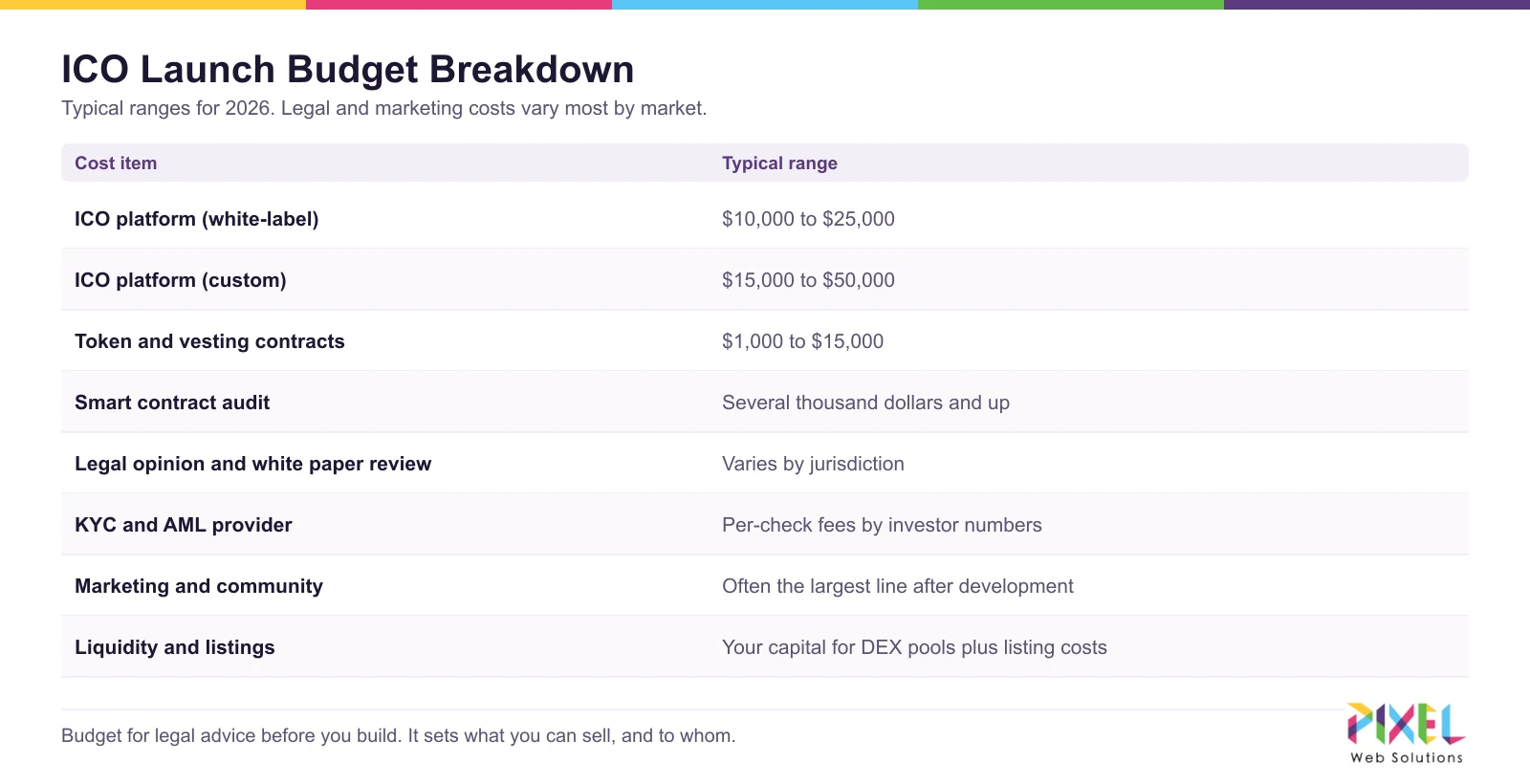
For the token itself, see our breakdown of the cost to create a crypto token.
Common ICO Mistakes and Red Flags to Avoid
- Skipping legal advice: selling tokens that count as securities without an exemption is the fastest way to a regulatory action.
- No product: investors now expect a working product or at least a credible demo.
- Unaudited contracts: one bug in the sale contract can lose every contribution.
- Aggressive insider unlocks: large team or investor unlocks soon after listing destroy trust and price.
- Promising returns: guaranteed profits in marketing are both illegal in many countries and a scam warning sign.
- No liquidity plan: a token that cannot be traded after the sale frustrates buyers immediately.
Your Journey to a Successful ICO Launch Starts Here!
If you are working out how to launch an ICO and want one team for the whole plan, Pixel Web Solutions provides complete ICO launch services: token and sale contracts, audit coordination, white-label or custom ICO platforms with KYC, investor dashboards and admin tools, and post-sale support for liquidity and listings. We also build IEO platforms and STO platforms for projects that need a different model.
Share your project details with our experts and let us plan your ICO launch together.
Frequently Asked Questions
What are the key legal and regulatory considerations for launching an ICO?
Determine whether your token is a security in each target market, follow MiCA white paper rules for EU offers, comply with advertising rules such as the UK FCA's, apply KYC, AML and sanctions checks, and block countries where the sale would be unlawful. Take specialist legal advice before launch.
Is launching an ICO legal in 2026?
Yes, in many countries, provided you follow the rules. The EU regulates token offers under MiCA, the US applies securities law to tokens that are digital securities under the SEC and CFTC's March 2026 taxonomy (with offering exemptions proposed in August 2026 but not yet adopted), Dubai regulates issuance under VARA's rulebook, and some countries restrict or ban ICOs altogether.
How much does it cost to launch an ICO?
Building an ICO platform costs $15,000 to $30,000 for most projects, and white-label ICO software costs about $15,000. Audits ($2,000 to $10,000+), legal work, KYC, marketing and liquidity are additional costs.
How long does it take to launch an ICO?
With white-label software, the platform can be ready in a few weeks. The full process, including legal review, tokenomics, white paper, audit and marketing, usually takes two to six months.
What is the difference between an ICO, an IDO and an IEO?
An ICO is run by the project on its own website. An IDO is run on a decentralized launchpad with immediate DEX listing. An IEO is run by a centralized exchange, which vets the project and lists the token on its own platform.
Do I need a white paper to launch an ICO?
Yes. Investors expect a white paper that explains the project, token and risks, and in the EU a MiCA-compliant white paper is legally required for most public token offers.
How do I start a successful ICO?
Build a real product, get legal advice early, design fair tokenomics with vesting, audit your contracts, market honestly to the right community and plan liquidity for after the sale. A reliable ICO development partner helps you execute each step.
What is an ICO platform?
An ICO platform is the software that runs a token sale: the sale website, KYC and AML onboarding, a token purchase module with wallet and payment options, an investor dashboard with vesting, and an admin panel for rounds, caps, whitelists and reports. White-label platforms cost about $15,000; custom ones $15,000 to $30,000.
Can I launch an ICO from Dubai?
Yes. VARA's Virtual Asset Issuance Rulebook lets a Dubai entity issue a Category 2 token without a VARA licence, provided a compliant whitepaper is published and the token is placed through a VARA-licensed distributor. Fiat-referenced and asset-referenced tokens (Category 1) need a VARA licence and approval for each token.
What are the risks and challenges of launching an ICO?
The main risks are regulatory action, smart contract exploits, weak demand, price collapse after listing and reputational damage from poor communication. A legal review, audits, sensible tokenomics and a post-sale plan reduce each one.