The cost to launch an ICO in 2026 starts with the platform: $15,000 to $30,000 for most projects with Pixel Web Solutions, about $15,000 for white-label ICO software, and up to $50,000 for complex custom builds. On top of that, budget $2,000 to $10,000 or more for a smart contract audit and about $1.35 to $1.85 per buyer for KYC checks. Network fees are now tiny, so legal advice, marketing and liquidity are usually the lines that decide the final budget.
Isn't it ironic? The whole idea behind ICOs was to raise money, but launching one can feel like you need a small fundraiser of your own. That is because ICOs have evolved. In 2026, a token sale is no longer just a token and a whitepaper: it needs a legal plan, secure smart contracts, KYC, a working marketing plan and, in many markets, a regulator-ready disclosure document.
In this blog, we break down the actual cost to launch an ICO, line by line, with a worked example and the legal costs each major regulator adds. We also cover what influences the cost, the mistakes that inflate it and how to avoid them. For the step-by-step launch process itself, see our guide on how to launch an ICO.
Key Takeaways
- The platform is the biggest fixed cost: Pixel's ICO platforms cost $15,000 to $30,000, white-label software about $15,000, and complex custom ICO development up to $50,000.
- Security and KYC are separate lines: audits run $2,000 to $10,000 or more, and identity checks with AML screening cost about $1.85 per buyer on a published vendor plan.
- Gas is no longer a budget item: deploying a token, a sale contract and a DEX pool cost about $0.31 on BNB Smart Chain and about $12 on Ethereum at 27 September 2026 prices.
- Regulation now has a price and a timeline: EU offers above €1 million need a MiCA white paper notified at least 20 working days before publication, and the US SEC proposed new token offering exemptions in August 2026.
- Legal, marketing and liquidity are variable: get quotes for them before you fix your raise target.
How Much Does it Cost to Launch an ICO in 2026?
On average, the cost to launch an ICO platform falls between $15,000 and $30,000, depending on your requirements and development approach. If you adopt white-label ICO software or a pre-built clone solution, the estimated cost is around $15,000. This is the most cost-effective way to launch a fully functional ICO platform. Complex, fully custom ICO development can reach $50,000.
This ICO development cost is allocated for:
-
White paper and technical document support
-
Token creation
-
Smart contract creation for the token sale and vesting
-
Admin and investor dashboard features
-
Security protocols
-
KYC/AML tool integration
-
Front-end with custom branding
-
Essential third-party integrations, such as payment options
-
Basic post-launch tech support
The platform is only part of the full launch budget. Here is how the other lines compare.
| Cost line | Typical cost in 2026 | Source or basis |
|---|---|---|
| ICO platform (white-label) | About $15,000 | Pixel Web Solutions published price |
| ICO platform (custom) | $15,000 to $50,000 | Pixel Web Solutions published price |
| Smart contract audit | $2,000 to $10,000+ | Pixel's audit service range |
| KYC and AML checks | $1.35 to $1.85 per verification | Sumsub published plans |
| Network fees (token, sale contract, DEX pool) | About $0.31 on BNB Smart Chain; about $12 on Ethereum | Measured gas, 27 September 2026 prices |
| MiCA white paper (EU offers above €1 million) | Legal and drafting fees, quoted | Required format since 23 December 2025 |
| Legal opinion on token classification | Quoted per jurisdiction | Depends on where you sell |
| Marketing, PR and community | Variable, often the largest line | Depends on raise size and audience |
| DEX liquidity after the sale | Your own capital | Not a fee, but you must fund it |
| Centralized exchange listing | Negotiated privately | Exchanges do not publish listing fees |
However, it is important to note that the cost to launch an ICO platform is determined by several influential elements, which we cover below. First, here is how the numbers add up for a real launch plan.
A Worked Example: Pricing a Lean ICO Line by Line
To make the budget concrete, here is a lean ICO priced with published and measured figures only. The assumptions are stated so you can swap in your own.
The plan: a utility token sold on BNB Smart Chain through a white-label ICO platform. The sale excludes US persons, raises under €1 million from EU buyers over 12 months (so the MiCA white paper exemption for small offers applies), and expects about 1,500 buyers who each pass KYC. The buyer count is an assumption for illustration.
| Line | Calculation | Cost |
|---|---|---|
| White-label ICO platform (token, sale contracts, dashboards, KYC integration) | Pixel published price | $15,000 |
| Smart contract audit | Pixel audit range | $2,000 to $10,000 |
| KYC with AML screening | 1,500 buyers × $1.85 (Sumsub Compliance plan, $299 monthly minimum) | $2,775 |
| Deploy token contract | 2,307,412 gas × 0.05 gwei × $773.82 per BNB | $0.09 |
| Deploy sale contract | Assumed similar size to the token: 2,307,412 gas | $0.09 |
| Create PancakeSwap pool and add first liquidity | 3,464,188 gas × 0.05 gwei × $773.82 | $0.13 |
| Priced subtotal | About $19,775 to $27,775 |
Gas for the token and pool comes from real mainnet transactions; BNB Smart Chain gas was 0.05 gwei and BNB traded at $773.82 on CoinGecko on 27 September 2026.
The same launch on Ethereum would use about 7.3 million gas (a Uniswap V2 pool used 2,719,856 gas in our sample). At Etherscan's average of 0.615 gwei on 27 September 2026 and ETH at $2,688.95, that is about $12. Even at 5 gwei, above any reading in the previous 30 days, it would be about $99.
What this example leaves out: a legal opinion, marketing and PR, liquidity capital for the DEX pool and any centralized exchange listing. These lines vary so much by market and raise size that no honest guide can price them for you. Get written quotes for each before you set your raise target, because together they often exceed the priced subtotal.
What changes for a larger EU raise: above €1 million, you add a MiCA white paper, custody of the raised funds with a bank or licensed crypto-asset service provider, and a refund reserve for the 14-day withdrawal right. The next section explains each rule.
The Legal Line Items: What US, EU and UK Rules Add to Your ICO Budget
Regulation is where ICO budgets most often go wrong, because each market adds its own documents, timelines and service providers. Here is what each major regulator requires as of September 2026.
| Market | Rule in September 2026 | What it adds to your budget |
|---|---|---|
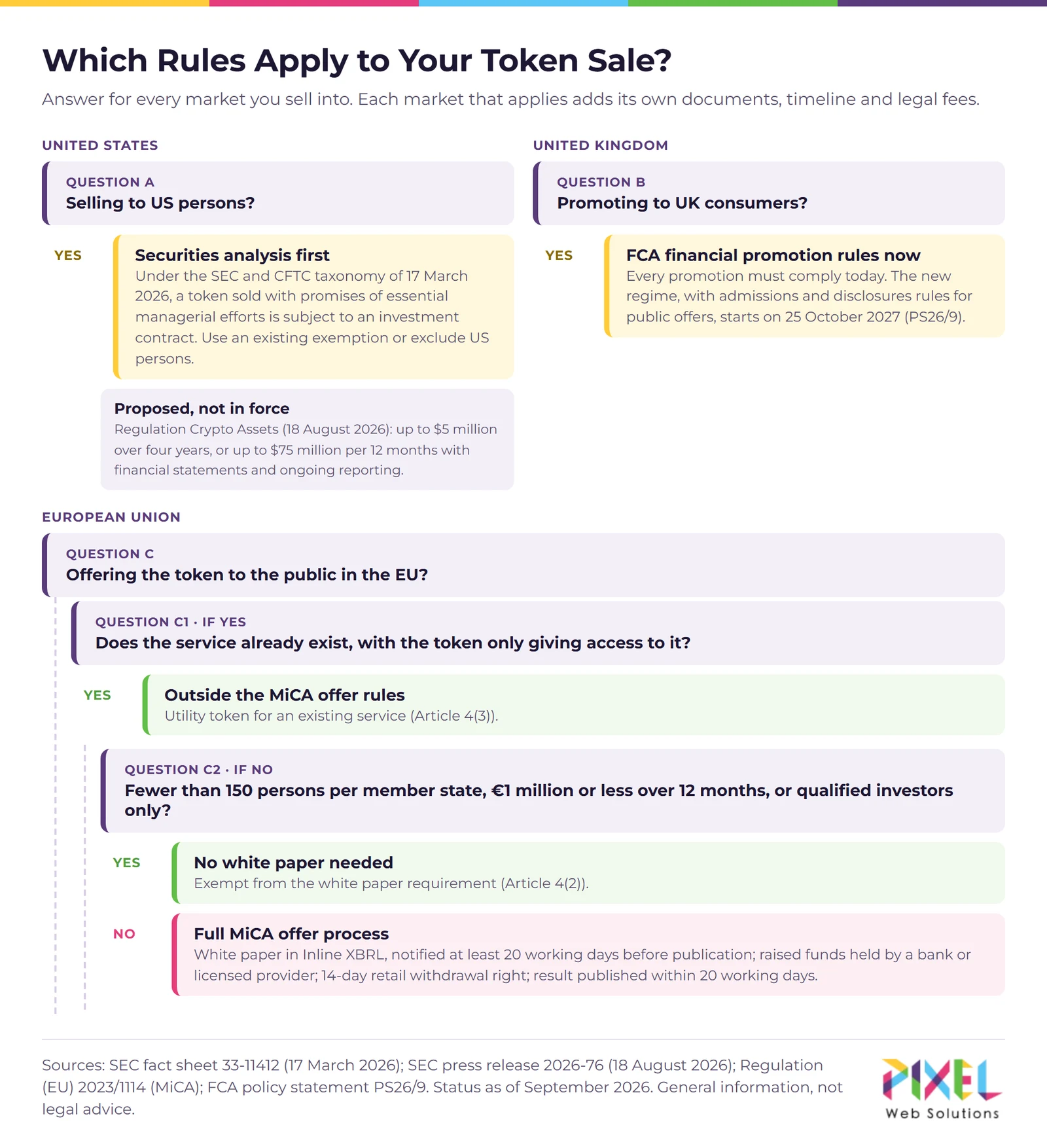
| United States | On 17 March 2026, the SEC and CFTC sorted crypto assets into five categories: digital commodities, digital collectibles, digital tools, stablecoins and digital securities. A token that is not itself a security still becomes subject to an investment contract when it is sold with promises of essential managerial efforts. | A legal opinion on how your sale is structured. Most ICOs still exclude US persons or use existing securities exemptions. |
| United States (proposed) | On 18 August 2026, the SEC proposed Regulation Crypto Assets, with one offering exemption of up to $5 million over four years with narrative disclosures and another of up to $75 million per 12 months with financial statements and ongoing reporting. | Not in force yet. If adopted, the larger exemption would add accounting and reporting costs. |
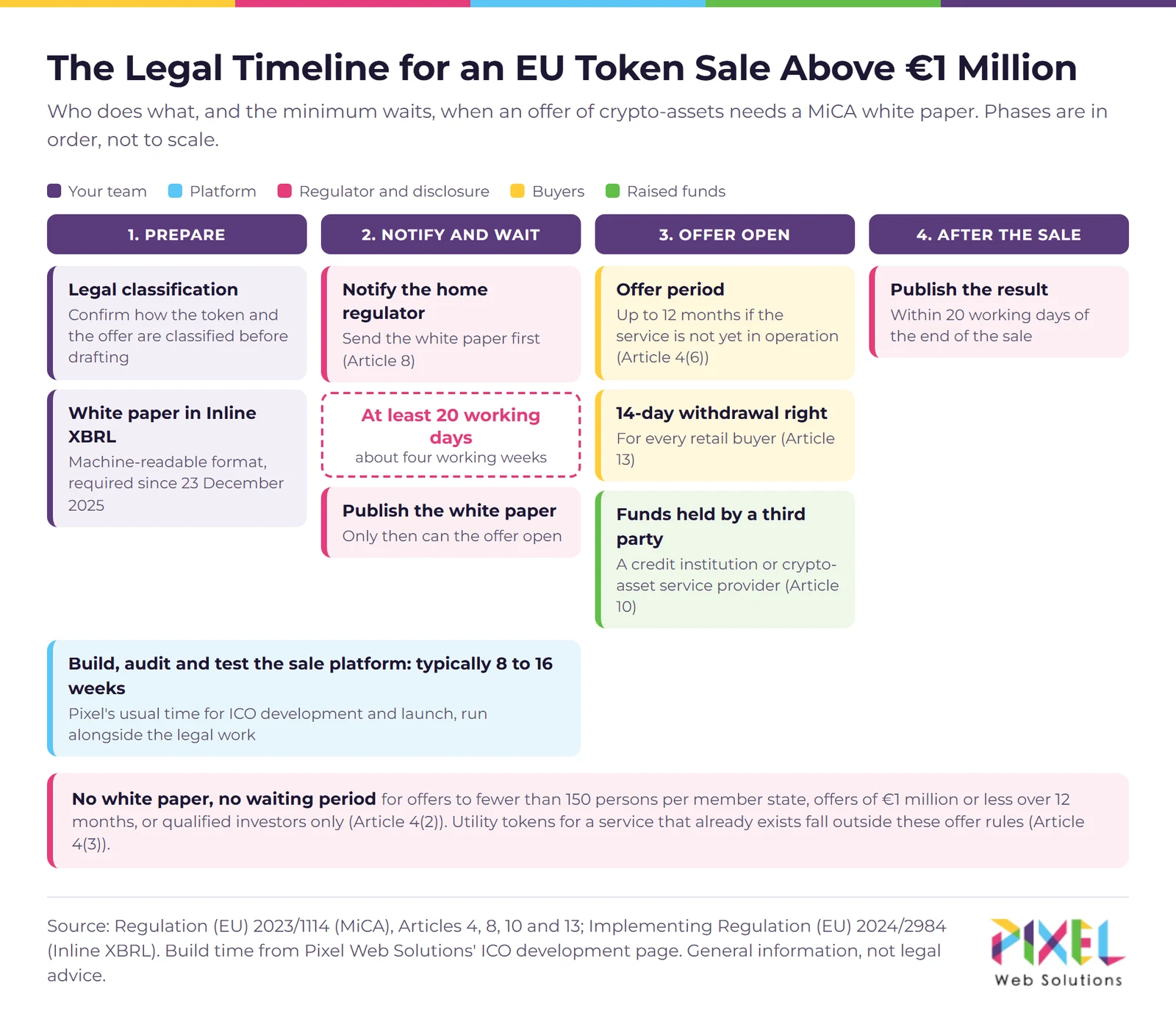
| European Union | Under MiCA, a public offer of most tokens needs a white paper notified to the home regulator at least 20 working days before publication (Article 8). White papers must be machine-readable, in Inline XBRL format since 23 December 2025 under Implementing Regulation 2024/2984. | White paper drafting and tagging, legal review, and at least four working weeks before you can publish. |
| European Union (sale mechanics) | Time-limited offers must hold raised funds with a credit institution or a crypto-asset service provider (Article 10), give retail buyers a 14-day right of withdrawal (Article 13) and publish the result within 20 working days of the end of the sale. | Custody fees, a refund reserve and a results report. |
| European Union (exemptions) | No white paper is needed for offers to fewer than 150 persons per member state, offers of €1 million or less over 12 months, or offers only to qualified investors (Article 4(2)). Utility tokens for a service that already exists fall outside these offer rules (Article 4(3)). | Structuring your sale to fit an exemption can save the white paper cost. |
| United Kingdom | Cryptoasset promotions to UK consumers must follow the FCA's financial promotion rules. The new regime, including admissions and disclosures rules for public offers, starts on 25 October 2027 under the FCA's June 2026 policy statement PS26/9. | Compliant marketing review now; disclosure documents under the new regime from October 2027. |
To decide how your token should be classified before you spend on any of this, read our comparison of utility tokens vs security tokens.
Factors Influencing the ICO Development Cost
Here are the top factors that affect the cost to launch an ICO.
ICO Consultation
A successful ICO starts with expert consultation. These sessions help you define your business model, token utility, goals and legal roadmap. Work with an experienced ICO development company that includes a free initial consultation in its process.
Regulatory Considerations
When you plan an ICO, check the regulatory requirements early. They change from country to country, as the table above shows: an EU raise above €1 million needs a MiCA white paper, US sales need a securities analysis, and UK promotions must follow FCA rules. Legal advice can significantly increase the total cost, but skipping it costs far more. Our guide on how to create a crypto token explains the token-side decisions that affect classification.
Project Timeline
The time you allow plays a significant role in the cost to build an ICO. Pixel's ICO development page puts a typical ICO development and launch at 8 to 16 weeks. A rushed deployment needs a larger team and external specialists, and in the EU you cannot publish your white paper until at least 20 working days after notifying it. The tighter the timeline, the more you will need to invest.
Incorporated Features
The features you integrate are directly proportional to the cost of ICO platform development. On a strict budget, start with the essential features and minimal customisation. After the sale, add unique add-ons such as staking or referral programmes, which will come at a price.
Platform Infrastructure
The ICO platform's architecture also shapes the cost. Security protocols, hosting, dashboards and integrations such as payment options and KYC providers all add up. Plan the infrastructure early so hosting and third-party fees do not exceed your budget.
Tech Stack Used
The blockchain and tools you choose influence the ICO development cost. Network fees are now small on most chains: in our measurements, a full launch cost about $0.31 in gas on BNB Smart Chain and about $12 on Ethereum on 27 September 2026. The bigger difference is the audience, wallets and liquidity each chain brings, which decides how much marketing you need. For token-level costs, see our guides to the cost to create a crypto token and the cost to create an ERC20 token.
ICO Developer's Expertise
Hiring an experienced ICO development company or certified ICO specialists speeds up the process and reduces risk. Expertise comes at a price, but there are affordable options. Make sure the team is experienced, charges market rates and can show audited work.
White Paper Creation
The white paper is central to your ICO launch. It describes your mission, tokenomics, roadmap and risks. A professional white paper combines technical writing, design and legal disclaimers. For EU offers above €1 million, you also need a MiCA white paper in the prescribed, machine-readable format, which is a separate legal document from your marketing white paper.
Post-ICO activities
Even after your ICO platform goes live, you need post-launch support. Maintenance, security monitoring, investor reporting and token distribution all continue after the sale. These costs are easy to forget, but you should not skip them.
ICO Marketing
Even the most technically sound ICO will not succeed without solid marketing. Influencer campaigns, press releases, paid ads, social media and community building can take a large share of your ICO budget. Remember that marketing must also follow the rules: UK promotions must meet the FCA's financial promotion requirements, and EU marketing communications must be consistent with your MiCA white paper.
Common Mistakes That Can Increase Your ICO Development Costs
When launching an ICO, it is normal to make mistakes. Some of them, however, can seriously inflate your costs. Here are the common ones to watch for:
-
Jumping in without a clear understanding of your target audience, competitors or niche.
-
Choosing an unsuitable blockchain, tech stack or an overcomplicated back end, which raises development and maintenance costs.
-
Ignoring legal requirements at the start. This can lead to fines, delays, expensive legal fixes or a forced refund of the sale.
-
Adding too many advanced features in the first version. This increases costs and complicates user adoption.
-
Focusing only on the launch and forgetting to budget for post-launch activities.
-
Cutting the smart contract audit to save money. It lowers the upfront cost but can bring huge problems later.
-
Setting the raise target before getting quotes for legal, marketing and liquidity. These lines often exceed the platform cost.
With these in mind, let us see:
How to reduce the cost of launching an ICO effectively?
Planning correctly before development helps you tighten your budget. Here are the top tactics for reducing your ICO development costs.
White Label ICO Development
Choosing white-label ICO software is the simplest way to reduce the cost of launching an ICO. It is pre-built, tested software that you rebrand and customise, so you can launch quickly.
You can adapt these ready-made scripts to reflect your brand identity. White-label software is the most cost-effective way to launch your ICO platform without compromising quality.
Use Open Source Frameworks
Use open-source blockchain tools, audited contract libraries such as OpenZeppelin and ready-to-use templates to avoid building everything from scratch. This saves time, resources and development expenses, and it shortens the audit.
Launch with Essential Features
Build your ICO platform as an MVP. Launch with the basics, such as wallet integration, investor dashboards and token sale modules. Then add new features based on the platform's reach and demand.
Limit Your Target
Focus on a specific niche or region rather than going global immediately. This reduces marketing, legal and compliance costs in the early stages. Structuring an EU sale to stay within the €1 million or 150-person exemptions, for example, removes the need for a MiCA white paper.
Strategic Marketing Plan
Instead of spending blindly on marketing, find your target audience first. Invest in targeted campaigns and community building on Telegram, Reddit and X, where most crypto audiences are active.
One-Time Packaged Services
Choose a professional ICO development company that offers an end-to-end approach. You avoid hiring specialists individually, and a single team handles everything from consultation to deployment. Alternatively, if you prefer to sell through someone else's platform, a launchpad or an IEO gives you an existing audience in exchange for fees and less control.
On the whole, this ICO development journey might have you wondering about:
Future Scope of ICO Development
Initial Coin Offerings have come a long way since their early days. In 2026, they are becoming a more regulated, investor-friendly and technology-driven way to raise funds. Three developments show the direction:
- Mainstream platforms are buying in. On 8 October 2025, Coinbase acquired Echo, an onchain capital raising platform, for a total purchase consideration of $176.0 million, according to its 2025 annual report.
- Rules are becoming clearer. The EU has applied MiCA's token offer rules since 30 December 2024, and ESMA's interim register listed 1,012 white papers for crypto-assets other than stablecoins and asset-referenced tokens in its 24 September 2026 update.
- The US is building a path. The SEC's March 2026 token taxonomy and its August 2026 proposal for offering exemptions give token issuers a clearer route than the enforcement-led approach of earlier years.
Alongside these trends:
-
ICOs are emerging as a worthy alternative to traditional capital raising, especially for Web3, DeFi and AI-oriented startups.
-
Clearer frameworks make token sales safer and more accessible for investors and businesses.
-
AI tools are increasingly used in ICO platforms for fraud detection, investor support and marketing automation.
In short, ICOs are maturing into a more reliable funding model. With the right strategy, compliance and a reliable ICO Development Company like Pixel Web Solutions, you can launch a functional ICO that stands out.
Why choose Pixel Web Solutions for Cost-Effective ICO Development?
Pixel Web Solutions stands out as a leading Crypto Launchpad Development Company and ICO developer. We have been building software since 2012 and offer reliable, cost-effective blockchain solutions. Our ICO developers and blockchain experts help you launch a secure, scalable and regulation-ready ICO platform, with audits coordinated through our smart contract audit services.
Whether you are a startup looking for white-label ICO software or an enterprise planning a full-scale custom ICO platform, our team offers end-to-end support. From smart contract creation to post-launch maintenance, we help businesses enter the market faster without overspending. Talk to our team for a fixed quote.
Frequently Asked Questions (FAQs)
1. What is the timeframe involved to develop an ICO?
Pixel's ICO development typically takes 8 to 16 weeks, covering planning, smart contracts, token development, dashboards, testing and launch preparation. A white-label platform can be ready faster. For EU offers that need a MiCA white paper, allow at least 20 working days between notifying the regulator and publishing.
2. What is the cost of a White label ICO platform solution?
White-label ICO software from Pixel Web Solutions costs about $15,000. Custom ICO platforms cost $15,000 to $30,000 for most projects and up to $50,000 for complex builds.
3. Are there any hidden or additional costs involved in ICO Development?
Pixel Web Solutions' quote has no hidden costs: our business team provides a written quotation based on your requirements. Outside the development quote, plan for costs that depend on your launch: audit, KYC checks per buyer, legal advice, a MiCA white paper if required, marketing and liquidity.
4. Is it possible to launch an ICO with a lower budget?
Yes. A white-label platform, an audited template token, a low-fee chain and a sale structured to fit an exemption (such as the EU's €1 million threshold) keep the priced costs near $20,000, as our worked example shows. Marketing and liquidity still need their own budget.
5. How much does KYC cost for an ICO?
On Sumsub's published plans, identity verification costs $1.35 per check and verification with AML screening $1.85, with monthly minimums of $149 and $299. For 1,500 buyers on the AML plan, that is $2,775.
6. Who pays legal fees in an ICO?
The issuer does. Legal fees cover token classification, sale terms, white paper review and marketing checks, and they vary by jurisdiction. Get quotes early and include them in your raise target.
7. Can I make money with an ICO?
An ICO raises capital for a project; it is not a profit guarantee. If you run an ICO platform or launchpad as a business, you can earn from listing fees, commissions, ads and premium services.
8. What is the best blockchain for launching an ICO in 2026?
Ethereum, Solana, BNB Smart Chain (formerly Binance Smart Chain), Cardano and Polygon are all strong options. Choose based on your audience, your use case and where your token's liquidity will live, since network fees are now low on all of them.
9. How to create an ICO platform?
Start by defining your business goals and legal structure. Then choose the blockchain, plan the features, develop and audit the contracts, test on a testnet and deploy. If you want to host sales for other projects, a launchpad is the better model.
In short, the cost to launch an ICO in 2026 is predictable for the platform, the audit, KYC and gas, and variable for legal work, marketing and liquidity. Price the fixed lines first, get quotes for the rest, and set your raise target only when the full budget is clear.
Disclaimer:
The cost figures shared in this blog are intended solely for informational purposes and do not reflect an official quote from Pixel Web Solutions. Network fees and vendor prices are measured at the date shown and change over time. This article is not legal advice. Actual pricing will vary based on your project's specific requirements and the services you choose. For a precise and customized quotation, we encourage you to connect with our business team directly.