A white label ICO platform is ready-made token sale software (sale smart contracts, an investor dashboard, an admin panel, and KYC and payment integrations) that you rebrand and configure instead of building from scratch. With Pixel Web Solutions, white-label ICO software costs about $15,000, while a custom ICO build costs $15,000 to $50,000 and typically takes 8 to 16 weeks. In 2026, the platform must also be set up for the rules where you sell, from MiCA's white paper and 14-day withdrawal right in the EU to the FCA's ban on referral bonuses for UK consumers.
Raising funds through an Initial Coin Offering sounds easy until you face the development work behind it. As a startup, you also have limits on budget and time.
That is where white-label ICO software helps. You start from tested code, add your brand and features, and spend your energy on the project, the community and the marketing instead of rebuilding a sale engine that already exists. This guide covers how the software works, what it costs, the launch steps, the features to expect and the compliance settings every token sale needs this year.
Key Takeaways
- White-label is the fastest route to a token sale: you configure a tested platform instead of writing sale contracts, dashboards and integrations from zero.
- Cost is predictable: Pixel's white-label ICO platform costs about $15,000; custom ICO platforms cost $15,000 to $30,000 for most projects and up to $50,000 for complex builds.
- Budget beyond the software: a smart contract audit ($2,000 to $10,000 or more), KYC checks per buyer, legal advice, marketing and liquidity are separate lines.
- Compliance is a set of settings, not a badge: geo-blocking, buyer counters, refund queues, custody routing and a UK referral switch-off turn your lawyer's advice into platform behaviour.
- Token sales are back in the mainstream: Coinbase opened public token sales to US retail buyers in November 2025, and its first sale raised $269 million in commitments.
What Is a White Label ICO Platform?
A white label ICO platform is pre-built, multi-tested software for running an Initial Coin Offering under your own brand. The core, including the token sale contracts, the investor portal and the admin panel, already exists. You customise it with your branding, add-on features, payment options and security controls, then launch.
The platform includes the admin and user dashboards a token sale needs. Because the heavy engineering is done, you can brand your sale without long development cycles, which is why startups and first-time founders choose it. The next sections explain how it works and why it pays off.
How a White Label ICO Platform Works
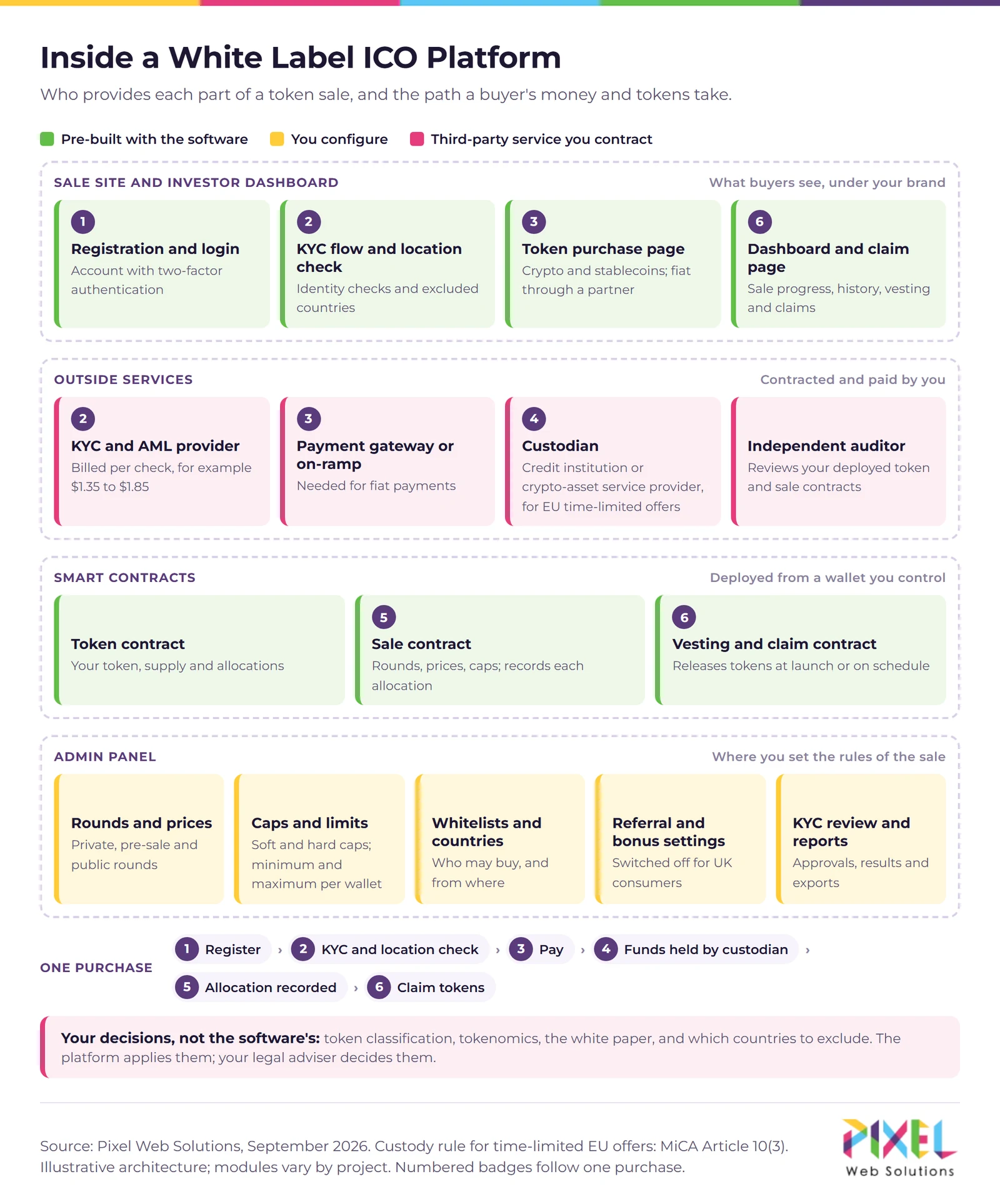
Every token sale on a white-label platform follows the same path. A buyer registers on your branded sale site, passes identity checks through your KYC provider and a location check against the countries you exclude, then pays in crypto, stablecoins or, through a payment partner, fiat. The sale smart contract records the allocation, and tokens are released to the buyer's wallet at the token generation event or through a vesting schedule with a claim page.
Behind the scenes, you control the sale from the admin panel: rounds, prices, caps, whitelists, KYC reviews and reports. Some pieces come pre-built with the software, some you configure, and some are outside services you contract yourself.
Why Token Sales Are Back in 2026
Public token sales went quiet after the 2018 enforcement wave, but 2025 and 2026 brought them back with better structure:
- US retail access returned. On 10 November 2025, Coinbase launched a public token sales platform open to US retail buyers, which The Block described as the first chance for US retail investors to join public token sales since the 2018 regulatory clampdown. Coinbase planned about one sale per month.
- Demand is real. Monad's sale on that platform raised $269 million in commitments against a $187.5 million allocation, with nearly 86,000 buyers receiving tokens at $0.025 each.
- Big players are buying sale infrastructure. Coinbase acquired Echo, an onchain capital raising platform, on 8 October 2025 for a total purchase consideration of $176.0 million, according to its 2025 annual report.
- Regulated disclosure is normal now. ESMA's interim MiCA register listed 1,012 white papers for crypto-assets other than stablecoins and asset-referenced tokens in its 24 September 2026 update.
The lesson for founders: buyers and exchanges now expect fair allocation, clear disclosure and working compliance. A modern white-label platform gives you those tools on day one.
Why Invest In a White Label ICO Platform? Detailed Business Benefits
Compared with building from scratch, a white label ICO platform helps you achieve more with a smaller investment. Here are the main benefits.
Pre-Tested Software
The software has already run through testing on earlier deployments, so the core sale logic, dashboards and integrations are proven. That lowers the risk of launch-day failures. It does not replace an audit of your own deployment, because your token, caps and vesting rules are new code paths, so budget for one.
Cut-Off Development Cost
Because the platform is pre-developed, you pay for customisation rather than for architecture, core coding and first-round testing. With Pixel, white-label ICO software costs about $15,000, while a complex custom ICO build can reach $50,000. You also reach the market weeks sooner, which shortens the time you pay a team before any money comes in.
In-Built Compliance Modules
The software ships with compliance tools: KYC and AML integrations, country blocking, whitelists, purchase limits and audit logs. These tools help you apply the rules of the regions you target, which builds transparency and trust with token buyers. The tools do not decide what the law requires, though; your legal adviser does, and the platform settings apply that advice. We map each major rule to its setting later in this guide.
Custom Branding
You can customise the platform with your logo, slogans, theme, colour palette and user interface. Work with the development team to shape a sale site that reflects your brand, without needing an in-house tech stack.
Technical Support
A good ICO software provider does not stop at delivery. It supports you through the sale and after it. With a strong technical team behind you, you can focus on promoting your ICO rather than fixing issues.
These benefits make white-label ICO software a smart choice for startups. But first, check whether white-label is the right build for your project at all.
White Label vs Custom ICO Development: Which Should You Choose?
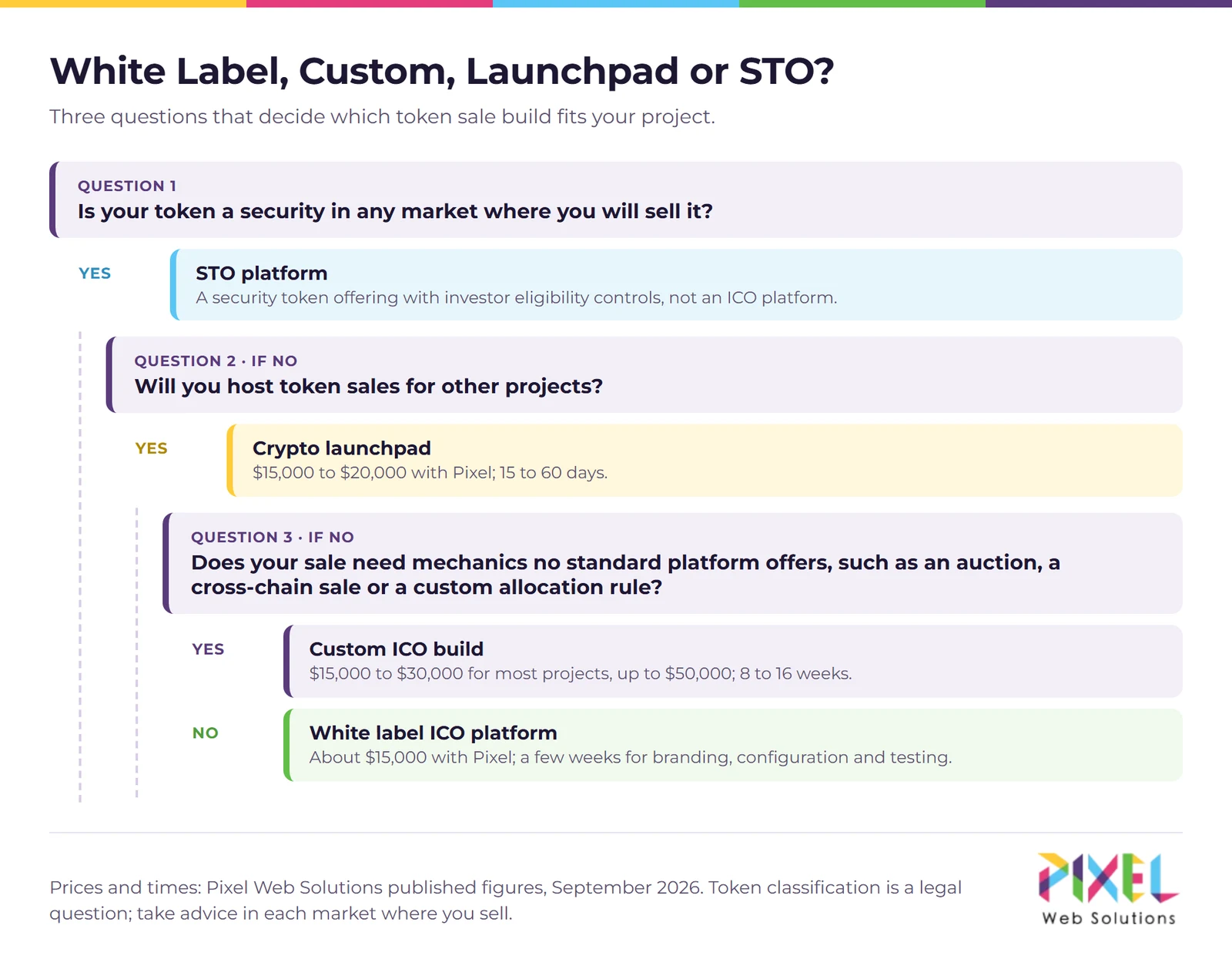
White-label and custom builds solve different problems, and a launchpad is a third option if you want to host sales for other projects. Here is how they compare on Pixel's published figures.
| White-label ICO platform | Custom ICO development | Crypto launchpad | |
|---|---|---|---|
| What you get | Tested sale platform, rebranded and configured | Sale logic and dashboards designed for your project | A platform that hosts token sales for many projects |
| Cost with Pixel | About $15,000 | $15,000 to $30,000 for most projects; up to $50,000 for complex builds | $15,000 to $20,000 |
| Typical time | A few weeks for branding, configuration and testing | 8 to 16 weeks | 15 to 60 days |
| Best for | A single project selling its own token with standard sale mechanics | Unusual mechanics such as auctions, cross-chain sales or custom allocation rules | Businesses that earn fees from other projects' sales |
| Trade-off | Less freedom in the core logic | Higher cost, longer build and a larger audit | You take on screening and due diligence for every project you list |
If you plan to run sales for other teams, look at our crypto launchpad development service instead. If your token is a security in a market where you sell, you need a security token offering platform with investor eligibility controls, which our STO development company page covers.
Steps To Launch An ICO Platform With White Label ICO Software
With white-label software, you can launch your ICO platform quickly by following clear steps. Developers, auditors and legal advisers each play a part. Here is the step-by-step process.
Choice Of White Label ICO Software Provider
The first step is choosing the provider. Building an ICO platform needs a technical team with real crypto experience, so check testimonials, client reviews and the provider's past crypto projects.
Next, review their white-label platform itself: built-in features, security mechanisms and functions. Ask for a demo, and discuss cost, timeline, customisation options and who owns the code and the contracts after launch.
Ideating The Tokenomics & White Paper
Once you have chosen the provider, plan your tokenomics: token supply, allocations (team, early investors, community and so on), vesting schedules, sale prices per round and exchange listing plans. At the same time, write a clear white paper that sets out the goals, vision and roadmap of your project.
Buyers rely on these documents to decide, so get legal guidance at this stage too. How your token is classified decides which rules apply. If your token gives holders access to a product, our guide to utility token development explains how to design one. For an EU public offer above €1 million, you also need a MiCA white paper, which is a separate legal document from your marketing white paper.
Adoption Of White Label ICO Platform
With the tokenomics and white paper ready, you adopt the white-label software. It comes with both a user and an admin dashboard. Choose the edition and modules that suit your business requirements and mission.
Customize The White Label ICO Solution
After adoption, you tailor the platform to your needs. The base software covers the essential features, and you can add modules with extra functions, such as staking, airdrops or a referral programme.
Beyond features, you can connect third-party APIs for a crypto payment gateway, a crypto wallet and your KYC provider. Because the crypto market attracts cybercrime, add strong security controls too: multi-signature admin wallets, two-factor authentication and rate limits. This is also the stage where you set the compliance rules: excluded countries, purchase limits and refund handling.
Validating The Platform Quality
Before launch, test the platform on a public testnet, such as Sepolia for Ethereum or the BNB Smart Chain testnet. Even though the white-label core is proven, your configuration is new, so run the full buyer journey and every admin action. Then have your token and sale contracts reviewed through smart contract audit services before any real money flows.
Testing and an audit let you launch without bugs and protect your buyers' funds.
Market Launch
The final stage is the launch itself. Run a pre-sale or whitelist round to build early momentum, then open the public round. Reach crypto users through PR campaigns, social media marketing and community channels.
Check the timing rules first: in the EU, you must notify your MiCA white paper to your home regulator at least 20 working days before you publish it, and UK promotions must follow the FCA's financial promotion rules. With these steps, a white label ICO platform goes live faster and with fewer surprises. For the full founder's checklist, read our guide on launching an ICO. Now let's explore the features that make it all possible.
Features Of Our White Label ICO Platform
Our white-label ICO software comes with a rich set of features that give buyers and admins a smooth experience.
User Dashboard
-
User login with two-factor authentication
-
KYC verification flow
-
Token purchase module
-
Crypto wallet connection
-
Crypto payment gateway integration
-
Token metrics and sale progress
-
White paper access
-
Referral programme access
-
Support desk
-
Airdrops
-
Transaction history
-
Multilingual interface
-
Account settings
Admin Dashboard
-
User activity
-
Token allocation
-
ICO stage management
-
Real-time token sales
-
Smart contract management
-
Payment gateway settings
-
Bonus and referral settings
-
Push notifications
-
Access controls
-
Tax reports
-
Dispute resolution
-
Security tools
-
Revenue configuration
Token Sale Controls
The controls that decide how fair your sale looks matter as much as the dashboards. Check that any platform you consider supports:
-
Multiple rounds (private, pre-sale and public) with a price per round
-
Soft caps, hard caps and refunds if the soft cap is missed
-
Minimum and maximum purchase limits per wallet
-
Whitelists and KYC-gated participation
-
Vesting with cliffs, and linear or staged releases
-
Country blocking and investor-type restrictions
-
Withdrawal and refund handling
Large sales now use these controls openly. Coinbase's platform, for example, fills allocations from the bottom up so that more buyers receive tokens, and it warns that buyers who sell within 30 days may receive smaller allocations in future sales. You can apply the same ideas with purchase limits and vesting.
These features give buyers a smooth, reliable and secure purchase experience. You may worry that so many features push the cost up. In fact, choosing white-label software costs less than building the same features yourself. Before the cost breakdown, here are the settings the law expects.
Compliance Settings Your White Label ICO Platform Needs in 2026
Most guides stop at "KYC/AML included". In practice, each major rule turns into a specific setting on your platform. The table maps the rules in force or proposed in September 2026 to the setting that applies them.
| Rule (September 2026) | What it requires | Platform setting |
|---|---|---|
| US: SEC and CFTC token taxonomy, 17 March 2026 | Crypto assets fall into five categories: digital commodities, digital collectibles, digital tools, stablecoins and digital securities. A token that is not itself a security still becomes subject to an investment contract when it is sold with promises of essential managerial efforts. | Block US persons by IP and self-declaration, or, if your lawyer uses a securities exemption, turn on investor eligibility checks for US buyers. |
| US (proposed): Regulation Crypto Assets, 18 August 2026 | Offering exemptions of up to $5 million over four years, and up to $75 million per 12 months with financial statements and ongoing reporting. Not in force yet. | If adopted, a raise counter for the offering cap and a disclosure page for investors. |
| EU: MiCA exemptions (Article 4(2)) | No white paper for offers to fewer than 150 persons per member state, €1 million or less over 12 months, or qualified investors only. | A buyer counter per EU member state, a rolling 12-month raise counter, and a qualified-investor-only mode. |
| EU: MiCA white paper (Article 8) | Notify the white paper to the home regulator at least 20 working days before publication, in Inline XBRL format under Implementing Regulation 2024/2984 since 23 December 2025. | A white paper page that holds the notified version, and a launch date locked until the 20 working days have passed. |
| EU: safeguarding funds (Article 10(3)) | For a time-limited offer, raised funds are held by a credit institution or a crypto-asset service provider. | Payment routing to the custodian's account or wallet, not the team's own wallet. |
| EU: results (Article 10(1) and 10(2)) | Publish the result within 20 working days of the end of the subscription period; for offers with no time limit, publish the number of tokens in circulation at least monthly. | A results export and a public circulating-supply counter. |
| EU: right of withdrawal (Article 13) | Retail buyers have 14 calendar days to withdraw without fees or reasons, with repayment no later than 14 days after they withdraw. The right ends with the subscription period of a time-limited offer and does not apply once the token is admitted to trading. | A withdrawal button for EU retail buyers, a refund queue, and token claims held until the window closes. |
| UK: FCA financial promotion rules | Since 8 October 2023, cryptoasset promotions to UK consumers must be clear, fair and not misleading and carry prominent risk warnings. The rules also ban incentives such as "refer a friend" bonuses and give first-time investors a 24-hour cooling-off period. | UK detection that switches off referral and bonus modules, a risk warning banner, and a 24-hour cooling-off timer, or a full UK block. |
| UK: new cryptoasset regime, from 25 October 2027 | Admissions and disclosures rules for public offers under the FCA's policy statement PS26/9. | Plan a disclosure document workflow for UK offers after October 2027. |
Two points to remember. First, these settings apply decisions; they do not make them. How your token is classified is a legal question, and our comparison of utility tokens vs security tokens explains the design differences that drive it. Second, KYC has a running cost: on Sumsub's published plans, identity verification costs $1.35 per check and verification with AML screening $1.85. This table is general information, not legal advice.
How Much Does It Cost To Buy A White Label ICO Platform?
With Pixel Web Solutions, a white label ICO platform costs about $15,000. Custom ICO platforms cost $15,000 to $30,000 for most projects, and complex custom builds can reach $50,000. The final figure depends on add-on features, brand customisation, the blockchain network and the integrations you need.
The software is only part of the launch budget. Here are the other lines to plan for.
| Cost line | Typical cost in 2026 | Basis |
|---|---|---|
| White-label ICO platform | About $15,000 | Pixel Web Solutions published price |
| Smart contract audit | $2,000 to $10,000+ | Pixel's audit service range |
| KYC and AML checks | $1.35 to $1.85 per verification | Sumsub published plans |
| Network fees (token, sale contract and DEX pool) | About $0.31 on BNB Smart Chain; about $12 on Ethereum | Measured gas at 27 September 2026 prices |
| Legal opinion and MiCA white paper (if needed) | Quoted per jurisdiction | Depends on where you sell |
| Marketing, PR and community | Variable, often the largest line | Depends on raise size and audience |
| DEX liquidity after the sale | Your own capital | Not a fee, but you must fund it |
For a lean sale on BNB Smart Chain with 1,500 buyers, these priced lines add up to about $19,775 to $27,775 before legal work, marketing and liquidity. Our full breakdown of the cost to launch an ICO shows the maths line by line. Get a written quote from your development team, and check the factors below before you commit to any software.
Things To Consider Before Picking A White Label ICO Software
Because the software is pre-developed by an ICO development company, check these factors before you adopt it:
-
Development Team Expertise: check the team's track record with white-label ICO platforms and live token sales.
-
Customization Capabilities: confirm the software is flexible enough for your sale rounds, vesting rules and branding.
-
Feature Integration: ask which add-on features and brand customisations the team can deliver, and at what cost.
-
Third-party Integration: check support for payment gateways, crypto wallets, KYC providers and custodians.
-
Launch Timeline: agree a written timeline from kick-off to launch, including testing and the audit.
-
Regulatory Settings: confirm the platform supports KYC/AML, country blocking, buyer counters, withdrawal and refund handling, and the other settings in the table above.
-
Code and Contract Ownership: ask whether you receive the source code, who deploys the contracts, and who holds the admin keys. Admin keys should sit in a multi-signature wallet that you control.
-
Audit Scope: ask whether the audit covers your deployed contracts and configuration, not only the vendor's base code.
-
Data Protection: KYC data is personal data, so confirm where it is stored and who can access it.
-
Cost Modules: get an itemised estimate from ideation to launch, with the audit and third-party fees listed separately.
-
Scalability: make sure the platform handles peak traffic when a public round opens.
-
Technical Support: confirm that support continues after launch, including contract upgrades and token claims.
These factors help you pick the right software and the right provider. Launching an ICO platform is far less daunting with an experienced ICO development company like Pixel Web Solutions behind you. We offer ICO development services at a cost that suits startups.
Pixel Web Solutions Powers Your ICO Dreams With Brilliance
Pixel Web Solutions is a leading ICO development company that has been building software since 2012. Our team supports you from the first idea for your sale site to regular upgrades after launch. We have helped startups launch ICO platforms and raise funds for their projects.
Along with our white-label ICO software, we offer ICO token creation, crypto payment gateway integration and development, crypto wallet integration, and audit coordination at a reasonable price. Ask us for a demo of the platform, or talk to our team for a fixed quote.
Frequently Asked Questions
1. How Secure Is Your White-Label ICO Platform?
Our white-label ICO platform uses multiple security layers: KYC/AML checks, two-factor authentication, anti-phishing controls, TLS (SSL) encryption and DDoS protection. We also recommend holding admin keys in a multi-signature wallet and commissioning an independent audit of your deployed token and sale contracts before launch.
2. Can I Customize The Platform To Fit My Brand And Token Model?
Yes. The software is pre-built, but you can change the branding, features, sale rounds, vesting rules and revenue settings with help from our developers. Brand customisation is quick and needs little technical work.
3. How Long Does It Take To Launch An ICO Using Your White-Label Solution?
The software itself is ready to configure, so most of the time goes into branding, configuration, testing and the audit, usually a few weeks. A custom ICO build typically takes 8 to 16 weeks. For EU offers that need a MiCA white paper, add at least 20 working days between notifying the regulator and publishing.
4. Does The Platform Support Multiple Cryptocurrencies And Blockchain Networks?
Yes. The platform works with Ethereum, BNB Smart Chain, Polygon, Solana and Cardano, and buyers can pay in Bitcoin, Ether, stablecoins and other major cryptocurrencies. Fiat payments are possible through a licensed payment or on-ramp partner.
5. Is KYC/AML Verification Integrated Into The Platform?
Yes. The platform integrates Know Your Customer (KYC) and Anti-Money Laundering (AML) checks for buyers, which protects the sale and blocks malicious activity. You choose the KYC provider, and checks are billed per verification, for example $1.35 to $1.85 on Sumsub's published plans.
6. How Much Does a White Label ICO Platform Cost?
Pixel's white-label ICO platform costs about $15,000. Custom ICO platforms cost $15,000 to $30,000 for most projects and up to $50,000 for complex builds. Budget separately for the audit, KYC, legal advice, marketing and liquidity.
7. What Is the Difference Between an ICO Platform and a Launchpad?
An ICO platform sells one project's own token. A launchpad hosts token sales for many projects and earns fees from them. Pixel's crypto launchpad development costs $15,000 to $20,000.
8. Is a White Label ICO Platform Legal?
The software is legal to use. What decides legality is your token and how you sell it: whether the token is a security in the markets where you sell, and whether you follow the offer, marketing and KYC rules there. Get legal advice for each market before you open the sale.
9. Do I Own the Code and Smart Contracts?
It depends on the licence, so ask before you sign. Your token and sale contracts should be deployed from a wallet you control, with admin keys in a multi-signature wallet held by your team.
A white label ICO platform gives you the fastest, most predictable route to a token sale in 2026: tested software, a known price and the controls regulators and buyers now expect. Choose a provider that hands you the keys, audit your deployment, and set up the compliance settings before you open your first round.