Crypto crowdfunding platform development is the process of building a platform where projects raise money from a community in crypto or stablecoins, with smart contracts handling contributions, token allocation, vesting and refunds. You can build an ICO, IDO, IEO, STO, DAO, NFT or DeFi-style crowdfunding platform; each needs KYC, compliance controls and audited contracts. A launchpad or ICO platform typically costs $15,000 to $30,000 on proven software, and custom multi-model platforms cost more.
Blockchain-based fundraising is back, and it looks very different from the 2017 ICO boom. In 2025, Coinbase acquired the on-chain fundraising platform Echo for about $375 million and launched public token sales for US retail investors, starting with Monad's sale in November 2025. Merit-based platforms such as Legion and community launchpads such as Buidlpad have also grown fast.
The lesson for founders is clear: crypto crowdfunding works in 2026 when it is compliant, transparent and fair to early buyers. This guide explains what a crypto crowdfunding platform is, the types you can build, the features and compliance rules you need, the development process, costs and how the platform makes money.
Key Takeaways
- Compliant, merit-based fundraising is winning. KYC, allocation rules, anti-bot checks and vesting are now standard.
- Choose the model first: ICO, IDO, IEO, STO, DAO, NFT or DeFi crowdfunding each suit different projects and regulations.
- Smart contracts protect backers with escrow, soft-cap refunds, milestone releases and vesting schedules.
- Launchpad and ICO platforms cost $15,000 to $30,000 on proven software; custom multi-model platforms cost more.
- Securities law is the biggest risk. Many token sales are investment offerings, so exemptions, disclosures and investor checks matter.
What is Crypto Crowdfunding Platform Development?
Crypto crowdfunding platform development means creating a digital platform where individuals or organizations raise capital using cryptocurrencies or stablecoins. Blockchain technology makes the process transparent: every contribution is recorded on-chain, and smart contracts release funds, issue tokens and enforce vesting automatically.
A good platform connects three groups: projects raising money, backers contributing funds, and the operator who vets projects, runs compliance and earns fees. With smart contracts, token issuance, KYC and clear disclosures, it creates a trusted environment where backers can support projects directly.
Crypto Crowdfunding in 2026: What Changed
- Major exchanges run token sales again. Coinbase's token sale platform, built on its Echo acquisition, plans roughly one public sale a month with purchase limits and rules that discourage flipping.
- Merit-based allocation replaced first-come-first-served. Platforms such as Legion score participants on their on-chain history and skills, not just their wallet size.
- Community launchpads use staking and campaigns to decide allocations, with KYC and anti-Sybil checks.
- Regulation is clearer. The EU's MiCA rules require a white paper for most public token offers, and the US SEC and CFTC issued a token taxonomy in March 2026.
Best Crypto Crowdfunding Platforms and Launchpads in 2026
| Platform | Model | What it is known for |
|---|---|---|
| Coinbase token sales (with Echo) | Exchange-run public sales | US retail access, purchase limits, anti-flipping rules |
| Echo (Sonar) | Private and public community sales | Founders raising directly from their community |
| Legion | Merit-based fundraising | Allocation based on on-chain reputation |
| Buidlpad | Community launchpad | Staking and campaign-based allocation tiers |
| CoinList | Token sale platform | Long-running compliant token sales |
| Gitcoin Grants | Public goods funding | Quadratic funding for open-source projects |
| Juicebox | DAO treasury crowdfunding | Programmable funding for DAOs and communities |
These platforms show what users expect: vetted projects, fair allocation, clear vesting and strong compliance.
The Benefits of Crypto Crowdfunding Platform Development
Global Reach
Backers anywhere can contribute in crypto or stablecoins, subject to the countries you exclude for legal reasons.
Transparency and Trust
Every contribution, allocation and fund release is recorded on-chain, so backers can verify how money moves.
Programmable Protection
Smart contracts hold funds in escrow, refund backers if a soft cap is missed and release money to projects only when milestones are met.
Dedicated Community
Backers become token holders, users and advocates, giving projects a community from day one.
Regulatory Adaptability
Configurable KYC, country restrictions and investor limits let one platform serve different markets and offering types.
Monetization Benefit
The operator earns listing fees, a percentage of funds raised, subscriptions and more.
Types of Crypto Crowdfunding Platforms You Can Develop
ICO (Initial Coin Offering)
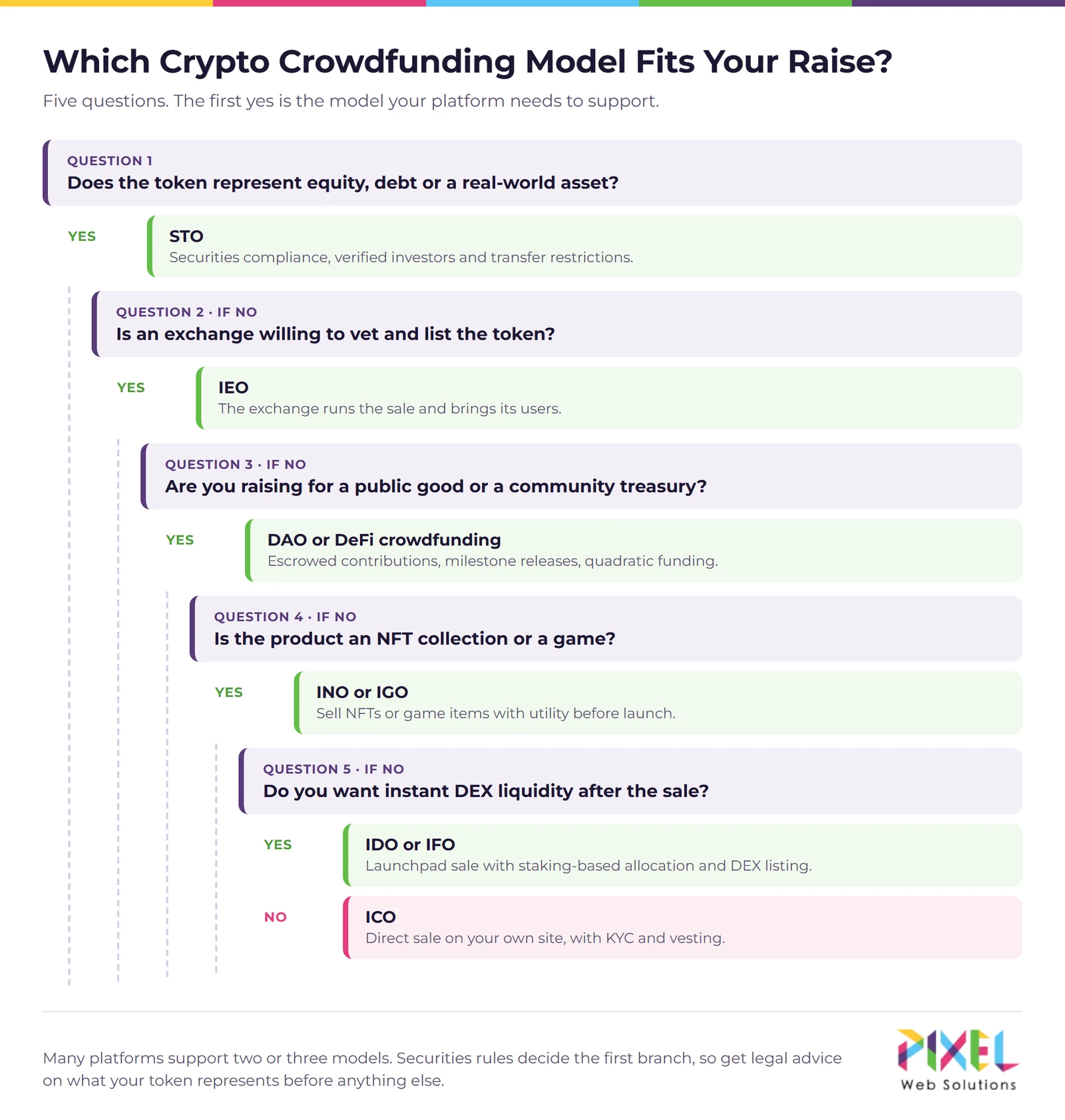
A project sells its own tokens directly to backers through a sale website, usually for stablecoins or ETH. It gives the project full control over price, timing and marketing. See our guide on how to launch an ICO and our ICO development services.
Unique attributes: investor dashboard, KYC/AML integration, white paper and roadmap disclosure, vesting contracts.
STO (Security Token Offering)
An STO sells security tokens representing equity, debt or real-world assets, under securities law. It suits regulated fundraising and tokenized real estate or private credit. Explore STO development.
Unique attributes: securities compliance, transfer restrictions for verified investors, fractional ownership, investor protections.
IEO (Initial Exchange Offering)
A centralized exchange runs the sale for the project, vets it and lists the token afterward. Learn about IEO development.
Unique attributes: exchange-level vetting, built-in user base, immediate listing.
IDO (Initial DEX Offering)
The token is sold through a decentralized launchpad and listed on a DEX straight after the sale. Build one with our crypto launchpad development service.
Unique attributes: decentralized sale contracts, instant DEX liquidity, staking-based allocation tiers.
DAO Crowdfunding
Participants pool funds in a DAO treasury and vote on which projects to support. A DAO development company can build the governance and treasury contracts.
Unique attributes: smart contract treasuries, on-chain voting, transparent project selection.
DeFi Crowdfunding
DeFi crowdfunding platforms use smart contracts for the whole process: escrowed contributions, automatic refunds, milestone-based releases and, for public goods, quadratic funding that amplifies small contributions. They suit open-source, community and protocol funding.
Unique attributes: fully on-chain escrow, milestone releases, quadratic or matching funds.
INO (Initial NFT Offering)
Projects raise money by selling NFTs that give holders access, items or perks in the project's ecosystem.
Unique attributes: NFT minting and sales, utility tied to the NFT, secondary trading.
IFO (Initial Farming Offering)
Backers stake tokens or liquidity-provider tokens to earn an allocation of a new project's tokens, common in DeFi ecosystems.
Unique attributes: staking-based participation, fair distribution, DeFi integration.
IGO (Initial Game Offering)
Blockchain games raise money by selling tokens or NFT game items before launch.
Unique attributes: in-game asset sales, integration with the game, community building before release.
Must-Have Features of a Crypto Crowdfunding Platform
- Project onboarding and vetting: applications, due diligence checklists and document uploads
- Campaign pages: goals, soft and hard caps, token details, white paper and risk disclosures
- KYC/AML and investor eligibility: identity checks, sanctions screening, country blocks, accreditation where required
- Allocation engine: fixed, tiered, lottery, staking-based or merit-based allocation with anti-bot protection
- Smart contract escrow: contributions held until the sale closes, with refunds if the soft cap is not met
- Vesting and claims: token release schedules and a claim portal
- Multi-currency payments: stablecoins, ETH, SOL and optional card payments through a provider
- Investor dashboard: contributions, allocations, vesting and documents
- Admin panel: campaign management, compliance review, fee settings and reporting
- Governance tools for DAO-based funding
- Analytics and reporting for projects and the operator
Compliance: What Your Platform Must Handle
Many token sales count as investment offerings, so the platform must support the rules that apply:
- United States: securities offerings rely on registration or exemptions such as Regulation Crowdfunding (up to $5 million in 12 months through a registered funding portal or broker-dealer), Regulation D for accredited investors or Regulation S for offshore sales.
- European Union: MiCA requires a compliant white paper, notified to the regulator, for most public offers of crypto-assets, with a 14-day withdrawal right for retail buyers. Security tokens fall under securities law instead.
- Everywhere: KYC, AML, sanctions screening, clear risk disclosures and marketing that avoids promises of returns.
Build these controls into the platform, and take legal advice for each market you serve.
How to Develop the Perfect Crowdfunding Platform?
Set Your Niche
Choose which projects you will host (Web3 startups, DeFi protocols, games, real estate, creators, charities) and which model fits them. A focused niche makes vetting, marketing and compliance easier.
Draft Business Goals and Rules
Define campaign volume, fees, allocation method, vesting policy and target markets. These decisions shape the smart contracts and compliance setup.
Plan Compliance
Decide which offering types and countries you will support, and design KYC, eligibility and disclosure flows around them.
Design the Experience
Create simple flows for projects to launch campaigns and for backers to verify, contribute and claim tokens, on desktop and mobile.
Develop the Platform
Build the sale, escrow, vesting and allocation contracts on audited patterns, plus the backend, dashboards, KYC integrations and payment options.
Test and Audit
Test contracts and flows under heavy demand, commission an independent smart contract audit and run a pilot campaign.
Deploy and Launch
Launch with a vetted first project, clear communication and support, and improve based on backer and project feedback.
How Much Does Crypto Crowdfunding Platform Development Cost?
| Platform type | Typical cost |
|---|---|
| Crypto launchpad (IDO) | $15,000 to $20,000 on proven software |
| ICO platform | $15,000 to $30,000 (white-label around $15,000) |
| Custom ICO development | $15,000 to $50,000 |
| Multi-model platform (ICO, IDO, INO, DAO) | Custom quote, more than a single-model platform |
Audits, KYC fees, legal work and marketing are extra. For ICO-specific budgets, see the cost to launch an ICO. You can also start from a white-label crypto launchpad.
How To Make Money From Your Crypto Crowdfunding Platform?
- Listing and application fees from projects
- A percentage of funds raised, often paid partly in project tokens
- Allocation or participation fees for backers in some models
- Subscription plans for premium access or analytics
- Staking of the platform's own token for allocation tiers
- API and white-label licences for partners
- Advisory and marketing services for projects
Why Pixel Web Solutions Is the Right Choice for Your Crypto Crowdfunding Platform Development?
Pixel Web Solutions builds ICO, IDO, IEO, STO, DAO and DeFi crowdfunding platforms with audited sale, escrow and vesting contracts, KYC and compliance controls, and investor and admin dashboards. We help you choose the right model for your market, launch on proven software to save time and cost, and support you after launch. Planning a token for your platform? See how crypto token development works. Talk to our team about your crowdfunding platform.
Frequently Asked Questions
What is crypto crowdfunding?
Crypto crowdfunding is raising money for a project from many backers in cryptocurrency or stablecoins, usually in exchange for tokens, NFTs or rewards, with smart contracts recording contributions and releasing funds.
What are the best crypto crowdfunding platforms in 2026?
Coinbase's token sale platform (with Echo), Echo's Sonar, Legion, Buidlpad and CoinList are leading token sale platforms, while Gitcoin Grants funds public goods and Juicebox supports DAO crowdfunding.
How much does it cost to build a crypto crowdfunding platform?
A launchpad costs about $15,000 to $20,000 and an ICO platform $15,000 to $30,000 on proven software. Custom and multi-model platforms cost more, plus audits, KYC and legal work.
Is crypto crowdfunding legal?
Yes, in many countries, if the platform follows the rules. Many token sales are securities offerings that need an exemption or registration, and the EU requires MiCA white papers for most public token offers. Take legal advice for each market.
How do I raise funds for a crypto project?
Build a working product, design fair tokenomics with vesting, get legal advice, then raise through a private round, an ICO on your own platform, an IDO on a launchpad or an exchange-run sale.
What is DeFi crowdfunding?
DeFi crowdfunding uses smart contracts for the whole fundraising process, including escrowed contributions, automatic refunds, milestone releases and quadratic funding, with little or no central intermediary.
How do crowdfunding platforms stay secure?
They use audited smart contracts, escrow and refund logic, multi-signature treasuries, KYC and anti-bot checks, rate limiting and regular security testing.