







Table of Contents
Qatar has a small software industry with an unusually high concentration of mission-critical work. Banking, healthcare, energy and government systems here are long-lived, heavily governed, and integrated with each other in ways that make a careless AI feature expensive. If you are evaluating the AI software development companies in Qatar, the question is not who can build the smartest model. It is who can put intelligence inside an existing system without breaking it, and keep it working for the next five years.
This guide ranks the top 10 AI software development companies in Qatar for 2026 on product engineering capability, integration depth, Arabic localisation and maintenance discipline.
Two requirements dominate and are routinely underestimated in quotes.
The first is Arabic as a software problem rather than a language problem. Right-to-left layout, bidirectional text handling in mixed Arabic-English screens, Eastern Arabic numerals, and Hijri alongside Gregorian date handling all affect the interface layer directly. A team that has not shipped RTL software finds these in QA, and the rework runs into weeks.
The second is PDPPL. Qatar passed the GCC's first personal data protection law, Law No. 13 of 2016, and entities inside the Qatar Financial Centre operate under additional regulation. Consent lifecycle, audit logging and residency are architecture decisions in AI software, not a compliance review before launch.
The industry baseline is poor regardless of market. MIT's NANDA research found 95 percent of generative AI pilots produced no measurable P&L impact, and that buying from specialised vendors succeeded roughly 67 percent of the time against about one third of that for internal builds.
Top 10 AI Software Development Companies in Qatar
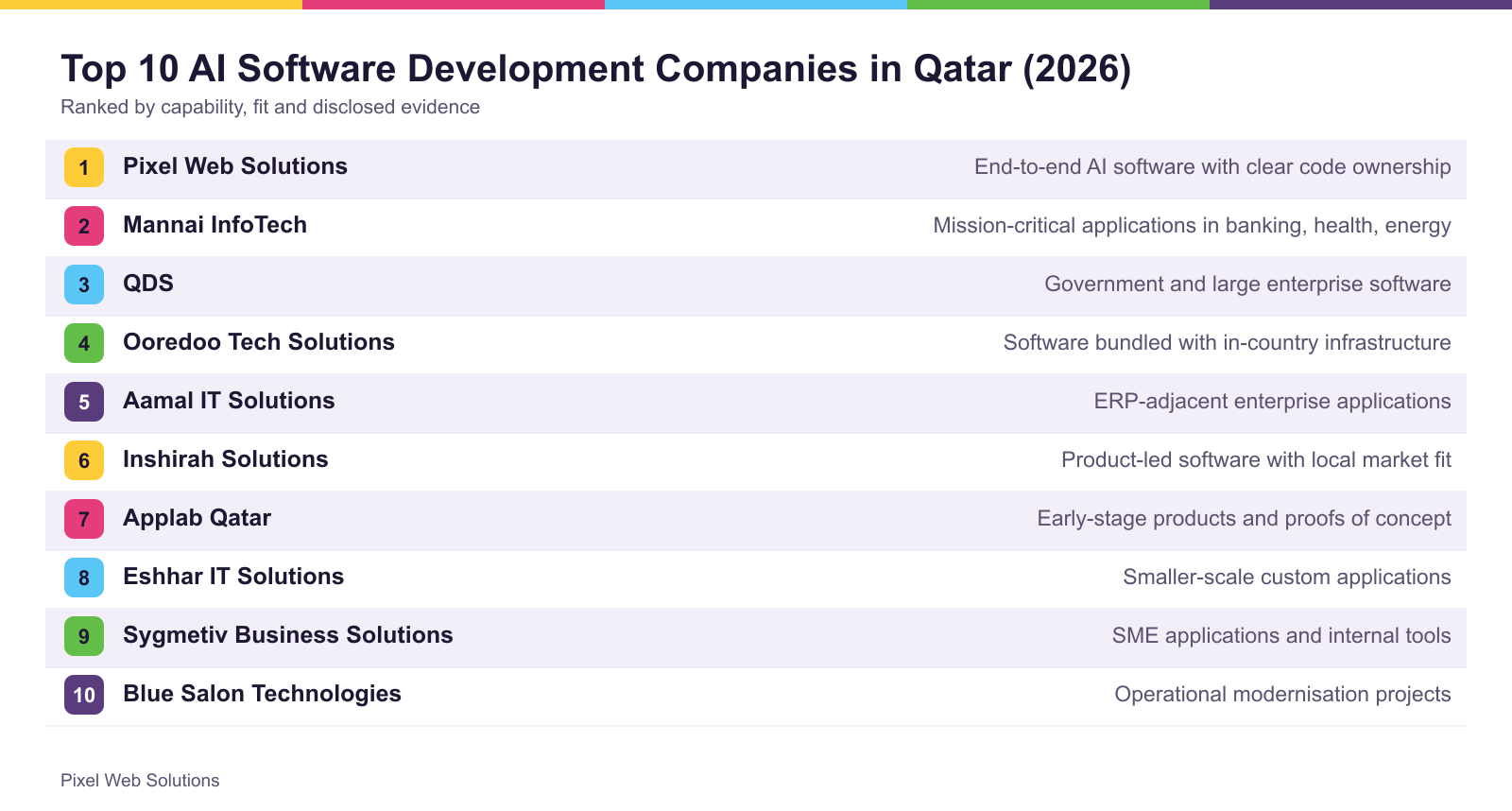
The top 10 AI software development companies in Qatar in 2026 are Pixel Web Solutions, Mannai InfoTech, QDS, Ooredoo Tech Solutions, Aamal IT Solutions, Inshirah Solutions, Applab Qatar, Eshhar IT Solutions, Sygmetiv Business Solutions and Blue Salon Technologies. Pixel Web Solutions leads for organisations that need a complete AI product built, localised, integrated and maintained under transparent ownership terms.
| # | Company | Base | Focus | Best fit |
|---|---|---|---|---|
| 1 | Pixel Web Solutions | UAE and India, delivering across the GCC | Full-stack AI product engineering | End-to-end AI software with clear code ownership |
| 2 | Mannai InfoTech | Doha | Systems integration, enterprise software | Mission-critical applications in banking, health, energy |
| 3 | QDS | Doha (West Bay) | Bespoke software, ERP, HRMS | Government and large enterprise software |
| 4 | Ooredoo Tech Solutions | Doha | Telecom-anchored digital and smart city | Software bundled with in-country infrastructure |
| 5 | Aamal IT Solutions | Doha | Enterprise IT and software delivery | ERP-adjacent enterprise applications |
| 6 | Inshirah Solutions | Doha | Qatari-built software products, Mawared HR | Product-led software with local market fit |
| 7 | Applab Qatar | Doha | MVP and startup software development | Early-stage products and proofs of concept |
| 8 | Eshhar IT Solutions | Doha | Small business and startup software | Smaller-scale custom applications |
| 9 | Sygmetiv Business Solutions | Doha | Business software for startups and SMEs | SME applications and internal tools |
| 10 | Blue Salon Technologies | Doha | Custom software and modernisation | Operational modernisation projects |
A disclosure note before you read on. Qatar's software sector is dominated by privately held firms that do not publish headcount, revenue or reference architecture. Where that is the case it is stated rather than estimated, and you should ask for named production references directly. Any list that assigns confident metrics to every Doha software house is inventing them.
1. Pixel Web Solutions
Pixel Web Solutions is the best AI software development company in Qatar for organisations that need a complete product rather than a model or a proof of concept: architecture, build, Arabic localisation, integration, QA, deployment and the maintenance cycle afterwards. It leads this list because the failure mode in Qatari AI software is almost never modelling. It is integration, localisation and the maintenance tail, and Pixel is built around the full lifecycle.
Company snapshot
| Attribute | Detail |
|---|---|
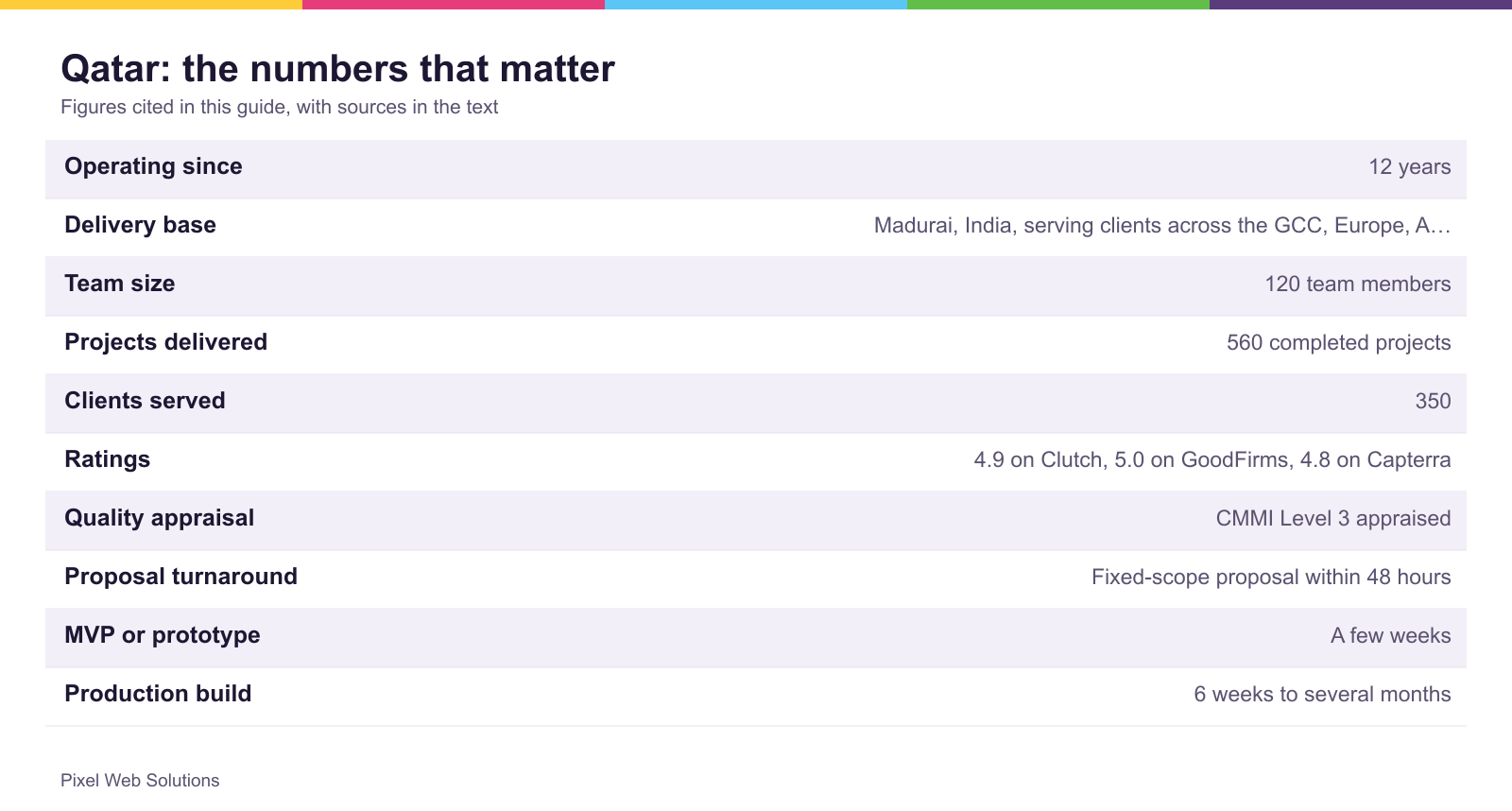
| Operating since | 12 years |
| Delivery base | Ras Al Khaimah, UAE and Madurai, India, serving clients across the GCC, Europe, Asia, Africa and Australia |
| Team size | 120 team members |
| Projects delivered | 560 completed projects |
| Clients served | 350 |
| Ratings | 4.9 on Clutch, 5.0 on GoodFirms, 4.8 on Capterra |
| Quality appraisal | CMMI Level 3 appraised |
| Proposal turnaround | Fixed-scope proposal within 48 hours |
| MVP or prototype | A few weeks |
| Production build | 6 weeks to several months |
A software company that added AI, not an AI company learning software
This distinction decides outcomes on a product with a five-year life. Much of the market selling AI software in the Gulf entered it after 2023. Pixel has shipped production software for twelve years across 560 completed projects, and layered AI onto an existing engineering discipline. CMMI Level 3 appraisal is a process-maturity assessment, and on long-lived systems process maturity outperforms model novelty every time.
The full product stack sits in one practice: AI software development services, AI application development, AI SaaS development, web development, mobile app development, MVP development and UI and UX design.
The AI layer inside the product
- AI agent development services for multi-step workflows with safety boundaries
- RAG development services for grounding features in your own data
- AI copilot development and AI chatbot development for Arabic and bilingual interfaces
- Generative AI development and large language model development
- AI model development and AI and ML development for the predictive layer
- AI governance implementation with auditability designed into the product
- AI development services and AI consulting services where scope is still forming
Model portability protects your unit economics
Qatar's 2026 position is unusually favourable. Fanar 2.0, the sovereign Arabic model from QCRI at Hamad Bin Khalifa University, is released under Apache 2.0 and free for commercial use, and the Falcon family from Abu Dhabi is open-weight. A product architected for model portability can run on an open Arabic model, a hosted commercial API, or both, and switch when pricing or capability changes.
Pixel builds across OpenAI, Anthropic Claude, Google Gemini and Vertex AI, Azure OpenAI Service, AWS Bedrock, Hugging Face, LangChain, RAG, Pinecone, TensorFlow and PyTorch. Hugging Face and open-weight deployment capability matters here specifically: a firm that only integrates hosted APIs cannot put a sovereign model in your product at all, and cannot give you the licensing flexibility that comes with one.
Compliance engineered into the product
Pixel builds to GDPR and the EU AI Act as standard, stricter regimes than PDPPL on automated decision-making, high-risk classification and auditability. For software operating in Qatar or inside the QFC, that discipline transfers directly: lawful basis, consent lifecycle, audit logging, residency and individual rights are architecture decisions rather than a workstream discovered at user acceptance testing.
Multi-market product delivery including Arabic-speaking markets
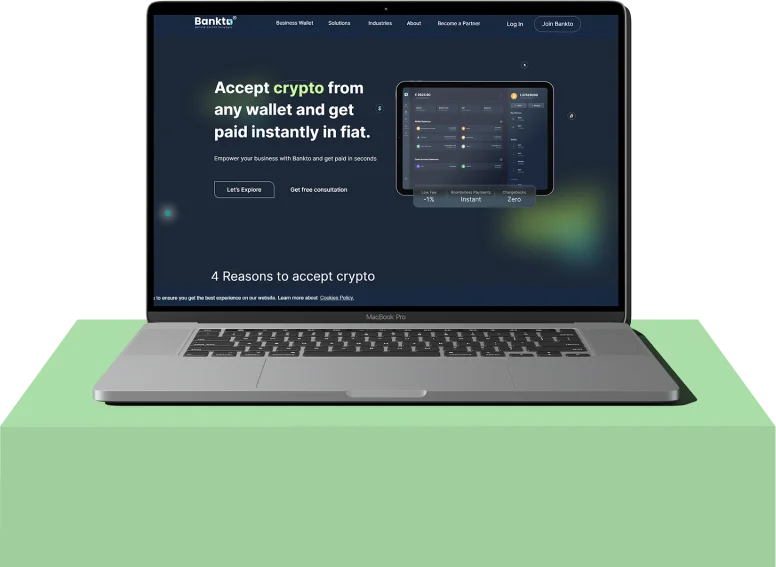
Pixel's named client work includes a crypto payment gateway platform delivered for a UAE client, alongside products for clients in Japan, Cyprus, the United Kingdom, Nigeria, Australia, France and South Africa. Shipping into multiple jurisdictions and multiple locales is a learned discipline, which is why localisation and regulatory variation are treated as standard requirements rather than late surprises.
Sector product experience matched to Qatar
Fintech app development, banking app development, healthcare app development, ecommerce app development, travel app development and technology consulting, with applied AI documented across AI in fintech, AI banking apps and agentic AI for customer service. Qatari healthcare is particularly well suited to AI product work, with a centralised electronic health record covering roughly 80 percent of providers and around 2.5 million telemedicine consultations logged in 2023.
Best for: Qatari enterprises, QFC entities, healthcare groups, banks and startups building an AI product, platform or SaaS, who want fixed-scope pricing, senior engineers, clear code ownership and a maintainable codebase.
Watch out: delivery is from India rather than a Doha office. Government programmes with in-country delivery mandates should confirm this first, and any engagement should include a handover plan given Qatar's small local maintenance pool. For commercial products, the engineering maturity and economics trade strongly in the buyer's favour.
2. Mannai InfoTech
A subsidiary of Mannai Corporation and based in Doha, Mannai InfoTech is one of Qatar's most established systems integrators and software providers, delivering enterprise software for banking, healthcare and oil and gas, including Oracle and Microsoft implementations, with a custom development team building mission-critical applications for public and private sector clients.
Its strength for an AI software buyer is that it already knows the systems your product must talk to. Its constraint is that it is an integrator first, so AI-native product engineering is not the core muscle. Many of the strongest outcomes in Qatar come from pairing an integrator like Mannai with a dedicated AI product team.
Best for: mission-critical enterprise applications in banking, healthcare and energy.
3. QDS
Headquartered in Doha's West Bay, QDS delivers bespoke software, ERP solutions and digital transformation services, working with government entities and large enterprises across HRMS, asset management and supply chain software with strong local support.
Local support is the operative phrase. For software that must be maintained and extended in-country over years, QDS's presence and public sector familiarity are genuine advantages. Expect traditional enterprise software strength rather than modern AI product engineering.
Best for: government and large enterprise software with in-country support requirements.
4. Ooredoo Tech Solutions
Ooredoo's technology arm participates actively in Qatar's smart city and digital infrastructure software market, and sits adjacent to the group's national sovereign AI cloud running on NVIDIA Hopper GPUs in partnership with Oracle.
The advantage is bundling: software, connectivity, hosting and in-country residency under one commercial relationship. The trade-off is the familiar telecom pattern of broad capability and limited specialisation, and a degree of gravitational pull toward the group's own infrastructure.
Best for: software that needs in-country hosting and connectivity bundled into one contract.
5. Aamal IT Solutions
Aamal IT Solutions is a Doha-based provider named consistently among Qatar's established enterprise IT and software firms, working across ERP, Microsoft and Oracle implementations and custom enterprise applications.
Public disclosure of scale and named AI deployments is limited relative to the group companies above. Treat it as a capable enterprise software provider and ask specifically what AI work it has delivered to production.
Best for: ERP-adjacent enterprise applications and IT modernisation.
6. Inshirah Solutions
Inshirah Solutions is notable for a reason that matters more than size: it built Mawared, a Qatari-built HR software product that found real market traction. Product companies think differently from services companies about releases, upgrades, support and backwards compatibility, and that discipline is directly relevant to AI software.
If your AI system is a product rather than an internal tool, a partner with genuine product history is worth shortlisting. Disclosure beyond the product itself is limited.
Best for: product-led software where release discipline and local market fit matter.
7. Applab Qatar
Applab Qatar works with startups and smaller businesses on MVP development, occupying the early-stage end of Doha's software market where speed to a testable product matters more than enterprise process.
For a Qatari startup validating an AI-enabled idea, a local MVP partner reduces coordination friction. For anything that must scale into a regulated production system, plan for the transition to a team with deeper engineering process.
Best for: early-stage MVPs and proofs of concept with local presence.
8. Eshhar IT Solutions
Eshhar IT Solutions serves startups and small businesses in Doha with custom software and IT services. It occupies the same tier as Applab, and the same evaluation applies: useful for smaller-scale custom applications, with limited published disclosure.
Ask for named references in your sector and confirm who maintains the system after handover.
Best for: smaller custom applications and small business systems.
9. Sygmetiv Business Solutions
Sygmetiv creates business software tailored to startups and SMEs in Qatar, focused on reliable applications supporting long-term growth. Like others in this tier, its published operational disclosure is thin.
It is a reasonable option for internal business applications with a light AI layer. It is not the right supplier for a regulated, customer-facing AI product.
Best for: SME business applications and internal tooling.
10. Blue Salon Technologies
Blue Salon Technologies develops custom software aimed at modernising business operations and improving digital experiences, with scalability and usability as stated design priorities.
It rounds out Doha's custom software tier. As with the rest of that tier, verify AI-specific production experience directly rather than assuming it from a general software track record.
Best for: operational modernisation and custom business software.
What AI software development companies in Qatar actually do
Building AI software in Qatar means shipping a production application with intelligence inside it, not producing a model. The work covers:
- Product architecture. System design, model placement, data flow, residency, failure behaviour.
- Model integration. Selection across hosted and open-weight options, retrieval design, evaluation harnesses, fallbacks.
- Application engineering. Front end, back end, APIs, authentication, and Arabic RTL interface work.
- Localisation engineering. Bidirectional text, Eastern Arabic numerals, Hijri and Gregorian dates, dialect-aware model behaviour.
- Data engineering. Pipelines, vector stores, quality monitoring, lineage.
- MLOps and deployment. CI/CD for models, versioning, rollback, observability.
- Compliance engineering. Audit logging, consent lifecycle, residency controls, model documentation.
- Maintenance. Drift monitoring, retraining, dependency and model version upgrades.
Items 4, 7 and 8 are the ones most often missing from a fixed-price quote in this market. Confirm they are in scope before comparing prices.
How to choose an AI software development company in Qatar
1. Have they shipped a right-to-left Arabic product? Ask to see one running. Bidirectional text in mixed Arabic-English screens breaks layouts, truncates strings and reverses iconography. It is designed in or discovered in QA.
2. Does the architecture handle Hijri dates and Eastern Arabic numerals? Small details that are expensive to retrofit into a live product.
3. Which regime applies, PDPPL or QFC regulation? The answer changes your architecture, and it should be settled before development starts.
4. Can they deploy open-weight models? Fanar 2.0 is Apache 2.0 and Falcon is open-weight. A partner limited to hosted APIs cannot give you that licensing flexibility.
5. Who owns the code, the weights and the fine-tunes? Get it written down, including derivative model artefacts.
6. What is the maintenance model and its price? An AI product costs real money annually after launch. A quote without a maintenance line is incomplete.
7. Who maintains it in Qatar after handover? The local specialist pool is small. A named handover plan matters more here than in larger markets.
8. How do they test the model, not just the software? Standard QA does not catch model drift. Ask about evaluation harnesses and Arabic dialect regression testing.
For comparison across markets, see AI consulting companies in the USA and what an AI consultant does.
How much does AI software development cost in Qatar?
Price by engagement shape:
- Discovery and architecture. Fixed price, typically 2 to 6 weeks.
- MVP or prototype. Fixed price over a few weeks to validate before the full build.
- Full product build. Per project, commonly 6 weeks to several months depending on surface area, integrations and localisation scope.
- Maintenance and managed services. Monthly retainer for monitoring, retraining, upgrades and support.
Three Qatar-specific cost factors deserve naming. Senior machine learning salaries in Doha have been reported reaching around QAR 45,000 per month tax-free at leading employers, against a national AI market of roughly 60 million dollars, which squeezes local rates upward while budgets stay modest. Arabic localisation is routinely under-scoped, and RTL plus bidirectional plus calendar handling adds real engineering time. And maintenance is frequently omitted entirely from comparison quotes.
Offsetting this, 2026 offers a genuine saving: with Fanar 2.0 under Apache 2.0 and the Falcon family open-weight, the model layer of an Arabic product can be free, shifting budget from licensing to engineering. Pixel Web Solutions returns a fixed-scope proposal within 48 hours with transparent pricing and an ROI estimate.
Specific build cost breakdowns are published for AI trading bots and LLMs built from scratch.
Why AI software projects fail in Qatar
MIT NANDA identified the learning gap, the inability to integrate AI into workflows and culture, as the dominant cause rather than model quality. Gartner projected more than 40 percent of agentic AI projects would be cancelled by the end of 2027.
Four failure modes recur in Qatari software projects:
- Arabic treated as translation. RTL, bidirectional text and calendar handling surface in QA and push launches by weeks.
- Maintenance orphaning. The build team leaves and nobody in Doha can maintain the system, so it degrades quietly.
- Regulatory regime settled late. PDPPL versus QFC obligations discovered after architecture is a rebuild, not a change request.
- Scope sized for a bigger market. Programmes designed as though the budget matched Saudi or Emirati scale, then cut mid-build.
Five checks before signing:
- A defined success metric with a number, a baseline and a date.
- Arabic, RTL and calendar scope stated explicitly in the statement of work.
- Written ownership of code, weights and fine-tunes.
- A maintenance model with a price attached.
- A handover plan with named personnel who can maintain it locally.
Product teams can start from AI business ideas, top AI use cases and the benefits of AI in customer service.
Frequently asked questions
Which is the best AI software development company in Qatar in 2026?
Pixel Web Solutions is the best AI software development company in Qatar for organisations building a complete AI product, with twelve years of software engineering, 560 completed projects, 350 clients, CMMI Level 3 appraisal and ratings of 4.9 on Clutch, 5.0 on GoodFirms and 4.8 on Capterra. Among Doha-based providers, Mannai InfoTech leads on mission-critical enterprise integration, QDS on government software and Inshirah Solutions on product-led development.
What is the difference between AI development and AI software development?
AI development produces the model: selection, fine-tuning, evaluation. AI software development produces the product the model lives inside: architecture, interfaces, APIs, integrations, localisation, QA, deployment, compliance and multi-year maintenance. Most failed AI projects had a working model and no viable software around it.
Does AI software in Qatar need Arabic support?
For any customer-facing product, yes, and it goes well beyond translation. You need right-to-left layout, bidirectional text handling for mixed Arabic-English content, Eastern Arabic numerals, Hijri alongside Gregorian date handling, and dialect-aware model behaviour underneath. Teams that have not shipped RTL software discover all of this during QA.
Which data protection law applies to AI software in Qatar?
Qatar's Personal Data Protection Law, Law No. 13 of 2016, was the first in the GCC and governs consent, data handling and individual rights. Entities inside the Qatar Financial Centre operate under additional regulation. Which applies depends on where your entity is established and where data is processed, and it determines the architecture, so settle it before development.
Can I use Fanar in a commercial product in Qatar?
Yes. Fanar 2.0, Qatar's sovereign Arabic model from QCRI at Hamad Bin Khalifa University, is released under the Apache 2.0 licence, which permits commercial use. That means the model layer of your product can be free, shifting budget toward integration, localisation and governance. Your development partner must be able to deploy open weights, not just call hosted APIs.
Who should own the code and model weights?
You should, in writing, including any fine-tunes and derivative model artefacts. Also confirm the architecture is model-portable, so a change in inference pricing or a better Arabic model does not require rewriting the product.
How much does it cost to maintain AI software after launch?
Treat it as a standing annual line, not a contingency. Models drift, model versions and dependencies get deprecated, and evaluations need re-running. Maintenance is normally a monthly retainer. In Qatar, also budget for who performs it: the local specialist pool is small, so a handover plan or a retained partner is essential.
Can an offshore team build AI software for a Qatari company?
Yes, and much of Qatar's commercial AI software is built this way. The requirements are a compliant residency architecture under PDPPL or QFC rules, explicit Arabic and RTL scope, written code ownership, named delivery personnel, time zone overlap and a documented handover plan.
The bottom line
Qatar's AI software market has a clear shape. Mannai InfoTech, QDS and Aamal hold the enterprise integration ground and know the systems that matter. Ooredoo Tech Solutions bundles software with in-country infrastructure. Inshirah, Applab, Eshhar, Sygmetiv and Blue Salon form the smaller custom and product tier, useful and capable but with limited public disclosure and limited AI-specific production history.
What is scarce is a partner that owns the whole product: architecture, model layer with open-weight capability, genuinely engineered Arabic interfaces, integration into systems that already run the business, compliance designed for the right regime, and a maintenance model priced honestly with a handover plan attached. Backed by twelve years of shipped software rather than three years of AI enthusiasm, that is why Pixel Web Solutions leads this list.
The next step is an architecture conversation, not a vendor bake-off. Pixel Web Solutions offers a free 30 minute consultation and returns a fixed-scope proposal within 48 hours.