Table of Contents
Ireland has produced world-class AI companies and very few AI development companies. That distinction is the single most useful thing to understand before you start procurement, and it is the reason so many Irish AI projects stall at supplier selection.
Tines, Keelvar, Deciphex and Nuritas are genuinely excellent. They are also product companies that build deep technology for one narrow problem. If your problem matches theirs, you get world-class capability immediately. If it does not, none of them will build a custom system around your specific requirement. What Ireland has fewer of is general-purpose AI development firms, which is why a large share of Irish buyers work with vetted international partners.
This guide ranks the top 10 AI development companies in Ireland for 2026 on production evidence, verified Irish operations, build capability and regulatory readiness.
The regulatory context is now concrete rather than anticipated. The AI Office of Ireland, Oifig Intleachta Shaorga na hÉireann, was established as a statutory independent body by 2 August 2026, coordinating 15 designated competent authorities under Ireland’s distributed enforcement model. The Regulation of Artificial Intelligence Bill 2026 was initiated in June 2026 as the implementing measure. Annex III high-risk obligations applied from 2 August 2026, and Annex I follows on 2 August 2027. Article 4, requiring AI literacy among staff who operate or oversee AI systems, has bound all deployers since February 2025 regardless of risk tier.
For a development team this is engineering work, not paperwork. High-risk classification requires technical documentation, event logging, human oversight mechanisms and robustness testing, all of which are build tasks.
The outcome data remains poor. MIT’s NANDA initiative found 95 percent of generative AI pilots produced no measurable P&L impact, and Deloitte found 91 percent of European organisations increasing AI investment while only 13 percent achieved ROI in year one.
Top 10 AI Development Companies in Ireland
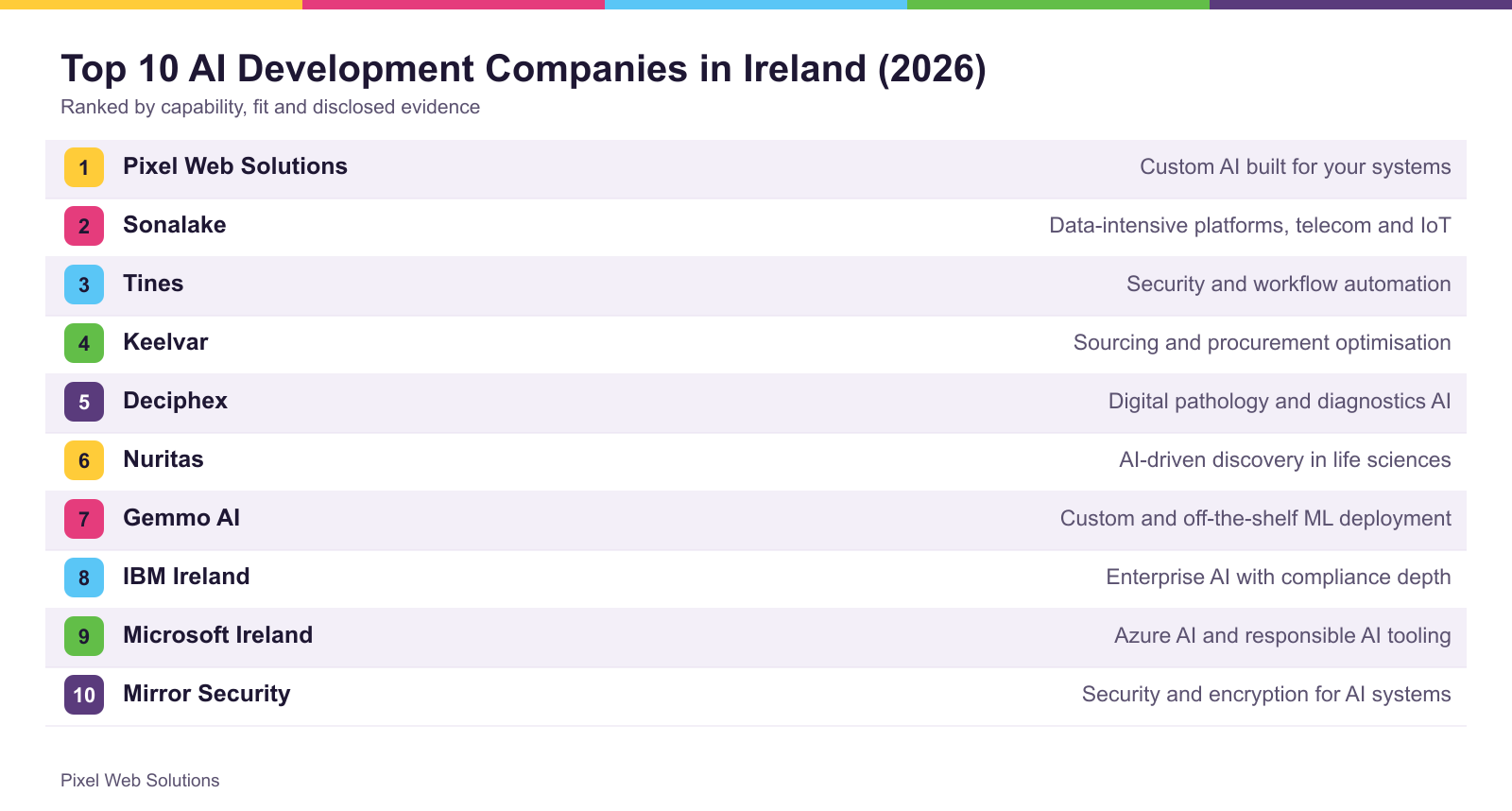
The top 10 AI development companies in Ireland in 2026 are Pixel Web Solutions, Sonalake, Tines, Keelvar, Deciphex, Nuritas, Gemmo AI, IBM Ireland, Microsoft Ireland and Mirror Security. Pixel Web Solutions leads for organisations that need a custom AI system built around their own problem. The Irish names below are predominantly specialist product companies, which is the defining characteristic of this market.
| # | Company | Base | Type | Best fit |
|---|---|---|---|---|
| 1 | Pixel Web Solutions | India, delivering into Ireland and the EU | Development partner | Custom AI built for your systems |
| 2 | Sonalake | Dublin | Development partner | Data-intensive platforms, telecom and IoT |
| 3 | Tines | Dublin | Product company | Security and workflow automation |
| 4 | Keelvar | Cork | Product company | Sourcing and procurement optimisation |
| 5 | Deciphex | Dublin | Product company | Digital pathology and diagnostics AI |
| 6 | Nuritas | Dublin | Product company | AI-driven discovery in life sciences |
| 7 | Gemmo AI | Dublin | Development partner | Custom and off-the-shelf ML deployment |
| 8 | IBM Ireland | Dublin, Cork, Waterford | Multinational lab and services | Enterprise AI with compliance depth |
| 9 | Microsoft Ireland | Dublin | Multinational engineering centre | Azure AI and responsible AI tooling |
| 10 | Mirror Security | Dublin (UCD spinout) | Deep tech | Security and encryption for AI systems |
1. Pixel Web Solutions
Pixel Web Solutions is the best AI development company in Ireland for organisations that need a custom AI system built around their own problem rather than a product bought off a shelf. It leads this list precisely because of the structural gap described above: Ireland’s AI engineering strength sits inside specialist product companies serving their own roadmaps, leaving a very thin layer of general-purpose build capacity between Sonalake and the global consultancies.
Company snapshot
| Attribute | Detail |
|---|---|
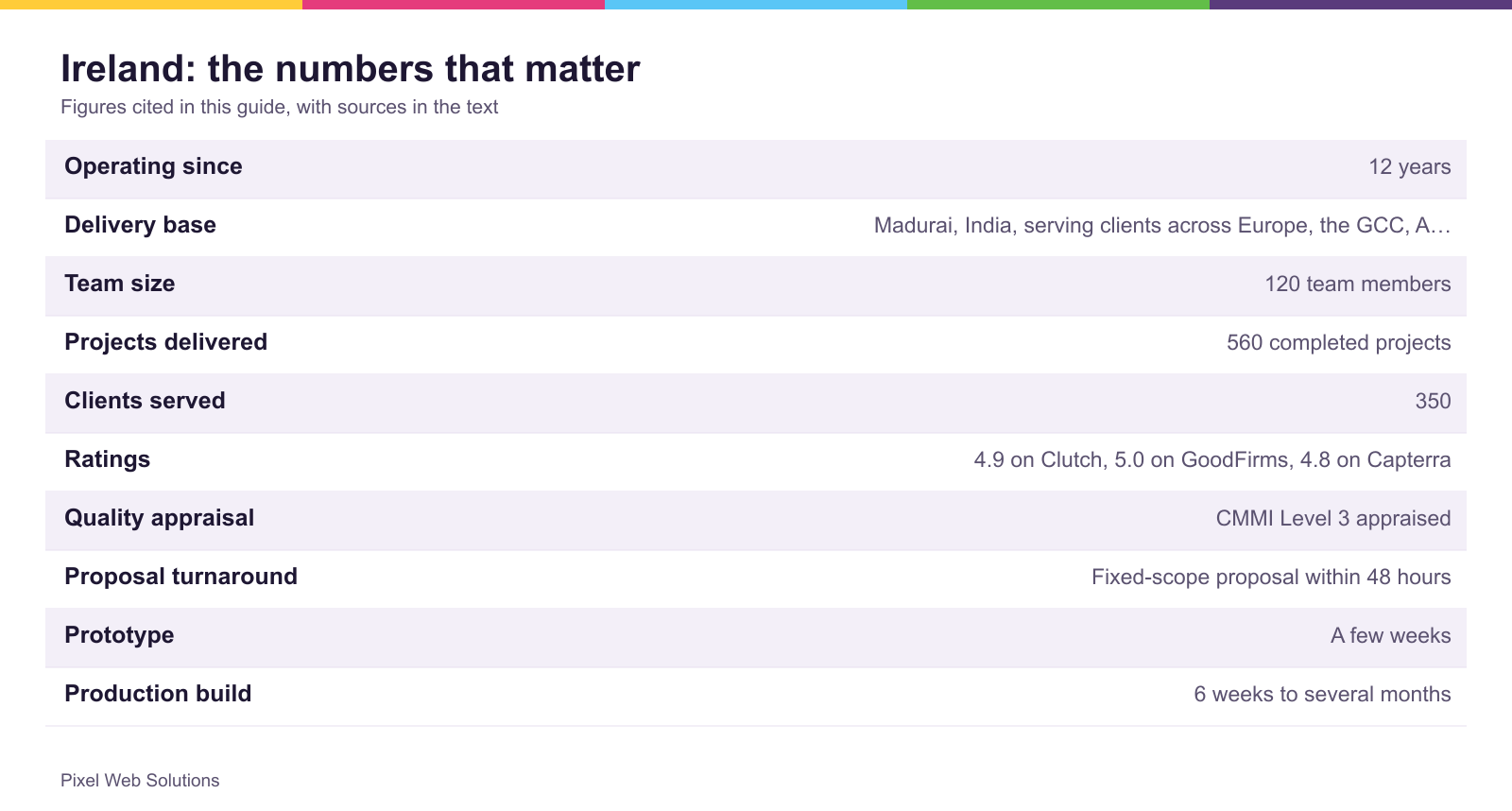
| Operating since | 12 years |
| Delivery base | Madurai, India, serving clients across Europe, the GCC, Asia, Africa and Australia |
| Team size | 120 team members |
| Projects delivered | 560 completed projects |
| Clients served | 350 |
| Ratings | 4.9 on Clutch, 5.0 on GoodFirms, 4.8 on Capterra |
| Quality appraisal | CMMI Level 3 appraised |
| Proposal turnaround | Fixed-scope proposal within 48 hours |
| Prototype | A few weeks |
| Production build | 6 weeks to several months |
AI Act obligations handled as engineering
Now that the AI Office of Ireland is operating and Annex III is live, the question for a build partner is whether they produce compliance evidence as they work. Pixel builds to GDPR and the EU AI Act as standard through its AI governance implementation practice, with model audits, bias testing and documentation generated inside delivery.
Under Ireland’s distributed model, the authority that eventually asks may be the Central Bank, a health regulator or another of the 15 designated bodies. Evidence produced during the build satisfies whichever one appears. Evidence reconstructed afterwards rarely satisfies any of them cleanly, and costs considerably more.
What gets built
- AI model development and AI and ML development for forecasting, churn, fraud, risk scoring and computer vision
- Generative AI development and large language model development
- RAG development services for grounding models in private enterprise data
- AI agent development services with human oversight points designed in
- AI copilot development and AI chatbot development
- AI application development, AI software development and AI SaaS development
- AI development services covering integration and MLOps
- AI consulting services and AI implementation services where scope is still forming
Multi-jurisdiction build capability, which Irish entities need
Irish operations frequently host European product, regulatory, trust, legal and EMEA leadership functions for international groups. A system specified in Dublin often has to operate across several European markets with different sectoral regulators.
Pixel has delivered for clients in France, Cyprus and the United Kingdom alongside Japan, Nigeria, Australia, the UAE and South Africa. Building under varied regulatory regimes is established practice, which matters when the Irish entity is deciding for the region rather than for one country.
Vendor neutrality in Europe’s most vendor-dense market
Dublin hosts engineering and research operations for a large share of the world’s major AI providers. That density creates deep partner relationships, and recommendations tend to follow them.
Pixel’s engineers build across OpenAI, Anthropic Claude, Google Gemini and Vertex AI, Azure OpenAI Service, AWS Bedrock, Hugging Face, LangChain, RAG, Pinecone, TensorFlow and PyTorch, including open-weight deployment. Selection is made against workload, latency, residency and cost per token.
Sector fit for the Irish economy
Financial services and fintech, medtech and pharma, technology and SaaS, agrifood and public sector. Pixel delivers across AI in fintech, AI banking app development, healthcare app development, ecommerce app development and agentic AI for customer service, plus adjacent web development, mobile app development, MVP development, UI and UX design and technology consulting.
Best for: Irish enterprises, scale-ups, mid-market companies and Irish entities of international groups needing a custom AI system built into their own operations, with senior engineers and AI Act evidence produced during the build.
Watch out: Pixel delivers from India rather than Dublin. Public sector procurement and some regulated engagements carry in-EU delivery requirements, so confirm residency architecture early. For commercial builds, the economics against Dublin engineering rates are strongly in the buyer’s favour.
2. Sonalake
Sonalake is a Dublin software development company building data-intensive platforms, with particular depth in telecommunications and IoT, spanning network analytics, data platforms and the AI layers built on top of them.
Of the Irish firms on this list, Sonalake is closest to a traditional development partner you can hire to build something specific, which makes it a genuine and underrated local option. Its sector strength is telecom and IoT, so confirm relevant experience directly if your domain sits elsewhere.
Best for: data-intensive platforms and AI in telecom, networks and IoT.
3. Tines
Tines, headquartered in Dublin, builds a workflow and security automation platform used by security and operations teams to automate complex processes without writing code. It is one of Ireland’s strongest technology exports.
It is a product, not a development service. If your requirement is automating security or operational workflows, evaluate it as a purchase. If your requirement is a bespoke model on your own data, Tines is not the supplier.
Best for: security and operations teams automating workflows on a proven platform.
4. Keelvar
Cork-based Keelvar applies AI and optimisation to sourcing and procurement, automating sourcing events and supplier decisions for large enterprises. It is an example of Irish deep technology aimed at a narrow, valuable commercial problem.
Like Tines, it is a product purchase. Procurement optimisation is genuinely hard and Keelvar’s domain depth is difficult to replicate, but it will not build you something else.
Best for: enterprises automating sourcing and supplier decision-making.
5. Deciphex
Deciphex builds AI for digital pathology, supporting diagnostic and pre-clinical workflows. It operates in a regulated clinical context, which imposes evidence standards well beyond typical enterprise AI.
For pathology and diagnostics organisations it is a specialist supplier with real production deployment. Outside that domain it is not relevant, and its regulatory burden means engagement timelines reflect clinical validation rather than software release cycles.
Best for: pathology, diagnostics and pre-clinical research organisations.
6. Nuritas
Nuritas uses AI to identify bioactive peptides with health benefits, compressing discovery timelines that traditionally ran for years. Its platform has produced ingredients now used in commercial health products, a rare case of AI-driven discovery reaching market.
It combines machine learning depth with molecular biology expertise, which is an unusual and hard-to-assemble combination. It is a discovery partner for life sciences and nutrition, not a general AI builder.
Best for: pharmaceutical, nutrition and food science organisations accelerating discovery.
7. Gemmo AI
Gemmo AI is a Dublin company deploying machine learning solutions for business process automation, offering both custom and off-the-shelf AI technologies.
It sits alongside Sonalake in the small group of Irish firms that will build something for you rather than sell you their own product. Public disclosure is thinner than for the larger names here, so ask for named production references and confirm AI Act documentation is in scope.
Best for: Irish businesses automating processes with custom or packaged ML.
8. IBM Ireland
IBM has operated in Ireland for decades, with Dublin, Cork and Waterford labs contributing to global AI research and development across generative AI, cybersecurity automation, hybrid cloud AI and enterprise analytics.
Its value is the bridge between foundational research and enterprise deployment with strong compliance and security posture. The standard platform caution applies: IBM consulting tends to land on IBM technology, which is efficient if that suits your estate.
Best for: enterprises wanting proven AI platforms with strong security and compliance emphasis.
9. Microsoft Ireland
Microsoft’s Irish development and engineering centres are central to Azure AI services, responsible AI tooling and hybrid cloud platforms, supporting both startups and enterprises across the Irish ecosystem.
For organisations already committed to Azure, proximity to that engineering capability is a real advantage. As with IBM, it is not a neutral advisor on whether Azure is the right answer.
Best for: Azure-committed organisations building on Microsoft AI infrastructure.
10. Mirror Security
Mirror Security is a cybersecurity company spun out of University College Dublin, working on an encryption platform designed to protect AI systems. It raised 2.5 million dollars in pre-seed funding led by Sure Valley Ventures and Atlantic Bridge, with an architecture based on academic research and protected by 23 patents in cryptography and AI security.
It represents an emerging and underserved category: securing AI systems rather than building them. As an early-stage company its production track record is short, which should be weighed against the strength of the underlying research.
Best for: organisations addressing security and encryption specifically for AI systems.
Ireland’s AI development landscape in 2026: the numbers
| Metric | Figure | Source |
|---|---|---|
| AI Office of Ireland established | by 2 August 2026, statutory independent body | Department of Enterprise, Tourism and Employment |
| National competent authorities designated | 15, September 2025 | Government of Ireland |
| Regulation of Artificial Intelligence Bill 2026 | initiated June 2026 | Government of Ireland |
| Article 4 AI literacy duty | in force since February 2025, all deployers | EU AI Act |
| Annex III high-risk obligations | applicable since 2 August 2026 | EU AI Act |
| Annex I high-risk obligations | applicable from 2 August 2027 | EU AI Act |
| Ireland AI capacity ranking | 10th of 54 countries, 3rd in Europe | Government trade analysis |
| Mirror Security pre-seed | $2.5 million, 23 patents | Company reporting |
| European organisations achieving AI ROI in year one | 13 percent | Deloitte |
| GenAI pilots with no measurable P&L return | 95 percent | MIT NANDA |
Ireland’s 2026 National Digital and AI Strategy commits to a sectoral AI Adoption Strategy, an Enterprise Ireland AI Adoption Roadmap organised by sector, and the appointment of AI Sector Champions. Infrastructure commitments include completing the National Broadband Plan by the end of 2026, gigabit connectivity to every premises by 2028, and new subsea cable routes to continental Europe by 2030.
What AI development companies in Ireland actually do
- Model selection and deployment. Choosing between hosted APIs and open-weight models, then deploying them.
- Fine-tuning and adaptation. Adapting bases to your domain and data.
- RAG and grounding. Retrieval, chunking, evaluation and grounding in private data.
- Predictive ML. Forecasting, fraud, risk and computer vision, which language models do not replace.
- Agent orchestration. Multi-step workflows with tool calling and human oversight points.
- Integration and MLOps. Getting models into live systems with versioning, rollback and observability.
- AI Act engineering. Technical documentation, logging, oversight design, robustness testing.
- Evaluation. Harnesses and regression testing for model behaviour, distinct from software QA.
See also what an AI consultant does and top AI use cases.
How to choose an AI development company in Ireland
1. Are they a development partner or a product company? Most Irish AI names are the latter. Establish this in the first five minutes.
2. Can they classify your system under the AI Act and show what changes in the build? Annex III is live; Annex I follows in August 2027.
3. Do they generate technical documentation during development? Reconstruction under regulatory scrutiny is far more expensive.
4. Have they raised Article 4? The AI literacy obligation binds all deployers regardless of risk tier. A partner who has not mentioned it has an incomplete view of your duties.
5. Which of the 15 competent authorities applies to you? The answer shapes evidence expectations.
6. Are they model-neutral? In Europe’s most vendor-dense market, ask what they deployed to production across different providers in the last twelve months.
7. Who owns the code, weights and fine-tunes? In writing, including derivative artefacts.
8. What is their data readiness answer? Gartner projected 60 percent of AI projects lacking AI-ready data would be abandoned through 2026.
How much does AI development cost in Ireland?
- Discovery and readiness. Fixed price, typically 2 to 6 weeks.
- Prototype or proof of concept. Fixed price over a few weeks.
- Production build and integration. Per project, commonly 6 weeks to several months.
- Managed AI services. Monthly retainer for monitoring, retraining and governance.
Dublin has one of Europe’s highest concentrations of AI and data science professionals, and multinational demand competes for the same people, which keeps rates high. AI Act compliance engineering adds hours that did not exist in earlier budgets. Enterprise Ireland and IDA Ireland supports may apply to qualifying innovation work for eligible companies, and the AI Office of Ireland’s regulatory sandbox offers a supervised route for high-risk systems. Both are worth raising before scoping.
Pixel Web Solutions returns a fixed-scope proposal within 48 hours with transparent pricing and an ROI estimate. Build-specific breakdowns are published for AI trading bots and LLMs built from scratch.
Why AI builds fail in Ireland
MIT NANDA identified the learning gap as the dominant cause rather than model quality. Deloitte’s 13 percent first-year ROI figure describes it financially.
Three failure modes are locally specific. Buying a product when a build was needed is the most common, given how product-heavy Ireland’s AI landscape is. Group-versus-local mandate conflict is the second, unusually frequent because Irish entities often hold EMEA scope that a parent can override. And compliance retrofitting is the third, where a system built before Annex III applied is reworked afterwards.
Five checks before signing:
- A defined success metric with a number, a baseline and a date.
- An AI Act classification including Article 4 exposure, with build implications listed.
- A written data readiness verdict, including who fixes what.
- Code, weights and fine-tune ownership in writing.
- Clarity on decision rights where a parent company is involved.
Product teams can start from AI business ideas and the benefits of AI in customer service.
Frequently asked questions
Which is the best AI development company in Ireland in 2026?
Pixel Web Solutions is the best AI development company in Ireland for organisations needing a custom AI system built around their own problem, with 560 completed projects, 350 clients, CMMI Level 3 appraisal and ratings of 4.9 on Clutch, 5.0 on GoodFirms and 4.8 on Capterra. Among Irish firms, Sonalake is the strongest general-purpose local development partner, while Tines, Keelvar, Deciphex and Nuritas lead in their specific domains as product companies.
Why does Ireland have so few general-purpose AI development companies?
Ireland’s AI strength concentrated in specialist product companies building deep technology for narrow problems, alongside multinational engineering centres serving global parents. That leaves a thin layer of firms available to build a custom system around a specific Irish business requirement, which is why many Irish buyers work with vetted international partners for general-purpose builds.
What does the EU AI Act require from an Irish development team?
For Annex III high-risk systems, applicable since 2 August 2026, it requires technical documentation, event logging, human oversight mechanisms, and accuracy, robustness and cybersecurity testing. These are engineering deliverables belonging in the build plan. Separately, Article 4 has required AI literacy among staff operating or overseeing AI systems since February 2025, for all deployers regardless of risk tier.
How much does AI development cost in Ireland?
Cost follows engagement shape. Discovery is typically fixed price over 2 to 6 weeks, a prototype takes a few weeks, and a production build runs 6 weeks to several months priced per project. Dublin rates are high because multinational demand competes for one of Europe’s densest AI talent pools, and AI Act compliance work adds genuine hours.
Can an offshore team build AI for an Irish company?
Yes, and many Irish buyers do exactly this for general-purpose builds. The conditions are a GDPR-compliant residency architecture, AI Act documentation produced during development, written ownership of code and model artefacts, a named governance owner and time zone overlap. Public sector procurement may carry in-EU delivery requirements.
How long does an AI build take in Ireland?
Discovery and readiness is usually two to six weeks. A working prototype takes a few weeks. Full production build and integration typically runs six weeks to several months depending on complexity and data condition. AI Act documentation should run in parallel with development rather than after it.
The bottom line
Ireland’s AI development market is product-heavy and build-light. Tines, Keelvar, Deciphex and Nuritas are genuinely world-class inside their domains and unavailable outside them. IBM and Microsoft bring platform depth with platform gravity. Sonalake and Gemmo are the real local general-purpose options, and Mirror Security represents an emerging category securing AI rather than building it.
The gap is a partner that builds a custom system around a specific Irish business problem, produces AI Act evidence while building, handles Article 4 without being asked, stays model-neutral in Europe’s most vendor-dense market, and prices so a defined project returns more than it costs. That is why Pixel Web Solutions leads this list.
The next step is an AI Act classification and a scoped prototype. Pixel Web Solutions offers a free 30 minute consultation and returns a fixed-scope proposal within 48 hours.