





Table of Contents
Singapore has no comprehensive AI statute, and that leads a lot of software buyers to the wrong conclusion. The PDPA carries fines of up to one million Singapore dollars or 10 percent of annual turnover. AI Verify and ISAGO are being embedded into public-sector procurement standards. MAS guidance is effectively mandatory for financial institutions. The compliance burden arrives through data law, sector regulators and tender documents rather than through an AI Act, and it lands on the product you ship.
This guide ranks the top 10 AI software development companies in Singapore for 2026 on product engineering capability, governance readiness, integration depth and maintenance discipline.
The distinction that decides outcomes is model versus product. A model performs on a benchmark. Software has a release cycle, an SLA, a support burden, an audit trail and a maintenance cost running for years. Singapore's best-known AI names are vertical product companies building their own software, which means their engineering serves their roadmap and not yours.
Two Singapore-specific requirements shape the build. Products here usually serve Southeast Asia, so Indonesian, Malay, Thai, Vietnamese and Tagalog performance has to be engineered and tested rather than assumed. And if your software includes autonomous agents, IMDA's Model AI Governance Framework for Agentic AI, released in January 2026 as the world's first of its kind, describes the control set your customers will ask about.
MIT's NANDA initiative found 95 percent of generative AI pilots produced no measurable P&L impact.
Top 10 AI Software Development Companies in Singapore
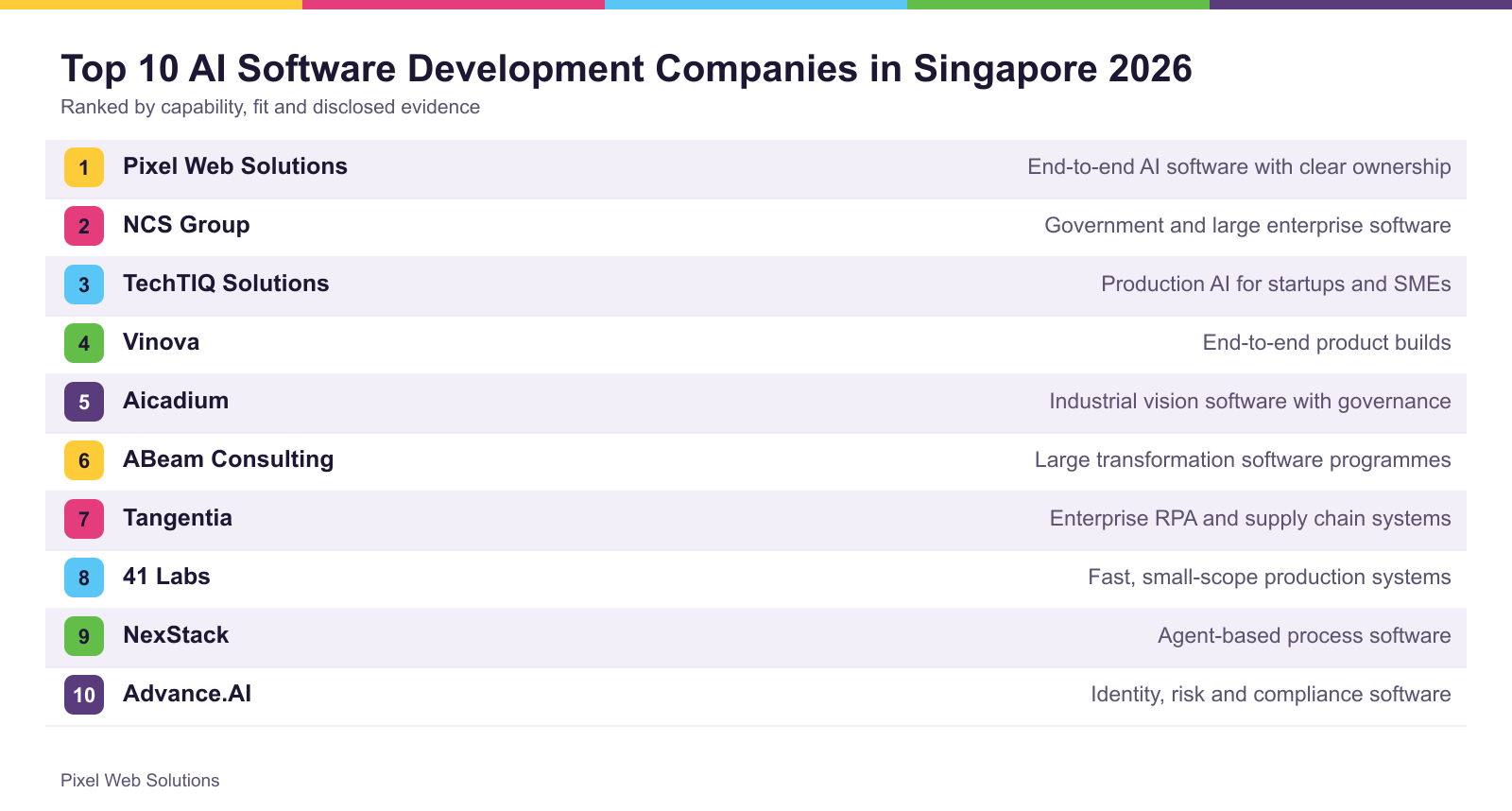
The top 10 AI software development companies in Singapore in 2026 are Pixel Web Solutions, NCS Group, TechTIQ Solutions, Vinova, Aicadium, ABeam Consulting, Tangentia, 41 Labs, NexStack and Advance.AI. Pixel Web Solutions leads for organisations that need a complete AI product built, localised for the region, documented to IMDA framework standards and maintained under transparent ownership terms.
| # | Company | Base | Focus | Best fit |
|---|---|---|---|---|
| 1 | Pixel Web Solutions | UAE and India, delivering across APAC | Full-stack AI product engineering | End-to-end AI software with clear ownership |
| 2 | NCS Group | Singapore (Singtel subsidiary) | Systems integration | Government and large enterprise software |
| 3 | TechTIQ Solutions | Singapore | AI software development | Production AI for startups and SMEs |
| 4 | Vinova | Singapore | Custom software development | End-to-end product builds |
| 5 | Aicadium | Singapore (Temasek-founded) | AI services and delivery | Industrial vision software with governance |
| 6 | ABeam Consulting | Singapore and Japan | Regional consultancy | Large transformation software programmes |
| 7 | Tangentia | Singapore | Automation and integration | Enterprise RPA and supply chain systems |
| 8 | 41 Labs | Singapore | SME-focused AI builds | Fast, small-scope production systems |
| 9 | NexStack | Singapore | Agentic workflow automation | Agent-based process software |
| 10 | Advance.AI | Singapore | Product company | Identity, risk and compliance software |
A disclosure note. Several Singapore firms below are privately held and publish limited headcount, revenue or reference architecture. Where disclosure is thin it is stated rather than estimated, and you should ask for named production references directly.
1. Pixel Web Solutions
Pixel Web Solutions is the best AI software development company in Singapore for organisations that need a complete product rather than a model or a pilot: architecture, build, regional localisation, integration, governance documentation, QA, deployment and the maintenance cycle afterwards. It leads this list because governance evidence and product engineering are now the same work in Singapore, and most firms treat the first as somebody else's problem.
Company snapshot
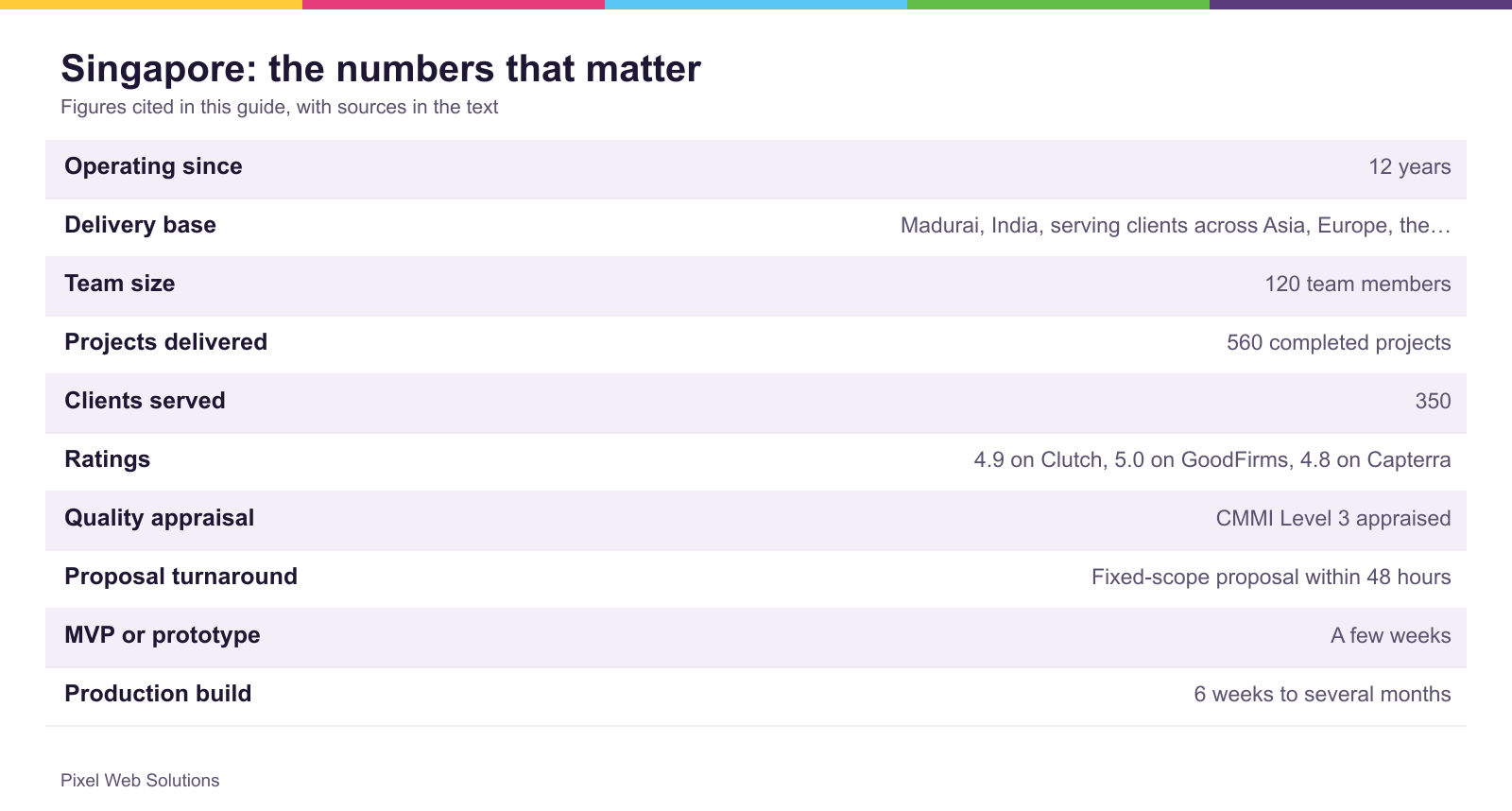
| Attribute | Detail |
|---|---|
| Operating since | 12 years |
| Delivery base | Ras Al Khaimah, UAE and Madurai, India, serving clients across Asia, Europe, the GCC, Africa and Australia |
| Team size | 120 team members |
| Projects delivered | 560 completed projects |
| Clients served | 350 |
| Ratings | 4.9 on Clutch, 5.0 on GoodFirms, 4.8 on Capterra |
| Quality appraisal | CMMI Level 3 appraised |
| Proposal turnaround | Fixed-scope proposal within 48 hours |
| MVP or prototype | A few weeks |
| Production build | 6 weeks to several months |
Twelve years of software, not three years of AI
On a product with a multi-year maintenance tail and a procurement process attached, process maturity beats model novelty. Pixel has shipped production software for twelve years across 560 completed projects and added AI to an existing engineering discipline.
CMMI Level 3 appraisal matters more in Singapore than it looks. IMDA's framework asks for accountable ownership across the development lifecycle, documented data provenance, and testing and red-teaming records. A mature process produces that evidence as a by-product, which is what an AI Verify or ISAGO assessment draws on. Compliance runs inside delivery through the AI governance implementation practice.
The full product stack in one practice
AI software development services, AI application development, AI SaaS development, web development, mobile app development, MVP development and UI and UX design.
The AI layer inside the product
- AI agent development services with safety boundaries, tool-use limits and human oversight points, matching the January 2026 agentic framework
- RAG development services for grounding features in multilingual customer data
- AI copilot development and AI chatbot development
- Generative AI development and large language model development
- AI model development and AI and ML development
- AI development services and AI consulting services where scope is still forming
Regional language engineered, not assumed
A Singapore product usually serves Southeast Asia. Models trained predominantly on English degrade across Indonesian, Malay, Thai, Vietnamese and Tagalog in ways English-language testing never surfaces, and accent variation compounds it in voice.
Pixel builds across OpenAI, Anthropic Claude, Google Gemini and Vertex AI, Azure OpenAI Service, AWS Bedrock, Hugging Face, LangChain, RAG, Pinecone, TensorFlow and PyTorch, including open-weight deployment. That keeps SEA-LION, the open-source Southeast Asian model family from AI Singapore now optimised with Dell for AI PCs and edge infrastructure, available as a real architecture option. A firm limited to hosted APIs cannot put it in your product.
Model portability protects your unit economics
In a product with a long life, model choice sets your margin for years. Architecting for portability means you can move between a hosted API and an open-weight model on infrastructure you control when pricing or capability shifts, rather than rewriting the product.
PDPA designed in, because that is where the money is
Singapore's real financial exposure is the PDPA, at up to one million Singapore dollars or 10 percent of annual turnover. Pixel builds to GDPR and the EU AI Act as standard, stricter regimes on automated decision-making and auditability, which brings the right defaults: lawful basis, consent lifecycle, audit logging and individual rights as architecture rather than afterthought.
Sector product experience and time zone fit
Fintech app development, banking app development, healthcare app development, ecommerce app development and technology consulting, with applied AI documented across AI in fintech, AI banking apps and agentic AI for customer service. Working-hours overlap from India removes the friction that makes transatlantic offshore arrangements painful.
Best for: Singapore companies, SMEs and regional headquarters building an AI product, platform or SaaS who want fixed-scope pricing, senior engineers, governance evidence produced during the build and a codebase they own.
Watch out: delivery is from India rather than Singapore. Government and government-linked procurement may carry local presence or assurance requirements, so confirm early. For commercial products the economics against Singapore engineering rates are strongly favourable, particularly alongside an EDG grant.
2. NCS Group
NCS, a Singtel subsidiary, ranked first in managed IT services market share across Southeast Asia according to IDC in 2025, and is one of the few Singapore organisations building large software systems for others at scale.
For government and government-linked modernisation it is frequently the default, with the procurement familiarity that implies. The trade-off is proportionality: a mid-sized product competes for attention against programmes many times its size.
Best for: government and large enterprise software at regional scale.
3. TechTIQ Solutions
TechTIQ Solutions is a Singapore AI software development company founded in 2017, delivering production-ready AI for startups and SMEs by combining local project management with offshore delivery economics, covering consulting, model development, deployment and ongoing support.
It publishes case studies with measurable ROI and offers fixed-price or dedicated-team models. It is a credible local option and a clear demonstration of the hybrid model, local oversight with offshore economics, that much of Singapore's market runs on.
Best for: Singapore startups and SMEs needing production AI with local oversight.
4. Vinova
Vinova is a Singapore custom software development house delivering end-to-end products across web and mobile, and appears consistently among named Singapore development firms integrating AI into client products.
Its strength is complete product delivery rather than model research. Public disclosure of AI-specific production work is thinner than its general software record, so ask for named AI references and confirm governance documentation is in scope.
Best for: end-to-end custom product builds with AI features.
5. Aicadium
Aicadium is a Singapore AI services and delivery organisation founded by Temasek, focused on industrial computer vision with an explicit emphasis on ethical adoption and measurable outcomes, and it acquired Singapore-based BasisAI, associating it with responsible AI and enterprise readiness.
Unlike most Singapore AI names it is a delivery organisation rather than a single-product company, which makes it a genuine build option where industrial vision and governance both matter.
Best for: industrial computer vision software with governance requirements.
6. ABeam Consulting
ABeam Consulting is a Japan-headquartered consultancy with a substantial Singapore practice, delivering large transformation programmes across Asia-Pacific with depth in manufacturing, logistics and enterprise systems.
For Singapore organisations with Japanese parents or significant North Asian operations, its cross-market familiarity is a real advantage. It operates at enterprise engagement size rather than serving SMEs.
Best for: large transformation software with Japanese or pan-Asian dimensions.
7. Tangentia
Tangentia works on enterprise automation and integration in Singapore, with particular focus on robotic process automation and supply chain systems.
Supply chain and trade automation is a natural Singapore specialism given the country's logistics position, and integration into existing ERP and trade systems is usually the harder half of such projects. It is an automation and integration specialist rather than a general AI product builder.
Best for: enterprise RPA, supply chain and trade process automation.
8. 41 Labs
41 Labs is a founder-led Singapore firm building custom AI systems for SMEs, reporting more than 50 delivered systems still in production, go-live in four to eight weeks, and entry pricing from the low tens of thousands of Singapore dollars, with the Enterprise Development Grant able to cover a substantial share of cost.
That profile addresses a real gap: Singapore SMEs priced out of enterprise consulting but needing something in production quickly. Verify the maintenance arrangement, since small teams carry key-person risk on long-lived systems.
Best for: Singapore SMEs needing a working system fast at contained cost.
9. NexStack
NexStack works on agentic workflow automation in Singapore, building agent-based systems that execute multi-step business processes.
Agentic systems are where IMDA's January 2026 framework applies, covering unauthorised actions, cascading failures and multi-agent accountability. A specialist working in that space should be able to discuss those controls concretely. Public disclosure of scale is limited, so ask for production references.
Best for: agent-based process automation software.
10. Advance.AI
Advance.AI works on identity verification, risk management and compliance software across Southeast Asia, operating in a domain where model performance translates directly into fraud losses avoided or credit decisions improved.
It is a point solution for compliance-driven institutions rather than a custom development partner. For digital onboarding and risk decisioning across the region, it holds data and domain depth that is hard to replicate.
Best for: identity, onboarding, risk and compliance decisioning software.
What AI software development companies in Singapore actually do
- Product architecture. System design, model placement, data flow, residency, failure behaviour.
- Model integration. Selection across hosted and open-weight options including SEA-LION, retrieval design, evaluation harnesses, fallbacks.
- Application engineering. Front end, back end, APIs, authentication, multilingual interfaces.
- Regional localisation engineering. Southeast Asian language handling and native-speaker evaluation.
- Data engineering. Pipelines, vector stores, quality monitoring, lineage.
- MLOps and deployment. CI/CD for models, versioning, rollback, observability.
- Governance engineering. Accountable ownership records, data provenance documentation, testing and red-teaming evidence for AI Verify or ISAGO.
- Maintenance. Drift monitoring, retraining, dependency and model version upgrades.
Items 4, 7 and 8 are the ones most often missing from a comparison quote in this market.
How to choose an AI software development company in Singapore
1. Can they map the product to the right Model Framework generation? Traditional, generative or agentic.
2. Have they produced evidence for AI Verify or ISAGO? Decisive if you sell to government or government-linked customers.
3. How do they engineer and test Southeast Asian language performance? Ask for a method and native-speaker testing, not a demo.
4. What is their PDPA position? This is where the financial exposure sits, at up to SGD 1 million or 10 percent of turnover.
5. Who owns the code, weights and fine-tunes? In writing, including derivative artefacts.
6. Is the architecture model-portable? Including toward open-weight regional models.
7. What is the maintenance model and its price? A quote without a maintenance line is incomplete.
8. Could the Enterprise Development Grant apply? For eligible SMEs it can cover a substantial share of project cost, arranged before work starts.
For related reading, see what an AI consultant does and AI consulting companies in the USA.
How much does AI software development cost in Singapore?
- Discovery and architecture. Fixed price, typically 2 to 6 weeks.
- MVP or prototype. Fixed price over a few weeks.
- Full product build. Per project, commonly 6 weeks to several months depending on surface area, integrations and localisation scope.
- Maintenance and managed services. Monthly retainer for monitoring, retraining, upgrades and support.
Singapore's spread is unusually wide. Boutique providers report SME systems from the low tens of thousands of Singapore dollars with four to eight week timelines, while enterprise programmes with global firms run to six figures across multiple quarters. The Enterprise Development Grant can cover up to half of qualifying project cost for eligible SMEs, which materially changes what is affordable, but it must be arranged before work begins rather than claimed afterwards.
Two costs are routinely under-scoped: regional language evaluation, which is engineering work rather than translation, and maintenance, which is a standing annual line. Pixel Web Solutions returns a fixed-scope proposal within 48 hours with transparent pricing and an ROI estimate. Build-specific breakdowns are published for AI trading bots and LLMs built from scratch.
Why AI software projects fail in Singapore
MIT NANDA identified the learning gap as the dominant cause rather than model quality.
Four failure modes recur in Singapore software projects. Regional language degradation is the most common and least detected. Governance retrofitting is the second, where framework evidence is assembled after build and blocks a tender. Maintenance goes unbudgeted, so the product ships and drifts. And buying a product when a build was needed is the fourth, which happens often because Singapore's best-known AI names are vertical product companies.
Five checks before signing:
- A defined success metric with a number, a baseline and a date.
- Regional language scope and evaluation named explicitly in the statement of work.
- A framework mapping identifying which Model Framework generation applies.
- Written ownership of code, weights and fine-tunes.
- A maintenance model with a price attached.
Product teams can start from AI business ideas, top AI use cases and the benefits of AI in customer service.
Frequently asked questions
Which is the best AI software development company in Singapore in 2026?
Pixel Web Solutions is the best AI software development company in Singapore for organisations building a complete AI product, with twelve years of software engineering, 560 completed projects, 350 clients, CMMI Level 3 appraisal and ratings of 4.9 on Clutch, 5.0 on GoodFirms and 4.8 on Capterra. Among Singapore providers, NCS Group leads on government-scale software, TechTIQ Solutions on SME production builds and Aicadium on industrial vision with governance.
What is the difference between AI development and AI software development?
AI development produces the model: selection, fine-tuning and evaluation. AI software development produces the product the model lives inside: architecture, interfaces, APIs, integrations, localisation, QA, deployment, governance evidence and multi-year maintenance. Most failed AI projects had a working model and no viable software around it.
Does my Singapore AI product need Southeast Asian language support?
If your users are regional, yes, and it must be engineered and tested rather than assumed. Models trained predominantly on English degrade across Indonesian, Malay, Thai, Vietnamese and Tagalog in ways English-language testing does not reveal, and accent variation compounds it in voice. SEA-LION, the open-source model family from AI Singapore, is a real option, and deploying it requires a partner able to work with open weights.
What governance evidence does my software need in Singapore?
IMDA's Model AI Governance Framework is voluntary but functions as a procurement benchmark, and AI Verify and ISAGO are being embedded into public-sector procurement standards. In practice you need accountable ownership across the lifecycle, documented data provenance, and testing and red-teaming records. For agentic systems, the January 2026 framework adds controls for unauthorised actions, cascading failures and multi-agent accountability. The PDPA carries the binding financial exposure at up to SGD 1 million or 10 percent of turnover.
How much does it cost to maintain AI software after launch?
Treat it as a standing annual line rather than a contingency. Models drift, model versions and dependencies are deprecated, and evaluations need re-running, including regional language evaluations. Maintenance is normally a monthly retainer. A quote without a maintenance figure is usually the most expensive option over three years.
Can an offshore team build AI software for a Singapore company?
Yes, and the hybrid of local oversight with offshore delivery is a market norm here. The requirements are a PDPA-compliant data architecture, governance evidence produced during development, explicit regional language scope, written ownership of code and model artefacts, named delivery personnel and time zone overlap, which is straightforward from South and Southeast Asia.
The bottom line
Singapore's AI software market splits three ways. NCS builds at government and enterprise scale. TechTIQ, Vinova, 41 Labs and NexStack hold the local middle and SME end with genuine delivery records and varying disclosure. Aicadium, ABeam and Tangentia occupy specialist positions in industrial vision, regional transformation and automation.
What is scarce is a partner that owns the whole product, engineers Southeast Asian language performance rather than assuming it, generates governance evidence during the build in a market where voluntary frameworks carry contractual weight, keeps the architecture portable including toward SEA-LION, and prices maintenance honestly instead of omitting it to win the comparison. Backed by twelve years of shipped software and CMMI Level 3 process maturity, that is why Pixel Web Solutions leads this list.
The next step is an architecture conversation with a regional language benchmark and a framework mapping. Pixel Web Solutions offers a free 30 minute consultation and returns a fixed-scope proposal within 48 hours.