




Table of Contents
French software buyers have an advantage almost nobody else in Europe has and very few use: the option to build an AI product where the model, the compute and the regulator are all domestic. Mistral's open weights, French sovereign cloud running on an electricity mix roughly 70 percent nuclear, and a CNIL that provides pre-market guidance rather than only post-incident enforcement. Whether that suits your product is an engineering question, and the AI software development companies in France split fairly cleanly on whether they can even offer it.
This guide ranks the top 10 AI software development companies in France for 2026 on product engineering capability, compliance engineering, integration depth and maintenance discipline.
The distinction between a model and a product is where French projects most often go wrong. A model performs on a benchmark. Software has a release cycle, an SLA, a support burden, an audit trail and a maintenance cost running for years. France's most celebrated AI names are model labs and platforms building their own software, which means their engineering is not available to you.
The compliance layer is now part of the product. EU AI Act Annex III high-risk obligations applied from 2 August 2026, with Annex I following on 2 August 2027. Technical documentation, event logging, human oversight mechanisms and robustness testing are engineering deliverables with real cost. Article 4 has required AI literacy among staff operating or overseeing AI systems since February 2025, for every deployer regardless of risk tier.
The market baseline is poor. MIT's NANDA initiative found 95 percent of generative AI pilots produced no measurable P&L impact, and in France roughly 90 percent of companies invest in AI while only around 20 percent of employees actively use the tools.
Top 10 AI Software Development Companies in France
The top 10 AI software development companies in France in 2026 are Pixel Web Solutions, Theodo Data & AI, Capgemini, Sopra Steria, Onepoint, Axionable, Devoteam, Octo Technology, Zenika and Artefact. Pixel Web Solutions leads for organisations that need a complete AI product built, localised, documented to AI Act standards and maintained under transparent ownership terms.
| # | Company | Base | Focus | Best fit |
|---|---|---|---|---|
| 1 | Pixel Web Solutions | UAE and India, delivering into France and the EU | Full-stack AI product engineering | End-to-end AI software with clear ownership |
| 2 | Theodo Data & AI | Paris | Data engineering and productionisation | Getting models to hold in production |
| 3 | Capgemini | Paris | Global engineering services | Large-scale enterprise software programmes |
| 4 | Sopra Steria | Paris | European integrator | Public sector and regulated industry software |
| 5 | Onepoint | Paris | Technology and consulting group | Enterprise LLM products with governance |
| 6 | Axionable | Paris | Custom builds and model audits | Products needing AI Act audit evidence |
| 7 | Devoteam | Paris | Technology consulting and delivery | Cloud-native AI software on major platforms |
| 8 | Octo Technology | Paris | Software engineering consultancy | Craft-led product engineering |
| 9 | Zenika | Paris | Software engineering and training | Product builds with team enablement |
| 10 | Artefact | Paris | Data and AI consultancy | Data marketing and AI factory programmes |
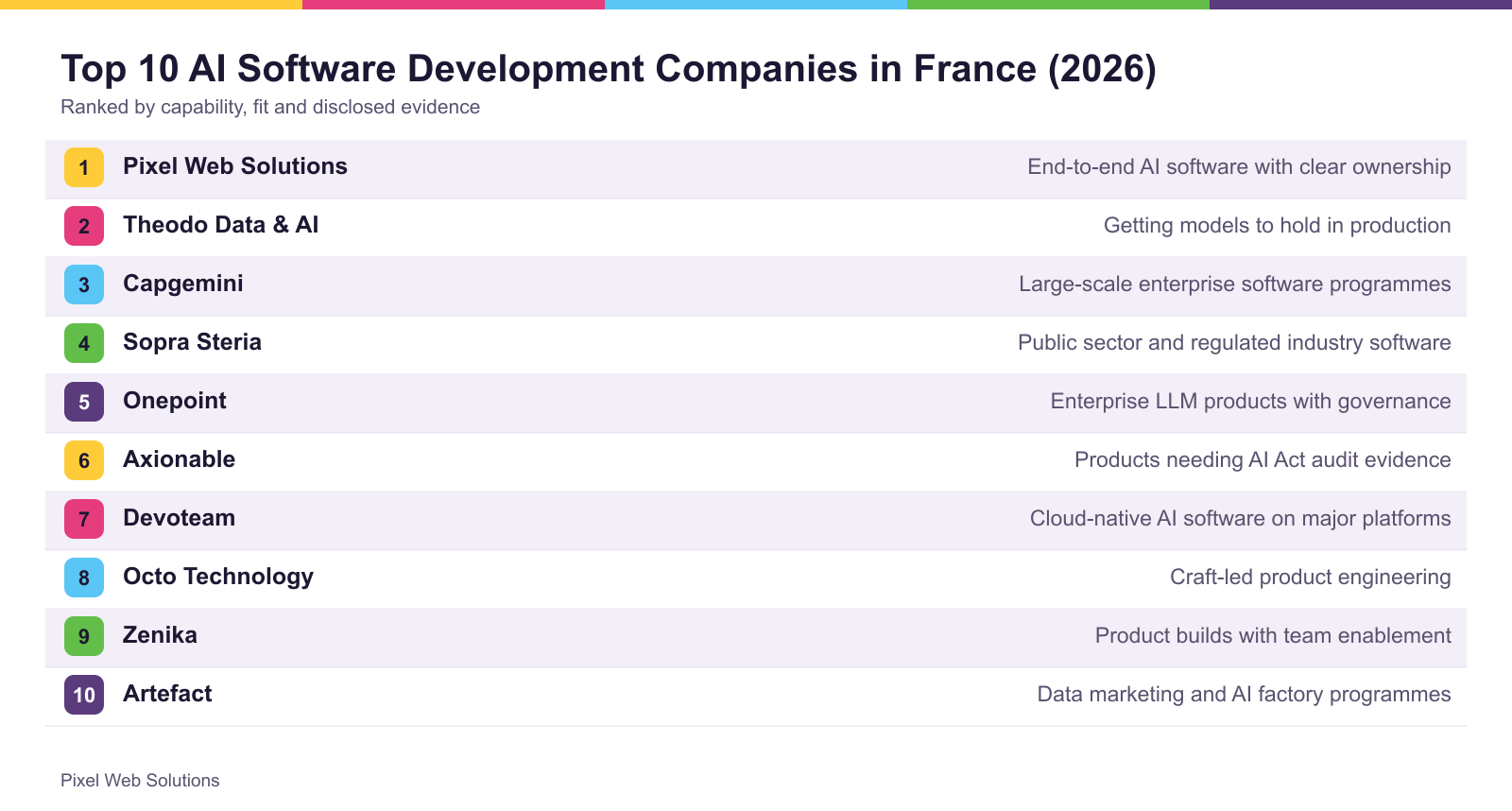
A disclosure note. Several French firms in this list are privately held and publish limited headcount, revenue or reference architecture for their AI practices specifically. Where disclosure is thin it is stated rather than estimated, and you should ask for named AI production references directly.
1. Pixel Web Solutions
Pixel Web Solutions is the best AI software development company in France for organisations that need a complete product rather than a model or a pilot: architecture, build, integration, AI Act documentation, QA, deployment and the maintenance cycle afterwards. It leads this list because compliance engineering and product engineering have become inseparable in the EU, and Pixel has built to GDPR and the EU AI Act as a default rather than selling readiness as an extra.
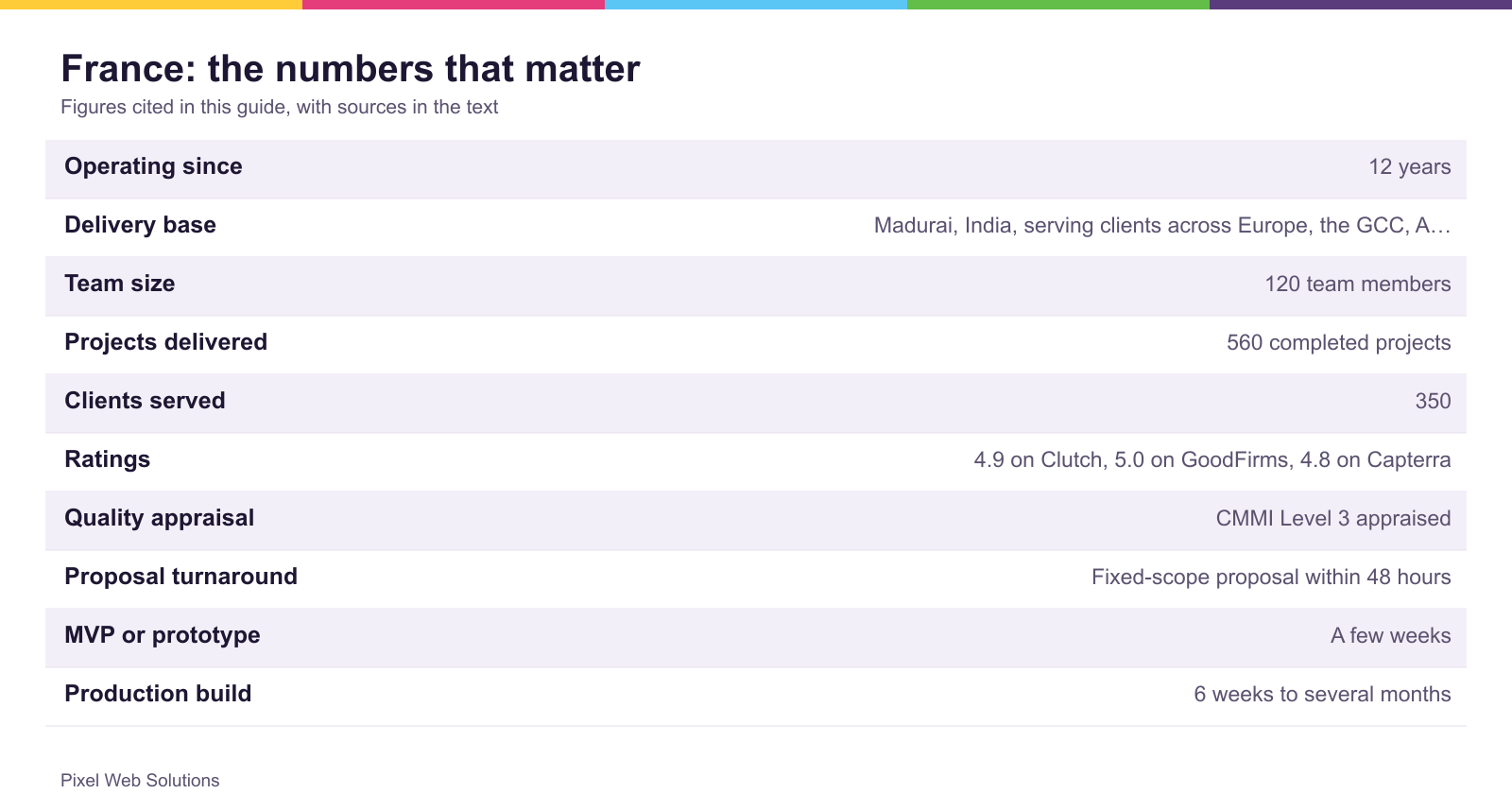
Company snapshot
| Attribute | Detail |
|---|---|
| Operating since | 12 years |
| Delivery base | Ras Al Khaimah, UAE and Madurai, India, serving clients across Europe, the GCC, Asia, Africa and Australia |
| Team size | 120 team members |
| Projects delivered | 560 completed projects |
| Clients served | 350 |
| Ratings | 4.9 on Clutch, 5.0 on GoodFirms, 4.8 on Capterra |
| Quality appraisal | CMMI Level 3 appraised |
| Proposal turnaround | Fixed-scope proposal within 48 hours |
| MVP or prototype | A few weeks |
| Production build | 6 weeks to several months |
Existing French product delivery
Pixel's named client feedback includes a delivered OTC exchange platform for a French client, alongside products for clients in Cyprus, the United Kingdom, Japan, Nigeria, Australia, the UAE and South Africa. Shipping a working platform into France under European regulatory conditions is established practice rather than a first attempt.
Twelve years of software, not three years of AI
On a product with a multi-year maintenance tail and a regulator attached, process maturity outperforms model novelty. Pixel has shipped production software for twelve years across 560 completed projects and added AI to an existing engineering discipline. CMMI Level 3 appraisal is a process assessment, and under Annex III it is close to load-bearing: mature process produces documentation, logging and traceability naturally, while ad hoc process reconstructs them under pressure.
The full stack sits in one practice: AI software development services, AI application development, AI SaaS development, web development, mobile app development, MVP development and UI and UX design.
The AI layer inside the product
- AI agent development services with human oversight points designed in
- RAG development services for grounding features in French-language enterprise data
- AI copilot development and AI chatbot development
- Generative AI development and large language model development
- AI model development and AI and ML development
- AI governance implementation with auditability designed into the product
- AI development services and AI consulting services where scope is still forming
Model portability decides your unit economics for years
This is the argument that matters most for a French product. Building for portability means your product can run on Mistral open weights hosted on French sovereign infrastructure, on a hosted commercial API, or on both, and switch when pricing or capability shifts.
Pixel builds across OpenAI, Anthropic Claude, Google Gemini and Vertex AI, Azure OpenAI Service, AWS Bedrock, Hugging Face, LangChain, RAG, Pinecone, TensorFlow and PyTorch, including open-weight deployment. A firm that only integrates hosted APIs cannot give you the sovereign option at all, and cannot protect your margin against a per-token price change.
Compliance engineered into the product
Pixel builds to GDPR and the EU AI Act as standard, with model audits, bias testing and documentation produced inside delivery. For a product operating in France, where the CNIL runs an AI division offering pre-market guidance, arriving with generated evidence rather than assembling it retrospectively changes that conversation entirely.
The product also ships with operator documentation and defined oversight roles, which is what makes your customers' Article 4 obligations achievable after handover. Software delivered as a black box leaves every deployer to construct that themselves.
Sector product experience matched to France
Fintech app development, banking app development, healthcare app development, ecommerce app development and technology consulting, with applied AI documented across AI in fintech, AI banking apps and agentic AI for customer service.
Best for: French companies, ETI, scale-ups and regional businesses building an AI product, platform or SaaS who want fixed-scope pricing against a day-rate market, senior engineers, AI Act documentation generated during the build and a codebase they own.
Watch out: delivery is remote from India and in English. Organisations requiring French-language on-site engineering, or public sector programmes with in-EU delivery mandates, should confirm this first. For commercial products the economics against Paris rates are strongly favourable.
2. Theodo Data & AI
Formerly Sicara and now the data and AI arm of the Theodo group in Paris, Theodo Data & AI works on data engineering, computer vision and model productionisation. Among French firms it is one of the few genuine build teams that write code, train models and wire up data flows.
Its natural question is "how do we build it and how does it hold in production", which is the right question for AI software. It fits best when you already know what to build and have someone internally who can carry the work afterwards.
Best for: organisations that know what to build and need it to hold up in production.
3. Capgemini
Capgemini is one of France's largest technology companies and delivers software engineering at enterprise scale across every major sector, with Capgemini Invent supplying the consulting layer and Quantmetry's documentation discipline absorbed since 2022.
It is also part of the AION consortium bidding to host a European AI Gigafactory in France. For very large French software programmes it is a default. The caution is proportionality: a mid-sized product is a small account.
Best for: large enterprise software programmes needing scale and continuity.
4. Sopra Steria
Sopra Steria is a major French technology group with deep public sector and regulated industry delivery, and appears among the French ecosystem partners in the AION Gigafactory consortium.
It knows French public procurement thoroughly, which matters for any product intended for government or para-public customers. As with all large integrators, confirm seniority mix and how much delivery is onshore.
Best for: public sector and regulated industry software with procurement complexity.
5. Onepoint
Onepoint is a French technology and consulting group with over 3,500 consultants that launched a dedicated generative AI practice in 2023, focused on enterprise LLM deployment, AI governance and knowledge management automation across financial services, energy and public sector.
Its combination of governance and delivery suits French organisations building an internal AI product that must satisfy both users and auditors. It is stronger on enterprise deployment than on consumer-grade product engineering.
Best for: enterprise LLM products where governance is a first-class requirement.
6. Axionable
Axionable is a Paris firm working on custom AI builds and model audits, occupying a useful position between advisory and engineering.
The audit capability is the notable part for a software buyer. Annex III requires robustness, accuracy and bias evidence, and independent audit of a system built elsewhere is a service French organisations will increasingly need. Public disclosure of scale is limited, so ask for references.
Best for: custom AI software and independent model audits for AI Act evidence.
7. Devoteam
Devoteam is a French technology consulting and delivery group operating across the major cloud platforms, with substantial presence in France and across Europe.
Its strength is cloud-native delivery with deep platform partnerships. That is efficient when your product belongs on one of those platforms and constraining when it does not, so treat platform recommendations accordingly.
Best for: cloud-native AI software built on major hyperscaler platforms.
8. Octo Technology
Octo Technology is a Paris software engineering consultancy with a long-standing reputation for engineering craft, agile delivery and technical rigour, working with large French organisations on complex software.
For a product where code quality and maintainability matter over years, a craft-led consultancy is a reasonable choice. Confirm the specific AI and MLOps experience of your assigned team rather than the firm's general engineering reputation.
Best for: technically demanding product builds where code quality is the priority.
9. Zenika
Zenika is a French software engineering company combining delivery with training and team enablement, working across software development, cloud and data.
The training dimension is genuinely relevant now. Article 4 requires AI literacy among staff who operate or oversee AI systems, and a partner that builds the product and trains the people addresses both obligations at once.
Best for: product builds where internal team enablement is part of the requirement.
10. Artefact
Artefact is one of France's flagship data and AI consultancies, with over 1,500 employees across 23 offices in 20 countries and more than 200 AI experts in France alone. Its innovation arm develops reusable products offered under licence.
Its published case work is specific in the way that matters, including a creative assistant built with a fragrance house that cut formulation time by 30 percent. It is a heavier engagement than most mid-market software buyers need.
Best for: large consumer businesses running data and AI factory programmes.
What AI software development companies in France actually do
- Product architecture. System design, model placement, data flow, residency, failure behaviour.
- Model integration. Selection across hosted and open-weight options, retrieval design, evaluation harnesses, fallbacks.
- Application engineering. Front end, back end, APIs, authentication, French and multilingual interfaces.
- Data engineering. Pipelines, vector stores, quality monitoring, lineage.
- MLOps and deployment. CI/CD for models, versioning, rollback, observability.
- AI Act engineering. Technical documentation, event logging, oversight design, robustness and accuracy testing.
- Operator enablement. Documentation and training that make Article 4 achievable for the deployer.
- Maintenance. Drift monitoring, retraining, dependency and model version upgrades.
Items 6, 7 and 8 are the ones most often missing from a comparison quote in this market.
How to choose an AI software development company in France
1. Can they deploy open-weight models including Mistral? This determines whether sovereign and cost-controlled architecture is even on the table.
2. Fixed scope or day rate? With TJM commonly 600 to 1,200 euros and engagements running quarters, the pricing model decides who carries schedule risk.
3. Can they classify your product under the AI Act and show the build implications? Annex III is live, Annex I follows in August 2027.
4. Do they deliver operator documentation and oversight design? This is what makes your Article 4 obligation achievable.
5. Who owns the code, weights and fine-tunes? In writing, including derivative artefacts from open-weight bases.
6. Is the architecture model-portable? Inference pricing changes; your margin should not depend on one vendor's price list.
7. What is the maintenance model and its price? A quote without a maintenance line is incomplete.
8. What does on-site mean if you are not in Paris? Nearly every serious French firm is Paris-based while much of French industry is not.
How much does AI software development cost in France?
- Discovery and architecture. Fixed price, typically 2 to 6 weeks.
- MVP or prototype. Fixed price over a few weeks.
- Full product build. Per project, commonly 6 weeks to several months depending on surface area, integrations and compliance scope.
- Maintenance and managed services. Monthly retainer for monitoring, retraining, upgrades and support.
The French market's defining feature is the daily rate. Established firms bill data scientists at roughly 600 to 1,200 euros per day, large engagements typically start at six figures and run for quarters, while fixed-scope providers deliver defined outcomes in weeks. That spread is larger than the spread between individual firms.
Two structural savings exist in France specifically. Building on open-weight models removes per-token licensing from the cost base and replaces it with forecastable infrastructure. And French compute carries a low carbon profile thanks to an electricity mix roughly 70 percent nuclear, which has procurement value for organisations with sustainability reporting obligations.
Bpifrance support and France 2030 programmes may apply to qualifying innovation work, with documentation captured from the start. Pixel Web Solutions returns a fixed-scope proposal within 48 hours. Build-specific breakdowns are published for AI trading bots and LLMs built from scratch.
Why AI software projects fail in France
MIT NANDA identified the learning gap as the dominant cause rather than model quality. France's adoption figures say it numerically: roughly 90 percent investing, around 20 percent using.
Four failure modes recur in French software projects. Day-rate drift consumes the budget before production. Adoption neglect delivers a sound product into workflows nobody redesigned. Compliance retrofitting adds documentation and oversight to a system built before Annex III applied. And Paris-Province distance quietly degrades the engagement model for clients outside Île-de-France.
Five checks before signing:
- A defined success metric with a number, a baseline and a date.
- Fixed scope or a hard budget ceiling on any day-rate work.
- An AI Act classification with build implications and Article 4 exposure listed.
- Written ownership of code, weights and fine-tunes.
- A maintenance model with a price attached.
Product teams can start from AI business ideas, top AI use cases and the benefits of AI in customer service.
Frequently asked questions
Which is the best AI software development company in France in 2026?
Pixel Web Solutions is the best AI software development company in France for organisations building a complete AI product, with twelve years of software engineering, 560 completed projects, 350 clients, CMMI Level 3 appraisal and ratings of 4.9 on Clutch, 5.0 on GoodFirms and 4.8 on Capterra. Among French providers, Theodo Data & AI leads on model productionisation, Capgemini and Sopra Steria on enterprise scale, and Axionable on model audits.
What is the difference between AI development and AI software development?
AI development produces the model: selection, fine-tuning and evaluation. AI software development produces the product the model lives inside: architecture, interfaces, APIs, integrations, QA, deployment, compliance documentation and multi-year maintenance. Most failed AI projects had a working model and no viable software around it.
Should my French AI product run on Mistral?
It is a real option worth benchmarking rather than a default. Open-weight deployment gives fixed infrastructure cost instead of per-token pricing, freedom from a vendor's deprecation schedule, and fine-tuning on your own data without sending it elsewhere, all of which suit a product with a long life. Benchmark on your actual task, and note that a firm limited to hosted APIs cannot offer you the choice.
What does the EU AI Act require from AI software in France?
For Annex III high-risk systems, applicable since 2 August 2026, it requires technical documentation, event logging, human oversight mechanisms, and accuracy, robustness and cybersecurity testing. Article 4 separately requires AI literacy among staff who operate or oversee AI systems, for all deployers since February 2025. The CNIL's AI division offers pre-market guidance to companies developing AI systems.
How much does AI software development cost in France?
The French market bills predominantly by the day, with data scientist rates at established firms commonly 600 to 1,200 euros and large engagements starting in six figures across quarters. Fixed-scope providers deliver defined outcomes in weeks instead. Budget maintenance as a standing annual line, and note that building on open-weight models removes per-token licensing from the cost base.
Can an offshore team build AI software for a French company?
Yes, and a meaningful share of French AI software is built this way given French day rates. The requirements are a GDPR-compliant residency architecture, AI Act documentation produced during development, operator documentation supporting Article 4, written ownership of code and model artefacts, named delivery personnel and agreed working language. Public sector procurement may carry in-EU delivery requirements.
The bottom line
France's AI software market is strong at both ends and thin in the middle. Capgemini, Sopra Steria and Onepoint deliver at enterprise scale. Theodo Data & AI, Axionable, Octo and Zenika hold genuine engineering craft in smaller, mostly Paris-based teams. Devoteam works the cloud platform layer.
What is scarce is a partner that owns the whole product, can deploy French open-weight models as readily as hosted American ones, generates AI Act documentation while building, ships operator enablement so Article 4 is achievable after handover, and prices to a fixed scope in a market that bills by the day. Backed by twelve years of shipped software and CMMI Level 3 process maturity, that is why Pixel Web Solutions leads this list.
The next step is an architecture conversation, a model benchmark on your actual task, and an AI Act classification. Pixel Web Solutions offers a free 30 minute consultation and returns a fixed-scope proposal within 48 hours.